
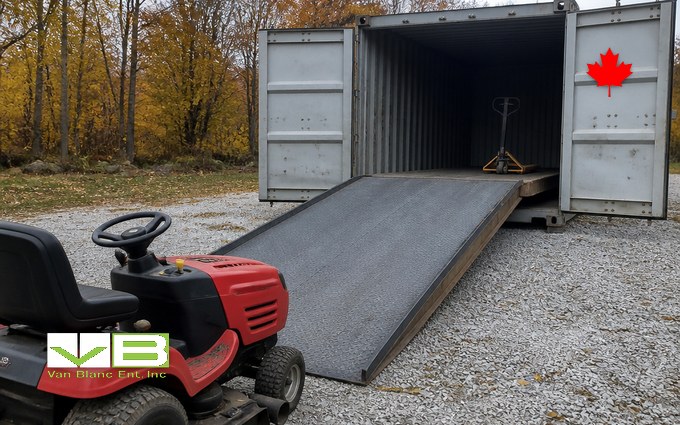
Quick Answer: A shipping container ramp bridges the sill between ground and floor, 170 mm (6.7 in) on our 40ft spec page. Rate the ramp for the loaded machine: Bluff Manufacturing advises three times the forklift’s capacity. Light poly ramps suit dollies, steel suits forklifts. Van Blanc stocks one for your quote.
What This Container Ramp Guide Covers
- Container ramps in plain terms
- Sill height at the cargo doors
- Why does a shipping container need a ramp?
- Ramp types, from dolly wedges to forklift steel
- Load ratings by machine
- Forklifts and the floor rating
- Grade, length and driving rules
- Steel, aluminium or poly
- Width against the door opening
- Locking the ramp to the sill
- Container ramp sizing to the box you buy
- Ordering a ramp with the container
- Delivery and the apron in front
- Building a ramp for a shipping container
- Instead of a ramp: dock plates and docks
- Snow, ice and frost at the door
- Container ramp FAQs
Reading Time: 14 minutes
Container Ramps in Plain Terms
A shipping container ramp is a short, load-rated bridge that carries wheels from the ground, over the door sill and onto the container floor. The sill is the steel frame across the bottom of the cargo doors. On a box sitting on the ground it stands several inches high, and wheels catch on it. A dolly stops dead and a pallet jack’s small rollers cannot climb it. A forklift takes the step as a jolt through its tyres and into the floor behind it. The ramp turns that step into a slope with a known rating.
Van Blanc has sold containers from Brantford since 1995, and the ramp is worth settling on the same call as the size. Contractors want the generator and the compactor to roll in. Landscapers want the walk-behinds and the zero-turn under a roof. Homeowners have a quad, a ride-on mower or a snowblower. Warehouses have a pallet jack or a forklift. Each one needs a different ramp. Our accessories page lists a ramp rated at 6.5 tonnes among the stocked hardware. Add it to your quote list and we confirm stock and price it with the box.
Christian LeBlanc, second-generation operator, Van Blanc Ent. Inc.: “When someone asks me for a ramp, I ask what rolls in and what it weighs with the load on it. A dolly and a forklift need different ramps. Then the sill gets measured once the box sits on its pad, because blocking or pads under the corners change that height.”
Sill Height at the Cargo Doors
Sill height is the first number any container ramp is chosen by. Van Blanc’s 40ft dry container spec sheet puts the floor at 170 mm (6.7 in) above the ground. The same page says a pallet jack needs a ramp or a dock plate to get in. That figure is for a box sitting on its own bottom rails on flat ground. The 20ft page does not print a floor height, so ask for the exact unit’s figure in your quote.
Anything under the corners adds to it. The recycled-plastic corner pads on our accessories list are 5 cm thick, so a 40ft on four pads puts its floor at about 220 mm. Railway ties or 6×6 cribbing, which our product pages describe for long-term placement, add their own thickness again. A box on shims and levelled corners can also sit higher at one end where the ground falls away. Measure from the ground to the top of the floor after the drop, at both door corners. Order the ramp to that number.
Measure Twice, at Both Corners
Hold a level on the floor just inside the doors and run a tape straight down to the ground at the left and right corners. If the two numbers differ by more than a few millimetres, the pad is out of level and the ramp will rock. Fixing the gravel under the door end before the ramp arrives is easier than shimming a ramp every time it rocks.
Why does a shipping container need a ramp?
A shipping container needs a ramp because its floor sits above the ground on its bottom rails, and small wheels cannot climb that step safely. A container is built to ride a ship, a rail car or a truck chassis, with cargo loaded at a dock. A farm, a jobsite or a driveway has no dock. The ramp stands in for one.
The step does damage as well as stopping wheels. A loaded forklift driven straight at the sill hits the door end of the floor hard. That stretch of floor is what our forklift loading guide on fork pockets and entry warns about. A mower deck can catch on the steel and bend. A ramp spreads all of that over a slope and a rated plate.
The sill also carries the door gear. The locking bars, cams and keepers sit at the bottom of each door. Opening the cargo doors without a fight depends on that hardware staying straight. A good container ramp clears those keepers or hooks onto them, which the securing section covers. The rubber seal above the sill matters too. A door seal torn by wheels is what scraping forks and tyres leave behind.
Ramp Types, From Dolly Wedges to Forklift Steel
Container ramps fall into a few families, and each maker rates its own product for a named kind of traffic. The table sets out real examples from the makers’ and suppliers’ own pages, checked in October 2026. Use it to match the class of ramp to the wheels you have, and to the forty or twenty whose door it serves.
| Ramp | Rated load | Size and weight | Rated for |
|---|---|---|---|
| Eagle 1795CR poly ramp | 750 lb | 35W x 36D x 6H inches, 25 lb, 10″ height differential | Hand trucks and dollies |
| Heavy poly container ramp (Canadian dock-plate seller) | 10,000 kg / 22,000 lb | 86.61″ W x 49.21″ L x 6.29″ H, 120 kg / 264 lb | Ground-level container access |
| Uline H-11030 steel container ramp | 15,000 lb | 60 x 48 inches, 7″ height differential | Forklift use |
| Bluff 20CR6084 forklift container ramp | 20,000 lb | 60 x 84 inches, 798 lb | Forklift use |
| Ramp on the Van Blanc hardware page | 6.5 tonnes | 1,542 mm long, 2,000 mm wide, 145 mm tall | Pallet jacks, carts and equipment |
Two things stand out. The light poly ramps are rated in hundreds of pounds and the steel ones in tens of thousands. And each ramp lists a height differential or a height, which has to match the sill height you measured at both corners. Bluff makes its container ramps in standard 15K, 20K, 25K and 30K capacities, built to ANSI Standard MH30.2. For a riding mower, a quad or a heavy cart, step up from the dolly wedge. Pick a rated ramp from the heavier families, sized to a 20ft that often suits mowers and quads.
Load Ratings by Machine
Load rating is the easiest number to get wrong. A container ramp has to carry the heaviest thing that rolls over it, which is the machine and its load together. Bluff Manufacturing recommends a ramp capacity three times the capacity of the forklift truck. Its own example pairs a forklift rated at 6,000 lbs with a ramp rated at 20,000 lb. Uline’s container ramp table carries the same rule in a footnote: capacity equals triple the capacity of your forklift.
Apply that rule to the 6.5-tonne ramp Van Blanc can add to an order, and it points to a forklift rated at about 2.2 tonnes or less. A heavier forklift wants a heavier ramp. Name the forklift’s rated capacity in your quote or on a call, and Van Blanc will tell you what we can source to match.
| Machine | What sets the rating | Ramp family to look at |
|---|---|---|
| Hand truck or dolly | Load plus the person’s push; Eagle rates its poly ramp at 750 lb | Light poly wedge that hooks to the door keepers |
| Manual pallet jack | Pallet weight; our 40ft page’s pallet jack note calls for a ramp or dock plate | Heavy poly, or the 6.5-tonne ramp from our list |
| Riding mower, quad, compact gear | Machine’s operating weight from its manual, plus the rider | Heavy poly or steel, rated well above that total |
| Forklift | Three times the forklift’s rated capacity (Bluff, Uline) | Steel forklift container ramp, 15,000 lb and up |
For the mower and the quad, the maker’s manual gives the operating weight. Add the rider and anything carried, then pick a ramp rated well above that number. A dolly-rated poly wedge is the wrong class for a ride-on, however short the sill. Where the gear lives once it is inside is its own plan. Racking set up inside the box keeps the floor clear for the wheels.
Forklifts and the Floor Rating
A forklift on a container floor is a second load-rating question, separate from the ramp. The ramp can be rated for the truck while the floor behind it is not. Van Blanc’s 40ft spec page lists the forklift axle load the floor carries as 5,460 kg (12,037 lb). That rating assumes 142 cm² or more of tyre contact per wheel, and the same figure appears in the page’s High Cube column. The 20ft page does not print a floor rating, so ask for the figure on the exact unit you are buying.
The number that has to stay under that rating is the forklift’s loaded front axle. It carries part of the truck plus the pallet on the forks, so it can be well above the rated lifting capacity. Get that figure from the forklift maker or the dealer’s spec sheet before the truck drives in. Some forklifts fit inside the floor rating when loaded and some do not. The check is per truck, every time, and what a loaded container weighs on its pad is the same arithmetic one step further out.
The same spec page gives two more limits. A concentrated load on a 40ft floor should stay under 3 tonnes per running metre, and each lashing point is rated at 1,000 kg (2,205 lb). CCOHS adds the forklift-side checks: make sure the deck can support the combined weight of the forklift and the load, and look inside for holes or weak flooring first. Older boxes earn a look at the boards, and a worn marine plywood floor is worth spotting before a forklift goes in. Drive the centreline, and plan the pallets with the inside measurements to plan pallets against.
Grade, Length and Driving Rules
Ramp grade is rise over run, and a short container ramp is steep in grade terms even when the sill is low. The add-on ramp in our hardware list climbs 145 mm over 1,542 mm, which is about 9.4 percent. With a 170 mm sill and a ramp of the same length, the slope is about 11 percent. Global Industrial’s listing for the Bluff 20CR8496, 8 ft long, gives a 12 in rise at a 14% grade and 15 in at 19%.
Those numbers matter because CCOHS sets driving rules by grade. Its forklift guidance says to check the manufacturer’s operating instructions first. In general, loaded trucks on a hill greater than a 5% grade should travel with the load pointed uphill. The unloaded truck should travel with the forks pointed downhill, regardless of the grade. CCOHS also says not to turn on ramps, and not to raise a load while the truck is on an incline. Almost every container ramp is steeper than 5 percent, so those rules apply at the door.
Inside a box 2.352 m wide there is no room to turn a forklift around. How an operator meets the CCOHS direction rules at a container door is a matter for their training and the site’s own procedure. Plan it before the first pallet goes in. CCOHS also asks operators to sound the horn when entering and leaving trailers, and the habit fits a container door with people working nearby. A double door container open at both ends lets a truck drive through instead of backing out, which changes the plan again.
Ramp Length for a Taller Rise
A box set on piers or a raised pad can leave a far taller step than a ground-level box. Length follows from the grade you accept. At the 14% grade listed for the Bluff 20CR8496, a 2 ft rise needs about 171 inches (about 14 ft 3 in) of ramp. At that height the job has moved from a container ramp to a yard ramp, and the pad is usually the easier thing to change.
Steel, Aluminium or Poly
Ramp material sets the weight you carry, the rating you get and how the ramp lives outdoors. Forklift container ramps are steel. Bluff’s line is all-steel welded construction with standard capacities from 15,000 to 40,000 lb. That strength is heavy: the 20CR6084 weighs 798 lb, and the 8 ft 20CR8496 is listed at 1,235 lb. Bluff fits fold-down lift loops so a forklift can carry and set the ramp at the door.
Aluminium sits in the middle on weight. Bluff rates its aluminium dock boards at 10,000 to 15,000 lb for low to medium volume work, and calls aluminium dock plates ideal for hand truck and pallet jack traffic. Poly covers the light end, and heavy poly builds carry ratings in the tens of thousands of pounds. Eagle’s poly ramp weighs 25 lb and carries 750 lb. The heavy poly ramp in the first table carries 10,000 kg at 120 kg of its own weight.
Surface and portability come with the material. Uline’s steel container ramps use a non-slip diamond plate traction surface with side curbs. A portable ramp lifts away between uses, while Bluff also builds stationary steel yard ramps for permanent ground-to-dock work. Most container owners want the portable kind, so the doors can close and lock at night.
| Material | Examples and ratings | Handling | Fits |
|---|---|---|---|
| Steel | Bluff container ramps, 15,000 to 40,000 lb | Hundreds of pounds; moved by forklift | Forklift traffic, daily use |
| Aluminium | Bluff aluminium dock boards, 10,000 to 15,000 lb | Lighter than steel | Low to medium volume, hand trucks, pallet jacks |
| Poly | Eagle 750 lb; heavy poly 10,000 kg | 25 lb to 120 kg | Dollies at the light end, carts and jacks at the heavy end |
Width Against the Door Opening
Ramp width has to fit inside the door opening and still carry the widest thing that rolls in. The door opening in the 20ft page’s door table is 7 ft 8 in wide (2.343 m) and 7 ft 5 in high (2.280 m). The 40ft lists 2.340 m wide and the same 2.280 m high. A 40ft High Cube door opens to 8 ft 5 in (2.575 m), which adds mast clearance for a forklift.
Bluff’s container ramps come in widths starting at 60 inches, with 72 and 84 inch models in the same chart. Uline notes that usable width is about 6″ less than overall width. The ramp on our accessories list is 2,000 mm wide, which its page describes as wide enough for a full pallet with room to steer. A standard 48 by 40 inch pallet on a pallet jack needs that room. A dolly needs far less.
Height clearance belongs in the same check. CCOHS asks forklift operators to confirm clearance between the forklift, including the raised load, and a trailer’s roof. Apply the same check to the container’s door header before a mast goes through it. Our 20ft spec page with inside and door measurements lists the rest of the numbers for the smaller box.
Locking the Ramp to the Sill
A container ramp that slides off the sill under a wheel is the failure every maker designs against. Bluff fits a full-width stiffener that bumps up against the container. Locking chains with a keeper lock into the holes in the container. Its ramps also carry 4-inch curbs on each side as runoff protection. Eagle’s poly ramp uses a hook rail that attaches to the keepers at the foot of each door. A tab that inserts into the keepers helps prevent sideways movement.
CCOHS puts the same idea in one line for dock plates. The plate is properly positioned, levelled, secured, and able to support the load and forklift before anyone drives over it. It adds that the dock plate load weight should be clearly marked. A ramp with its rating stamped or labelled on it answers that at a glance. Keep the surface clear too: CCOHS says docks and dock plates should not be oily or wet.
Door direction decides where the ramp lands. Pointing the doors toward the work area sets whether the ramp sits on the driveway, a prepared gravel apron or the lawn. It also decides whether a forklift has room to line up straight. A separate man door in a side wall is a job for a fabricator the buyer hires. It gives people a way in that keeps them off the ramp while a machine is on it.
Container Ramp Sizing to the Box You Buy
Container ramp sizing starts with the container, because the box sets the sill, the door width and the floor the machine drives onto. Buyers with wheeled gear often pick between a 20ft and a 40ft. The 20ft holds 11 standard North American pallets on Van Blanc’s product page. The 40ft holds 20 to 21 in a single layer. Our forty-foot spec sheet describes contractor compounds running two to four 40-footers side by side, with a forklift aisle between them.
| Buyer | A box that often suits | What rolls in | Ramp to ask for |
|---|---|---|---|
| Homeowner with a quad or ride-on | 20ft standard | Mower, quad, snowblower, dollies | Heavy poly or steel rated above machine plus rider |
| Landscaping crew | 20ft or 40ft | Walk-behinds, zero-turns, trimmers on carts | Steel or heavy poly at least as wide as the widest deck |
| Contractor or trades | 20ft, or 40ft for a compound | Gang boxes, generators, pallet jack loads | Pallet-wide ramp, such as the 6.5-tonne unit |
| Warehouse or plant | 40ft or 40ft High Cube | Forklift and pallets | Steel forklift ramp at three times forklift capacity |
Those pairings are guidance from how the sizes get used, not a rule. A crew running a forklift every day on gravel needs more than a homeowner who wheels a mower in twice a week. Grade is the buyer’s call as well. New one-trip containers with a clean, flat floor suit buyers who want unmarked boards under a forklift from day one. Used cargo worthy boxes have the same door openings and floor plan, and the grade decision is yours to make on the walk.
A crew’s box opens and closes every working day, so the ramp has to go on and off fast and stay put when it is on. A chained steel ramp or a heavy poly unit that hooks the keepers both work. Walk the widest machine through the door opening in your head first, because a zero-turn deck can be wider than a pallet. For a homeowner, a 20ft usually has room for the mower, the quad and the snowblower. The ramp is easy to forget until the first Saturday, so add the ramp to the same order. A 40ft High Cube buys the extra door height a mast needs.
Ordering a Ramp With the Container
Ordering the ramp with the container saves a second delivery and a second wait. The 6.5-tonne ramp is on the Van Blanc stocked accessories list: add it to your quote, and we confirm stock and price it with the box. The sale list with every size and grade side by side is where to pick the container first. Then tell us four things.
Four Things for the Ramp Line on Your Quote
- What rolls in: dolly, pallet jack, mower, quad or forklift, with its make and model.
- The heaviest loaded weight, or the forklift’s rated capacity.
- The widest wheelbase or deck that has to fit between the curbs.
- What the box will sit on: bare ground, corner pads, ties or a slab.
Box and Ramp on One Quote
Tell us the size, the grade, what rolls in and your postal code. We will come back with the container, the ramp that matches the machine, and one all-in number with a real lead time. The fastest answer is a call to the yard.
Family-run in Brantford since 1995 · 200-plus containers in stock · 4.9★ across 140+ Google reviews.
Delivery and the Apron in Front
Delivery sets the sill height, so the pad and the drop belong in the ramp plan. Van Blanc delivers from our 4 Brantford yards in 1-3 days across most of Ontario, Eastern Ontario runs included. The tilt-deck drop that slides the box onto your pad leaves it on its bottom rails. That is the 170 mm sill case if the ground is flat.
A flat, firm apron in front of the doors matters as much as the pad under the box. The foot of the ramp has to land on ground that does not rut under a loaded wheel. Site prep before the truck arrives covers the gravel depth and drainage that keep that apron firm. A late-season order adds one more step, covered in our notes on a drop onto frozen ground.
Where Ramp Questions Come From
Landscaping and trades crews around Kitchener and Brampton contractors who load gang boxes by jack face the same sill. So do Windsor plants that run forklifts into the box. Van Blanc asks the same sill and rating questions of each. Every quote comes with a real lead time, not a hopeful one.
Building a Ramp for a Shipping Container
Building a ramp for a shipping container from timber is common for foot traffic and light carts. The trade-off is the rating. A manufactured container ramp is built and tested to a standard such as ANSI MH30.2, with a stated capacity. A timber wedge carries whatever its builder guessed, and CCOHS says a dock plate’s load weight should be clearly marked, a fair test for anything a forklift drives over.
To make one for a wheelbarrow or a hand cart, cut a solid wedge to the sill height and fix it so it cannot slide. That can do the job. Keep it as wide as the cart, face it with something gritty for wet days, and check it each spring for rot and splits. For a mower, a quad, a pallet jack or a forklift, a rated ramp is the safer buy. A powered machine puts its whole weight on the ramp at once. Van Blanc can price a rated ramp with the box.
Instead of a Ramp: Dock Plates and Docks
A container at dock height needs a dock plate or dock board, not a ground ramp. Bluff describes dock plates as ideal for hand truck and pallet jack traffic, and its steel dock boards as rated for forklift use. When the box sits on a chassis at a loading dock, the plate bridges the gap between dock and container floor. The CCOHS dock plate rules (positioned, levelled, secured, load marked) apply to the plate.
For a box on the ground, the other route is to change the ground. A gravel apron built up and compacted to sill height at the door turns the step into a gentle approach. That takes room in front of the doors and good drainage. The box still needs a firm pad under its corners, and the room a delivery truck needs on site is worth checking before the apron goes in.
Snow, Ice and Frost at the Door
Winter is where an outdoor container ramp earns its curbs and its surface. Snow and slush on a ramp are the wet surface CCOHS warns about for dock plates. Clear the ramp before a machine goes up it, and keep the apron at its foot clear as well. Bluff’s 4-inch curbs are there as runoff protection at the edges.
Frost can move a pad, and Van Blanc’s 40ft page notes clay-loam ground that heaves in February. Recheck the sill height in spring. A ramp that sat flat in October can rock in March when one corner lifts. Store a light poly ramp inside the box between uses, against the wall, out of the snow and clear of the door gear.
Frequently Asked Questions
How high is a shipping container floor off the ground?
Our 40ft dry container spec page puts the floor at 170 mm (6.7 in) above the ground for a box on its own rails on flat ground. Corner pads, ties or cribbing add their thickness on top, so a 40ft on the 5 cm pads from our accessories list sits at about 220 mm. Measure at both door corners after delivery.
How much weight should a container ramp hold for a forklift?
Bluff Manufacturing recommends a ramp rated at three times the forklift’s capacity, so a forklift rated at 6,000 lbs pairs with a 20,000 lb ramp. Uline’s ramp table uses the same rule. The container floor is a separate limit: our 40ft page rates it at 5,460 kg (12,037 lb) of forklift axle load.
What is a good plastic ramp for shipping containers?
It depends on the wheels. Eagle’s 1795CR poly ramp is rated at 750 lb for hand trucks and dollies and hooks onto the door keepers. Heavy poly container ramps go much higher: one Canadian listing rates its ramp at 10,000 kg. Match the rating to the loaded machine and the height to your sill.
Where can I buy a loading ramp for a container?
Dock-equipment makers and industrial suppliers sell container ramps, and you can also name one on your Van Blanc container quote. Our accessories page stocks a 6.5-tonne container ramp: tell us what rolls in and its weight, and we confirm stock and price it with the box.
How long should a ramp be for a 2 ft rise?
At the 14% grade Global Industrial lists for the Bluff 20CR8496, a 2 ft rise needs about 171 inches of ramp, roughly 14 ft 3 in. A container on its rails on flat ground has a far lower sill, so most container ramps are a few feet long.
Can a forklift drive into a shipping container?
Yes, when both the ramp and the floor are rated for it. Check the forklift’s loaded front axle against the floor figure for the exact box; our 40ft page lists 142 cm² or more of tyre contact per wheel for its rating. Then drive the centreline, slowly, with the CCOHS ramp rules in mind.
Sources
- Bluff Manufacturing. (2026). Shipping Container Ramps, Model CR. Bluff Manufacturing Container Ramps, checked October 2026.
- Global Industrial. (2026). Bluff 20CR8496 Forklift Container Ramp 84 x 96, 20,000 Lb. Cap. Global Industrial Bluff 20CR8496 listing, checked October 2026.
- Canadian Centre for Occupational Health and Safety. (2026). Forklift Trucks: Loading and Unloading and Maintaining Truck Control. CCOHS OSH Answers, forklift loading and CCOHS OSH Answers, truck control, checked October 2026.
- Eagle Manufacturing (Justrite). (2026). Plastic Shipping Container Ramp, 10″ Height Difference, 1795CR. Eagle 1795CR product page, checked October 2026.
- Uline Canada. (2026). Container Ramps. Uline Canada Container Ramps, checked October 2026.
- Mr Dock Plate. (2026). Poly Container Ramp, Ground Level Ramp. Mr Dock Plate poly container ramp, checked October 2026.
Ramps and Boxes From Brantford
We have been supplying shipping containers across Ontario since 1995. Our office is at 90 Morton Avenue East in Brantford, and we deliver across the province with payment on the day the box lands.
Van Blanc Ent. Inc., 90 Morton Ave E Unit 1B, Brantford, ON N3R 7J7, 519-754-6844 (cell) or 1-888-509-6658 (toll-free).
Bring the machine’s make and model, or a photo of the forklift’s data plate, and we will match a ramp to it on the call. Worth the drive for unbeatable quality, family customer service with 30 years of experience.