
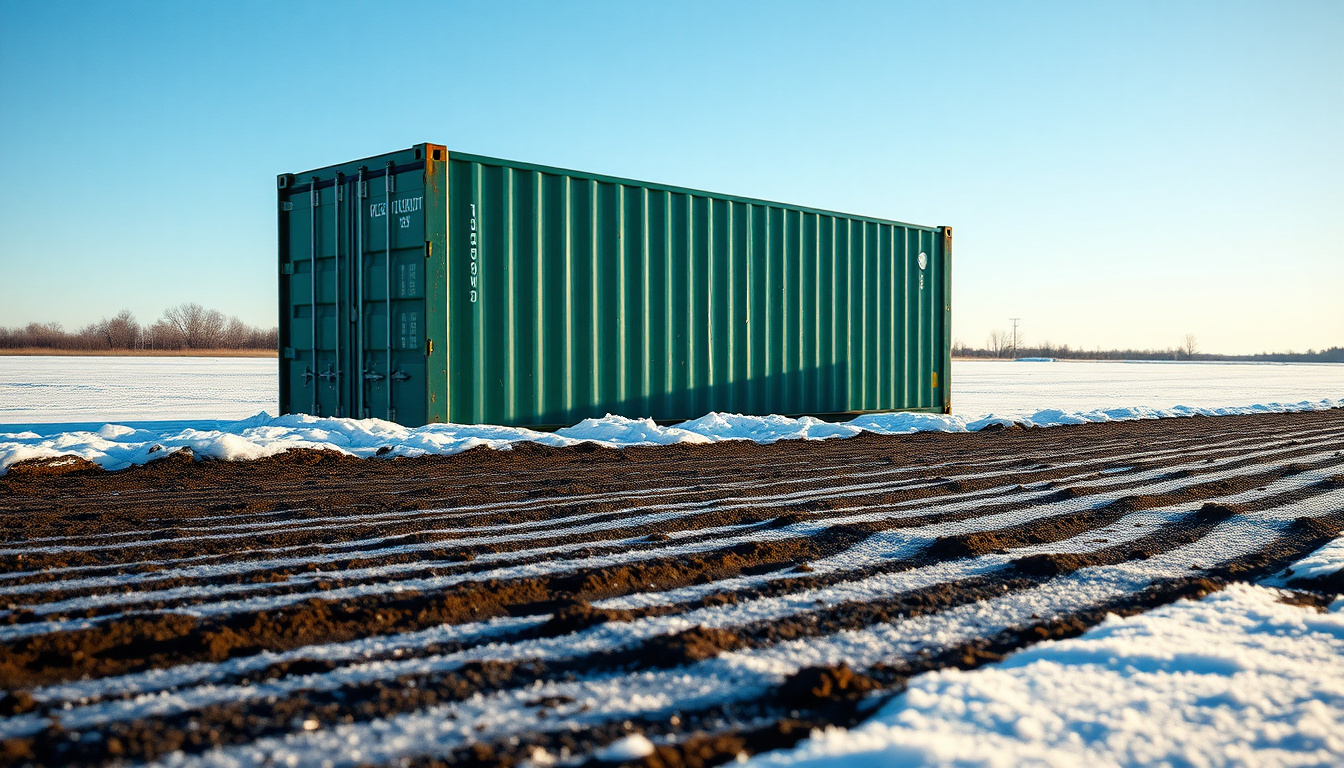
Quick Answer: An empty shipping container is more vulnerable to frost heave than a loaded one because the four corner-casting downforces (roughly 1,000 lbs each on an empty 20ft) cannot resist the 5,000+ lb upward heave pressure that ice lenses generate in Ontario silty clay subgrade. Prevention in Ontario means either piers driven below the regional frost depth (1.2 m south, 1.4 m central, 1.5 m north, 1.8 m+ James Bay coast), or a free-draining gravel pad with geotextile that pulls capillary water away from the freezing front before it can build ice. 30+ years operating, 4.9 stars on 140+ Google reviews. 1-3 day delivery Ontario-wide from our Brantford yards.
In This Field Guide
- Why Do Shipping Containers Heave in Ontario Winters?
- What Causes Frost Heave and How Do Ice Lenses Form?
- Why Does an Empty Container Heave More Than a Loaded One?
- How Deep Does Frost Go Across Ontario?
- Which Ontario Soils Heave, and Which Sit Still?
- Why Does Heave Get Worse After Three Winters?
- How Do Piers Below the Frost Line Stop Heave?
- Does a Gravel and Geotextile Pad Prevent Frost Heave?
- What Is an Insulated Foundation Skirt (FPSF)?
- Why Does Cribbing on Clay Fail?
- How Do You Re-Level a Heaved Container?
- What Does Frost Heave Look Like on Real Ontario Lots?
- FAQs
Reading Time: 16 minutes
Why Do Shipping Containers Heave in Ontario Winters?
Shipping container frost heave happens when water in frost-susceptible Ontario subgrade is drawn up to the freezing front, freezes into stacked horizontal ice lenses, and lifts the corner castings unevenly through winter. An empty box lacks the downforce to resist that thrust, so it tilts. The cure is a foundation that bears below the frost line or drains the water away before it can form ice.
Every March, the phones at our Brantford yard light up with the same call. A buyer who placed a 20ft container on his lot last August walks out of the house on a thaw morning, looks at his box, and notices the door no longer closes flush. One corner sits two inches higher than the other three. The cargo doors that swung clean all summer now bind against the header. He thinks the container has somehow warped over the winter, calls us, and asks if there is a structural defect to claim against.
There is no defect. The container is exactly the same shape it was the day we delivered it. The ground under one corner casting has lifted relative to the other three by an inch or two, and that small differential is enough to twist the steel box-section just enough that the doors stop sealing. The lift came from frost heave: the slow, patient, season-long mechanism by which water in Ontario clay subgrade migrates upward toward the freezing front, accumulates into horizontal ice lenses, and pushes whatever sits on top of it gradually skyward. By March the ground releases its grip as the thaw works downward, but the cumulative lift over the winter has already done the damage to the box’s level.
I have been delivering containers across Southern Ontario since the late 1990s, and frost heave is the single most common winter callback we field. It is more common than rust complaints, more common than door-seal issues, more common than delivery-access disputes. Every year, without exception, the first warm week of March brings the calls. And every year, the buyers who avoided the call are the ones whose foundation pad was designed for Ontario subgrade reality before the container was set down.
This Field Guide explains the physics of frost heave in clear language, maps the actual frost-penetration depths across Ontario, explains why an empty container heaves more violently than a loaded one (counterintuitive but true), and walks through the four foundation strategies that work and the one tempting shortcut that fails every time. Where the engineering literature is dense, I have translated it into what I have actually watched happen on customer lots over thirty years.
Paul LeBlanc, owner, thirty years in the trade: “Frost heave is the number one March callback I get every single year. And the painful part is that the fix, if it goes in before the container does, is a bag of gravel and a roll of geotextile. The fix after the fact, where I have to send a crew with a hi-lift jack to re-level the box and reshim the corners, costs many times that, every few years. Same physics, a fraction of the trouble. Do the pad first.”
What Causes Frost Heave and How Do Ice Lenses Form?
Frost heave is not the simple expansion of frozen ground water. If it were, the lift would be uniform and predictable, and engineers would have designed around it a century ago. The real mechanism is more subtle and more destructive, and it is driven by a process called segregated ice formation, or ice lensing.
Here is what happens. As winter air temperature drops, the ground surface freezes first. The freezing front, the boundary between frozen soil above and unfrozen soil below, begins migrating downward. In a coarse, well-drained sandy soil, the front advances quickly and uniformly, the in-place pore water freezes more or less where it sits, and the only volumetric expansion is the roughly nine-percent jump in volume that liquid water makes when it crystallizes into ice. Annoying but mild.
In silty clay loam, which is the dominant subgrade across most of Southern and Central Ontario, the freezing front moves slowly. The fine particle size means the pores between particles are narrow enough to behave as capillaries. Unfrozen water deeper in the profile is drawn upward toward the freezing front by capillary suction, the same way water climbs up a paper towel dipped in a glass. When that capillary-fed water reaches the freezing front, it freezes into a thin horizontal sheet of pure ice that wedges between the soil grains. The Canadian Conservation literature and the National Research Council’s foundation engineering work both describe this carefully: the ice that forms is not the original pore water expanding, it is fresh water imported from below and added to the soil column as a new ice mass.
That horizontal sheet is an ice lens. Once it begins forming, the freezing front pauses at the lens’s lower boundary because the latent heat released by water freezing onto the lens slows further frost penetration. The lens grows thicker as more capillary water arrives from below and freezes onto its underside. A single lens can reach several centimetres in thickness in one winter under the right soil and moisture conditions. And because the ice is forming in a sheet rather than uniformly in the pore space, the entire soil column above the lens is lifted by the lens’s growing thickness. Not by nine percent of the pore water volume, but by the full thickness of the new ice sheet.
Worse, multiple lenses can form vertically through a single winter. As surface temperature drops further and the freezing front resumes advancing downward, a second lens can begin growing below the first. Then a third. The cumulative lift from three or four stacked lenses in a Southern Ontario clay loam can reach five to ten centimetres of vertical heave at the surface over a single winter. That is two to four inches of upward movement on whatever the soil supports. On a container that lift arrives at the corner castings first, which is why the pad under those four points, covered in the pad walkthrough we send every buyer, is the whole conversation.
The Three Necessary Conditions for Ice Lensing
Frost heave requires three ingredients in combination. Remove any one and ice lensing essentially stops. First, freezing temperatures sustained long enough for the frost line to penetrate the soil column. Second, a frost-susceptible soil with fine particles small enough to wick water by capillary action but large enough to permit water flow toward the freezing front. Silt and silty clay are the worst. Coarse sand and gravel do not lens because the pore spaces are too large to support capillary suction. Third, a water source within reach of the capillary fringe, which in Ontario clay can extend three metres above the actual water table. Cut off any one of these and the mechanism breaks.
The lifting pressure that ice lenses can develop is genuinely impressive. Laboratory measurements per ASTM D5918 frost-heave testing show that segregated ice formation in a saturated frost-susceptible soil generates upward pressures in the range of 30,000 to 50,000 pounds per square foot at the freezing front. That works out to roughly 200 to 350 PSI of vertical thrust over the area of the lens. Translated to the load at one corner casting of a shipping container (a corner casting bears on roughly 50 square inches of pad), the upward thrust at one corner can exceed five thousand pounds. At four corners simultaneously, twenty thousand pounds of upward force is plausible under bad subgrade conditions. That is more than the empty weight of a 20ft container, which is the central paradox we are to unpack.
Why Does an Empty Container Heave More Than a Loaded One?
An empty shipping container heaves more than a loaded one because heave is a contest between upward ice-lens thrust and the downforce holding each corner in place, and an empty box brings far less downforce to that contest. This is the part that surprises new container buyers. Logic suggests a heavier container would press harder on the ground and be more vulnerable to seasonal movement. The physics works the other way for frost heave.
An empty 20ft standard container weighs approximately 4,800 to 5,200 pounds. Distributed across four corner castings, that is roughly 1,200 to 1,300 pounds of downforce per corner. An empty 40ft High Cube weighs around 8,800 pounds, so about 2,200 pounds per corner. These numbers are the resistance available at each corner against any upward force from the soil below.
Now consider the math. Ice-lens thrust at one corner casting, on bad silty clay subgrade with adequate water supply, can deliver five thousand pounds or more of upward force. The empty-box downforce of 1,200 pounds at that corner is not even close to enough to hold the corner in place. The corner lifts. And because each of the four corners sits over independent subgrade conditions, the lifting is uneven. The corner where the ice lens grew thickest lifts most. The corner over slightly better-drained ground lifts least. The box tilts.
A loaded container behaves differently. A 20ft container filled with twenty-five thousand pounds of dense cargo (machinery, tools, palletized inventory, a small vehicle) carries roughly six to seven thousand pounds of downforce per corner. That downforce is enough to hold the corner against typical Ontario ice-lens thrust. The lens still forms in the soil, but the corner does not rise off it. Instead, the loaded box compresses the lens or forces the lens to redirect its growth horizontally into easier ground. The container stays roughly level. The same lot, same subgrade, same winter, with a heavier load, suffers no visible heave at the box.
This is exactly why long-term cargo storage installations sometimes look fine for years while the same buyer’s empty backup unit on the same lot is gradually tilting. The full container has the downforce to resist heave. The empty one does not. By the time you notice the empty one is leaning, the cumulative ice-lens activity has displaced subgrade soil enough that even loading the container will not bring it back to level. You have to re-level mechanically.
The Heave Math, Worked One Corner at a Time
Take a 20ft empty container on saturated silty clay subgrade in Brantford. Empty corner load: 1,300 lb downforce. Ice-lens thrust under one corner during a bad December-through-February freeze: 4,000 to 6,000 lb upward force. Net force at that corner: 2,700 to 4,700 lb upward. Translated to vertical lift over a winter (the corner literally rises against gravity): typically 2 to 6 centimetres of unrecovered heave by the time the thaw finishes. The same lot with a 15,000 lb load on the floor: 5,000 lb downforce per corner, 4,000 to 6,000 lb ice-lens thrust, net force roughly balanced. Little to no visible heave at the corners. Same physics. Different outcome because the load shifted the balance.
How Deep Does Frost Go Across Ontario?
Frost-penetration depth in Ontario runs from about 1.2 m in the far south to 1.8 m and beyond near James Bay, and that regional number sets how deep a container foundation must reach. The actual frost-penetration depths vary substantially across the province. Foundation design that works in Brantford fails in Sudbury. Foundation design that works in Sudbury is overkill for Windsor. Knowing your regional frost depth is the first step in designing a foundation that does not heave.
Here is the field map we use at the yard when buyers ask. These numbers reflect the design frost penetration depths typically referenced by municipal building departments across the province. Individual sites can run shallower (rock outcrop, well-drained gravel) or deeper (north-facing slope, swampy ground) but the regional averages drive the foundation conversation.
| Region | Typical Frost Depth | Representative Towns | Foundation Implication |
|---|---|---|---|
| Southern Ontario (Lake Erie / Niagara / Brantford / GTA) | 1.2 m (4 ft) | Brantford, Hamilton, St. Catharines, Toronto, Mississauga, London, Windsor, Sarnia | Piers to 4 ft, or well-drained gravel pad |
| Central Ontario (Muskoka / Haliburton / Algonquin edge) | 1.4 m (4.5 ft) | Bracebridge, Huntsville, Parry Sound, Bancroft, Minden, Haliburton | Piers to 5 ft on clay, gravel pad on Shield |
| Near-North Ontario (Sudbury / North Bay / Timmins) | 1.5 m (5 ft) | Sudbury, North Bay, Timmins, New Liskeard, Cobalt, Englehart | Piers to 5-6 ft, frost skirt on permanent installs |
| Northern Ontario (Hearst / Cochrane / Moosonee) | 1.8 m+ (6 ft+) | Hearst, Cochrane, Kapuskasing, Moosonee, Attawapiskat, Fort Albany | Engineered foundation, frost skirt strongly recommended |
| James Bay / Hudson Bay coast | 2.4 m+ (8 ft+), discontinuous permafrost begins | Fort Severn, Peawanuck, Big Trout Lake | Specialized cold-region engineering required |
A few practical notes on reading the map. The “frost depth” figure is the design depth at which the engineer assumes the ground will reliably freeze in an average winter. The actual frost line in a given winter can go shallower (mild winter, heavy snow cover acting as insulation, well-drained sandy site) or deeper (severe winter, exposed lot stripped of snow by wind, saturated clay site). When designing a container foundation, you build to the design depth so that even a bad winter does not lift the box.
The dramatic jump going north of Highway 11 reflects the climatic transition from the lake-moderated southern shield to the genuine boreal-and-subarctic conditions of the James Bay lowlands. The further north your lot sits, the deeper a frost-stable foundation has to reach, which is why the same gravel pad that holds a box dead level in Brantford would be undersized in Hearst.
The Shield Bedrock Exception
Across the Canadian Shield outcrop region (a band running from Georgian Bay northeast through the Muskokas to Algonquin Park and on to the Ottawa Valley), some lots have bedrock at or very near the surface. A container set on competent bedrock with proper levelling sleepers does not heave because there is no frost-susceptible soil beneath it to lens. We have customers in Bracebridge and Burk’s Falls whose containers have sat on Shield rock for fifteen years without a millimetre of seasonal movement. If you are buying in Shield country, the question to ask before pad construction is whether your site is bedrock outcrop, glacial till over rock, or deep clay basin. The answer changes the foundation plan entirely.
Which Ontario Soils Heave, and Which Sit Still?
Frost-heave susceptibility is not uniform across Ontario soils. The Canadian Foundation Engineering Manual classifies soils into frost-susceptibility categories based on grain size distribution and capillary behaviour. Understanding which category your lot’s subgrade falls into tells you almost everything you need to know about how aggressively to design the container foundation.
Most heave-prone: Silty clay loam, clay silt, lacustrine silt, varved clay. These are the dominant subgrade soils across most of southern and central Ontario, from the Niagara Peninsula north through the Holland Marsh, the Grand River basin, the Thames valley, and the Lake Simcoe basin. The Leda clay of the Ottawa Valley is a notorious example. Brant County, where our yard sits, has extensive silty clay loam over glacial till. Almost every customer who calls us about heave is on a subgrade that falls in this category. The capillary suction in fine silt is strong enough to draw water from a metre or more below the freezing front, and the resulting ice lenses develop the full thrust pressures the engineering literature predicts.
Moderately heave-prone: Glacial till with mixed grain sizes, sandy silt, silty sand with significant fines content. These soils still wick water by capillary action but less efficiently than pure silt. Heave occurs, but typically half to two-thirds of the rate seen in pure silty clay. Many Southern Ontario lots are on this kind of mixed glacial till and the heave behaviour is moderate. A well-drained gravel pad is usually sufficient prevention.
Minimally heave-prone: Clean medium-to-coarse sand, clean gravel, crushed-stone fill. The pores between sand grains are large enough that capillary suction is weak and water drains downward by gravity faster than it can climb up to the freezing front. Properly drained granular fill effectively shuts off the ice-lensing mechanism. This is the engineering principle behind every gravel-pad foundation in cold climates: replace the heave-prone native soil with a frost-stable granular layer that drains rather than wicks.
Non-heave: Competent bedrock, well-drained boulder fields, properly engineered insulated foundations. No frost-susceptible soil means no ice lensing. The Canadian Shield outcrop is the most common non-heave subgrade in Ontario.
For most Southern Ontario container buyers, the lot is going to fall in the most-heave-prone or moderately-heave-prone categories. A simple field test: dig a hole eighteen inches deep at the proposed container location, fill it with water from a garden hose, and watch what happens. If the water drains in under an hour, you are probably on sandier till and heave will be manageable. If the water is still pooling six hours later, you are on silty clay and the foundation needs to be designed accordingly.
Why Does Heave Get Worse After Three Winters?
Frost heave on a poor container pad is cumulative: each winter disturbs the subgrade a little more, the ice lenses grow thicker the next year, and the lift that releases on thaw becomes the lift that stays. Frost heave is rarely catastrophic in the first winter. That is part of what makes it sneaky.
Year one: a buyer places a 20ft container on a thin pad of crusher dust or four-by-four wood sleepers on packed earth. Through the first winter, ice lenses form under the corner castings. The corner over the wettest spot rises maybe two centimetres. The corner over the driest spot stays put. The doors might bind a little in February but by April the ground has settled mostly back and the box returns to nearly its original position. The buyer notices nothing.
Year two: the same process happens, but the soil under the corner that lifted last year has been disturbed by the lensing and is now slightly looser, slightly more permeable to vertical water movement, and slightly more capable of supporting ice-lens growth. That corner lifts three centimetres this time. The thaw returns it to position but not quite. By spring the corner is sitting a few millimetres higher than it started. The buyer notices the door binds in February but assumes it is normal.
Year three: cumulative effect kicks in. The corner over the worst subgrade has now been disturbed by two winters of lensing and the soil column above the lensing zone has been physically reorganized. Ice lenses now form more easily and grow thicker. That corner heaves five centimetres in February. The thaw releases it back to maybe three centimetres above its original position. The door no longer closes properly. The container has a noticeable visible tilt. The buyer calls us.
This three-year sleeper curve is one of the reasons frost heave catches container owners by surprise. The first winter looks fine. The second winter looks slightly worse but tolerable. The third winter is when the cumulative damage becomes obvious. By that point, the subgrade damage is in place and even loading the box or pouring concrete around it will not undo the structural disturbance below. The fix is excavation and rebuild of the foundation pad with frost-stable material.
The Year-One Warning Signs
You can sometimes catch the heave problem early if you watch for the right signs in the first winter. In late February or early March, walk around the container in daylight. Look at the gap between the bottom rail and the top of your pad at each corner. If one corner shows a wider visible gap than the others, the soil under that corner has lifted relative to the others. Even a quarter-inch differential is the first sign the lensing mechanism is active. That is the moment to plan a foundation upgrade for the next summer, before year-two and year-three damage accumulates.
How Do Piers Below the Frost Line Stop Heave?
Piers stop frost heave by carrying each corner casting down to soil that never freezes, so no ice lens can ever form beneath the bearing point. The most reliable frost-heave prevention method for a permanent container installation is to support each corner casting on a concrete pier that extends below the regional frost-penetration depth. The principle is simple: if the pier foundation is bearing on soil that never freezes, no ice lensing can lift it.

For a Southern Ontario site (1.2 m design frost depth), this means a sonotube-formed concrete pier excavated to at least 1.2 m of depth, with a bell at the bottom for bearing area, and the top of the pier rising six to eight inches above grade. We walk through the full tube-and-rebar pour, step by step, in a separate guide for buyers who want to dig their own. A 12-inch diameter sonotube filled with 25 MPa concrete and reinforced with two vertical rebar gives ample compressive capacity for a corner casting load. Four piers total, one under each corner.
The container’s corner castings sit on a steel bearing plate welded or bolted to the top of the pier. Some buyers use a 6×6 timber sleeper between the pier and the corner casting as a sacrificial bearing layer that can be replaced in twenty years without disturbing the pier itself. Others run a continuous steel I-beam between piers and rest the container on the beam.
For Central Ontario (1.4 m frost depth), the pier depth extends to 1.4 m or 4.5 ft. For Sudbury and Near-North (1.5 m), 1.5 m or 5 ft. For genuine Northern Ontario where frost can drive to 1.8 m or deeper, the pier depth follows. In every region, the principle is the same: get the pier base into soil that does not freeze.
Cost is driven mainly by pier depth, soil hardness, and whether the buyer or a local contractor digs the holes by hand or rents a one-man auger. Deeper frost zones in the north mean longer sonotubes and more concrete per pier, so a Northern Ontario install runs higher than the same four-pier set in Brantford. Either way, this is a permanent foundation that will not heave for the life of the container, and spread across the years it sits level, it costs a fraction of a repeated re-level service call.
Does a Gravel and Geotextile Pad Prevent Frost Heave?
A free-draining gravel pad with geotextile prevents frost heave by removing the water supply that ice lenses need: crushed stone drains rather than wicks, and the fabric stops native fines from migrating up and reintroducing capillary lift. For installations that do not justify the cost of below-frost piers (smaller residential storage, semi-permanent agricultural use, sites where the buyer wants flexibility to relocate the container later), the free-draining gravel pad with geotextile is the workhorse solution. It is the option I recommend to roughly two-thirds of the buyers who ask me about foundation prep at the yard. Why a shed floats on that pad instead of going below the frost line, and when it should not, is explained in the Ontario shed foundations page.
The principle: replace the frost-susceptible silty clay subgrade under the container footprint with a thick layer of clean crushed stone, separated from the native soil by a permeable geotextile fabric that prevents the fines from migrating up into the gravel and clogging it. Water that enters the gravel layer drains horizontally and downward instead of being available for capillary lift to the freezing front. With no available water supply, ice lensing cannot form even when the gravel itself freezes.
The build sequence I describe to buyers:
- Excavate the container footprint plus a 1-foot margin on all sides to a depth of 8 to 12 inches below current grade. On heavy clay sites, dig deeper toward the 12-inch end. On well-drained sandy till, 8 inches is usually adequate.
- Lay non-woven geotextile fabric (Mirafi 140N or equivalent) across the entire excavated area, overlapping seams by 12 inches and extending up the sides of the excavation. This fabric prevents the native subgrade fines from migrating into your gravel layer over time and clogging it.
- Fill with clean crushed stone, ¾-inch clear (no fines), in two lifts of 4 to 6 inches each, compacting each lift with a plate compactor. Total gravel depth after compaction: 6 to 10 inches. Slope the surface very slightly (a half-inch over the length of the container) to direct any surface water away from the box.
- Set the container on the gravel directly. The corner castings bear on the gravel through their full bearing area. Some buyers add 4×4 or 6×6 timbers under each corner as a sacrificial bearing layer that lifts the steel off the gravel and shortens the inspection-and-repair cycle.
The total for a 20ft container comes down to the volume of clean crushed stone you need, the geotextile, and a half-day of excavation labour, so a wetter clay site that needs a deeper dig costs a bit more than a well-drained one. Dollar for dollar it is the single most cost-effective frost-heave prevention available, and buyers who do this rarely call us in March.
The Geotextile is the Hidden Hero
Many buyers want to skip the geotextile to shave a few dollars off the build. Don’t. Without the fabric layer separating the gravel from the native silty clay below, capillary action will pull silt up into the gravel pore spaces over two to four years. Once that happens, the gravel pad has fines in it, the fines support capillary lift, and you have rebuilt your frost-susceptible soil one centimetre above your original grade. The geotextile is what makes the pad permanent. Skip it and you have built a pad that will fail in year three or four, right when the box has settled into place and is hard to move for re-prep.
What Is an Insulated Foundation Skirt (FPSF)?
An insulated foundation skirt, or frost-protected shallow foundation (FPSF), prevents heave by changing where the frost line goes rather than digging below it: horizontal foam boards around the perimeter deflect the freezing isotherm away from the soil under the container. The frost-protected shallow foundation, or FPSF, is the third prevention method and it appears most often on northern cottage builds and on container installations that have been integrated into a permanent structure with a heated interior. The concept is elegant: instead of getting the foundation bearing below the frost line, you change where the frost line goes by laying horizontal insulation around the foundation perimeter.
The mechanism: extruded polystyrene (XPS) foam boards, typically 2 inches thick and laid flat on the ground extending 3 to 4 feet horizontally outward from the foundation perimeter, deflect the frost line outward and downward. The soil immediately under the container stays warmer than the surrounding ground, and the freezing isotherm gets shoved away from the foundation. Combined with a vertical insulation skirt on the foundation walls themselves, this can keep the soil under a shallow foundation above freezing even in Northern Ontario winters.
FPSF is more common on container cottages and container shelters where the interior is heated. The interior warmth radiates downward through the floor and helps maintain the warm soil envelope. For unheated storage containers, FPSF still works but the perimeter insulation has to do all the work without help from interior heat.
The Builder’s Guide to Frost-Protected Shallow Foundations (NRC and Canada Mortgage and Housing Corporation, revised 2004) provides the engineering protocol for FPSF design in Canadian climates. It is the document the engineer or designer references when sizing the insulation thickness and horizontal extent for a given regional climate.
The cost of an FPSF install around a 20ft container is driven by the area of XPS foam board and protective covering plus the excavation and backfill, and it lands in roughly the same range as piers, just by a different engineering route. It is rarely the first recommendation for a strict container storage application; it makes more sense when the container is being integrated into a heated cottage or workshop where the FPSF protects not just the container floor but the whole conditioned space.
Ready to price your container?
Tell us the size and your postal code and we’ll send back an honest, all-in number, container, delivery, and placement, usually within 1-3 days. No pressure, no mystery fees.
Family-run in Brantford since 1995 · 200+ containers in stock · 4.9★ across 140+ Google reviews · every box graded by a person, walk it before it lands.
Why Does Cribbing on Clay Fail?
Cribbing on clay fails because timber sleepers laid straight on the ground spread the load but do nothing to stop ice lensing in the clay below, so they simply ride the heave upward with the corner casting they were meant to protect. The single most common foundation mistake I see buyers make is laying down a few 4×4 or 6×6 timber sleepers (sometimes called cribbing or cribs) directly on the existing clay surface and setting the container on top of them. The logic is appealing: the wood spreads the corner-casting load over a larger area than the steel-on-clay contact, and the wood is easy to shim or replace if needed.
The fatal problem: cribbing on clay does nothing to address the underlying frost-heave mechanism. The clay still wicks water up to the freezing front. Ice lenses still form. The frozen-clay column still lifts. And because the cribbing is sitting directly on the clay, it lifts with the clay, carrying the corner casting upward with it. The cribbing approach reduces the point-load on the clay surface but does absolutely nothing to prevent ice lensing.
Worse, because the cribbing is wood, the differential lift between the four corners over a few winters causes the wood to rot unevenly (some sleepers get more compressed against wet clay, others sit drier and rot slower). After three or four winters, the cribbing itself is non-uniform and the container’s level is off both from the original lift and from the differential decay of the supports.
Cribbing has a legitimate role: as a sacrificial bearing layer on top of a properly designed gravel pad or pier, between the steel corner casting and the foundation, where the wood can be replaced periodically without disturbing the foundation below. As the foundation itself? Never on Ontario clay. The few inches you save by skipping the gravel-and-geotextile prep cost you the price of the eventual re-level service call several times over.
How Do You Re-Level a Heaved Container?
You re-level a heaved container by waiting for the spring thaw to fully release the subgrade, then jacking each high corner casting with a hi-lift farm jack and shimming the gap back to level. For containers that are already installed on inadequate foundations and showing seasonal heave, the practical reality is annual re-leveling. It is not the right long-term answer, but it keeps the box functional until the buyer can do the proper foundation rebuild.
The procedure: in late April or early May, after the thaw has fully released the subgrade and the corners have settled to their post-thaw position, check the level of all four corners with a long spirit level laid across the door header. If any corner is more than a quarter-inch off the others, that corner needs lifting back to level. A 48-inch hi-lift farm jack rated to 3 tons is the right tool. Position it under the heavy steel of the corner casting (never under the thin wall plate or the floor cross-member), lift the corner an inch or two, and shim the gap with treated 2×6 or steel shim plates until the corner sits at the correct height. Lower the jack. Move to the next out-of-level corner. Repeat.
If the box is on rigid pier foundations, this routine is rarely needed. If the box is on cribbing or a thin gravel layer, expect to do it every spring. The service-call cost when we send a crew swings with the severity of the lift and how accessible the lot is, a quick single-corner shim being far cheaper than wrestling a badly jammed box on a tight site. Cumulative over five or ten years, the re-leveling costs exceed the original foundation upgrade many times over.
Paul LeBlanc, owner: “I tell buyers this every time. A proper gravel pad with geotextile is a modest pile of materials and a day of digging. Pretending you do not need it buys you a re-level visit every few years, plus the doors that will not close right all winter long, plus the eventual full foundation rebuild when the cumulative heave damage has gone past what shimming can fix. The cheap version is not cheaper. It is just deferred.”
What Does Frost Heave Look Like on Real Ontario Lots?
On real Ontario lots, frost heave shows up as a corner that creeps higher each winter until cargo doors jam, and the severity tracks the subgrade: saturated clay heaves dramatically, sandy till barely moves, and Shield bedrock never budges. A few cases from the last decade of Brantford-yard customer service, with names changed but the engineering facts kept faithful.
The Brant County clay loam, year three: A buyer in St. George placed a 20ft empty container on packed earth in 2021. Year one, no issues. Year two, a slight bind on the cargo doors in February that resolved by April. Year three (February 2024), the buyer called us with the cargo doors completely jammed. We sent a crew. Differential heave between the two long-side corners had reached 7 cm. We re-leveled with shims, told the buyer he would face the same issue every winter, and quoted a gravel-pad rebuild for spring. He chose the rebuild. Three winters later, no heave, no callback. The rebuild took gravel and one day of labour, and the prior re-level visits and door repairs had already cost him more than triple what that one-time pad would have.
The Bracebridge Shield rock, no heave ever: A cottage owner near Bracebridge placed a 20ft container in 2010 on a flat outcrop of competent Canadian Shield bedrock, with a simple steel shim plate between the rock and each corner casting. Fifteen years later, the container is dead level. No heave, no movement, no service calls. His entire foundation outlay was a handful of steel shims, because competent bedrock solved the heave problem for free.
The Norfolk County sand bank, no heave needed: A farm buyer near Simcoe had a sandy till bank on his lot, well-drained even in spring runoff. He placed the container directly on the existing surface in 2018 with 6×6 timber sleepers under each corner. The sand drains so freely that no capillary water reaches the freezing front in any meaningful quantity. Seven winters in, no measurable heave. We told him the foundation prep he skipped was not needed on his specific soil, because the site itself was already a free-draining frost-resistant matrix. Read the soil before designing the pad.
The Lindsay clay basin, year-one disaster: A buyer in Kawartha Lakes placed a 20ft container in October 2022 on a thin layer of crusher dust on top of saturated post-harvest agricultural clay. Within one winter, the southwest corner had lifted 11 cm (more than four inches) above the northeast corner. The doors would not open at all in February. We had to send a crew with the hi-lift, jack the corner, support it on temporary cribbing, and the buyer rebuilt the whole pad with gravel and geotextile the following spring. The lesson: the worst sites combine saturated clay subgrade with poor drainage, and on those sites even one winter of inadequate foundation can produce dramatic heave. Do not gamble on year-one being mild.
Reach Van Blanc in Brantford
We have been supplying shipping containers across Ontario since 1995. Our warehouse is at 90 Morton Avenue E in Brantford, and we deliver right across the province on a cash-on-delivery basis. No surprise fees, no chase-the-paperwork. If you are still deciding which unit goes on that pad, our current yard stock and grades are a good place to start, and you can read up on how the box gets dropped on your site before you commit. When you order a container from us, ask about your foundation plan during the call. Paul or Christian will walk through your specific subgrade situation and recommend the right pad for your soil, your region’s frost depth, and your container’s intended load. The right advice costs nothing.
Van Blanc Ent. Inc. 90 Morton Ave E Unit 1B, Brantford, ON N3R 7J7. Call 519-754-6844 or toll-free 1-888-509-6658. Fast 1-3 day delivery to every region across Ontario once you pick your unit. Worth the drive for unbeatable quality, family customer service with thirty years of experience, and a real lead time, not a hopeful one.
Frequently Asked Questions
Why does an empty shipping container heave more than a loaded one?
An empty 20ft container weighs about 5,000 pounds, distributed as roughly 1,200 pounds of downforce at each corner casting. Ice-lens thrust on bad Ontario silty clay subgrade can exceed 5,000 pounds of upward force at one corner. The empty downforce is not enough to resist the heave thrust, so the corner lifts. A loaded container with 15,000 to 25,000 pounds of cargo distributes 4,000 to 7,000 pounds of downforce per corner, which is enough to resist typical heave thrust. Same lot, same physics, different outcome.
How deep do shipping container foundation piers need to be in Ontario?
Match the regional frost-penetration depth. Southern Ontario including Brantford, Hamilton, Toronto, and Niagara: 1.2 metres (4 feet). Central Ontario including Muskoka and Haliburton: 1.4 metres (4.5 feet). Near-North including Sudbury and North Bay: 1.5 metres (5 feet). Northern Ontario including Hearst and Cochrane: 1.8 metres or deeper. Site-specific conditions, a north-facing slope, swampy ground, or an exposed lot stripped of snow by wind, can drive the frost line deeper, so build to the design depth and a little past it rather than just meeting it.
What is the cheapest effective frost-heave prevention for an Ontario container?
A free-draining gravel pad with non-woven geotextile fabric between the gravel and the native subgrade. Excavate 8 to 12 inches deep, lay the geotextile, fill with clean ¾-inch crushed stone in compacted lifts, slope slightly for surface drainage. The material cost is modest and scales mainly with how much crushed stone a 20ft footprint needs, which makes it far cheaper than piers or a footed slab. The geotextile is the critical detail. Without it, silty fines migrate up into the gravel over a few years and the pad starts to heave again.
Can I put a shipping container on cribbing or wood sleepers directly on clay?
Not as a foundation. Wood sleepers on bare Ontario clay do nothing to prevent ice-lens formation in the soil below. The clay still wicks water to the freezing front, ice lenses still form, and the cribbing rides the heave upward along with the corner casting. Cribbing has a legitimate role as a sacrificial bearing layer on top of a proper gravel or pier foundation, where it can be replaced periodically without disturbing the foundation below.
Why does the container look fine in year one but tilted by year three?
Frost heave is cumulative on poor foundations. Year one: minor ice-lens activity that mostly releases on thaw. Year two: the subgrade soil is slightly disturbed from year one, lenses grow more easily, and a small portion of the lift persists past thaw. Year three: the cumulative disturbance allows thicker lenses, larger lift, and visible permanent tilt. The first winter is not predictive. Plan the foundation for the third-year reality, not the first-year impression.
Will a concrete slab prevent frost heave under a shipping container?
Only if the slab edges extend below the regional frost depth, which usually means a 4-foot footing perimeter below a 1.2-metre frost depth in Southern Ontario. A slab cast on top of the ground without that perimeter footing will heave with the soil exactly the same way the container would. The slab is more expensive than gravel-and-geotextile and is usually unnecessary for storage use. Reserve the full slab approach for container builds that need a heated, conditioned interior or that integrate the slab into a larger building.
Does Canadian Shield bedrock require any frost-heave prevention?
No, assuming the container is set on competent bedrock with proper levelling shims between rock and corner casting. Bedrock does not lens because there is no frost-susceptible soil. Customers on Shield outcrop sites across the Muskokas, Haliburton, and Algonquin region routinely have containers sitting level for fifteen years with no foundation prep beyond a few steel shim plates. Confirm the rock is competent and not glacial till mistaken for rock, which heaves like any other till.
What does a frost-heave service call typically cost?
The cost of a re-level with a hi-lift jack and corner shims scales with the severity of the lift and how easily a crew can reach the lot, and it recurs every spring as long as the underlying foundation goes uncorrected. A proper foundation upgrade, a gravel pad with geotextile or piers below the frost line, is a single outlay that ends the recurring service call entirely. Over a few seasons the math always favours the one-time foundation upgrade.
Sources
- National Research Council Canada, Institute for Research in Construction. Ground Temperatures and Frost Penetration Depths in Canada (climatic design data). nrc.canada.ca
- National Research Council Canada and Canadian Geotechnical Society. (2024). Canadian Foundation Engineering Manual, 5th Edition. Chapter 4: Frost Action and Frost-Susceptible Soils. nrc-publications.canada.ca
- Canadian Standards Association. (2014). CSA S406-14: Construction of Preserved Wood Foundations and Cold-Climate Foundation Design. csagroup.org
- ASTM International. (2013, reapproved). ASTM D5918-13: Standard Test Methods for Frost Heave and Thaw Weakening Susceptibility of Soils. astm.org/d5918-13
- Canada Mortgage and Housing Corporation and National Research Council. (2004). Builder’s Guide to Frost-Protected Shallow Foundations (Revised). cmhc-schl.gc.ca
- Peppin, S. S. L., and Style, R. W. (2013). The Physics of Frost Heave and Ice-Lens Growth. Vadose Zone Journal, 12(1). Wiley Online Library
Placement requirements vary by municipality. A quick call to your local planning office before delivery is the easiest way to confirm what works for your property.