
Quick Answer
An open-top shipping container is a 20ft or 40ft ISO unit with the welded steel roof replaced by a removable PVC tarpaulin stretched over removable steel bows. The tarp anchors to lashing rings on the top rail, the bows lift out, and a crane lowers cargo straight down into the box from above. Open-tops carry ISO Size Type Codes 22U1 (20ft) and 42U1 (40ft), are built to ISO 1496-1, and ship with a CSC plate. The tarp covers only in-gauge cargo at or below the roof line. Anything taller is loaded uncovered or under an oversize tarp ordered for the trip. According to the World Shipping Council, open-tops sit in the same Series 1 freight-container family as standard dry boxes. In Canada they are almost always source-to-order with two to four week lead times rather than yard stock. Real Brantford yards, real reviews (4.9 / 140+), real 1-3 day delivery on standard inventory. Family-operated since 1995.
Most of the Ontario buyers who phone us asking about an open-top container know exactly why they need one. The cargo is taller than the rear door header. The load has to come in from a crane hook rather than rolled in on a forklift. The job is short-term and the container is going to do a trip or two carrying something specific. The buyers who phone asking about a hardtop are usually solving a different problem, which is installing a piece of machinery that has to live inside the box for years under a sealed steel roof. Different problems. Different boxes. Both sit alongside the standard dry units and reefers in the wider range of container sizes and configurations Canadian buyers can choose from.
This guide walks the open-top in plain terms. What it actually is in the steel. How the PVC tarp and the removable steel bows assemble and disassemble. The Canadian procurement reality, which is source-to-order rather than yard stock at our Brantford yards. The use cases where the tarp roof and crane access pay for the premium over a standard sealed box. And the cleanest comparison to the hardtop container with a removable steel roof, which sits one tier up in price and in permanence. Christian LeBlanc has spent four years on the yard taking these calls. His advice is that most open-top buyers are doing short-term cargo work; most hardtop buyers are installing permanent machinery. Knowing which side of that line your job sits on is the first decision.
In This Guide
- What an Open-Top Container Actually Is
- The PVC Tarp and the Removable Bow Assembly
- Crane Loading and Overhead Access
- Oversize Cargo and Out-of-Gauge Loading
- Open-Top vs Hardtop: Which One Fits the Job?
- Ontario Use Cases We See Most
- Canadian Lead Time and Pricing
- ISO 1496-1 Rating and CSC Plate Reality
- Frequently Asked Questions
What Is an Open-Top Shipping Container?
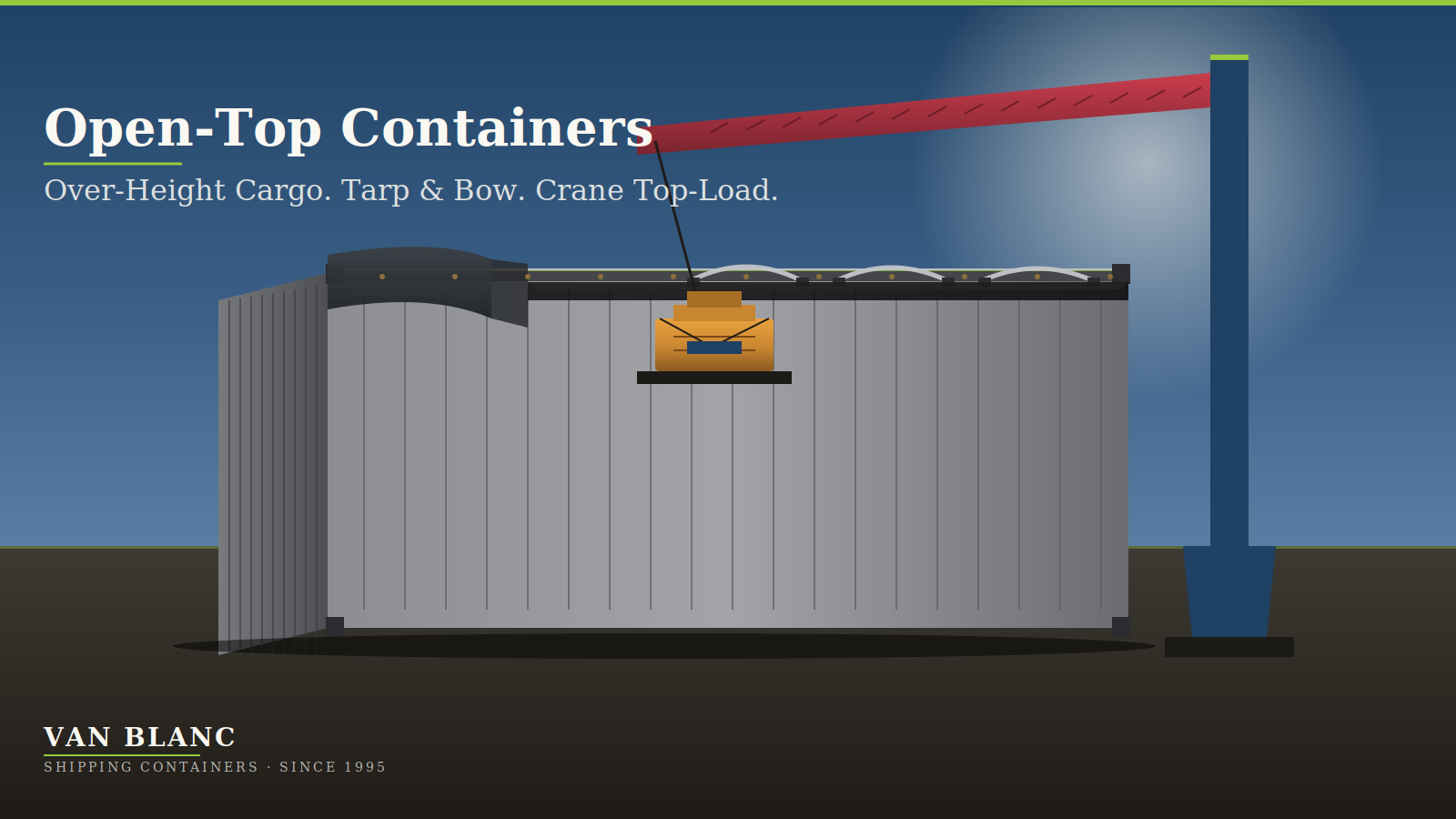
An open-top shipping container is a standard 20ft or 40ft steel box with the fixed roof swapped for a removable PVC tarpaulin over liftable steel bows. With the bows out, the entire top is open, so a crane can lower cargo straight down. It carries an ISO 1496-1 rating and a CSC plate, the same as a sealed container.
An open-top container shares the same ISO frame as a 20ft or 40ft general-purpose dry box. The corner castings are identical. The side walls, the bottom rails, the floor, the rear cargo doors all match a standard GP unit. The difference is what is above the top side rails. Instead of welded corrugated steel sheets running the full perimeter, an open-top has nothing permanent. The top rail itself runs the full perimeter as a structural beam. Across the open span, removable steel roof bows sit in pockets cast into the top rail at regular intervals. A heavy PVC tarpaulin stretches over those bows and ropes down to lashing rings welded along the top rail.
The size type codes name the family clearly. A 20ft open-top with a soft tarp roof is coded 22U1. A 40ft open-top is 42U1. The U in the third position is the ISO designation for open-top containers; the 1 in the fourth position indicates the soft removable cover, distinct from the rigid removable hood (a hardtop) which carries a 6 suffix. The codes get cast into the corner casting plates so a depot operator, customs inspector, or terminal lift driver can identify the unit at a glance.
Standard external dimensions match a regular box. A 20ft open-top measures 20 feet long, 8 feet wide, and 8 feet 6 inches tall to the top of the steel rail. Interior usable space comes in at roughly 19 feet 4 inches long, 7 feet 9 inches wide, and 7 feet 10 inches under the bows when the tarp is in place. A 40ft open-top runs 40 feet by 8 feet by 8 feet 6 inches externally, with roughly 39 feet 6 inches by 7 feet 9 inches by 7 feet 10 inches of usable interior. Payload runs in the range of 28 tonnes for a 20ft and 30 tonnes for a 40ft, depending on the manufacturer and the certified gross weight stamped on the CSC plate.
Empty weight (tare) on an open-top is usually 200 to 400 kilograms higher than a standard GP box of the same length. The extra steel goes into reinforcing the top rail (which is now carrying the structural load that a fixed roof would normally share) and into the bow pockets and lashing-ring welds. A 20ft open-top usually tares around 2,400 kilograms; a 40ft around 4,000 kilograms. The difference is small enough that hauling an open-top in Ontario behaves the same as hauling a standard box: a loaded open-top on a tilt-deck trailer travels under the same MTO weight limits as a loaded standard 20ft or 40ft.
The PVC Tarp and the Removable Bow Assembly
The tarp is the part of the unit that asks the most questions on a first call. Buyers want to know what it is made of, how it stays put in wind, and how secure it actually is once the cargo is in place. The answer is that the tarp is heavy-duty PVC-coated polyester fabric, typically in the 600 to 900 grams per square metre range (roughly 20 to 30 ounces per square yard in imperial), the same weight class used for industrial trailer covers and silage covers across Ontario agriculture. It is not canvas. Canvas was the old standard decades ago; modern open-tops have been PVC-coated polyester for the last 30 years in the ocean freight industry.
The bows are the structural element under the tarp. They are rolled steel arches, painted to match the container, sized to drop into stamped pockets on the inside face of the top rail. A 20ft open-top typically uses three or four bows spaced along the length; a 40ft uses six to eight. The bows lift out by hand, two people on the longer 40ft bows, and stack along the side of the box during loading. With bows out, the unit is fully open from above with nothing but the top rails framing the opening. Cargo can clear the roof line if it has to and the tarp can be re-fitted afterward with an oversize cover if the trip needs weather protection.
“The first thing I tell anyone calling about an open-top is that the tarp is a roof for weather, not a lid for security. People picture it like a sealed box with a soft top. It is not that. It keeps rain off the load and it lets us crane cargo in from above, and that is the whole job. If you need the contents locked away, that is a different bin.”
Christian LeBlanc, second-generation operator, Van Blanc Ent. Inc.
What the tarp actually does and does not do
The tarp is rated to keep water out under normal road and ocean conditions. It is not a security barrier. A motivated thief with a knife can cut through PVC tarpaulin in seconds. Open-tops loaded with valuable cargo for a long-distance trip almost always travel under bond seal and customs inspection with the assumption that the tarp is weather protection, not theft deterrent. For Ontario buyers using an open-top as a job-site storage box, the same rule applies: the tarp keeps the rain off the aggregate or the scrap inside. It does not lock the contents away. Buyers who need security after loading should be looking at a hardtop with a bolted steel roof, not an open-top.
Anchoring the tarp uses a TIR cable, named for the international road transport convention (Transports Internationaux Routiers) that standardized the system across European trucking decades ago. The tarp has reinforced grommets every 200 to 300 millimetres along the bottom edge. A steel cable threads through the grommets and through the lashing rings welded along the top rail. The cable terminates with a customs seal at one end. Once the seal is in place, opening the tarp without breaking the seal is impossible, which is what lets an open-top travel through customs and bond without a steel roof. For purely domestic Ontario use the seal is not required; buyers use the same cable but anchor it with a standard locking mechanism.
Lifespan on the tarp itself is the most common follow-up question. A well-treated PVC tarp on an open-top container runs five to eight years of useful life in Canadian weather before UV degradation and pinhole leaks make replacement worthwhile. A fresh tarp is a standard parts item, and the same yard that handles cutting doors, vents, and panels into a box can size and fit a replacement cover. What it costs depends on the length of the unit and the weight grade of the fabric, so we quote it per unit rather than post a number. The bows themselves last the working life of the container with periodic repainting to manage rust.
How Do You Load an Open-Top Container with a Crane?
Crane loading is the whole reason an open-top container exists, and the mechanics are simple: the bows lift out, a yard crane, gantry crane, or mobile boom truck rigs the cargo, and the load drops straight down through the open top. Overhead access is what a sealed box cannot offer. The cleanest way to load it is a yard crane, a gantry crane, or a mobile boom truck with a strop or sling rigged to the cargo. The crane operator lowers the load down through the open top, the rigger on the ground positions it on the floor, lashes it to the floor’s D-rings, and the unit is ready to close up. The whole operation takes a fraction of the time it would take to skid the same load in through the rear doors of a sealed box, and for cargo that physically cannot fit through the door header it is the only way to load at all.
The crane work itself is straightforward at any commercial yard. The cargo gets rigged with whatever the manufacturer or the customer specifies (chain slings, web slings, certified shackles). The bows come out. The crane swings the load over the open top, lowers, releases. The bows go back in. The tarp gets rolled back across. The whole sequence on a single piece of cargo runs 30 to 60 minutes including rigging time. Multi-piece loads stretch longer but follow the same rhythm: bows out, load in, bows in, tarp on.
For Ontario buyers loading open-tops in the field rather than at a depot, the rigging consideration is bigger than people expect. Job sites need to either bring a crane to the open-top or move the open-top to where the crane lives. A crane truck for the day is a third-party rental, and the rate scales with the lift capacity you need and the travel distance to the site. That cost is usually minor next to the value of the machinery being loaded, but it is worth planning for before assuming open-top loading is automatic. Buyers who do this regularly often own a small mobile crane or a forklift with a jib attachment specifically for this work.
Oversize Cargo and Out-of-Gauge Loading
Oversize or out-of-gauge cargo is cargo that sits taller or wider than the container’s roof line, and it is the single most common reason commercial buyers reach for an open-top. The standard tarp covers only what fits below the roof line. Once cargo extends above the top rails, the unit is moving as “out of gauge” (OOG) freight and the tarp either gets removed entirely or replaced with an oversize cover that drapes over the load and ties down to the rails. The shipping line or freight carrier classifies the load as OOG, charges accordingly, and routes the container with extra clearance on the road and at the terminal.
Out-of-gauge loading is the most common reason commercial freight buyers reach for an open-top in the first place. Industrial machinery that does not break down into below-roof-line modules. Pre-cast concrete elements. Large fabricated steel components for construction projects. Wind-turbine sub-assemblies. Mining equipment with shafts or arms that won’t fold. Pieces of agricultural equipment that have to ship as one welded assembly. The list is long and specific to industry, and the open-top exists precisely for these loads. When a piece is wider than the box or has no need for side walls at all, buyers often step over to a flat rack with collapsible end walls instead, which we cover in its own guide.
Tarp coverage rule the dispatcher uses
If the cargo sits flush with or below the top rail and a standard tarp covers it cleanly, the open-top travels as standard freight. If the cargo extends above the top rail by any amount, the load is out-of-gauge and the carrier charges OOG rates, often 50 to 100 percent above standard container rates. The oversize tarp is bought separately for the trip and travels with the cargo. For Ontario buyers using an open-top purely as a storage box on their own property, OOG rules do not apply; this only matters when the unit is moving as freight on the road or rail or sea.
The structural floor is the other half of the OOG question. An open-top floor is rated to the same payload as a standard GP box, but heavy concentrated point loads (a single large industrial machine landing on four feet) need to be assessed against the floor’s point-load rating. Most manufacturers spec the floor to handle a forklift tyre concentration of roughly seven tonnes; bigger point loads need load-spreading dunnage between the machine and the wooden floor. Christian’s note to most buyers calling in: if the load is heavier than a standard skid loader at 12 tonnes, ask the manufacturer for a floor point-load spec sheet before paying for the unit.
Open-Top vs Hardtop: Which One Fits the Job?
The cleanest line between open-top and hardtop is permanence of use. The decision logic looks like this. Is the box doing a job and then returning to general inventory, or is it carrying a single piece of cargo on a short trip? Open-top wins on both. Is the box being installed once with machinery inside and expected to live in place for years under a sealed roof? Hardtop wins. Two different problems. Two different price points. Two different lead times.
| Feature | Open-Top (22U1 / 42U1) | Hardtop (22U6 / 42U6) |
|---|---|---|
| Roof construction | PVC tarpaulin on removable steel bows | Removable steel panels bolted to top rails |
| Cargo loading method | Rear doors or full overhead crane access | Rear doors or full overhead crane access |
| Time to open the roof | 10 to 20 minutes (untie tarp, lift bows) | 15 to 25 minutes (28 to 36 bolts, lift panels) |
| Sealed weather protection | Limited, tarp seal only | Full CSC wind and water tight |
| Security when closed | Lower, tarp can be cut through | High, bolted steel roof |
| Equipment to handle roof | Two people can move bows and tarp | Forklift or overhead crane required |
| Typical Ontario lead time | 2 to 4 weeks source-to-order | 2 to 6 weeks source-to-order |
| Pricing premium over standard GP | Roughly 25 to 45 percent premium | Roughly 35 to 65 percent premium |
| Best fit | Short-term cargo work, ocean freight OOG, mining samples, aggregate | Permanent machinery install, generator enclosures, transformer housings |
“Most buyers picking open-top are buying for short-term cargo work. The bin is going to load a thing, ship it, unload it, and come back into general use. Hardtop buyers are usually installing permanent machinery and they need the steel roof for the next twenty years. Different problem, different bin. If a customer is not sure which one they need, the question I ask is whether the cargo lives in the box after loading. If the cargo lives in there, they want a hardtop. If the cargo gets unloaded at the other end, they want an open-top.”
Christian LeBlanc, second-generation operator, Van Blanc Ent. Inc.
The lead-time gap is small but real. Open-tops generally source about a week faster than hardtops because the unit is simpler and the manufacturing volume in Asia is higher for soft-roof units. Both are still source-to-order in Canada. Neither sits in yard inventory at any Ontario container yard the way a standard 20ft or 40ft GP does, and any supplier claiming yard stock on either specialty unit should be checked carefully.
Ontario Use Cases We See Most
The buyers reaching for open-tops in Ontario fall into a few clear groups. Each has a slightly different reason for the choice and a slightly different expectation about what the unit has to do.
Aggregate, sand, and gravel storage
Small-yard aggregate operations use open-tops as drop-loading bins for sand, road salt, gravel, and crushed stone. A wheel loader scoops material out of a stockpile, swings it over the open top, and dumps it into the box. The tarp stays rolled back during active loading and gets pulled across when the bin is parked between uses. The open roof means a loader bucket can dump cleanly without the operator having to thread the bucket through a doorway. Material capacity in a 20ft open-top runs 15 to 20 cubic metres depending on density.
Mining ore samples and exploration drill cores
Northern Ontario mining operations near Sudbury, Timmins, and the Ring of Fire use open-tops to consolidate drill cores and ore samples from exploration sites. The cores arrive on site as long tubes that won’t pass through a rear door header; the open roof lets the geologists drop them in with a crane and ship the bin south to the assay lab in one move. The unit usually comes back empty and goes back into rotation for the next site.
Oversize industrial machinery and pre-fabricated components
Southwestern Ontario manufacturers in the Hamilton, Brantford, and London corridor use open-tops to ship oversize fabricated parts to job sites or to export ports. Welded steel assemblies, pre-cast concrete elements, large transformer housings, and wind-turbine components routinely move under tarp roofs because the cargo exceeds the rear door header by enough to make a standard box impossible.
Scrap metal collection
Scrap dealers and demolition contractors use open-tops as collection bins. Crews drop cut steel, copper wire, mixed metal, and large appliances over the top with a magnet on a crane or with manual lift. When the bin is full, the tarp gets pulled across and the unit ships to the scrap processor. Open-top floors are reinforced enough to handle the impact loading from dropped scrap, which standard GP boxes are not.
Agricultural seed, feed, and grain transfer
Norfolk County, Wellington County, and Lambton County farms use open-tops as bulk transfer bins during harvest. Combine augers and grain trucks can offload directly into the open roof without lining up with a rear door. The tarp keeps the load dry between operations. For mid-sized farms running their own logistics rather than relying on co-op silos, open-tops are a cheaper alternative to fixed silo construction.
In every one of these use cases, the open-top is doing work that a sealed GP box cannot do at all. The premium pays for itself the first time a load that would have needed disassembly to fit through a rear door gets craned in as a single piece.
How Long Does It Take to Get an Open-Top in Canada?
Lead time on an open-top container in Canada runs two to four weeks for a 20ft and two to five weeks for a 40ft, because the unit is source-to-order rather than yard stock. The first thing to know about open-top pricing in Canada is that the unit is source-to-order. Almost no yard in Ontario carries open-tops as standing inventory. The economics do not support it. A standard 20ft GP box turns over in our yard several times a year; an open-top might sell once or twice a year. Carrying inventory means a yard’s capital sits in steel that nobody is buying. Every Canadian supplier worth dealing with quotes open-tops on a sourcing basis: confirmed deposit, confirmed manufacturer order or container-depot transfer, lead time tracked, delivery scheduled when the unit arrives.
Realistic lead time runs two to four weeks for a 20ft open-top and two to five weeks for a 40ft. The lead-time clock starts when the deposit clears and the supplier confirms the sourcing channel: either a fresh one-trip unit from an Asian manufacturer (longer end of the range) or a recently de-commissioned cargo-worthy unit from a Canadian port depot (shorter end). One-trip units arrive in essentially new condition with a fresh tarp and unworn bows. Cargo-worthy units are used, often with surface rust and a tarp that has five years of UV behind it, but they ship faster and price lower.
Pricing in Canada for 2026 sits roughly in these bands. A 20ft one-trip open-top runs the equivalent of 25 to 45 percent above the price of a standard 20ft one-trip GP box, which puts it in the upper specialty range. A 40ft one-trip open-top runs a similar premium over a standard 40ft. Cargo-worthy used open-tops trade at a discount to one-trip but the supply is thinner and the tarp condition needs to be inspected before committing. Wind-and-watertight grade open-tops do exist on the market but most buyers find that if the tarp is degraded enough to drop the unit from cargo-worthy to WWT, the tarp is going to need replacement before the unit is useful, which closes the price gap on the cargo-worthy upgrade.
Worth the drive to our Brantford yard for an open-top
Open-top buyers in Ontario almost always benefit from coming to Brantford to inspect the unit before paying the balance, because the tarp condition, the bow paint, and the lashing ring weld quality are all visual inspection items that no online photo set covers properly. Our yard sits at 90 Morton Avenue East. Buyers regularly drive in from Hamilton, Niagara, Toronto, Kitchener, London, and as far as Sudbury and Ottawa to walk a unit before signing. Worth the drive for unbeatable quality, family customer service, and 30 years of operating experience watching this market.
Delivery costs for open-tops match standard container delivery, billed per kilometre from our Brantford yards so the distance to your site is the main driver. Tilt-deck trailer delivery is the default; the unit lifts off the trailer and lands on level ground in the same operation we use for any 20ft or 40ft box you would buy from our Ontario inventory. There is no premium for delivering an open-top over a sealed unit. The premium is in the unit itself, not the freight.
Ready to price your container?
Tell us the size and your postal code and we’ll send back an all-in number, container, delivery, and placement, usually within 1-3 days. No pressure, no mystery fees.
Family-run in Brantford since 1995 · 200+ containers in stock · 4.9★ across 140+ Google reviews · every box graded by a person, walk it before it lands.
ISO 1496-1 Rating and CSC Plate Reality
Open-top containers are built and tested to ISO 1496-1, the general cargo container specification that covers Series 1 freight containers including standard GP, open-top, and hardtop variants. ISO 1496-2 covers thermal containers (reefers); ISO 1496-3 covers tank containers. The open-top sits inside the same testing regime as a standard box for stacking strength, racking strength, end-wall strength, side-wall strength, and floor point-loading. The only difference is that the roof’s contribution to stacking strength comes from the top rail itself rather than from a welded steel roof skin; the rail is reinforced accordingly.
The CSC plate (Container Safety Convention plate) on an open-top confirms that the unit meets the International Maritime Organization’s safety standard for international shipping. A new one-trip open-top carries a fresh CSC plate with a five-year initial validity, after which periodic re-inspection extends the certification for another 30 months or 24 months depending on the inspection regime the unit is enrolled in. A WWT or cargo-worthy used open-top may have a current CSC plate or an expired one; expired CSC is fine for any non-ocean use including storage on Ontario property or domestic road transport.
For Ontario buyers who will only ever use the open-top for storage on their own property or for domestic in-province transport, the CSC plate is not relevant. The unit is fine without one. For buyers planning to use the unit in international freight (export an OOG load to an Asian or European port), the CSC plate must be current and the tarp condition must be documented as part of the freight booking. Most Ontario buyers we deal with are in the first group; they treat the CSC plate as background information rather than a buying decision.
Frequently Asked Questions
What is an open-top shipping container used for?
Open-tops are used for cargo that is too tall to fit through the rear doors of a standard sealed container, or for cargo that has to be loaded from above with a crane. Common uses include oversize industrial machinery, pre-fabricated steel and concrete components, drill cores and mining samples, aggregate and gravel storage, scrap metal collection, and agricultural bulk transfer for seed, feed, and grain.
What is the tarp on an open-top container made of?
The tarp is heavy-duty PVC-coated polyester fabric, typically in the 600 to 900 grams per square metre range. It is not canvas. PVC-coated polyester has been the ocean-freight industry standard for open-top tarps for the last 30 years because it holds up to UV exposure and salt-water spray far better than canvas. A well-treated tarp on a Canadian open-top runs five to eight years before replacement.
How does an open-top container compare to a hardtop?
Both let cargo load through the roof with a crane. The open-top uses a removable PVC tarp on removable steel bows; the hardtop uses removable bolted steel panels. Hardtop runs 35 to 65 percent above a standard GP box and gives full sealed weather protection and high security. Open-top runs 25 to 45 percent above a standard GP box and gives tarp-grade weather protection only. Open-top buyers are usually doing short-term cargo work; hardtop buyers are usually installing permanent machinery. Our full hardtop container guide walks the hardtop in detail.
Can an open-top container carry cargo taller than the roof line?
Yes. The bows lift out and the tarp gets replaced with an oversize tarp ordered for the trip, or the cargo travels uncovered as out-of-gauge (OOG) freight. The shipping line or road carrier rates OOG loads at 50 to 100 percent above standard container freight to account for the extra clearance and routing required. For storage use on your own property the OOG rules do not apply; the unit is just a container holding tall cargo.
Are open-top containers in yard stock in Ontario?
No. Very few Ontario yards, ours included, carry open-tops as standing inventory. The unit is source-to-order with two to four week lead times, sourced either from a fresh one-trip manufacturing order in Asia or from a Canadian port depot transfer. Suppliers claiming open-top yard stock should be checked carefully. The unit is simply too low-volume for any yard to justify holding inventory.
How much does a 20ft open-top container cost in Canada?
A 20ft one-trip open-top in 2026 sits roughly 25 to 45 percent above the equivalent 20ft standard GP box, which puts it in the upper specialty range. A used cargo-worthy open-top trades at a discount to one-trip with thinner supply. Pricing depends on tarp grade, bow condition, and delivery distance from our Brantford yards. Every quote comes with a real lead time, not a hopeful one. Call us at 519-754-6844 for a current quote tailored to your project.
Does an open-top container have a CSC plate?
Yes. Open-tops are built and tested to ISO 1496-1 and carry a CSC plate when new. A new one-trip open-top has a fresh five-year CSC validity. A used cargo-worthy open-top may have a current or expired plate. Expired CSC is fine for any domestic Ontario use including storage on your own property and in-province road transport. Only international ocean freight requires the plate to be current.
How secure is an open-top container when the tarp is closed?
The tarp is weather protection, not theft deterrent. A knife will cut through PVC tarpaulin in seconds. Open-tops are not the right choice for storing valuable cargo long-term on an unsecured site. Buyers who need security after loading should look at a sealed standard box or a hardtop with a bolted steel roof. Open-tops earn their place on jobs where the cargo is short-term, low-theft-risk (aggregate, scrap, drill cores), or where the unit lives inside a fenced yard or facility.
Reach Van Blanc in Brantford
We have been supplying shipping containers across Ontario since 1995. Our warehouse is at 90 Morton Avenue East in Brantford, and we deliver across the province from our 4 Brantford yards. Open-tops are source-to-order with two to four week lead times. Every quote comes with a real lead time, not a hopeful one.
Van Blanc Ent. Inc. 90 Morton Ave E Unit 1B, Brantford, ON N3R 7J7. Call 519-754-6844 or toll-free 1-888-509-6658.
If you are weighing an open-top against a hardtop for an installation, the cleanest answer comes from walking both unit types in our yard with Christian. Worth the drive for unbeatable quality, family customer service, and 30 years of operating experience.
Sources
- International Organization for Standardization. (2013). ISO 1496-1:2013 Series 1 freight containers, Specification and testing, Part 1: General cargo containers for general purposes. iso.org/standard/52187.html
- International Maritime Organization. (1972, amended). International Convention for Safe Containers (CSC). imo.org
- International Organization for Standardization. (1995). ISO 6346:1995 Freight containers, Coding, identification and marking. iso.org/standard/20453.html
- DSV. (2026). 20 and 40 open top container dimensions for shipping. dsv.com
- Transport Canada. (2025). Cargo Securement Standard 10 Containerized Cargo. tc.canada.ca