
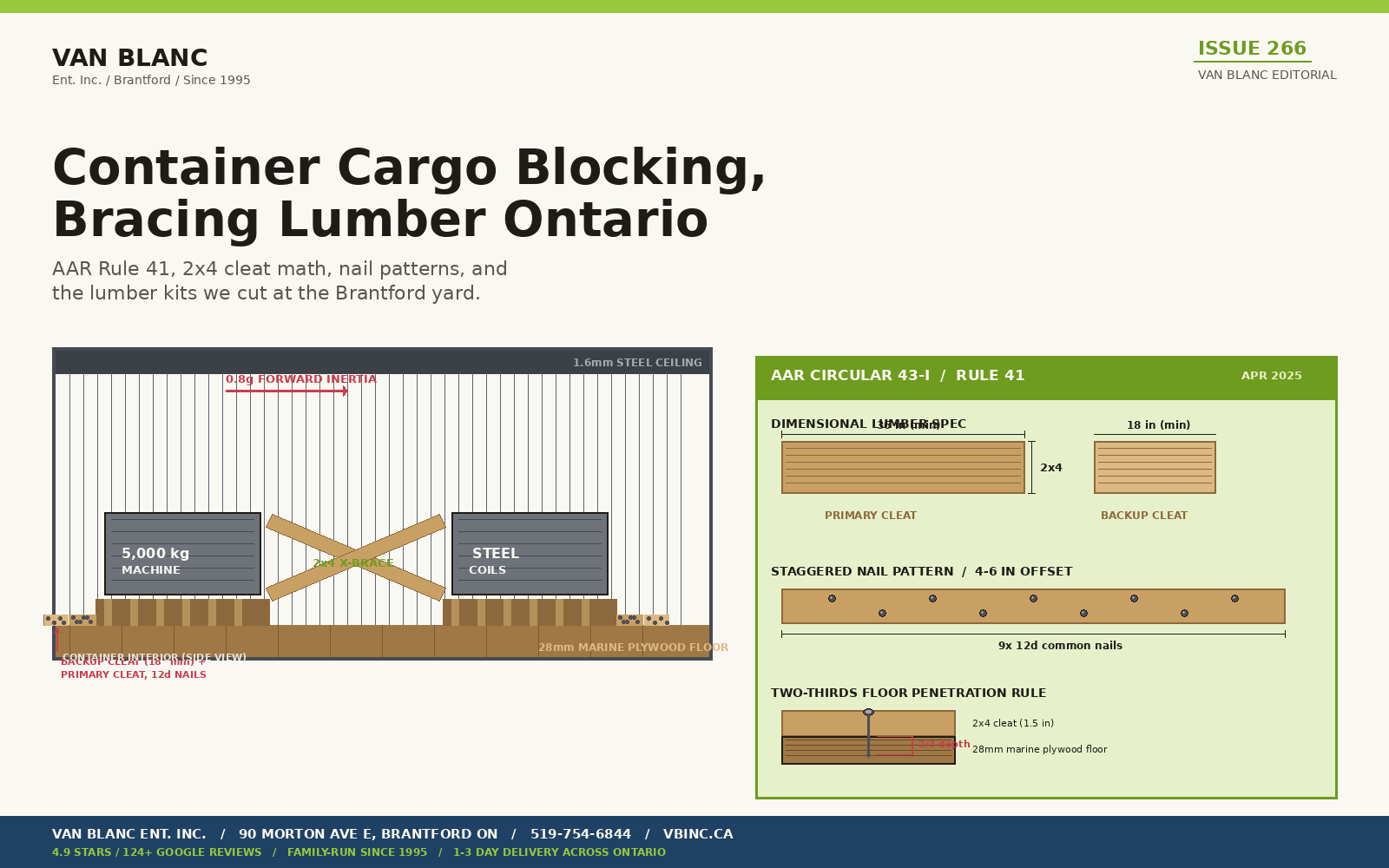
Quick Answer: Container cargo blocking and bracing with dimensional lumber in Ontario follows AAR Circular 43-I and Rule 41: use minimum 2×4 sound seasoned softwood, 18-inch backup cleats, nails staggered every 4 to 6 inches penetrating two-thirds of the floor thickness, and never nail into container walls. Van Blanc has supplied containers across Ontario since 1995. 4.9-star service, 1-3 day delivery from 4 Brantford yards.
In This Guide
- Why Does Wood Still Beat Metal for Heavy-Cargo Bracing?
- What Does AAR Rule 41 Require for Container Bracing?
- Lumber Grade, Species, and the Knot Rule
- Floor Cleat Anatomy and the 18-Inch Backup
- What Nail Size and Pattern Should You Use for Floor Cleats?
- Can You Nail Bracing Lumber Into Container Walls?
- Void Fill with Lumber Frames and Side Struts
- Christian on Bracing Lumber at the Yard
- Real Ontario Cargo That Needs Wood Bracing
- The Facebook Bin and Its Lumber Story
- Frequently Asked Questions
Reading Time: about 15 minutes.
Why Does Wood Still Beat Metal for Heavy-Cargo Bracing?
Wood bracing beats metal for one failure mode: heavy, rigid, or sharp-edged cargo that has to be pinned to the container floor rather than tensioned against a wall. A nailed softwood cleat blocks forward inertia and transmits it into the floor structure, where webbing tears and a chain deflects. That is why AAR rail standards are written around lumber.
Walk into any rail-served warehouse in Hamilton or any cross-dock in Brampton and you will see two bracing systems running in parallel. Metal e-track and ratchet straps handle palletized freight. Stacks of cut 2×4 and 4×4 softwood lumber, with a coffee can of 16d sinker nails beside the saw horse, handle everything else. The everything else is heavier than the rated metal can hold, or it has sharp edges that would slice webbing, or it sits on the floor of the container and needs to be pinned in place against forward inertia rather than tensioned against a wall.
Wood bracing earns its keep on one specific failure mode: the heavy machine, the steel coil, the granite slab on a wooden pallet, the engine block on a custom skid. Inertia from a hard brake at 0.8g translates to a forward force equal to 80 percent of the cargo weight. A 5,000 kg machine becomes a 4,000 kg battering ram against the container nose. Webbing cannot hold that. A chain across the top will deflect, not block. The only thing that holds is a wooden cleat nailed to the floor in front of and behind every contact point, sized to transmit the force back into the floor structure and the corner posts where it dissipates safely.
This is why the Association of American Railroads, the canonical North American rail standards body, wrote its blocking and bracing rules around dimensional lumber. Wood is cheap, locally available, and engineered for compression. A 2×4 in compression along the long grain handles roughly 1,100 pounds per square inch before failure. Cut a six-inch contact face on it and that cleat will stop a tonne of forward motion before it splits. Get the nail count right and the assembly does not come loose under cyclic load from rail vibration or highway frost heaves.
The Three Wood-Bracing Roles in a Container
Floor cleats stop horizontal sliding. They are 2×4 or 2×6 lumber nailed to the wooden floor against the bottom edges of the cargo footprint. Side fills jam the cargo against a container sidewall by filling the void between cargo and wall with framed lumber struts. Top cleats and rear gates stop the load from tipping or rocking back during deceleration. Every loaded container with rigid heavy cargo wants all three. Most palletized freight just needs floor cleats and a rear gate. Wood bracing is one tool in the broader job of keeping a load still under Transport Canada Standard 10, and the lumber list for a typical load runs from short 18-inch backup cleats up to full 8-foot 4×4 side fills.
What Does AAR Rule 41 Require for Container Bracing?
AAR Rule 41 is the bracing standard that governs every loaded container offered for rail interchange in North America. It lives inside AAR Circular 43-I, titled Rules Governing the Loading, Blocking, and Bracing of Freight in Closed Containers and Trailers for Intermodal Service. The current edition is the April 2025 revision. Inside that document, the rule that most often gets cited in cargo manifests and bills of lading is Rule 41, which sets the universal blocking and bracing requirements for closed containers and trailers carried by rail or in intermodal interchange.
Rule 41 is short in spirit and long in particulars. The spirit: every loaded container in interchange must be blocked and braced so that nothing inside the container moves under normal rail and road operating forces. The particulars cover lumber dimensions, nailing patterns, wood quality, prohibited practices, and the burden of proof when freight arrives damaged at destination. Carriers can refuse to interchange a container that does not meet Rule 41 standards, which means a poorly braced load can sit on a yard track in Vaughan or Brampton for days while the shipper sends a crew to fix it.
Paul LeBlanc, owner: “People think the rules are red tape until a carrier leaves their bin sitting on a track in Vaughan. I have watched Rule 41 stop loads cold for thirty years in this industry. The cleat plan costs almost nothing and it is the difference between a clean arrival and a damaged-freight claim. We would rather spend five minutes on it in the Brantford yard than have a buyer find out the expensive way.”
The most consequential rule under Rule 41 is the prohibition on nailing into container walls. This rule exists because container walls are 1.6 mm corrugated steel panels welded to corner posts. Nailing into the corrugation either drives the nail through into open air on the outside (compromising the corrosion seal and the wind and water tight rating) or splits the corrugation if it hits a peak. Either way, the container is damaged and the carrier has grounds to refuse the next interchange. Every cleat under Rule 41 must therefore be nailed to the wooden floor, not the walls. Walls only ever take pressure through frames bearing horizontally against them.
Toe-nailing, defined as driving a nail at an angle through one piece of wood into another, is also generally prohibited under Rule 41 except where specifically permitted by a commodity-specific AAR loading publication. The reason is that toe-nailed joints split easily under cyclic vibration. Rail movement vibrates at frequencies that work toe-nailed joints loose within a few hundred kilometres of travel, where straight-driven nails through perpendicular contact stay tight for the full transit.
Where AAR Rule 41 Touches Ontario Freight
Every container that moves on Canadian National or Canadian Pacific Kansas City rail between Toronto, Montreal, Halifax, or Western Canada falls under AAR Circular 43-I. The same rule applies to containers heading south on intermodal trains from Brampton or Vaughan to Chicago and the US Gulf. Containers in straight-truck service across Ontario fall under federal road rules (NSC Standard 10), but the moment a container is offered for rail interchange, Rule 41 governs the internal bracing. We sell and deliver the container within Ontario from the Brantford yard; the rail carrier the buyer books handles the leg beyond the province. A buyer who buys here and then loads for an export run out of an Ontario rail terminal still has to brace to Rule 41 standards before it ever moves.
Lumber Grade, Species, and the Knot Rule
Not every 2×4 at the lumber yard qualifies for cargo bracing. AAR Circular 43-I and the BNSF Intermodal Loading Guide specify the lumber must be sound, seasoned, free of dry rot or decay, free of knotholes, and free of splits or shakes that compromise strength or interfere with proper nailing. The reason is mechanical: a knot is a transverse grain pattern that has roughly half the compression strength of clear grain, and a knothole is missing material altogether. A cleat that fails through a knot is the same as no cleat at all.
Species matters less than grade. Spruce-pine-fir (SPF), the standard Canadian construction softwood, works fine for cargo bracing when sorted to a clear-grain grade. Douglas-fir is slightly stronger and is preferred where premium ratings matter. Hardwoods like oak or maple appear only in custom heavy-load applications where compression strength against a sharp steel edge matters more than weight or cost. The 28mm Apitong or Keruing marine plywood on the container floor itself is a tropical hardwood, but the bracing lumber bolted to it can be Ontario softwood.
Moisture content matters. Green lumber, with moisture content above 19 percent, will shrink as it dries during the trip, loosening every nailed joint. Kiln-dried or air-dried lumber at 12 to 19 percent moisture content stays dimensionally stable. The KD or S-DRY stamps on the lumber tag tell the buyer the wood has been dried. Any 2×4 sitting in a Brantford lumber yard for more than three weeks in summer humidity will equilibrate to the local moisture content and be fine for bracing. The mistake is buying green wood straight off a freshly milled load and trying to use it the same day.
| Lumber type | AAR qualified | Typical use |
|---|---|---|
| SPF 2×4 #2 or better, kiln dried | Yes | Standard floor cleats, backup cleats |
| Douglas-fir 2×4 or 2×6 | Yes | Heavy machinery floor cleats, side struts |
| Hardwood 2×4 (oak, maple) | Yes, premium | Sharp-edged cargo, abrasive contact |
| Green softwood, untagged moisture | No | Reject, will shrink and loosen |
| Knotty pine, visible knotholes | No | Reject, mechanical failure at knot |
| OSB or plywood as primary cleat | No | Reject, not a cleat material |
| Cedar (decay resistant grade) | Yes but rarely used | Cost-prohibitive for one-trip use |
Floor Cleat Anatomy and the 18-Inch Backup
A floor cleat is a piece of dimensional lumber, typically 2×4 or 2×6, cut to extend at least the full width of the cargo footprint it is bracing, nailed perpendicular to the direction of forward inertia. For a pallet load moving forward, the cleat sits across the front edge of the pallet, perpendicular to the long axis of the container. For lateral bracing, cleats run lengthwise along the sides of the cargo.
The cleat alone is not enough. AAR Circular 43-I requires a backup cleat behind every primary cleat. The backup cleat is the same dimensional lumber, at least 18 inches in length, nailed to the floor immediately behind the primary cleat. The function is mechanical: the primary cleat takes the impact force from the cargo edge and would tend to skid backward under load. The backup cleat blocks that skid. Together, the two-piece cleat assembly transmits the cargo’s forward inertia into the floor structure through shear in the nails and bearing pressure between the cleat lumber and the backup.
The 18-inch minimum for backup cleats is not arbitrary. Eighteen inches gives the backup cleat enough length to span across multiple floor cross-members underneath the marine plywood. Container floors are built with steel cross-members roughly 12 inches on centre. A 12-inch backup cleat might land entirely between cross-members and pull free under load by ripping the plywood. An 18-inch cleat spans at least two cross-members, and ideally three, so the nail withdrawal load distributes across structural steel rather than the plywood alone.
The Cleat Stack: What an Inspector Looks For
A Rule 41 compliant cleat assembly at the front of a cargo footprint looks like this. The primary cleat is a 2×4 cut to full cargo width, sitting flush against the cargo edge. Two to three inches behind it, a 2×4 backup cleat at least 18 inches long, nailed to the floor. The primary cleat has nails driven through it into the floor at staggered 4 to 6 inch intervals. The backup cleat has its own nail pattern, offset from the primary’s so no two nails share a floor location. Both cleats are sound, seasoned, knot-free softwood. An AAR inspector at an intermodal terminal will count nails, eyeball lumber quality, and reject the load if either cleat is missing, undersized, or split.
What Nail Size and Pattern Should You Use for Floor Cleats?
Nail size and pattern for container floor cleats come down to two rules: a 12d or 10d common nail that obeys the two-thirds penetration rule, driven in a staggered pattern every 4 to 6 inches. The single most important rule in nailed cargo bracing is the two-thirds penetration rule. The nail driven into the container floor must penetrate a minimum of two-thirds of the floor’s thickness without exiting the bottom. Container floors are 28mm thick (about 1.1 inches), so the nail must penetrate at least 19mm (three-quarters of an inch) of floor without poking through the underside. The reason is straightforward: a nail that pokes through the bottom exits into open air or grates against the steel cross-members, neither of which adds withdrawal strength.
For a 2×4 cleat (1.5 inches actual thickness) sitting on a 28mm floor (1.1 inches), the total stack is roughly 2.6 inches. A 16d common nail is 3.5 inches long, which would punch through the floor entirely. The right nail for floor cleat bracing is a 12d or 10d common nail, 3.25 to 3 inches long, which gives full penetration through the cleat plus three-quarters of an inch into the floor without exiting. The USDA Forest Products Laboratory report on nailed cleats in blocking and bracing (FPLRN-0200) documents the withdrawal load profile across nail sizes, and 10d to 12d sinkers consistently top the list for combined holding strength and floor preservation.
Nail pattern is the next discipline. Stagger the nails in an offset pattern every 4 to 6 inches along the cleat length. Staggering means no two adjacent nails share the same fibre line in the wood. A row of nails along a single fibre splits the cleat lengthwise the first time a heavy load hits it. A staggered offset distributes the withdrawal load across multiple fibre lines and prevents the split. For a 2×4 cleat 36 inches long, that means six to nine nails total in a zig-zag pattern, each driven perpendicular to the floor.
Nail Math for a Standard Floor Cleat
A 36-inch 2×4 floor cleat needs roughly six 12d common nails driven in a staggered pattern at 6-inch centres, each penetrating two-thirds of the container floor without exiting. An 18-inch backup cleat needs three to four nails on the same pattern, offset from the primary cleat so no two nails share a floor location. For a heavier 2×6 cleat under a 5,000 kg machine, bump to 16d sinkers driven at the same staggered 6-inch spacing but watch the penetration depth. If the nail exits the floor underside, switch to 12d or use a shorter cleat to limit through-stack.
Can You Nail Bracing Lumber Into Container Walls?
Nailing bracing lumber into container walls is prohibited. Section 4.1 of AAR Circular 43-I and the BNSF Intermodal Loading Guide both spell out the same prohibition: do not drive nails into container walls. The rule is so common it has its own carrier-rejection clause. Walls are 1.6 mm corrugated steel, welded to the corner posts and top and bottom rails. A nail driven through the corrugation either exits into open air on the outside or hits a corrugation peak and splits the panel. Both failures wreck the container’s structural integrity and the wind and water tight rating.
The carrier-level consequence is concrete. A container with nail holes in the side panels, even from old bracing that has been removed, can be rejected for further use and billed back to the shipper as damaged equipment. Every hole has to be patch-welded and repainted, which is real shop time on a used box. A used container at our yard with old nail holes from a previous shipper’s wall-mounted cleats gets re-graded down a tier and priced accordingly, which is one of the visible reasons CW and WWT prices vary on units that otherwise look identical.
What this means practically is that all bracing force has to channel through the floor, the corner posts, and the rear gate. The four corner posts of an ISO container are forged steel columns rated to hold the full stack weight when the container is loaded onto another container in port. They are the natural anchor points for any bracing system that needs to lock against a wall. Custom bracing assemblies use frames that bear on the corner posts from inside the container, transmitting force into the corner casting structure rather than the corrugation. Wood bracing that needs lateral load support uses framed lumber struts wedged between the floor and a vertical post, with no nails into the wall itself.
What Old Wall-Nail Damage Looks Like in a Used Bin
Buyers who walk our Brantford yard learn to spot old wall-nail damage on used Cargo Worthy and Wind & Water Tight units. The signs are a row of small steel patches along the inside corrugation peaks, sometimes paint-matched, sometimes obvious. A unit with patched wall holes is structurally fine for storage but does not interchange cleanly on rail without a fresh inspection. Christian or Paul will point this out before pricing. The grade reflects what the buyer is actually getting, including any history of prior bracing damage.
Void Fill with Lumber Frames and Side Struts
A loaded container almost never has cargo filling the full footprint corner to corner. Cargo is irregular, comes in standard pallet sizes that do not divide the 8-foot interior width evenly, and leaves voids at the sides and rear. Those voids let the cargo shift sideways during deceleration or rocking. Void fill is the bracing technique that closes those gaps.
Lumber-based void fill has two common forms. The side strut is a single piece of 2×4 or 2×6 cut to fit the width of the void between the cargo edge and the container sidewall, then wedged in place and nailed to a floor cleat at each end. For a 4-inch void along a pallet edge, a 4-inch-wide framed strut handles the force. For a larger void of 18 inches or more, the strut needs to be reinforced with cross-bracing to prevent buckling. A second pattern is the lumber frame, which is essentially a wooden box built into the void with vertical posts and horizontal cross-pieces, nailed together at the corners, sized to fully fill the void with rigid wood.
The UNECE CTU Code chapter on blocking and bracing material covers void fill in detail and notes that the void filler must transmit force across the full surface of the cargo edge, not just a single contact point. A single 2×4 wedged against a pallet edge concentrates force at one point and can crush the pallet under load. A 2×4 backed by a wider plywood spreader, or a frame that spans the cargo edge, distributes the force across the full pallet width and prevents the load from rotating into the void during transit.
One detail from the BNSF dimensional lumber floor blocking publication: when the void between the cleat and the cargo is greater than one inch, apply an appropriately sized nail every 12 inches along the strut length. The closer the void to zero, the fewer nails needed to lock the strut in place. As the void widens, more nails are required to keep the strut from rotating or sliding under cyclic vibration. Real installs we have watched leave our Brantford yard usually carry the strut tight to the cargo with no measurable void, which is the safest configuration.
Christian on Bracing Lumber at the Yard
Most buyers who walk into the Brantford yard for a 40-foot container heading to a job site or warehouse have not thought about bracing yet. They are thinking about grade, price, and how the container gets dropped on their site. The bracing conversation happens when we ask what is going inside. Pallets of consumer goods, light tools, palletized retail freight, those go with ratchet straps and e-track from our e-track install guide, often paired with welded-in anchor points along the rails. Heavy machinery, steel coils, oversized industrial cargo, motorcycle crates with sharp tie-down points: those need wood.
Christian LeBlanc, second-generation operator: “A Hamilton steel fabricator came in last fall for a 40-foot bin going to a project in Sault Ste. Marie. He was bringing a 6,000 kg laser cutter, on a custom skid, north on rail. We talked through Rule 41 right there at the yard. He’d planned to ratchet-strap it. We sized him 2×6 cleats, an 18-inch backup pair on each side, and walked him through the staggered 12d nail pattern. He bought the cleats and nails from a Brantford lumber yard the same afternoon. The bin shipped on Friday, arrived in the Soo on Monday. Machine moved less than an inch the whole trip. We hear back when a load arrives clean. We also hear back when it doesn’t.”
That laser cutter rode north in a standard 40 foot dry box, the same unit most heavy-cargo buyers leave the yard with.
We do not stock bracing lumber; the Brantford lumber yards a few minutes from us carry kiln-dried 2×4 and 2×6 and will cut to length for buyers who do not have a saw with them. We will not pre-install bracing for a buyer’s cargo because we cannot inspect the cargo’s exact weight distribution and rated forces, but we will walk the buyer through cleat placement, backup cleat sizing, and nail pattern before they leave. Most cleat plans get drawn up alongside a freshly bought box: buyers shopping a brand-new one-trip unit for a clean export floor tend to spec cleats at the same time, since a pristine plywood deck takes a nail cleanly. For buyers who want a turnkey load, we recommend a certified rigger or freight company that specializes in heavy cargo bracing and signs off on the Rule 41 compliance.
Real Ontario Cargo That Needs Wood Bracing
Most loads moving through Ontario by container do not need wood bracing. Palletized retail, food service supplies, light industrial parts, and household goods all handle fine with ratchet straps and dunnage bags. The cargo that demands wood is heavy, rigid, or sharp-edged.
The buyer profiles we see at the yard for wood-bracing loads break down by industry. Steel fabricators in Hamilton, Cambridge, and the GTA ship coils, plate stock, and finished structural pieces on flatbed-stuck pallets that ride floor cleats. Forestry and mining operators in Sudbury, Thunder Bay, and Timmins ship drill rigs, generators, and modular bunkhouse sections that need full lumber frames at every contact point. Manufacturers in Brantford and the Grand River corridor ship CNC machines, hydraulic presses, and packaged production lines, all bolted to custom wooden skids that themselves need cleating to the floor. Auto-sector tier-one suppliers in Cambridge and Oakville ship robot arms, tooling, and engine subassemblies that ride wooden cradles.
Northern Ontario routes account for a disproportionate share of wood-bracing loads because rail and long-haul road from the south to the mines means longer transit, more cyclic vibration, and more chances for a poorly braced load to work loose. The containers we sell for wood-braced loads see more Northern destinations than Southern, by a ratio of about three to one in our delivery records.
Pre-Buy Bracing Discussion at the Yard
When a buyer arrives at our Brantford yard for a container that will haul heavy or rigid cargo, the bracing conversation happens before the price conversation. We need to know the cargo weight, dimensions, and contact-point geometry to make sense of the cleat plan. A 6,000 kg machine on a single skid is different from twelve 500 kg packages on twelve separate pallets. Bring sketches, photos, or a phone screenshot of the cargo. Five minutes of bracing planning at the yard saves a week of rebracing at a rail terminal in Vaughan.
The Facebook Bin and Its Lumber Story
Many buyers calling the yard come in after being burned by a Facebook listing for a 20-foot container priced well below the market with “free delivery and bracing included.” We have not seen a single one of those listings deliver. What we have seen is the call-back two weeks later asking who actually knows how to brace a Rule 41 compliant load.
The pattern is consistent. The Facebook listing shows a stock photo of a container with some wood blocks visible inside. The seller takes a deposit, promises delivery, then disappears. The buyer who paid the deposit calls every Ontario container supplier in turn until somebody answers, and that is when we get the conversation. Sometimes we can help. Sometimes the buyer has already lost the deposit and has to start over with a graded unit from a real yard that they can walk before they pay.
Lumber bracing is not a place to cut corners. The cleats, nails, and labour for a properly braced loaded container are a rounding error against the value of a typical industrial load, and the bracing is what stops the cargo from arriving damaged. A buyer who saves on a Facebook bin and then loses a 5,000 kg machine to a poorly braced load during rail interchange has lost an order of magnitude more than the bin was supposedly worth. Paul has been operating Van Blanc since 1995 and has watched this exact pattern repeat through every Ontario freight cycle. Bracing lumber is one of the few topics where the right answer also happens to be the cheapest in the long run.
Worth the drive for unbeatable quality, family customer service with 30 years of experience. Christian and Paul walk every cargo plan with the buyer at the yard. Every quote comes with a real lead time, not a hopeful one. The bracing conversation is part of the quote, not an upsell at the end.
Frequently Asked Questions
What size lumber is required for blocking and bracing cargo in a shipping container?
AAR Circular 43-I and BNSF Intermodal Loading Guide specify a minimum 2×4 dimensional lumber for cleats securing non-hazardous cargo. Backup cleats must be the same minimum lumber dimension and at least 18 inches in length. Heavier loads (over 4,500 kg) and sharp-edged cargo move up to 2×6 or 4×4 lumber.
Can I nail bracing lumber into shipping container walls?
No. AAR Rule 41 and every major intermodal carrier guide prohibit nailing into container walls. Walls are 1.6 mm corrugated steel that will rust, split, or be rejected at carrier interchange if punctured. All bracing nails go into the wooden floor only. Lateral bracing pushes against frames bearing on corner posts, never nailed.
How deep should a nail penetrate the container floor for cargo bracing?
The two-thirds rule applies. A nail driven through a cleat into the marine plywood floor must penetrate at least two-thirds of the floor thickness without exiting the underside. Standard 28mm container floor calls for a 12d or 10d common nail (3 to 3.25 inches) that gives full cleat penetration plus three-quarters of an inch into the floor.
What is AAR Rule 41 and does it apply to containers in Ontario?
AAR Rule 41 is the canonical blocking and bracing standard from Association of American Railroads Circular 43-I, governing freight in closed containers and trailers in intermodal service. It applies to every container moving by rail interchange in Canada and the US, including all CN and CPKC routes through Ontario, plus US Gulf-bound intermodal trains from Brampton or Vaughan.
What is the minimum length for a backup cleat under AAR rules?
Backup cleats must be a minimum of 18 inches in length per AAR Circular 43-I. The 18-inch minimum lets the cleat span at least two container floor cross-members, distributing nail withdrawal load across structural steel rather than the marine plywood alone. Heavier cargo applications use 24 inch or 36 inch backup cleats for higher safety margin.
What nail pattern is correct for floor cleats inside a container?
Stagger nails in an offset pattern every 4 to 6 inches along the cleat length. Staggered means no two adjacent nails share the same wood-grain fibre line, which prevents the cleat from splitting under load. A 36-inch 2×4 floor cleat needs roughly six to nine 12d common nails in a zig-zag pattern at perpendicular angles.
Can I use any 2×4 from a lumber yard for cargo bracing?
No. AAR Circular 43-I requires lumber to be sound, seasoned, kiln-dried or air-dried, free of knots, knotholes, dry rot, decay, and splits that compromise strength. Green wood with moisture content above 19 percent will shrink during transit and loosen every joint. Reject any 2×4 with visible knotholes, splits, or a missing kiln-dried (KD) or S-DRY moisture stamp.
How much does container bracing lumber cost in Ontario?
Bracing lumber is one of the cheapest line items in a freight move, and the cost is driven by how much wood the load demands rather than any fixed rate. A few SPF 2×4 studs and a box of 12d common nails cover a light pallet load, while a single heavy machine on a custom skid in a 40-foot container needs more cleat lumber, backup cleats, and side struts. The factors that move the total are cargo weight, the number of contact points to cleat, whether 2×6 or 4×4 is required for sharp-edged or oversized cargo, and whether you cut and nail it yourself or buy a pre-built kit from a specialized supplier. Against the value of the cargo it protects, the lumber is a rounding error.
What happens if a container fails AAR Rule 41 inspection at a rail terminal?
The carrier can refuse to interchange the container until the bracing is corrected. The container sits on a yard track, often in Brampton or Vaughan, accumulating storage fees. The shipper sends a crew to rebrace, the carrier re-inspects, and the container resumes transit. A refused-interchange event piles up storage charges and lost transit time, which is why getting the cleat plan right before the load leaves the yard is always cheaper than fixing it at a rail terminal.
How fast can Van Blanc deliver a container ready for wood bracing in Ontario?
Standard 1 to 3 day delivery from our four Brantford yards across most of Ontario. Buyers arriving at the yard can walk the cleat plan with Christian or Paul before the container leaves, then pick up lumber and nails at a Brantford lumber yard on the way out. Northern Ontario destinations run 5 to 10 days with premium freight. Every quote comes with a real lead time, not a hopeful one.
Sources
- Association of American Railroads. (2025, April). Circular 43-I: Rules Governing the Loading, Blocking, and Bracing of Freight in Closed Containers and Trailers for Intermodal Service. aar.com
- BNSF Railway. (2019). Intermodal Loading Guide (Revised 2019). bnsf.com
- Union Pacific Railroad. Intermodal General Loading Guidelines. up.com
- USDA Forest Products Laboratory. Performance of Nailed Cleats in Blocking and Bracing (FPLRN-0200). fpl.fs.usda.gov
- UNECE. (2022). CTU Code: Blocking and Bracing Material and Arrangements. unece.org
Reach Van Blanc in Brantford
We have been supplying shipping containers across Ontario since 1995. Our warehouse is at 90 Morton Avenue E in Brantford, and we deliver across the province on a cash-on-delivery basis. No surprise fees, no chase-the-paperwork.
Van Blanc Ent. Inc. 90 Morton Ave E Unit 1B, Brantford, ON N3R 7J7 +1 888-509-6658
Come walk the yard with the cleat plan for your cargo. Christian or Paul will size lumber and nails to AAR Rule 41 for your specific load before you leave. Worth the drive for unbeatable quality, family customer service with 30 years of experience.
Related Reading
Ready to price your container?
Tell us the size and your postal code and we’ll send back an all-in number, container, delivery, and placement, usually within 1-3 days. No pressure, no mystery fees.
Family-run in Brantford since 1995 · 200+ containers in stock · 4.9★ across 140+ Google reviews · every box graded by a person, walk it before it lands.