
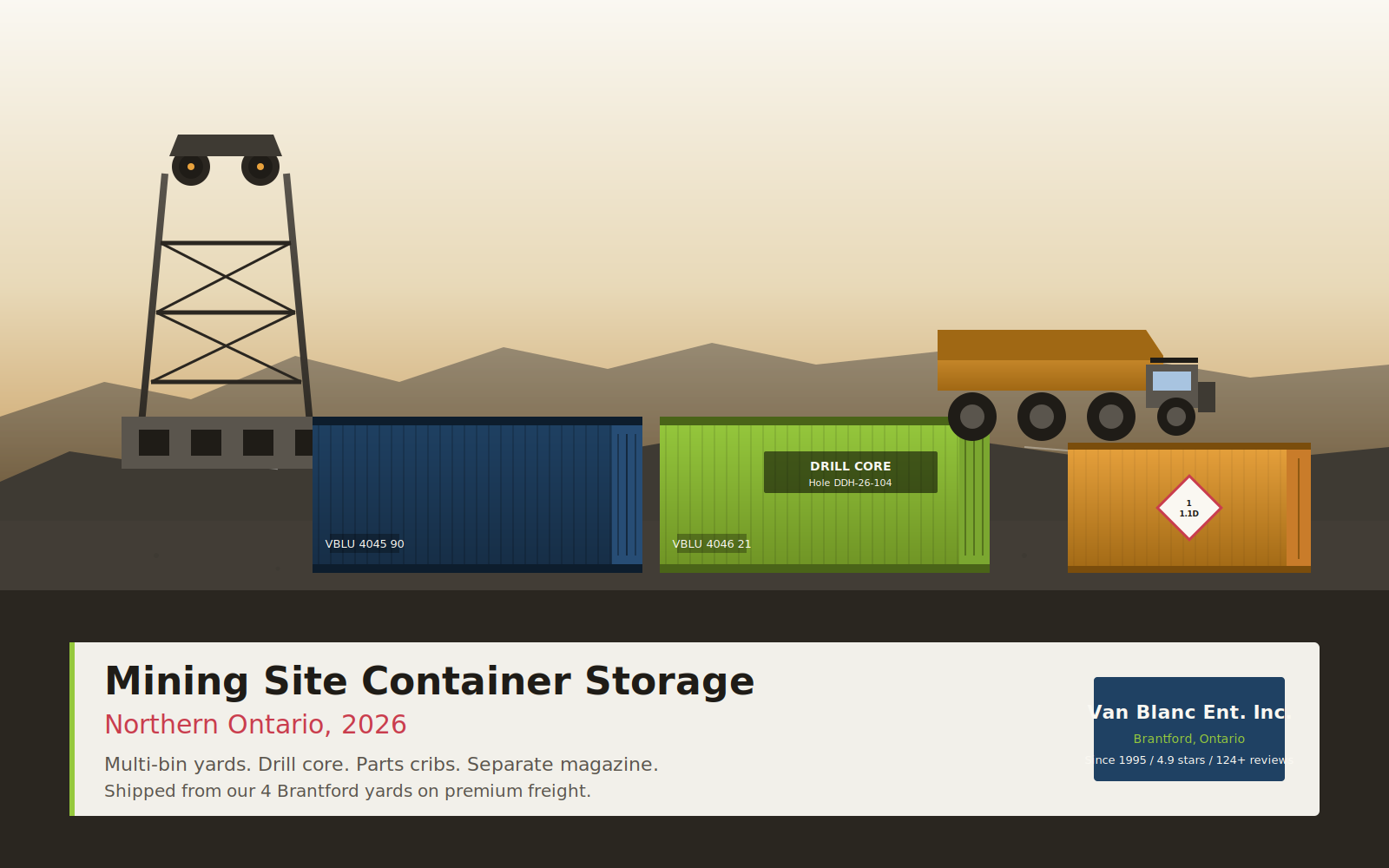
Quick Answer: An active Northern Ontario mining site usually runs 5 to 30 shipping containers per project, split into drill core, parts cribs, PPE storage, and a stand-alone explosives magazine kept apart from the rest of the yard. Van Blanc ships these multi-bin orders from our 4 Brantford yards on premium freight to Sudbury, Timmins, Red Lake, and Kirkland Lake. Plan 5 to 10 days from order to on-site, and ask us for a multi-bin quote.
In This Guide
- What does a mining-site container yard look like?
- How do you store drill core in a container?
- What container works best for a parts crib?
- Can you store explosives in a container?
- How do you secure a container at a remote camp?
- What foundation holds a container on Shield rock?
- How long does delivery take to a northern mine?
- How does bulk pricing work on a fleet order?
- FAQs
Reading Time: 14 minutes
What Does a Northern Ontario Mining-Site Container Yard Actually Look Like?
Mining-site procurement is its own world. The buyer is rarely a single person at a desk picking out one bin for a backyard. The bins arrive in batches. They get stacked, signed, locked, and lit, and they stay where the haul-road grade lets them stay for the life of the project. Then they leave.
A mining-site container yard is a cluster of separated steel boxes, each one assigned a single job. A typical site uses a 40ft High Cube as the drill core archive, a 40ft Cargo Worthy as the parts crib, a 20ft for small equipment, and one stand-alone magazine set well apart from the rest. The split keeps the site organised and safe.
Paul LeBlanc, owner: “A mining yard is not one container, it is a system. The core bin, the parts bin, the magazine, the dry, they each sit in their own spot for a reason. I have been routing steel to the North for thirty years, and the camps that plan the layout before the trucks roll are the ones that rarely call us back with a problem.”
This guide is for that crew. We have shipped shipping containers north for years, sometimes one at a time when a junior is just spudding the first holes, sometimes ten at once when the property has moved from exploration to advanced and the camp is doubling. The same 20ft and 40ft steel boxes serve farms in Norfolk and contractors in Brampton, but at a remote mining site in Northern Ontario they pick up roles you do not see anywhere else: core archive, sample triage, magazine-adjacent storage, parts crib, PPE shed, first-aid station, dry. Each role has its own layout, its own door swing, and its own foundation question. Each role has its own freight surcharge.
Where these bins go in Ontario
The bulk of our mining freight runs to four corridors. Sudbury basin (the historic nickel-copper basin, where Vale and Glencore still dominate but a thick layer of junior exploration sits underneath). Timmins-Porcupine camp (where Highway 144 carries you to Côté Gold, where Newmont and Pan American still hold legacy claims). Red Lake greenstone belt (Evolution Mining, Pure Gold legacy, and a steady stream of joint ventures along the Trans-Canada north of Kenora). Kirkland Lake camp (Macassa, the western Abitibi sub-province, and the long Ontario Geological Survey core archive at the Resident Geologist office). Each corridor has a different freight reality, but they share one thing: the bin you put on that pad is the bin that has to last until the property is decommissioned or the option lapses.
Most buyers calling us from the North use a mix of vocabulary. The procurement officer will write “intermodal container” in the purchase order. The driller will call it a sea can on the radio. The veteran on the day crew, the one who came up through forestry and went underground in the eighties, still calls them conex boxes. They are all the same 8-foot-wide weathering steel container that ocean ships move around the world. We deliver every type from our 4 Brantford yards and we are happy with whatever name your camp uses.
How Do You Store Drill Core and Sample Bags in a Shipping Container?
Drill core is the single most valuable cargo a 40ft container will ever hold for an exploration project, and choosing the right box for it is exactly the kind of decision our step-by-step purchase walkthrough is built to help with. Every metre of NQ or HQ rock pulled out of the ground is the only physical record of what is happening at depth. Lose a tray, mislabel an interval, let water sit on a Mengele box for a season, and you have lost data that is expensive to acquire, with a real cost attached to every metre drilled. The Ontario Geological Survey maintains the permanent drill hole database for the province, and the Resident Geologist offices archive historic core, but day-to-day live core sits on your property in whatever you put it in.1

For active drilling, the working layout we see most often inside a 40ft High Cube is a centre aisle wide enough to walk a tray down, with shelving running both walls. The shelves are usually shop-fabricated from angle iron and plywood, sized for whatever plastic core tray system the project standardised on. HDPE trays have effectively replaced wood for serious work because they survive subzero handling, do not split when stacked, and do not absorb groundwater the way pine boxes do.2 The shelves carry roughly 80 to 120 trays per side per container depending on geometry. A 40ft HC is the strong choice over a standard 40ft because the extra foot of headroom means you can run a useful top shelf without stooping.
Practical drill core layout inside a 40ft HC
- Aisle width: 36 inches minimum. Trays are heavy, geologists carry them two-handed, and you do not want to be twisting in a packed corridor with a wet HQ tray.
- Shelf depth: sized to your tray. Most plastic trays run 1050mm long, so a shelf depth of about 44 inches with a small front lip works.
- Shelf spacing vertical: 7 to 9 inches between shelves depending on whether you stack trays or not.
- Lighting: a single warm 4000K LED strip per side runs cold-tolerant, draws little, and lets a logger tell sulphide from oxide without going outside.
- Ventilation: two simple gable vents above the doors keep moisture moving. Sealed bins sweat through a Sudbury winter.
- Floor: we leave the marine plywood as-is. Some camps lay rubber matting where loggers stand.
For sample bags (assay shipments going out, returned pulps and rejects coming back), the layout question is different. You want a 20ft Wind & Watertight bin near the office trailer, with a wide door swing and floor space for pallets rather than shelves. Assay turnaround can stretch eight weeks at peak season, and the pulps and rejects pile up if you do not stage them properly. We have a separate piece on our notes on container modification options that walks through shelving, lighting, and ventilation options in more depth, but the layout question for live core is geometry first, then climate.
What Container Works Best for a Mining-Site Parts Crib?
The parts crib is the unsung container on every mining site, and the 40ft Cargo Worthy is the bin that does the job. A drill rig is one breakdown away from a stand-down day, and a stand-down day at a remote camp costs more than the part. The mechanical crew burns through filters, hoses, hydraulic fittings, sprockets, bits, and the strange little brackets that no one writes down in a parts manual until the second time they fail. By the time the camp is six months old, the parts crib has more dollar value in it than the office.
The 40ft Cargo Worthy bin is the workhorse here. Cargo Worthy grade shows its dents and surface rust, but the floor is sound and the doors close cleanly, and the bin will swallow heavy industrial shelving without complaint. We see camps put pallet racking down both walls (often Redirack or Pallet Rack 9000 series), add a small lockbox by the door for the high-value fittings, and run a single LED strip with a motion sensor on the rear wall. Parts cribs almost never get climate-controlled because the parts themselves do not need it. They get locked.
Practical parts-crib tip
If you are running multiple rigs from one camp, give each rig its own colour-coded bay inside the parts crib. Sounds elementary, but in a real Northern Ontario December at 06:30, with a driller on the phone and a single hot light over the door, you do not want to be reading labels. Yellow tape on the floor for Rig 1, blue for Rig 2, red for Rig 3. Christian has seen camps where the foreman just keeps a hand-drawn map on the inside of the door. Whatever works. The container itself is forgiving; the organisation system inside it is the thing that pays.
For small-equipment storage (jackhammers, generators, hand-held survey gear, replacement core barrels, the toolboxes the line cutters carry), a second 20ft Cargo Worthy bin nested against the parts crib is the standard pattern. The two together cost less than a single oversized 53ft bin, give you separated inventory control, and let you lock high-theft items in the smaller of the two while leaving the daily-grab tools in the larger. When a camp wants the longest service life out of a bin that stays on a property for years, we point them at our factory-built stock fresh off its single ocean voyage rather than a weathered used unit.
Can You Store Explosives in a Shipping Container on a Mine Site?
Explosives on a mine site go in a stand-alone magazine container, never in the same bin as powder, detonators, parts, or the office. This is the section where the layout question stops being about convenience and starts being about the law. Explosives storage on an Ontario mining site is governed by the federal Explosives Act and Regulations administered by the Explosives Regulatory Division of Natural Resources Canada, with provincial oversight where it overlaps with the Ministry of Labour. The short version that matters for a container conversation: you cannot store detonators in the same bin as the powder, you cannot store either in the parts crib or the office, and the magazine bin itself has to meet separation distance requirements from your other structures, your access roads, and your inhabited buildings.3
What this means in practice is that the explosives magazine is a stand-alone container, set apart from your other yard, with its own access lane and its own signage. The regulator will care about exact distances, ventilation, the lining of the bin (typically softwood interior to prevent spark generation against the steel), the lock type, the placarding (Class 1 Explosives diamonds with the correct division code), and the powder magazine logbook. We do not pretend to be your magazine compliance consultant. What we do is supply the bin in the configuration the powder vendor and your regulator agree on.
What we deliver, what we don’t deliver
Van Blanc supplies the container, the doors, basic modifications finished at the yard (vents, signage placards, exterior lock-box welds), and the freight. The actual magazine certification process (licence application under the Explosives Act, the powder vendor agreement, the inspection by the Explosives Regulatory Division, the site-specific separation-distance approval) sits with your project. Most operators work with their powder vendor (Orica, Dyno Nobel, Austin Powder) on this end because the vendor’s compliance team has seen every regulator in the province. We come into the conversation when the bin spec is finalised.
The bin we ship most often for magazine duty is a 20ft One-Trip in a high-visibility colour (so it is unmistakable from the rest of the yard) with interior softwood lining finished at the yard before delivery. The powder-rated electrical and the explosion-relief vents are vendor-specced and are not part of the yard work. We ship the steel, you finish the conversion with the certified contractor your magazine inspector approves.
How Do You Secure a Container Against Theft at a Remote Mine Site?
Securing a container at a remote camp comes down to a layered stack of physical locks plus one surveillance camera. People underestimate theft at Northern Ontario mining sites until it happens. A remote camp on a 50km access road, dark seventeen hours a day in December, is not in the city, but it is also not invisible. Local snowmobile traffic crosses the property in winter. Floatplane operators land within sight. Fly-camp visitors come and go. The 40ft bin full of new core barrels and a generator is exactly the bin someone with a sled and a few hours of darkness will try.
The layered approach we recommend, in plain order of cost:
- Lock box welded to the door rod. A simple steel lock box (these are welded on at the yard before shipping, or in the field by your own crew) makes a hardened-shackle disc lock effectively un-cuttable from the outside. Cost is low, deterrent is high.
- High-security disc lock inside the box. Abloy or Abus Granit class. Not the brass disc lock from the hardware store.
- Secondary internal locking bar. A bar that drops across the inside of the doors. Burglar has to cut through the steel skin, which is loud, slow, and visible.
- Cellular trail camera or solar IP camera facing the door. A cell-trail cam (Spypoint, Reconyx) running on a solar panel will email you the image of whatever shows up at the door at 02:00. The cost of one is a tenth of the cost of one full replacement of the parts inside the container.
- Lighting on a dusk-to-dawn solar sensor. A 30W LED flood mounted high enough to discourage a sledge attack from the rear.
We have a fuller breakdown in our deeper write-up on keeping a bin locked down piece. The mining-site specific point is that all of this still works at minus thirty. Magnetic alarm contacts get unreliable. Cellular notifications get spotty. The physical security stack (lock box, disc lock, internal bar) is the layer you can count on year-round, and the surveillance is the add-on.
What Foundation Holds a Container on Canadian Shield Rock?
The Canadian Shield is rock. Beautiful, ancient, and almost completely impossible to pour a footing into without serious excavation. The good news is that a shipping container does not need a footing in the conventional sense. The bad news is that it still needs a level base that drains water, distributes load evenly across the four corner castings, and does not heave in the freeze-thaw cycle.
The two approaches we see on Northern Ontario sites:
Gravel pad (the common Northern approach)
Excavate down to bedrock or hard glacial till. Lay geotextile. Bring in compacted crusher run (typically Granular A or 25mm clear stone, depending on what the local pit will supply) to a depth of 200 to 300mm. Level with a laser or a long board. Place the container on four 8×8 hardwood sleepers (or 6×6 pressure-treated cribbing) set on the gravel under each corner casting. The gravel drains, the sleepers spread the load, the bin sits level. Most mining sites can put this together in half a day with the equipment already on site.
Sleepers directly on rock (the fast approach)
Where bedrock is right at the surface and reasonably flat, skip the gravel and set six 6×6 pressure-treated sleepers directly under the container. Shim with hardwood blocks to bring each corner casting level. This approach gets you in and out fast, works for exploration phases where the bin might move, but does not drain water away from the underside the way a gravel pad does. Good for one-season camps. Less good for a five-year plan.
Avoid concrete footings unless you have a clear long-term operational case for them. Concrete on the Shield wants forms, cure time, frost protection, and a contractor who will haul the materials in. By the time it is finished, the gravel pad you could have done in a morning would have lived through six winters.
How Long Does Container Delivery Take to a Northern Ontario Mine Site?
This is the section we get the most questions about. Van Blanc’s default delivery promise across Ontario is 1 to 3 days from our 4 Brantford yards. Northern Ontario mining sites do not get 1 to 3 days. Real freight reality to Sudbury is roughly 1 day on the truck once the trailer is loaded; Timmins is 2 days; Red Lake or Kirkland Lake or anything past the Trans-Canada split at Wawa is 2 to 4 days on the road; remote access roads add another day on top of that. Building the load, coordinating the tilt-deck or the rollback, and clearing whatever weather window is open adds 1-3 days on our side. Plan for 5 to 10 days from order to on-site for any Northern Ontario delivery. Every quote we give comes with a real lead time. If you want the wider picture on how we schedule and route loads across the province, our rundown of how shipments reach sites across Ontario covers the logistics in detail.
Why the freight is premium
The trucking economics for a 40ft container north of the French River are not the same as the trucking economics south of Barrie. You are paying for the empty backhaul (most loads do not have a southbound revenue freight to balance the trip), for the specialised tilt-deck or rollback equipment with the reach to set a container on a Shield gravel pad, and for the driver hours that come with a 1,200km round trip. The big regional flatbed carriers understand this freight inside and out. We coordinate the load with them on every Northern shipment.4
What we ask of you on the receiving end:
- Pad ready before the truck rolls. Gravel laid, sleepers cut, corner positions marked. The driver should be able to drop and leave inside 90 minutes.
- Site contact reachable by satellite or cell. Drivers will sometimes lose signal 20km out from a remote camp. A satellite InReach or a check-in protocol with your dispatcher solves this.
- Access description. Tell us the worst part of the access road rather than the best part. Tilt-decks have a turning radius and a clearance limit. We would rather know about the tight 90-degree corner at the gate now than find out about it at the gate.
- Winter window. Some loads can only run in true winter (after freeze-up, before breakup) when the bush roads are firm. Others can only run in summer. Tell us which one you are working inside.
How Does Bulk Container Pricing Work for a Fleet Order?
Most of the mining-site work we do is not one bin. It is a fleet order. An exploration program advancing to advanced exploration usually needs five to eight containers in a single procurement (core, sample, parts, dry, magazine support, office). A producing mine doing a phase expansion can need fifteen to thirty in a season. The pricing structure works in your favour at volume.
| Order size | Typical use case | Bulk pricing posture |
|---|---|---|
| 1 to 4 containers | Spudding a new program, single rig | Standard list pricing, posted grade rates |
| 5 to 9 containers | Early advanced exploration, dual rig with camp expansion | Volume discount on bin price, freight optimisation on combined loads |
| 10 to 19 containers | Producing mine phase expansion, multi-property junior | Project-specific quote, dedicated load coordination |
| 20-plus containers | Large producer fleet refresh, full camp build | Direct quote from ownership, scheduled multi-load delivery over weeks |
Christian LeBlanc, second-generation operator: “When a junior calls in March saying they need eight bins on the ground by mid-May, that is the call we clear the calendar for. We will walk them through which bins go on which truck, which grade fits which use, which loads can combine, and what the realistic delivery window looks like once we have the freight booked. Dad has been doing these fleet orders for years. I grew up around them. We have seen what works.”
Ready to price your container?
Tell us the size and your postal code and we’ll send back an all-in number, container, delivery, and placement, usually within 1-3 days. No pressure, no mystery fees.
Family-run in Brantford since 1995 · 200+ containers in stock · 4.9★ across 140+ Google reviews · every box graded by a person, walk it before it lands.
Why Do Northern Ontario Operators Drive to a Brantford Container Yard?
Online resellers will sell you the bin without ever showing you the bin. The Facebook listings will quote you well under the real number and disappear three weeks later with your deposit. Many people call us saying they can get a container far cheaper on Facebook. Two weeks later they call back saying they got scammed. Don’t fall for it.

Van Blanc has been operating since 1995. Paul has been selling containers since 1995. Christian is his son, raised in the business and around the yard. The yards are real. The bins are real. The reviews (4.9 stars across 140+ verified Google reviews) are real. You are welcome to fly down to Brantford to walk a row of bins before you commit to a thirty-container fleet order. People have done it. Worth the drive for the quality, family customer service with 30 years of experience.
Sold outright. Delivered in 1 to 3 days.
Van Blanc sells new and used shipping containers outright from our 4 Brantford yards, with delivery in 1 to 3 days and payment on delivery. We do not rent, lease or offer rent-to-own. Request a sale quote or call the yard at 519-754-6844.
Frequently Asked Questions
How many shipping containers does an active Northern Ontario mining site typically use?
An exploration camp advancing to advanced exploration usually runs 5 to 10 containers (core, sample triage, parts, dry, magazine, small-equipment). A producing mine doing phase expansion can run 15 to 30 containers across multiple working areas. Fleet orders that size go through a project-specific quote with dedicated load coordination from our Brantford yards.
How long does delivery take to Sudbury, Timmins, Red Lake, or Kirkland Lake?
Plan for 5 to 10 days from order to on-site. The truck portion is 1 to 4 days depending on which corridor you are in (Sudbury closest, Red Lake and Kirkland Lake furthest). Load coordination, equipment scheduling, and weather windows add 1-3 days on our side. We give you a real lead time at quote.
What container size is best for drill core storage?
A 40ft High Cube is the strong choice. The extra foot of headroom over a standard 40ft means you can run a useful top shelf on each wall without geologists stooping. Standard layout is a 36-inch centre aisle with shop-fabricated angle-iron-and-plywood shelving sized to your HDPE plastic core trays.
Can I store explosives in the same container as other materials?
No. Federal Explosives Act and the Explosives Regulatory Division of Natural Resources Canada require a stand-alone magazine container, separated by specific distances from other structures, access roads, and inhabited buildings. Detonators and powder are stored in separate compartments or separate magazines. Your powder vendor (Orica, Dyno Nobel, Austin Powder) and your regulator will spec the configuration. We supply the steel.
What foundation works on Canadian Shield bedrock?
A compacted crusher-run gravel pad (200 to 300mm deep over geotextile) with 8×8 hardwood sleepers under each corner casting is the standard Northern approach. Where bedrock is at the surface and reasonably level, six pressure-treated 6×6 sleepers shimmed level can work for short-term camps. Skip concrete footings unless you have a five-plus-year operational case.
What grade of container is right for a parts crib at a remote mining site?
A 40ft Cargo Worthy is the workhorse. Cosmetic wear (surface rust, occasional dent) but the floor is sound and the doors close cleanly. Cargo Worthy will swallow industrial pallet racking, take a lockbox weld, and survive a Northern winter without complaint. One-Trip grade is the pick for a parts crib that is visible from a property tour.
Can I rent containers for a short exploration season instead of buying?
No. Van Blanc sells containers outright and does not rent, lease, or offer rent-to-own. The trade-offs between a mobile-storage pod or a self-storage unit and a container are compared on a separate page. Past a few months, buying a used wind-and-watertight box normally costs less than renting one, and you can sell it on or ask us about buyback when you are done.
How do I protect containers from theft at a remote camp?
Layered approach: welded lockbox over a hardened-shackle disc lock, internal locking bar across the doors, dusk-to-dawn solar LED flood, and a cellular trail camera (Spypoint, Reconyx) emailing images on motion. The physical layer (lockbox, disc lock, internal bar) works year-round at minus thirty. The surveillance layer is the add-on. Full breakdown in our container security guide.
Do you deliver to active access roads, or is there a transfer point?
We deliver directly to the pad on prepared access where the tilt-deck or rollback can safely reach. For remote roads with tight clearance, we will sometimes coordinate with a regional carrier on the last leg. Tell us the worst part of the access road at quote stage rather than at the gate. Drivers prefer the warning.
What pricing should I expect for a fleet order of 10 to 20 containers?
It depends on the grade mix, the size mix, and the freight corridor. Volume discount on bin price kicks in around 5 containers. Project-specific quotes go through ownership at 10-plus. For a typical 10-container Northern Ontario fleet (mix of 20ft and 40ft, mix of One-Trip and Cargo Worthy and Wind & Watertight, premium freight to Sudbury or Timmins), call 519-754-6844 for a real quote. We will walk through the grade mix and the freight before quoting anything.
Sources
- Ontario Geological Survey, Ministry of Mines. (2025). Ontario Drill Hole Database. Geology Ontario. geologyontario.mndm.gov.on.ca
- Plastic Core Trays. (2025). Plastic Core Trays Explained: A Practical Guide for Mining and Exploration Professionals. plasticcoretrays.com
- Natural Resources Canada, Explosives Regulatory Division. (2025). Explosives Act and Regulations: Storage Licences and Magazine Standards. natural-resources.canada.ca/explosives
- Ontario Northland. (2025). Freight Rail Services Across Northeastern Ontario. ontarionorthland.ca/en/freight
- CBC News Sudbury. (2025). Federal Government Building Digital Library of Mineral Core Samples. cbc.ca/news/canada/sudbury
- International Organization for Standardization. (2022). ISO 6346:2022 Freight Containers Coding, Identification and Marking. iso.org
Reach Van Blanc in Brantford
We have been supplying shipping containers across Ontario since 1995. Our warehouse is at 90 Morton Avenue East in Brantford, and we deliver right across the province, including premium freight north to every active mining corridor. We give you a real lead time on every quote.
Van Blanc Ent. Inc. 90 Morton Ave E Unit 1B, Brantford, ON N3R 7J7. 519-754-6844 or toll-free 1-888-509-6658.
If you are scoping a fleet order for an active mining program, call us before you finalise the procurement spec. We can usually save you a freight leg by combining loads, and we will tell you up front when buying makes more sense than renting.