
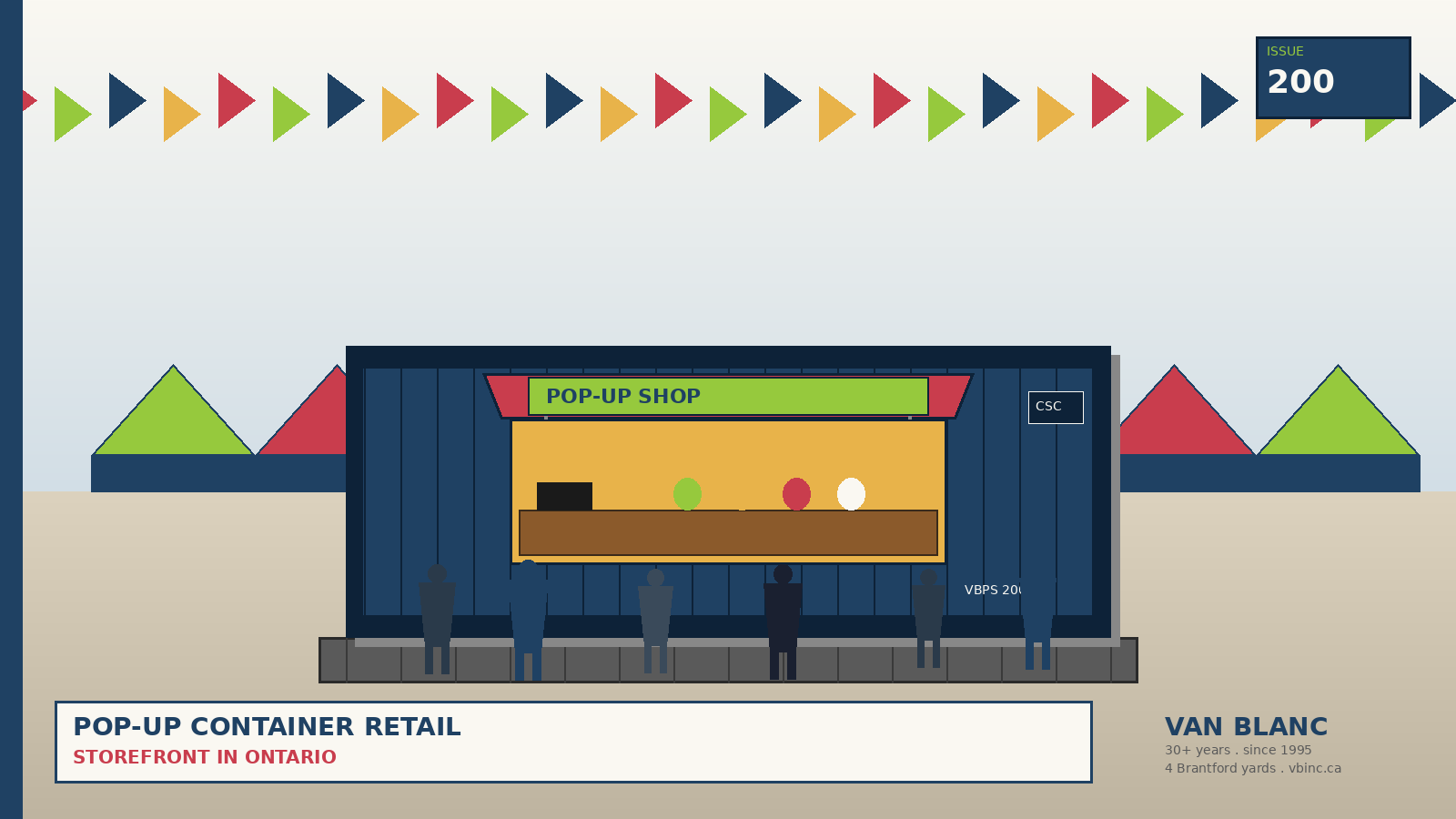
A pop-up container retail storefront in Ontario starts with a 20ft unit. The all-in budget covers the container itself, local Ontario delivery, and the conversion work: insulation, serving window, electrical rough-in, and finished interior. Any wiring is filed with the Electrical Safety Authority by your licensed electrical contractor before work starts. Most pop-up container retail storefront builds ship in three to six weeks when planned in advance of festival season. Van Blanc is family-run in Brantford since 1995, sells and delivers the steel shell across Ontario, and quotes an all-in number tailored to your site, usually the same day.
What you will learn
- What a pop-up container retail storefront actually is in Ontario practice
- Real all-in budget ranges for a 20ft unit in 2026
- How the serving window, signage face, and platform decisions get made
- ESA notification timing and who handles the electrical work
- Which container grade to pick for a pop-up storefront
- Festival, market, and seasonal-deployment booking realities
- Insulation, heat, and shoulder-season operation across Ontario weather
- Branding, vinyl wrap, and the visual rules that drive foot traffic
- Logistics: tilt-bed delivery, siting, and moving the box at end of run
- How Van Blanc supplies the box that becomes your pop-up
Reading time: about 14 minutes.
What is a pop-up container retail storefront in Ontario?
A pop-up container retail storefront is a 20ft shipping container converted into a temporary, movable point of sale, with a cut serving window, a branded exterior, and a finished interior where staff transact. It sits on a gravel or asphalt pad for one season or festival run, then leaves on a tilt-bed truck for the next site or storage.
A pop-up container retail storefront is a shipping container, almost always a 20ft standard or high-cube, converted into a working retail point of sale with a serving window or roll-up opening, branded exterior, and enough finish work inside that staff can stand at a counter and transact. It is not a permanent building. It sits on a temporary footing (gravel pad, asphalt, or a portable platform) for the length of one season, one festival run, or one product activation. When the run ends, the container leaves on a tilt-bed truck for the next site, the owner’s own storage spot, or a resale buyer.
Ontario operators use this format because it solves three things at once. The container is the structure, the security shell, and the brand canvas. A vendor tent gives you none of those. A leased bricks-and-mortar storefront gives you all three but binds you to a multi-year lease in a market where you may only sell forty days a year. The container splits the difference: real walls, lockable steel doors, weather resistance, and the ability to drive the entire store to a new location when the audience moves.
“A pop-up box has to be sound where it counts. We look at the corner posts, the floor, and the long side wall that’s going to get the serving window cut into it, because that panel becomes your counter and your storefront. I’ve bought and sold containers since 1995, and the worst thing you can do is wrap a brand around a unit with a soft side panel. Pick the box for what you’re building rather than just the price tag.”
Paul LeBlanc, owner, Van Blanc Ent. Inc.
If you are still mapping the broader category and want to understand where pop-up sits inside the wider retail conversion landscape, our walkthrough of Ontario container retail formats covers the hub-level decisions, including how pop-up compares to fixed cafe and quick-service builds. This article goes deeper into the pop-up build specifically.
What goes into the budget for a 20ft pop-up container storefront?
The budget for a 20ft pop-up container storefront breaks into two parts: the steel shell and the conversion. The container is the single cheapest line. The conversion work, insulation, the cut serving window, electrical rough-in, finished interior, and exterior branding, drives most of the total. What moves the number up or down is the grade of unit you start with, the season you operate, the delivery distance, and how finished you want the interior. The table below shows each line and what pushes it higher or lower.
| Line item | What drives the cost up or down | Notes |
|---|---|---|
| 20ft used container (cargo-worthy) | Grade and surface condition; the lowest base cost of any line | Wind and watertight grade, CSC plate present, surface rust acceptable |
| 20ft one-trip container (premium) | Near-new finish carries a premium over used | Preferred when the paint job is the brand |
| Local Ontario delivery | Haul distance and site access; rises with kilometres travelled | Tilt-bed truck, under 100km haul radius |
| Cut and frame serving window | Opening size and style; bi-fold glass costs more than awning | Roll-up or awning-style, framed in steel |
| Insulation and interior wall finish | R-value target and finish material; climbs with thickness | Closed-cell spray foam, plywood or laminate skin |
| Electrical rough-in (panel, lights, outlets) | Circuit count and load; three-phase costs more than single | Must be done by licensed contractor with ESA notification |
| Service counter, shelving, finish | Built-in millwork costs more than modular fixtures | Built-in or modular, retail height |
| Exterior vinyl wrap or paint | Coverage area and finish; full wrap costs more than accent paint | Brand graphics, often the highest-ROI single spend |
| Total typical build | Driven by season, grade, and finish level chosen above | Excludes inventory, POS hardware, and event fees |
The container itself is the cheapest line. Conversion is where the money goes. A full office or retail buildout with insulation, electrical, HVAC, windows, and finished walls typically costs several times the price of the bare container, and that ratio holds for an Ontario pop-up retail-ready unit too. Where the brand finish is the whole point of the build, some operators start from a near-new shell instead of a used one; the trade-offs are laid out in our guide to buying a brand-new one-trip unit in Ontario.
Where teams overspend is in trying to make a pop-up feel like a permanent shop. You do not need climate control sized for January if you are running June through September. You do not need three-phase power if your loads are LED lighting, a small fridge, and a tap card reader. Match the build to the season you will actually operate.
Should you choose a 20ft, 40ft, or high-cube container for pop-up retail?
For pop-up retail in Ontario, the 20ft container is the default size, and most first-season operators should choose it. Most pop-up retail in Ontario lives in 20ft units. The reason is mobility and footprint. A 20ft container sits on most parking spaces, fits inside most festival vendor footprints (which are commonly sized at 10×20 or 12×24), and ships on a single tilt-bed truck with no escort. A 40ft container nearly doubles your interior floorspace but cuts your siting options in half and often forces you off festival grounds onto adjacent lots where foot traffic drops.
High-cube (9’6″ tall) versus standard (8’6″) matters less for retail than people assume. The extra foot of headroom is welcome but rarely changes what fits in the store. Where it does matter is if you plan to install a roof-mounted HVAC penetration, ceiling-mounted lighting on track, or signage on the exterior roof line. The extra height also reads as more “store-like” from the sidewalk, which is a small but real branding lift.
Pop-up coffee and quick-service operators sometimes split the difference with two 20ft containers joined in an L-shape or back-to-back, separating customer-facing and prep zones. This raises cost and logistics complexity but doubles serving capacity for high-volume sites. For first-season operators, a single 20ft is almost always the right call. If you are weighing the jump to more floorspace, our breakdown of one big 40ft versus a pair of 20ft units walks through the siting and logistics trade-offs in plain terms.
What is the best serving window for a container pop-up?
The serving window is the most important design decision in a container pop-up build, because it turns the side wall into a counter, the counter into a transaction surface, and the surface into a queue. A pop-up container without a proper serving window is just a storage box with branding. There are three common approaches, and the right one depends on whether customers stand outside, step up to a threshold, or expect a premium activation.
The three serving-window styles
- Awning window: A horizontal panel cut into the side wall that lifts up on hinges or hydraulic struts and becomes an overhead canopy when open. Common dimensions: 6ft to 10ft wide, 3ft to 4ft tall. Best for quick-service food, coffee, and merch sales where staff stands inside and customers approach from outside.
- Roll-up door: A garage-style coiling door retrofitted into the side wall, usually 7ft to 10ft wide. Opens fully so the container becomes an indoor-outdoor retail space. Best for fashion, vintage, art, or merchandise where customers physically enter or browse the threshold.
- Bi-fold or accordion glass: A multi-panel folding glass system, more expensive and finicky but visually striking. Best for premium brand activations where the wow factor is the buy.
The window placement matters too. Cut it on the long side rather than the end. The end panels (under the original cargo doors) carry the structural corners and the original double-door hardware, so leave them intact. The long sides have flat corrugated steel that frames a clean rectangular opening with reinforcement around it. If you are torn between a coiling roll-up and keeping the original cargo doors as your opening, we compare how a roll-up door stacks up against the factory cargo doors for access and security.
Who handles the electrical work in a container pop-up?
The electrical work in a container pop-up is handled by a licensed electrical contractor rather than by you or by us. Any wiring done in your pop-up container (panel, outlets, lighting circuits, exterior plug, sign power) requires a notification filed with the Electrical Safety Authority by that contractor. According to the Electrical Safety Authority of Ontario, the contractor files the notification before or within 48 hours of work starting. Van Blanc supplies the steel shell and can have the wall pre-cut at the yard before delivery, with the rough-in left for your electrician to plan; your licensed electrician completes and certifies the live work on site. The exact wiring layout for a retail floor is its own subject, and we lay out the circuits, panel size, and counter outlets in our guide to setting up power for a container retail point of sale.
The notification is not optional and not a formality. ESA conducts inspections. Operating a pop-up at a festival with uninspected electrical is the kind of thing that gets you shut down on opening day if a safety inspector decides to look. Festivals and markets that host vendors in containers often require proof of ESA inspection as part of their vendor onboarding.
Practical timeline: budget two to four weeks between hiring an electrician and having the inspection signed off. Spring and summer are the busiest seasons for ESA inspections, so anything you book in May for a June festival is tight. Plan winter or early-spring electrical work for summer pop-ups.
“The customers who get burned on timeline are the ones who buy a container in late April for a Canada Day pop-up and figure they will sort the electrical the week before. By then, every good electrician in Brantford is booked, and ESA inspection windows are pushed out. We tell people: if you want to open in July, your container is on your pad by mid-May at the latest, with the electrical contractor already engaged and the notification filed.”
Christian LeBlanc, second-generation operator, Van Blanc Ent. Inc.
Which container grade should you pick for a pop-up storefront?
The right container grade for a pop-up storefront depends on whether the box itself is the brand. A pop-up has two paths: a cargo-worthy used 20ft, which costs less and carries some surface rust and paint variance, or a near-new one-trip 20ft, which arrives with clean factory paint that gives a wrap or repaint a flawless start. Both work. The deciding question is how much of your storefront image rides on the steel showing through. The grade ladder below compares the two we recommend for retail, plus where each lands.
| Grade | Condition | Best for a pop-up when |
|---|---|---|
| Cargo-worthy used (CW) | Used, structurally sound, valid CSC plate, surface rust and paint variance possible | You are wrapping in full vinyl or repainting, so cosmetic wear disappears under the finish |
| One-trip (near-new) | One ocean voyage only, clean factory paint, doors operate cleanly, minor handling marks possible | The bare-steel or accent-paint look is the brand, or the box runs three-plus seasons and resale matters |
We rarely point a retail buyer at the lower used grades or as-is units, because a soft side panel or a dented face fights you the moment you cut a serving window and try to wrap a logo over it. If you want the full picture across every grade before you decide, our plain-language walkthrough of the container grade ladder covers what separates one tier from the next. Walk the row at the yard and you can see the difference between a CW unit and a one-trip with your own eyes.
How do festival and seasonal pop-up bookings work in Ontario?
The pop-up container scene in Ontario lives heavily around the festival, food market, and seasonal pop-up calendar. Toronto’s STACKT Market is the largest dedicated container marketplace in the country, hosting anchor and pop-up vendors year-round. Outside of dedicated container venues, vendors deploy units at the Canadian National Exhibition, Toronto’s holiday markets, summer street festivals across the GTA, agricultural fairs in Brantford and Norfolk, and university campus activations.
Booking realities to plan around:
- Major festival vendor applications close 3 to 6 months before the event. CNE vendor applications usually close in early March for the August run.
- Container-format vendors often pay a premium fee compared to tent vendors because the host has to allocate a larger footprint and confirm load-bearing surface and access.
- Some venues require the container to be lifted off a pad onto blocks or jacks to clear stormwater drainage. Plan for jack stands or a portable platform if your venue specifies this.
- Insurance certificates listing the host venue as additional insured are standard. Your commercial general liability policy must be in place before the booking is confirmed.
Quick tip on multi-event runs
If you plan to run the same pop-up at three to five Ontario events across a summer, build the delivery and relocation logistics into the purchase decision upfront. Van Blanc sells outright and does not rent. The container we sell travels with you from the first event to the last, and an owned unit resells when the run ends.
How do you keep a container pop-up comfortable in Ontario weather?
You keep a container pop-up comfortable by matching insulation and a small heating or cooling unit to the season you actually operate. Steel boxes amplify whatever the weather is doing outside. A summer afternoon at 30C with sun beating on the south wall turns an unconditioned container into a 45C box inside. A November shoulder-season pop-up at 4C with wind feels like 0C inside without insulation. Match your build to your operating window.
For a June-to-September pop-up, closed-cell spray foam on the ceiling and the sun-facing wall plus a small window AC or portable AC unit will hold a comfortable retail temperature. Closed-cell at 2 inches gives you about R-13 and seals out moisture, which matters because condensation inside a poorly-insulated container drips on inventory.
For shoulder-season operation through October or starting in April, increase insulation to 3 inches of closed-cell on all walls plus the ceiling, and budget for an electric resistance heater or small heat pump. Propane heating inside an occupied retail container needs a ventilation assessment and is generally not the right call for staffed pop-ups.
For four-season pop-ups (the rarer permanent-temporary format that some operators run year-round at fixed sites), the build approaches a small-building spec: full insulation envelope, mini-split heat pump, vapour barrier, and proper finished flooring. Costs climb well above a seasonal build for a unit specified this way, because every system is sized for year-round use.
Should you wrap or paint a pop-up container to pull foot traffic?
Branding a pop-up container, whether you wrap it or paint it, is the single highest-ROI line item in the build. A bare corten container reads as construction equipment. A wrapped or painted container reads as a destination. Foot traffic data from event vendors consistently shows that branded containers pull two to four times the casual walk-in rate of unbranded ones at the same event.
Two finish approaches dominate:
- Vinyl wrap: Adhesive printed vinyl applied over the corrugated steel. Cost scales with the wrapped area of a 20ft unit. Faster turnaround (5 to 10 business days). Removable, which matters if you want to repurpose the container later or resell. Vulnerable to peeling at corners and edges over multiple deployment cycles.
- Paint and signage: Spray paint or roll-applied marine-grade paint plus rigid signage panels or hand-lettered logos. Cost rises with a two-tone or accent treatment. Slower turnaround (10 to 20 business days including cure time). More durable over multi-year ownership but harder to change as the brand evolves.
For the first season, vinyl wrap usually wins. It gives you the flexibility to iterate the brand if the first run reveals what works. For owned units running three or more seasons, paint pays back through durability.
How does tilt-bed delivery and siting work for a pop-up container?
Tilt-bed delivery is how a 20ft pop-up container reaches your Ontario site, and it needs a level pad with clear access. A 20ft container delivered to an Ontario site arrives on a tilt-bed truck. The trailer tilts up, the container slides off down rollers, and the driver positions it on the pad you’ve prepared. The full delivery window from arrival to truck leaving is typically 30 to 60 minutes for a clean site.
What “clean site” means:
- The pad is level. Stone, asphalt, concrete, or compacted gravel. Lawn does not work because the container sinks unevenly and doors stop closing properly.
- Clearance overhead. Tilt-bed delivery needs roughly 14 feet of vertical clearance during the tilt. Watch for overhead wires, branches, and awnings.
- Truck access. The truck needs a straight pull-in and pull-out. Tight corners, soft ground, or low-clearance entries kill the delivery.
- You or a representative on site. The driver needs you to confirm exact placement once the truck arrives.
Moving the box at the end of the season works the same way in reverse: book a carrier two weeks out so you can clear inventory and prep the unit. The loading window is shorter than delivery, usually a single hour, because the driver just loads and goes.
How does Van Blanc supply the box that becomes your pop-up?
Van Blanc supplies the steel shell at the centre of your pop-up: we sell the container, deliver it on a tilt-bed across Ontario, and set it on your pad. We have been in the container business since 1995, and our four Brantford yards run an inventory of 200+ containers any given week. We make sure the unit you buy is suited to the conversion you have planned, and the cut serving window, venting, and interior fit-out are done at the yard before delivery, with the final electrical connections completed by your licensed trades on site.
For a pop-up retail build, this usually means picking a cargo-worthy used 20ft with sound corner posts, intact CSC plate, no major dents on the side panel that will host the serving window, and a recent surface paint that gives the wrap or repaint a clean start. We let buyers walk the row and pick the actual container they want, no surprise unit shipped from a national pool. For multi-event operators, we also keep one-trip premium units in stock for clients where the box itself is the brand.
If you are planning a 2026 summer pop-up and want to walk the inventory in person, our Brantford location is open Monday through Friday. The earlier in the year you visit, the more selection you have for the unit and the more lead time you have for conversion and electrical work before festival season opens. To see where a pop-up sits alongside cafe, bar, and quick-service container builds, our overview of converting containers into Ontario retail spaces is the right next read.
Frequently asked questions
How much does a pop-up container retail storefront in Ontario cost in 2026?
The all-in cost is a 20ft used container plus conversion, which covers insulation, serving window, electrical rough-in, finished interior, and exterior branding. The container is the cheapest line and conversion drives most of the total, so the figure moves with the season you operate, the grade of unit, and the finish level you choose. Premium one-trip units or four-season builds run higher. Inventory, POS hardware, and event vendor fees are separate.
Who handles the electrical work in a container pop-up in Ontario?
A licensed electrical contractor handles it. Any wiring work in the container requires an ESA notification filed by that contractor before or within 48 hours of work starting, and ESA may inspect. Van Blanc supplies the shell and can have the wall pre-cut at the yard; the electrician plans, completes, and certifies the wiring. Festivals and markets often require proof of ESA-inspected electrical as part of vendor onboarding.
How do you keep a container pop-up secure overnight at an event?
The container is the security feature. Lockable steel cargo doors and a coiling or awning serving window that closes flush turn the unit into a safe at the end of the day, which a vendor tent never can. A lockbox welded over the door handles adds a hardened padlock housing. For multi-day festivals, leaving inventory inside a closed and locked container overnight is one of the main reasons operators choose steel over a tent in the first place.
20ft or 40ft container for retail pop-up?
20ft is the default for Ontario pop-ups. It fits festival vendor footprints, ships easily on a tilt-bed, and provides enough interior space for one to two staff plus a serving counter. 40ft makes sense only for high-volume operations or split-zone layouts and limits where you can site the unit.
What is the best serving window style for a container pop-up?
Awning windows work for quick-service and merch where customers approach from outside. Roll-up doors work for fashion, vintage, and browse-style retail where customers enter the threshold. Bi-fold glass works for premium activations. Match the window to the customer flow you want.
How long does a container pop-up conversion take in Ontario?
Three to six weeks from delivery to ready-for-business when planned ahead. The slow steps are the serving window cut and frame, electrical rough-in plus ESA notification and inspection window, and exterior wrap or paint cure time. Tight summer schedules push lead times longer.
Do you rent pop-up containers?
Van Blanc does not rent; we sell the container outright. A unit you buy is yours for every event after the first. Owning pays back by the third deployment, because rental costs compound across summers while an owned unit simply moves to the next site, and it resells when the run ends.
Will a container pop-up be hot in summer or cold in winter?
Yes, without insulation. A bare container hits 45C inside on a sunny 30C day. Closed-cell spray foam (2 to 3 inches) plus a small AC or heat pump holds retail-comfortable temps from May through October. Year-round operation needs a fuller insulation envelope and a mini-split heat pump.
What kind of pad does a pop-up container need?
Level stone, asphalt, concrete, or compacted gravel. Lawn or soft soil does not work because the unit sinks unevenly and doors bind. Many festival venues require the unit to be jacked up onto blocks to clear stormwater drainage, so jack stands or a portable platform are worth budgeting for.
Where can I buy a container for pop-up retail in Brantford or Ontario?
Van Blanc Ent. Inc. supplies cargo-worthy used and premium one-trip 20ft units from four Brantford yards with 200+ containers in stock. Buyers can walk the inventory in person and pick the actual unit, which matters when the side wall will host a serving window and the paint will become the brand canvas.
Sources
Visit Van Blanc in Brantford
If you are planning a 2026 pop-up container retail storefront and want to inspect the actual box you will buy before committing, walk our Brantford row. We keep 200+ containers across four yards, with cargo-worthy used 20ft units ideal for retail conversion and premium one-trip stock for brand-forward builds. We deliver 1 to 3 days across Ontario from Brantford. Contact us for stock availability or call to schedule a yard visit.
Van Blanc Ent. Inc.
30+ years in the container business since 1995
4 Brantford yards · 200+ containers in stock
4.9 stars · 140+ Google reviews
Ready to price your container?
Tell us the size and your postal code and we’ll send back an all-in number, container, delivery, and placement, usually within 1-3 days. No pressure, no mystery fees.
Family-run in Brantford since 1995 · 200+ containers in stock · 4.9★ across 140+ Google reviews · every box graded by a person, walk it before it lands.