
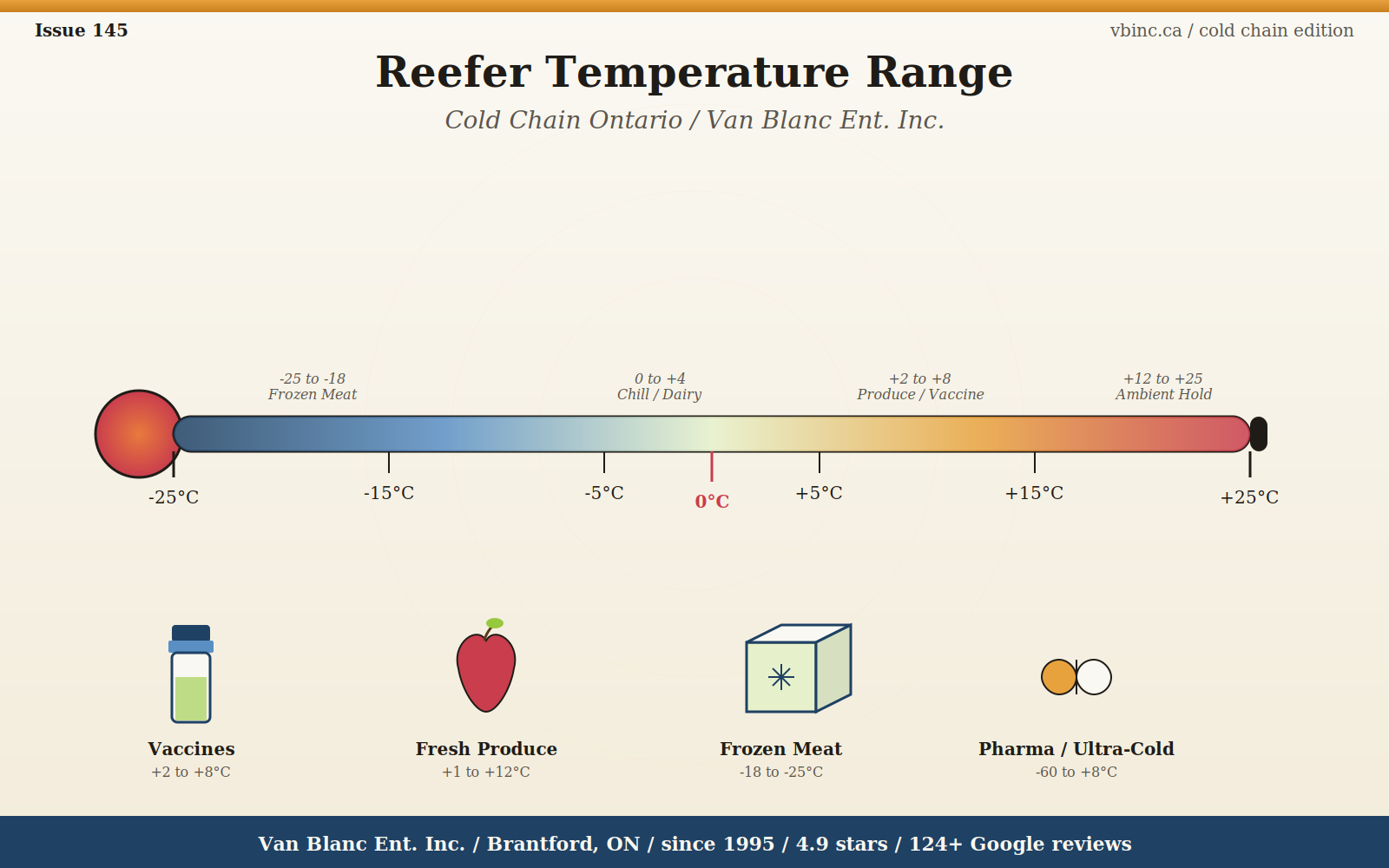
Quick Answer: A standard reefer container holds -25°C to +25°C for Ontario cold chain work, per CFIA cold chain guidance. Frozen meat sits at -18°C, produce at +2°C to +8°C, and vaccines at +2°C to +8°C per Health Canada. Van Blanc carries 20ft and 40ft HC reefers from our Brantford yards, delivered in 1-3 days.
In This Guide
- What Temperature Range Does a Reefer Container Hold?
- How Do Carrier and Thermo King Reefer Setpoints Work?
- What Temperature Suits Produce, Dairy, and Fresh Meat (+2°C to +8°C)?
- What Temperature Holds Frozen Cargo (-18°C to -25°C)?
- Can a Reefer Hold Vaccines and Pharma at +2°C to +8°C?
- What Reefer Temperatures Suit Cannabis, Craft Beverage, and Greenhouse Holding?
- Does a Reefer Keep the Cold Chain in an Ontario Winter?
- What CFIA Documentation Do You Actually Need?
- What Reefer Sizes, Specs, and Lead Times Does Van Blanc Offer From Brantford?
- Where Do Reefers Fail and How Do You Catch It Early?
- Frequently Asked Questions
Reading Time: 14 minutes
What Temperature Range Does a Reefer Container Hold?
A reefer container holds a temperature range of -25°C to +25°C, the band that handles nearly every Ontario cold chain job. Modern Carrier and Thermo King units extend to -30°C cold and +30°C warm. Below freezing it holds frozen cargo; above zero it chills produce, dairy, and vaccines. Set the temperature, the unit maintains it.
Most buyers calling our Brantford yard about a refrigerated unit ask the same first question. What temperature does it hold? The answer for a standard 20ft or 40ft high cube reefer is -25°C to +25°C, with most manufacturers (Carrier, Thermo King, Daikin, Star Cool) extending modern units to -30°C on the cold end and +30°C on the warm end. That range covers almost every cold chain job in Ontario, from frozen Lake Erie fish at -25°C to fresh greenhouse cucumbers at +12°C.
Christian, who walks buyers through reefer units at the yard, puts it plainly. “The first thing people get wrong is treating the temperature spec like a fridge dial,” he says. “A reefer holds the whole band from frozen to chilled because it heats as well as cools. Once a buyer sees the supply-air reading climb to setpoint in front of them, the spec stops being a mystery.” Christian grew up around the Brantford yard and works it alongside his father.
The number people miss is the ambient capability of the unit. A reefer is rated to hold its setpoint in outside air up to roughly +50°C, which matters less in Norfolk County than it does in Phoenix, but the inverse matters everywhere here. In a January cold snap at -25°C outside, the reefer is doing heating work to keep produce above freezing rather than cooling. Most operators forget the reefer is a temperature-control unit rather than a refrigerator. It moves heat in either direction.
For specialised loads, super-freezer reefers exist that reach -60°C to -70°C, originally built for tuna sashimi and now used for ultra-cold pharma. Those are special-order. The standard refrigerated units we stock at our Brantford yards, covered in detail on our full guide to how these units are built and graded, hold the +25°C to -25°C band that handles 95% of Ontario cold chain demand.
What ISO 1496-2 Actually Says About Insulated Containers
ISO 1496-2:2018 is the international standard for thermal and refrigerated containers. It specifies insulation values (typically U ≤ 0.4 W/m²·K for insulated panels), required door seals, and the structural test loads. A reefer that meets ISO 1496-2 has been engineered to hold its setpoint with the door closed and seals intact. None of that helps if the door is propped open during a load-in. We see this on construction sites with food-trailer kitchens. The unit hasn’t failed. The seal has been bypassed.
How Do Carrier and Thermo King Reefer Setpoints Work?
A reefer setpoint is the target temperature you program into the control panel, and the unit then works in either direction to hold it. The two units we see most often on Ontario reefers are the Carrier 69NT40 and the Thermo King Magnum / CFF family. Both let you punch a setpoint into the control panel, both log temperature continuously to a microlink data recorder, and both run on either three-phase 460V shore power or a clip-on generator (genset) for road haulage.
Setting a setpoint takes about three button presses on either unit. The Thermo King CFF holds chilled cargo to +/- 0.25°C of setpoint and frozen cargo to +/- 1°C. The Carrier 69NT40 hits similar tolerances. What you don’t get is instant response. A reefer pulled from ambient summer heat to a +2°C setpoint takes roughly 4 to 8 hours to pull the box down. Plan the load-in around that.
Pre-Cool Before You Load
The cardinal rule of cold chain. Pre-cool the reefer to setpoint before the cargo arrives at the loading dock. Loading warm produce into a warm reefer means the unit is fighting two thermal loads (the cargo plus the box), and you can lose 6 hours of pulldown time. Plug it in overnight. Verify the supply-air reading matches the setpoint. Then load.
Most Ontario buyers running reefers as stationary cold storage (not road haulage) use a single phase to three-phase rotary converter or wire in a dedicated 460V three-phase service from the panel. We hear about both setups every week. A craft brewery in Cambridge runs the reefer they bought from us off three-phase wired through their main plant panel. A cannabis processor in Tillsonburg runs theirs off a rotary converter feeding 460V three-phase from a 200A single-phase residential-style service. Both work. The brewery’s setup is cheaper to run.
What Temperature Suits Produce, Dairy, and Fresh Meat (+2°C to +8°C)?
Produce, dairy, and fresh meat sit in the +2°C to +8°C band, the most common cold chain range in Ontario. Almost everything fresh lives between +2°C and +8°C, and the Canadian Food Inspection Agency (CFIA) requires it. Fresh red meat must be chilled to 4°C or less before shipping under CFIA refrigeration of red meat products guidance. Dairy holds at +4°C. Fresh produce typically runs +2°C to +12°C depending on the variety. Apples like +1°C. Cucumbers prefer +10°C and chill-damage below +7°C. Apples by variety, from the 0°C keepers to McIntosh at +3°C, get their own page in the apple cold storage breakdown.
For a Niagara fruit-belt grower, the practical reefer setpoint for tender fruit is +1°C to +4°C. For a Norfolk County greenhouse cucumber operation, it is +10°C to +12°C. For a Halton dairy processor, +2°C to +4°C with humidity control. The reefer holds all of these with the same hardware. What changes is the setpoint and the ventilation aperture (the small dial behind the unit that lets ethylene gas escape from ripening produce).
Niagara Tender Fruit and Wine Storage
A St. Catharines winery called us about a 40ft HC reefer last harvest. They had bottled wine that needed a holding cellar at +12°C to +14°C while their permanent cold room was being expanded. We delivered a one-trip reefer from our Brantford yard; they set the unit to +13°C and pre-cooled it overnight. The wine sat in there for four months. Their other option was a refrigerated warehouse rental at three times the monthly cost. The reefer paid for itself in month two.
What Temperature Holds Frozen Cargo (-18°C to -25°C)?
Frozen cargo holds at -18°C to -25°C in a reefer, with -18°C the Canadian regulatory floor for frozen food per CFIA. Most operators run their reefers a few degrees colder (-20°C to -22°C) to give themselves margin against door-opening events. Long-term ice cream storage runs at -25°C to keep the texture stable. Frozen fish and seafood lives at -18°C to -25°C.
The defrost cycle matters here. A reefer running at -20°C in Ontario summer heat will accumulate frost on the evaporator coil over the course of a day. Both Carrier and Thermo King run automatic defrost cycles every 6 to 24 hours that briefly raise the supply air temperature, melt the frost, and drain it out the bottom of the unit. The cargo temperature doesn’t move noticeably during defrost (the box stays cold), but the supply-air log will show a spike. Don’t panic at the log. Check the return-air temperature, which represents the actual cargo environment.
Supply Air vs Return Air vs Cargo Temperature
Three different readings on every reefer log. Supply air is what the unit is blowing out at the front of the box. Return air is what comes back from the cargo end. Cargo temperature is what the cargo itself measures (taken with a probe inserted into a pallet). Supply air swings during defrost cycles and during the pulldown after a door opening. Return air is the better indicator of cargo health. Cargo temperature, measured directly, is the only one CFIA cares about during a compliance audit.
Can a Reefer Hold Vaccines and Pharma at +2°C to +8°C?
Yes, a reefer holds vaccines and refrigerated pharma at +2°C to +8°C, and frozen agents below that. Health Canada’s Canadian Immunization Guide specifies that refrigerated vaccines and passive immunizing agents must be stored between +2°C and +8°C. Frozen vaccines hold at -15°C or colder, per product monograph. Ultra-cold pharma (some COVID-19 vaccines, gene therapies) requires -90°C to -60°C and a super-freezer reefer or dry-ice thermal shipper.
For a public health unit or pharmacy distributor running a standby reefer as cold-chain backup, the standard 20ft reefer at +5°C setpoint is the workhorse. We have delivered units to clinic groups, veterinary practices, and one rural Brantford-area public health office during their main fridge replacement. The reefer kept a full vaccine inventory at +5°C for six weeks with no excursions.
The non-negotiable for any pharma reefer use is continuous temperature logging. Both Carrier and Thermo King units log to onboard memory, but Health Canada and provincial pharmacy regulators expect a redundant logger (Onset HOBO, Lascar EasyLog, or similar) inside the box with the product. Two independent logs, one from the reefer and one from the standalone logger, satisfies the cold-chain documentation requirement for product release after the storage event.
Redundant Logging Is Non-Negotiable
If you are using a reefer for pharma, vaccine, or clinical-trial product, install a second temperature logger inside the box. Health Canada inspectors will accept the reefer microlink data as one record, but they want a redundant independent record from a calibrated logger. The HOBO MX2202 or Lascar EL-USB-2-LCD are common picks. Budget for one logger per box. Cheap insurance.
What Reefer Temperatures Suit Cannabis, Craft Beverage, and Greenhouse Holding?
Cannabis, craft beverage, and greenhouse holding each sit in their own slice of the reefer range: cannabis at +4°C to +18°C, beverage cold-crash at +2°C to +4°C, and greenhouse overflow wherever the crop needs it. Three Ontario verticals call our Brantford yard about reefers more than any other. Cannabis processors need +4°C to +18°C holding for trim, distillate, and finished product, with humidity control to keep moisture content stable. Craft breweries use reefers as fermentation cold-crash tanks at +2°C to +4°C and as kegged-beer storage at +4°C to +6°C. Greenhouse operators (Norfolk, Leamington, Niagara) use reefers as overflow cold storage during a harvest crunch when their permanent cold rooms are full.
Cannabis is the trickiest because Health Canada cannabis regulations expect a documented temperature and humidity history for the entire product lifecycle. The reefer handles temperature easily. Humidity gets supplemented with a portable industrial dehumidifier or a sachet system inside the storage totes. For operators who want venting, dehumidification, security bars, or interior shelving fitted before delivery, that work gets finished at the yard before the reefer ships. Tillsonburg, Norfolk County, and Brantford-area cannabis operators can get the modification details at quote time.
Craft Brewery Cold-Crash Setup
A Cambridge brewery uses the 40ft HC reefer they bought from us as a cold-crash zone for fermentation tanks. They run it at +2°C, hold beer in there for 7 to 14 days post-fermentation to settle yeast and proteins, then move to the kegging line. The reefer doubles as kegged-beer cold storage for finished product staging. One container, two roles, both inside the +2°C to +8°C band. The owner told Christian the reefer cost a fraction of the cold-room build quote he was getting from a refrigeration contractor.
Does a Reefer Keep the Cold Chain in an Ontario Winter?
Yes, a reefer keeps the cold chain through an Ontario winter, but the work flips direction. A reefer is a temperature-control unit rather than a refrigerator. In a -25°C January cold snap, the reefer holding produce at +4°C is running its heater (yes, the reefer has a heater) to keep the cargo from freezing. The unit consumes more power in deep Ontario winter for chilled cargo than it does in summer.
For frozen cargo in Ontario winter the math reverses. Holding -20°C cargo with -25°C outside ambient means the unit barely cycles. Power consumption drops to near zero. Some operators try to take advantage and shut the reefer off entirely in deep cold, relying on the insulation to hold the cargo. This works for a few days, but it fails the CFIA continuous-monitoring requirement and breaks if you get a midwinter thaw.
Paul has watched this pattern repeat for thirty years. “Operators think the reefer is overkill in January, so they unplug it to save power,” he says. “Then we get a four-day thaw, the cargo warms up to -5°C, they refreeze it, and the texture is destroyed. The reefer should run continuously, every season. The electricity bill in winter is lower than they think.” Buyers who only need the insulated box and never plan to power it should read what changes when you run a reefer as an unpowered insulated shell instead.
Brantford Yard, Brockville Cottage, Sudbury Mining Camp
We have delivered reefers to all three. The Brantford industrial buyer plugs into three-phase and runs it year-round for finished-goods cold storage. The Brockville cottage owner used a small reefer for two seasons of off-grid frozen-meat storage powered by a propane genset. The Sudbury mining camp ran a 40ft reefer as a frozen-meal staging unit for a 60-person crew rotation. Three buyers, three settings, same hardware. The cold chain holds in all three because the reefer holds.
What CFIA Documentation Do You Actually Need?
CFIA documentation for a reefer comes down to a Preventive Control Plan plus continuous logs, calibration records, and corrective-action records. The Canadian Food Inspection Agency expects every food cold chain operator to maintain a Preventive Control Plan (PCP) that documents temperature monitoring, corrective actions, and storage conditions. The specifics depend on your commodity category, but the universal requirements are:
- Continuous temperature logging with the data accessible for at least two years (CFIA prefers digital records)
- Calibration records for every temperature monitoring device, dated and re-certified at the interval the device manufacturer specifies
- Corrective-action logs documenting any temperature excursion, the cause, the response, and the disposition of affected product
- Staff training records on cold chain monitoring procedures
- Equipment maintenance records showing the reefer has been serviced per manufacturer recommendations
CFIA inspects the records rather than the reefer itself. A perfectly functioning reefer with no logs fails the audit. A reefer with one minor excursion and complete documentation showing the corrective action passes the audit.
Two-Year Record Retention is the Floor
CFIA’s two-year minimum is the regulatory floor. Most Ontario food processors hold their records for 3 to 5 years because customer audits (Walmart, Loblaws, Sobeys) and Safe Food for Canadians Regulations (SFCR) inspections frequently reach back further than CFIA does. Don’t delete logs at 24 months. Storage is cheap. A failed audit is not.
What Reefer Sizes, Specs, and Lead Times Does Van Blanc Offer From Brantford?
Van Blanc stocks two reefer sizes, the 20ft and the 40ft high cube, at our 4 Brantford yards, in one-trip and cargo-worthy used grades. What you pay reflects grade, age, and condition, so the table below sets out the specs that actually decide which unit fits your job. Talk to us for a real quote tailored to your project.
| Size | Grade | Internal Capacity | Typical Running Draw | Best Fit |
|---|---|---|---|---|
| 20ft Reefer | One-Trip | ~28 m³ | 7-12 kW | Pharma, vaccine, clinic backup, small-batch cold storage |
| 20ft Reefer | Cargo Worthy (used) | ~28 m³ | 7-12 kW | Budget stationary cold storage, seasonal overflow |
| 40ft HC Reefer | One-Trip | ~67 m³ | 9-15 kW | Brewery cold-crash, greenhouse harvest, finished-goods volume |
| 40ft HC Reefer | Cargo Worthy (used) | ~67 m³ | 9-15 kW | High-volume frozen or chilled holding on a working budget |
Lead time is 1-3 days for most of Ontario from our Brantford yards. Eastern Ontario (Kingston, Brockville, Ottawa) runs 1-3 days. Northern Ontario (Sudbury, Timmins, North Bay) is 5-10 days because the freight has to be quoted route-specific. Every quote comes with a real lead time.
The Cheaper Facebook Reefer is the Trap
We get the call almost every week. A buyer found a 40ft reefer on Facebook Marketplace priced well below what any real yard would charge. Two weeks later they call back because the seller vanished after the deposit cleared. Reefers are the highest-ticket scam target in the container market because the price tag draws the desperate-buyer profile. If a reefer listing is below market, that is the trap rather than a discount. We have a real Brantford yard. Walk the unit before you pay. See our shipping container scam guide for the full pattern.
Where Do Reefers Fail and How Do You Catch It Early?
Reefers fail in predictable ways: door seals, evaporator frost, compressor cycling, data logging, and genset fuel. After thirty years in containers Paul has seen the same five failure modes repeat. None are catastrophic if caught early. All are expensive if missed.
The Five Reefer Failure Patterns
- Door seal degradation: rubber gaskets harden after 8 to 12 years of UV exposure and stop sealing. Symptom is rising humidity inside the box and the unit running constantly. Fix is a seal kit installed.
- Evaporator coil frost-up: if the defrost cycle is set too long, ice builds on the coil and airflow drops. Symptom is supply air not hitting setpoint. Fix is a manual defrost and a re-set of the defrost interval.
- Compressor short-cycling: the unit cycles on and off every few minutes. Usually a low refrigerant charge or a failing high-pressure switch. Fix is a refrigeration tech visit.
- Microlink data corruption: the data logger stops recording but the unit keeps running. Symptom is the audit log shows gaps. Fix is to download the data more frequently or to install a redundant external logger as primary.
- Genset fuel issues (mobile only): a clip-on genset running diesel can gel in deep Ontario cold below -20°C. Fix is winterised diesel (Treat the fuel with anti-gel) and a block heater on the genset for long-haul winter routes.
Most failures show up in the temperature log days before the cargo notices. This is why Health Canada and CFIA require continuous logging and review of the logs. A reefer that has been running 3 degrees above setpoint for two weeks is a reefer to fail completely. Catching that pattern in week one means a seal kit. Catching it in week three means a container of spoiled inventory. If you are still weighing whether a reefer is the right tool at all, the sizing, setup, and power rundown walks through the broader operational picture.
Paul LeBlanc, owner: “I have watched cold chain operators in Ontario lose entire pallets of product because they treated the reefer like a fridge. It is not a fridge. It is a machine that needs a log, a pre-cool, a power source that does not flicker, and a tech on speed dial. We sell the unit and we tell them all of that on the way out the gate. Half of them call us back to thank us six months later when they catch their first early-warning excursion in the log.”
Ready to price your container?
Tell us the size and your postal code and we’ll send back an all-in number, container, delivery, and placement, usually within 1-3 days. No pressure, no mystery fees.
Family-run in Brantford since 1995 · 200+ containers in stock · 4.9★ across 140+ Google reviews · every box graded by a person, walk it before it lands.
Frequently Asked Questions
What is the standard temperature range of a reefer container?
Standard reefer containers hold -25°C to +25°C, with modern Carrier and Thermo King units extending to -30°C on the cold end. Specialised super-freezer reefers reach -60°C to -70°C for ultra-cold pharma. Van Blanc stocks the standard +/- 25°C range at our Brantford yards.
What temperature should I set a reefer for fresh produce in Ontario?
Fresh produce runs +2°C to +12°C depending on the crop. Apples like +1°C, leafy greens +2°C to +4°C, cucumbers and tomatoes +10°C to +12°C. Set the reefer to the most sensitive crop in the box. Adjust the ventilation aperture for ethylene-emitting produce.
Can a reefer hold vaccines at Health Canada cold chain temperatures?
Yes. Health Canada specifies +2°C to +8°C for refrigerated vaccines. A standard reefer holds that band easily. Install a redundant temperature logger inside the box (HOBO or Lascar) for compliance documentation. Two independent records satisfy the Health Canada cold chain audit requirement.
How accurate is the temperature control on a reefer?
The Thermo King CFF holds +/- 0.25°C in chilled mode and +/- 1°C in frozen mode. The Carrier 69NT40 hits similar tolerances. Setpoint accuracy is rarely the failure point. Door seal degradation, evaporator frost-up, and refrigerant leaks are the more common issues over a unit’s lifespan.
Does CFIA require continuous temperature logging in a reefer?
Yes. CFIA expects continuous temperature monitoring with logs retained for at least two years. Most Ontario food processors retain records for 3 to 5 years to cover Walmart, Loblaws, and Sobeys customer audits as well. The reefer’s onboard microlink data logger plus a redundant standalone logger covers both.
How much does a reefer container cost in Ontario?
Reefer cost is driven by size (20ft versus 40ft HC), grade (one-trip versus cargo-worthy used), the age and condition of the refrigeration unit, and how far you are from our Brantford yards. One-trip units cost more than used cargo-worthy units, and a 40ft HC costs more than a 20ft. Delivery is quoted separately by route. Call us for a real quote tailored to your project.
How fast can Van Blanc deliver a reefer to my Ontario site?
1-3 days to most of Ontario from our 4 Brantford yards. Eastern Ontario (Kingston, Brockville, Ottawa) is 1-3 days. Northern Ontario (Sudbury, Timmins, North Bay) is 5-10 days because the freight is quoted per route. Every quote comes with a real lead time.
What power does a reefer container need?
Standard 460V three-phase shore power. A 20ft reefer draws roughly 7-12 kW running, peaks higher on pulldown. A 40ft HC reefer draws roughly 9-15 kW. Most stationary Ontario installations wire in dedicated three-phase from the panel or run a rotary phase converter off single-phase service.
Can I freeze meat in a reefer at -25°C?
Yes. Frozen meat operates at -18°C as the CFIA floor, and most operators run -20°C to -22°C for margin. Long-term ice cream and seafood holds at -25°C. The standard reefer holds -25°C without trouble. CFIA red meat refrigeration guidance applies for any product moving in commerce.
Does the reefer keep working in an Ontario winter at -25°C outside?
Yes. The reefer is a temperature-control unit rather than a refrigerator. In deep Ontario cold it runs its heating circuit to keep chilled cargo above freezing. For frozen cargo in winter it barely cycles. Run it continuously every season. Don’t unplug to save power. A midwinter thaw will destroy the cargo if you do.
Sources
- Canadian Food Inspection Agency. (2024). Refrigeration of red meat products. Government of Canada. inspection.canada.ca
- Public Health Agency of Canada. (2024). Storage and handling of immunizing agents: Canadian Immunization Guide. Government of Canada. canada.ca
- International Organization for Standardization. (2018). ISO 1496-2:2018 Series 1 freight containers, Specification and testing, Part 2: Thermal containers. iso.org
- Thermo King. (2024). Container Fresh and Frozen (CFF) refrigeration units, product specifications. Thermo King Corporation. thermoking.com
- Transport Canada. (2025). Cargo Securement Standard 10, containerized cargo road haulage requirements. Government of Canada. tc.canada.ca
Reach Van Blanc in Brantford
We have been supplying shipping containers and reefers across Ontario since 1995. Our warehouse is at 90 Morton Avenue E in Brantford, and we deliver right across the province with payment options that include draft cheque, cash, wire transfer, and a credit card authorization form. No surprise fees, no chase-the-paperwork.
Van Blanc Ent. Inc. · 90 Morton Ave E Unit 1B, Brantford, ON N3R 7J7 · +1 888-509-6658
If you are planning a cold chain build for produce, pharma, cannabis, or craft beverage, walk our Brantford yard first. We will plug in a reefer, set a setpoint, and show you the supply-air log climbing toward target. Half a day at the yard answers most of the questions buyers spend three weeks researching online.