
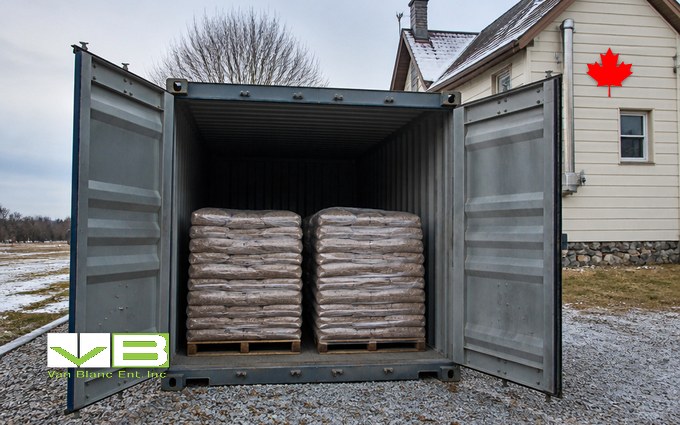
Quick Answer: A pellet stove burns compressed wood pellets that an auger feeds from a hopper into a burn pot. Electric fans push heat into the room and exhaust out a sealed pellet vent. Wet pellets crumble to sawdust, so a winter’s bags need dry storage, like a 10ft or 20ft container.
What This Pellet Heat Guide Covers
- How does a pellet stove work?
- Pellet stove start-up and burn cycle
- Pellet stove versus a wood stove
- Pellet stove efficiency and heat output
- Pellet stove power draw and outages
- Pellet stove venting in Canada
- Clearances and floor protection
- WETT inspection for a pellet stove
- Carbon monoxide alarms in Ontario homes
- Wood pellet grades, ash and heat value
- Bulk wood pellets for one winter
- Why wet pellets are lost pellets
- Pellet storage in a 10ft or 20ft
- Fresh air in a fuel box
- Service intervals by the ton
- Container grades for a fuel store
- November delivery before the fuel truck
- Pellet stove FAQs
Reading Time: 16 minutes
How Does a Pellet Stove Work?
A pellet stove is a room heater that burns small cylinders of compressed sawdust, fed in measured doses by a motor. You pour bags of pellets into a hopper on top or at the back. An auger, a slow screw, carries them down into a burn pot where an igniter lights them. One fan pulls combustion air through the pot and pushes exhaust out a sealed vent. A second fan blows room air across a heat exchanger and back into the house.
Van Blanc is a Brantford container seller, run by Paul LeBlanc’s family since 1995, and it comes into this story at the fuel end. A ten-foot steel box parked by the back door keeps a winter of bags dry. The stove, the vent and the install belong to your hearth dealer and a certified installer.
The U.S. EPA’s Burn Wise page describes two feed layouts. A top-fed stove drops pellets from a hopper above the fire, and its combustion chamber is more likely to collect ash and debris. A bottom-fed stove pushes pellets into the chamber from below and moves ash into the ash pan as it goes. The thermostat sets how fast the auger turns, and so how hot the stove runs. The same stove heats a four-season cabin, and log cabin kits meant for winter use often plan around one.
| Part | What it does |
|---|---|
| Hopper | Holds the pellets; on the Drolet Eco-65 it takes 125 lb (57 kg), about three bags |
| Auger and motor | Meters pellets into the burn pot at the rate the thermostat asks for |
| Igniter | Lights the pellets electrically at start-up, no kindling |
| Combustion fan | Draws air through the fire and pushes exhaust out the vent under pressure |
| Convection fan | Moves room air over the heat exchanger and back out the front |
| Ash pan | Catches what the burn pot leaves behind |
Pellet Stove Start-Up and Burn Cycle
A pellet stove runs a short programme every time it lights. Duroflame, a Dutch stove maker, lists its firing schedule in six stages: preheating and cleaning, loading, stabilisation, operation, cleaning and switch-off. Put simply, the stove clears the pot and feeds a first charge. It lights the charge, waits for a steady flame, then holds your set heat level. The Drolet manual gives what that draws: 360 W during ignition, then 258 W to 348 W while running. Those watts count on a cottage circuit, and a winter bunkie fed on its own breaker faces the same load question.
Shutdown is part of the cycle too. The auger stops first, and the blowers keep running until the fire is out and the firebox has cooled. That is why the plug stays in until the stove has finished on its own. If you suspect a fault, Drolet says do not unplug it; turn it off, monitor it and call your dealer if necessary. Unplugging disables all its safety features.
Pellet Stove Versus a Wood Stove
A wood stove burns split logs by natural draft, and the owner sets the burn by hand with an air control. A pellet stove burns a manufactured fuel on a motorized feed, set by a thermostat. Every other contrast grows from that one. The pellet stove lights itself, holds an even temperature and runs for days on one hopper. The wood stove needs nobody’s electricity and burns fuel a rural owner can cut on the property.
“If used correctly, pellet stoves produce very little smoke or creosote, which is the main cause of chimney fires.”
U.S. Environmental Protection Agency, Burn Wise: Pellet Stoves
The fuel changes the storage job too. Firewood is bought by the cord and dried in the open air, as the way a woodpile is stacked and covered to season sets out. Pellets arrive already dry, and New Hampshire’s Department of Energy describes quality pellets at 5 to 10 percent moisture. The storage task is to keep them that way. A yard furnace sits at the far end of the wood-heat family. The outdoor boiler that heats a farmhouse through buried lines carries its own clearances and emission rules.
| Question | Pellet stove | Wood stove |
|---|---|---|
| Fuel | Bagged pellets, 40 lb per bag | Split, seasoned logs |
| Draft | Fan-forced, sealed vent | Natural, through a chimney |
| Control | Thermostat and auger | Hand-set air control |
| Power | Needs electricity to run | Runs without power |
| Fuel storage | Bags kept dry, off concrete | Stacks kept covered with air moving through |
Pellet Stove Efficiency and Heat Output
Pellet stoves rate well on efficiency. The EPA says certified pellet stoves are usually 70 to 83 percent efficient. Their heating capacities run from 8,000 to 90,000 Btu per hour, and the agency has certified over 90 models. The Drolet Eco-65 is a bottom-fed stove from a maker in St-Augustin-de-Desmaures, Quebec. It lists an average overall efficiency of 68.8% on the higher heating value of the fuel, and 79.9% at its optimum burn rate. Its particulate rate is 2.45 g/h, tested to EPA and CSA B415.1-10 methods. The same CSA standard reaches yard boilers too, as the emission limits on outdoor wood furnaces show.
Output is a range, set by how fast the auger feeds. The same Drolet stove burns from 1.2 lb to 7.6 lb of pellets an hour and is rated for 800 to 2,600 square feet. Its maker states that it must serve as a supplementary heat source, backed by a conventional oil, gas or electric system. Read that line in your own stove’s manual before you plan a winter around it. A tight building stretches any stove, which is why foaming a steel cabin before the heater goes in comes first in a container conversion.
Pellet Stove Power Draw and Outages
A pellet stove needs electricity, and the EPA says so first. The motorized parts that feed the fire and blow out hot air need a supply. Some models carry backup batteries, and a few gravity-fed designs need no power at all. Most run on a standard outlet, and the Drolet manual warns against an adapter plug or a cut grounding prong.
When the power drops, the stove stops. Drolet’s instruction for an outage is to check the stove for smoke spillage, and to open a window to prevent negative pressure in the room. A proper vent system helps here too, because it gives the stove some natural draft when the fan quits. Owners who already run a standby unit can add the stove to its list of loads. A sheltered spot for the standby generator and its fuel belongs in that plan, and so does a transfer switch wired by a licensed electrician.
Pellet Stove Venting in Canada
Pellet stove venting is the part of the install that decides whether exhaust leaves the house safely. For Canada, the Drolet manual points installers to the CSA B365 Installation Code for Solid Fuel Burning Appliances and Equipment. Wiring follows CSA C22.1, the Canadian Electrical Code, wherever no local code says otherwise. Van Blanc cuts openings only in its own steel, such as a framed man door in a container wall. House venting belongs to the stove installer. The stove’s own manual and the vent maker’s instructions govern the details. The figures below are the Eco-65’s, so read your own manual for your model.
“Heating equipment is a leading source of home fires in Ontario.”
Ontario Office of the Fire Marshal, Fire safety guidebook: Heating safety
Pellet Vent Pipe and Rise
Pellet vent is a listed pipe sold for this job. Drolet recommends a listed pellet vent that meets CAN/ULC S609 or ULC/ORD C441 in Canada, in a 4 in (100 mm) size for this stove. An existing chimney wider than 4 in can carry the exhaust if it gets a listed stainless steel liner. The exhaust runs under pressure, so every joint is sealed with RTV silicone and metallic tape and held with at least three screws. The chimney connector shall not pass through an attic or roof space, a closet or similar concealed space, or floors or ceilings. A stove in a steel cabin runs its pipe out through the wall the same way, as in an off-grid box heated by a wood stove.
Rise matters as much as pipe. Drolet asks for at least 36 in (91 cm) of vertical rise before the termination. It also wants at least one foot of rise for each foot of horizontal run. A spark arrester at the end of the termination is mandatory. Exhaust gases can reach 500°F (260°C) and cause serious burns, so the cap must not sit where hot exhaust can be a hazard. A container’s own vents work differently, since passive louvres cut into a steel box move air with no fan at all.
Wall Cap Clearances From Windows and Grade
The Canadian termination table in the Drolet manual sets these minimums for the wall cap. WETT lists measurement of required clearances as part of a visual inspection.
| Vent cap must be at least | Distance |
|---|---|
| Above grade, or any surface that can hold snow, ice or debris | 12 in (30 cm) |
| From a window or door that opens | 39 in (100 cm) |
| From an inside corner or adjacent wall | 39 in (100 cm) |
| From another appliance’s combustion air inlet | 39 in (100 cm) |
| From the property boundary | 39 in (100 cm) |
| From a gas service regulator vent outlet | 72 in (183 cm) |
| From a mechanical air supply inlet | 72 in (183 cm) |
| Above a paved sidewalk or driveway on public property | 84 in (213 cm) |
In an Ontario winter, the 12 in line is the one that bites. Snow piles up on roofs too, and what a flat steel roof carries in a big snow year matters for the fuel box as well. A drift against the wall can bury a cap that met the rule in October. Ontario’s carbon monoxide page asks owners to keep outside vents and chimneys always clear of snow and debris. The same table rules out a cap under a veranda, porch or deck. It also bars a cap above a gas meter or regulator assembly within 39 in (100 cm) horizontally of the regulator’s centre-line. That limit runs for 15 ft vertically. Its 72 in line for a gas regulator vent also names a 39 in (100 cm) limit from an oil tank vent or fill inlet.
Clearances and Floor Protection
Pellet stove clearances to combustibles come from each stove’s label and manual. The Eco-65’s table lists 3 in (76 mm) and 6 in (152 mm), each keyed to a letter on its diagram. Drolet still recommends leaving 24 in on each side and 12 in at the back, so the stove can be reached for service. Leave the same working room around fuel in a box, where shelving bolted along one wall holds the scoop and spare parts clear of the skids.
The floor needs a pad. Drolet asks for a continuous noncombustible surface with grouted joints, such as ceramic tile, cement board, brick or millboard. Its Canadian table for the Eco-65 extends the pad 18 in (460 mm) in front of the door opening. It adds 8 in (205 mm) past each side and 8 in (205 mm) behind. Any type of tile needs a continuous noncombustible sheet beneath it, so embers cannot fall through a crack to the floor. The manual also says not to store fuel within the stove’s minimum clearances, so the day’s bag sits outside that zone. The same pad rules follow a stove into an off-grid container cabin with a stove in the corner.
WETT Inspection for a Pellet Stove
WETT stands for Wood Energy Technology Transfer. WETT Inc. says its mandate is training and education. It certifies individuals, not appliances, installations or companies. Stoves are certified by test laboratories, and a WETT inspection ends in a written report on WETT forms rather than a certificate.
Drolet’s manual recommends that its pellet stoves be installed and serviced by WETT-certified professionals in Canada. WETT lists real estate sales, malfunctions such as smoke spillage, general safety concerns and home insurance requirements among the reasons an owner books an inspection. Each insurer sets its own rule on how long it accepts a report, so call yours before the installer leaves. The same call is a good time to add a steel fuel box to the property policy.
“Use a qualified technician to install woodstoves and fireplaces.”
Office of the Fire Marshal (Ontario), Heating safety
Three SITE Inspection Levels
WETT’s standard inspection process is called SITE, and it has three levels.
- Visual: a non-invasive look at every visible part, with measured clearances. WETT says this level is used for most insurance and real estate needs.
- Technical: everything in a visual inspection plus hands-on checks, which can mean removing panels or pipe, entering the attic or going on the roof.
- Invasive: opening walls or ceilings, or taking chimneys apart, to reach hidden parts. It follows events such as a chimney fire, or a technical inspection that cannot reach them.
For an insurance file on a new install, that first level is usually the one asked for, but confirm the level with your insurer. Ask for the inspector’s WETT photo ID, or check the name against WETT’s own directory, since the certification belongs to the person. Keep the report with the house papers, the way the CSC plate on a cargo worthy box travels with the steel.
Carbon Monoxide Alarms in Ontario Homes
Any wood or pellet appliance makes carbon monoxide when fuel burns incompletely, and Ontario’s government page lists wood among those fuels. It also says over 65% of CO-related injuries and deaths in Ontario occur in the home. A house with a fuel-burning appliance or a fireplace must have a CO alarm adjacent to each sleeping area, meaning the hallway outside the bedrooms. Since January 1, 2026, the rule adds an alarm on every storey, including storeys with no bedrooms. Generators make the same gas, which is why keeping a standby generator clear of doors and windows sits on the same safety list.
“If your CO alarm sounds, you or other occupants may experience symptoms of CO poisoning.”
Government of Ontario, Carbon monoxide safety
The same page asks owners to have fuel-burning appliances, chimneys and vents cleaned and inspected by professionals every year before cold weather sets in. For a pellet stove that is the autumn service, and it pairs well with filling the fuel store. Buy the season’s bags first, then book the sweep. By November the stove is clean and the fuel sits dry in a twenty-foot box holding the full winter’s skids.
Wood Pellet Grades, Ash and Heat Value
Wood pellets are graded by ash, moisture, durability and fines. Drolet’s manual names three programs that set grades: the Pellet Fuels Institute (PFI), ENplus and CANplus. Its own stove wants premium grade or better, with ash under 1% and a heat value near 8,500 BTU/lb. The EPA adds that lower-quality pellets give less heat and create a fine dust. Better pellets burn cleaner and leave less ash.
Hardwood is not automatically the better pellet. New Hampshire’s energy office explains that pressing sawdust into pellets evens out density. A bag of softwood pellets therefore weighs and heats about the same as a bag of hardwood, and softwood resins can even add heat. The same office puts one ton of pellets at about the heat of 120 gallons of No. 2 heating oil. The Wood Pellet Association of Canada describes pellets as condensed biomass such as wood chips and sawdust. Steel boxes carry grades as well. What the cargo worthy stamp says about a used box is the container version of a grade on a bag.
Bulk Wood Pellets for One Winter
Bulk wood pellets are usually sold by the ton on a skid. The storage guide at woodpellets.com gives the usual load. A full one-ton skid is 50 forty-pound bags on a roughly 4 ft by 3.5 ft footprint, stacked about 4 feet high. Buying the season’s supply on skids in the fall makes dry storage worth planning. Both sizes of used 10ft and 20ft boxes from Van Blanc are planned around it.
How many skids is the harder question. New Hampshire’s Department of Energy says a typical house heating entirely with pellets burns five or six tons a season. It calls that an inexact answer. Gordon Murray, executive director of the Wood Pellet Association of Canada, worked his own house out in Canadian Biomass magazine. His home needs 81 GJ of heat a year, equivalent to 4.8 tonnes of pellets. A stove that tops up a furnace burns far less, so your own past bills are the best guide. Homes that mix pellets with cordwood plan both piles, and a firewood stack that stays dry through March covers the logs.
| Household | Season’s fuel | Skids | Container that usually suits |
|---|---|---|---|
| Stove topping up a furnace, or a cottage on weekends | About three tons or less | Up to 3 | 10ft |
| Full-heat house, Murray’s B.C. example | 4.8 tonnes | About 5 | 20ft |
| Full-heat house, New Hampshire’s typical case | Five or six tons | 5 to 6 | 20ft |
| Two stoves, or house plus shop | Add the two estimates | Up to 10 on the floor | 20ft |
The first row is a rule of thumb for planning, not a measured figure. Statistics Canada’s December 2025 release shows why both ends matter in Ontario. In 2023, 6% of households outside large urban centres heated mainly with wood or wood pellets, against 1% in census metropolitan areas. And 48% of households with a secondary property burned wood or pellets there. A rural or cottage lot can sit down a long laneway, and getting a container truck down a country lane is part of the plan.
Why Wet Pellets Are Lost Pellets
Moisture ruins pellets, and there is no undoing it. The woodpellets.com guide says wet pellets swell, crumble and turn back into sawdust, with no drying them out and no saving them. Pellets also draw moisture slowly from humid air. Swollen pellets and the fines they shed jam augers and choke burn pots, which is the cost a damp garage passes on to the stove.
“We recommend that you store your bags of pellets in a dry and well ventilated area if possible.”
Drolet, Eco-65 Installation and Operation Manual
That same guide sets three rules for a skid. Keep bags on the maker’s pallet and cardboard slip sheet, never on concrete or soil, because concrete floors wick moisture. Check the factory plastic shroud on delivery and patch any tear. Reseal opened bags with a clip or tape. Outdoors, it recommends a shed or shelter first, or high ground under a fastened tarp with air at the base. A wrapped skid in the driveway through a February thaw tests all three. The thaw stops mattering once the fuel goes, the day it arrives, into a graded used box with sound doors and floor from Van Blanc.
Unloading the Skid Into a Box
Leave the bags on their delivery pallet and slip sheet if the supplier’s truck can set the skid inside the doors. If they come off by hand, lay down a spare pallet first, and keep both doors open while you work inside. A Van Blanc container floor is marine plywood rather than concrete, but the pallet keeps an air gap under the bottom row.
Pellet Storage in a 10ft or 20ft
Pellet storage in a shipping container gives the bags a locked, roofed, raised room of their own, away from the house. A steel box stands on its corner castings above the ground, its doors seal on gaskets, and nothing chews in. It is a confined space too, so a pellet box needs vents and airing before entry, as set out below. Van Blanc sells both sizes from its 4 Brantford yards, used or as new 10ft and 20ft units still in factory paint. The inside numbers below come from Van Blanc’s own product pages.
| Measurement | 10ft | 20ft |
|---|---|---|
| Inside floor | 2,840 by 2,350 mm (about 9’4″ by 7’8″) | 19 ft 4 in by 7 ft 8 in (5.898 m by 2.352 m) |
| Inside height | about 7’10” | 7 ft 10 in (2.385 m) |
| Floor area | about 72 square feet | about 148 square feet |
| Volume | about 560 cubic feet | 1,172 cubic feet |
| Standard pallets on the floor | 4 | 10 |
Three Skids in a 10ft
The 10ft fits 4 standard pallets on its floor, but weight is the better limit for fuel. Van Blanc’s 10ft page shows one unit’s door stencil: a max gross of 4,500 kg, a tare of 950 kg and a payload of 3,550 kg. Four one-ton skids carry about 8,000 lb of pellets, more than that stencil allows. Three skids, about 6,000 lb plus pallets, sit under it with room to spare. Plan a 10ft as a three-ton store and read the plate on your own box. The fourth spot becomes the aisle. The 10ft page’s full spec table, with factory tens and cut-downs has the details, and Van Blanc’s yard can tell you which tens it has.
“Thirty years in trade taught me to weigh a load before I measure it. Pellet skids look small on a container floor, but the payload stencilled on the door decides how many go in, so read it before the fuel truck comes.”
Paul LeBlanc, owner, Van Blanc
A Full Winter in a 20ft
The 20ft holds 10 standard pallets in two rows, and its payload runs to 62,126 lb, so tonnage is never the limit for a household. As a rule of thumb, six skids set two across and three deep fill roughly the back 12 feet. That leaves the door end open for a snowblower or the summer furniture. The twenty-foot box with 1,172 cubic feet inside suits a house that heats entirely with pellets. It also suits a buyer who stocks two winters at once. Van Blanc stocks 20ft units in one-trip and cargo worthy grades.
“A pellet stove can only burn what reaches it dry. I’d sooner see a winter of skids in a sealed 20ft than stacked in a garage that sweats through every thaw.”
Paul LeBlanc, owner, Van Blanc
The Fuel Shed by the Laneway
Set the box where the pellet truck can reach the doors and you can reach the house on a shovelled path. Doors facing the laneway let a supplier’s tailgate lift set skids right at the opening. A level, crowned gravel pad under the four corners keeps the floor flat, so stacks stay square and doors swing true.
“Before a pellet box goes on the trailer, I ask where the fuel supplier backs in on your lane. Aim the doors at that spot and the skids come off the tailgate into the box, with no bags carried over frozen ground.”
Christian LeBlanc, second-generation operator, Van Blanc
Fresh Air in a Fuel Box
A pellet store needs air moving through it. The UK Health and Safety Executive issued a safety alert in November 2012. It warned that small quantities of wood pellets can produce life-threatening quantities of carbon monoxide in a confined space. It says pellets produce more carbon monoxide within the first six weeks of being manufactured, and more at higher temperatures. The alert was written for pellet boiler stores and hoppers. It recommends that the store room is ventilated at all times, either mechanically or by a through draught design. Before entry, it says to ventilate the store and check carbon monoxide and oxygen levels with an appropriate device. The woodpellets.com guide adds that large enclosed quantities can off-gas carbon monoxide in sealed, unventilated spaces.
“Do not enter the pellet storage area or place your head into a wood pellet hopper as they can contain toxic gases.”
UK Health and Safety Executive, Safety alert on wood pellet storage
A container of bagged pellets is a confined space, and the HSE’s finding covers small quantities too. Vents set high on one wall and low on the opposite wall give the box a through draught. Paired louvre vents that keep air crossing the box explains the placement, and Van Blanc fits them before delivery. Open both doors and let the box air out before you step in. Keep them open while you are inside, as the HSE’s sign wording asks. Take the most care in the first six weeks after a fresh delivery. A portable carbon monoxide meter is the household way to check the air before entry, as the HSE advises. Never store pellets in a box someone sleeps or works in, and keep the store apart from the house.
“We cut the vents into a pellet box in our shop, one high and one low on opposite walls. When I drop it off, I show the buyer how to open both doors and let it air out before stepping inside.”
Christian LeBlanc, second-generation operator, Van Blanc
Vents also fight condensation. A steel roof chills fast on a clear night, and warm, damp air meeting it leaves drips on whatever sits below. Moving air carries that moisture out. A plain dry box with vents suits pellets. For owners who keep fuel two winters, Van Blanc’s insulated box that slows the swing between day and night adds a margin.
Pricing a Pellet Box Before the Delivery
Tell us how many skids you buy, where the truck will set them and your postal code. We will say whether a 10ft or a 20ft fits, in which grade and with which vents. Then you get one all-in number with a real lead time.
Family-run in Brantford since 1995 · 4.9★ across 140+ Google reviews · see your unit by its container number first.
Service Intervals by the Ton
Pellet stoves need steady cleaning, and the EPA recommends a professional cleaning at least once a year. Drolet counts its schedule in fuel burned, which suits an owner counting skids out of a three-skid ten-footer by the house. Its Eco-65 table sets three intervals.
- Weekly, or after about 250 pounds: vacuum the baffle and air-wash inlet, scrape the burn pot, clean the glass and empty the ash drawer.
- Twice a year, or after about 1 ton: vacuum the exhaust channels and the exhaust and convection blowers, and inspect the combustion blower. Inspect or sweep the venting system and inspect the gaskets.
- Annually, or after about 2 tons: sweep and clean the venting system, and empty and vacuum the hopper.
The end of the season matters most. Drolet stresses that clearing the stove and vent at season’s end limits summer corrosion from the ash left inside. That is also the week to sweep the empty pallets out of the fuel box and order the next skids. Check the box’s own seals while the doors are open. Van Blanc sells door gaskets from the yard, and a tired door gasket on a steel box is a small fix. A WETT-certified technician or sweep can take the annual stove service off your list.
“Regular chimney maintenance and inspection can prevent chimney fires.”
Drolet, Eco-65 Installation and Operation Manual
Container Grades for a Fuel Store
Van Blanc sells four grades, and three of them make a fuel store. The choice usually follows where the box will sit and how long you want it to last.
- New (one-trip): one loaded voyage, factory paint and tight doors. It suits a box beside the house that guests will see, and new one-trip units in factory colours come in both sizes.
- Cargo worthy: a used box with a valid CSC plate, a sound floor and doors that seal. It is the common pick for a fuel store behind the garage.
- Wind and watertight: an older used box, roof and floor sealed, more rust on the panels. It keeps pellets dry at the back of a farm lot.
- As-is: donor stock sold with every defect written down, for cutting or scrap rather than fuel.
“Cargo worthy means the box could still go to sea, so its roof and doors already passed a hard look. That’s plenty for a pellet store behind the garage. The as-is units I keep for cutting jobs, never fuel.”
Paul LeBlanc, owner, Van Blanc
Vents, a lockbox and paint can all go on the same Van Blanc quote as the box. The roll-up doors, vents and lockboxes fitted in our shop are listed in one place. For the side-by-side of every size and grade, the current list across all four Brantford yards is the page to open. Price depends on size, grade, distance and season, and our posted container price calculator shows how those move the number.
November Delivery Before the Fuel Truck
Van Blanc delivers across Ontario in 1 to 3 days from its four yards in Brantford. That timing matters in November, because the box should be on site before the pellet truck. Book the container first, then the skids. A drop on firm fall ground is simple. Once the ground freezes hard, a plowed, sanded approach for a winter drop keeps the truck moving.
“In the fall I’d rather have the box on the ground a few days before the pellet truck shows up. Then the skids go straight onto a dry floor instead of sitting wrapped in the driveway waiting on us.”
Christian LeBlanc, second-generation operator, Van Blanc
Rural lots set the delivery method. A tilt-deck needs a straight run to slide the box off, and how a tilt-deck sets a box on its spot covers the room it needs. Where a laneway bends between trees, a HIAB truck that lifts over the obstacle places it instead.
From the Kawarthas to Perth County
Rural houses around Peterborough and the Kawartha lakes sit on the same 1 to 3 day Van Blanc schedule as the rest of Ontario. So do cottages, where StatCan’s 48% figure shows how much wood and pellet heat goes on. Huntsville and the lakes of north Muskoka are on the same delivery list. West of Brantford, farm lots around Stratford and Perth County are a short run. Every quote comes with a real lead time.
Frequently Asked Questions
Are pellet stoves very efficient?
Yes, by solid-fuel standards. The EPA says certified pellet stoves are usually 70 to 83 percent efficient. Efficiency in your house also depends on stove size, venting and clean burn pots. A stove sized too small and run flat out all winter loses efficiency and, by Drolet’s warning, life expectancy.
Can you leave the house with a pellet stove on?
Pellet stoves are built to run on a thermostat for long stretches. The Drolet Eco-65 lists a maximum burn time of 104 h on one hopper. Follow your own manual on unattended use. In a power outage the stove stops, and Drolet says to check for smoke spillage, so working CO alarms matter when nobody is home.
Is a pellet stove a biomass stove?
Yes. Wood pellets are a biomass fuel, which the Wood Pellet Association of Canada describes as condensed biomass materials such as wood chips and sawdust. The Drolet Eco-65 manual allows wood pellets only and prohibits burning other types of pellets in it.
How many years do pellet stoves last?
No standard sets a lifespan, and makers tie it to care. Drolet warns that a stove run at maximum for long periods will have a shorter life expectancy for the stove and its parts. Following the cleaning schedule by weight burned, and an annual professional service, protects the motors and igniter that wear first.
How often do you have to fill a pellet stove?
It depends on the hopper and the setting. The Drolet Eco-65 hopper holds 125 lb (57 kg) and burns 1.2 lb to 7.6 lb an hour. A full hopper lasts about 16 hours on high and up to 104 h on low. In deep cold, plan on topping it up daily.
Do you need to put anything under a pellet stove?
Yes, a noncombustible floor protector. Drolet’s Canadian figures for the Eco-65 extend it 18 in (460 mm) in front, and 8 in (205 mm) past each side and behind. Ceramic tile needs a continuous noncombustible sheet beneath it, so embers cannot reach the floor through a cracked joint.
Do wood stove fans work on pellet stoves?
A pellet stove already has its own convection blower, which Drolet describes as fans delivering warm air currents into the room. Heat-powered stovetop fans are sold for wood stoves. Check your pellet stove’s manual before you set anything on top of it.
Sources
- U.S. Environmental Protection Agency. EPA Burn Wise, Pellet Stoves (last updated April 30, 2026); Duroflame. Duroflame, How a pellet stove works, checked November 2026.
- Stove Builder International. Drolet, Eco-65 Installation and Operation Manual 45725A (September 18, 2024), checked November 2026.
- Wood Energy Technology Transfer Inc. WETT Inc., About WETT Inspections; WETT Inc., Levels of Inspections; WETT Inc., Frequently Asked Questions, checked November 2026.
- Government of Ontario. Ontario.ca, Carbon monoxide safety, checked November 2026.
- New Hampshire Department of Energy. NH Department of Energy, Wood Pellet Prices and FAQs, checked November 2026.
- Gordon Murray. Canadian Biomass, Heating with pellets (February 9, 2015); Wood Pellet Association of Canada. WPAC, Pellets and Your Home, checked November 2026.
- Statistics Canada. StatCan, Log fire burning bright on a cold winter night (December 23, 2025), checked November 2026.
- Woodpellets.com. Woodpellets.com, How to Store Wood Pellets: Storage and Handling Guide; UK Health and Safety Executive. HSE Safety Alert, Risk of carbon monoxide release during the storage of wood pellets (November 5, 2012), checked November 2026.
- Ontario Office of the Fire Marshal. Ontario.ca, Fire safety guidebook: Heating safety (updated October 13, 2026), checked November 2026.
Pellet Boxes From Four Brantford Yards
We have been supplying shipping containers across Ontario since 1995. The office sits at 90 Morton Avenue East, and the four yards where the stock stands are in Brantford as well.
Van Blanc Ent. Inc., 90 Morton Ave E Unit 1B, Brantford, ON N3R 7J7, 519-754-6844.
If the pellet truck is booked and the garage is already full, call with the number of skids and your postal code. We will tell you which box holds them and when it can be on your lot. Worth the drive for unbeatable quality, family customer service with 30 years of experience.