
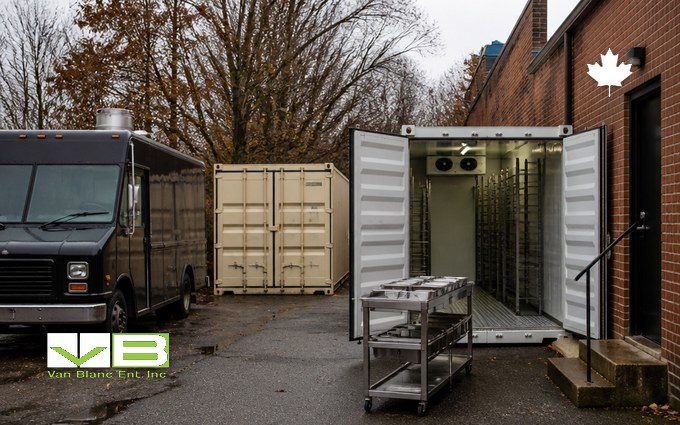
Quick Answer: A commissary kitchen is a licensed, inspected commercial kitchen that food trucks, caterers and small food brands rent by the hour or month. Wellington-Dufferin-Guelph Public Health says all truck food must be prepared in an inspected kitchen, not at home. An owned reefer and a dry box can sit nearby.
What This Commissary Guide Covers
- What Is a Commissary Kitchen?
- Commissary Kitchen Types and Who Uses Them
- Commercial Kitchen Rental: How Booking Works
- Commissary Pros and Cons for a Small Brand
- Ontario Commercial Kitchen Rules Under O. Reg. 493/17
- Food Trucks and Ontario Health Units
- Choosing a Commissary: Twelve Questions
- The Shelf Problem at a Shared Kitchen
- Winter Parking for Food Trucks and Trailers
- A 20ft Reefer as Your Own Walk-In
- Dry 20ft Box for Truck Gear and Packaging
- Siting Two Boxes on a Commissary Lot
- Ordering the Pair From Brantford
- FAQs
Reading Time: 16 minutes
What Is a Commissary Kitchen?
A commissary kitchen is a licensed commercial kitchen shared by food businesses that do not have one of their own. Tenants book time on the line, rent shelf space in the walk-in, and use the dish pit and loading door. Food trucks, caterers, bakers, sauce makers and meal-prep brands are the usual tenants. People also call it a shared kitchen, a community kitchen or a central kitchen.
The word comes from supply. A commissary was the depot that fed an army or a work camp, and the kitchen version still does that job. It is the base where the cooking, washing and storing happen before food goes out on a truck, to an event or to a delivery app. Van Blanc, a container supplier working from 4 Brantford yards since 1995, sells the steel boxes that tenants park beside those kitchens. A refrigerated 20-footer that holds a fixed set point is the one most food tenants ask about.
Paul and Christian LeBlanc run Van Blanc, a family company that dates from 1995. This guide answers the kitchen question first, then the storage one, because a truck owner needs both settled before spring.
Ghost kitchens are a different animal. A ghost kitchen cooks only for delivery apps, and it may start on commissary hours and outgrow them. Delivery-only kitchens and the path from shared hours to an owned shell are covered in their own guide, so this one stays on the commissary itself.
Commissary Kitchen Types and Who Uses Them
Commissary kitchens in Ontario come in a handful of shapes. The shape decides how much control you get over your hours, your equipment and your storage. Storage is the part a new steel box parked out back can take over. The table sorts the common shapes.
| Type | How you pay for access | Storage you usually get | Typical tenants |
|---|---|---|---|
| Shared hourly kitchen | Booked blocks of hours, often with a monthly minimum | A shelf or two in the walk-in, a dry rack, sometimes a freezer bin | Food trucks, farmers’ market vendors, new caterers |
| Shared kitchen with a dedicated station | Monthly, with one line or bench set aside | A fixed cold allotment and a locked cage | Bakers, sauce and meal-prep brands |
| Restaurant kitchen after hours | An agreement with the owner for closed hours | Whatever the owner can spare | Pop-up chefs, small caterers |
| Private or leased commissary | A lease on the whole kitchen | Everything inside the walls | Truck fleets, multi-unit food groups |
| Central kitchen for a group | Owned by the group | Built for the group’s own volume | Restaurant chains prepping for several sites |
Shared kitchens operate across the province, from the Toronto core and its inner suburbs to smaller cities. A commissary that serves food trucks often adds truck services. Some offer a place to fill the fresh-water tank, empty grey water, drop grease and park overnight. Ask about each one, because a truck that cannot dump its waste tank at the commissary needs another plan.
“A food truck renting two shelves in a commissary walk-in has to work around the other tenants. A 20ft of its own on the same lot keeps the packaging and off-season gear under the owner’s lock, open whenever the truck needs it.”
Paul LeBlanc, owner, Van Blanc
Caterers are the other big tenant group, and their start-up path has its own rules. The Ontario catering start-up walkthrough covers that trade, so the rest of this article stays with trucks, trailers and small packaged-food brands.
Commercial Kitchen Rental: How Booking Works
Commercial kitchen rental is the arrangement behind every shared kitchen. The operator holds the lease and the inspection, and tenants buy time and space under a written agreement. Expect an application, a tour, proof of insurance and a food handler certificate before your first shift.
Most kitchens sell time in blocks. Prime hours, such as early mornings and the days before a weekend, tend to book first. Late nights are usually easier to get. Storage is usually priced on its own line, by the shelf, the cage or the pallet spot. Truck parking, if offered, is another line again, much like seasonal parking for anything with a hitch.
What moves the monthly bill, roughly in order:
- Hours booked, and how many of them fall in prime time.
- Cold storage: shelves in the walk-in and space in the freezer.
- Dry storage: racks, cages and pallet spots.
- Truck services: parking, water fill, grey water and grease disposal.
- Extras such as a dedicated station, a packing room or a loading dock.
Van Blanc does not run a kitchen and rents nothing. We sell containers outright. Van Blanc’s part is the storage lines above, where an owned container can replace a rented shelf. Weigh that against the posted container price list before you sign a kitchen agreement.
Commissary Pros and Cons for a Small Brand
A commissary kitchen lets a small food business cook under inspection without building a kitchen. That is its main advantage, and for a first season it usually decides the matter. The trade-offs show up once sales grow.
| In its favour | Against it |
|---|---|
| The kitchen is already inspected and equipped | You share the line, the dish pit and the walk-in with other tenants |
| No build-out, no equipment purchase to start | Prime hours are booked out early |
| Short agreements, so a concept can be tested | Storage is small and charged by the shelf |
| Truck services may be on site | Gear often has to be loaded out after every shift |
| Other tenants are a network for events and suppliers | Another tenant’s mess can show up on your inspection day |
The storage line is the one Van Blanc can help with. A brand that has outgrown two shelves in someone else’s walk-in can own the cold space instead and keep the hours. For trucks that park at one spot all summer, the case for a fixed kiosk over a trailer is worth a read too.
Ontario Commercial Kitchen Rules Under O. Reg. 493/17
Every commercial kitchen in the province works under Ontario Regulation 493/17, the Food Premises Regulation, made under the Health Protection and Promotion Act. Local public health inspectors enforce it. A commissary operator carries most of the facility duties, and tenants carry the food handling ones. Cold rooms answer to the same sections, as the rules a walk-in cooler has to meet explains.
| O. Reg. 493/17 | What the regulation says |
|---|---|
| Clause 7(1)(c) | The floor or floor coverings are tight, smooth and non-absorbent in rooms where food is prepared, processed, packaged, served, transported, manufactured, handled, sold, offered for sale or displayed (and where utensils are cleaned or washing and toilet fixtures sit) |
| Clauses 7(3)(a) and (b) | A supply of potable water adequate for the operation, and hot and cold running water under pressure where food is processed, prepared or manufactured or utensils are cleaned |
| Clause 7(3)(c) | An adequate number of handwashing stations, maintained and kept adequately supplied, situated for convenient access by food handlers |
| Clause 7(3)(d) | Refrigerated space adequate for the safe storage of potentially hazardous food |
The food handling sections come next. They set how cold food is held and stored, whether it sits in the kitchen’s walk-in or in a reefer set to freezer temperatures.
| O. Reg. 493/17 | What the regulation says |
|---|---|
| Section 27 | Potentially hazardous food is stored, transported, displayed and sold only at an internal temperature of 4° Celsius or lower, or 60° Celsius or higher |
| Section 30 | Refrigeration and hot-holding equipment is of sufficient size for the food and holds the section 27 temperature, with accurate indicating thermometers that may be easily read |
| Section 31 | Racks, shelves or pallets used to store food protect it from contamination and are readily cleanable, such as wipe-clean steel racking |
| Section 32 | A food service premise has at least one food handler or supervisor with food handler training on the premise during every hour it operates |
Read clause 7(1)(c) closely. Its list of rooms covers food that is prepared, handled, packaged or displayed, and it does not name storage rooms. Storage shows up elsewhere, in clause 7(3)(d) and sections 30 and 31. Ask your inspector how those apply to any space you add outside the kitchen walls.
Inspections follow a risk score, whatever the kitchen cooks for, delivery-app brands included. The Ministry of Health’s 2019 reference document says routine inspections run from one to three times per year, depending on the risk categorization. Before you open, give the medical officer of health notice under subsection 16(2) of the Act. Section 5 lists what the notice includes. Permits are managed by your municipality, so check with your local building or planning department before you order.
Home Kitchen or Commercial Kitchen
A home kitchen and a commercial kitchen differ in law before they differ in equipment. The Act’s definition of a food premise leaves out “a room actually used as a dwelling in a private residence”. That is why nobody inspects a family kitchen. A commercial kitchen is a food premise, so the whole regulation applies to it. Floors, sinks, water, cold space and staff training all count. A commissary gives a new brand that legal footing without a build. Food trucks working around Hamilton’s harbour and mountain neighbourhoods meet the same sections as a downtown restaurant.
Food Trucks and Ontario Health Units
A food truck in Ontario is a mobile food premise. The regulation defines one as a trailer, cart or vehicle-mounted food premise, readily moved, in which food is prepared and offered for sale to the public. A stand that never moves, like a canteen at a ball diamond, is not a mobile premise. Section 4 adds four rules of its own. Food is prepared inside the premise and served by the people working in it. Only single-service articles are used to serve it. There are separate holding tanks for potable water and waste water, and each tank has an easily readable gauge.
The commissary enters through the health units, from Guelph to the festival grounds and plazas around London. Wellington-Dufferin-Guelph Public Health puts it plainly: all food must be prepared in an inspected kitchen, and no home food preparation is permitted. Peterborough Public Health’s 2023 guide, written before it became part of Lakelands Public Health, says off-site preparation must happen in an inspected food premise. For most new truck owners, that inspected food premise is a commissary. Health units word these rules differently, so read your own unit’s page.
“Food prepared in an uninspected kitchen is not permitted.”
York Region Public Health, Public Health Requirements for Mobile Food Vendors
The trade itself can pay. Innovation, Science and Economic Development Canada reports that 77.6% of small and medium mobile food services businesses were profitable in 2024, based on industry averages. Results vary with the menu, the spots and the weather. Storage is one line you can fix in advance, and a used box graded at our yards is the lower-cost way in.
What an Inspector Checks on a Truck
Health units run a pre-opening inspection before a truck sells anything. Peterborough’s 2023 guide set it at least one week before any planned use, with the truck ready to operate. Wellington-Dufferin-Guelph requires a mobile food premise to pass one before it starts operating each year. From the two units’ lists:
- Separate potable and waste water tanks, each with a readable gauge.
- A handwashing sink with hot and cold running water, soap and paper towels.
- A two- or three-compartment sink big enough to immerse equipment.
- Working fridges and freezers holding 4 °C or lower and keeping frozen food frozen.
- Thermometers, sanitizer and test strips on board.
- Screened service windows and doors, pest protection, ventilation and lighting.
- Proof of a certified food handler on site.
Fixed canteens meet the same sink rules, and sink layouts for a field canteen show how they fit them in. That Peterborough guide listed sanitizer strengths too: chlorine at least 100 ppm and quaternary ammonium compounds at least 200 ppm. A commissary with a proper dish pit makes the daily wash-down easier, which is one reason trucks sign on.
TSSA Rules for Propane on a Food Truck
Propane brings a second regulator. The Technical Standards and Safety Authority (TSSA) regulates mobile food service equipment, which covers any truck, trailer or cart with fuel-fired cooking. TSSA says all such equipment in Ontario must have a TSSA-issued field approval. Equipment built after February 13, 2006 may instead be certified by an accredited body. Trucks running since before that date are exempt, with proof. Every unit also undergoes an annual inspection by a TSSA-certified technician. Never store propane cylinders inside a closed container, a Van Blanc box included. Ask TSSA or your propane supplier where cylinders go over the winter. The same fuel rules follow a cooking kiosk or trailer, which the trailer versus kiosk breakdown compares on cost and floor space.
Choosing a Commissary: Twelve Questions
A commissary kitchen tour goes faster with a written list. Van Blanc drew these questions from the regulation and the health units’ truck checklists. The last few cover the storage gap that sends tenants looking for more room.
- Is the kitchen inspected, and can I see its latest posted result?
- Which hours are open, and how far ahead do prime slots book?
- How many walk-in shelves and freezer spots come with my agreement?
- Is there a locked dry cage or pallet spot for packaging and gear?
- Can I fill my truck’s potable water tank on site?
- Where do I empty grey water and drop used grease?
- Can the truck park overnight, and is the lot fenced and lit?
- Is there a plug-in for the truck’s fridges while it is parked?
- What insurance certificate does the operator want from me?
- Does the agreement require my own food handler certificate on every shift?
- Can I place a 20ft steel box of my own on the property for gear?
- What happens to my stored food if the walk-in fails?
Question 11 matters more than it looks. A commissary with spare yard space may let a tenant place an owned box, and that changes the storage maths. Get the answer in writing, and ask where on the lot the box would sit.
The Shelf Problem at a Shared Kitchen
Storage is where a commissary kitchen pinches first. When several tenants share one walk-in, a busy weekend can fill it days ahead. Dry racks fill with flour sacks, cups, lids, napkins and clamshells. Then the truck itself becomes the storeroom, and that only works while its fridges have power. That gap is the one a Van Blanc container fills, and a short note to our sales desk gets a delivered price back.
The squeeze gets worse in two seasons. Spring brings opening-day stock for every truck on the roster. In late fall the season ends, and a summer’s worth of gear needs a home. Think canopies, folding tables, empty generators, signs, coolers and unused packaging. The kitchen agreement rarely covers that kind of bulk.
Clause 7(3)(d) still wants refrigerated space adequate for the potentially hazardous food on hand. When the commissary’s walk-in cannot hold your share, an owned cold box can. Some kitchens add a panel cooler instead, and the panel walk-in route and how it compares covers that option. For packaging and gear, a steel box with shelves does the job, set up the way a field canteen gets locked up between seasons.
“Adequate refrigeration and freezer space must be available.”
Toronto Public Health, Structural requirements for food businesses
Winter Parking for Food Trucks and Trailers
Winter parking is the question an Ontario food truck owner faces once the outdoor season closes. A truck that stops selling for the cold months still needs a safe place to sit. A commissary with fenced parking is one answer. A heated building or an outdoor storage lot is another. Van Blanc does not store trucks, and options for parking a trailer through the winter lays them out for anything on wheels.
Water is the first job before the cold arrives. Drain the potable and waste tanks and the lines, because frozen water splits fittings. Wellington-Dufferin-Guelph says a seasonal mobile food premise should disinfect its holding tanks before opening each season. Its method fills the tanks and lines with a bleach and water solution and leaves it for 12 hours. Hose ends and connections get dipped in a 200 ppm bleach solution before they are joined.
Food Truck Winter Shutdown Checklist
- Sell down or move perishable stock to inspected cold storage before the last service.
- Drain potable and waste tanks, the water heater and all lines.
- Deep clean the line, the hood filters and the fridges, then prop fridge doors open.
- Shut off and disconnect the propane, and follow TSSA and supplier advice on cylinders.
- Take off everything that can walk away: tablets, the POS terminal, small wares and signs.
- Store canopies, tables, generators without fuel and packaging somewhere dry, behind a lockbox rather than a bare padlock.
- Book the TSSA annual inspection and the health unit’s pre-opening inspection for spring.
Step 6 is where a dry 20ft earns its keep for a truck owner. The truck can sit at the commissary or a storage lot, while the gear sits in a locked box you own. Each box needs some airflow, and passive vents against winter condensation keep cardboard packaging from going soft by March.
“When the truck season ends, a food truck’s gear box fills with canopies, folding tables and cases of lids. I ask owners to run their generators dry before they go in, and the propane cylinders never go in at all.”
Christian LeBlanc, second-generation operator, Van Blanc
A 20ft Reefer as Your Own Walk-In
A 20ft refrigerated container is an insulated steel box with its own refrigeration machine at one end. Van Blanc’s reefer spec sheet for the 20-foot size lists the figures below. Inside, it works like a small walk-in that no other tenant can fill.
- Inside volume of 27.7 m³ (978 cu ft), smaller than a dry box because the foam takes its share.
- Inside length, width and height of 5.440 x 2.270 x 2.240 m.
- A temperature range of -30°C to +30°C, so one box runs as a cooler or a freezer.
- About 3,000 kg empty, carried on four corner castings.
- A T-bar aluminium floor that moves cold air under the load.
One reefer holds one set point at a time. Chilled prep and frozen stock together means two reefers, or frozen goods left in the commissary’s freezer. Running a reefer as a freezer covers the low end of the range. Section 30 asks for accurate indicating thermometers that may be easily read. A display you can read from outside the doors helps.
“Provide storage thermometers inside all cold holding units.”
Simcoe Muskoka District Health Unit, Guidelines for Operating a Mobile Food Premises
Reefers sit outside Van Blanc’s standing price list. Ask the yard at 519-754-6844 which 20ft reefers are available, with each unit’s make, machine hours and data plate. A technician’s check before you buy is money well spent, and the reefer items a technician tests are listed in that guide.
“On a used reefer I read the machine before the box. Steel can be sound while the refrigeration unit is tired, so a food truck owner sees the make, the hours and the data plate before trusting it with prepped stock.”
Paul LeBlanc, owner, Van Blanc
Dry 20ft Box for Truck Gear and Packaging
A standard dry 20ft is the off-season home for everything a truck carries except food. Van Blanc’s dry 20ft with its inside dimensions gives the numbers in the table, with door figures from Hapag-Lloyd’s fleet specification.
| Spec | Dry 20ft, the gear box | 20ft reefer, the cold box |
|---|---|---|
| Inside size (L x W x H) | 5.898 x 2.352 x 2.385 m | 5.440 x 2.270 x 2.240 m |
| Cubic capacity | 33.2 m³ (1,172 cu ft) | 27.7 m³ (978 cu ft) |
| Clear door opening, wide by high | 2,340 x 2,292 mm | 2.290 x 2.210 m |
| Floor type | Marine plywood | Aluminium T-bar decking with air channels |
| How to load it | 10 pallets on the floor, or shelving down both walls | Racks that leave the air channels clear |
| Power | None needed | 380/460 V three-phase, 32 A plug |
| Typical contents | Canopies, tables, small wares, cups, lids, clamshells, signage | Prepped proteins, dairy, sauces, frozen stock at the set point |
Plan the inside of the dry box like a stockroom. Steel shelving down both long walls keeps cases off the plywood and leaves an aisle for a hand truck. Shelving layouts for a 20ft interior show the common setups. A lockbox over the padlock and vents near the roof can be fitted before delivery, from the add-ons we install at the yard.
Keep food out of the dry box altogether. It has no refrigeration, and it is for gear and packaging only. Food stays in the reefer or in the commissary’s own inspected storage, on racks that section 31 says must protect it and be readily cleanable.
Siting Two Boxes on a Commissary Lot
Placement starts with the landlord. Before Van Blanc books the delivery, get written permission from the commissary or property owner for the spot, the power and the access. Then work out power, because power decides where a Van Blanc reefer can sit. The reefer wants 380/460 V three-phase power, delivered through a 32 A plug. Where a lot has only single-phase service, the choices are a three-phase upgrade or a rotary phase converter matched to the data plate. Three-phase supply and phase converters for a reefer explains the options. Van Blanc roughs any electrical work to spec, and a licensed electrician makes the final connection.
“Before a reefer leaves our Brantford yards for a commissary lot, I want two answers: the landlord’s written okay for the spot, and a photo of the panel showing three-phase. Without both, the box ends up beside a kitchen it can’t plug into.”
Christian LeBlanc, second-generation operator, Van Blanc
Both boxes want a firm, level base, such as railway ties or cribbing under the four corners. Face the reefer’s doors toward the kitchen’s back door and its machine end toward the power. Park the gear box nearer the truck’s spot, doors facing it, so loading takes a few steps. Leave room to swing both sets of doors fully open.
Delivery comes on a tilt-deck truck that slides the box off the back. The clearances a tilt-deck needs on a tight lot are worth checking against the commissary’s yard before you order.
Ordering the Pair From Brantford
Dry 20ft boxes come in four grades at Van Blanc, and the buyer picks. A new, one-trip box has crossed the ocean once, loaded, and still wears its factory paint. Cargo worthy means used but inspected fit for shipping, with surface wear. Wind and watertight units are older boxes that keep weather out. As-is boxes have written-down defects and go to donor or project work. How each used grade looks up close shows the differences, and the one-trip stock we bring in new covers the top grade.
New and used 20ft units from our price list are in stock and ready for your order, spread across 4 Brantford yards. Delivery takes 1 to 3 days to every region of Ontario, Eastern Ontario included. Every quote comes with a real lead time, not a hopeful one. Our full lineup of sizes and grades sits on one page if a 40ft makes more sense for a fleet.
Payment is on delivery, by draft cheque, cash, wire transfer or credit card through an authorization form. Order the dry box first, and order the reefer once your electrician has confirmed the supply. Both can then be working before spring opening.
Price a Reefer and a Gear Box for Your Truck
Tell us your postal code, the commissary lot you will use and what you need to keep cold and dry. We will match a reefer and a dry 20ft, list the grades and machine hours, and send one delivered number. The quickest answer is a phone call.
Family-run in Brantford since 1995 · 4 Brantford yards · 4.9★ across 140+ Google reviews.
Frequently Asked Questions
What does commissary mean in a kitchen?
A commissary is a central base that supplies food to other places. In a kitchen, it means a licensed commercial kitchen where food trucks, caterers and small brands cook, wash up and store food before it goes out. Most rent their time and shelf space by the hour or month.
What does a commercial kitchen require?
It needs to meet the food premises rules where it operates. In Ontario, that starts with potable water and hot and cold running water under pressure. Add enough handwashing stations, adequate cold space, cleanable floors and accurate thermometers. A trained food handler works every open hour.
What are the requirements for a commercial kitchen in Ontario?
O. Reg. 493/17 sets them. Give notice to the medical officer of health before opening. Keep potentially hazardous food at 4 °C or lower, or 60 °C or higher. Use readily cleanable racks and shelves, and keep a food handler-trained person on site every hour. Public health inspectors check against it.
What is the difference between a regular kitchen and a commercial kitchen?
The Health Protection and Promotion Act keeps rooms people live in out of its food premise definition, so a home kitchen falls outside it. A commercial kitchen is a food premise, so the Food Premises Regulation and public health inspections apply to its floors, sinks, water, refrigeration and staff training.
Do food trucks need a commissary kitchen in Ontario?
Food is prepared inside the truck under the regulation. Any prep done elsewhere has to happen in an inspected kitchen, and health units such as Wellington-Dufferin-Guelph do not allow home preparation. A commissary is the usual inspected kitchen. Ask your health unit for its rules.
Can a reefer at a commissary run on regular power?
No. Reefers draw 380/460 V three-phase power and connect with a 32 A plug. On single-phase service you need a three-phase upgrade or a rotary phase converter matched to the reefer’s data plate. A licensed electrician does the hookup. Ask the yard at 519-754-6844 for a unit’s plate.
Sources
- Government of Ontario. O. Reg. 493/17: Food Premises, current consolidation. e-Laws text of the Food Premises regulation, checked November 2026.
- Ontario Ministry of Health. (2019). Food Premises Reference Document. Ministry of Health 2019 food premises reference guide, checked November 2026.
- Wellington-Dufferin-Guelph Public Health. Mobile Food Premises. WDG Public Health mobile food premises page, checked November 2026.
- Peterborough Public Health, now part of Lakelands Public Health. (2023). Operating a Mobile Food Premise. Peterborough Public Health mobile food premise guide, copy hosted by the Township of Selwyn, checked November 2026.
- Technical Standards and Safety Authority. Mobile Food Service Equipment. TSSA mobile food service equipment rules, checked November 2026.
- Innovation, Science and Economic Development Canada. Mobile food services, NAICS 72233: Canadian Industry Statistics summary. ISED Canadian Industry Statistics for mobile food services, checked November 2026.
- York Region Public Health. Public Health Requirements for Mobile Food Vendors. York Region mobile food vendor fact sheet, checked November 2026.
- Toronto Public Health. Structural Requirements. Toronto Public Health structural requirements for food businesses, checked November 2026.
- Simcoe Muskoka District Health Unit. Guidelines for Operating a Mobile Food Premises. Simcoe Muskoka mobile food premises guidelines, checked November 2026.
See a Reefer and a Dry Box at Our Brantford Yards
We have been supplying shipping containers across Ontario since 1995. Our public yard is at 90 Morton Avenue East, one of our 4 Brantford yards.
Van Blanc Ent. Inc., 90 Morton Ave E Unit 1B, Brantford, ON N3R 7J7, 519-754-6844.
Bring a list of your truck’s off-season gear and a photo of the commissary’s electrical panel. We will open a dry 20ft so you can picture your shelves, and run a reefer if one is on the ground that week. Worth the drive for unbeatable quality, family customer service with 30 years of experience.