
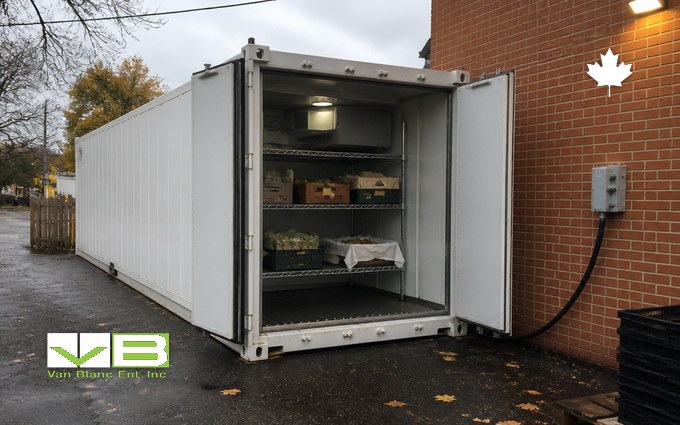
Quick Answer: A walk in cooler is an insulated, refrigerated room you step into, kept at 4 °C or lower to meet Ontario’s food-premises rule. Businesses build one from panels, buy an outdoor unit or set down a reefer container. Van Blanc’s reefers arrive fully built, holding -30 °C to +30 °C.
Cooler Options Covered Here
- What Is a Walk In Cooler?
- Walk-In Cooler Temperature Rules in Ontario
- Three Ways to Get a Walk-In
- Panel Coolers Built Inside the Building
- Outdoor Walk-In Coolers
- Walk In Cooler for Sale: The Reefer Route
- Reefer Walk-Ins for Kitchens, Butchers and Food Banks
- Power for a Reefer Walk-In
- Pad, Placement and Delivery
- Reefer Box Age and Machine Hours
- Commercial Walk In Cooler Costs
- Running a Reefer Walk-In Day to Day
- Frequently Asked Questions
Reading Time: 16 minutes
What Is a Walk In Cooler?
A walk-in cooler is a refrigerated room large enough to step inside, built for stock that has to stay cold between deliveries. Kitchens also call it a walk-in fridge or a cold room. Natural Resources Canada regulates the parts that go into one. Its definition is an enclosed storage space of less than 278.71 m² (3,000 square feet), designed to run at or above 0 °C. Design the same room to run below 0 °C and it becomes a walk-in freezer.
Ontario businesses get a walk-in in one of three ways. A refrigeration contractor builds a panel room inside the building, or sets an outdoor walk-in on a pad beside it. The third way comes on a truck: a reefer with its walls, door and machine already built. Van Blanc sells those from our 4 Brantford yards. Restaurants, caterers, butchers, farm markets and food banks run one as a commercial walk in cooler without adding a room to the building.
Every walk-in, whatever it looks like from the parking lot, runs on four sets of parts. Insulated walls, ceiling and floor hold the cold. A gasketed door lets people and carts through. A refrigeration system moves heat from an evaporator inside to a condensing unit outside. A controller and a thermometer show the room is holding its number.
Christian LeBlanc works the Van Blanc yards with his father, Paul, and his first questions about a reefer walk-in are about the kitchen’s routine. The same routine decides where a panel cold room built into one end of a container restaurant goes.
Christian LeBlanc, second-generation operator, Van Blanc Ent. Inc.: “When a kitchen asks about a reefer for its walk-in, I ask them to walk me through a Friday delivery. Where the truck stops, how far the cases roll, which door the cooks use at nine at night. The box belongs where the dolly runs, close to the back door, with the plug on the same wall.”
Walk-In Cooler Temperature Rules in Ontario
Walk-in cooler temperatures in Ontario come from one provincial regulation and two federal sources, and they agree on the chilled number. Ontario Regulation 493/17, the Food Premises Regulation, says potentially hazardous food is stored at an internal temperature of 4 °C or lower. Hot-held food sits at 60 °C or higher. The rule allows food outside that range for up to two hours when preparation, processing or manufacturing needs the time. A container kitchen answers to that rule too, and fitting a container out to food-grade standard starts there.
Frozen food is handled differently. Section 28 asks only that food meant to be kept or sold frozen stay frozen until it is sold or prepared. It names no temperature. The Ministry of Health’s reference document notes a jurisdictional review on the point. Of the national and international food safety regulations reviewed, 39 of the 67 set no specific freezing temperature. The familiar -18 °C freezer figure is federal guidance, and running a reefer below freezing has its own write-up on our site.
The Canadian Food Inspection Agency gives both numbers as examples of meeting section 65(1) of the Safe Food for Canadians Regulations. Food that needs refrigeration is stored at 4 °C or less, and food that needs freezing at -18 °C or less. Health Canada’s storage advice gives a fridge 4 °C (40 °F) or lower and a freezer -18 °C (0 °F) or lower. A reefer’s controller can hold either figure, and our defrost guide explains what keeps a reefer on its number between defrosts.
| Source | Chilled | Frozen | Who it speaks to |
|---|---|---|---|
| Ontario Food Premises Regulation (O. Reg. 493/17), s. 27 and 28 | 4 °C or lower, internal food temperature | Kept frozen; no figure set | Food premises in Ontario |
| CFIA guidance on SFCR s. 65(1) | 4 °C or less | -18 °C or less | Food businesses under the federal regulations |
| Health Canada, safe food storage | 4 °C (40 °F) or lower | -18 °C (0 °F) or lower | Household fridges and freezers |
| Natural Resources Canada, walk-in definitions | At or above 0 °C | Below 0 °C | Walk-in panels, doors and refrigeration systems |
| Master-Bilt, a walk-in maker | Around 35 °F (about 1.7 °C) | Around -10 °F (about -23 °C) | Its general rule of thumb for set points |
A room set at exactly 4 °C has no margin for a door propped open during a delivery. Master-Bilt gives its lower figure for food preservation and safety, and the extra degrees also cover a door opening. Game is a separate case, and our reefer page for hanging game at camp follows Ontario’s carcass-cooling guidance instead.
Thermometers, Racks and Air Flow
The regulation asks more of a walk-in than a number. Section 30 says refrigeration equipment for potentially hazardous food must be big enough to hold it at the section 27 temperature. It must also contain accurate indicating thermometers that are easy to read. Section 31 says racks, shelves and pallets must protect food from contamination and be readily cleanable. Section 7(3)(d) asks every food premise for refrigerated space adequate for the safe storage of potentially hazardous food. When that space runs out, a second walk-in that arrives on a truck is the answer Van Blanc sells.
The ministry’s reference document adds practical notes. Over-stocking a refrigerator can cause temperature swings and poor air circulation, and first-in, first-out rotation keeps older stock moving. Most commercial refrigerators are designed to hold food that is already chilled. The document adds that most are not intended to cool large volumes of hot food. Its accepted cooling path is 60 °C to 20 °C within 2 hours, then 20 °C to 4 °C within 4 hours.
The CFIA’s guidance adds a point about air: food goes into refrigerated or freezer storage in a way that does not restrict air flow. In a reefer the cold air travels through channels in the floor, so the load has to leave those channels open. What a refrigeration technician checks before you buy includes the evaporator fans and the T-bar floor that carry that air.
Three Ways to Get a Walk-In
A walk-in for an Ontario business comes as a room built inside, a unit set outside, or a refrigerated container delivered whole. All three can hold food at 4 °C. They differ in where they sit, who builds them, and how much of the work happens at your address.
| Question | Panel walk-in, indoors | Outdoor walk-in | Reefer container |
|---|---|---|---|
| Where it sits | Floor space inside the building | A pad beside the building | Ties, cribbing or piers outside |
| Walls | Insulated panels, at least RSI 4.40 (R-25) for a cooler under NRCan rules | The same panels, plus a roof and a door rain hood | Steel shell with factory foam insulation |
| Cooling | Condensing unit and evaporator, fitted by a contractor | Outdoor-rated condensing unit, held to a higher NRCan efficiency floor | Carrier, Thermo King or Daikin unit built into the front wall |
| Cooler or freezer | Chosen at design; freezer panels need RSI 5.64 (R-32) | Chosen at design | Either, set at the controller |
| Power | Set by the system installed | Set by the system installed | A dedicated 380/460-volt three-phase circuit, matched to the unit |
| How it arrives | Assembled on site | Assembled or set on site | Slid off the back of a tilt-deck truck, ready for its circuit |
The reefer column is the one Van Blanc sells. Refrigeration contractors build the other two, and the next two sections set out how, so the three routes can be weighed side by side.
Panel Coolers Built Inside the Building
A panel walk-in is a room of insulated panels locked together on site, with a refrigeration system sized to it. Walk-in panels and doors have had to meet Natural Resources Canada’s efficiency rules since June 5, 2017. Cooler structural panels need an RSI of at least 4.40, which is R-25. Freezer panels need RSI 5.64 (R-32), and freezer floor panels RSI 4.93 (R-28). An insulated container with a cooling unit added is the container version of a panel room.
The refrigeration side came under the rules later: dedicated condensing systems for walk-in coolers on January 1, 2020, and freezer systems on July 10, 2020. Danfoss, which makes walk-in refrigeration parts, sorts the systems into three layouts: self-contained, remote condensing and multiplex. A refrigeration contractor picks one, sizes it to the room and installs it.
Space is the cost a panel room charges up front. Master-Bilt advises shelving around the perimeter and aisles of about 40 inches where carts load the room. Every square metre of that comes out of the kitchen or the storeroom. A panel room suits a business with that floor to spare. A container restaurant can build one into its own box, a layout covered in our notes on fitting a cooler before the cook line.
Outdoor Walk-In Coolers
Outdoor walk-in coolers are panel rooms built to stand in the weather, set on a pad outside the building. They free floor space inside and take more parts to do it. Master-Bilt lists the extras outdoor models need. They are a vinyl roof, a rain hood for the door, and a low-ambient kit for the refrigeration in cold-winter areas. NRCan sets a higher minimum annual walk-in energy factor for outdoor condensing units than indoor ones: 2.227 against 1.644 for coolers.
The outdoor options suit a business with yard space and a wall to set the unit against. The work still happens on site: pad, panels, refrigeration and wiring. A reefer is an outdoor walk-in of a different build. Its shell was made for ocean shipping, and the forty-foot high cube reefers we sell carry a CSC safety plate. It lands with the refrigeration already fitted, and we start it for you.
Walk In Cooler for Sale: The Reefer Route
A walk in cooler for sale from Van Blanc is a refrigerated shipping container. The trade calls it a reefer: a steel box lined with foam, with a Carrier, Thermo King or Daikin refrigeration unit built into one end. It holds any set point in its range, so the same box runs as a cooler below 4 °C or a freezer at -18 °C. Van Blanc sells two sizes, and the figures below come from the 20ft reefer’s full spec sheet and its 40ft high cube counterpart.
| Measure | 20ft reefer | 40ft high cube reefer |
|---|---|---|
| Outside (L x W x H) | 6.058 x 2.438 x 2.591 m (20 ft x 8 ft x 8 ft 6 in) | 12.192 x 2.438 x 2.895 m (40 ft x 8 ft x 9 ft 6 in) |
| Clear inside (L x W x H) | 5.440 x 2.270 x 2.240 m (17 ft 10 in x 7 ft 5 in x 7 ft 4 in) | 11.583 x 2.294 x 2.548 m (38 ft x 7 ft 6 in x 8 ft 4 in) |
| Door opening (W x H) | 2.290 x 2.210 m (7 ft 6 in x 7 ft 3 in) | 2.294 x 2.520 m (7 ft 6 in x 8 ft 3 in) |
| Cold volume | 27.7 m³ (978 cu ft) | 67.0 m³ (2,366 cu ft) |
| Walls | Polyurethane foam 80-100 mm thick, U-value under 0.4 W/m²K | Same foam, plus a stainless steel food-grade lining |
| Floor | T-bar aluminium air-channel decking | T-bar aluminium air-channel decking |
| Empty weight with unit | 3,000 kg | 4,575 kg |
Both boxes sit on one list with every container on the ground today, reefers included, for anyone comparing them against the dry sizes. Our 20ft page says the thermal envelope takes about 16 percent of the volume of a dry 20ft, which holds 33.2 m³. Roughly 10 cm of foam lines each side, and about 90 cm of machine sits at the front.
How much fits is a rule-of-thumb question. Master-Bilt’s starting point is that one cubic foot holds about 28 lbs of food, before shelving and aisles. Run a busy week’s stock through that rule, compare it with the cold volume row above, and leave room for the carts.
Reefer Walk-Ins for Kitchens, Butchers and Food Banks
A standard reefer holds one set point for the whole box, so the number of boxes follows the number of temperatures a business keeps. A kitchen with only chilled stock starts with one. A business that also keeps frozen stock adds a second box run as a freezer. The other way is a 40ft high cube partitioned into a chilled room and a frozen room. Some Daikin units hold two set points natively and others need a freezer module added. Van Blanc delivers the bare box, and a refrigeration contractor builds the partition.
| Buyer | Box that usually suits | Set point to plan around | What goes inside | Where it sits |
|---|---|---|---|---|
| Restaurant | A 20-foot reefer parked by the kitchen door for overflow; a 40ft high cube for a group supplying several outlets | 4 °C or lower | Produce, dairy and proteins on cleanable racks | Behind the kitchen, doors toward the back entrance |
| Caterer | 20ft reefer | 4 °C or lower | Rolling racks of event trays | Near the loading door |
| Butcher or meat shop | 20ft; 40ft high cube for seasonal overflow | 4 °C or lower fresh; -18 °C frozen | Rails or racks for fresh cuts, boxed frozen stock in a second box | Beside the cutting room |
| Farm market | 20ft reefer | Set by the crop | Produce in crates | By the stand or market barn |
| Food bank | 40ft high cube reefer | Chilled, with a frozen room if partitioned | Pallets of donated food | At the receiving dock |
The table is a rule of thumb by buyer type, drawn from the uses our reefer pages list. Your own stock list decides the box.
Restaurants and Caterers
A reefer gives Toronto restaurant kitchens and small-town diners the same thing: overflow walk-in space outside the building. Restaurant and food-service overflow is one of the 20ft reefer’s listed uses, catering companies included. The box sits outside the back door, so cases go from the delivery truck to the shelf in one trip. Restaurant groups running a cold hub for several outlets use the 40ft high cube. Our 40HC page describes hubs serving 8 to 15 outlets.
Butchers and Farm Markets
Butchers, meat shops and game processors need cold that holds through a busy season. Our deer-season page covers hanging carcasses in a reefer through the fall hunt, and that rail-and-aisle layout serves a shop taking on seasonal overflow. A meat business adding curing or smoking can read the curing and smokehouse rooms for a meat plant alongside it. A farm market can run a 20ft reefer by the stand, set for whatever crop is inside that month.
Food Banks and Regional Hubs
Food banks take donations in waves, after harvest and over the holidays, and our 40HC page lists food bank distribution among its uses. A 40ft high cube gives the most cold floor per delivery. A 40ft high cube reefer split into chilled and frozen rooms keeps donated frozen food apart from fresh. Dry goods, hampers and event tables belong in a plain box beside it, the setup in our storage piece for churches and food banks.
Power for a Reefer Walk-In
A reefer walk-in needs a dedicated supply, and that is the first thing to check at the building. Our power guide puts a standard reefer on three-phase power at 460 volts, on a 32-amp circuit. Our freezer-container guide lists three-phase at 380-460 volts for the 20ft and the 40ft high cube alike. The same power guide covers reefers wired only for three-phase. It also covers the rotary phase converter, sized 15 to 20 hp, that lets a single-phase site run one. The make and model on the quote set the supply and plug your electrician works to. A licensed electrician confirms what your building can feed before the box ships.
The electrician wires the circuit, the ESA inspects the hookup, and that work is quoted separately from the box. Plan the cable run as well. Our 20ft page puts a typical run from the reefer’s plug to the site outlet at 30 to 60 feet. The pad has to leave room for it. On a site with no service at all, a 15-20 kW diesel genset runs a 20ft reefer through a proper generator tie-in. It burns roughly 1.5 to 2.5 litres of diesel an hour.
Electricity is the running cost, and it climbs with the job. Our product pages say below-zero duty draws well over half again what chilled storage does. A 40ft high cube uses roughly 1.4 to 1.7 times the electricity of a 20ft under the same conditions. Phase converters, transformers and gensets each get their own section in that guide.
Electrician First, Box Second
Book the electrician when you order the box, so the circuit can be ready by delivery day. Hand them the make and model from the quote and the measured cable run, so the outlet goes on the right wall.
Pad, Placement and Delivery
A reefer sits on the base any container uses. The 20ft page lists railway ties or pressure-treated 6 x 6 cribbing under the four corner castings. Concrete piers below the frost line suit a permanent spot. A reefer is heavier than a dry box. The 20ft runs about 1,000 kg over a standard 20ft, and a loaded 40ft high cube can reach 34,000 kg. Levelling the four corner castings comes before the first load goes in.
Placement follows the kitchen’s routine. A tilt-deck truck slides the box straight back along its own line of travel, so the truck’s approach decides which way the doors face. Mark where the doors should open toward the back entrance before the truck arrives. Then measure the cable run from the unit end to the outlet. Where a fence, a hedge or a tight lot blocks the approach, ask about lifting the box in with a HIAB when you call.
A reefer that is in stock lands at most Ontario addresses in 1-3 days, shipped from our 4 Brantford yards. That covers a kitchen in Kitchener or Waterloo and a restaurant in Windsor, along with the Toronto kitchens above. Eastern runs are no different, and Ottawa food businesses can plan on 1 to 3 days. A grade or spec we do not have on the ground is sourced to order in 2 to 4 weeks. The Van Blanc quote says which it is. Every quote comes with a real lead time, not a hopeful one.
Your Walk-In, Quoted Landed
Tell us what goes in, the temperature you need, what the panel can feed and where the box would sit. We will name the size, the grade and the hours on the machine. Then you get one landed number with a real lead time. The fastest answer is a call.
Family-run in Brantford since 1995 · 4 Brantford yards · 4.9★ across 140+ Google reviews.
Reefer Box Age and Machine Hours
A reefer has two ages, the box and the machine. Every Van Blanc quote lists the unit’s make, model and approximate hours. You watch the machine run before the box ships, at the yard or over video. Our reefer pages sort them into four grades:
- New (one-trip): one voyage from Asia, essentially new, with the refrigeration unit under 5,000 hours. Clean steel and factory-tight gaskets suit customer-facing sites, and our one-trip stock, fresh off its first voyage is where these sit.
- Cargo worthy (CW): used 8 to 15 years, serviced and CSC re-certified, with unit hours typically 30,000 to 60,000. It is the default reefer for working operations, restaurant overflow and food bank distribution included.
- Wind and watertight (WWT): an older box, 15+ years, with heavier exterior rust and often a recent compressor or fan replacement. It is matched to above-zero work in the 4-12 °C band, where the machine runs light.
- As-is: the unit may not run or may be gone, with the insulated envelope intact. It suits a custom cooling build, or a reefer body kept as insulated storage with no machine at all.
Cargo worthy and wind and watertight also label our used containers, each one graded. For a walk-in that will face a public-health inspection, we recommend a pre-purchase check by a refrigeration technician.
Commercial Walk In Cooler Costs
The cost of a commercial walk in cooler depends on the route, and each route has its own drivers. A panel room’s number moves with its size, panel thickness, floor, doors, refrigeration layout and installation time. An outdoor unit adds the pad, the weatherproofing and the outdoor-rated condensing unit. All three carry an electrician’s work.
A Van Blanc reefer quote is landed: the box plus delivery, priced together as one number. Size, grade and the hours on the machine move it first, then the delivery run and site access. The delivery charge per box drops on orders starting at three units. The electrical circuit is paid to your electrician, and any partition wall to the refrigeration contractor who builds it. Send the stock list and a photo of the panel and the number usually comes back the same day.
Life span sets the other half of the math. Master-Bilt puts a walk-in’s average life at 15 years, and longer with good maintenance. A reefer is judged by the hours on its machine instead, which is why every quote lists them.
One warning applies before any deposit. Plenty of buyers call to say a Facebook listing undercuts every yard’s price, and some call back two weeks later, scammed. Reefers are a rarer target than dry boxes, but the pattern repeats: a deposit by e-transfer, then a seller who vanishes. A real seller starts the machine for you to watch. The fake-listing warning signs are worth five minutes before any deposit.
Running a Reefer Walk-In Day to Day
A Van Blanc reefer walk-in runs like any walk-in, with a bigger door. Set the controller under the 4 °C limit so door openings leave a margin. Keep a thermometer inside where staff can read it, as section 30 asks. The display on the front of the unit shows the box temperature without anyone opening the doors.
The cargo doors are wide, and every opening lets warm air in. Danfoss names strip and air curtains as ways to cut heat gain at a walk-in door. A strip curtain can hang inside a reefer’s doorway too. Stack so air moves around the stock, the CFIA’s point about air flow. The unit also defrosts its own coil, and how a reefer’s defrost routine protects its set point is worth reading before the first busy weekend. Large batches of hot food start in shallow pans or an ice bath, as the ministry suggests. They still have to meet the 2-hour and 4-hour cooling path above.
Frequently Asked Questions
How much does it cost to put in a walk-in cooler?
It depends on the route. A panel walk-in is priced on its size, panels, floor, doors, refrigeration system and installation, and an outdoor unit adds a pad and weather protection. A Van Blanc reefer is quoted landed, box and delivery as one number, set mainly by size, grade and machine hours. The electrician’s circuit is a separate cost on every route. Call 519-754-6844 with the size and your postal code for a number, usually the same day.
Can I make my own walk-in cooler?
Yes. People insulate a room and cool it with a refrigeration unit, and the camp cooler builds hunters try each fall are a common version. A food business still has to hold food at 4 °C or lower, with an accurate thermometer and cleanable shelving. Walk-in panels and refrigeration systems also fall under NRCan efficiency rules. A reefer arrives with its insulation and machine already matched.
What is the best affordable walk-in cooler for a small business?
The most affordable walk-in is the one sized to your stock, so you are not cooling empty space. Master-Bilt’s starting rule is about 28 lbs of food per cubic foot, plus aisles for carts. For a single kitchen’s overflow, the 20ft reefer usually suits, and it needs no room built around it. Cargo worthy is the working grade for restaurant overflow, and one-trip carries the newest machine.
What is the life expectancy of a walk-in cooler?
Master-Bilt, a walk-in maker, puts the average at 15 years and says maintenance can stretch it. On a reefer, the hours on the refrigeration unit tell you more than the calendar does. Every Van Blanc quote lists the unit’s make, model and approximate hours. Ask us to start it while you watch, in person or on a video call.
What temperature should a walk-in cooler be in Ontario?
Cold enough that the food inside stays at 4 °C or lower, the limit Ontario’s Food Premises Regulation sets for potentially hazardous food. Setting the room a little under that leaves a margin for door openings, and Master-Bilt suggests around 35 °F. A walk-in freezer works to -18 °C or less, the figure in CFIA and Health Canada guidance.
Can a reefer container work as a walk-in freezer?
Yes. Our reefers hold any set point down to -30 °C, so one box can run at the -18 °C freezer figure. Frozen duty draws noticeably more power than chilled storage. A refrigeration contractor can also split a 40ft high cube into chilled and frozen rooms. Our guide to reefers in freezer service covers the running costs that change.
Where can I buy a walk in cooler in Ontario?
Panel and outdoor walk-ins come through refrigeration contractors and foodservice equipment dealers, and are assembled or set on site. A Van Blanc reefer arrives built, in 20ft or 40ft high cube. It ships from our 4 Brantford yards in 1-3 days to most of Ontario. You can watch one run before you buy, at one of the yards or on a video call.
Sources
- Natural Resources Canada. Walk-in freezer and walk-in cooler components, Energy Efficiency Regulations summary. NRCan walk-in cooler and freezer components, checked October 2026.
- Ontario Ministry of Health. (2019). Food Premises Reference Document, guidance on O. Reg. 493/17. Ontario Food Premises Reference Document 2019, checked October 2026.
- Canadian Food Inspection Agency. Regulatory requirements: Preventive controls for food businesses, subsection 65(1) of the SFCR. CFIA preventive control requirements, checked October 2026.
- Health Canada. Safe food storage. Health Canada safe food storage, checked October 2026.
- Master-Bilt. Walk-In Cooler and Freezer FAQs. Master-Bilt walk-in cooler and freezer FAQs, checked October 2026.
- Danfoss. Walk-in coolers: an introduction. Danfoss introduction to walk-in coolers, checked October 2026.
Book a Reefer Walk-Through in Brantford
We have been supplying shipping containers across Ontario since 1995. Our public yard is at 90 Morton Avenue East, one of our 4 Brantford yards.
Van Blanc Ent. Inc., 90 Morton Ave E Unit 1B, Brantford, ON N3R 7J7, 519-754-6844.
Call first with your stock list and a photo of the electrical panel, and we will run a reefer for you at the yards or on a video call, so you can watch the display hold its set point before you choose. Worth the drive for unbeatable quality, family customer service with 30 years of experience.