
Quick Answer: A concession stand is a fixed building that sells food at a field, arena, fair or park. In Ontario it comes four ways: a wood shed-style stand, a converted steel shipping container, a site-built canteen, or a trailer. Ontario’s public health sink rules set the layout before the menu does.
In This Guide
- Where We Stand
- Who Actually Buys a Concession Stand in Ontario
- The Sinks Come First: What Ontario Food Premises Rules Do to the Layout
- The Four Routes
- The Wood Shed-Style Stand
- The Trailer, and When It Is the Wrong Answer
- The Site-Built Canteen
- The Container Canteen
- The Serving Window, the Counter and the Line
- Power, Water and the Off-Season
- What the Building Lets You Sell
- What Moves the Price
- Concession Stand FAQs
Reading Time: 14 minutes
Where We Stand
A shipping container yard in Brantford wrote this. We convert containers into canteens, kiosks and bars at our yard, so one of the four routes below is ours, and you should read the other three knowing that. We have no connection to any builder or trailer maker named here, and for a lot of clubs the wood stand or the trailer is the right buy. The section on who should buy which says so without hedging.
The food-premises facts below come from Ontario public health unit guidance under the provincial food premises regulation and were checked on September 11, 2026. This page explains what shapes the building; your local public health unit approves the premises, and its inspector is the person to call before you order anything.
Who Actually Buys a Concession Stand in Ontario
The word conjures a ballpark, but the Ontario buyer is more specific. It is the minor baseball or soccer association whose canteen is a forty-year-old block building with a rusted serving hatch. It is the township recreation department replacing the arena snack bar, which the local paper reports on when a new operator takes the tender. It is the fair board, the ski hill, the go-kart track, the campground, the pick-your-own farm, the church that runs the fish fry, and the motorsport park. And it is the small operator who wins the canteen contract at the arena and wants a building they own rather than a booth they rent by the season. The other building on that purchase order is the dugout, and the dugout design guide puts the design numbers and the four build routes in one place.
What all of them share is a seasonal, high-volume, low-staff operation: two or three people, a short menu, a rush every ninety minutes, and a building that sits closed from October to April. That profile, more than the menu, decides which of the four routes below makes sense.
The Sinks Come First: What Ontario Food Premises Rules Do to the Layout
Every concession stand in Ontario is a food premises, and public health units approve them against the provincial food premises regulation. The rules that shape the building, as the Wellington-Dufferin-Guelph, Hamilton, Toronto and Windsor-Essex health units all publish them, come down to plumbing.
The Layout Rules, in Plain Language
- A separate hand-washing sink in every food preparation area, with hot and cold running water, soap in a dispenser and paper towels. It is for hands only; nothing else gets washed in it.
- A three-compartment sink, or an approved commercial dishwasher, for washing, rinsing and sanitizing any multi-use utensils and dishware. If you serve only with single-use items, a two-compartment sink is the minimum for the utensils you do use.
- Hot water at the sinks, which means a water heater and a supply line, or a self-contained tank system where there is no municipal water.
- Washable, non-absorbent surfaces on floors, walls and counters in the food area, and mechanical ventilation where there is cooking.
- Refrigeration that holds temperature, with a thermometer, and dry storage off the floor.
Count the sinks and you have the building. A canteen that serves only pre-packaged food, coffee and fountain drinks needs a hand sink and a two-compartment sink, which fits in a small footprint. A canteen that cooks fries and burgers needs the hand sink, the three-compartment sink, a hood, and a floor that mops, which is a bigger building with a real mechanical room. Design the sinks first and the serving window second; every stand that fails inspection did it the other way around.
The Four Routes
| Route | What it is | Arrives | Best for | Weak at |
|---|---|---|---|---|
| Wood shed-style stand | A framed building on skids with serving windows and overhangs, from a shed builder | Delivered built, or as a kit | Parks, fairs, farms; looks the part | Security, long service life, hot-water plumbing |
| Trailer | A licensed food trailer or concession trailer | Towed | Events that move; operators who work several venues | A fixed field; theft; a permanent address |
| Site-built canteen | A block or frame building built by a contractor | A construction season | Municipal arenas with budgets and timelines | Cost, time, and the next forty years of maintenance |
| Container canteen | A 20 or 40-foot container with a serving window, sinks, power and lockable steel | On a tilt-deck, built | Fields, arenas, tracks; anything that locks up for the winter | Looks like a container until clad; needs a truck path |
The Wood Shed-Style Stand
The builder that ranks second on this search, Sheds Unlimited, is the template for the route: a saltbox or classic shed frame with a deep front overhang to shade the customers, screened sliding serving windows with slat shutters, an interior counter and an exterior counter, a pedestrian door, and vinyl or wood siding. Custom versions add swing-open concession doors with fold-down counters on three sides so six people can serve at once. In Canada the same building comes from Amish and Mennonite shed shops, many in Ontario, built to order and delivered on a trailer.
It is the friendliest-looking option and the right one for a fair board or a farm stand where the building is part of the setting; the framed-shed guide covers what a framed building on skids asks of you over the years. What it is weak at is what every wood building is weak at on a field nobody watches at night: a shed door and a shed window are what a crowbar is for, and the fryer, the fridge and the till are inside. The hot-water plumbing also has to be run and drained like any outbuilding’s.
The Trailer, and When It Is the Wrong Answer
“Concession stand for sale” in Canada returns trailers: Kijiji listings, custom concession-trailer builders in Ontario, used food trucks. The trailer is the right answer for an operator who works the fair circuit or several venues in a season, because it is licensed as a mobile food premises and it goes where the crowd is. It is the wrong answer for the association that needs a canteen at one diamond for the next twenty years, for three reasons. A trailer parked on a field all summer is a theft target with wheels. It takes a truck and a driver to move for the winter and a place to store it. And a trailer’s interior is sized for a working crew, not for the storage a season of stock needs. Our food trailer versus container kiosk comparison is the long version of that argument.
The Site-Built Canteen
The block canteen at the arena is what most Ontario recreation departments already own, and replacing it with another site build is the default when a municipal budget line exists. It is the route for a building that has to match the arena, tie into its services and last as long as the rink does. The trade is the one everybody knows: a design, a tender, a contractor, a season, and a capital cost that a volunteer association cannot raise with a bottle drive. For a municipality with the budget it remains the right route; for the club that runs the canteen at the community diamond, it is the reason the block building is still there.
The Container Canteen
The fourth route is the one we sell, and it has become common enough at fields and events that a whole category of US builders now offers standard concession models with the same list of features: a serving window, insulation, interior walls and washable flooring, sinks, electrical, counters, storage, a water supply kit, lighting and ventilation. Here is the honest case in both directions.
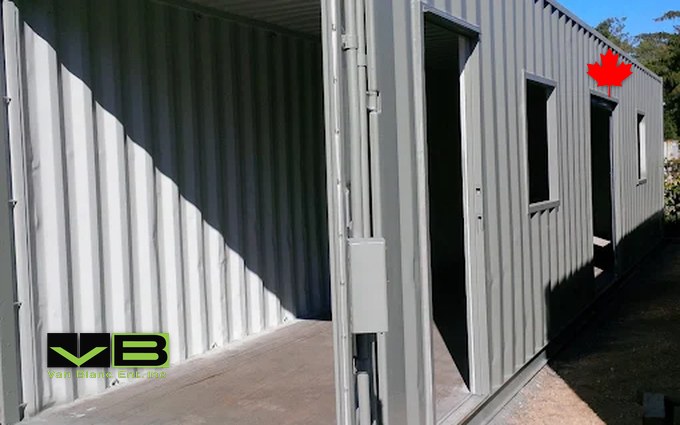
What it is good at. It locks. The walls are 1.6 millimetre Corten steel, the serving window closes behind a steel shutter, the man door takes a deadbolt behind a lockbox plate, and the fryer, fridge and till stay inside from October to April with nobody checking on them. It arrives built, on a tilt-deck, in one to three days anywhere the province’s roads go, and the tilt-deck set-down is the install: four level points and the truck leaves. A 20-foot box is a coffee-and-packaged canteen with room for two people and the sinks; a 40-foot unit is a cooking canteen with a hood end, a serving end and a stock room between. And it is a building the association owns outright, on a pad it can keep for decades, which the long-life comparison puts against the block building, or sell on, because a used container resells for real money.
What it is not. Unclad, it looks like a container, and at a heritage fairground that matters; cladding it in wood-look siding is a real cost we can prep for. It needs a truck path to the pad, which a fenced field with a footpath gate does not have. It is not licensed as a mobile premises, so it does not go to the next fair. And the food-premises approval is the same as for any building: the sinks, the hot water, the hood if you cook, all inspected on site.
Christian LeBlanc, Van Blanc: “The canteen call comes from a volunteer, usually in February, with a photo of the old block building and a budget from a fundraiser. What they want is a building that will still be standing and still be theirs when their kids are playing. What they’re worried about is the inspector. So we start with the sinks.”
The Serving Window, the Counter and the Line
The serving window is where a concession stand earns its keep and where most designs go wrong. The rules of thumb from the builders that do it well, wood or steel: the window sits at counter height with an exterior shelf wide enough for a tray and an interior counter deep enough for a till, a cup dispenser and the condiments, so the server never turns around. A single wide window with two stations beats two small ones. An overhang or awning over the line keeps the customers dry and the sun off the glass, and it is why the wood stands carry a deep front eave and why we frame an awning over the container’s cut. The line forms sideways along the building, so the window goes on the long side, never the end, and the door for staff goes on the far end where the line is not.
On a container that means a roll-up or a hinged steel shutter over a framed opening on the 20 or 40-foot side, a fold-down exterior counter, and a man door at the end, which is the same set of cuts we make for a pop-up shop; the retail kiosk guide shows the same openings in a different trade, and the outdoor kitchen page covers the serving-window build-out on the commercial side.
Power, Water and the Off-Season
A canteen in July also needs to stay cool inside, and our container cooling guide covers the mini-split that does it. A canteen needs a real electrical service: fridges, a freezer, a fryer or a warmer, a coffee maker and lighting on a single 30-amp circuit is how the breaker becomes the busiest person on staff. The service sizing guide walks the 60-versus-100-amp question for a container; the arithmetic is the same for a wood stand. Water is either a supply line with a heater and a drain to a sanitary connection or a tank system with a fresh tank, a grey tank and an on-demand heater, which is how a stand on a field without services meets the sink rules. Both are licensed-trade work: we rough in the runs and the panel location at the yard, and your electrician and plumber complete and certify on site, exactly as they would for a wood stand.
The off-season is where the routes separate again. A container canteen is drained, the tanks emptied, the shutter dropped and the door locked, and it sits until April with the fridge inside. A wood stand does the same with a padlock on a shed door. A trailer goes to storage. The winter venting guide covers the vents that keep a closed steel box dry through the winter, which is the one thing the container asks for that the wood stand does not.
What the Building Lets You Sell
Google asks what a concession stand sells and which food is most profitable, and the honest answer is that the building decides. A hand sink and a two-compartment sink, no hood: packaged snacks, candy, chips, bottled and fountain drinks, coffee, hot chocolate, hot dogs from a roller or a steamer, popcorn, nachos with warmed cheese. Add the three-compartment sink and a hood with mechanical exhaust: fries, burgers, poutine, grilled anything. The first list is where the margin lives for a volunteer canteen: high price, no waste, no cook, two people at the window. The second list is where the revenue lives at an arena with a 6 p.m. rush and a paid operator. Decide which canteen you are running, then buy the building that holds its sinks.
What Moves the Price
No dollar figures here, because a canteen’s price is mostly the equipment and the trades, and both change. The drivers are consistent. Size, which is set by the sink count and whether you cook. The window and counter package. The plumbing route, supply line or tank system, and the hot water. The electrical service and the hood if there is cooking. Cladding, if the building has to look like something other than what it is. Delivery distance. And on a container, the grade of the box: the grade write-up explains why a canteen that will be clad can start from a clean used unit while a canteen that will be seen bare starts from a new one-trip container. The container quote guide covers what moves the container half of the quote.
Who Should Buy Which
The fair board, the farm stand and the church supper: the wood stand, built by an Ontario shed shop, on skids, with a deep overhang. It looks right and it works for a building that is watched.
The circuit operator: the trailer, licensed as mobile, because the crowd moves.
The municipality replacing the arena canteen with a capital budget: the site build, tied into the arena’s services.
The association with a diamond, a rusted block building and a fundraiser’s worth of money; the track, the ski hill, the campground; any operator who wants a canteen that locks up for the winter and is theirs: the container. It is the route that arrives built, holds the sinks, and stops the break-ins.
Start with the sinks, then price the box
Tell us what you’ll sell, whether you’ll cook, whether the site has water and power, and your postal code, and we’ll send an all-in number for the converted container with the window, counters, partitions, vents and rough-ins done, delivered and placed, usually the same day. Or tour the Brantford yard and see a converted unit in the steel.
Every container we sell is sold outright; there is no rental fleet here. If the wood stand fits the setting, buy the wood stand. The building comparison hub compares every building people weigh against a container, the conversions section shows what the yard has built, and the yard’s stock is where the box under all of it comes from.
Concession Stand FAQs
What does a concession stand need to pass inspection in Ontario?
Every concession stand is a food premises under the provincial regulation, approved by the local public health unit. The layout rules that matter are a separate hand-washing sink with hot and cold water, soap and paper towels; a three-compartment sink or commercial dishwasher for multi-use utensils, or a two-compartment sink if you serve only with single-use items; washable surfaces; refrigeration that holds temperature; and mechanical ventilation where there is cooking.
Can a shipping container be a concession stand?
Yes, and it is one of the more common conversions at fields, tracks and events. A 20-foot unit holds a packaged-food canteen with two people and the required sinks; a 40-foot unit holds a cooking canteen with a hood end, a serving end and stock room. It arrives built on a tilt-deck, locks behind a steel shutter and a lockbox for the winter, and the plumbing and electrical are finished by licensed trades on site.
What is the most profitable concession stand food?
For a volunteer canteen with two people at the window, the packaged and roller-grill list: candy, chips, fountain drinks, coffee, hot chocolate, hot dogs, popcorn and nachos, because there is no cook, no waste and a high margin. Fries and burgers bring more revenue per game but need the three-compartment sink, a hood and a paid operator, which changes the building.
Is a concession trailer better than a concession stand?
A trailer is better for an operator who moves between venues, because it is licensed as a mobile premises. A fixed stand is better for a single field or arena, because a trailer parked all summer is a theft target, needs a truck and storage for the winter, and has less room for a season of stock. Most associations with one diamond want the building.
Does a concession stand need running water?
It needs hot and cold water at the sinks, which comes either from a supply line with a water heater and a sanitary drain, or from a tank system with fresh and grey tanks and an on-demand heater where the site has no services. Either way the plumbing is licensed-trade work and the public health unit inspects it before the stand opens.
How big should a concession stand be?
Size it by the sinks and the menu. A packaged-food canteen with a hand sink and a two-compartment sink works in a 20-foot container or an 8 by 12 wood stand. A cooking canteen with a three-compartment sink, a hood, a serving station and stock storage wants a 40-foot container or a 12 by 24 building. The serving window goes on the long side so the line forms along the building.
Sources
- Wellington-Dufferin-Guelph Public Health. (2026). Smart Start Package: requirements for public health approval of your food premises. wdgpublichealth.ca
- City of Hamilton. (2026). Food Premises and Food Handling Requirements. hamilton.ca
- City of Toronto. (2026). Starting a Food Business: Structural Requirements. toronto.ca
- Windsor-Essex County Health Unit. (2026). Guidelines for Opening and Renovating a Food Premises. wechu.org
- Sheds Unlimited. (2026). Portable Concession Stands. shedsunlimited.net
- windsoriteDOTca News. (2024). New Concession Operator at Kingsville Arena Canteen. windsorite.ca
- Cassone. (2026). Permanent and Portable Concession Stands: A Guide. cassone.com
Reach Van Blanc in Brantford
We have been supplying shipping containers across Ontario since 1995. Our yard is at 90 Morton Avenue East in Brantford, and we deliver right across the province with payment on the day of delivery. No deposit, no upfront wires, no chase-the-paperwork.
Van Blanc Ent. Inc., 90 Morton Ave E Unit 1B, Brantford, ON N3R 7J7, 519-754-6844 (cell) or 1-888-509-6658 (toll-free).
If you are the volunteer with the photo of the old block building, call with what you sell and whether the field has water, and we’ll tell you on the spot which size holds the sinks. Worth the drive for unbeatable quality, family customer service with 30 years of experience.