
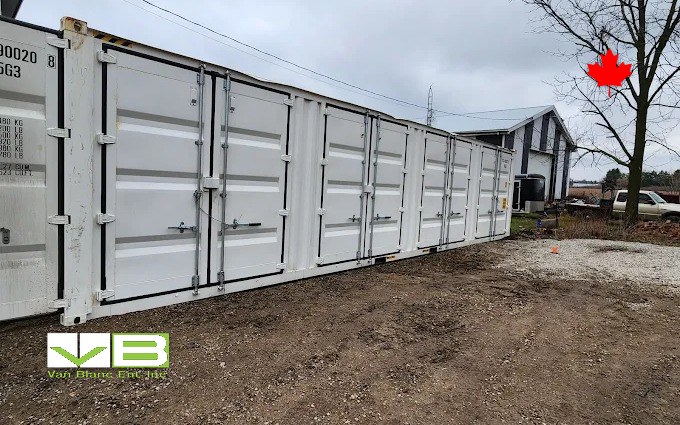
Quick Answer: An outdoor kitchen in Ontario has to cook through July and survive February, which makes materials and shelter the first decisions. Freeze-thaw tolerance decides what lasts: sintered stone counters, marine-grade cabinets, 304 stainless. Covered layouts extend the usable season into fall, and commercial patio kitchens increasingly start as converted containers.
In This Guide
- What Ontario Actually Asks of an Outdoor Kitchen
- Layout Before Appliances, Roof Before Layout
- Materials That Shrug Off Freeze-Thaw
- The Utilities Are the Real Project
- The Shutdown Ritual
- The Commercial Patio Kitchen, Where Steel Enters
- Trailer, Kiosk, or Container for Outdoor Service
- The Support-Building Pattern at Home
- The Back-of-House Spine
- Outdoor Kitchen FAQs
Reading Time: 14 minutes
What Ontario Actually Asks of an Outdoor Kitchen
An outdoor kitchen is the easiest backyard project to design badly, because the photos that sell the idea are all taken in places where water never freezes inside stone. Ontario asks harder questions. A counter here goes through dozens of freeze-thaw cycles a season, and any material that drinks water in October will crack itself apart by March. An appliance here sits under snow load, then thaw, then ultraviolet, and cheap stainless shows rust bloom by its second spring. The grilling season itself is honest: roughly May through October in comfort, stretchable at both ends with a roof and a heater, and genuinely year-round only for the dedicated few who shovel a path to the burner.
None of that is an argument against building one. Outdoor kitchens have become one of the strongest categories in Ontario landscape construction, and the design-build firms across the GTA report the same shift: buyers stopped asking for a grill island and started asking for a covered outdoor room that happens to cook. That shift is the right instinct for this climate, and it reorders the whole project. Get the shelter and the materials right and the appliances become the easy part. Get them wrong and the province takes the kitchen back one winter at a time.
Christian LeBlanc, Van Blanc: “The residential outdoor kitchen is a landscaper’s trade and I am happy to say so; we do not pour patios and we do not set stone. Where our yard keeps ending up in these conversations is the commercial side. A patio bar or a seasonal kitchen for a business is a building problem, and a converted container solves it fast, moves if the business moves, and locks up tight in the off-season.”
Layout Before Appliances, Roof Before Layout
The professionals sequence these projects backwards from what most buyers expect. The roof decision comes first, because a covered kitchen behaves differently in every later choice: it needs proper ventilation over the grill, it unlocks overhead lighting and fans and heaters, and it shelters every material underneath it well enough to widen your options. Pergolas with louvered roofs, full pavilions, and roof extensions off the house all serve; the point is deciding shelter before anything is plumbed into the ground beneath it.
Layout comes second, and the working logic is zones: a hot zone for the grill and burners with clearance from anything combustible, a wet zone if a sink is in the plan, a cold zone for refrigeration shaded from afternoon sun, and landing counters on both sides of the heat so nothing ever gets set on a railing. Distance to the indoor kitchen matters more than any showroom admits, because every metre between the two is a metre walked with a tray in each hand, in the dark, forty times a season. Appliances come last, sized to the zones rather than the other way around.
Materials That Shrug Off Freeze-Thaw
What the Climate Rewards
- Counters: sintered stone and porcelain slab lead the current wave for good reason: near-zero water absorption, so freeze-thaw has nothing to grip, plus heat and UV indifference. Natural stone works when it is dense and outdoor-rated; anything porous spalls.
- Cabinetry: powder-coated aluminum and marine-grade polymer own this category. Wood built for interiors composts itself out here, and ordinary coated steel blisters where snow sits against it.
- Appliance bodies: 304 stainless is the working floor, 316 if the kitchen lives near a pool or gets road-salt spray. The grade stamp matters more than the brand badge.
- Floors: whatever the surface, pitch it away from the cooking line so meltwater drains, and assume everything underfoot will be shoveled at least once a year.
The pattern across that list is one idea wearing four costumes: specify for water that freezes, and everything else follows. It is the same specification logic we apply to our own product, where the box is built from weathering steel because oceans are less forgiving than backyards. The comparison is not idle, and it becomes the hinge of this page a few sections down, because there is a version of the outdoor kitchen where the structure itself arrives already weatherproof.
The roof itself deserves the same scrutiny as the counters beneath it. A wood pergola carries charm and carries snow, and its rafters must be sized for a real Ontario load rather than a catalogue’s idea of one. Louvered aluminum roofs have surged in this market for a practical reason: closed, they shed rain and shade the cook line; open, they vent grill heat and smoke without a fan; and in winter their owners can dump snow load with a hand crank instead of a roof rake. Fabric shade sails and canopies belong to the same seasonal family as fabric car shelters, useful from May to October and stored away before the first wet snowfall, because none of them are load-bearing structures and all of them will pretend to be one until the night they fail.
The Utilities Are the Real Project
Strip away the stone and an outdoor kitchen is a utilities project wearing a nice counter. Gas wants a dedicated line with a proper shutoff, run and connected by a licensed gasfitter. Electrical wants exterior-rated circuits, GFCI protection, and a licensed electrician signing off on every receptacle that will meet rain. Water and drainage want a plan for winter from the first sketch, which usually means shutoffs inside the house and lines that can be blown down each fall. Permits are managed by your municipality, so check with your local building or planning department before you order. Budget-wise, buyers consistently report the below-grade and behind-wall work rivaling the visible kitchen, which surprises everyone once.
This is also where we state our own boundary plainly, because it applies to the commercial builds later in this page exactly as it applies to a backyard: the licensed trades finish and certify live systems, full stop. When our shop converts a container into a serving structure, we cut, frame, insulate, and rough in under engineered drawings, and the customer’s gasfitter, plumber, and electrician complete and certify on site. Any builder in any category who blurs that line is offering you a problem with a countertop on it.
The Shutdown Ritual
Ontario’s outdoor kitchens live exactly as long as their Octobers are disciplined. The contractor consensus on closing one down is short and worth following to the letter: portable appliances come indoors, built-in units get their gas shutoffs closed, everything gets cleaned before it gets covered so grease does not sit all winter, and the covers themselves must breathe. The cheap plastic tarp is the classic mistake, trapping condensation against stainless and stone and growing mould where a fitted breathable cover would have wicked it away. Refrigeration gets emptied, propped open, and disconnected; water lines get drained or blown down before the first hard frost, which in most of the province means Halloween discipline.
Everything that comes off the kitchen then needs somewhere to go, and this is the quiet storage problem the category never advertises: the portable burner, the pellet smoker, the patio heater, the furniture cushions, the cover bag for the umbrella, and the season’s worth of fuel all migrate somewhere dry. For households already juggling packing the patio season away properly, that migration is a solved problem with dedicated steel beside the garage. One honesty note belongs here in bold habit if not in type: propane cylinders never overwinter inside any enclosed structure, ours included. They live outside, upright, valves closed, per the cylinder rules, and no convenience justifies bending that.
Building the Commercial Version?
Patio bars, seasonal kitchens, and serving structures are what our conversion shop builds: cut, framed, insulated, and roughed in at the Brantford yard under engineered drawings, ready for your licensed trades to finish on site. Tell us the concept and we will quote the shell honestly, with a real lead time, not a hopeful one. Fast 1-3 day delivery across Ontario from our Brantford yards once the build is done.
Van Blanc Ent. Inc. · Brantford, Ontario · Since 1995 · 4.9 stars across 140+ Google reviews · Cash on delivery
The Commercial Patio Kitchen, Where Steel Enters
Scale the outdoor kitchen up to a business and the design brief flips. A golf course wanting a halfway house, a brewery adding patio service, a winery feeding a tasting lawn, or an event venue that needs a bar for twenty summer weekends is shopping for something no masonry island offers: speed, security, and the option to move. This is the slot where the converted container has quietly become a standard answer across our hospitality conversion line, and the reasons are structural. The building arrives finished, opens for service the week it lands, closes into a locked steel box every night, and holds its value as an asset that can be sold or relocated when the concept changes.
The build-outs themselves are the part of this industry we can describe from the shop floor rather than from research. A serving window with a fold-down counter, a lined and insulated interior, framing for the bar top, conduit paths and rough-ins placed under engineered drawings, and paint or cladding to the brand: that work happens at our yard before delivery. What turning a container into a licensed bar or restaurant shell involves end to end has its own guide, and the drink-forward version is walked through in the cocktail-station build-out walkthrough. Operators leaning espresso rather than espresso martini should read how the cafe version comes together; the bones are the same, the ventilation and water math differ. The poolside version of the same build, a bar hatch and change room on one side and the pump and chemicals locked on the other, is covered in our pool house and cabana guide.
For a business that wants the asset without the single cheque, the shape is an equipment loan through its own bank or financer, with payments against a container it owns from day one. We sell outright; we do not rent, lease or offer rent-to-own. A bar that serves only through the summer still owns its box in October, when the same steel becomes the locked off-season store, and it can be moved or resold if the concept changes.
The operational pattern we see most often is worth sketching, because it explains why the category grew. A fixed summer venue runs service perhaps twenty-six weekends a year. A stick-built kitchen for that duty cycle ties up capital in a structure that cannot move, cannot be sold except with the land, and sits exposed all winter. The container version inverts every one of those liabilities: the venue orders the build in late winter, the shop work happens in Brantford while the ground is still frozen, the unit lands on its pad in April, and by the season opener the trades have certified the connections and the window is serving. Come November, everything portable goes inside the structure itself, the window locks down, and the building becomes its own off-season warehouse. Operators who have wintered a patio program both ways do not go back.
Siting is the one conversation to have early. The unit wants a level pad, clearance for the delivery truck’s approach and swing, and utility stubs brought to within reach of the rough-ins before it arrives. A venue planning power, water, and drainage runs in the same trench cuts once instead of three times, and a serving window aimed to catch shade at four in the afternoon serves happier lines than one staring into the western sun. None of this is exotic; all of it is cheaper to decide in February than to regret in June.
Trailer, Kiosk, or Container for Outdoor Service
The commercial outdoor kitchen comes in three bodies. The food trailer is built for a business that travels: festivals, catering runs, a route. The light kiosk is built for plazas with tight footprints and landlord rules. The container wins when the location is fixed for seasons at a time and the operation needs real equipment, real security, and a building that shrugs at weather, which is why patio programs at fixed venues keep landing on it. We keep the trailer-versus-kiosk decision mapped in detail, including the resale-value argument that surprises first-time operators: a well-built container conversion depreciates like a building, and a hard-used trailer depreciates like a vehicle. The seasonal cousin of all three is the canteen at the ball diamond, and the concession stand comparison weighs wood stands, trailers, site builds and containers for that job.
There is also a fourth body worth knowing about even though it never serves a customer outdoors: the production-only kitchen. Operators running delivery-first concepts put the entire cook line inside the delivery-only kitchen model and treat patio service as a satellite. More than one Ontario operator runs both off the same yard: a container kitchen producing, a container bar serving, and the whole plant locked and alarmed by midnight.
The Support-Building Pattern at Home
Back at residential scale, the container’s usual role is the building behind the kitchen. A backyard hosting a serious outdoor kitchen is a backyard running a small hospitality operation: bulk pellets and charcoal that must stay dry, the smoker and flat-top that overwinter indoors, coolers, patio furniture and its cushions, the market umbrella, the propane-adjacent hardware that is allowed inside once cylinders are excluded, and every October the entire shutdown ritual’s output at once. A 20-foot unit along the fence line absorbs all of it, secured behind hardware built for exactly this duty, on steel that treats winter the way the shipping fleet’s own alloy treats salt spray.
Buyers with bigger ambitions sometimes ask whether the box itself can become the outdoor kitchen. An occupied, gas-fired cooking structure carries the same compliance a commercial build does: engineered drawings, and licensed trades certifying gas, plumbing and electrical on site. Households who would rather skip that paperwork put the kitchen on the patio and a 20-foot box twenty feet away to hold everything it sheds.
One sizing note from the delivery seat: households almost always overestimate the footprint this takes. A 20-foot unit occupies one parking space along a fence line, and the shutdown ritual of even an ambitious outdoor kitchen fills perhaps a third of it. The remaining volume is what quietly converts skeptics, because the bikes, the snowblower, and the garage overflow follow the patio gear in by Christmas.
The Back-of-House Spine
For the operators still reading, the difference between a patio kitchen that passes inspection and one that stalls all spring is the unglamorous spine behind the serving window. Grease has to go somewhere lawful, and where the grease actually goes is settled before the first service, never after. Anything frying or flat-topping under a roof needs exhaust hood and makeup air, explained properly, installed and certified by the licensed trades. Health units expect warewashing to a standard, which in most fixed builds means the three-compartment sink rule, and any menu with real cold-chain needs is better served by integrating a walk-in cooler than by a wall of undercounter fridges gasping through July.
Every item in that spine is drawn into the shop conversation at our yard early, because rough-ins placed correctly in Brantford save weeks of retrofit on site. That sequencing, shop work under drawings first, licensed trades certifying second, is the whole reason the container path is fast, and it is the part of the industry we have spent years refining while the patio trend caught up to it.
An outdoor kitchen is Ontario’s most optimistic building project, a bet that July is worth engineering for. The bet pays when the materials respect February and the utilities respect the trades. Build the backyard version with a good landscaper and a freeze-thaw spec sheet. Build the business version on steel, and it will still be worth money when the trend has moved on twice.
Sold outright. Delivered in 1 to 3 days.
Van Blanc sells new and used shipping containers outright from our 4 Brantford yards, with delivery in 1 to 3 days and payment on delivery. We do not rent, lease or offer rent-to-own. Request a sale quote or call the yard at 519-754-6844.
Outdoor Kitchen FAQs
What is the best countertop material for an outdoor kitchen in Ontario?
Sintered stone and porcelain slab lead for this climate because their near-zero water absorption gives freeze-thaw nothing to work on, and they resist heat, UV fading, and staining. Dense outdoor-rated natural stone also serves. Avoid porous stone and any interior-grade surface; they absorb water and crack apart over Ontario winters.
Can you use an outdoor kitchen in winter?
A covered outdoor kitchen with overhead heaters extends comfortable use well into late fall, and dedicated grillers cook year-round. Realistically, most Ontario outdoor kitchens run May through October. What matters more is the shutdown: gas shutoffs closed, portables stored indoors, everything cleaned, and breathable covers fitted before hard frost.
How do you winterize an outdoor kitchen?
Bring portable appliances indoors, close and tighten gas shutoff valves, empty and disconnect refrigeration, drain or blow down water lines before hard frost, clean every surface so grease never overwinters, and cover built-ins with fitted breathable covers. Skip plastic tarps; they trap condensation against stainless and stone and grow mould.
Do restaurants use shipping containers as outdoor kitchens?
Yes, widely and increasingly. Fixed venues like breweries, golf courses, wineries, and event spaces use converted containers as patio bars and seasonal kitchens because the structure arrives built, locks up nightly, and relocates if the concept changes. Conversion happens in a shop under engineered drawings, with licensed trades certifying gas, plumbing, and electrical on site.
Can I store my propane tank in a shipping container?
No. Propane cylinders should never be stored inside any enclosed structure, including a container, regardless of convenience. They belong outdoors, upright, valves closed, handled per the cylinder rules. The container earns its keep storing everything else the outdoor kitchen sheds each fall: appliances, furniture, fuel that is safe indoors, and covers.
Sources
- Greenside Up Contracting. (2025). How to Winterize Your Outdoor Kitchen in Toronto. greensideupcontracting.com. A Toronto contractor’s shutdown checklist for gas, refrigeration, and covers
- Dutra Landscape and Pools. (2025). Outdoor Kitchen Ideas for 2026: Design Trends, Layouts and Must-Have Features. dutrascape.ca. The covered-kitchen and sintered-stone trend data cited above
- Delta Decks. (2025). Outdoor Kitchen Toronto: Building Guide and Costs. deltadecks.com. A GTA builder’s walkthrough of structure, utilities, and sequencing
- Distinctive Outdoor Kitchens. (2025). Winter-Ready Outdoor Kitchens: How to Weather-Proof Your Backyard Space. distinctiveoutdoorkitchens.com. Material grades and weatherproofing practice for four-season exposure
Reach Van Blanc in Brantford
We have supplied and converted shipping containers across Ontario since 1995, and hospitality build-outs come off our Brantford benches every season: serving windows, lined interiors, and rough-ins placed under engineered drawings before the unit ever ships. If a patio kitchen or bar is on your business plan, come walk a conversion in progress at 90 Morton Avenue East.
Van Blanc Ent. Inc., 90 Morton Ave E Unit 1B, Brantford, ON N3R 7J7, 519-754-6844
Planning a backyard build instead? Call anyway. We will size the box that holds the smoker, the cushions and the shutdown gear, and point out which parts of the plan are the landscaper’s. That answer costs nothing and takes five minutes.