
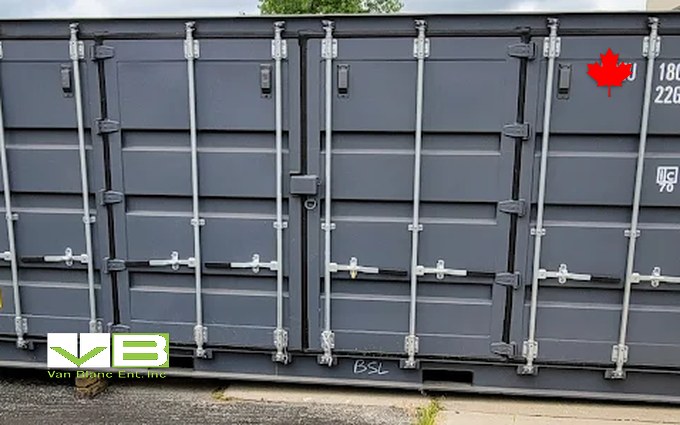
Quick Answer: A baseball dugout is the covered team bench: at least 20 feet long for youth, 30 for adults, 8 to 12 feet deep and high, its near corner 45 feet from home plate. Ontario diamonds build them in block, chain link, prefab aluminum or a container with a lockable room.
In This Guide
- Where We Stand
- What a Dugout Has to Do
- The Dimensions, in One Table
- Placement, Protection and Drainage
- The Four Ways an Ontario Diamond Builds a Dugout
- Who Pays: Associations, Municipalities and Field of Dreams
- The Container Dugout, Done Properly
- The Four Routes Compared
- The Diamond Buyer’s Checklist
- The Container You Would Buy
- Dugout FAQs
Reading Time: 13 minutes
Where We Stand
This guide is written by a shipping container yard in Brantford, Ontario, which means one of the four dugout routes below is a product we sell and three are not. We say so up front, we give the other three their due, and the section on which route fits which diamond is written to be useful to a parks department that will never buy a container. The design numbers come from the field-design guidance published by Beacon Athletics and the product specifications published by Sportsfield Specialties, both read on September 11, 2026 and attributed; the Ontario funding facts come from the Jays Care Foundation’s 2026 program as reported by Turf & Rec. Whether any structure can go beside a given diamond is the municipality’s or the landowner’s call, and this page does not answer it.
What a Dugout Has to Do
Strip the word of its big-league associations and a dugout is a simple building with four jobs. It seats a roster, in a line, facing the field, on a bench long enough that nobody stands in the door. It protects them from foul balls, which is why the front face and the placement are safety questions rather than style questions. It keeps the sun and the rain off, which on a July Saturday in southern Ontario is the difference between a team that plays the second game and one that does not. And, on any diamond that is not professionally staffed, it stores things: bats, helmets, the base set, the chalk, the first-aid kit, the scorebook, everything that would otherwise ride in a coach’s trunk. The fourth job is the one most dugout designs forget and the one the container route exists to do well, which is why it is worth naming first.
The Dimensions, in One Table
| Element | Guidance (ballfields.com field design; Sportsfield product specs) |
|---|---|
| Length, youth (ages 6 to 12) | Minimum 20 feet |
| Length, teen and high school (13 to 21) | Minimum 30 feet |
| Length, adult | 30 to 40 feet |
| Depth | 8 to 12 feet; the shallower end for a fully enclosed bench, the deeper end for a half wall with standing room in front and a second bench behind |
| Height | 8 to 12 feet, with enough clearance that an adult standing on the bench step does not hit the roof |
| Width of prefab enclosed units | 8 feet, in lengths of 16, 24, 32, 36, 40 and 48 feet |
| Bench | Sections of about 7 feet 6 inches bolted in a run; a 30-inch seat depth; a second tier for large rosters |
| Headroom over the bench step | About 7 feet |
| Setback from home plate | Nearest corner at least 45 feet for baseball, 35 feet for softball |
Read the table for the two facts that decide most Ontario builds. Length follows the oldest age group that will use the diamond, so a field that hosts a men’s league on Sunday needs the adult length even if the Tuesday tenants are eight-year-olds. And the prefab industry has settled on 8 feet as the width of an enclosed dugout, which happens to be the exterior width of every ISO shipping container ever built, a coincidence that the container section makes use of.
Placement, Protection and Drainage
The setback is the safety number. The ballfields.com field-design guidance puts the corner of the dugout nearest home plate at least 45 feet away on a baseball diamond and 35 on a softball diamond, so that on-deck hitters and the bench are out of the line of a hard foul, and the front face follows the same logic: baseball dugouts run from full chain-link fronts to half-fence-and-netting combinations, while softball dugouts should always have full protection because home plate is so close. The back can be chain link with or without windscreen and a roof, poured concrete, block, brick or stone, which is the range of the site-built route below.
Elevation is the other choice. A sunken dugout, the big-league picture, is a hole beside the field, and a hole beside a field in Ontario fills with water in April unless the drainage was designed with it, which is why that guidance ties sunken designs to drainage infrastructure and why nearly every community diamond in the province builds at grade. At grade, the dugout floor is the pad it stands on, and the pad is where every route on this page starts.
The Four Ways an Ontario Diamond Builds a Dugout
The site-built dugout. A block or poured back wall, steel posts, a shed roof, a chain-link front, a bench along the back: the Ontario standard, built by a contractor over a couple of weeks, permanent, and as good as its drainage and its roof. It is the right answer for a municipal park with a capital budget and a decade horizon, and the wrong one for an association with a volunteer crew and a season.
The chain-link cage. Fence panels on three sides, a fabric or steel roof panel, a bench: the quickest and cheapest, the least protection from weather, and no storage at all. The right answer for a practice diamond or a school field; the wrong one for anywhere the bats need locking up.
The prefab enclosed dugout. Sportsfield’s enclosed modular units are the reference: 8 feet wide, 16 to 48 feet long, aluminum construction with lap siding, delivered fully pre-assembled and ready to place, with bat and helmet storage that can be integrated at build or added later, colour choices for walls, siding and fascia, custom sizes on request, and a five-year manufacturer’s warranty. It is the right answer for a facility that wants a finished building on a pad in a day and has the budget for a purpose-built product; the honest trade-off is that it is a lightweight building that ships from a specialty manufacturer, and the lockable storage is an option inside it rather than a room of its own.
The container dugout. A 20 or 40-foot shipping container set on a pad with one long wall opened to the field, a mesh or chain-link front in the opening, a bench along the back wall, and a lockable equipment room walled off at one end. It is the route this page is qualified to describe in detail, below, and the right answer for a diamond that needs the storage as much as the bench.
Who Pays: Associations, Municipalities and Field of Dreams
Most Ontario dugouts are bought by one of two buyers. The municipality that owns the park, through a parks capital budget and a procurement process, which the municipal container procurement guide describes from the purchasing coordinator’s side. Or the minor baseball or softball association that leases the diamond, through fundraising, sponsorship boards on the outfield fence, and the canteen, whose building is a build we cover separately and is often the dugout’s twin on the same purchase order.
The third source is the one worth knowing about in 2026. The Jays Care Foundation, the Toronto Blue Jays’ charity, runs a Field of Dreams grant program that funds diamond upgrades across the country, and its published list of eligible improvements includes dugouts alongside fencing, lighting, infield refurbishment, mounds, bullpens, bleachers, safety netting, warning tracks and accessibility features. Turf & Rec reported 22 Canadian municipalities funded this year, among them Joe Kaine Field in the city of Guelph, Port Hope’s Welcome Park and Burk’s Falls in Ontario. An association planning a dugout should read the program’s current terms before it prices anything, because a funded diamond upgrade is often the year the dugouts get done.
The Container Dugout, Done Properly
Start with the width, because it is the reason the build works: a container is 8 feet wide outside, the same as the prefab enclosed dugout standard, so the bench-to-front depth is right without any design. A 20-foot unit meets the youth minimum length exactly. A 40-foot unit gives a 30-foot adult dugout with a 10-foot lockable equipment room walled off at the far end, which is the configuration most associations end up wanting once they see it drawn; a 20-footer can give up 4 to 6 feet to a smaller locker and still seat a youth roster.
The opening is the work. One long wall is cut out between the corner posts, leaving the top and bottom rails intact and a structural header framed in across the opening so the roof carries as it did before; the cut is made at the yard’s modification bay with the header welded in, the way a window cutout is framed on an office, only longer. Into the opening goes a chain-link or welded-mesh front panel with a gate at the end nearest the field entrance, which is the foul-ball protection the field-design guidance calls for and, on a softball diamond, should be full height. The bench runs along the intact back wall on brackets or a welded frame, 7-foot-6 sections in a row, with a bat rack and a helmet shelf on the wall above it and a rubber mat on the floor. The container roof is the dugout roof, corrugated steel with a drip edge added over the opening; it sheds snow, carries a March load, and the roof recoat guide is the only maintenance it asks for in a decade.
The equipment room is the reason to choose this route. A steel partition wall with a personnel door closes off the far end; the original cargo doors on the end of the container become the outside access for the mower, the drag mat and the base set, secured with a welded lock box and a hardened puck lock, and the inside door serves the coaches during a game. The tool crib organization guide is the shelving pattern, and the guard shack guide is the same partition-and-door build on a 10-foot box. The whole thing lands on a compacted gravel base or a poured strip, anchored per the ground anchor guide because an open-fronted steel box is a sail in a spring wind, and painted in the association’s colours. Off-season, a diamond that floods can have its dugout lifted onto a truck and moved, which no other route offers.
Paul LeBlanc, Van Blanc: “The dugout jobs come from the associations, never the leagues with money, because the associations are the ones whose bats are in somebody’s garage. A forty-footer with the side opened up and a room at the end fixes both problems in one delivery, and I tell them to pour the pad first and get the setback from whoever runs the diamond before they order, because I can’t move home plate.”
The Four Routes Compared
| Site-built (block or poured) | Chain-link cage | Prefab enclosed | Container dugout | |
|---|---|---|---|---|
| Build time | Weeks, on site | A day or two | A day on the pad, pre-assembled | A day on the pad, modified at the shop first |
| Weather protection | Full | Roof only | Full | Full, steel roof and three steel walls |
| Storage | If designed in | None | Integrated racks and options | A lockable room with its own outside doors |
| Foul-ball front | Chain link or netting, to spec | Chain link | Per product | Chain link or welded mesh in the framed opening |
| Permanence | Permanent | Movable | Placed; movable with equipment | Lifts onto a truck whole |
| Warranty | Contractor’s | Fence supplier’s | Five-year manufacturer’s, per Sportsfield | Yard-graded shell; shop-warranted modifications |
| Best for | Municipal parks with a capital budget | Practice and school fields | Facilities wanting a finished purpose-built unit | Associations and parks that need the storage as much as the bench |
No prices, because a dugout is priced by the pad, the front, the length and the storage, and all four routes move with those. The fourth column’s shell is priced the way any container quote gets built, and the modification is quoted by the opening, the front panel, the partition and the paint.
The Diamond Buyer’s Checklist
Before any route is priced: the oldest age group the diamond hosts, which sets the length; the sport, which sets the setback and the front; the setback measured from the nearest corner to home plate on the actual diamond, not the drawing; the pad, poured or gravel, level, with drainage away from the field; the storage list, written down, because it decides whether a chain-link cage will ever be enough; the power question, if a scoreboard or lights will share the structure; the funding source and its deadline, Field of Dreams included; and the landowner’s or municipality’s approval for a structure beside the diamond. Our ground-conditions guide covers the pad and the truck’s straight run for the container route, and the parks-yard storage build is the same purchase from the public works side.
The Container You Would Buy
For the container route, the yard’s answer is a used wind-and-watertight unit from the used inventory at the yard, because a dugout’s steel is going to be cut, painted and stood in the weather and a used box with sound rails and a good floor is the right shell at the right grade; the grade definitions explain why the top rails matter once the side is opened. A plain 20-footer is the youth dugout; the taller 40-footer is the adult dugout with the equipment room and a foot of extra headroom for the bench step. A one-trip unit from the new stock is the choice when the diamond wants the building to look new for a decade.
Every container we sell is picked by a person and can be picked by you: drive to 90 Morton Avenue East, walk the rows with Paul or Christian, and choose the shell by its number and its rails before any money moves. Payment is on delivery, after you have seen the box on your pad. Delivery is by tilt-deck in one to three days to any diamond in the province we deliver to, the delivery walkthrough shows the sequence, and the opening, the front panel, the partition and the paint are done at the shop before the truck leaves, with the container-buildings guide showing the kind of work involved. Whether a structure can sit beside a given diamond is the municipality’s or the landowner’s call, so confirm it before you order. Everything is sold outright; Van Blanc keeps no rental fleet and does not lease.
Setback measured and the pad planned? Price the dugout once
Tell us the length, youth or adult, whether you want the equipment room, and your postal code, and we will send an all-in number for the shell modified, delivered and placed, usually the same day. If your diamond is really a site-built job, we will say so. Or come to Morton Avenue and pick the shell yourself.
The canteen that goes beside the dugout is the subject of the canteen guide, Peterborough and the Kawarthas are where a good share of the association calls come from, and the container-versus-everything comparison is the wider read for a parks department deciding what kind of building any of its diamonds need.
Dugout FAQs
How long should a baseball dugout be?
Per the ballfields.com field-design guidance, at least 20 feet for youth players aged 6 to 12, at least 30 feet for teens and high school players, and 30 to 40 feet for adults, sized to the oldest age group and the largest roster that will use the diamond. Prefab enclosed dugouts are sold in 16 to 48-foot lengths, and a 20 or 40-foot shipping container matches the youth and adult lengths directly.
How deep and how high is a dugout?
Eight to twelve feet in both directions, per the same guidance: the shallower depth for a fully enclosed bench, the deeper one for a half wall with standing room in front and a second bench behind, and a roof high enough that an adult standing on the bench step does not hit it, which works out to about seven feet of headroom over the step. Prefab enclosed units are built 8 feet wide.
How far from home plate should a dugout be?
The corner nearest home plate should be at least 45 feet away on a baseball diamond and at least 35 feet on a softball diamond, so that on-deck hitters and the bench are out of the line of a hard foul ball. Softball dugouts should have a full-height protected front because home plate is so close; baseball dugouts range from full chain link to half-fence-and-netting fronts.
What is a prefab dugout?
A factory-built enclosed dugout delivered assembled and set on a pad. Sportsfield Specialties’ units are 8 feet wide in 16, 24, 32, 36, 40 and 48-foot lengths, aluminum construction with lap siding, colour options, integrated bat and helmet storage that can be added later, custom sizes on request, and a five-year manufacturer’s warranty. It suits a facility that wants a finished purpose-built building in a day.
Can a shipping container be used as a dugout?
Yes. A container is 8 feet wide, the prefab dugout standard; a 20-foot unit meets the youth length and a 40-foot unit gives a 30-foot adult dugout plus a 10-foot lockable equipment room. One long wall is cut out and framed with a header, a chain-link or mesh front is fitted, a bench runs along the back wall, and the steel roof and three steel walls give full weather protection. It lands on a pad in a day and can be moved off a flooding diamond in the off-season.
What does a dugout cost?
It is priced by the pad, the length, the front, the storage and the route, and figures on a page like this would be wrong by the time you read them. A chain-link cage costs least and stores nothing; a site-built block dugout is a contractor’s job; a prefab enclosed unit is a manufactured product plus freight; a container dugout is a graded shell plus the opening, the front panel, the partition and the paint. Price two routes for the same length and storage list.
Who funds baseball diamond upgrades in Canada?
The park owner, usually a municipality, the association that leases the diamond through fundraising and sponsorship, and, since it began, the Jays Care Foundation’s Field of Dreams grant program, which funds dugouts among fencing, lighting, infields, mounds, bleachers, netting, warning tracks and accessibility work; Turf & Rec reported 22 Canadian municipalities funded in 2026, including Guelph, Port Hope and Burk’s Falls in Ontario.
Sources
- Beacon Athletics. (2026). Dugout Design: Baseball Field Dimensions. ballfields.com
- Sportsfield Specialties. (2026). Enclosed Dugouts. sportsfield.com
- Sportsfield Specialties. (2026). Baseball & Softball Dugouts. sportsfield.com
- Turf & Rec. (2026, June 11). Blue Jays charity helping municipalities across Canada with diamond upgrades. turfandrec.com
- Wikipedia. (2026). Dugout (baseball). en.wikipedia.org
- Van Blanc Ent. Inc. (2026). Concession Stands in Ontario. vbinc.ca
Reach Van Blanc in Brantford
We have been supplying shipping containers across Ontario since 1995. Our yard is at 90 Morton Avenue East in Brantford, and we deliver right across the province with payment on the day of delivery. No deposit, no upfront wires, no chase-the-paperwork.
Van Blanc Ent. Inc., 90 Morton Ave E Unit 1B, Brantford, ON N3R 7J7, 519-754-6844 (cell) or 1-888-509-6658 (toll-free).
If the diamond has its funding and the next question is the dugouts, call with the length, the storage list and your postal code and we will tell you on the spot what shells are in stock and when a modified one can land. Worth the drive for unbeatable quality, family customer service with 30 years of experience.