
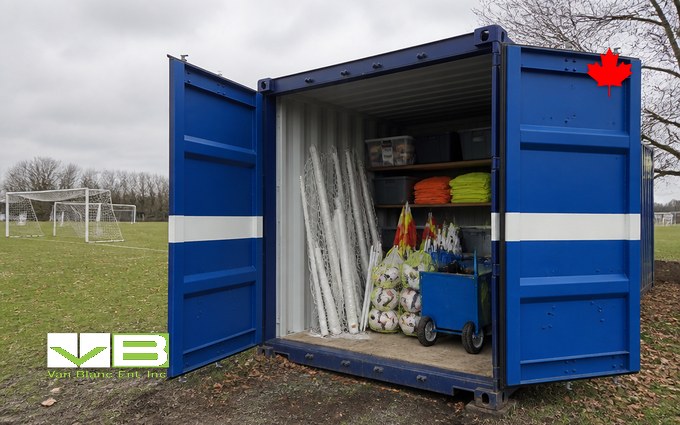
Quick Answer: Sports equipment storage works when gear goes away dry, off the floor and sorted by season. Hockey bags get emptied and aired after every skate. For clubs, one 20ft container per soccer field or one 10ft per ball diamond usually holds the nets, bases, line markers and jerseys between seasons.
From the Garage Hook to the Club Box
- What is the best way to store sports equipment?
- Sports equipment storage starts with dry gear
- Hockey equipment storage in the garage
- Hockey helmets and their CSA labels
- Club equipment between seasons
- Soccer goals and nets by age group
- Ball diamond gear and catcher’s sets
- Lacrosse nets and box season kit
- Hockey association loaner sets
- Field closing dates and the long gap
- Sports storage containers, field by field
- Grades and club colours
- Fitting out the club box
- Setting the box near the field
- Delivery to clubs across Ontario
- Sports storage FAQs
Reading Time: 17 minutes
What Is the Best Way to Store Sports Equipment?
Sports equipment storage is the routine of drying, sorting and housing gear so it is clean, safe and findable when the next season starts. The best way is plain: everything goes away dry, nothing sits on a damp floor, and each sport has its own shelf or hook. Gear you use this month stays near the door. Gear for the other season goes higher, further back or out of the house. That rule holds for one family’s hockey bags and for a soccer club with eleven fields. The difference is scale. A family needs a wall in the garage. A club needs a locked room near the field, and that is where Van Blanc comes in. Van Blanc has sold shipping containers from Brantford since 1995. The same box can hold a curling club’s stones through the humid months or a camp’s waterfront gear. Christian LeBlanc, the second generation at Van Blanc, walks buyers through our yards before they pay. This guide covers the home routine first, then the club version, sport by sport, with the box sizes that fit each one.
A container is a steel room you buy once. It rests on a drained base under the corner castings and locks with a padlock in a lockbox. It holds its contents through an Ontario winter with no roof to shovel. For a league whose nets live in a volunteer’s garage, a container bought once, new or used, is the step up.
Sports Equipment Storage Starts With Dry Gear
Sweat is the enemy of stored sports equipment. A wet chest protector zipped into a bag overnight starts to smell by morning, and a wet glove grows mould in a week. The fix costs nothing: open the bag the moment you get home and hang every piece where air reaches it. Shin pads, gloves and jerseys dry fastest on open hooks or a rack, away from a direct heater. The U.S. Centers for Disease Control and Prevention puts the club version simply. Its guidance for athletic facilities says to clean shared equipment after each use and allow to dry before use. Leagues that share pinnies, goalie sets or catcher’s gear between players are exactly that case.
Drying first also decides where storage can live. Damp gear sealed in any closed room, a basement closet, a car trunk or a steel box, will sweat and smell. Dry gear in a ventilated room keeps. So clubs that store in a container ask for airflow sized to the humidity in the box. They hang the soft goods instead of piling them. The last practice of the season is the wrong day to pack. Let the nets and bags dry in the sun for an afternoon, then load them.
Hockey Equipment Storage in the Garage
Hockey equipment storage at home has one job between games: get every piece out of the bag and into moving air. Most Ontario families do it in the garage, because the garage is where the bag lands when the car door opens. A stand-up drying rack holds a full set, from helmet on top to skates on the bottom tray. A row of heavy hooks along a wall does the same for two or three players. Sticks go blade-up in a floor rack or on wall clips so they do not fall across the car. Skates come out of their guards, because a guard holds water against the steel. In a club box, the same drying job falls to vents that keep air moving through a closed container.
Two habits keep the gear from turning. Wash the base layers and jerseys after each skate, and wipe the helmet and gloves as the maker’s booklet says. Then leave the bag itself open and empty overnight, since the bag holds as much sweat as anything in it. A heated garage in January dries a set faster. An unheated one still works if the air moves, which is why a small fan is worth more than a bigger rack.
When a family has three players and a goalie, the garage wall runs out. Some parents move the off-season sports into a backyard box. Van Blanc’s compact ten-footer for a side yard takes the summer and winter bags in turn.
Garage Lockers, Racks and Hooks
Hockey lockers for a garage are open-front cubbies, often wood or steel, with a bench, a shelf for the helmet and hooks for pads. They work because they never close: sweat dries while the gear hangs in its own slot. Freestanding steel lockers with vented doors do the same for families that want the garage to look tidy. Wall systems of slatted panels and hooks are the flexible option, since the hooks move as kids grow from one sport to the next. Whichever you pick, give each player a slot and keep wet gear off shelves where it touches other bags. A club that needs lockers for a whole team can build the same open slots inside a container with hooks, rails and parts from our accessories counter.
Purge before you organize. Outgrown skates, cleats and gloves go to a swap before any new rack goes up, or the rack fills with gear nobody wears. Balls of every kind, basketballs included, live in a wall-mounted cage or a tall bin so they stop rolling under the car. Bikes hang by a wheel on wall or ceiling hooks. Large equipment, a backyard net or a pitching machine, stands against the back wall where the car doors never reach it. When the back wall is full too, the overflow fits a standard twenty behind the garage.
Hockey Helmets and Their CSA Labels
A hockey helmet sold for Canadian ice is certified to the national standard, CAN/CSA Z262.1. Hockey Alberta’s guide explains what to look for. The tamper-proof sticker names the standard, a serial number and the year the helmet was manufactured. CSA Group adds that its helmet certification carries no mandated expiry date. For when to replace one, CSA points owners to the user manual and to regular checks for wear or damage.
That label matters most when helmets are stored in bulk. Think of a minor hockey association with a shelf of loaner helmets, or a baseball league with a bin of batting helmets. Each should read the manufacture years at the start of each season. Any helmet with cracks or crushed foam comes out of service. Store helmets on a shelf, not at the bottom of a pile, and away from direct heat. The same check applies at home before a hand-me-down helmet goes to a younger sibling. In a club box, tubs of helmets sit well on shelf brackets bolted to a container wall, each tub labelled by size.
Club Equipment Between Seasons
Club equipment is everything a team uses that no family owns. Think goals and nets, base sets, pitching rubbers, corner flags, ball bags, cones and pinnies. Add line-marking machines, first-aid kits, jersey sets, scoreboard numbers, tournament tents and sponsor banners. Some of it is bulky, some is valuable and all of it needs a home for half the year. That home is often a volunteer’s garage, a coach’s basement or a corner of a shared building. It works until the volunteer moves or the coach’s kids age out.
Club storage has three jobs a home garage never faces. It has to hold gear for many teams at once. It has to sit close to the field, because nobody wants to haul goals across town twice a week. And several people need it on different nights, so it takes a key list, a combination or keyed-alike puck locks for every coach. A shipping container answers all three. It locks, it lands beside the field and it holds the gear of a whole age group.
Christian LeBlanc, second-generation operator, Van Blanc Ent. Inc.: “Clubs call us in October, when somebody’s garage is full of nets again. I ask how many fields and diamonds they run, then what comes off them every night: the goals, the bases, the line marker, the ball bags. One field’s worth of gear tells me whether it’s a ten or a twenty.”
A workable rule of thumb is one box beside each field or diamond the club looks after. Two neighbouring cases have their own pages: curling stones, and where a summer camp’s gear goes for ten months. This one stays on field and arena sports.
Soccer Goals and Nets by Age Group
Soccer clubs carry a heavy storage load, because goals come in several sizes and a club running every age group owns each one. Ontario Soccer’s Grassroots Standards apply to all soccer played in Ontario from Under-4 to Under-12. They set a maximum goal size for each age group. Over 70% of Ontario Soccer’s membership plays in these grassroots stages, so most of the goals a club owns are small or medium frames.
| Age group (Ontario Soccer) | Game format | Maximum goal size | Storage note |
|---|---|---|---|
| U6 and younger, U7 | Informal play, 3v3 | Pop-up goals 3 ft x 5 ft | Fold flat; stack on a wire-deck shelf unit |
| U8 to U9 | 4v4, 5v5 | 5 ft x 8 ft | Fits a 10ft or 20ft whole |
| U10 to U11 | 7v7 | 6 ft x 16 ft | Disassembled; long pieces along the floor of a 20ft |
| U12 | 9v9 | 6 ft x 18 ft | Disassembled; crossbar along the floor of a 20ft |
Goal size drives box size. A U12 goal is 18 feet wide inside the posts, so its crossbar runs a little longer than that and will not fit any 10ft container. It still lies along the floor of a 20ft, whose inside length is 19 ft 4 in on our 20ft dry container specification sheet. A club running U10 and U12 programs on one field usually needs the twenty for that reason alone.
Goal Safety Ends in Storage
The U.S. Consumer Product Safety Commission covers this in its guidelines for movable soccer goals. Most are metal frames typically weighing 150 to 500 pounds, and an unanchored goal can tip. Its advice for the off-season is direct: remove nets when goals are not in use, and fully disassemble goals for seasonal storage. A goal left standing on an empty field all winter is a tip-over waiting for a climber. A goal broken down and locked in a box is not.
Nets come off first, dry in the sun and go into labelled bags. Frames break down by size, and the bolts go in a coffee can taped to the crossbar. Corner flags hang on bolt-on French cleat strips along the wall, and cones and pinnies fill the shelves above.
Ball Diamond Gear and Catcher’s Sets
A ball diamond runs on smaller gear than a soccer field, and more of it. Baseball Ontario, established in 1918, governs the game across the province, and its member associations each kit out their own teams. Baseball Oshawa’s house league page is a fair picture. Each team gets team equipment (bats, balls, bases, etc.) and catcher’s equipment, plus jerseys and hats. Multiply that by twelve house teams and a rep program and the pile is real. Bats, helmets, catcher’s sets, base sets, ball buckets, rakes, chalk and the line marker all want one locked room near the diamond.
That gear suits a ten. A 10ft container’s footprint is 8 ft x 10 ft, half a parking stall, and it holds about 560 cubic feet. Bases stack, bats stand in tubs, and catcher’s sets hang on hooks so the chest protectors dry. The rakes and tamps lean in a corner rack. Van Blanc’s diamond-sized ten with its own door options lists some units with a roll-up door or an oversized man door. Those suit a diamond where the box opens every evening.
Bags of chalk and infield conditioner sit on a pallet, off the floor and dry. A diamond that hosts adult leagues on weekends may want the next size up, a 20ft with room for the adult-league gear.
Lacrosse Nets and Box Season Kit
Box lacrosse is played on an arena floor, and the associations that run it own more than sticks. The box rules published by World Lacrosse and carried by Lacrosse Canada set the goal size. It is 4 ft 9 in between the posts and 4 ft high, inside dimensions, built from 1 ½ in metal pipe. A frame that size should pass through a container’s cargo doors whole, so an association that owns its own goals can roll them straight in. Add the goalie equipment, the ball pails, the shot clocks and scoreboard kit, pinnies, and the table and banners for the home game.
Where an arena floor switches between ice and lacrosse, the association’s gear needs a home for the ice months. A ten behind the arena, where the association has permission to place it, gives that gear a home. Larger associations running several age groups may want a twenty, and the goalie sets dry better hung in a line than stacked in a bag. A new box with its factory vents and lockbox gives summer gear the airflow it needs when it goes away in August heat.
Hockey Association Loaner Sets
Hockey clubs store people gear. The Ontario Minor Hockey Association’s Goalie Assist program gives member associations new goalie sets to lend to young players. The OMHA’s 2020 call for applications said each set would be retained by the local association at season’s end, to loan again in following years. By 2022 an association could also give a set to a player to keep. In 2022 the OMHA ran both programs together, and 70 associations each received a set of goalie gear. Another 10 associations received 10 full player sets, 100 in all, sized for U9 and below. A goalie set is pads, blocker, catcher, chest protector, stick and bag. A player set is a full kit.
That is a library of gear, and a library needs shelves. Associations also hold jersey sets for every team, practice pucks, pylons, tournament supplies and the raffle table. Arena storage rooms, where a club has one, tend to be small and shared. A Van Blanc ten parked at the edge of an arena lot holds the loaner program with room left for jersey bins. Hang the pads to dry on hooks bolted through the wall corrugation before the doors close, then check helmet labels each September.
Field Closing Dates and the Long Gap
Municipal fields close for months, which is why storage is a real problem for field sports. The City of Kingston’s sport field allocation policy is a typical example. Its diamond sport fields are closed between September 30th and April 30th. Its rectangular sports fields close between September 16th and May 14th. The city gives the reason plainly: fields need time to rest during the wettest months. Ontario Soccer’s standards list season lengths of 10 to 22 weeks for its grassroots age groups.
Put those together and a club’s gear spends more of the year waiting than working. Seven months on a shelf is long enough for a damp net to rot and for a pile of bases to go missing. A box beside the field turns the gap into a non-event. The goals come apart in September, the nets dry, everything goes in and the lock goes on. The box itself asks little over those months, and a yearly check of doors, gaskets and roof takes an afternoon. In April the same volunteer opens the doors and the season starts from a sorted room. Clubs that also run winter indoor programs keep the indoor bags near the front and the field gear at the back. For a December delivery, read what a December drop on frozen ground needs.
Sports Storage Containers, Field by Field
A sports storage container is a standard shipping container bought to hold one field’s or one program’s gear. Van Blanc stocks both club sizes across our 4 Brantford yards, and one tilt-deck truck sets either size. The table uses figures from our own product pages; the “usually holds” column is planning guidance, not a measured load.
| Size | Inside (from our product pages) | Door opening | Usually holds | Typical club |
|---|---|---|---|---|
| 10ft dry | About 560 cubic feet; 9 ft 10 in long outside; 8 ft x 10 ft footprint | Cargo doors; some stock units with a roll-up or oversized man door | One diamond’s bases, bats, helmets, catcher’s sets, chalk and rakes; a hockey loaner program | One ball diamond, one lacrosse association, one arena |
| 20ft dry | 19 ft 4 in x 7 ft 8 in x 7 ft 10 in; 1,172 cubic feet | 7 ft 8 in wide x 7 ft 5 in high | A field’s goals broken down, nets, corner flags, ball bags, pinnies and the line marker, wheeled over a sill-bridging ramp for the line marker | One soccer field, a diamond with adult leagues, a multi-sport park |
A 20ft Beside a Soccer Field
A 20ft is the soccer field’s box because of the long pieces. A U12 crossbar, folded goal frames and a line-marking machine all fit along its floor. The 7 ft 8 in door lets them in without turning. Shelves along one wall take the nets in bags, the corner flags and the cones. To compare the two sizes or see every grade side by side, open our full sale list, sizes and grades together.
A 10ft Beside a Ball Diamond
A 10ft is the diamond’s box because the gear is short and the spot is tight. Diamonds sit in the corners of parks, between backstops and parking lots. Our 10ft page’s rule of thumb is that if a pickup truck can reach the spot and back out, the ten can usually land there. That leaves room for a box behind the backstop without losing parking, once the ground behind the backstop is levelled and drained.
Grades and Club Colours
Container grades describe condition. A used 20ft has the same inside dimensions as a new one. Van Blanc grades in four tiers. The club picks the one that suits where the box sits and how it should look.
| Grade | What it is | What a club notices |
|---|---|---|
| New (one-trip) | Made one loaded voyage from the factory | Factory paint, smooth doors, clean floor |
| Cargo worthy (CW) | Used, re-inspected, CSC plate re-certified | Surface rust and paint variance, sound frame and floor |
| Wind and watertight (WWT) | Used, sealed against weather, CSC plate may be expired | More cosmetic wear, doors close and seal |
| As-Is | Donor or project stock, defects written down | A shell for builds where the steel gets reworked |
The industry calls new containers one-trip because they made exactly one loaded voyage. Our new one-trip containers for clubs that want factory paint stand a short walk from the yards’ used rows, graded CW and WWT. A committee can walk both in one visit.
Club colours are the part volunteers enjoy. Our curling club page describes clubs choosing a repaint in club colours for the branding, with sponsors’ logos on the side facing the parking lot. A club can paint its own box once it lands. Factory colours on new stock vary by inbound load, so ask what is in the yards when you call.
Fitting Out the Club Box
A club box earns its keep from the inside out. Start with the walls. Wall-mounted brackets carry net bags, helmets and cones above the floor. Freestanding units of wire deck shelving that lets damp gear breathe hold ball bags and pinnies. Keep the centre aisle clear and the long goal pieces against the opposite wall. Hooks at shoulder height take catcher’s sets and goalie pads so they dry hanging.
Vents, Lockboxes and Door Options in Stock
Most containers ship with 2 to 4 vents, and Van Blanc’s new stock mostly comes with a standard lockbox. Some 10ft stock units arrive with a roll-up door or an oversized man door already in place. For a box that coaches open every night, read up on how a man door in the side wall works day to day and ask which stock units have one.
Security comes next. A box in a public park is visible at night, so the lock matters. A club can pair the lockbox with a shielded puck lock on the cargo-door hasp, and keep a written key list with the club executive. A park with a history of break-ins can add a solar trail camera watching the doors. Our accessories counter for hooks, locks and parts covers the small pieces. If an indoor program stores electronics or scoreboard batteries through winter, an insulated container with foamed walls is the version to ask about.
Setting the Box Near the Field
Placement is the club’s call, and it is usually the first question the executive faces. Permits are managed by your municipality, so check with your local building or planning department before you order. A club playing on city fields can look at club-controlled ground, a school yard by agreement, or a partner’s lot next to the field.
The ground under the box matters more than its paint. A container bears on its four corner castings, so a level, drained base keeps the doors square for years. Van Blanc’s page on how deep and how wide to build the stone pad covers drainage. Our walk-through of grading a drop spot before the truck comes covers the slope. On open parkland, where a summer storm crosses the field, ground anchors that hold a box through a storm are worth reading about before the box lands.
Truck access comes last. Our 20ft page asks for a 70-foot straight-line approach to the drop spot and a foot of clearance on each side. Mark the spot, walk the approach, and send a photo of the gate and the path. See the tilt-deck drop, step by step for what the driver needs.
Delivery to Clubs Across Ontario
Van Blanc delivers in 1-3 days across Ontario from our 4 Brantford yards, on our own tilt-deck trucks. Every quote comes with a real lead time, not a hopeful one. Two booking windows work well for clubs: late summer, before fields close, so the gear goes straight in; and early spring, before the first practice. Fall suits the field sports; arena programs can book whenever their room changes hands.
Clubs anywhere in Ontario can order. Soccer and baseball associations in Peel can book deliveries into Brampton’s parks and school fields. Durham clubs can price a container for sale near the Ajax lakeshore fields. Waterloo Region leagues can see the club grounds we deliver to around Kitchener. Windsor and Essex County clubs read what we deliver along the Windsor riverfront and county roads.
Wherever the field is, the box we show you in the yard is the box that arrives. Clubs can walk the rows at our Brantford yards or see the exact unit on a video call before the committee votes. Van Blanc holds 4.9 stars across 140+ Google reviews, and buyers can read them before they commit.
Club Equipment Count for a Quote
Before the call, count what comes off each field. A short list does it. Note the fields and diamonds, the largest goal size, the base and catcher’s sets, the loaner gear and the spot for each box. Then note who needs keys. With that, Van Blanc can size every box in one conversation.
Pricing Boxes for a Club’s Fields
Tell us how many fields and diamonds you run, the gear that comes off each one, the spot beside each field and your postal code. We will match a 10ft or 20ft to each field in the grade you choose. You get one all-in number and a real lead time.
One warning belongs here. Many people call us saying they found a cheaper bin on Facebook. Two weeks later they call back, scammed. Club money is donated money, so buy a box you can see by its container number, and pay when it lands.
Frequently Asked Questions
Where can I find garage lockers for sports equipment?
Garage lockers for sports equipment are sold by hardware stores, sporting goods stores and garage-organization installers, in wood or steel, open-front or with vented doors. Open-front cubbies with a bench dry hockey gear best. Clubs that need lockers for dozens of players can line a container with hooks and shelving instead, and Van Blanc sells those boxes from Brantford.
What is a good garage organizer for sports equipment?
A good garage organizer for sports equipment keeps gear off the floor and lets it dry. Slatted wall panels with movable hooks, a ball cage, a stick rack and a stand-up drying rack for hockey gear cover most families. Give each player a zone and each season a shelf. When the garage runs out, a 10ft container in the yard takes the off-season sports.
What are some good storage ideas for PE equipment?
PE equipment stores best in rolling ball carts, labelled bins by activity and wall racks for hoops, scooters and mats. Keep the outdoor gear separate from the gym gear. A school with its own fields can keep goals, bases and line markers in a locked 10ft or 20ft container near the field.
What are some good storage options for fitness equipment?
Fitness equipment stores well on wall racks for bars and bands, floor racks for dumbbells and plates, and rubber mats under anything heavy. Keep it dry to stop rust. A club or boot-camp program that trains outdoors in summer can keep that gear in a container. Its floor takes heavy loads.
What should you do with old hockey equipment?
Outgrown hockey equipment in good shape can go to a club equipment swap, a minor hockey association’s loaner program or a used sporting goods store. Check helmets first: the CSA label shows the year manufactured, and any helmet with cracks or crushed foam should be retired. Gear that is torn or smells after washing is finished.
What size container does a soccer club need?
A soccer club usually needs one 20ft container per field. A U12 goal is 18 feet wide inside the posts, too long for a 10ft, and its crossbar fits along a 20ft’s 19 ft 4 in floor. A club playing only small-sided games with pop-up and U8 to U9 goals can often use a 10ft. Count the goals and nets per field and send the count for a quote.
Can a storage container be painted in club colours?
Yes. A club can paint its own container in team colours once it lands, with room for sponsor logos on the side. Factory colours on new stock vary by inbound load, so ask what is on the ground when you call 519-754-6844.
How fast can a container reach a club field in Ontario?
Stocked containers reach most Ontario fields in 1-3 days from our 4 Brantford yards. Book before fields close in the fall or before the first spring practice so the gear goes straight in.
Sources
- Ontario Soccer. Ontario Soccer, Grassroots Recommended Standards, checked October 2026.
- U.S. Consumer Product Safety Commission. CPSC, Guidelines for Movable Soccer Goals, checked October 2026.
- World Lacrosse, published by Lacrosse Canada. 2026-2028 Box Lacrosse Official Playing Rules, Rule 1.2.1, checked October 2026.
- City of Kingston. City of Kingston, Sport Field Allocation Policy and Guideline (POL-68), section 3.22.1, checked October 2026.
- Ontario Minor Hockey Association. OMHA, OMHA Gives 170 Sets of Free Equipment to Help Hockey Families (November 2, 2022); OMHA, Associations Can Apply for Free Goalie Equipment (September 16, 2020), checked October 2026.
- Baseball Canada. Baseball Canada, Get to Know Your PSO: Baseball Ontario; Baseball Oshawa. Baseball Oshawa, House League Equipment, checked October 2026.
- CSA Group. CSA Group, Hockey Helmet Safety FAQs; Hockey Alberta. Hockey Alberta, CSA-Certified Hockey Helmets, checked October 2026.
- U.S. Centers for Disease Control and Prevention. CDC, Athletic Facilities: MRSA Prevention and Control (reviewed June 27, 2025), checked October 2026.
Walk the Rows Before the Club Votes
We have been supplying shipping containers across Ontario since 1995. Our office is at 90 Morton Avenue East in Brantford, and all four of our yards are in Brantford.
Van Blanc Ent. Inc., 90 Morton Ave E Unit 1B, Brantford, ON N3R 7J7, 519-754-6844.
Bring the treasurer and the equipment convenor, open the doors on a 10ft and a 20ft, and check the floor where the goals will lie. By the time you drive home, the committee will have a size for every field and a delivery date to put in the minutes. Worth the drive for unbeatable quality, family customer service with 30 years of experience.