
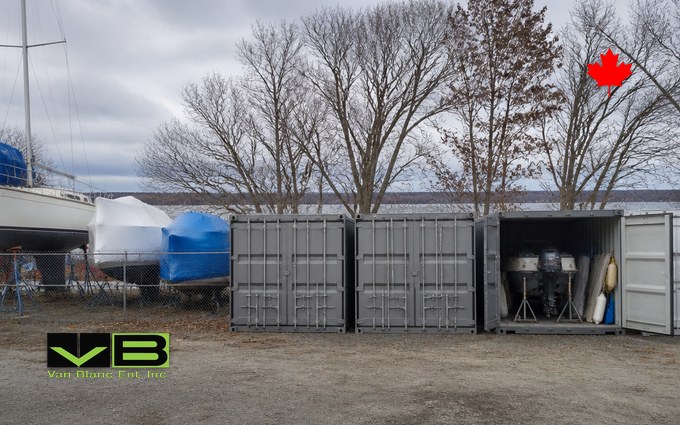
Quick Answer: Marina winter storage in Ontario begins at haul-out, late September through October, when boats go onto cradles on the hardstand. Race marks, junior dinghies, dock hardware and covers still need a locked, dry home. Van Blanc sets a row of 20ft and 40ft containers on that hardstand in 1-3 days.
Haul-Out Storage Plan at a Glance
- Marina Winter Storage Starts at Haul-Out
- How Do Marinas Store Boats in Winter?
- What Comes Off the Docks and Water
- Yacht Club Storage, Line by Line
- Winter Homes for Club Gear Today
- Marina Storage in a Row of Containers
- Laying Out the Row on the Hardstand
- Delivery Before the Cradles Come Down
- Ordering Two to Six Boxes
- Club Budgets and Container Grades
- Ramps, Shelves, Vents and Locks
- Keeping Sails and Batteries Dry
- Summer Use of the Same Row
- Lake Simcoe, Toronto Harbour, Detroit River
- Frequently Asked Questions
Reading Time: 18 minutes
Marina Winter Storage Starts at Haul-Out
Marina winter storage is the season between haul-out and launch. A marina or yacht club lifts its boats from the water, blocks them on cradles or stands, and keeps them ashore until spring. The hardstand is the yard they sit on. It is compacted gravel or pavement, laid out in rows with lanes for a travel lift or a hydraulic trailer. Most Ontario clubs run some version of that stretch, and each finishes it with a second pile that has no hull.
The second pile is the club’s own gear. Race marks and their anchors come ashore with the learn-to-sail fleet and the coach boat kit. Dock ladders, bumpers, sails, life jackets, covers and the ship store’s shelves follow within the same few weeks. Van Blanc Ent. Inc. has sold shipping containers from Brantford since 1995. The plan laid out here is a short row of steel boxes along the edge of the hardstand, locked from haul-out to launch. A forty-foot box for the junior fleet and a 20ft for marks and dock hardware make a two-box start.
The boats come first, because their schedule sets the calendar for everything else on the yard.
How Do Marinas Store Boats in Winter?
Ontario marinas store most boats on land for the winter. A travel lift, crane or hydraulic trailer pulls each hull, and the bottom gets pressure-washed. The boat then goes onto its own cradle or a set of adjustable stands. Sailboat masts are unstepped and laid on racks. Winterizing follows, then shrink wrap or a framed cover, and the yard goes quiet until the spring launch.
The scale varies a great deal from one waterfront to the next. Thunder Bay Yacht Club lays up 220 boats on its Mission Island yard. Most sit on their own cradles and some on trailers, with a place set aside for masts. The Toronto Multihull Cruising Club, near the eastern end of Toronto’s harbour, keeps roughly 40 swing moorings and about 15 dry storage spots. Its boats on summer moorings are hauled out about mid-October, and masts must come down onto the club’s racks or stands.
Haul-Out Dates Around Ontario
Published dates for 2026 give a fair picture of the window. A club can read its own place in it from the table.
| Marina or club | Water | 2026 timing, as published |
|---|---|---|
| Port Credit Yacht Club, Mississauga | Lake Ontario | In haul-out during the J/24 North American Championship, Sep 30-Oct 4, 2026 |
| Toronto Multihull Cruising Club | Toronto harbour, Lake Ontario | Boats on summer moorings hauled out about mid-October |
| Lakeview Park Marina, Windsor’s east riverfront | Detroit River | All services end Sunday, October 25, 2026; seasonal boats off the docks by end of day October 26 |
| City of Barrie Marina | Kempenfelt Bay, Lake Simcoe | Opened for the season May 1, 2026; offers shrink wrapping and winter storage |
Read together, the dates put the busy stretch between the last week of September and the last week of October. Launch comes back around in April or May. A container row has to be standing before the first cradle comes down, because after that the yard’s lanes belong to the lift. Marking each box’s footprint on the gravel before delivery day lets the driver set the row in one visit.
Christian LeBlanc, Van Blanc: “With a marina, I ask when the lift starts before I ask about size. If the boxes are down in September, the truck has the whole yard to swing in. Once the cradles are out, every lane is half as wide and nobody wants to move a boat for us.”
What Comes Off the Docks and Water
A sailing club’s winter list is longer than its boat list. Ontario Sailing, the provincial sport association, works with over 200 member organizations. Any of them running learn-to-sail or racing has gear that cannot stay on the water. A club with only a mark set and a few anchors could start with a 10ft box beside the race hut. A typical October list follows.
- Racing kit: inflatable and hard marks, mark anchors and rode, the committee boat’s flags, horns and signal boards.
- The junior fleet: Optimists, ILCA dinghies and doublehanders, with rudders, daggerboards, spars and sails.
- Coach and safety boat gear, such as paddles, first-aid kits, handheld radios, kill cords and spare props.
- Removable dock pieces. Swim ladders, fender boards, hose reels, shore-power cords and dock signs all come off the floats.
- Soft goods: life jackets, wetsuits, sail bags, cockpit cushions and covers.
- The ship store’s stock and the fuel dock’s oil, filters and cleaning supplies.
- Summer furniture, regatta tents and the barbecue.
Rowing and paddling clubs carry a version of the same list with longer hulls. The way rowing clubs rack shells inside a box answers the racking questions for any narrow boat. Fuel stays off the list. The Toronto Multihull club allows no fuel storage in its member sheds, and the same rule suits a steel box on a hardstand.
Yacht Club Storage, Line by Line
Yacht club storage covers two kinds of property, and they behave differently. A yacht club is a members’ organization built around racing, cruising, learn-to-sail and the social calendar. It usually has a clubhouse, docks or moorings and a winter yard. The club owns the marks, the junior boats, the coach boats and the dock hardware. Members own their sails, cushions, outboards and tool bags, and they want somewhere on the grounds to keep them. A club that keeps its boxes on a commercial wharf has its own conditions. The guide to containers staged on a Great Lakes wharf covers paint and tie-downs there.
Clubs already run both kinds of storage on a small scale. The Toronto Multihull club keeps a storage shed and covered work area for club equipment and tools. Its members can take lockers for an annual fee, as shared 4ft x 4ft x 7ft high half-sheds. Bronte Harbour Yacht Club offers members summer storage for dinghies, kayaks and dry-sail boats. The National Yacht Club in Toronto lists summer cradle storage, which is the reverse problem. Once the boats are back in the water, a yard full of empty cradles needs somewhere to sit.
Both halves fit in steel. One box holds the club’s own kit under the commodore’s padlock, and a second holds member lockers, each bay with its own lock. The storage case for community groups and nonprofits works the same way for a members’ club. The board makes one purchase and controls a locked room for years.
Winter Homes for Club Gear Today
Winter homes for club gear are usually improvised. The marks go under the clubhouse stairs. The Optimists stack in a boat shed that also holds the lawn tractor. The ship store’s leftovers spend the season in a volunteer’s garage, and some soft goods end up under tarps beneath the hulls.
Each of those homes fails in a predictable way. Mice move into sail bags and life jackets in any shed that is not sealed. Damp gets into whatever was packed wet in October, in a shed or in steel. Why closed steel sweats on cold nights explains the steel side of it. A pile under a tarp in an unwatched yard is an easy theft. Then in April nobody can find the mark anchors, because three people stored them in three places.
A sealed steel box answers those four problems together. The doors close on gaskets, and the floor is marine plywood on steel cross-members. A steel lockbox covers the padlock. Everything the club owns sits in one numbered place. Clubs reviewing their insurance can read how a container and its contents show up on a property policy before they call the broker.
Marina Storage in a Row of Containers
Marina storage in containers means a row of two to six shipping containers set side by side at the edge of the hardstand. Their doors face the lane members use. A shipping container is a steel box built to an ISO size code, with a sealed roof and a plywood floor on steel cross-members. It has double doors at one end and four corner castings that carry its weight. It sits on those four corners the way a boat sits on stands. On a firm hardstand, level support under each corner is all the box needs.
The row grows with the inventory. Anyone who wants every size and grade on one page first can open Van Blanc’s full sale list, 10ft to 53ft. As a rule of thumb, two boxes cover a small sailing club. One is a 20ft for marks, anchors and dock hardware, the other a 40ft for the junior fleet and its spars. A club with a racing program and member lockers can add a third and fourth. A full-service marina with a ship store, a fuel dock and seasonal staff can fill six.
Which Box Takes Which Job
Van Blanc’s product pages give the inside figures behind each pairing. The chart of every box from the 10 up to the 53 lists the outside measurements. A 20ft is 19 ft 4 in (5.898 m) long inside, and a 40ft is 39 ft 5 in (12.029 m). Both are 7 ft 8 in wide inside, with a door opening of 7 ft 8 in by 7 ft 5 in.
| Job | Box | Why it fits |
|---|---|---|
| Race marks, anchors, rode, signal kit | 20ft | 1,172 cu ft inside; inflatable marks deflate onto shelves |
| Dock ladders, fender boards, hoses, power cords | 20ft | Heavy, awkward pieces go in through a door 7 ft 8 in wide |
| Junior fleet hulls, foils and spars | 40ft | 12.029 m of floor takes hulls in a line and long spars flat |
| Member lockers | 40ft | Nine 4 ft bays along one wall leave a 3 ft 8 in aisle |
| Ship store and fuel dock stock, no fuel | 20ft | Shelving on both walls; a roll-up door turns it into a counter |
| Sails, life jackets, covers | 20ft or 40ft | Shelving keeps soft goods off the floor; extra vents move damp air |
The locker row is simple arithmetic. Nine bays of 4 ft use 36 ft of the 40ft’s inside length. A bay 4 ft deep leaves a 3 ft 8 in aisle in the 7 ft 8 in width. A 7 ft high bay stands under the 7 ft 10 in ceiling. Every box in the table is sold in the grades covered further down. The twenty that carries a club’s marks and dock gear is the natural first box on the quote.
Junior Fleet and Spar Fit
Junior fleet storage is where the 40ft earns its length. The figures below come from published specifications: the Far East Optimist as listed by G-Force Marine, its Australian dealer, and Ovington’s ILCA. Every hull passes through the 7 ft 8 in (2.340 m) door with room on both sides.
| Item | Length | Beam | 20ft (5.898 m inside) | 40ft (12.029 m inside) |
|---|---|---|---|---|
| Optimist hull | 2.30 m | 1.14 m | Two end to end use 4.60 m | Five end to end use 11.50 m |
| Optimist mast and boom | 2.33 m and 1.90 m | n/a | Fits | Fits |
| ILCA hull | 4.2 m | 1.39 m | One per line | Two end to end use 8.4 m |
| ILCA 4 mast | 5.41 m | n/a | Fits | Fits |
| ILCA 6 mast | 5.86 m | n/a | Too tight in one piece; store as two sections | Fits |
| ILCA 7 mast | 6.46 m | n/a | Too long in one piece; store as two sections | Fits |
Cantilever arms of the kind used for long stock lift spars and mast sections off the floor. Hulls in a single line are only the floor plan, and two-tier racks up each wall multiply that count. A keelboat mast longer than the 40ft’s floor goes on the club’s mast rack. The other option is a 53ft high cube with room for a longer spar, at 52 ft 4 in long inside.
Laying Out the Row on the Hardstand
A hardstand row works best on the edge of the yard, outside the travel lift’s lanes and the cradle rows. The doors should face the lane members walk with carts, and the long sides can sit close together. Three measurements set the layout: the gap between boxes, the clear space in front of the doors, and the lane a truck needs.
Gaps, Doors and Lanes
Van Blanc’s guide to spacing boxes set alongside each other suggests a few inches to about a foot between containers that stand outdoors for years. Water drains, and the sides dry. A cargo door leaf runs close to 4 ft wide. A door hinged beside a neighbouring box has no room to fold back along the side wall. In a tight row the doors open square and stand about 4 ft out into the lane. A row also needs its door direction agreed before the truck loads. The delivery rule on door direction explains why it is fixed at the yard.
Lanes matter as much as gaps. Our planning notes for yards with several boxes call for 16 ft down the centre lane for a tilt-deck arriving. They allow 12 ft between row ends for forklift work and 14 ft lanes for snow clearing. That last figure matters on a hardstand that gets plowed all winter.
Corners on the Gravel
Corner support decides how well a box stays level. The 40ft product page says a container bears its weight on the four corner castings only. For temporary placement under 18 months, the page puts the box on packed gravel. A box staying for years sits on railway ties or pressure-treated 6×6 cribbing under each corner. It keeps a half-inch drainage gap between the steel and the ground. Van Blanc’s corner pads are another option. They are recycled plastic, 40 x 40 x 5 cm, with a 45 ton capacity per pad and 4 recommended per box. If the hardstand is soft at the edge, our page on how wide and deep the stone base should run works it out.
Delivery Before the Cradles Come Down
Delivery to a marina runs on the tilt-deck trucks that carry most Van Blanc boxes in Ontario. The deck tilts, the box slides off onto its spot, and the driver pulls away. A 40ft needs a longer straight run than a 20ft. Every approach needs about 12 ft of clear width, gates included. The room a delivery truck needs to work is set out in full on its own page. We run a Google Earth pre-check before the delivery is booked, so a tight entrance shows up on the screen first.
Timing is the marina-specific part. Before haul-out the hardstand is wide open, and a row of three or four can arrive together. After the boats are blocked, lanes narrow and the travel lift has priority. September and the weeks after spring launch are the easy windows. Where a 20ft has to land just past a seawall or a fence near the road, a truck-mounted crane lifts the box in from the road side.
Overhead Wires and Masts
Overhead clearance is the hazard marinas add. Van Blanc’s new container page asks for at least 14 ft clear of wires and branches along the whole approach. The figure rises to 16 ft for a high cube, and a marina yard adds its own obstacles. Shore-power poles, yard lights and any boat still standing with its mast stepped all belong on the list. A club that wants headroom for tall racks may choose the 40ft high cube and its extra foot inside. That is the box that needs the higher figure. Walk the truck’s path once with that list in hand.
Boxes never go on the docks. An empty 20ft weighs 2,260 kg and an empty 40ft 3,780 kg, before anything goes inside. Floating docks are not built for that load, and our page on what each size weighs empty and loaded has the full figures. The table shows road distances from our east Brantford yards to four Ontario clubs and marinas. They were measured with the OSRM route planner on OpenStreetMap, at free-flow car times.
| Club or marina | Road distance | Car time, free flow | Main route |
|---|---|---|---|
| Port Credit Yacht Club, Mississauga | 83.4 km | 68 min | Highway 403 and the QEW |
| National Yacht Club, Toronto | 98.4 km | 79 min | Highway 403, QEW, Gardiner Expressway |
| City of Barrie Marina | 176.6 km | 132 min | Highways 403, 407 ETR, 401 and 400 |
| Lakeview Park Marina, Windsor | 270.0 km | 197 min | Highway 403 and Highway 401 |
A tilt-deck carrying a 40 takes longer than any car time in the table, so a club’s quote books the drop for a set day and window. Each of the four takes 1-3 days from our 4 Brantford yards. Marinas east toward Kingston get the same 1-3 days. Harbour clubs along Toronto’s waterfront are a short run down the QEW. Clubs on Kempenfelt Bay in Barrie sit at the top of Highway 400.
Ordering Two to Six Boxes
Ordering the whole row at once is simpler than ordering one box at a time, and from three boxes up it also saves on the truck. Van Blanc’s product pages state that multi-bin orders get a per-box discount on delivery starting at three units, with deeper discounts at five and ten. Multi-box orders run as a single delivery route, so a row of three or four arrives together on one run. Quotes hold 14 days, long enough for a board to meet.
Each box is picked by its container number. A club representative can walk the rows in Brantford or pick on a video call with the number in frame. We photograph the unit and its CSC plate before anything is paid, and payment happens on delivery, once the box is on the hardstand. A treasurer gets an invoice listing the grade and container number of every unit. That is the paper trail a members’ club needs for its asset list.
Larger plans can be staged. The guide to buying containers in quantity describes deliveries spread over several days, or held at our yards and released on the buyer’s call. A marina could take two boxes this fall and add two more after launch. Van Blanc sells containers outright. A club that wants to spread the cost can arrange an equipment loan through its own bank, with our invoice and serial numbers on file. One warning applies to any buyer. A listing that undercuts every Ontario yard and wants a deposit before you see the box is the scam pattern.
Club Budgets and Container Grades
Club budgets meet four container grades, and each grade does a different job well. New (one-trip) boxes from the Brantford stock have made one loaded voyage from the factory and still carry their original paint. Cargo worthy (CW) boxes are used, 8 to 15 years old, with a current CSC plate and doors that seal. Wind and watertight (WWT) boxes are used 12+ years, sealed against weather, with heavier surface rust. As-Is boxes carry specific defects that we disclose in writing before purchase.
Members and guests see the box beside the clubhouse lawn all summer. That spot suits a new unit, with factory paint and the longest service life of the four. The cranes and chassis that move a one-trip box can leave a small scuff, and we point out any on the unit before the club commits. At the back of the hardstand, the used grades deliver what matters there: a dry interior and doors that lock tight. Clubs comparing those can walk graded used boxes sized for a club budget by container number. A row can mix the two, with one new unit facing the clubhouse and used units behind it.
Ramps, Shelves, Vents and Locks
A club box earns its keep through four small additions, all available from Van Blanc before delivery. Dinghy dollies and the mark cart meet a step at the door, because a container floor stands 170 mm (6.7 in) off the ground. Our container ramp is 1542 mm long, 2000 mm wide and 145 mm high, rated for 6.5 tonnes.
- Three-tier brackets clip onto the corrugated wall with no drilling or welding, and the club supplies the boards. Laying out shelves along a container’s walls covers spacing and loads.
- A box usually arrives with 2 to 4 vents, and one full of damp sails can take more.
- A welded lockbox puts a steel shroud around the padlock, out of reach of bolt cutters and pry bars. A club can key its padlocks alike so one key opens the row.
- On any face of the box, a roll-up door comes in 6, 7, 8 and 10 foot widths. A roll-up on the ship store box turns it into a summer counter.
Wiring is split: we rough it in to spec at the yard, and a licensed Ontario electrician makes the final connection at the marina. The full list of add-ons, from ramps and corner pads to welded lockboxes, can go on the same quote. The modifications done before a box leaves Brantford cover doors, windows and insulation.
Pricing a Row for the Hardstand?
Send us the list that comes off your docks, the haul-out date and the postal code of the marina. We will tell you how many boxes, which sizes and which grade, then send one all-in number for the row delivered and set. The fastest answer is a phone call to the yard.
Family-run in Brantford since 1995 · four Brantford yards · 4.9★ across 140+ Google reviews.
Keeping Sails and Batteries Dry
Condensation is the winter risk inside any steel box. On a sunny February afternoon the roof warms and the air inside picks up moisture. At night that moisture beads on the cold steel and drips. Sails, life jackets and cushions packed wet in October will mildew by spring wherever they are stored. Dry everything before it goes in, keep soft goods on shelves off the floor, and leave the vents open. Airflow options for a box full of wet canvas compares passive vents with a small fan.
Batteries have their own rule. Practical Sailor reports that a fully charged lead-acid battery will withstand 75 degrees below zero (Fahrenheit) without freezing. The electrolyte in a fully discharged one can start freezing at 32 degrees (0 °C). The same article recommends bringing a stored battery up to full charge about once a month. A Van Blanc box with no power cannot do that. Coach boat batteries either go home with a member or stay in a box wired for a charger by a licensed electrician.
Summer Use of the Same Row
Summer turns the row inside out. Once the boats are launched, the winter gear needs a home: stands, blocking, shrink-wrap frames, snow shovels and the yard’s plywood. The junior fleet comes out for the season, and the 40ft that held it becomes the club’s dry store for cradle hardware. Regatta weekends use the 20ft as the race office’s cupboard, with the signal flags, horns, clipboards and a radio charger all in one place.
The same thinking runs through storage for businesses that sleep half the year. One box holds whichever half of the operation is out of season.
Lake Simcoe, Toronto Harbour, Detroit River
Barrie’s municipal marina on Lake Simcoe shows the scale. The City of Barrie Marina has 128 slips for boats 22 ft and under. It has another 215 slips with hydro for boats over 22 ft, up to 60 ft. The City of Barrie says the marina has held Blue Flag status since 2015, and it offers shrink wrapping and winter storage. Every one of those boats clears the docks in the fall, along with the hardware that served them. Boxes trucked up Highway 400 to the Barrie waterfront land on the same 1-3 day schedule.
Toronto’s clubs work in tight quarters along the harbour. The multihull club works from a small site on Regatta Road in the Port Lands. The National Yacht Club lists summer cradle storage among its facilities. Along the shore in Mississauga, Port Credit’s haul-out runs into the first days of October. Windsor’s Lakeview Park Marina has 225 permanent slips on the Detroit River and a firm October 26 deadline for boats to leave the docks. A Detroit River marina in Windsor sits at the far end of Highway 401 from our yards and is a 1-3 day delivery.
Muskoka marinas and their winter yards sit on regular delivery routes too, as do the Almaguin Highlands, according to the 20ft product page.
Frequently Asked Questions
How much does marina winter storage cost in Ontario?
Marina winter storage is usually priced by the foot. Trent Port Marina, for example, charges per foot of length overall including trailer and overhangs. The City of Barrie Marina prices by length including bow pulpit and swim platform. Haul-out, launch, blocking and shrink wrap are often separate items. For a club’s container row, Van Blanc sends one all-in number for the boxes delivered and set.
What is the best way to store a boat for winter?
Out of the water, on its own cradle, stands or trailer, on firm and level ground. Winterize the engine and water systems, and unstep and rack a sailboat’s mast as the club requires. Cover the boat with shrink wrap or a framed cover. Take sails, cushions, electronics and batteries ashore to a dry, locked place.
Should marine batteries stay in the boat over winter?
They can stay aboard if they are fully charged, loads are switched off, and someone recharges them monthly. That is the routine Practical Sailor describes. A fully charged lead-acid battery resists freezing down to about 75 below zero Fahrenheit, while a flat one can freeze near 0 °C. Taking them home to a cool, dry place is the other option.
What does a yacht club do with its gear in winter?
It brings everything ashore: race marks and anchors, junior dinghies and spars, coach boat kit, dock ladders and hoses, sails and life jackets. Without a dedicated store, that gear scatters between sheds, basements and members’ garages. A row of 20ft and 40ft containers on the hardstand holds it in one locked, numbered place until launch.
How many shipping containers does a marina or yacht club need?
Count the gear, then match it to boxes. A small sailing club can fit in two: a 20ft for marks and dock hardware and a 40ft for the junior fleet. Member lockers, a ship store or a racing program each add a box, and a full-service marina can fill six. Our product pages state that multi-bin orders get a per-box discount on delivery starting at three units.
Can a shipping container sit on a marina hardstand all winter?
Yes. A container rests on its four corner castings, so a firm gravel or paved hardstand carries it with no slab. Level the corners on ties, cribbing or corner pads, and leave a small gap between boxes for drainage. Keep the row out of the travel lift’s lanes, and set it in September, before the cradles come down.
How fast can Van Blanc deliver containers to a marina?
In 1-3 days to most of Ontario from our 4 Brantford yards, Eastern Ontario runs such as Kingston included. Several boxes run as one delivery route. Each quote sets the drop for a named day and window. Book before haul-out if you can, because a hardstand full of blocked boats leaves the truck far less room to work.
Sources
- City of Windsor and City of Barrie. City of Windsor: Lakeview Park Marina and City of Barrie: City of Barrie Marina, checked October 2026.
- Ontario sailing clubs. 2026 J/24 North American Championship at Port Credit Yacht Club, Toronto Multihull Cruising Club: General Storage and Work Areas, Thunder Bay Yacht Club: Mission Island Storage, National Yacht Club: Club Facilities and Bronte Harbour Yacht Club: Summer and Winter Storage, checked October 2026.
- Ontario Sailing. Ontario Sailing: Provincial Sport Association for Sailing, checked October 2026.
- Darrell Nicholson, Practical Sailor. Practical Sailor: Helping Your Boat Battery Survive Winter Storage (updated May 2020), checked October 2026.
- Far East Boats and Ovington Boats. G-Force Marine: Far East Optimist Specifications and Ovington Boats: ILCA Specifications, checked October 2026.
- Trent Port Marina and OSRM. Trent Port Marina: Winter Storage and OSRM Route Planner on OpenStreetMap Data, checked October 2026.
Call Before the Travel Lift Runs
We have been supplying shipping containers across Ontario since 1995. The office and public yard sit at 90 Morton Avenue East, one of our 4 Brantford yards, and every box is paid for on the day it lands.
Van Blanc Ent. Inc., 90 Morton Ave E Unit 1B, Brantford, ON N3R 7J7, 519-754-6844.
Have a rough sketch of the hardstand in front of you when you call. We will tell you on the spot how the row breaks down and when it can land. Worth the drive for unbeatable quality, family customer service with 30 years of experience.