
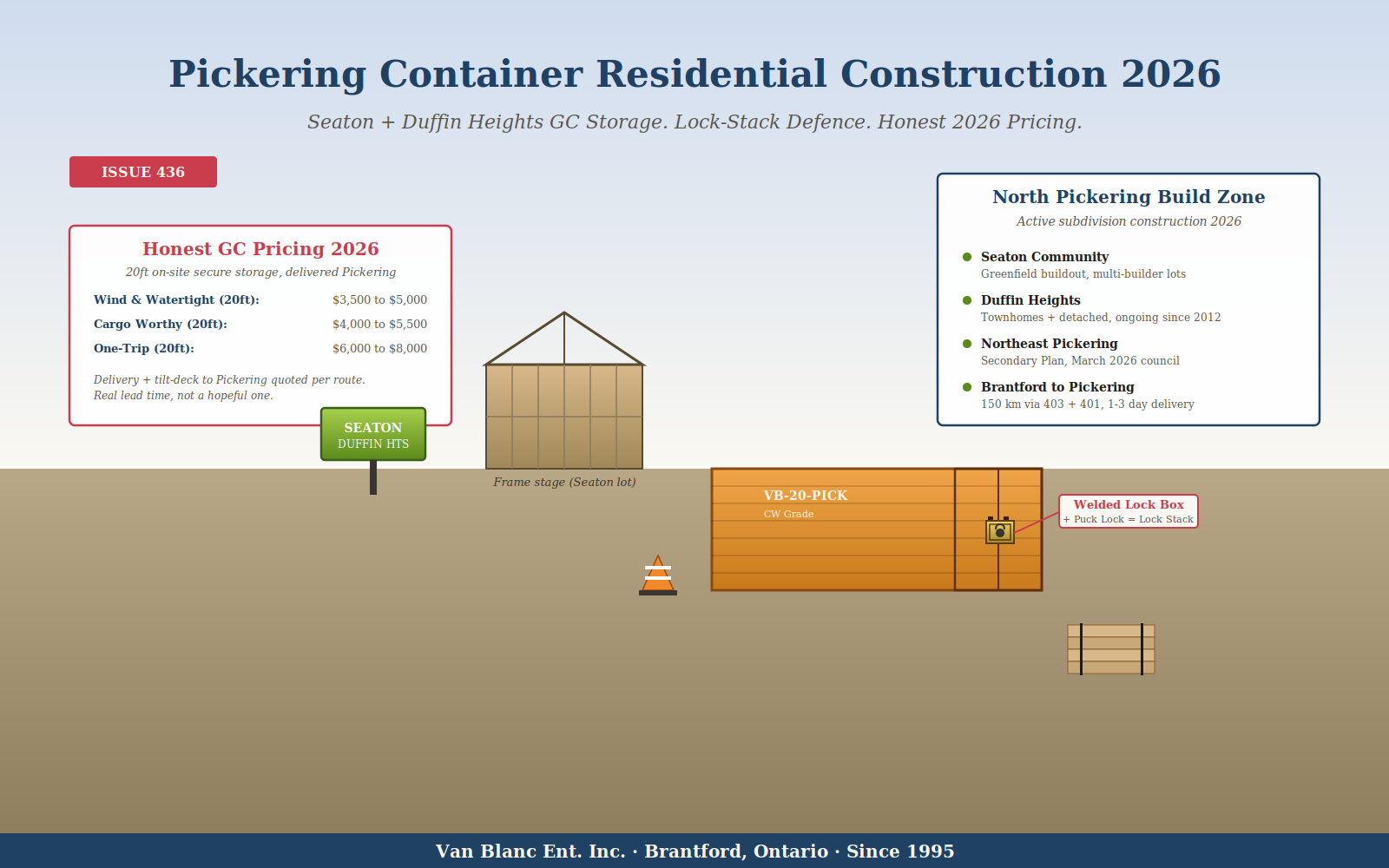
Quick Answer: Pickering residential GCs building in Seaton and Duffin Heights use 20ft cargo-worthy containers as on-site secure storage for lumber, copper, hardware, and finishings. Lock-stack defence, tilt-deck delivery onto graded subdivision lots, and a buyback at the end of the build. Van Blanc delivers in 1-3 days from our 4 Brantford yards. Three decades family-run, 140+ verified Google reviews. 1-3 day delivery from our 4 Brantford yards across Ontario.
In This Guide
- What makes north Pickering (Seaton, Duffin Heights) a container market?
- Why a 20ft secure storage container during the build?
- How do you lock-stack a container on an open lot?
- Cargo Worthy vs Wind & Watertight: which grade for a Pickering build?
- What drives Pickering GC container pricing in 2026?
- How does tilt-deck delivery work on a subdivision lot?
- What happens to the container at the end of the build?
- Why do Pickering crews get hit by the Facebook scam?
- FAQs
- Reach Van Blanc in Brantford
Reading Time: 14 minutes
What Makes North Pickering (Seaton and Duffin Heights) a Container Storage Market?
North Pickering, the Seaton and Duffin Heights subdivisions, is one of the busiest greenfield build zones in the GTA. Residential general contractors there keep a 20ft cargo-worthy shipping container on each active lot as locked, watertight storage for lumber, copper, and finishings through a 4 to 8 month build cycle.
Pickering, and specifically its north end, is one of the busiest residential build zones in the GTA right now, and the busiest part of Pickering is the north end. Seaton, the largest greenfield community in the region, is in active subdivision buildout across multiple builders. Duffin Heights has been adding townhomes and detached homes steadily since 2012 and the inventory keeps pushing further north. The Northeast Pickering Secondary Plan reached council recommendation stage on March 30, 2026, which puts another big chunk of land into the planning pipeline. Seaton Centre Plaza broke ground for commercial construction in 2026, the Pickering Heritage and Community Centre is opening this year, and the residential trades feeding all of it are moving from lot to lot on a 4 to 8 month cycle.
For a residential GC working a subdivision lot in this stretch of north Pickering, the operational picture is the same on every site. Materials arrive in waves. Framing lumber lands when the foundation cures. Sheathing, windows, exterior doors, and house wrap arrive when the frame is closed in. Mechanical rough-ins, insulation, drywall, finishings, and appliances stack up in the months that follow. None of it can sit on the lot exposed. None of it can be stored in the next subdivision over because the next subdivision is another GC’s site. And the existing self-storage operators on the Pickering 401 corridor (Atkinson, StorageMart, SmartStop, Parkway, Renewable Storage) charge by the cubic foot and price like an addressable Toronto market. A 10×10 self-storage unit in Pickering carries a recurring monthly rate that climbs the longer the build runs, and you still have to truck materials back and forth between the unit and the lot.
The math is straightforward: one secure 20ft container, bought outright, on each active lot pays for itself inside the build cycle, and the rent-versus-buy math lands on buying almost every time. We have been delivering containers to Pickering GCs for the full Duffin Heights buildout and into Seaton’s first phases. Most of our calls now come from second-generation crews whose foreman remembers their last build and just wants the same setup again.
Why the north end of Pickering is different from the south end
South Pickering (Frenchman’s Bay, Liverpool, the Bayly corridor) is mostly built out. The work down there is renovations, mid-rise condo finishing, and commercial interiors, the kind of jobs covered in our look at commercial storage builds around Pickering. The trades there use storage differently, mostly tool trailers and rented yards. North Pickering, from Highway 7 up through Whitevale Road and into the Seaton lands, is fresh subdivision construction. Open lots, no neighbours yet on most streets, graded earth waiting for foundations. That changes the storage equation entirely.
“Most of our Pickering calls come from a foreman who ran a lot with us last year and just wants the same box on the next one. North Pickering is open subdivision ground, so the container is the only secure thing standing on the lot overnight. That is the whole job it does.” Christian LeBlanc, second-generation operator, Van Blanc Ent. Inc.
Why Do Pickering GCs Use a 20ft Container for Secure Storage During the Build?
The 20ft container is the dominant size for residential construction storage in Pickering. Forty-foot bins are too big for a single-lot subdivision build. They eat driveway space, complicate trades vehicle parking, and they cost more to deliver and resell at the end. The 20ft is 8 feet wide by 8 feet 6 inches tall by 19 feet 10 inches long, which works out to 33 cubic metres of interior volume. That is enough to swallow the framing pack, the sheathing pack, all the rough-in materials, the cabinet boxes, the appliances if they show up early, and still leave room for a workbench in the back.
The buyer profile is consistent across north Pickering. Mid-size GC, 8 to 20 active lots across Seaton or Duffin Heights, runs each lot through framing-to-finish in 4 to 8 months. Anyone weighing options across the wider catchment can also browse what we stock for buyers right across the Pickering area. The container lands at lot 1 when framing starts. Lumber pack stacks against the back wall. Sheathing and house wrap stack on top. Once exterior is closed in, the contents shift: rough-in copper, electrical panel, HVAC bundles, then drywall sheets, then finish carpentry, then cabinets and tile. The container stays put through the build, or once lot 1 reaches finishing the GC arranges for it to be shifted to lot 2. By the time the build closes, the container has carried six to eight phases of material through one Pickering winter.
What actually goes inside a Pickering construction bin
From delivery notes across Pickering builds 2024 through 2026: framing lumber (kept off the ground on stickers inside the container), sheathing, OSB, house wrap and tar paper, exterior doors and windows (laid flat on padded supports), copper rough-in, PEX, electrical panel and breakers, HVAC ducting, insulation batts and rigid foam, drywall (stood vertical against the wall, never flat), finish flooring (kept off the floor on dunnage), cabinets, plumbing fixtures, appliances if they arrive ahead of schedule, hand tools, power tools, small generators, and (more often than crews admit) cases of warm Tim Hortons coffee left over from the morning meeting. Almost none of that is replaceable on a Monday morning if it walks off the lot Sunday night. The container is the line of defence between the GC’s progress draw and a stop-work week.
How Do You Secure a Container on an Open Subdivision Lot?
The single biggest reason Pickering GCs call us is theft prevention. Construction site theft on subdivision builds in the GTA has climbed every year since 2019, and the trades industry sources (the insurer briefings that get circulated through the OHBA, the National Insurance Crime Bureau) all converge on the same finding: copper, tools, and pre-staged finishings get hit hardest, and unsecured site offices and storage trailers get hit easiest. A shipping container with the right lock setup is not impenetrable, but it shifts a casual theft attempt into a full-effort break-in, and the casual attempt is what 80 percent of site theft actually is.
The defence layer we ship every Pickering construction bin with is the lock stack:
The lock stack (in order, applied at delivery)
- Welded lock box: A steel cover plate welded to the right-hand door over the existing padlock area. It covers the padlock body so a bolt cutter cannot reach the shackle. This is the single most cost-effective theft deterrent on the market.
- Puck lock inside the lock box: A hockey-puck shaped solid steel lock with a recessed shackle. Once seated inside the welded box, there is no shackle to cut. Disc detainer key.
- Secondary internal slide bolt: A horizontal steel bar across the inside of both doors, secured with its own padlock through the inside locking rods. Only accessible from inside, so it only gets engaged at end of day when the foreman locks up.
- Door-frame anti-pry plates: Steel L-brackets welded around the door seam at top and bottom to defeat the crowbar-the-corner approach.
The full lock stack is a modest add-on per container at the time of delivery if it is fitted at the yard, and it is one of the cheapest line items on the whole quote relative to the materials it protects. A GC running 8 to 20 lots through Seaton or Duffin Heights amortises that across every bin in the fleet.
Lighting and visibility help too. A solar-powered motion light mounted on the lot’s temporary power pole, aimed at the container doors, and turns the container into a visible signal that the GC takes site security seriously. We have had foremen tell us the lights are more effective than the locks because they redirect the casual attempt to the next site over.
“On a subdivision lot, the container is the only thing on site overnight worth more than a tool belt. The lock box gets welded on at the yard before the bin ships. Putting it on after the fact in a Pickering driveway in February is harder than it sounds. Get the lock stack handled before the bin lands and the GC sleeps better through every weekend of the build.” Paul LeBlanc, owner, Van Blanc Ent. Inc.
Cargo Worthy vs Wind & Watertight: Which Grade Fits a Pickering Build?
The grade question matters more on a residential construction site than it does on a farm. A farmer storing hay does not care if the bin has a few dents and surface rust. A GC storing a load of finished cabinetry and pre-finished hardwood does care, because moisture intrusion is a callback waiting to happen. Here is how the four grades shake out for a Pickering build.
| Grade | Condition | Fit for Pickering residential GC? | Relative cost & resale recovery |
|---|---|---|---|
| One-Trip | Essentially new, one ocean crossing, original factory paint, 25+ year life | Best when the container stays on across the GC’s full Seaton portfolio | Highest tier; the 25-year life spreads the premium across every build the bin serves, with the strongest resale at the end |
| Cargo Worthy (CW) | Multiple ocean crossings, surface rust spots, paint variance, structurally inspected for international shipping | The sweet spot. Watertight, structurally sound, looks like a working construction asset (not a brand-new pristine thing that draws thieves) | Mid tier and the best value: a 2-year-old CW 20ft typically returns 70 to 85 percent of purchase at resale |
| Wind & Watertight (WWT) | Used, doors close and seal, no light leaks, more cosmetic wear than CW, not re-certified for shipping | Acceptable for framing and sheathing phase. Marginal once cabinets and pre-finished flooring move in. Inspect seals before storing moisture-sensitive finishings. | Lower than CW; resale recovery is softer because it carries no shipping re-certification |
| As-Is | Older units with floor damage, frame issues, or door problems. Lowest grade. | Not recommended for a residential GC. Better suited to scrap-value or donor-unit conversions. | Cheapest up front, but resale value is near scrap, so it returns little at end of build |
For most Pickering residential GCs, a Cargo Worthy 20ft is the right call. Watertight enough for the full build cycle including finishings, structurally rated, and priced where the bin is recoverable at end of build through resale. If you are weighing the trade-offs across the full range of grades and container options, the CW 20ft consistently lands in the sweet spot for a residential build. Paul’s rule of thumb: if the container is going to sit on the lot through one Pickering winter, go CW. If it is moving lot to lot in summer only, WWT covers framing and sheathing, and CW is still the safer grade once finishings move in. If the GC is buying for a fleet across the next 3 to 5 years of Seaton work, a brand-new (one-trip) build starts to make sense because the 25-year service life amortises across multiple jobs and holds the strongest resale.
What Drives the Price of a Pickering GC Container in 2026?
Pod fleets and the bigger online sellers publish Pickering pricing as a single all-in number. That number usually buries the delivery fee, the lock box cost, the tilt-deck surcharge, and the end-of-build haul-back fee. The price looks competitive on the landing page and looks different on the invoice. We price differently.

What goes into a Pickering GC quote in 2026
A typical full quote for a Cargo Worthy 20ft delivered to a Seaton or Duffin Heights subdivision lot breaks out into these lines, and each one moves for a reason you can see:
- Container (CW 20ft): the base, driven by grade and current steel-market conditions
- Welded lock box fitted at the Brantford yard before ship: a small fixed add-on
- Puck lock (good quality, disc detainer key): a small fixed add-on
- Delivery from Brantford to Pickering (150 km via 403 + 401): scales with distance, route, and date
- Tilt-deck unload on a graded subdivision lot: included in delivery if site access is straightforward
- End-of-build haul-back (if reselling back through us): a carrier leg back to Brantford, quoted separately, often around the delivery rate
The total landed on lot, ready to lock and load, is simply those lines added together. Every quote we send breaks out each line so the GC’s accountant can match the PO to the invoice without arguing about what is included. Every quote comes with a real lead time.
Compare that to renting a 20ft container by the month from a fleet operator in Pickering. Over a 6-month build, the rental payments add up steadily and the GC owns nothing at the end. Buying pays off fastest when the GC has 3+ months of build life remaining or another lot coming in the same subdivision. Even on a 60-day build, a bought bin goes back through a buyback or moves to the next lot, so the money is not gone when the build closes. Most Seaton GCs we serve buy, because Seaton is going to run for another 5+ years and the bins move from lot to lot.
How Does Tilt-Deck Delivery Work on a Subdivision Lot?
Subdivision delivery in Pickering looks different from urban Toronto delivery. The advantage: graded earth lots with no curb to navigate, no neighbours to coordinate with, no interlock driveway to protect. The constraint: the lot has to be firm enough for the tilt-deck truck to back onto, and the GC’s foreman needs to mark where the container goes before we arrive. Carriers have unloaded into mud once or twice and the recovery story is not one anyone enjoys retelling.
Pre-delivery checklist for a Pickering subdivision lot
- Lot graded and compacted: Firm enough for a 27,000-pound combined truck and container weight to back across without sinking. Right after foundation pour is ideal. Before backfill is risky.
- Container footprint marked: The 20ft sits on a 20-foot by 8-foot footprint. Mark the four corners with stakes. Locate it so framing crews can park, materials trucks can unload alongside, and the foreman can see the doors from the build progress meeting spot.
- Access path clear: 14 feet of width minimum for the tilt-deck truck approach. No parked trades vehicles, no temporary fencing in the path, no rebar piles on the line.
- Dunnage staged (optional but recommended): Four 4×4 pressure-treated blocks ready to slide under the container corners at touchdown. Keeps the floor off the ground, prevents rust on the underside, makes pickup easier at end of build.
- Foreman or site super on site at delivery: Someone with authority to confirm placement and sign the delivery slip. The driver will not unload to an empty lot.
From our Brantford yards, a Pickering delivery is a 1 to 3 day window. The actual drive is 150 km via Highway 403 east to the 401 east and up Brock Road or Whitevale Road into the build zone. Two hours each way, three with traffic on a bad day. Pickering deliveries get scheduled in clusters when multiple GCs in the same subdivision have orders running, which brings the per-delivery cost down for everyone.
What Happens to the Container at the End of a Pickering Build?
One thing residential GCs forget when they buy a container for a Pickering build: the container has a residual value at the end of the build. Done right, the bin is an asset that comes off the books at 70 to 90 percent of what was paid for it, not a sunk cost like a rental that returns nothing.
Three paths at end of build:
- Resell back to us. If the bin is still CW grade (no major damage, doors operate, seals intact) we will quote a buyback once the bin is back at the yard. Resale value depends on market grade pricing at that month, but a 2-year-old CW 20ft generally returns 70 to 85 percent of the original purchase. The GC covers the carrier haul back to Brantford; we deduct it from the buyback.
- Keep it and shift it to the next lot. The bin is the GC’s asset, so if there is another build in Pickering, Ajax, Whitby, Markham, or anywhere in the GTA pipeline, the GC keeps the same container and arranges a hauler to move it across. No new purchase, no new lock box, the bin keeps working. This is the common path for GCs running parallel Seaton lots. We can sell you a replacement and deliver it if you would rather a fresh box land on the new lot while the old one stays where it is.
- Carry forward as fleet. Some GCs build their own container fleet across a 5 to 10-year Seaton commitment. The bin stays with the GC permanently, moves from build to build, and the lock stack and any modifications (vents, shelving, mezzanine floor) compound over time. The first bin pays for itself by year 2; bins 2 through 8 are pure cost-of-doing-business savings.
Case profile: 12-lot Seaton GC running 4 bins on rotation
One GC we have served since the early Seaton phases runs four CW 20ft bins across 12 active lots. The bins rotate based on which lots are at material-intensive phase (framing, drywall, finishings). Each bin sees about 18 months of service before the GC requests a swap. The older bin comes back to the yard on a carrier (still good for another 3 to 5 years on a quieter site), the buyback is applied, and a freshly serviced replacement is delivered. The math works in the GC’s favour: four bins bought new, each earning a buyback at 18 months, means the net cost per bin per cycle is only the difference between purchase and resale plus the delivery and haul-back legs. Renting equivalent storage for the same 18 months per bin builds no asset and returns nothing at the end. By buying and rotating through us, the GC keeps roughly 70 to 85 percent of each bin’s value working for the next cycle instead of writing it off.
Why Do Pickering Crews Get Hit by the Facebook Container Scam?
Pickering construction crews are a frequent target for the Facebook Marketplace container scam, because the buyer profile is exactly the one the scammers screen for: GC running multiple sites, fast-moving decision cycle, needs the container next week, pays through e-transfer to keep accounting simple. Many people call us saying they can get a bin far cheaper on Facebook. Two weeks later they call back saying they got scammed.
The pattern is consistent. A listing appears on Facebook Marketplace for a 20ft cargo-worthy container at well below market. The seller has a name that sounds like a real business, sometimes a knockoff of a real Ontario supplier’s name. They communicate fast, send photos that look professional (often stolen from an actual yard’s website). They ask for an e-transfer deposit to “hold the unit” and promise delivery in 5 days. The deposit clears. The seller goes quiet. The phone number stops working. The Facebook listing disappears. The GC is out the deposit, has no container, and has lost a week of build schedule because the framing crew is now standing on lumber that has no roof over it.
How a Pickering GC spots the scam before the e-transfer
- Real Ontario yard you can drive to. Van Blanc has been at 90 Morton Avenue East in Brantford since 1995. Drive there, walk the container before you pay. If the seller has no yard or refuses an in-person visit, the listing is fake.
- Phone number that connects to a person, not voicemail. 519-754-6844 reaches Paul or Christian directly. If you call the Facebook seller and get a voicemail with no business name, walk away.
- Google review history. Van Blanc carries a 4.9 across 140+ verified Google reviews. Scam sellers have no Google business listing or have one created within the last 90 days with three suspiciously identical reviews.
- Price within range. A CW 20ft listed far below the going market rate in 2026 is almost certainly bait. Real yards do not undercut market by 30 percent.
- Payment terms. Real Ontario container yards accept draft cheque, cash on delivery, wire transfer, or credit card via authorization form. Scam sellers insist on e-transfer up front because e-transfer is not reversible.
The Facebook scam is the single most frequent loss pattern we hear from Pickering GCs who call us after the fact. It is preventable with a yard visit and a Google review check. If a deal looks too good for the build schedule, it almost certainly is. See our guide to spotting fake container sellers for the full pattern catalogue.
Frequently Asked Questions
How fast can Van Blanc deliver a 20ft container to a Pickering subdivision lot?
Most Seaton and Duffin Heights deliveries land within 1 to 3 days of order confirmation from our 4 Brantford yards. The actual drive is 150 km via Highway 403 and the 401. Pickering deliveries get scheduled in clusters when multiple GCs in the same subdivision have orders pending, which compresses everyone’s wait time. Every quote comes with a real lead time.
Can a tilt-deck truck back onto a graded subdivision lot in Seaton?
Yes, on most lots. The lot needs to be firm enough to support roughly 27,000 pounds of combined truck and container weight. Right after foundation pour and before backfill is the ideal window. Mud, fresh fill not yet compacted, or steep slopes can block access. The foreman should walk the access path with the driver before the truck commits to the back-in.
What size container is right for a single-lot Pickering residential build?
20ft is the dominant choice for single-lot Pickering residential construction. It holds the full framing pack plus rough-in materials plus finishings across the build cycle, fits a single subdivision lot footprint without eating driveway space, and is easy to resell or have hauled to another site at end of build. A forty-foot bin needs more room to land than a single lot usually gives it.
Should a Pickering GC buy or rent a construction storage container?
For builds with 3+ months of remaining schedule or any prospect of a follow-on Pickering lot, buying is the better math. Renting in Pickering means steady monthly payments with no asset at the end. Purchase recovers 70 to 85 percent of value at resale, and the bin you own can be shifted to the next lot by a hauler. Most Seaton GCs buy because Seaton is a multi-year buildout.
What lock setup does Van Blanc ship Pickering construction containers with?
The full lock stack: welded lock box on the right-hand door (covers the padlock so bolt cutters cannot reach), a high-security puck lock inside the box (no exposed shackle), internal slide bolt for end-of-day reinforcement, and anti-pry plates at door seam corners. Fitted at the Brantford yard before the bin ships. It is a small add-on relative to the container price and one of the cheapest forms of insurance on a build site.
What drives the cost of a Cargo Worthy 20ft container in Pickering in 2026?
A Cargo Worthy 20ft delivered to a Pickering subdivision lot is built from three things: the container itself (driven by grade and current steel-market conditions), the delivery leg (which scales with the 150 km distance, route, and date), and the optional lock stack if you want it welded and installed before shipping. The total landed and locked on the lot is simply those lines added together, and every line is itemised on the quote so there are no surprises on the invoice.
Is a pod fleet or online reseller the right container option for a Pickering GC?
A pod fleet or online reseller ships from a generic pool; Van Blanc is a family-run Brantford yard operating since 1995. A Pickering GC choosing between them usually picks Van Blanc when they want to walk the actual container in our yard before paying, want the lock stack finished at the yard rather than shipped-and-hope, and want a real Ontario phone line that reaches Paul or Christian directly. Compare both, drive to our yard, decide for yourself.
Can the container stay on the lot through a Pickering winter?
Yes, that is the normal operating condition. The Cargo Worthy steel is rated for outdoor industrial use. The recommendation is to set the container on four pressure-treated dunnage blocks (one per corner) so the floor sits off the ground, which prevents rust on the underside through freeze-thaw cycles. Snow load is not a concern; the roof is rated well beyond a Pickering snow event.
What happens to the container at the end of a Pickering build?
Three paths. Sell back to us once a carrier hauls the bin back to the yard (typically 70 to 85 percent of original purchase if the bin is still CW grade), keep it and have a hauler shift it to the next Pickering lot or anywhere in the GTA pipeline since the bin is your asset, or carry it forward as a permanent GC fleet asset. Tell us the size and your build phase and we will quote the buyback or a fresh delivery, usually the same day.
Sources
- City of Pickering. (2026). Seaton Community: Pickering’s largest greenfield community. pickering.ca/business-building-development/seaton-community
- City of Pickering. (2026). Northeast Pickering Secondary Plan: Council Recommendation Report. Let’s Talk Pickering. letstalkpickering.ca/NEP
- International Organization for Standardization. (2022). ISO 6346:2022: Freight containers, Coding, identification and marking. iso.org/standard/82754
- Transport Canada. (2025). Cargo Securement Standard 10: Containerized Cargo. tc.canada.ca
Reach Van Blanc in Brantford
We have been supplying shipping containers across Ontario since 1995. Our warehouse is at 90 Morton Avenue East in Brantford, and we deliver across the province on a cash-on-delivery basis. No surprise fees, no chase-the-paperwork.
Van Blanc Ent. Inc. · 90 Morton Ave E Unit 1B, Brantford, ON N3R 7J7 · 519-754-6844 or toll-free 1-888-509-6658
If you are running lots in Seaton, Duffin Heights, or anywhere on the Pickering north end, call Paul or Christian directly. We can quote the full setup (container, lock stack, delivery, tilt-deck) over a 10-minute call and have the bin on your lot inside the week.
Tell us the lot address and where you want the box and we will sort out the tilt-deck approach before the truck rolls. The fastest answer to any site question is a call to the Brantford yard at 519-754-6844.
Related Reading
- Container delivery across Pickering
- Pickering Container Commercial Storage
- Used Shipping Container Buying Guide (Grades, CSC Plate, What to Look For)
- Container Accessories Canada (Lock Boxes, Puck Locks, Site Hardware)
- Shipping Container Scams: The Facebook Pattern
- Shipping Container Rental Ontario (Rent vs Buy Math)
Ready to price your container?
Tell us the size and your postal code and we’ll send back an all-in number, container, delivery, and placement, usually within 1-3 days. No pressure, no mystery fees.
Family-run in Brantford since 1995 · 200+ containers in stock · 4.9★ across 140+ Google reviews · every box graded by a person, walk it before it lands.