
We sell containers. We do not rent.
Van Blanc sells shipping containers outright. We do not rent, we do not lease, and we do not offer rent-to-own. Renting comes up on this page because buyers compare it against owning, and that comparison is worth reading, but purchase is the only arrangement we offer. Stocked units deliver from our Brantford yards in 1 to 3 days. Request a sale quote or call the yard at 519-754-6844.
Quick Answer: PODS 16ft units rent on a recurring monthly basis in Ontario (2026) plus delivery fees. A 20ft Wind & Watertight container is a one-time purchase plus delivery. Break-even crossover: 11 months for WWT, 21 months for a One-Trip container. Storage durations over a year favour buying. Pricing varies by grade, size, and freight zone, so call Christian or Paul for a same-day quote. Family-run since 1995, 4.9 stars across 140+ verified Google reviews. Delivery in 1-3 days from our 4 Brantford yards.
In This Guide
- The question that decides everything: how long?
- What PODS actually costs in Ontario in 2026
- What a shipping container actually costs in Ontario in 2026
- The break-even math at 3, 6, 11, 18, and 24 months
- When PODS is the right answer
- When a shipping container is the right answer
- The hybrid path: rent first, decide later
- Trade-offs that money does not capture
- FAQs
Reading Time: about 13 minutes
The question that decides everything: how long?
Every PODS-versus-shipping-container decision in Ontario comes down to one variable: how long will you actually need the storage. Three months, six months, one year, three years, ten years. The honest cost math swings dramatically across that range, and almost every buyer who comes to our Brantford yard has been comparing the wrong two numbers (monthly PODS rent versus total container purchase) without putting both on a common timeline.
The right comparison is cumulative cost over the actual storage duration. A PODS unit billed monthly looks much cheaper than a container in month one. By month eleven, the PODS renter has paid more than the container buyer. By month twenty-four, the PODS renter has paid roughly twice the container purchase cost and still owns nothing. Beyond five years, the PODS renter has paid several times what the container cost, while the container buyer already owns the asset.
The other variable that matters: mobility. PODS transports the loaded unit to a new address. A purchased shipping container moves on a tilt-deck truck, billed once per move within Ontario. For one-time inter-city residential moves, PODS is structurally better at delivering the loaded unit to the new home. For storage that stays on one property, the container wins on every metric beyond month eleven.
This guide walks the real 2026 Ontario numbers for both options and gives you the honest break-even points so you can pick the right tool for your actual situation. Paul has been delivering containers across Ontario since 1995, and we see customers every week who already tried PODS for a renovation or move and want to know whether a container makes more sense for the next stretch. Most of the time the answer is yes, but not always.
Why both options exist in the Ontario market
PODS launched in the United States in 1998 and arrived in Canada in the mid-2000s. Their model solves a specific real problem: people moving between Canadian cities who do not want to drive a rental truck. PODS delivers the empty unit to your origin, you load on your schedule, PODS transports the loaded unit to your destination, you unload on your schedule. The convenience of inter-city transport without operating a moving truck is real and worth paying for, when that is the actual job. Where PODS gets used as a long-term storage rental instead of a transport service, the monthly fees keep accumulating. Containers solve the long-term-stationary-storage problem; PODS solves the temporary-transport problem. The two products are not interchangeable, and forcing them to be is where most buyer regret originates.
What PODS actually costs in Ontario in 2026
PODS Canada operates in six provinces including Ontario, where pods.ca lists two markets, Toronto and Ottawa, served with their three standard container sizes. The pricing structure splits across two cost categories: monthly rental fee and per-event service fees. We have written a separate comparison of BigSteelBox vs PODS for Canadian buyers if you are weighing those two portable-storage options against each other rather than against an owned container. The dealer-run pod brands fill in around that footprint, and the MI-BOX guide maps the Hamilton and GTA dealers against buying outright.
| PODS Size | Approx. Usable Volume | Footprint | Typical Use | Relative Monthly Cost |
|---|---|---|---|---|
| 8ft (smallest) | about 11 m³ | roughly 2.4m x 2.2m | studio or single-room move | lowest tier |
| 12ft | about 17 m³ | roughly 3.7m x 2.2m | two to three rooms | middle tier |
| 16ft (largest) | about 24 m³ | roughly 4.9m x 2.2m | full house or long-term storage | highest tier |
Toronto and GTA pricing tends to run at the higher end of the Ontario range due to delivery density and higher urban operating costs. Outside those two markets availability thins quickly: pods.ca itself notes that limited-service areas may apply, and most rural, southwestern and Northern Ontario addresses are not listed at all. The 16ft unit is the closest functional equivalent to a 20ft shipping container, though the shipping container is larger (33 m³ vs 24 m³).
Important fine print: the first 30 days are typically included in the initial delivery fee. Storage after day 30 begins billing monthly. Many Ontario customers who use PODS for a quick move never enter monthly billing if they finish unloading within the included period. Customers who use PODS for storage past 30 days are the cohort where container purchase becomes worth modelling.
Sample real-world PODS bills in Ontario
For a Toronto-area family using a 16ft unit for a local move with 3 weeks of overlap (origin loading, transport, destination unloading), the bill is driven almost entirely by service events rather than rent: initial delivery, redelivery to the new address, and final pickup, with no monthly rental because the job stays under 30 days.
For an Ottawa homeowner using a 16ft unit for a 4-month renovation on their driveway, the bill stacks the service fees (initial delivery and pickup) on top of roughly three months of rent past the included period, so duration becomes the dominant cost driver.
For a Mississauga family storing a 16ft unit for 12 months between sale and new build, the same service fees apply once, but eleven months of recurring rent now dwarf them, which is precisely the cohort where buying a container starts to pay off.
What a shipping container actually costs in Ontario in 2026
Container costs split into purchase price plus delivery. Unlike PODS, there is no monthly fee after delivery; the container is yours.
| Size + Grade | Approx. Volume | Condition | Best For | Relative Cost Level |
|---|---|---|---|---|
| 20ft Wind & Watertight | about 33 m³ | used, sealed against weather | budget-conscious on-site storage | entry level |
| 20ft Cargo Worthy | about 33 m³ | certified for one more sea voyage | storage where a CSC plate matters | mid level |
| 20ft One-Trip (new) | about 33 m³ | near-new, single shipment only | conversions and curb appeal | premium |
| 40ft WWT | about 67 m³ | used, sealed against weather | maximum volume on a budget | mid level |
| 40ft HC One-Trip | about 76 m³ | near-new, extra height | workshops, offices, ADUs | highest |
The container purchase is a single transaction. Cash on delivery, no monthly fees, no contract, no renewal pricing. The asset is yours. If five years later you no longer need the storage, the container has resale value in the Ontario used-container market, typically 50-70 percent of the original purchase price for a well-maintained unit. Our used container inspection guide walks through the same checks buyers should make at resale time. The PODS renter has no equivalent asset after five years of monthly payments. For buyers comparing grades, the new vs used breakdown explains where One-Trip, Cargo Worthy, and WWT each make sense.
The break-even math at 3, 6, 11, 18, and 24 months
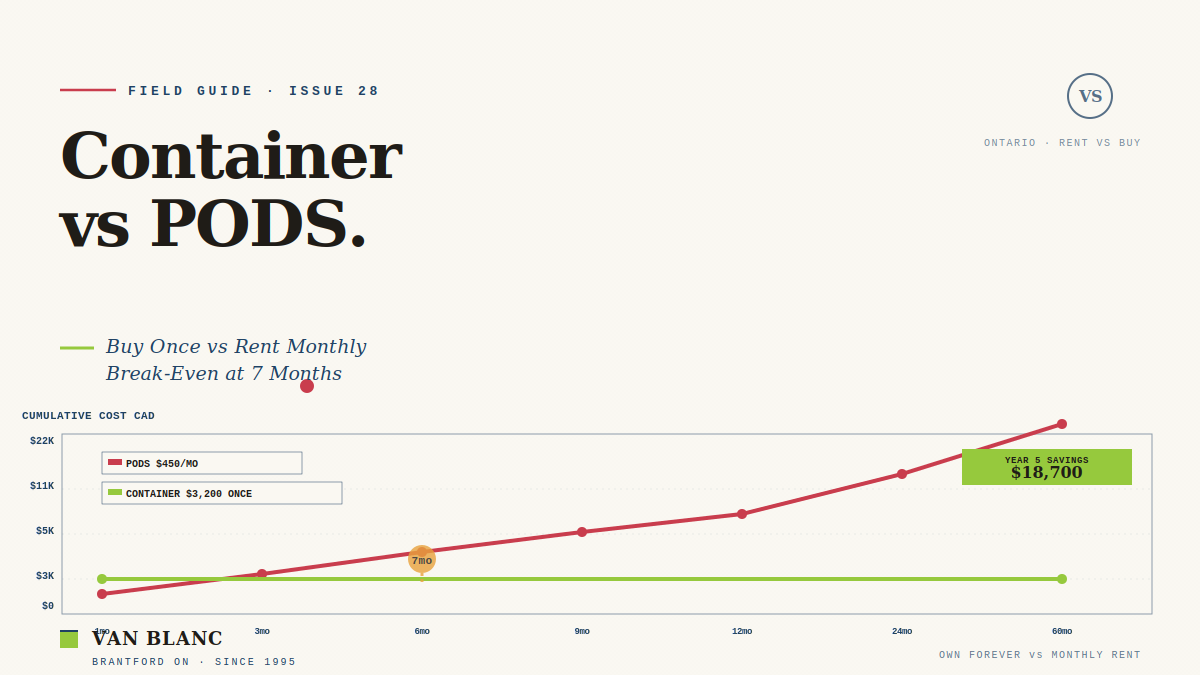
Below is the cumulative cost over 60 months for the most common Ontario customer profile: a buyer comparing a 16ft PODS monthly rental against a one-time 20ft WWT container purchase (unit plus delivery). The PODS column carries one round-trip set of delivery and pickup fees plus the recurring rent past the first 30 days. The container column is a single up-front cost that does not change month to month.
| Storage Duration | PODS Cost Trend | Container Cost Trend | Who Is Ahead |
|---|---|---|---|
| 1 month (under free period) | delivery fees only, rent not yet started | full purchase paid up front | PODS, by a wide margin |
| 3 months | fees plus a few months of rent | unchanged from day one | PODS still ahead |
| 6 months | rent has accumulated past the fees | unchanged | PODS, but the gap is closing |
| 9 months | rent climbing toward the container total | unchanged | PODS, narrowly |
| 11 months (break-even) | cumulative rent meets the container total | unchanged | roughly even, crossover point |
| 12 months | now above the container total | unchanged | Container pulls ahead |
| 18 months | rent keeps compounding | unchanged | Container, clearly |
| 24 months | roughly double the container cost | unchanged | Container, by a wide margin |
| 36 months | several times the container cost | unchanged | Container, decisively |
| 60 months (5 years) | many multiples of the container cost | unchanged, plus resale value | Container, no contest |
The 11-month break-even is the operational threshold to remember. Below 11 months of expected storage, PODS is cheaper. Above 11 months, the container is cheaper, and the gap widens fast.
For comparison, the equivalent calculation for a One-Trip (new) 20ft container moves the crossover later because the up-front cost is higher: break-even with PODS lands around month 22. For a 40ft HC One-Trip, break-even sits near month 40 against a single 16ft PODS, though many buyers would rent two PODS units to match a 40ft container’s volume, which pulls the break-even back to roughly month 20.
Paul LeBlanc, owner: “Customers come to our Brantford yard after they have already paid PODS for a year and the renovation extended another six months. They are sitting on a year of rental bills and asking what happens if they buy. Honest answer: they should have bought eleven months ago, but the second-best time is right now, and the container they buy today still costs less over the next year than continuing to rent. We have a guy in Hamilton who switched from PODS to one of our 40ft units four years ago and still tells everyone who asks. He has 96 months left in that container before he hits the cumulative cost of where he would be on PODS.”
When PODS is the right answer
Three scenarios where renting PODS beats buying a container:
1. Inter-city residential move with 2-4 weeks of overlap
You sold the Toronto house, closing is in three weeks, the new place in Ottawa is ready in five weeks. PODS delivers a 16ft to Toronto, you load over the weekend, PODS transports to Ottawa, holds it for two weeks until closing, and delivers to your new driveway. The cost here is mostly the transport service plus zero to one months of rent. A container does not solve this job well, because moving an owned box between cities adds a separate tilt-deck haul and you still own the container after.
2. Short renovation under 8 months
You are gutting the basement, replacing flooring throughout, or staging the home for sale. The work runs 3-7 months. PODS sits in the driveway, holds the furniture and stored items, and disappears at the end. The total scales with how many months the reno actually runs. A container purchase makes no sense here because you do not want to keep it after the reno.
3. Temporary corporate or military relocation
You are posted to another province for 18 months and need storage of household goods during that period. PODS delivers a unit to your origin home, transports to a PODS warehouse, holds it during your absence, and re-delivers when you return. The total depends on unit size and how long the posting runs. A container does not deliver the warehoused-storage portion of this job; you would have to rent self-storage in addition, which usually loses to PODS.
When a shipping container is the right answer
Three scenarios where buying a container beats renting PODS:
1. Year-round on-site storage on a residential or rural property
You have a farm, cottage, or large-lot home and need permanent storage for equipment, tools, seasonal items, or overflow from the main building. The container goes on a stone pad behind the barn or alongside the driveway and stays there for decades. The cost is a single turnkey purchase. Compared to 10+ years of monthly PODS rental, the cumulative rent dwarfs the one-time container cost many times over, so the container wins by roughly an order of magnitude.
2. Recreational property in cottage country, off-grid use
You bought 5-50 acres in Muskoka, Haliburton, or the Kawarthas and need storage for ATVs, snowmobiles, watercraft, and tools. The container becomes the year-round building on the property. PODS does not list most cottage country areas on its Ontario map, and even where service is available, monthly fees keep accumulating for as long as the property is held. Container makes obvious sense.
3. Conversion or modification use cases (office, workshop, garage, ADU)
You want to turn the container into a permanent structure: a backyard or job-site office, a workshop or man-cave, a vehicle garage, an accessory dwelling unit, or any other modification. PODS is a transport rental and is not engineered for permanent placement or modification. Containers are designed for both. Cost not even comparable.
The honest test: write the date you expect to be done with it
Most buyers cannot estimate storage duration accurately. The honest test we recommend at the Van Blanc yard: write the date on which you expect to no longer need the storage. If that date is more than 11 months out, buy the container. If it is less than 11 months out and you are confident, rent PODS. If you are not confident which side of 11 months you are on, the optionality argument favours buying the container, because containers have resale value if your timeline shrinks and PODS has no equivalent recoverable cost if your timeline extends.
The hybrid path: rent first, decide later
A third option sits between PODS and outright container purchase: renting a plain steel container from an Ontario yard that runs a rental fleet, then buying once the timeline is clear. Van Blanc is not that yard; we sell only, and we say so on every page. The shape is still worth knowing. The container gets delivered to your property the same way a purchase would, you pay a monthly rate that scales with size, lower for a 20ft unit and higher for a 40ft, and the box stays on your driveway rather than moving to a warehouse. Along the way you can:
- Stop when the job stops. A rental from a local yard ends with a pickup call, and the unit leaves on a tilt-deck.
- Buy instead. Once you know you want the box for years, a used wind-and-watertight unit bought outright from our Brantford yard ends the monthly bill for good.
- Compare it against a pod. If the use case is truly transient and measured in weeks, a pod rental still wins, and we will say so.
Container rental from a local Ontario yard is quoted by the yard for the same sizes, and the unit stays on your property rather than moving to a warehouse. The trade-off versus owning is that you pay monthly for as long as the box sits there, so the honest use of the hybrid path is short: rent to learn your real timeline, then buy the container outright when the timeline says years.
Trade-offs that money does not capture
The cumulative cost table is the headline number, but seven secondary factors influence the right choice:
- Mobility. PODS picks up the loaded unit and transports it. A container moves only by tilt-deck truck, billed per move within Ontario; our how your container gets delivered walks through the process. For one-time inter-city moves, PODS has structural advantage. For storage that stays put, irrelevant.
- Container appearance. A 16ft PODS unit on the driveway looks temporary and renovation-coded. A 40ft shipping container on a residential property looks more permanent, which some neighbours and some HOAs notice. Address this with cladding or paint if the property aesthetic matters to you.
- Modification potential. Container can be cut into for windows and personnel doors, electrical, plumbing, and any modification. PODS cannot be modified.
- Insulation. Container can be spray-foamed and made fully year-round liveable. PODS is not designed for occupant use even temporarily.
- Resale value. Container retains 50-70 percent of purchase price for years. PODS rental payments are entirely sunk cost.
- Site footprint flexibility. PODS units are 8ft, 12ft, or 16ft. Container sizes are 20ft, 40ft, 45ft, and 53ft. Our 20ft vs 40ft cost-per-cubic-metre breakdown helps match size to actual storage need.
- Service area coverage. PODS Canada lists Toronto and Ottawa as its Ontario markets; cottage country, southwestern and Northern Ontario are not on its map. Van Blanc delivers anywhere in Ontario with tilt-deck access.
Who insures the contents? A question to ask before either quote
One more trade-off that money captures poorly because it only surfaces when something goes wrong. When your goods sit in a rented pod, especially one stored at the company’s facility, coverage is a three-way question between your home policy, the rental agreement, and whatever contents-protection plan the company offers as an add-on. Off-premises coverage under a typical home policy has limits and exclusions of its own, and the answer genuinely differs by insurer, which is why the right move before signing is a five-minute call to your broker asking specifically about goods stored in a portable container off your property.
A container you own, sitting on your own property, is the simple case by comparison: it is your structure on your land, insured the way your broker adds any outbuilding, with the contents falling under the same conversation. Neither arrangement is uninsurable and neither is automatic. The difference is that ownership keeps the whole question inside one policy you already have, while rental splits it across three documents written by three different parties. Ask the question before the goods are loaded, whichever way you go.
Frequently Asked Questions
What is the break-even point between PODS and buying a shipping container?
For a monthly 16ft PODS rental versus a one-time 20ft Wind & Watertight container purchase, break-even lands at month 11. For a 20ft One-Trip (new) container, the higher up-front cost pushes break-even to month 21. For a 40ft High Cube One-Trip, break-even is month 40 against one PODS, or month 20 against two PODS units sized to match its volume.
How much does PODS cost per month in Ontario?
16ft PODS units are the most commonly rented size in Ontario, with 12ft and 8ft units costing progressively less per month. The first 30 days are typically included in the initial delivery fee, after which recurring monthly rent begins. Separate delivery and pickup service fees apply on top of the rent, so the monthly rate is only part of the total.
Can a shipping container replace PODS for an inter-city move?
Not efficiently. PODS is engineered for inter-city loaded-unit transport (drop empty, load on schedule, transport, redeliver). An owned container moves only by tilt-deck truck, billed per move within Ontario, and longer hauls cost more the farther they go. For one-time residential moves between Canadian cities, PODS structurally beats container purchase. For storage that stays put after the move, buy the container after you arrive.
What size container matches a 16ft PODS?
The closest equivalent is a 20ft shipping container, which is slightly larger (33 m³ versus the 16ft PODS at 24 m³). A 40ft container is nearly three times the volume of a 16ft PODS. For most Ontario buyers comparing PODS to a container, the 20ft container is the right size to model the cost comparison against.
Is renting a shipping container cheaper than PODS?
Not from Van Blanc, which sells rather than rents. A 20ft or 40ft bought outright from our Brantford yard costs roughly what two years of comparable PODS rent does for the same size, delivers larger volume from day one, and stays on your property rather than relocating to a warehouse. Businesses that want a monthly shape for a short stretch can rent from a yard that runs a rental fleet, then buy outright from us once the timeline is clear.
Can I inspect a container before I buy?
Yes at the Van Blanc Brantford yard. We carry over 200 containers in inventory at any time and let buyers physically walk the row, check CSC plates, verify door seals, inspect floor condition, and pick the specific unit before paying. PODS supplies a unit from its rental fleet rather than one you pick in person. Walk the yard with Paul or Christian for the kind of inspection that prevents a year of “I should have looked at it first.”
What about damage to the driveway from a container delivery?
Tilt-deck delivery places the container without ground damage in most conditions. Wet or freshly poured concrete, soft topsoil, or interlock pavers with shallow base can show pressure marks. The fix is to place plywood or sheets of OSB under the corner-casting positions during the drop, then remove after settling. PODS has similar concerns with its lift truck. Both options work for most Ontario driveways with reasonable site preparation.
Sources
- PODS Canada. (2026). Toronto, Ontario Storage and Moving Services. pods.ca
- MoveBuddha. (2026). PODS Cost 2026: Prices by Size, Distance, and Season. movebuddha.com
- Ontario Construction News. (2026). Shipping Container Pricing in Canada: A 2026 Guide for Construction Professionals. ontarioconstructionnews.com
- International Organization for Standardization. (2022). ISO 6346:2022, Freight containers – Coding, identification and marking. iso.org
- Statistics Canada. (2026). Statistics Canada, official site. statcan.gc.ca
Reach Van Blanc in Brantford
We have been supplying shipping containers across Ontario since 1995. Our warehouse is at 90 Morton Avenue E in Brantford, and we deliver right across the province on a cash-on-delivery basis. Purchase options for 20ft, 40ft, and refrigerated containers, every one sold outright, with COD-honest delivery and zero monthly fees once the container is yours.
Van Blanc Ent. Inc. – 90 Morton Ave E Unit 1B, Brantford, ON N3R 7J7 – +1 888-509-6658
Already paying PODS for over six months? Drive to Brantford, walk our row with Paul or Christian, and run the real cost math on switching to a container. Over 200 containers in inventory, and you pick your specific bin before paying.
Related Reading
Ready to price your container?
Tell us the size and your postal code and we’ll send back an honest, all-in number, container, delivery, and placement, usually within 1-3 days. No pressure, no mystery fees.
Family-run in Brantford since 1995 · 200+ containers in stock · 4.9★ across 140+ Google reviews · every box graded by a person, walk it before it lands.