
for 2026
Last updated: October 24, 2026
Quick Answer: To buy a shipping container in Ontario, settle the size, the grade, the payment and the seller. Then check that a truck can reach your pad. See the actual container before money moves. Van Blanc sells new and used containers from 4 Brantford yards, delivered in 1 to 3 days.
How to Buy a Shipping Container in Ontario
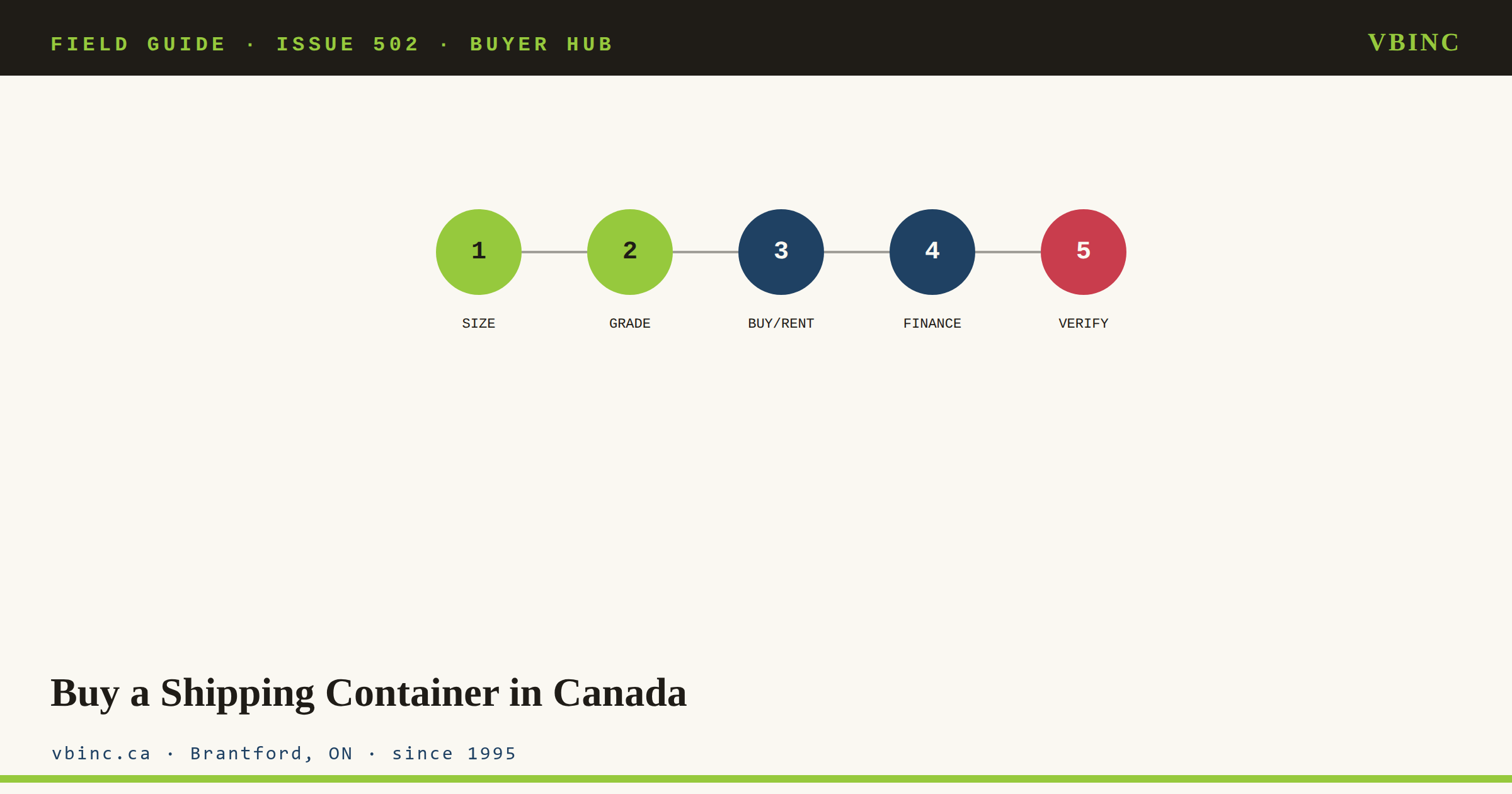
Buying a shipping container in Ontario is a short run of decisions taken in the right order. A shipping container is a welded steel box built to ISO size rules. It has a corner casting at each of its eight corners, so cranes, trucks and twist-locks can lift and hold it. When buying a container, settle the size and the grade first. Payment, seller and delivery questions get much easier once those two are fixed, and the containers we have for sale right now sort the same way.
Van Blanc Ent. Inc. has been buying and selling shipping containers in Ontario since 1995. Paul LeBlanc started the business in Brantford. Christian, his son, runs day-to-day operations now. The steps below follow the conversation we have with buyers on the phone and in the rows, and each one links to a longer guide on our site.
| Step | The decision | What settles it |
|---|---|---|
| 1 | Size | What you store, the longest single item, and the space on your lot |
| 2 | Grade | Where the box will sit, who sees it, and whether it will ever ship again |
| 3 | Own it or rent one | How long the job runs and whether you want resale value at the end |
| 4 | Payment | Pay on delivery, or a loan from your own bank or BDC |
| 5 | Seller | A yard you can visit and a container number on the invoice |
| 6 | Delivery | A level, drained pad, a 12 ft wide path and at least 14 ft of overhead room |
One thing worth clearing up first: the product has a pile of names, and buyers land on this page searching all of them. A shipping container is the same steel box whether you call it a sea can or a conex. Sea can is the common Canadian term, and the sea cans for sale page speaks it fluently. Conex is the old US military name. Buyers also say steel storage container or metal storage container. A caller to our Brantford yards asking for “steel box containers” means the same ISO-standard units we sell as 20ft and 40ft dry boxes. The grade and size language below applies no matter which name you arrived with.
Decision 1: Container Size for the Job
The size question is the first commitment and the hardest to undo. Most first-time buyers default to 20ft because it is the size they have seen on a residential driveway. Most operations buyers default to 40ft because it is the size they have seen at industrial yards. Both defaults are sometimes right and sometimes wrong.
The size-decision questions: How much volume do you actually need to store (cubic feet, not vague impressions)? What is the longest single item you need to fit? Every 40ft measurement in one place helps here, and CN’s intermodal sheet puts the inside of a 40ft at 39 ft 6 in. How tight is the delivery access at your property? Is there any chance you will need more storage in 2-3 years, where adding a second 20ft would be cleaner than upgrading to a 40ft? Will the container ever need to move?
Each size does one job best. A 20ft fits most driveways and holds a household renovation, a cottage’s off-season gear or a small shop’s stock. A standard 40 foot box gives farms, contractors and small manufacturers the most floor per delivery. A 40ft high cube with the extra foot of headroom holds about 12% more than the standard 40, which matters for tall racking and machinery. The 45ft and 53ft high cubes carry long items and the most volume in one piece, and refrigerated containers in 20ft and 40ft lengths cover cold storage.
Van Blanc carries every size in both standard and high cube height, the 20ft included. A high cube adds a foot of inside height, and on a 20ft our 20ft high cube comparison puts the gain at about 12 percent more interior volume.
| Size | Inside length | Usable volume | 48 x 40 in pallets | Figure from |
|---|---|---|---|---|
| 20ft standard box | 19 ft 4.5 in | 1,169 cu ft (33.1 m³) | 10 | CN Intermodal 20ft sheet |
| 20ft high cube | Same floor as the 20ft standard | about 1,300 cu ft (37.3 m³) | Same floor as the 20ft | Van Blanc 20ft high cube guide |
| 40ft standard | 39 ft 6 in | 2,395 cu ft (67.8 m³) | 20 | CN Intermodal 40ft sheet |
| 40ft high cube | 39 ft 6 in | 2,689 cu ft (76.1 m³) | 20 | CN Intermodal 40ft sheet |
| 45ft high cube | 44 ft 6 in | 3,040 cu ft (86.0 m³) | 24 to 26 | Van Blanc 45ft listing |
| 53ft high cube | 52 ft 4 in | 3,901 cu ft (110.5 m³) | 28 to 30 | Van Blanc 53ft listing |
| 20ft reefer | 5.44 m | 27.7 m³ | Set by airflow | Van Blanc 20ft reefer listing |
| 40ft high cube reefer | 11.583 m | 67.0 m³ | Set by airflow | Van Blanc 40ft reefer listing |
Reefers lose inside room to their insulated walls and the refrigeration unit, which is why a 40ft high cube reefer holds less than a dry 40ft high cube. Pallet counts on a cold box depend on how much space the load needs for air to move, so plan those with the unit’s own spec sheet. The 45 foot high cube and the domestic 53 foot box each have a full spec table on their own page. Our guide to reefer power and sizes covers the electrical side before you buy.
Decision 2: New or Used Grade
A container grade is a written promise about condition. It tells you how the box looks, whether it is certified to ship again, and how many working years are left in the steel. Van Blanc grades every unit four ways, and the grade goes on the quote in writing. Our graded used containers carry the three lower grades. The table runs from the top of the ladder down.
| Grade | What it is | What it does well |
|---|---|---|
| New (one-trip) | One loaded voyage from the factory, factory paint, a valid CSC plate | Visible placements, conversions, branded sites, the longest working life |
| Cargo worthy (CW) | Used 8 to 15 years; its plate is re-certified for ocean shipping | Storage that may need to ship or pass a survey later |
| Wind and watertight (WWT) | Used 12+ years, sealed against weather and rodents, plate may have lapsed | Stationary storage on a farm, a back lot or a jobsite |
| As-Is | Faults declared up front with photos of the defects | Heavy modification, cladding stock or a donor shell |
A one-trip container is a new box that has made a single loaded voyage from its factory in Asia before reaching a Canadian yard. The trade calls it one-trip and buyers call it new, so Van Blanc lists it under both names. It lands with factory paint in one clean colour, a valid CSC plate and door gaskets that have sealed one ocean crossing. Our new one-trip shipping containers page covers what minor handling marks can look like on new steel.
Grade also sets how long the box works for you. On a level pad with basic drainage, our lifespan figures by grade put a one-trip container at 25 to 30 years. Cargo worthy runs 20 to 25 and wind and watertight 15 to 20. Used grades are cosmetic history on sound steel: dents, surface rust and faded paint on a box that still keeps weather out. The full grade and container-type guide walks each one with photos.
What does NOT exist as a real grade: “Used Like New,” “Premium Used,” and other marketing terms. If a seller uses these instead of One-Trip / Cargo Worthy / Wind-and-Watertight / As-Is, ask which of the four real grades the unit actually is.
Decision 3: Buying Outright Versus Renting
Buying a shipping container outright means the box is yours from delivery day. Van Blanc sells outright and does not rent, lease or offer rent-to-own. In the wider market, renting is a monthly fee for a box that goes back to the fleet when the job ends. The payments stop only when the container leaves.
Owning turns that money into steel you keep. The box stays on your site for as long as the work runs, and a tilt-deck can carry it to the next site. It still has resale value when your needs change. When an operation changes, we quote a buyback on serviceable boxes, so the container you buy today has a way out later. Our guide to how long each container grade lasts in Ontario shows how many years that steel keeps working.
If cash flow is the reason a monthly fee looks attractive, financing the purchase spreads the cost the same way while the box belongs to you from day one. Decision 4 covers how that works.
Decision 4: Paying Cash or Financing
Paying for a shipping container is simplest at the door. Van Blanc takes draft cheque, cash, wire transfer, or a credit card through an authorization form, as listed on our contact and payment page. Payment is on delivery, never a deposit. A larger order, or a business that would rather keep its working capital, can finance the box instead. Van Blanc supplies the invoice, the grade and the container serial number the lender asks for.
| Path | How it works | Worth knowing |
|---|---|---|
| Pay on delivery | Draft cheque, cash, wire transfer or credit card authorization, paid when the box lands | No interest and no lender paperwork |
| Business line of credit | Draw on your bank’s existing credit line | Your bank sets the rate and terms |
| BDC loan for a container | Covers up to 125% of the purchase price of new or used equipment | Interest-only for up to the first 24 months, up to 12 years to repay |
| Credit union loan | A local lender finances the purchase | Often a good fit for rural Ontario businesses with a branch relationship |
| Rent-to-own | Offered by fleet operators, not by Van Blanc | Add up every payment and compare it with the outright quote |
The Business Development Bank of Canada says the room above the purchase price covers costs such as shipping and installation. For a container, that means delivery and placement. A line of credit drawn for a container suits a working business that already banks with one lender. Credit unions sometimes price equipment loans well for rural buyers, because the account manager knows the local operation.
Decision 5: Verified Yard or Unverified Seller?
Choosing the seller decides whether you receive a container at all. The Canadian container market in 2026 is split into two populations. One is real yards with physical inventory and accountable operators. The other is a sprawling shadow market of fraud listings on Facebook Marketplace, Kijiji, and Craigslist, where the “seller” takes a deposit and disappears.
Merchandise fraud is common enough to have its own line in the national numbers. In 2024 the Canadian Anti-Fraud Centre received 108,878 fraud reports, and merchandise scams made its top-10 list with 3,225 reports from 2,734 victims. A container listed far below every real Ontario yard fits that pattern exactly.
The fraud listings are easy to identify in retrospect and harder to identify upfront. The patterns repeat. A 20ft is priced far under what any verified yard could deliver, and the messages push urgency. The seller asks for an e-transfer deposit before any verification, uses photographs lifted from other yards’ inventory pages, and gives a mobile-only number that stops working after the deposit clears. Our walk-through of the Marketplace container scam shows the messages these sellers send.
The verification check is simple. Ask for the seller’s physical yard address and CRA business number. Drive past the address on Google Maps street view. Call the phone number and ask how long it has been theirs. Search for the business name plus “review”: a real seller has reviews going back years, and a fraud listing has no review trail. Ask for a specific unit serial number on the invoice, and walk the box with a ten-point inspection list. Any seller refusing those answers is not someone to send money to.
Read the CSC plate too. The Bureau International des Containers says the safety approval plate is riveted to the outside of the left door at manufacture. It shows the month and year the box was built. Under the periodic examination scheme a container is examined no more than 5 years after manufacture, then at intervals of less than 30 months. Our line-by-line CSC plate check covers the rest of the plate.
Van Blanc has been in business since 1995, with an office at 90 Morton Avenue East in Brantford and 200-plus graded units in the rows. You pick your box by container number, in person or on a video call, and Google reviewers rate us 4.9 stars across 140+ reviews. Any real Ontario container yard can show you the same kind of history. A fraud listing has none of it.
Where Canadians Actually Buy Containers
Every container in the country reaches its buyer through one of six channels, and knowing which one you are standing in explains the price and the risk. Direct yards like ours own inventory you can walk. National dealers sell the same steel through a sales office and a freight partner. Brokers sell containers they have never seen, which works until a grading dispute starts. Auction platforms move port surplus with no recourse and no inspection. Classifieds are a mixed market that rewards the careful. And social marketplaces are, in 2026, the scam channel often enough that we wrote a separate field guide on Marketplace listings for them. This is the map we wish every first-time buyer had before the deposit conversation.
Shipping Container Prices: What Moves the Quote
A shipping container price in Ontario moves with five things. They are the size, the grade, the delivery distance to your postal code, the season, and the global steel market. New one-trip sits above cargo worthy, cargo worthy above wind and watertight, and As-Is below all three. Length, height and door layout move the price of a new box too, and our posted price list for 20ft and 40ft containers shows each line before HST. A 40ft reefer with its own refrigeration unit is priced on a call, because the condition of the machine bolted into its front wall moves the number. Our new container stock and used container rows show the grades side by side.
Delivery is the line buyers forget. Van Blanc charges delivery by the kilometre, on a tilt-deck truck with a fully insured carrier. Two buyers looking at the same box get different totals in a Hamilton driveway and in Owen Sound. A Van Blanc quote lists the container and the delivery as separate lines with one all-in total, usually the same day you call, with a real lead time attached. Tell us the size, the grade and your postal code and that number comes back in writing.
Modifying the container is priced on its own line of the same quote as the box itself. Vents, lockboxes, roll-up doors, steel man doors and windows, security bars, insulation and full office conversions are fitted in Brantford. The work happens before the container leaves on the truck, so the box lands ready to use. The in-yard modification list shows each option with its own field guide.
Compare quotes the same way. Line up the grade, the size, the delivery and the placement on each, then look at the total. Any listing that undercuts every Ontario yard by a wide margin is the scam pattern from Decision 5, whatever the photos show. Our driver-by-driver look at container prices in Canada goes deeper into how each one moves the figure.
Delivery Day and Site Prep
Delivery of a shipping container in Ontario takes 1 to 3 days from our 4 Brantford yards to over 160 Ontario communities, Eastern Ontario included. Far-north sites are quoted route by route. A tilt-deck truck backs up to your spot, tips its deck, and slides the box off onto the ground where you want it. The site has to be ready before the truck is booked.
- A straight approach at least 12 ft wide for the truck.
- At least 14 ft of overhead room for a standard box, and more for a high cube. Wires and branches count.
- Firm, level ground under the corners: compacted gravel, a slab, or solid blocking under each corner casting.
- Room for the deck to tilt and for the doors to swing open once the box is down.
The space a delivery truck needs is measured out step by step in its own guide, and our site prep notes for a level pad cover gravel, blocks and drainage. When a tilt-deck can’t reach the spot, a crane truck can lift the box over a fence or onto a tight pad. The tilt-deck versus HIAB comparison shows when each one fits. Permits are managed by your municipality, so check with your local building or planning department before you order.
Shipping containers are built to stack through their corner castings, and the CSC plate records the stacking test load the design was approved to. Stacking on land still needs a level base and a crane or a loader with the right attachment, so plan a stack with the delivery crew before the trucks book.
Buying Guides for Each Decision
The articles below answer the five-decision sequence above in detail. Each one carries the operational story Paul and Christian have built up over thirty years of Ontario container deliveries.
Shipping Container For Sale Canada: 2026 Buying Guide
The long-form buying guide for Canadian shipping containers in 2026. Covers the full five-decision sequence, the verified-supplier checklist, and the red flags that signal a fraud listing. The starting point for anyone serious about a first purchase.
How Much Does a Shipping Container Cost in Canada? 2026 Pricing Guide
What moves the price for every container size and grade combination in Canada. Includes the break-even run from the owning side, regional delivery cost variations, and the real-market floor that fraud listings price below to look attractive.
First-Time Shipping Container Buyer Mistakes 2026
The decisions Canadian first-time buyers most often regret in the first 12 months. Covers wrong-size purchases, the grade-trap (buying below your actual need), and placement mistakes that require expensive repositioning.
BDC Equipment Loan for Shipping Containers: Rates and Terms
How a Business Development Bank of Canada equipment loan works for a container purchase. Covers the 125% figure, the application timeline from first call to delivery, and how it compares with a bank loan.
Used Shipping Container Buying Guide: Inspect Before You Pay
The pre-purchase inspection checklist for used containers in Ontario. Covers door operation, gasket integrity, floor condition, roof seam inspection, the CSC plate read, and the cosmetic-vs-structural distinction that separates a Cargo Worthy from a Wind-and-Watertight unit. Also the scam-warning patterns specific to used-container listings.
Container Buying Guides by Topic
Every article in our container-buying cluster, grouped by the decision it answers. If you have a specific question, this is the fast path.
Pricing and cost reality
- Shipping Container Cost in Ontario 2026: Complete Price Guide
- Shipping Container Cost by Size: Canada 2026
- Shipping Container Price Negotiation Ontario
Buying guides and process
- Shipping Container For Sale Canada: the full Canadian guide
- Sea Can For Sale Canada: 2026 Pricing + Buying Guide
- Shipping Container Inspection Checklist Ontario: 10 Points Before You Buy
- Used Shipping Container Buying Guide: How to Inspect Before You Pay
- When to Walk Away From a Used Shipping Container
First-time buyer and avoiding mistakes
Owning the box for the long run
Financing options
- BDC Equipment Loan for Shipping Containers Canada
- Shipping Container Business Line of Credit Ontario
- Shipping Container Credit Union Financing Ontario
Specialized buyer types
- Small Business Container Buying Guide Canada 2026
- Contractor Container Bulk Discount Strategy Canada 2026
- Industrial Buyer Container Procurement Guide Canada 2026
- Government RFP Shipping Container Procurement Canada
- Non-Profit Charity Container Procurement Canada 2026
Buyer Reviews From Google
“We bought 2 containers from them and the service and the whole process from quote to delivery and every process in between was really easy. There was no stress at all. We called to other places and there are a lot of scammers out there. VB is the best around and the most honest.”
Jodi M., May 2024, Google review
The “we called to other places” pattern shows up in dozens of our customer reviews. Canadian container buyers do their research first, encounter fraud listings, then call us. The reviews then say what surfaced after the call: the supplier was verifiable, the quote matched the invoice, the delivery happened on schedule, and the box arrived as described. That buying-process pattern is what we have built the business on.
Sold outright. Delivered in 1 to 3 days.
Van Blanc sells new and used shipping containers outright from our 4 Brantford yards, with delivery in 1 to 3 days and payment on delivery. We do not rent, lease or offer rent-to-own. Request a sale quote or call the yard at 519-754-6844.
Frequently asked questions about buying a shipping container in Canada
How much does a shipping container cost in Canada in 2026?
No single sticker number exists, because the delivered Ontario price moves with size, grade, your distance from Brantford, the season, and the global steel market. New one-trip sits at the top of the grade ladder, then cargo worthy, then wind and watertight, with As-Is below all three. Length, height and door layout move the price of a new box as well, and a refrigerated unit adds the cost of its refrigeration machine. The reliable way to get a real figure is a quote to your exact address and spec. Any listing priced far below the verified-yard range is almost certainly a fraud listing.
What size shipping container should I buy?
Size the box to what you store. A 20ft suits a household renovation, a cottage’s seasonal gear or a small shop’s stock, and fits most driveways. A 40ft gives farms, contractors and manufacturers the most floor per delivery, and the 40ft high cube adds a foot of headroom for about 12% more volume. The 45ft and 53ft high cubes take long items and the largest single load. Every size comes in standard or high cube height, the 20ft included.
What grade of container should I buy?
Pick the grade by where the box will sit and what it has to do. New one-trip suits visible placements, conversions and the longest working life. Cargo worthy (CW) is CSC-plated and surveyable for ocean cargo, the grade to choose if the box may ship again. Wind and watertight (WWT) is sealed against weather for stationary storage. As-Is is sold with its faults declared, for buyers planning heavy modification. Van Blanc puts the grade on the quote in writing.
Is it better to buy or rent a shipping container?
Van Blanc sells outright and does not rent, lease or offer rent-to-own. Buying stops the monthly cost for good. The box is yours from delivery day, it works for decades on a level pad, and it keeps resale value or a buyback when your needs change. Buyers who want to spread the cost finance the purchase through their own bank, BDC or a credit union, and own the container from the start.
How can I avoid shipping container scams in Canada?
The single defence: ask for the seller’s physical yard address and visit it or verify it on Google Maps street view. Real Canadian sellers have a physical yard with inventory you can walk through. Ask for the CRA business number, the phone number’s history, the years of review history. Ask for a specific unit serial number on the invoice. Any seller refusing these answers is not someone to send a deposit to.
What financing options exist for shipping containers in Canada?
Four lender paths cover most buyers: a business line of credit, a BDC equipment loan, a credit union loan, or a bank equipment loan. BDC’s loan covers up to 125% of the purchase price, with interest-only payments for up to 24 months and up to 12 years to repay. Paying on delivery by draft cheque, cash, wire transfer or credit card authorization has no interest at all. Rent-to-own is sold by fleet operators, not by Van Blanc.
Can I inspect a shipping container before I buy it?
Yes, and you should. Real Canadian yards welcome buyer visits. Across our 4 Brantford yards we keep 200-plus graded units in the rows. Customers walk them, read the CSC plate on specific units, and pick the exact container number that goes on their invoice. Buyers who can’t make the drive see the same unit on a video call. Any seller who refuses an inspection is signalling the inventory does not exist.
What is the difference between One-Trip, Cargo Worthy, and Wind-and-Watertight?
One-Trip is a new box with a single loaded voyage behind it. Cargo Worthy is a used box, typically used 8 to 15 years, CSC-plated and surveyable for ocean cargo. Wind-and-Watertight is a used box, typically used 12+ years, sound and sealed against weather with more cosmetic age. As-Is is the fourth grade, sold with its faults declared. Marketing terms like “premium used” are not real grades, so ask which of the four the unit belongs to.
How long does container delivery take in Ontario?
One to three days from confirmed order is standard for stocked units across Ontario, Eastern Ontario included, from our 4 Brantford yards. Far-north routes are quoted with their own lead time before you commit. The delivery is the easy part once the site has a 12 ft wide approach and at least 14 ft of overhead room.
Can I sell the container back if my needs change?
Yes, often. If the unit is in serviceable condition, we quote a buyback price reflecting its grade, its condition and the transport back to Brantford. A box kept level and drained holds its value best, which is one more reason buying outright pays off over a long job.
Do you have used sea cans for sale in Ontario?
Yes. We stock used sea cans (used steel boxes and metal storage containers) in Cargo Worthy, Wind-and-Watertight, and As-Is grades at our Brantford yards in 20ft and 40ft, and we sell sizes from 10ft to 53ft. The right used grade depends on whether the box will be inspected or shipped (Cargo Worthy), sit stationary as weather-tight storage (Wind-and-Watertight), or be modified heavily (As-Is). Used availability changes with the stock on the ground, so call 519-754-6844 or submit a quote request at /contact-us/ for what is on the lot today and a delivered price.
Used Sea Cans for Sale in Ontario: What Is on the Lot
When buyers search “used sea can for sale,” they want three answers: which grades exist, what to check before paying, and how to buy without getting burned. Here is the short version, with the deeper inspection detail linked where it lives. A used sea can (a used steel box or metal storage container, same thing) is a shipping container that has finished its ocean-freight life. It has been graded for a second career on Ontario land.
On a used steel box, three grades show up in our Brantford rows, and the right one depends on the job.
- Cargo Worthy (CW): used, but re-inspected and CSC-plated for ocean cargo. Sound frame, intact seals, cosmetic wear. The grade most Ontario buyers pick when they want a used metal storage container that will still pass a survey.
- Wind-and-Watertight (WWT): used and sealed against weather, no daylight and no leaks, with more surface rust and dings and often an expired CSC plate. Built for stationary storage on a farm, a back lot, or behind a building.
- As-Is: the clearance tier, sold exactly as it stands with the specific defects documented in photos. Bought for heavy modification, cladding stock, or a donor box.
Check a used sea can in this order. Read the CSC plate on the door to confirm the build date and inspection history. Open and close both doors to feel the gasket seal and hinge swing. Step inside and check the floor for soft spots, rot, or rust-through, then look up at the roof and seams for patches or pooling. Close the doors behind you and look for daylight: any light through the roof or walls is a hole. Surface rust on the panels is normal on any used box and is cosmetic. A soft floor or a badly patched roof is structural, and it changes what the unit is worth. The full point-by-point walk-through lives in our new vs used shipping container guide, which explains all four grades and how to read a CSC plate properly.
How to buy is the easy part. Tell us your size, your grade, and your delivery address, and we quote the real number for your spec and your distance from Brantford. Used pricing moves with grade, age, and the live stock on the ground, so we do not publish a fixed figure that would be wrong by the time you call. You can also walk the rows yourself at 90 Morton Avenue East and pick the exact serial number that goes on your invoice. Customers have bought that way here since 1995. Call 519-754-6844 or submit a quote request at /contact-us/ for current used sea can availability and a delivered price. To see the specific units and sizes we stock, browse our container options.
Ready to Buy: Stock, Sizes and a Quote
The five decisions above land you at the supplier conversation properly prepared. If your decisions point toward a 20ft for residential storage, or a 40ft Standard Dry for farm equipment, or a 45ft High Cube for a contractor’s mobile depot, or any reefer for cold-chain use, the current Van Blanc inventory shows what is on the ground today.
Browse our full catalog: Shipping Containers For Sale. Or jump directly to the size you have decided on: 20ft Standard Dry, 40ft Standard Dry, 40ft High Cube, 45ft High Cube, 53ft High Cube, 20ft Refrigerated, or 40ft High Cube Refrigerated.
If you want to talk through the decisions before committing, call us. The fastest answer is a call to 519-754-6844. Paul and Christian are usually both on site at the Brantford yards, Monday to Thursday 9:30 AM to 5 PM, Friday 9:30 AM to 4 PM. 90 Morton Avenue East, Unit 1-B, Brantford, Ontario, N3R 7J7.
Ontario Towns on Our Delivery Routes
Buyers drive to our Brantford yards from right across the province. We deliver from our four Brantford yards to communities right across the province, including Mississauga, Kitchener, London, Barrie, Oshawa and Brantford. See the full Ontario service-area map to find your town.
Price the box, delivered
Tell us the size and your postal code and we’ll send back an honest, all-in number, container, delivery, and placement, usually within 1-3 days. No pressure, no mystery fees.
Family-run in Brantford since 1995 · 200+ containers in stock · 4.9★ across 140+ Google reviews · every box graded by a person, walk it before it lands.
Sources
- CN Intermodal, 20-foot container equipment sheet, checked October 2026.
- CN Intermodal, 40-foot and 40-foot Hi-Cube container equipment sheet, checked October 2026.
- Canadian Anti-Fraud Centre, Fraud Prevention Month 2025 and the 2024 top-10 frauds, checked October 2026.
- Business Development Bank of Canada, Equipment Loan, checked October 2026.
- Bureau International des Containers, the CSC safety approval plate, checked October 2026.