
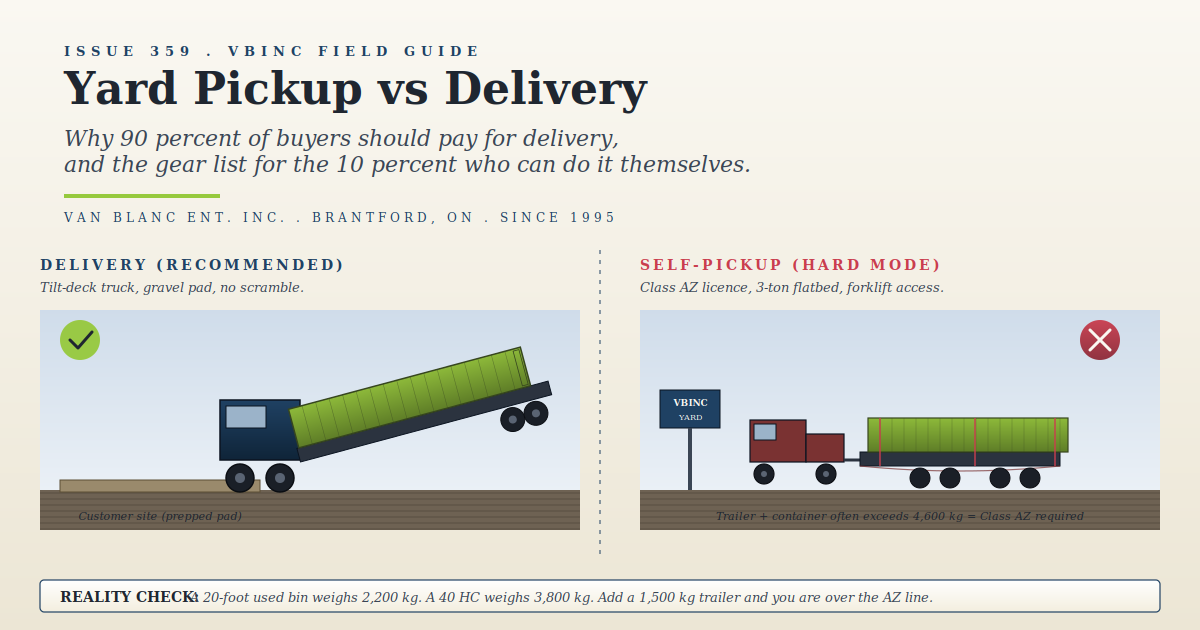
Quick Answer: Roughly 90 percent of Canadian container buyers should pay for delivery. Self-pickup from a Brantford yard is technically allowed, but the gear list is serious: a 1-ton truck minimum (3-ton flatbed is realistic), a registered trailer rated for the gross weight, a Class A or AZ Ontario driver’s licence once your combination exceeds 4,600 kg, and a forklift or crane at both ends to load and unload the bin. A used 20-foot Wind and Water Tight container weighs roughly 2,200 kg empty and a 40-foot High Cube runs about 3,800 kg. Pair that with a 1,500 kg flatbed trailer and you are over the licensing threshold before the container is even strapped. For most buyers the delivery charge to anywhere in Ontario buys a tilt-deck driver, proper twistlocks, commercial insurance, and a tested unload procedure. DIY pickup makes sense for active fleet operators with a yard truck, a Class AZ driver, and a daily forklift. Everyone else is better off paying delivery, walking the yard to pick the box first, and meeting the tilt-deck on the pad. Real lead times and COD pricing, quoted to your specific address. Call us at 519-754-6844.
In This Field Guide
- What does self-pickup actually require (truck, trailer, load capacity)?
- Do you need an air brake licence (Class A or AZ over 4,600 kg)?
- How is a container loaded at the yard (forklift, crane, tie-down)?
- How do you unload at the destination (the hard part)?
- Is delivery cheaper than DIY pickup?
- Does your auto policy cover the haul (the insurance gap)?
- When does DIY pickup actually make sense?
- Why does Van Blanc recommend delivery for first-time buyers?
- What are the yard pickup rules if you are still going DIY?
- Frequently asked questions
Reading time: about 12 minutes. This article sits under our our breakdown of container purchase basics and pairs with our tilt-deck vs Hiab delivery comparison, our cash vs financing guide, and our container pricing field guide.
What Does Self-Pickup of a Shipping Container Actually Require?
Self-pickup of a shipping container requires a 1-ton truck minimum, a flatbed or gooseneck trailer rated for the gross weight, four Grade 70 tie-down chains with rated binders, a forklift or crane at both the yard and the destination, and a Class AR or AZ Ontario licence once the combination exceeds 4,600 kg. Missing any one item stops the pickup.
The first conversation we have with any buyer asking about self-pickup is the same conversation we have had a hundred times across our four Brantford yards. Self-pickup looks like a way to skip a delivery fee. It is actually a serious logistics commitment that very few first-time buyers are equipped to handle. The gear list below is the real minimum, and missing any single item turns the pickup into a phone call where you ask us to send a tilt-deck driver after all.
A serious truck. A 1-ton pickup (Ford F-350, Ram 3500, GMC Sierra 3500) is the floor. A half-ton truck cannot legally or safely tow a flatbed trailer with a loaded 20-foot container on it; the trailer alone will exceed the truck’s tow rating long before you put a bin on it. The realistic vehicle for a 20-foot Wind and Water Tight container plus trailer is a 1-ton dually with a Class V receiver, gooseneck, or fifth wheel hitch. For a 40-foot High Cube you need a tractor truck (Class 8 semi) with a flatbed trailer, full stop. There is no half-measure on a 40-footer.
The right trailer. Containers have no wheels and no hitch. They sit on their corner castings and have to be loaded onto a flatbed, gooseneck deck, or a purpose-built container chassis. The trailer must be rated for the gross weight (truck plus trailer plus container plus any straps and chains), and the deck length has to match. A 20-foot container needs a deck of at least 22 feet to land it properly; a 40-foot bin needs a 45-foot drop deck or specialized chassis. The trailer is the part most DIY buyers underestimate. According to Pickup Truck Talk’s 2025 owner guide, the common mistake is renting a generic 20-foot landscape trailer and discovering at the yard that the load capacity is rated at 7,000 lbs gross combined weight, which a single empty 20-foot container blows past once you add the trailer.
Tie-down hardware that is rated for container weight. US Federal Motor Carrier Safety regulations require at least one tie-down for every 10 feet of cargo length, and for steel containers the standard is Grade 8 or Grade 10 chains with rated ratchet binders, not ratchet straps. Canadian National Safety Code 10 mirrors the same load securement rules. Per the VeriTread flatbed freight guide, straps alone are rarely deemed adequate for heavy containers, and you need engineered anchor points on the trailer that match the chain rating. A standard set of four 5/16-inch Grade 70 chains with rated binders is a one-time hardware purchase, and the chain rating, not the brand, is what matters. Twistlocks (the proper mechanical engagement that locks into the corner castings) are even better and are what every tilt-deck delivery truck uses.
Knowledge of axle loading and balance. A 20-foot container loaded straight onto a flatbed without thought to axle position will overload either the rear axle of the truck or the trailer axles, depending on how it sits. Proper hauling means measuring the deck, marking the centre of gravity of the container (forward of centre for a standard 20-foot dry van), and positioning the bin so the axle loads stay legal. Most DIY buyers skip this step and discover the problem only when a Ministry of Transportation inspector pulls them over on the 403.
Christian LeBlanc, second-generation operator: “We get the call once a week. A buyer drives to the yard with a half-ton truck and a 16-foot landscape trailer and asks if we can load a 20-foot container on it. The answer is no. The trailer is undersized, the truck is undersized, and we are not putting our forklift operator at risk loading a unit that we know is going to fail on the highway. The right move for that buyer is to walk the yard, pick the bin, pay the delivery, and have a tilt-deck driver land it on their site in 1 to 3 days.”
Do You Need a Class A or AZ Licence to Tow a Container Over 4,600 kg?
The licence question is the part the YouTube tutorials skip. Towing a shipping container in Ontario often demands more than a standard Class G card, and the trigger is the gross weight on the towed unit. Ontario driver’s licence law is clear: once your combination (truck plus trailer plus load) crosses 4,600 kg gross weight on the towed side, your standard Class G licence stops covering you. You need to upgrade. The Ontario Ministry of Transportation’s official truck driver licensing page lays it out class by class, and the relevant rules are summarized below.

Class G. Standard passenger licence. Covers cars, light trucks, vans, and trailers where the towed unit does not exceed 4,600 kg. A pickup with a small utility trailer is fine. A pickup with a flatbed and a container almost never is. Most of the buyers who ask about pickup hold a Class G, which is why the tilt-deck run from our yard ends up being the answer for most of them.
Class AR (Class A Restricted). Covers a combination where the towed trailer exceeds 4,600 kg but does not have air brakes. Per the Ontario government licensing portal, the AR licence is the realistic upgrade path for a hobbyist towing an over-4,600 kg trailer that uses electric or surge brakes. AR requires a written knowledge test, a road test, and a vision test. The road test is conducted in your own combination vehicle. Buyers who go this route usually already own the trailer; the ones who do not tend to end up weighing a one-way tilt-deck run against the whole DIY kit.
Class A (full) with Z endorsement (AZ). Required if the towed trailer exceeds 4,600 kg AND has air brakes, or if you are operating a tractor-trailer combination. Most flatbed trailers rated for container loads have air brakes, which pushes most container hauls into the AZ category. AZ requires the mandatory Entry-Level Training course (MELT), a substantial written exam, an air brake (Z) endorsement test, and a road test in a tractor-trailer. The MELT course tuition plus the layered testing fees make this the single largest line item in a DIY pickup, and it takes weeks to complete. Per DriveTest’s commercial licensing page, MELT is now mandatory before any Class A road test.
The math to run before driving to the yard. A used 20-foot Wind and Water Tight container weighs about 2,200 kg empty. A 20-foot Cargo-Worthy unit runs 2,300 kg. A 40-foot High Cube comes in at 3,800 kg. A typical 22-foot flatbed trailer rated for container loads weighs 1,500 to 2,000 kg empty. Add 2,200 plus 1,500 and you are at 3,700 kg trailer-plus-load. Add a 40-footer instead and you are at 5,800 kg, which crosses the AR threshold and almost certainly the AZ threshold once the trailer has air brakes. A buyer with a Class G licence and a 20-foot bin on a flatbed is technically inside the law only if the trailer is rated low enough; with a 40-footer they are over the line.
What happens if you get pulled over. The MTO and OPP run commercial vehicle inspection stops on the 401, 403, QEW, and 400 series highways. A Class G driver towing a combination over 4,600 kg gets ticketed for driving without proper licence class, the load gets impounded until a properly licensed driver can take over, and the buyer pays the tow plus storage plus fine. We have seen this play out twice with customers who skipped the licence check. Both ended up paying more in fines and tow fees than the delivery would have cost.
How Is a Shipping Container Loaded onto Your Trailer at the Yard?
Loading a shipping container onto a customer trailer is the next constraint, even with the right truck and trailer and licence in hand. A container at the yard is loaded one of three ways and each requires equipment most DIY buyers do not have.
Top-pick forklift (or container handler). The fastest method is a heavy-duty forklift or a container handler rated for the gross weight, with a top-pick spreader bar that engages the corner castings. Most well-equipped Ontario yards have one. Van Blanc’s yards run forklifts rated for 20 and 40 foot loads, and our operators load customer trailers in 5 to 10 minutes when the trailer is positioned correctly. The customer’s job is to back the trailer in, set the brakes, and stay clear of the swing zone.
Crane (mobile or yard-mounted). Some yards use a yard-mounted crane or a mobile boom truck. Slower than a forklift, more flexible on tight sites. Crane lift is the only realistic option if a forklift cannot get under the container (rare in a working yard, common on a customer pickup at a non-yard site).
Tilt-deck transfer (yard truck to customer trailer). If the yard does not have a forklift in the right rating, sometimes the container gets transferred from a tilt-deck yard truck to the customer trailer. This is the slowest method and requires both decks to be at compatible heights. Most yards charge a small loading fee when this method is used because of the equipment time.
The tie-down step. Once the container is on the customer trailer, the load has to be secured before it leaves the yard. The FMCSA tie-down standard is at least one rated chain or strap for every 10 feet of cargo length, with rated angles and engineered anchor points. For a 20-foot container that means at least two chains; in practice we run four (one at each corner casting). The chains have to be Grade 70 minimum, the binders have to be load-rated and locked, and the customer has to know how to throw and tension a binder. We will not let a customer leave our yard with an unsecured load. That is not optional. The chain stack and the time to set it correctly is a 20-minute job for someone who knows what they are doing and a 45-minute scramble for someone who does not.
What our yard checks before you leave. Our forklift operator does a walk-around with the customer before the gate opens. Are the chains rated? Are the corners properly engaged? Is the load centred on the deck? Are the trailer tires inflated and the bearings clean? Are the trailer lights working? If any of those fails we hold the load until it is right. That is not us being difficult; it is us not putting our yard’s name on a load that we know is going to fail on the highway.
How Do You Unload a Shipping Container at the Destination?
Unloading a shipping container at the destination is the hard part, and loading at the yard is the easy part by comparison. Unloading at home is where most DIY pickup operations actually break down, and it is the part the cost calculator never shows.
You need equipment at the destination too. The container has to come off the trailer somehow. A tilt-deck delivery truck can slide the container off onto a prepared pad with no additional equipment because the deck does the work. A flatbed cannot. A flatbed needs either a forklift, a crane, a Hiab knuckle-boom, or a long, expensive lift truck rental at the customer site. The flatbed option is cheaper for transport but requires customer-side lift equipment, which most rural and residential sites do not have.
Forklift rental in southern Ontario. A heavy-duty forklift rated for a 20-foot container (15,000 lb capacity minimum) rents by the day from companies in Brantford, Hamilton, and the GTA, and the forklift itself has to be floated to your site and back, which adds a second delivery charge on top of the daily rate. For a 40-foot container you need a container handler, which rents for more and is not always available on short notice. Pile that equipment cost onto the container itself and the DIY math gets worse fast.
The level pad problem. A flatbed unload requires a flat, firm staging area where the forklift can roll up beside the trailer and lift the container off. Most residential driveways and rural properties do not have this. A tilt-deck delivery can land the container directly onto a prepared gravel pad with the truck still on the access road, which is one of the reasons tilt-deck is the dominant Ontario delivery method.
The “I will just rent a forklift for a day” trap. The customer rents a forklift for a Saturday. The trailer arrives at 9 AM. The forklift operator (you) has never operated a 15,000 lb forklift before. Lifting a 4,000 lb container ten feet off a trailer onto a pad is not a YouTube-tutorial job. The container can rock, the forklift can tip, the customer can drop the bin off the forks and bend the corner castings. Every season we replace a corner casting that a DIY buyer crushed during unload. That repair means cutting out the damaged casting and a half-day of certified welder time, a bill that erases any delivery saving the buyer thought they had captured.
Is Container Delivery Cheaper Than DIY Pickup?
Container delivery is usually cheaper than DIY pickup once you total the real line items, and the DIY case gets harder the closer you look. Below are the typical line items for a 20-foot used container, Brantford yard to a southern Ontario customer site 60 km away.
| Factor | Tilt-deck delivery | DIY self-pickup |
|---|---|---|
| Truck needed | None (we bring it) | 1-ton dually for a 20-foot bin; tractor-trailer for a 40-footer |
| Trailer needed | None (we bring it) | Flatbed or gooseneck rated for gross weight, 22 ft+ deck |
| Licence required | Ours (commercial AZ driver) | Class AR or AZ once the combination exceeds 4,600 kg |
| Loading at yard | Done by our forklift operator | Done by our forklift operator (no charge in most cases) |
| Unloading at site | Tilt-deck slides it onto a prepared pad | You supply a forklift, crane, or Hiab on site |
| Tie-down hardware | Twistlocks on the delivery truck | Four Grade 70 chains with rated binders, your responsibility |
| In-transit insurance | Carrier cargo and liability coverage | Your auto policy, often excluded for commercial cargo |
| Your time on the day | About 30 minutes at unload | 8 to 12 hours driving, loading, unloading |
Delivery path (tilt-deck). Container price plus one delivery line, quoted all-in to your address. For a southern Ontario site within 100 km of Brantford that single delivery line is the whole logistics cost, and it scales with distance rather than with the size of the bin. That line covers the truck, the driver, fuel, commercial insurance, twistlock equipment, and a 30-minute unload window on a prepared pad. The container arrives, the driver tilts the deck, the bin slides onto your pad, the driver pulls forward, and you pay cash on delivery once it is sitting where you want it.
DIY pickup path. The line items stack up fast: a 1-ton flatbed truck rental by the day plus its fuel, a trailer rental rated for container weight by the day, diesel for a 1-ton dually pulling a loaded trailer on a 120 km round trip, tie-down chains and binders if you do not already own them, a forklift rental at the destination for the unload plus the cost of floating that forklift to your site, and 8 to 12 hours of your own time spent driving, loading, and unloading. If you do not already hold the right class of licence, add AR or AZ training on top, which is its own bill and 30 to 60 days of lead time before you can legally make the trip.
The full comparison. A buyer with no equipment and no special licence ends up spending several times the cost of a delivery line once the truck rental, trailer rental, fuel, and destination forklift are totalled, and that is before counting a full Saturday of their own labour. A single tilt-deck delivery, by contrast, takes 30 minutes of your time on the receiving end. The DIY path is more expensive in cash, dramatically more expensive in time, and structurally more risky on insurance and licensing. The only scenario where DIY breaks even is a buyer who already owns the truck, the trailer, the chains, the forklift, and the licence. Most of those buyers are construction companies or logistics operators with a yard and a daily forklift, which is exactly who we recommend DIY for.
Delivery is not the rip-off it looks like. Buyers see a delivery line on the quote and assume the yard is padding it. The reality is that delivery operates on a thin commercial-trucking margin: the large majority of that line is fuel, driver time, and truck depreciation. Only a small slice is actual margin, and that slice pays for the dispatcher, the route planner, and the commercial insurance the yard carries on every load that leaves the gate. We charge what it costs to do it right, not what the market will bear.
Does Your Auto Policy Cover Hauling a Shipping Container?
Your personal auto policy probably does not cover hauling a shipping container, and the insurance gap is the part DIY buyers think about least and that costs the most when it goes wrong.
Personal auto policy. Your standard Ontario auto policy covers personal use of the vehicle. Once you are hauling a commercial load (a shipping container is commercial cargo by any reasonable definition), most personal policies exclude the trip. The exclusion is usually buried in the policy under “use of vehicle for compensation” or “use of vehicle for transport of goods for hire,” but insurers have been known to deny claims even on uncompensated transport of obviously commercial cargo. Read your policy and call your broker before driving to the yard.
Cargo insurance. The container itself is your asset once you pay for it (or technically the moment it is loaded on your trailer, depending on the bill of sale). Damage to the container during transport is your loss. A commercial carrier delivering on a tilt-deck carries cargo insurance that covers in-transit damage. A DIY buyer carrying their own container on their own trailer is self-insured unless they buy a one-day inland marine policy, which most do not.
Liability if something goes wrong on the highway. If your unsecured container slides off the trailer and damages another vehicle, your liability is direct and uncapped. A commercial carrier carries multi-million-dollar liability coverage and is structurally protected by their carrier authority. A DIY buyer carries only whatever liability limit is on their personal auto policy, and may have even that denied because the trip was commercial. The downside on a bad day is uncapped liability and a denied personal claim.
What we recommend. If you are determined to DIY, call your broker first, get a written confirmation that the trip is covered under your existing policy (or buy a one-day commercial rider, which a few Ontario brokers offer), and document the load condition with photos before you leave the yard. Without that paperwork the insurance gap is an uncapped exposure on the wrong day.
When Does DIY Container Pickup Actually Make Sense?
DIY container pickup makes sense for a specific category of buyer, and this article is not anti-DIY. Self-pickup is the right call when you already own the equipment and hold the licence. Below is the profile.
Active construction or logistics operators. A construction company with a 1-ton crew truck, a registered flatbed, a Class AZ driver on staff, a yard forklift, and commercial vehicle insurance already on the books has no DIY cost. The truck would otherwise be sitting idle on a Saturday. The driver is paid hourly anyway. The forklift unloads on Monday at the company yard. For that buyer, DIY pickup saves the entire delivery fee and adds no marginal cost.
Buyers with an existing trailer fleet. Equipment rental companies, agricultural operations, and rural property owners with a serious gooseneck flatbed already in the yard are well-positioned to DIY. The trailer is rated. The truck is rated. The chains are in the toolbox. The only new line item is the time, which is fine if it is your own time on your own schedule.
Buyers picking up multiple bins. If you are buying 4 to 8 containers for a large project and have the equipment, DIY pickup over 2 to 3 trips with your own driver can save real money over per-bin delivery. We have customers who run their own pickup operation on jobs of that size, and the math works.
Buyers who want to walk a specific bin onto a specific trailer. Some buyers want maximum control: they want to see the unit get loaded, ride with it on the highway, and be the last person to touch the load before it lands at the site. For high-value modifications (refrigerated container conversions, off-grid builds, custom interior work in progress) that level of control is worth the time.
For every other buyer (first-time, no equipment, no special licence, no commercial insurance) the delivery path is the right answer and we will tell you that on the phone before you drive to the yard.
Why Does Van Blanc Recommend Delivery for First-Time Buyers?
Van Blanc recommends delivery for first-time buyers because the recommendation is structural, not commercial. We make more margin on delivery than on a pickup-only sale (the delivery line carries a small profit; the container sale has thinner margin). But our recommendation lines up with what is best for the buyer in 9 out of 10 cases.
Delivery is faster. Walk the yard, pick the bin, schedule delivery. 1 to 3 day lead time across our four Brantford yards. The buyer’s only on-site time is the 30-minute unload window. A DIY pickup, even for an experienced operator, is a full day of driving, loading, unloading, and recovery.
Delivery is safer. Commercial driver, tested equipment, twistlock engagement on the corner castings, multi-million-dollar liability coverage, cargo insurance, and road experience hauling containers daily. A first-time DIY buyer is taking on every variable for the first time at once.
Delivery has a fallback. If something goes wrong on a delivery run (truck breakdown, weather, route obstruction) we manage it from the dispatch desk. If something goes wrong on a DIY run, the customer is alone on the shoulder of the 403 trying to find a tow truck rated for the load.
Delivery cost is a smaller line than most buyers expect. Quoted to most Ontario locations from a Brantford yard, the delivery line lands as a modest share of the whole purchase. As a percentage of the total container investment, delivery is roughly 6 to 18 percent of the total, with the bigger end of that range reserved for the longest hauls. The buyer’s time and risk savings over DIY are worth multiples of that.
Before you weigh pickup against delivery, you have to choose the unit, and you can browse the bins we keep in our Brantford yards to see what is in stock by size and grade. For how the grades affect the number on your quote, the breakdown by condition in our field notes on what moves the price covers the 2026 Ontario market. To compare the two main delivery methods, our tilt-deck vs Hiab comparison covers when to choose each. And if you are weighing how to pay, the deposit-free payment terms we walk through here spell out cash versus financing.
What Are Van Blanc’s Yard Pickup Rules If You Still Want to DIY?
Van Blanc’s yard pickup rules are the conditions we apply before we load any customer trailer. If after all of the above you are still committed to DIY pickup, the rules below are the ones we apply at our four Brantford yards. They are not negotiable and they exist because we have seen every failure mode at least twice.

- Show up with the right truck and trailer. 1-ton minimum for a 20-foot bin, tractor-trailer for a 40-footer. Trailer must be rated and registered. We will inspect both before we load.
- Show the licence. Class AR or AZ for any combination over 4,600 kg. We will check the front of the licence card. A buyer with a Class G licence and a flatbed over 4,600 kg gets refused at the gate. That refusal is on the operator side too; we will not put our yard’s name on a load that we know is going to fail an inspection stop.
- Bring rated tie-down hardware. Four Grade 70 chains with rated ratchet binders minimum. We sell chains in the office if you forgot them. We will not let an unsecured load leave the yard.
- Plan your unload before you load. Where is the forklift on the receiving end? If you do not have an answer, we will offer to deliver instead.
- Pay before we load. Cash, draft cheque, or our credit card authorization form at the office counter. Once paid we load and you leave. No e-Transfer deposits, no pre-payment online.
- Realistic expectations on the time. Load takes 15 to 30 minutes from when the trailer is positioned. Tie-down adds another 20 to 30 minutes. Plan for an hour at the yard if everything goes right.
Most buyers who walk into the office with self-pickup plans end up changing their mind on the phone before they drive in. The hour-long conversation about truck, trailer, licence, chains, and unload equipment is usually enough to make the delivery line look like a bargain. For the buyers who do go DIY, the rules above keep everyone (the buyer, our forklift operator, the public road) safe.
For broader brand context on why we prefer to ship from our own four yards rather than drop-ship from a generic national pool, see our about Van Blanc page. For service-area specifics on delivery lead times, see our Brantford service area page. For first-time buyer questions about scams and red flags, see our shipping container scam parent guide.
Frequently Asked Questions
Can I pick up a 20-foot shipping container with a half-ton pickup truck?
No. A half-ton pickup (Ford F-150, Ram 1500, Chevy Silverado 1500) does not have the tow rating, the chassis rating, or the brake capacity to safely haul a 20-foot used container on a flatbed trailer. The container alone weighs about 2,200 kg empty, and adding a 1,500 kg flatbed trailer puts you well past a half-ton’s rated capacity. The realistic floor is a 1-ton dually (F-350, Ram 3500, GMC 3500) with the correct hitch class and trailer brakes. Anything smaller is unsafe and almost certainly illegal under provincial commercial vehicle rules.
Do I need a special driver’s licence to tow a shipping container in Ontario?
Probably yes. Ontario’s threshold is 4,600 kg gross weight on the towed unit. Once the trailer plus container exceeds that, a Class G licence no longer covers the trip. The two upgrade paths are Class AR (Class A Restricted, no air brakes) and Class AZ (full Class A with air brake endorsement, required if the trailer has air brakes). A 20-foot used container on a flatbed often crosses the 4,600 kg threshold; a 40-foot High Cube almost always does. AZ training in Ontario in 2026 means mandatory MELT coursework plus layered testing fees per DriveTest commercial licensing, and it is the most expensive single step in a DIY pickup.
How much does delivery cost compared to self-pickup?
For a typical southern Ontario delivery within 100 km of Brantford, one tilt-deck delivery line covers the truck, driver, fuel, twistlocks, commercial insurance, and a 30-minute unload. A DIY self-pickup with no existing equipment stacks up truck rental, trailer rental, fuel, chains, and destination forklift rental, and ends up costing several times that single delivery line, plus 8 to 12 hours of the buyer’s time. DIY only breaks even for buyers who already own the truck, trailer, hardware, and have the correct licence.
What tie-down equipment do I need to legally haul a shipping container on a flatbed?
At minimum, four Grade 70 transport chains with rated ratchet binders engaging the four corner castings. Per US Federal Motor Carrier Safety Administration rules and Canadian National Safety Code 10, you need at least one tie-down for every 10 feet of cargo length, with rated angles and engineered anchor points on the trailer. Twistlocks (the proper mechanical engagement that locks into the corner castings) are the gold standard and what every tilt-deck delivery truck uses. Ratchet straps alone are not adequate for a steel shipping container.
How do I unload a shipping container at home if it arrives on a flatbed?
You need a heavy-duty forklift (15,000 lb capacity minimum for a 20-foot bin, container handler for a 40-footer) or a crane on site at the time of delivery. That means a daily forklift rental in southern Ontario on top of a charge to float the forklift to your site and back. Most residential and rural sites do not have this equipment. The alternative is to choose tilt-deck delivery instead: the truck’s hydraulic deck slides the container off onto a prepared pad with no additional equipment required.
Will my personal auto insurance cover me hauling a shipping container?
Probably not. Standard Ontario personal auto policies exclude transport of commercial cargo for hire, and most insurers consider an unweighted shipping container on a flatbed as commercial cargo even when the buyer is not being compensated. Call your broker for a written confirmation before any DIY trip. Some Ontario brokers offer an inexpensive one-day commercial cargo rider for a single trip. Without specific coverage, an at-fault incident during the haul could leave a buyer personally liable for a very large claim.
Can I rent a trailer to pick up a shipping container?
You can rent a rated flatbed or gooseneck trailer from rental companies in Brantford, Hamilton, and the GTA, charged by the day for a 20-foot deck rated for container loads. The catch is that most generic landscape and equipment trailers are not rated high enough for a container plus the trailer’s own weight, so verify the gross trailer weight rating (GTWR) and the gross combined weight rating (GCWR) with the rental company before reserving. A 22-foot deck rated for 14,000 lbs gross weight is the realistic minimum for a 20-foot container.
Does Van Blanc charge a loading fee for self-pickup?
No loading fee in most cases. Our forklift operator loads the customer trailer at no charge as part of the yard purchase. The exceptions are when the customer trailer is too low, too high, or non-standard and the container has to be moved by tilt-deck from a yard truck to the customer trailer, in which case we charge a modest fee for the extra equipment time. Tie-down chains can be purchased in the office if you forgot them: rated 5/16-inch Grade 70 chains with matching binders.
What happens if I get pulled over hauling a container without the right licence?
Ministry of Transportation enforcement runs commercial vehicle inspection stops on the 401, 403, QEW, and 400-series highways. A driver towing a combination over 4,600 kg without the correct licence class (Class AR or AZ) gets ticketed under the Highway Traffic Act for driving outside of licence class. The set fine is substantial and comes with demerit points. The load gets impounded until a properly licensed driver can take over, and the buyer pays the tow plus storage plus fine. Cumulative cost typically exceeds what a tilt-deck delivery would have cost.
Why does Van Blanc recommend delivery over self-pickup for most buyers?
The math. 90 percent of first-time buyers do not own the truck, the trailer, the chains, the destination forklift, or the licence needed to DIY a container haul safely. Renting all of that for one trip costs more than delivery, takes a full day of buyer time, and exposes the buyer to insurance and licensing risk. Tilt-deck delivery from our Brantford yards reaches most Ontario locations, takes 1 to 3 days from order, and lands the container on a prepared pad in 30 minutes. For the 10 percent of buyers who are active fleet operators with the gear and the licence, DIY makes sense and our pickup rules above support it.
Sources and Further Reading
- Ontario.ca: Get a truck driver’s licence (Classes A, AR, AZ)
- DriveTest: Commercial driver’s licences and MELT requirement
- Pickup Truck Talk: Towing a shipping container, what pickup owners need to know (2025)
- VeriTread: Everything you need to know about flatbed freight shipping
- Ontario Federation of Agriculture: Trailer towing checklist
Ready to price your container?
Tell us the size and your postal code and we’ll send back an all-in number, container, delivery, and placement, usually within 1-3 days. No pressure, no mystery fees.
Family-run in Brantford since 1995 · 200+ containers in stock · 4.9★ across 140+ Google reviews · every box graded by a person, walk it before it lands.