
Quick Answer: Mini-Split vs Window AC for an Ontario Container
For a converted shipping container in Ontario, a ductless mini-split heat pump is the right pick for any year-round use case (office, workshop, secondary suite, four-season cottage). It cools in summer at 18 to 25 SEER, heats in winter on a cold-climate model down to minus 25 Celsius, and runs quiet at 25 to 40 decibels indoors. Installed cost for a single-zone system tracks the BTU rating, whether you choose a cold-climate heat pump, the line-set run, and local installer rates. A window AC unit is the right pick only for summer-only sites that never see winter occupancy (seasonal storage with humidity control, May to September job-site trailers, summer pop-ups). It installs in an afternoon, but cannot heat, leaks conditioned air around the steel cutout, runs at 50 to 60 decibels, and freezes solid in winter. Any fixed wiring for either system has to meet the Ontario Electrical Safety Code. Van Blanc supplies the container in 1 to 3 days from our four Brantford yards. Call 519-754-6844 to walk the row and talk through which system fits your use case. Delivered pricing, confirmed before payment: get a real quote from Paul or Christian.
A mini-split is a two-part ductless heat pump: a wall head unit inside the container and a small condenser outside, linked by a slim copper line set. It cools and heats year-round. A window AC is a single cooling-only box wedged through a cut in the steel side wall, and it works only in summer.
Paul LeBlanc, who has run Van Blanc since 1995, puts the choice in plain terms. “People walk into the yard asking which air conditioner to buy, and the real question is whether anyone sits in that box in January,” he says. “If the answer is yes, a window unit is a false saving. We have watched too many of them get torn out and replaced the second winter.”
The cooling-system question is the most common one we field once a buyer commits to converting a 20ft or 40ft container into an office, workshop, or secondary structure. The decision almost always comes down to two paths. The mini-split path is the premium, year-round, energy-efficient route that costs ten times more up front. The window AC path is the cheap, summer-only, install-it-yourself route that buys you a season at a quarter of the budget. Both are defensible answers. The wrong move is picking based on price alone without thinking through the use case across all four seasons.
Van Blanc has been in containers in southern Ontario for thirty years. We supply the container; the HVAC comes from your installer. What we do is walk you through the realistic operating reality of both systems before you commit, because the wrong call here either sinks money into a system you never use in summer storage, or leaves you in a 5 degree office every January regretting the window unit. This guide is the version of that conversation we have at the yard most weeks of the year.
If you want the install-side detail on the premium path (BTU sizing, condenser placement, line-set routing, electrical inspection), our companion piece walks through exactly how a ductless head and condenser go onto a steel box in Ontario. For the bigger picture, the hub that ties heating, cooling, and ventilation into one conversion plan covers the decision from every angle.
How does a window AC unit work in a shipping container?
A window AC unit in a shipping container is the cheapest path to a cooled box. A 10,000 to 12,000 BTU through-the-wall unit from Frigidaire, Friedrich, or LG sits on the shelf at any Canadian Tire or Home Depot, with the higher-efficiency models costing somewhat more. Installation takes one motivated person an afternoon. The work involves cutting a rectangular opening in the corrugated steel side wall, building a wood or metal sub-frame to support the unit, slotting the AC into the frame, and sealing the perimeter with weather stripping and exterior caulk.

For seasonal storage with humidity-sensitive contents, this works. A 12,000 BTU window unit holds a 20ft container with proper wall insulation at 22 to 24 Celsius through a southern Ontario July, drops relative humidity from 70 percent to 50 percent, and uses roughly 1.2 kilowatts when running. At Ontario residential electricity rates around 13 cents per kilowatt-hour, that works out to a modest daily running cost and a small fraction of the equipment cost across a full cooling season. The capital math works at this price point.
The install caveats on window units in containers:
- The cutout is permanent. Once the opening exists in the side wall, the container has lost most of its resale value as a standard storage box.
- Sealing against corrugated steel is hard. Window units are designed to seal against flat wood frames. The corrugated profile means the perimeter never sits flat without a custom sub-frame. Air leaks are the most common complaint within the first cooling season.
- The unit blocks one usable wall position. A 12,000 BTU window AC takes up a 24 by 16 inch section of side wall, off-limits for shelving, signage, or a side-mounted desk.
- Theft target on unsecured sites. Window units are pulled in five minutes with a screwdriver. On a fenced site this is a non-issue; on an unsecured rural or downtown location, factor in replacement at least once.
Most container-conversion guides place window units in the same bracket: summer-only, budget-driven, and tolerable for cooling-only applications where the box is empty by November.
Where do window AC units fail in an Ontario container?
Window AC units fail in an Ontario container in three specific patterns. None of them are dealbreakers if the use case is summer-only. All of them are dealbreakers if there is any winter occupancy expectation.
Winter air leak. A window AC unit is a heat exchanger with the indoor and outdoor halves separated only by a thin metal partition and a couple of inches of foam. When the unit is off in December with the container sitting at minus 10 outside, that partition conducts cold straight through to the interior. Even with the unit pulled and the cutout plated for winter, the seal around the cutout leaks. We have seen interior temperatures inside a Brantford-area container with a window AC installed sit 4 to 6 Celsius below an identical container without the cutout, all winter long.
No heating capability. Window AC units in 2026 are cooling-only. The reverse-cycle window heat pump exists as a product category but is not stocked in any meaningful volume in Canadian retail, and the Energy Star Canada listing for window heat pumps is short and expensive. For Ontario specifically, where the heating season runs October through April, a cooling-only system buys you four useful months and shuts you out the other eight.
Aesthetic and structural compromise. The cutout in the side wall, the exposed unit hanging out the side, and the visible weatherstripping all read as a budget afterthought. For a customer-facing pop-up, an office that hosts visitors, or any container that lives in a residential neighbourhood within sight of the road, the visual cost is real. A wall-mounted mini-split head unit inside and a discreet condenser pad behind the container reads as a finished build. A window AC reads as a workshop hack.
Window units also vibrate against the steel wall in ways that drywall framing never does. The compressor cycling sends a low-frequency hum through the entire side wall. On a workshop with three or four people working, the hum is tolerable. On a container that doubles as a quiet office or studio, the hum is the first complaint within two weeks.
Why is a mini-split heat pump better for a year-round container?
The ductless mini-split heat pump is the premium tool for the job and the only sensible answer for any year-round container application. The system is two halves connected by a slim copper line set. The outdoor half sits on a concrete pad or a wall-mounted bracket off the back of the container. The indoor half is a wall-mounted head unit roughly 32 inches wide by 12 inches tall, blowing conditioned air directly into the container interior. No ducts, no flat-wall window cutout, no compromise on the side-wall structure.
Installed cost in 2026 for an Ontario container conversion scales with the BTU rating and whether you choose a cold-climate heat pump, so match the size to the use case:
- 9,000 to 12,000 BTU single-zone cooling-only: the entry tier. Right size for an insulated 20ft container in seasonal or storage use.
- 12,000 BTU cold-climate heat pump: a step up for adding winter heat. The most common pick for a year-round 20ft office or workshop.
- 18,000 BTU cold-climate heat pump: the mid tier. Right for a single-zone 40ft office or a 20ft with heavy door cycles.
- 24,000 BTU cold-climate heat pump: the top single-zone tier. Workshop-class 40ft with three or four occupants and frequent door openings.
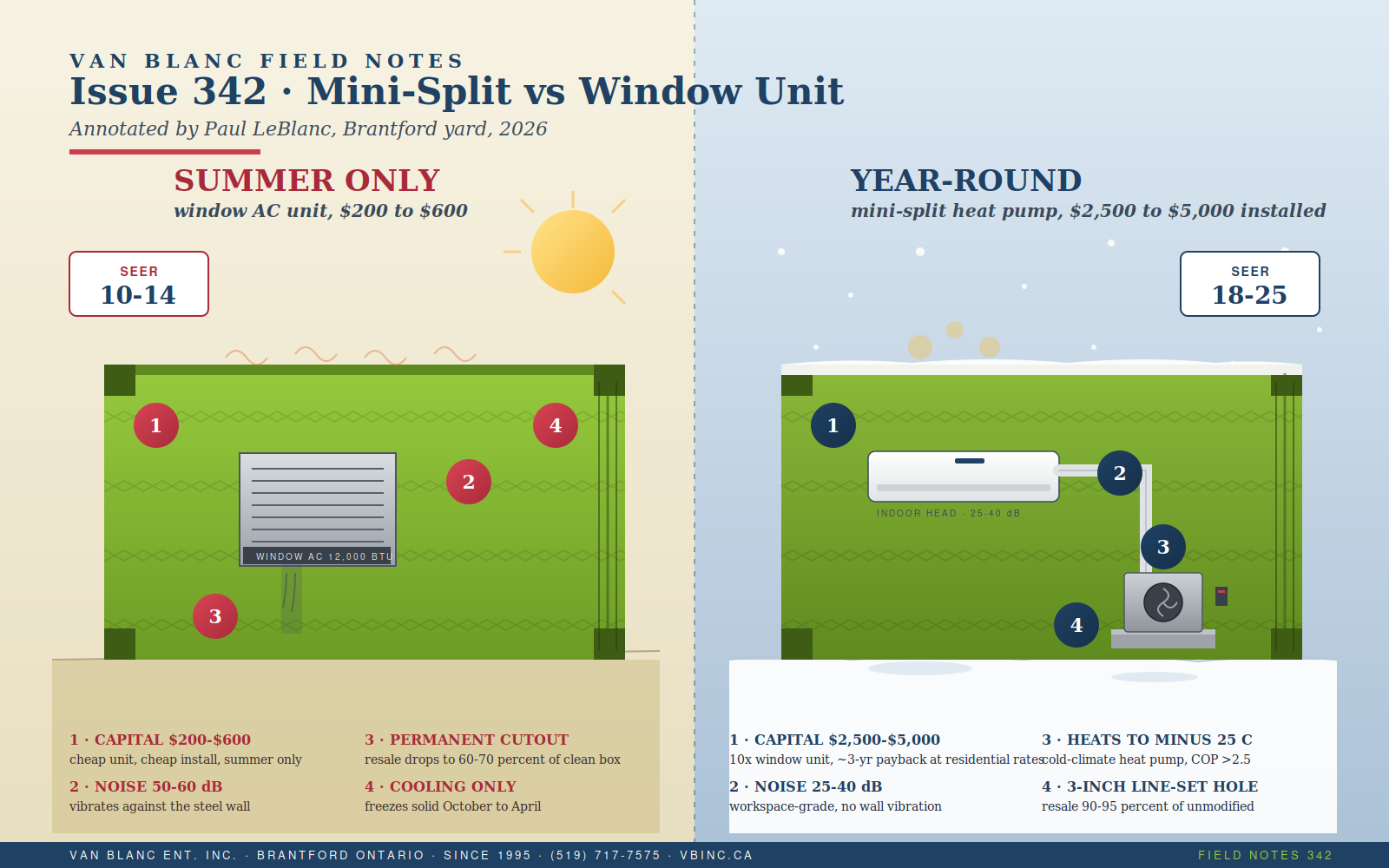
The cost gap between window unit and mini-split looks ridiculous on paper. The mini-split is ten times the equipment cost. The work it does, though, is different. Modern inverter mini-splits operate at 18 to 25 SEER (Seasonal Energy Efficiency Ratio) compared to 10 to 14 SEER for window units. That translates to roughly 30 percent less electricity for the same cooling output, every running hour, for the 12 to 15 year life of the equipment. On a container that runs HVAC 10 hours a day through a southern Ontario summer, the electricity savings alone offset the higher capital cost within 12 to 18 months on commercial rates and within 24 to 30 months on residential.
Indoor noise is the other gap that does not show up on the price tag. A mini-split head unit runs at 25 to 40 decibels at the indoor coil. A window AC runs at 50 to 60 decibels. The 20 decibel difference is not a 20 percent gap, it is roughly a four-times perceived loudness difference. For an office, a studio, or any container with phone calls happening inside, the mini-split is the difference between a workspace and a noise problem.
Cold-Climate Heat Pump: The Winter Half of the Argument
A cold-climate mini-split heat pump is what makes the mini-split case get stronger every winter. A cooling-only window AC sits drained and capped from October to April. The container either heats with a small electric resistance heater (cheap to buy, a month to run), a propane heater (combustion risk in a sealed box, requires ventilation and a CO detector), or nothing at all (which freezes pipes, cracks finishes, and ruins anything humidity-sensitive). A cold-climate mini-split heat pump runs the refrigerant cycle in reverse and pulls heat out of cold outdoor air into the container interior.
The 2026 cold-climate models worth knowing by name:
- Mitsubishi Hyper-Heat (H2i). Rated to 100 percent heating capacity at minus 15 Celsius, useful output to minus 25. The Zuba series is what most southern Ontario installers default to for shop and small commercial work.
- Fujitsu XLTH. Comparable cold-climate spec to Mitsubishi, slightly lower price point in the Ontario distributor channel. The 12RLS3H and 15RLS3YH are the common picks for container-sized loads.
- Daikin Aurora. Cold-climate inverter line, common in residential retrofits, also fitted to container conversions where the homeowner wants a brand they recognize from a house install.
- Carrier Cold Climate (Greenspeed). Newer to the Canadian container channel but increasingly common. The 38MURA series carries the cold-climate badge and rebate eligibility.
Natural Resources Canada test data at the Canadian Centre for Housing Technology shows cold-climate mini-splits maintaining seasonal coefficient of performance above 2.5 across a full Ottawa-region winter. Translated to plain English: every kilowatt-hour of electricity in produces roughly 2.5 kilowatt-hours of heat out, even averaged across cold January nights. A resistance heater, by comparison, is a flat 1.0 coefficient. A propane heater costs roughly 18 to 25 cents per delivered kilowatt-hour at 2026 Ontario propane prices versus 13 cents for the heat-pump-delivered electricity.
The caveat: below minus 25 Celsius the cold-climate units lose capacity fast, and a backup heat source matters. For a container in southern Ontario where the deepest cold typically sits in the minus 15 to minus 22 range, the cold-climate heat pump handles roughly 90 percent of the winter without supplemental heat. For a container in northern Ontario where minus 30 nights are routine, a small backup electric resistance heater on a separate thermostat is the safety net.
Which system is cheaper to run over a full Ontario year?
Operating cost is where the mini-split earns back its higher purchase price, because the capital gap closes once the kilowatt-hour math runs across multiple years. The numbers below assume an insulated 20ft container in southern Ontario, 8 hours of daytime cooling demand from June through August, 8 hours of daytime heating demand from November through March, and a 2026 Ontario blended residential rate of roughly 13 cents per kilowatt-hour.
- Window AC, summer only. 12,000 BTU at 10 SEER pulls roughly 1.2 kilowatts running. Across 90 cooling days at 8 hours each, that is 864 kilowatt-hours per season. Winter heating from an electric resistance heater (1.5 kilowatts, 8 hours, 120 days) adds 1,440 kilowatt-hours. Total annual electricity draw lands near 2,300 kilowatt-hours.
- Mini-split heat pump cooling, identical season. 12,000 BTU at 20 SEER pulls roughly 0.6 kilowatts running. Across the same 720 cooling hours, that is 432 kilowatt-hours. Winter heating from the same heat pump at COP 2.5 across 960 heating hours pulls roughly 460 kilowatt-hours. Total annual electricity draw lands near 900 kilowatt-hours.
That difference of roughly 1,400 kilowatt-hours a year is what the mini-split saves on a container office at residential rates, because the heat pump does the same work for less than half the electricity. At commercial rates closer to 17 cents per kilowatt-hour, the gap in dollar terms widens further. Across the 12 to 15 year service life of the equipment, the accumulated operating savings close most of the capital gap between the two systems. The math gets sharper on heavily used workshops, lighter on weekend-only containers.
For a Brantford-area container that runs as an at-home office five days a week year-round, the payback math on the mini-split lands around year three. For a seasonal cottage box that runs three months a year, the window AC plus a small heater never gets caught by the mini-split on operating cost alone. Both answers are defensible. Run the math for your actual use pattern before signing the contract.
Aesthetics, Footprint, and Resale Value
Aesthetics and resale value separate the two systems more than installers usually admit. A mini-split installs as a slim indoor head unit on one wall, a plastic line-set raceway running outside, and a square condenser on a concrete pad behind the container. The system reads as deliberate. The container looks finished. A window AC installs as a rectangular cutout in the side wall, a unit hanging halfway in and halfway out, a drip line of condensate staining the paint, and a brace supporting the heavy half from outside. The system reads as compromise.
This shows up on resale. A container with a clean mini-split install and a sealed line-set hole sells at 90 to 95 percent of an unmodified equivalent. A container with a permanent window AC cutout sells at 60 to 70 percent because the cutout has to be plated, rewelded, primed, and painted before the box is presentable to a new buyer. We see this every couple of years when an old conversion gets traded back into the yard. The mini-split is also a platform you can upgrade in 2032 without touching the line set or pad. A window cutout sized for 10,000 BTU is awkward to fit a 14,000 BTU upgrade into without re-cutting steel.
Container Wall Integrity and Long-Term Steel Health
The corten steel side wall is a continuous structural skin. Every penetration through that skin is a small structural compromise and a long-term corrosion risk. A mini-split line set cuts a single 3 inch round hole, deburred, primed, sleeved with plastic, and sealed with marine polyurethane. The penetration is small, round (which distributes stress evenly), and tucked behind the indoor head unit where rain never hits the seal directly. A correctly installed line-set hole lasts the structural life of the container.
A window AC cuts a rectangular opening typically 24 by 16 inches with sharp 90 degree corners where stress concentrates and where the cut paint exposes bare corten to weather. Even with high-quality weatherstripping, the corners crack and the cut edges rust within three to five winters. We have pulled abandoned window units out of side walls where the bottom edge of the cutout had rusted through to the wood sub-frame. For a 15 to 30 year service life, the line-set hole is the right call. The window cutout is defensible only on short-service or end-of-life boxes.
Decision Tree: Match the System to the Use Case
Here is the mini-split versus window AC comparison at a glance, before the use-case flow below. Every row is a head-to-head on the factors that actually drive the choice for an Ontario container, with no dollar figures because the real number depends on size, grade, and your site.
| Factor | Mini-Split Heat Pump | Window AC Unit |
|---|---|---|
| Seasons it covers | Year-round: cools in summer, heats in winter | Summer only: cooling-only, no heat |
| Cooling efficiency | 18 to 25 SEER (inverter) | 10 to 14 SEER |
| Winter performance (Ontario) | Cold-climate models hold output to minus 25 Celsius | Drained and capped; leaks cold through the cutout |
| Indoor noise | 25 to 40 decibels at the head unit | 50 to 60 decibels next to the user |
| Wall penetration | One 3 inch round line-set hole, sealed | 24 by 16 inch rectangular cutout, permanent |
| Resale value of the box | 90 to 95 percent of an unmodified equivalent | 60 to 70 percent of an unmodified equivalent |
| Install effort | Professional install, condenser pad or bracket | One motivated person, one afternoon |
| Relative up-front cost | Higher: roughly ten times the equipment outlay | Lower: about a quarter of the budget |
| Best fit | Year-round office, workshop, suite, studio | Summer-only storage, seasonal job-site trailer |
The decision flow from the yard at Van Blanc:
- Year-round occupied office or workshop. Cold-climate mini-split heat pump, 12,000 to 18,000 BTU. No defensible argument for the window unit at this use case. The winter heating capability alone closes the case.
- Secondary suite or four-season cottage. Cold-climate mini-split heat pump, 12,000 to 24,000 BTU depending on size. Comfort through an Ontario winter and resale value both demand the proper install.
- Summer-only job-site trailer or pop-up. Window AC at 10,000 to 12,000 BTU is defensible. Plan the cutout knowing it is permanent. Budget for the unit and one afternoon for the install.
- Seasonal storage with humidity control. Window AC or even a small portable spot cooler with an exhaust hose to a sealed vent. The cheaper system is the right answer when the container holds inventory not people.
- Quiet studio or recording space. Mini-split, no exception. The 25 decibel indoor noise floor is the only acceptable answer for any audio-sensitive use.
- Container that will be sold or moved within 5 years. Mini-split with a clean line-set hole. The resale math punishes the window cutout heavily.
- Container that will be scrapped at end of life with no resale intent. Window AC saves money where you have the use case to spend it on.
The pattern that holds in 90 percent of the conversations: if the container is going to be occupied by people in any season other than summer, the mini-split is the right system. If the container holds stuff (not people) and only operates June through September, the window unit pays for itself in five seasons. Pick the system that matches the actual use case, rather than the system that matches the lowest sticker price.
Where Van Blanc Fits in the Decision
Van Blanc is the container supplier; the HVAC contractor is yours to choose. What we do is supply the right container for the conversion, talk you through the realistic install and operating reality of both systems, and point you to HRAI-certified installers in your service area for the mini-split path or a competent residential handyman for the window unit path. We have been in containers in southern Ontario for thirty years, and the same buyers come back year after year because the advice does not change with the sales pitch.

Our four Brantford yards hold roughly 200+ containers in stock, every box visible and walkable before you sign anything. You can browse the boxes we currently have ready to convert and pick the grade to suit the build: new one-trip 20ft and 40ft boxes for clean office conversions, cargo-worthy boxes for workshop and storage conversions, and wind-and-water-tight grades for budget conversions. Delivery is 1 to 3 days across Ontario from our four Brantford yards. Two things buyers tell us repeatedly: walk the row before paying, and ask about the scams. The latter is why we wrote up how the fake-listing fraud actually plays out in Ontario; we have customers who came to us after losing to a phantom Facebook Marketplace ad that demanded an e-transfer for delivery on a container that never existed.
Once the cooling choice is settled, buyers usually ask what else goes into the box. We keep a running rundown of the vents, lockboxes, and add-ons that pair with either cooling path, and a wider walkthrough of turning a plain steel box into a finished workspace covers doors, windows, and interior build-out alongside the HVAC call. Whichever way you lean, the right starting container is the one decision we can settle for you on the phone.
Frequently Asked Questions: Mini-Split vs Window Unit for Ontario Containers
Is a mini-split worth the extra cost over a window AC unit for a shipping container in Ontario?
For year-round occupied use the mini-split is worth it every time. The cold-climate heat pump heats the container all winter at a seasonal coefficient of performance above 2.5, runs at 18 to 25 SEER for cooling versus 10 to 14 SEER on a window unit, and operates at 25 to 40 decibels versus 50 to 60. The capital cost gap is real, but operating-cost savings at Ontario rates close most of that within three years on continuous use. For summer-only storage, the window unit is the right answer because the year-round features go unused.
Can I use a window AC unit in a shipping container in winter?
No. Window AC units in 2026 are cooling-only. The reverse-cycle window heat pump exists but is rare in Canadian retail. For an Ontario container with any winter occupancy, the window unit needs to be supplemented with a separate electric resistance heater or propane heater. The combined capital cost of a window AC plus a winter heater plus the inefficiency of resistance heating makes the mini-split heat pump the cheaper answer once heating hours add up.
How much does a window AC unit for a 20ft shipping container cost installed in 2026?
The unit itself is the cheaper part for a 10,000 to 12,000 BTU model from Frigidaire, Friedrich, or LG. Installation in a corrugated steel side wall is a half-day owner-builder job involving a sabre-saw cutout, a wood or metal sub-frame, weatherstripping, and exterior caulk. A contractor adds a labour charge for the install if you do not want to cut steel yourself. Total installed cost stays modest, roughly one-quarter of a comparable mini-split.
What is the noise difference between a mini-split and a window AC in a shipping container?
A wall-mounted mini-split head unit runs at 25 to 40 decibels at the indoor coil. A window AC runs at 50 to 60 decibels right next to the user. The 20 decibel gap is roughly a four-times perceived loudness difference. The window unit also vibrates against the steel side wall and transmits a low-frequency hum through the entire container. For offices, studios, or any audio-sensitive use the mini-split is the only acceptable answer.
Does a cold-climate mini-split heat pump work in an Ontario winter?
Yes. Cold-climate models from Mitsubishi (Hyper-Heat), Fujitsu (XLTH), Daikin (Aurora), and Carrier (Greenspeed) maintain rated capacity at minus 15 Celsius and useful output to minus 25. Natural Resources Canada test data at the Canadian Centre for Housing Technology shows seasonal coefficients of performance above 2.5 across full Ottawa-region winters. Below minus 25 the heat pump loses capacity fast and a small backup electric heater on a separate thermostat is the safety net. For southern Ontario, the heat pump handles roughly 90 percent of the heating season without supplemental heat.
Will a window AC unit hurt the resale value of my shipping container?
Yes, materially. The permanent rectangular cutout in the side wall means the next owner has to plate, weld, prime, and paint the opening before the container is presentable as a standard shipping or storage box. A container with a window AC cutout typically sells at 60 to 70 percent of an unmodified equivalent. A container with a clean mini-split line-set hole, by contrast, sells at 90 to 95 percent because the small round penetration is easily sealed and rarely affects the next use case.
How much electricity does each system use across a full year in southern Ontario?
For an insulated 20ft container with 8 hours daily summer cooling and 8 hours daily winter heating: a 12,000 BTU window AC plus a 1.5 kilowatt electric resistance heater uses roughly 2,300 kilowatt-hours per year at 13 cents per kilowatt-hour. The same workload on a 12,000 BTU cold-climate mini-split heat pump uses roughly 900 kilowatt-hours, less than half the electricity. That annual saving of about 1,400 kilowatt-hours closes most of the capital cost gap within three years on continuous use.
Can I install a window AC unit in a container myself?
Yes, most owners do. The work involves cutting a rectangular opening in the corrugated side wall with a reciprocating saw or angle grinder, building a wood or steel sub-frame, slotting the AC unit into the frame, and sealing the perimeter with weatherstripping and exterior caulk. Plan for an afternoon and budget for the cut blades, sub-frame lumber, weatherstripping, and a tube of high-grade polyurethane sealant. The result lasts five to ten summers if the sealing is done well, but the cutout in the steel is permanent.
What size BTU is right for cooling a 20ft container with a window unit?
For an insulated 20ft container in southern Ontario, a 10,000 to 12,000 BTU window unit holds the box at 22 to 24 Celsius through a typical July. For an uninsulated container, push up to 14,000 to 18,000 BTU because the steel roof and walls add significant solar gain. Oversizing a window unit is more common than undersizing; the unit short-cycles, never reaches good humidity control, and the compressor wears out faster than necessary. Match the BTU to the actual insulated volume, not the maximum hot-day load.
Does Van Blanc help me decide between a mini-split and a window AC?
Yes, that conversation is part of every container sale where the buyer is converting to office, workshop, or living space. We do not install HVAC ourselves. What we do is walk you through the real operating reality of each system based on thirty years of watching customers choose one path or the other, point you to HRAI-certified installers in your service area for the mini-split path, and make sure the container you choose is the right starting point for either install. Walk the row at one of our four Brantford yards, see 200+ containers in stock, and pick the specific box before you pay. Call 519-754-6844 or visit a yard to book the conversation in person.
Sources
- EnergySage, Mini Splits vs Window ACs 2026 Guide
- Natural Resources Canada, cold-climate heat pump performance data
- Carrier Canada, cold-climate heat pump technical specifications
- Energy Star, ductless heating and cooling certification
- Enercare, how to install a window air conditioner
Related Reading
Ready to price your container?
Tell us the size and your postal code and we’ll send back an all-in number, container, delivery, and placement, usually within 1-3 days. No pressure, no mystery fees.
Family-run in Brantford since 1995 · 200+ containers in stock · 4.9★ across 140+ Google reviews · every box graded by a person, walk it before it lands.
Sources & References
Authoritative external sources cited or referenced in this guide: