
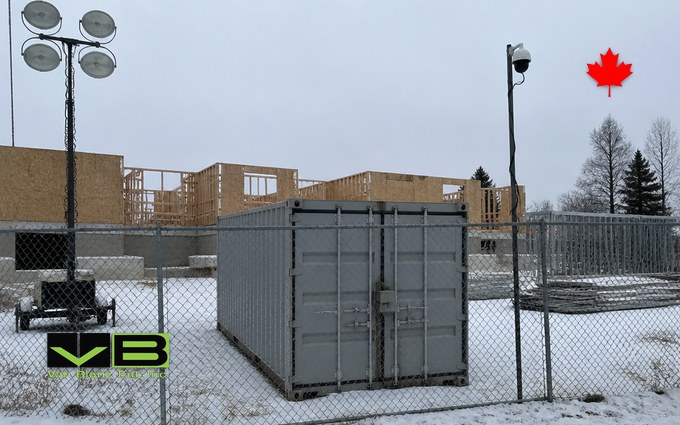
Quick Answer: Construction site security in Ontario works in layers. Fence panels are fixed to the ground and joined, gates locked, the perimeter lit, cameras viewable remotely, and visitors signed in. For a holiday shutdown, Intact’s idle-site tipsheet adds a line on tools: lock them inside containers, and use more than one.
Winter Site Security, Section by Section
- What security does a construction site need?
- Construction site theft in 2026 police reports
- Idle sites over the holiday shutdown
- Fencing and gates insurers expect
- Perimeter lighting for long nights
- Cameras, alarms and remote monitoring
- Security guards, patrols and what sets the cost
- Sign-in logs, keys and serial numbers
- Insurer bulletins side by side
- Site shutdown checklist, gate to gas valve
- Jobsite storage inside the fence line
- Container grades for a tool crib
- Booking the box ahead of the holidays
- Site security FAQs
Reading Time: 17 minutes
What Security Does a Construction Site Need?
Construction site security is the set of barriers, lights, eyes, records and locks that keeps people off a site after hours. It also keeps the tools and machines where the crew left them. No single item carries the whole load. Northbridge Insurance, a Canadian commercial insurer, describes equipment protection as a multi-layered approach, from locked doors and pulled keys up to GPS tracking and cameras.
On an Ontario site that goes quiet for the winter, the layers usually stack up like this.
- A perimeter: fence panels joined and fixed to the ground, with gates chained and padlocked.
- Light along the fence line, at the gate and over the storage area.
- Eyes on the site: cameras someone can view remotely, a monitored alarm, or a licensed guard or patrol.
- Paper: a sign-in sheet, control of the keys, and a list of serial numbers.
- A lock-up for everything light enough to carry off, which on most sites means a steel container with a lockbox welded over the padlock.
Van Blanc sells that last layer. The LeBlanc family has supplied shipping containers to Ontario contractors since 1995, and every box now ships from our 4 Brantford yards. The hardware on the doors has its own write-up, with padlocks, puck locks and crossbars compared against a cutter. So does the Friday lock-up a site box gets every week. Over a long winter stop, every other layer gets tested at once.
Paul LeBlanc, owner, Van Blanc Ent. Inc.: “Put the box where somebody would notice a man working on its doors: inside the fence, under a light, doors toward the camera. Then split the costly tools between two boxes. If one lock gets cut over the holidays, the other box is still full.”
Construction Site Theft in 2026 Police Reports
Construction site theft in Ontario turns up in police releases right through 2026, and three of them sketch the pattern. On September 9, 2026, Brant County OPP officers searched a home in Brantford. By September 24, the investigation had recovered 62 pieces of stolen construction equipment, CTV News and the Brant Beacon reported. They included excavator components such as GPS modules and antennas. Two people were charged. For Van Blanc, that case sits in the same city as all four of our yards.
Wire is a steady target too. On June 17, 2026, Waterloo Regional Police said officers had investigated 38 incidents involving scrap metal or wire thefts across Cambridge. Those incidents fell between February 4 and May 30, 2026. The targets included construction sites and homes under construction. Copper wiring, scrap metal, tools and wiring pulled from heating and cooling systems were taken. An electrician’s spool racks behind a locked steel door answer the copper problem for one trade.
The third release shows the layers doing their job. Guelph Police reported on August 20, 2026 that, at about 11:50 p.m., security cameras showed a man inside a fenced construction site in southwest Guelph. He fled on foot when officers arrived, was arrested a short time later, and had stolen items on him. A fenced site, a camera someone was watching, and a call made in time ended in an arrest.
Stolen machines are hard to get back. Équité Association tracks insurance crime for Canadian insurers. Its first cargo and heavy equipment theft report came out on June 26, 2024, covering 2019 to 2023. Truck News reported the heavy equipment recovery rate at just under 24%. Skid steers and mini excavators were the machines taken most often. Aviva Canada’s bulletin on construction site theft, dated May 4, 2018, cites an independent survey of 100 construction companies that averaged two thefts per year. Van Blanc’s tool crib guide sets out a four-layer plan against tool theft on site.
What Gets Taken From Ontario Sites
| Taken or targeted | Reported by | Date | Where it belongs over a shutdown |
|---|---|---|---|
| Skid steers and mini excavators | Équité Association data for 2019 to 2023, via Truck News | June 26, 2024 | Keys off site, battery disconnected, a GPS tracker fitted |
| Excavator GPS modules and antennas | Brant County OPP recovery in Brantford, via the Brant Beacon | September 24, 2026 | Taken off the machine where its dealer shows how, then locked in a container |
| Copper wiring, scrap metal, tools, HVAC wiring | Waterloo Regional Police, Cambridge | June 17, 2026 | Locked buildings, containers or fenced compounds, in the police release’s own words |
| Stolen items found on a man inside a fenced site | Guelph Police Service, southwest Guelph | August 20, 2026 | Cameras that someone is watching, such as a cellular camera checked from a phone |
Idle Sites Over the Holiday Shutdown
Idle sites are where Intact Insurance aims its warning. Intact’s 2020 tipsheet on idle or stopped construction sites makes the point plainly. When a site is stopped or activity drops, the risk of theft, vandalism and civil liability goes up. The tipsheet adds that the length of the interruption, and the nature and size of the site, can influence the measures taken.
The Christmas and New Year break is that kind of stop. The crew is gone, deliveries end, and the site sits fenced and empty for days at a stretch. A skid steer or mini excavator on that site is a quick job for a thief. Insurance Portal’s summary of the Équité report says those two machines are often stolen from sites at night, through a lack of surveillance. Both are small enough to load onto a trailer and be gone in a few minutes. A weekend has the same shape, only shorter, and a two-day version of this routine handles it. The holiday version adds the machines, the stockpiles and the building’s power and gas.
Winter adds a second job for the box. Van Blanc’s own winter storage guide lists water-based paint, premixed drywall mud and construction adhesives among the stock a hard freeze ruins. A crib holding them needs heat as well as a lock. Van Blanc’s page on foam, a small heater and a steel box through a hard freeze covers that part of the plan.
Fencing and Gates Insurers Expect
A construction fence only stops anyone if it behaves as one piece. Intact’s tipsheet asks for a fence firmly fixed to the ground, with every section connected to the next. Barriers get locked with a high-security padlock at minimum. When the stop will run longer, it suggests concrete divider blocks across the opening so no vehicle can drive in or out.
Aviva Canada’s bulletin asks for fencing with controlled access at the gates. Waterloo Regional Police’s June release adds clearly visible No Trespassing signage, plus restricted access with secured gates and locks. Intact is specific about the posters on the fence: access prohibited, a risk of injury, and, where it is true, that the site is monitored.
On the last working day, walk the whole line to prevent the easy entry. Look at every clamp and every base, and check the gate hinge pins as well as the chain. A chained gate is only as good as its padlock. A puck lock’s hidden shackle answers the cutter at a gate hasp just as it does on a container door. Van Blanc fits puck locks at the yard when the order asks for one.
Perimeter Lighting for Long Nights
Perimeter lighting is about visibility, and it does two jobs. It shows anyone near the fence and gives the cameras a picture worth keeping. Intact asks for minimum lighting along the perimeter. On an interior job it wants minimum lighting inside the building too, so anyone inside can be seen. Aviva calls for ample light, with motion-activated fixtures.
The insurer Beneva tells contractors, in an article dated May 29, 2024, to keep work areas brightly lit at night. Waterloo Regional Police point the light at storage areas and entry points. That puts a fixture over the container doors and another on the gate, on top of the fence-line lights.
Power is the catch over a shutdown. A site running on a temporary service mast and cord drops needs its lighting circuit marked before anyone starts flipping breakers. Intact’s advice is to cut the supply except for essential items such as security lighting, alarms and surveillance. That circuit stays live. Long winter nights also mean the lights carry the site from late afternoon to morning, every night of the break.
Cameras, Alarms and Remote Monitoring
Cameras matter most when nobody is on site to see anything. Intact’s tipsheet puts continuous monitoring first. Where that is not possible, it suggests surveillance cameras with remote access, and patrols a few times a day. Aviva Canada asks for an alarm system with video surveillance that is monitored. Beneva recommends cameras covering the entire site, with clearly visible signs announcing them.
The Guelph arrest in August is the reason the word “monitored” carries weight. Recorded footage helps after a loss, but a camera someone is watching gets a patrol car moving while the intruder is still inside the fence. At the gate, a camera that reads licence plates records the vehicle as well as the person. Northbridge puts GPS tracking, geofencing, motion sensor lighting and surveillance cameras together in its fourth layer, which monitors and controls costly equipment.
Point at least one camera at the container doors and one at the gate. Test the remote view from a phone on the last afternoon, while a dead link can still be fixed. Mounting a camera on the box itself is a job of its own, with solar panels and data plans to size for winter. Van Blanc’s guide to powering and aiming a camera on a remote container covers it.
Security Guards, Patrols and What Sets the Cost
Security guards are the one layer that can speak to a trespasser. In Ontario, you must have a valid licence to work as a security guard, under the Private Security and Investigative Services Act, 2005. A business that sells security services needs an agency licence. The Ontario government’s page on private security, updated July 6, 2026, sets out both. Ask any guard company for its licence numbers before the holiday booking.
Sites usually choose among three kinds of coverage. A guard posted on site through the night is the heaviest. A mobile patrol drives a round of several sites and checks each one a few times. Remote video monitoring watches the cameras and calls a patrol or the police when something moves. Intact’s tipsheet allows for the lighter options where continuous monitoring is not possible. Aviva’s bulletin fits here too: it asks for a monitored alarm with video surveillance, and a call to the authorities after any breach. How a container alarm reaches a ULC central station has its own guide.
A guard quote turns on the hours covered and the number of posts. Behind one locked door, the costly gear is a single check for the patrol instead of a floor of gang boxes. A plumbing and HVAC crew’s parts room inside a container shows how that one door gets organised.
Sign-In Logs, Keys and Serial Numbers
Records are the paper layer, and each insurer bulletin cited here touches them. Aviva Canada asks that all visitors sign in and out. It wants vehicles locked when not in use, under a key control system. Identification codes get engraved or painted on all equipment and listed on an up-to-date inventory. Beneva adds ID tags for workers and subcontractors.
Northbridge Insurance spells out what an equipment record should hold. It lists the serial number, make and model, year built, purchase date and value, and any markings. Its contractor tips add one end-of-day habit: disconnect batteries and ignition fuses, and keep them in a secured location. Intact would have vehicle keys secured off the premises altogether, and suggests pulling parts such as the battery or spark plugs from mobile equipment.
A tool crib makes the count easier, especially a crib with a sign-out clipboard and a shadow-board wall. When every drill, laser and charger has a hook, a missing one shows the next morning. The inventory becomes a two-minute walk. Waterloo Regional Police add marking materials where possible and regular inventory checks. On a site, that means a dated count before the break and another on the first morning back.
Insurer Bulletins Side by Side
Four Canadian insurer bulletins cover the same ground in different words. Laid out by layer, they agree more than they differ, and the tools line is the one that names containers outright. On the box itself, the lockbox Van Blanc welds on at the yard answers the tools line before delivery.
| Layer | Intact, idle sites tipsheet (2020) | Aviva Canada (May 4, 2018) | Northbridge Insurance | Beneva (May 29, 2024) |
|---|---|---|---|---|
| Perimeter | Fence fixed to the ground, sections connected; barriers locked with a high-security padlock | Fencing with controlled access at gates | Equipment stored somewhere with controlled access | Fences and gates to limit access |
| Lighting | Minimum lighting at the perimeter, and inside an interior site | Ample light, motion-activated | Motion sensor lighting | Work areas brightly lit at night |
| Cameras, alarms, patrols | Continuous monitoring, or cameras with remote access plus patrols a few times a day | Monitored alarm with video surveillance | Surveillance cameras, GPS tracking, geofencing | Cameras covering the whole site, with visible signs; patrols |
| Tools and materials | Lock tools inside containers; use more than one container; keep materials on site to a minimum | A locked storage shed for smaller items | Locked doors, equipment secured together | Costly material in a secure location, such as a locked warehouse |
| Keys and records | Keys secured off the premises; battery or spark plugs removed | Sign-in and sign-out; key control; engraved codes on an inventory list | Serial number, make, model, year built, purchase date | Access control with ID tags for workers and subcontractors |
Van Blanc’s tool crib build, with bars over a vented window is one way to meet the tools row.
Bulletins Advise, the Policy Decides
Every bulletin in that table is guidance, and Intact’s tipsheet says as much in its own footer: the insurance contract prevails at all times. What a theft claim needs is set by the policy wording. Read the theft conditions with your broker before the last crew leaves. Then photograph the fence, the lights and the welded lockbox on each box you leave on closing day, with the date showing. Keep those photos with the serial list.
Site Shutdown Checklist, Gate to Gas Valve
Site shutdown day runs smoother as a list. Each step below comes from one of the bulletins above, and the order runs from the fence inward.
Last Afternoon Before the Break
- Walk the fence line. Every panel fixed to the ground and joined to the next, every gate chained with a high-security padlock (Intact), such as a puck-style padlock on the gate chain.
- For a long stop, set concrete divider blocks across the vehicle opening so nothing drives in or out (Intact).
- Post the signs: no access, risk of injury, and monitored if it is (Intact; Waterloo Regional Police).
- Test the perimeter lights and the fixtures over the gate and the container doors.
- Open the camera view on a phone, including the camera on the container itself, and plan patrols a few times a day through the break (Intact).
- Machines: keys off the premises, batteries and ignition fuses disconnected, and the units parked and secured together (Intact; Northbridge).
- Tools into the containers, split across more than one box (Intact), with the vents left clear so a shut box does not sweat onto steel tools for two weeks.
- Materials: keep the stock on site as small as possible, and away from the building, which Intact ties to arson risk.
- Cut the power except security lighting, alarms and surveillance; on an indoor job, shut the gas except for minimum heat (Intact).
- Photograph each machine and tool, and update the serial list and inventory (Northbridge; Aviva).
- Name the first person back. Aviva asks for a senior staff member to arrive first, inspect, and report any sign of a break-in to the police.
The container’s own closing routine is shorter, and the weekly lock-up linked near the top already covers it. What the padlock does, and what the steel shroud around it does, explains why both belong on a box left alone over a holiday.
Price the Site Lock-Up Before the Break
Tell us the site’s postal code, how many crews stay on through the winter, and what has to sit locked over the holidays. We will name the size, the number of boxes and the hardware, with one all-in number and a real lead time, not a hopeful one.
Family-run in Brantford since 1995 · 4.9★ across 140+ Google reviews · 4 Brantford yards.
Jobsite Storage Inside the Fence Line
Jobsite storage is the layer that takes the easy targets off the ground. Intact’s line on tools is blunt: do not leave tools or equipment on site, and if they must stay, lock them inside containers. Waterloo Regional Police gave the same advice in June, naming locked buildings, containers or fenced compounds. A shipping container is a steel room with doors at one end, and most new ones arrive with a lockbox over the padlock. Van Blanc sells them outright, new and used, and this section sticks to the 20ft and 40ft lengths.
Tool Crib Sizes, 20ft and 40ft
The two standard lengths share a width, a height and a door opening, so the choice comes down to floor length. The 20ft dry container’s full spec sheet and the 40ft’s inside measurements and weights carry every figure. The ones that matter for a crib are below.
| Measure | 20ft standard | 40ft standard |
|---|---|---|
| Inside length | 19 ft 4 in (5.898 m) | 39 ft 5 in (12.029 m) |
| Inside width | 7 ft 8 in (2.352 m) | 7 ft 8 in (2.350 m) |
| Inside height | 7 ft 10 in (2.385 m) | 7 ft 10 in (2.385 m) |
| Door opening, width by height | 7 ft 8 in by 7 ft 5 in | 7 ft 8 in by 7 ft 5 in |
| Inside volume | 1,172 cu ft (33.2 m³) | 2,395 cu ft (67.8 m³) |
| Usual site role, as a rule of thumb | Tool crib for one crew or one trade | Staged materials, or tools and materials in two zones |
Van Blanc’s 20ft page puts a complete tradesperson’s tool inventory plus six months of finish-stage materials inside a single 20ft on a jobsite. A 40ft doubles the floor for a site that stages drywall, fixtures or wire for the next phase. Sizing a container against the crew and the build works through more site types.
Heater Fuel and Propane Stay Outside
Propane cylinders, gasoline and diesel tanks do not go into a closed tool crib. Intact’s tipsheet says hazardous materials like these should be secured. The location must have air circulation, though, to reduce the fire risk if one of them leaks. Secure them where air moves freely, and keep them out of the steel box. Extinguishers and fire rules around a container are a separate read.
One to Three Boxes per Site
Intact’s tipsheet makes the case for a second box in one line. Use more than one container, it says, because dividing the tools between places may reduce the scale of a potential robbery. A rule of thumb that fits most builds follows, as guidance rather than a measured standard.
- A house build or a renovation: one 20ft for the crew’s tools and the finish hardware.
- A subdivision phase or a low-rise: a 20ft for tools and a 40ft for staged materials, or a 20ft per trade that stays on through the winter. How much a 40ft really holds, in pallets helps with that split.
- A mid-rise, or any site holding copper and machine electronics: a third box for the high-value items, so the costliest gear is split from everything else.
Placing the Box for the Camera
The spot is chosen before the truck arrives, and the doors face whichever way you decide on delivery day. The tilt-deck that sets the box down needs a 70-foot straight-line approach to the drop spot, by Van Blanc’s 20ft page. It also needs a foot of clearance on either side, and a 40ft needs a longer run. Leave a strip in front of the doors that the plow can clear all winter. Compacted stone under the four corners keeps the box level, so the doors swing and latch the way they did in the yard.
Lockboxes, Bars and Racking
Most new containers come with a lockbox already fitted. Van Blanc adds factory-style lockboxes to any used container. Extra lockboxes go on any box where the contents call for more, as our in-yard modification list describes. That page lists steel security bars over windows as standard for unsupervised yards or higher-value contents. Its secure tool crib is a lockbox, bars over a vented window, and interior racking. Racking bolted along both long walls keeps the floor clear for the inventory count.
Container Grades for a Tool Crib
Container grade decides the age, the paint and the resale value of a site box. Van Blanc sells four grades, from new down to as-is.
- New (one-trip): a single voyage from Asia, clean paint, tight doors and factory gaskets. One-trip boxes with clean steel suit a crib that sits in public view or follows the company from site to site for years.
- Cargo worthy: used 8 to 15 years, with a valid CSC re-certification and doors that seal fully. Van Blanc’s 20ft page lists jobsite storage first among its uses.
- Wind and watertight: used 12+ years, roof and floor sealed, heavier surface rust. It suits secondary tool storage and equipment-yard overflow.
- As-is: donor stock with its defects disclosed in writing, sold for modification builds where the shell gets reworked.
A used crib comes with its container number and its flaws named before you pay. That is how graded used units in the rows are sold. How the four grades are judged goes further on CSC plates and wear. The whole sale list, size by size and grade by grade, sets every length side by side, from minis to 53-footers. A site box keeps working after the build, at the next site or in the company yard. It holds resale value if it is ever sold on.
Booking the Box Ahead of the Holidays
Van Blanc delivers in 1 to 3 days to most of Ontario from our 4 Brantford yards, Eastern Ontario, Ottawa and Kingston included. Every quote comes with a real lead time, not a hopeful one. That matters when the last working day before Christmas is fixed. Order with a few days in hand, so the box is on site, loaded and locked before the crew leaves.
The same window covers lock-up boxes for Toronto towers and infill builds, Brampton’s warehouse and plant construction and subdivision lots across Ajax. West of the GTA, Kitchener’s downtown condo pours sit closer still, and so do sites around Brantford and Brant County. The box is paid for when it lands on your ground.
On delivery day the driver calls before the run and sets the box where you point. Each step of a tilt-deck drop on a fenced site shows what the truck needs at the gate. Bring the site plan to the call, with the fence, the lights and the cameras marked. The spot for each box can then be settled in one conversation.
Frequently Asked Questions
Is there security at construction sites at night?
Many sites have it, in one of three forms. A guard is posted on site, a mobile patrol checks several sites through the night, or a monitoring service watches the cameras remotely. Intact’s idle-site tipsheet suggests continuous monitoring where possible, and cameras with remote access plus patrols a few times a day where it is not. Guards in Ontario must hold a licence under the Private Security and Investigative Services Act, 2005.
How do you secure a construction site over the holidays?
Work from the fence inward: panels fixed and joined, gates chained and padlocked, signs posted, lights tested and cameras checked remotely. Then take the machine keys off the premises, disconnect batteries, keep materials to a minimum, and lock the tools inside more than one container. The full list, with the source for each step, is in the shutdown checklist above.
What do thieves steal most from construction sites?
Équité Association’s 2019 to 2023 data puts skid steers and mini excavators at the top of the heavy equipment list. Ontario police releases in 2026 add copper wiring, scrap metal and tools in Cambridge, and excavator GPS modules and antennas in a Brantford recovery. Anything light enough to carry and easy to resell belongs in a locked container over a shutdown.
What is a job box used for?
A job box, or gang box, is a lockable steel chest for a crew’s tools. It sits on the floor of a site or rides in a truck, and it works well for a few tools. Once a crew runs three or four of them, a container crib does the same job as one walk-in room. It has shelving down both walls and one lockbox to check.
Does insurance require a fence or a guard on a construction site?
That depends on your policy wording, which prevails over any bulletin. Canadian insurers such as Intact, Aviva Canada, Northbridge and Beneva publish theft prevention guidance. It recommends fencing, lighting, cameras or patrols, records and locked storage. Read the theft conditions with your broker before the site closes, and keep dated photos of the security in place.
How many storage containers does a construction site need?
As a rule of thumb, one 20ft covers a house build or renovation. A 20ft and a 40ft suit a subdivision phase or a low-rise, and a third box splits out the high-value gear on a larger site. Intact’s tipsheet supports more than one box, since dividing the tools may reduce the scale of a potential robbery.
How fast can Van Blanc deliver a container to a construction site?
In 1 to 3 days to most of Ontario from our 4 Brantford yards, Ottawa, Kingston and the rest of Eastern Ontario included. Every quote states the delivery date, so book with a few days in hand before a holiday shutdown. Call 519-754-6844 with the site’s postal code and the size you need.
Sources
- Intact Insurance. (2020). Idle or stopped construction sites, risk control tipsheet. Intact idle construction site tipsheet, checked October 2026.
- Aviva Canada. (May 4, 2018). Theft and Vandalism on Construction Sites; Beneva. (May 29, 2024). How to prevent theft on construction sites. Aviva Canada construction theft bulletin; Beneva construction site theft article, checked October 2026.
- Northbridge Insurance. Tips to prevent construction equipment theft and Preventing equipment and tool theft on job sites. Northbridge equipment theft layers; Northbridge contractor theft tips, checked October 2026.
- Équité Association. (June 26, 2024). Inaugural Cargo and Heavy Equipment Theft Trend Report, as reported by Truck News (June 26, 2024) and Insurance Portal (July 12, 2024). Équité Association report release; Truck News report coverage; Insurance Portal heavy equipment summary, checked October 2026.
- Ontario police releases: Waterloo Regional Police Service (June 17, 2026), Guelph Police Service (August 20, 2026), and Brant County OPP as reported by CTV News Kitchener and the Brant Beacon (September 24, 2026). Waterloo Regional Police Cambridge wire theft release; Guelph Police August 20 media release; CTV News Kitchener on the Brant County OPP seizure; Brant Beacon on the OPP equipment recovery, checked October 2026.
- Government of Ontario. (Updated July 6, 2026). Private security and investigative services. Ontario private security licensing page, checked October 2026.
Lock-Up Steel for the Site, From Brantford
We have been supplying shipping containers across Ontario since 1995. The office sits at 90 Morton Avenue East, all four yards are in Brantford, and any box can be inspected before you pay for it.
Van Blanc Ent. Inc., 90 Morton Ave E Unit 1B, Brantford, ON N3R 7J7, 519-754-6844.
Call with the site plan, the number of crews staying through winter and your postal code. We will tell you on the spot how many boxes fit the fence line and when they can land. Worth the drive for unbeatable quality, family customer service with 30 years of experience.