
Quick Answer: Christmas light installation is the paid service of designing, hanging, maintaining and removing outdoor holiday lights. A pro brings ladders, clips and outdoor-rated strings; ESA says connect no more than three light strings together. Installers then need dry storage for 11 months, and Van Blanc delivers that box Ontario-wide.
What This Light Installation Guide Covers
- Christmas Light Installation, Start to Finish
- What a Professional Install Includes
- Hanging Your Own Lights
- Ladder Safety on the Roofline
- ESA Rules for Outdoor Holiday Lights
- Can Christmas Lights Start a Fire?
- Christmas Light Installation Cost Drivers
- Booking Windows and Takedown Dates
- Permanent Lights Beside Seasonal Strings
- Christmas Light Installation Business Basics
- Light Inventory From January to October
- Shelving a 20ft for Reels and Totes
- New or Used Steel for the Light Store
- Delivery Before the First Install Day
- Installer’s Pre-Season List
- Light Installation FAQs
Reading Time: 16 minutes
Christmas Light Installation, Start to Finish
Christmas light installation is a seasonal trade that puts outdoor lights on a house or business for the holidays and takes them down after. A full job runs in four parts: a design walk, the hang, service calls through December, and a January takedown. Some companies supply the lights and keep them between seasons. Others hang strings the homeowner already owns. In Ontario the work is done on cold roofs, wet eaves and short days, which is most of the reason people pay for it.
This guide covers both sides of the ladder. The first half is for homeowners comparing a pro crew with doing it themselves. It uses safety rules from the Electrical Safety Authority, CSA Group and the ladder makers. The second half is for the people who do the hanging. Landscapers, window cleaners and roofers add holiday lighting each fall. Many of them end January with crates of strings and nowhere dry to put them. That storage problem is where Van Blanc comes in, with steel that holds gear between seasons.
Paul LeBlanc started Van Blanc in Brantford in 1995, and the company now sells shipping containers out of 4 Brantford yards. An installer’s off-season store is usually a twenty-foot steel box with shelving down both walls, set behind the shop. It holds client strings, reels, clips, timers and ladders from January to October. A landscaping crew that already parks its mowers in steel will recognise the setup from the season vault and daily depot a landscaper runs.
What a Professional Install Includes
Installation companies package the work differently, so compare what each quote includes. The table lists the usual stages, with a question worth asking at each. Storage, the last row, is where Van Blanc fits, because that is where installers buy steel.
| Stage | What the crew does | Question to ask |
|---|---|---|
| Design walk | Measures rooflines, peaks, windows and trees, and agrees on colours and bulb styles | Is the design priced by the measured run or by the house? |
| Supply | Provides cut-to-length strings, clips, timers and cords, or uses the owner’s lights | Who owns the lights after the season? |
| Installation | Hangs the lights from ladders and lifts, clips them to gutters and shingles, and sets the timer | Is the crew insured for work at height? |
| In-season service | Replaces dead bulbs or sections and resets timers after storms | How fast is a service call, and is it included? |
| Takedown | Removes clips and strings in January, coiled and labelled | Is takedown in the price or billed later? |
| Storage | Keeps company-owned lights tagged by client until fall, the way an auto shop’s tire hotel tags each set | Where are the lights kept, and are they labelled to my address? |
Storage is the line homeowners rarely ask about, and it decides how next year goes. Cut strings kept in a dry, labelled tote go back up with little rework. Strings tossed into a damp garage may come out in October with corroded sockets. When a crew says it stores the lights, ask where. The good answer is a dry, locked space with shelving, sorted much like bins in a jobsite tool crib.
Hanging Your Own Lights
Doing it yourself trades money for ladder time and cold fingers. The lights, clips, timer and cords are bought once and reused for years. The labour comes back twice a year: up the ladder in November and down again in January. Homeowners who dread the ladder are the installers’ best customers.
Before you climb, measure each roofline, count the outdoor outlets and check that each has a cover. Buy for the run you measured, plus a little spare. Commercial crews often use C7 or C9 bulbs on cut-to-length wire, while box-store strings come in fixed lengths. Plastic gutter and shingle clips hold either kind without piercing the wire.
The hidden cost of DIY is the risk at height. A two-storey roofline puts you on an extension ladder, often on frozen ground, with a string in one hand. That is where many people decide the crew is worth it. If you keep going, store the strings dry in January, since dry, binned off-season storage for holiday stock keeps sockets clean.
Ladder Safety on the Roofline
Most of the danger in hanging lights comes from the ladder. The rules below come from Werner and Little Giant, two ladder makers, and from CSA Group, which writes Canada’s portable ladder standard. They cover extension and straight ladders leaned against a house.
The 4-to-1 Ladder Angle
Werner’s guidance is to set the base 1 foot away from the wall for every 4 feet of vertical height to the point where the ladder rests. Werner says that gives a climbing angle of approximately 75 degrees. Little Giant states the same rule and puts the extension ladder angle at 75.5 degrees. So for a gutter 16 feet up, the feet go about 4 feet out from the wall.
Werner also describes a quick check. Stand with your toes against the ladder’s feet and stretch your arms straight out. Your hands should reach a rung at about shoulder height. Ladders left leaning on a fence overnight can disappear, a problem jobsite security across Ontario deals with too. Werner notes that a base set too close can tip the ladder backward, and one set too far out can slide. The rule is for leaning ladders only, not stepladders.
Ladder Grades and CSA Z11
Canada’s standard for portable ladders is CSA Z11, Portable ladders, now in its fifth edition as Z11-18 and reaffirmed in 2022. It sets design, performance, test and marking requirements. Its scope says the ladders it covers are intended for use by one person at a time, trestle ladders excepted. The 2018 edition added new and updated safe-use markings, so read the labels on the rails before the first climb.
For a light crew, that means one person on the ladder and a second on the ground handing up strings. It also means a ladder bought for the job, with the grade and load rating on its label matched to the climber and the gear. A good ladder is worth locking up between jobs, and a puck lock on the storage box door keeps it there. Hung flat on brackets, as in an electrician’s container fitted with ladder racks, the rails stay straight.
Power Lines and the 3 Metre Rule
ESA’s holiday guidance says to check for overhead power lines before using ladders or decorating outdoor trees, and to stay at least 3 metres away. That rule matters most at the street side of the house, where the service drop comes in, and on tall trees near the road. An aluminium ladder swung upright near a line is how this goes wrong. The same wires matter on delivery day, so check the overhead room a tilt-deck unload takes before the truck arrives.
ESA Rules for Outdoor Holiday Lights
The Electrical Safety Authority oversees electrical safety in Ontario, and its holiday safety page reads like an installer’s checklist. Each point below follows ESA’s wording, for homeowners and crews alike. Van Blanc sells the box the gear lives in, so this guide quotes ESA rather than adding to it. Wiring inside a box is a separate subject, covered in the wiring side of a container workshop.
ESA’s outdoor lighting points
- Use lights rated for where they go, indoors or out, and never exceed the wattage limits.
- Choose lights with a recognized Canadian approval mark, and buy from trusted retailers.
- Follow the maker’s instructions and connect no more than three light strings together.
- Use Ground Fault Circuit Interrupters (GFCIs) for outdoor connections.
- Keep connections off the ground and away from puddles, driveways and walkways.
- Use proper clips, and avoid staples or nails that can damage cords.
- Never remove the third prong, the grounding pin, from a plug.
- Remove decorations after the holidays, since they are not meant for year-round use.
ESA’s 2025 tips sheet adds weatherproof covers on outdoor outlets, even with cords plugged in. It hedges the string limit: “usually no more than three light strings can be safely connected.”
Outdoor-Rated Lights and Approval Marks
ESA warns that typos in product information can signal counterfeits, the same kind of tell found in a fake container listing. Its advice is to check for a Canadian certification mark from an accredited agency, on the label or in the online description. The mark shows the product was tested to the applicable standards. If a product lacks certification or seems unsafe, ESA says to return it and report it.
For installers buying in bulk, this belongs in the purchasing routine. Cut-to-length wire, sockets, timers and extension cords should all carry an approval mark and an outdoor rating. Approved stock is worth guarding, and covering the padlock with a lockbox is a cheap first step. On its web page, ESA also lists frequent blown fuses or tripped circuits as warning signs of overloading.
Can Christmas Lights Start a Fire?
Christmas lights can start a fire, and ESA names the usual causes. Too many lights or decorations on one outlet or circuit can overheat and cause fires, according to ESA. Bulbs touching cords, wires, cloth, paper or other flammable materials are another, so ESA says to keep them apart. ESA also says to replace damaged cords, plugs or ornaments.
Switching from incandescent to LED strings cuts the electrical load sharply. The Canada Energy Regulator’s market snapshot on LED Christmas lights compared strings of 100 bulbs. It worked from 40.8 watts for an incandescent string and 4.8 watts for an LED string. It says LEDs cut electricity use by 85 per cent compared to incandescent lights.
That gap matters on a long roofline, where several strings share one outdoor circuit. Older incandescent sets still come out of plenty of attics. The new LEDs that replace them can winter in a dry twenty behind the shop. Statistics Canada reported that 35 per cent of Canadian households had LED holiday lights in 2021.
Christmas Light Installation Cost Drivers
Installation prices vary by house, so a quote is built from the job. Ask each company to quote the same scope.
| Cost driver | Why it moves the quote |
|---|---|
| Measured run of roofline | More length means more wire, more clips and more ladder time |
| Storeys, pitch and peaks | Steep roofs and second-storey eaves need taller ladders or a lift, and slower work |
| Who supplies the lights | New cut strings cost more in year one; hanging the owner’s lights is labour only |
| Trees, shrubs and wraps | Trunk and branch wraps are slow hand work, priced apart from rooflines |
| Power and timers | Extra outlets, cord runs and timers add parts and set-up time |
| Service calls | Some packages include December repairs; others bill each visit |
| Takedown and storage | A second visit, plus a year of dry storage space |
| Booking date | Late bookings land in the busiest weeks |
Containers are priced the opposite way: Van Blanc posts container prices by size and grade, then quotes delivery to your postal code. Light installation can’t work like that. “How much to install 200 feet of lights” depends on most of those rows at once. Two hundred feet along a bungalow’s single eave is a short, low job. The same length over three peaks on a two-storey house is another job, which is why reputable crews measure first.
Repeat customers usually see a different number in year two when the company owns and stores the lights. The strings are already cut, and the design is already drawn. That depends on storage that keeps those strings working. AV and tent companies face the same problem, and how event crews winter their gear runs on the same idea.
Booking Windows and Takedown Dates
How early is too early to put up Christmas lights? There is no rule for switching them on. For hanging them, many crews start in fall, while the eaves are dry and the ground is not frozen. A crew can hang lights in early November and leave them unlit until the date the owner prefers. Booking early gets you a better slot, before the late-November rush.
The end of the season is easier to pin down. ESA says to remove decorations after the holidays, because they are not meant for year-round use. Installers book takedowns from early January, working the same routes as the fall hang. For a homeowner, the January takedown and removal is the chore many people forget to price when they choose DIY. An installer who decides in December that the garage is full can still order a box. A delivery onto frozen January ground explains what changes.
Permanent Lights Beside Seasonal Strings
Permanent lighting is a track of LED fixtures mounted along the roofline and left in place all year, run from an app or controller. Owners use it for holidays, sports nights and everyday accent light. Seasonal strings go up in fall and come down in winter. Many installation companies now sell both.
The choice comes down to how the house looks in July and how often the owner wants a ladder on the wall. Permanent systems are a different product from the seasonal decorations ESA’s holiday advice covers. Ask any permanent-lighting installer how the track connects to power and who makes that connection. For seasonal work, the installer still needs a dry place for every string that comes down in January. Tree farms carry the same January to October gap, and a tree farm’s year-round box for its baler shows how one container covers it.
Christmas Light Installation Business Basics
How do you start a Christmas lights installation business? Most new companies grow out of a trade that already owns ladders, trucks and a client list. Landscapers and lawn crews use it to fill November and December. Window cleaners and eavestrough crews already work at height on the same houses. Their busy seasons end just as holiday lighting begins. Van Blanc does not hang lights; it sells the steel box the lights live in.
The start-up list is short to write and slower to finish. You need ladders built to the grade the work demands, liability insurance for work at height, and a supplier of approval-marked commercial strings and clips. You also need a booking system and a crew trained on the ESA and ladder rules above. The last item is a place to keep everything for the eleven months the business sleeps. Insuring a container and what sits in it belongs on the same list. Buyers looking at a December tree lot run out of steel huts will see the same pattern.
Is hanging Christmas lights profitable? It can be, and the economics favour repeat clients. Year one carries the design, the measuring and often the lights. In year two the strings are cut, labelled and ready. A business that keeps those strings in good shape spends less time on rework each fall. A business that loses track of them starts from scratch every November.
The bottleneck most new installers hit is space. Fifty clients with company-owned lights means fifty labelled totes, plus reels of spare wire, cases of clips, timers, extension cords and the ladders themselves. A garage fills by the second season, and the overflow needs a home that locks. Crews who sell at holiday market stalls with a lockable box face the same squeeze with stall gear.
Light Inventory From January to October
From the January takedown to the fall restart, an installer’s gear sits idle for about eleven months. That stretch includes a damp spring and a hot summer. Strings stored damp corrode at the sockets. Timers and controllers do not like moisture either. Reels left on a shop floor get driven over, and ladders on a fence go missing. That is why some installers add a camera watching the storage box.
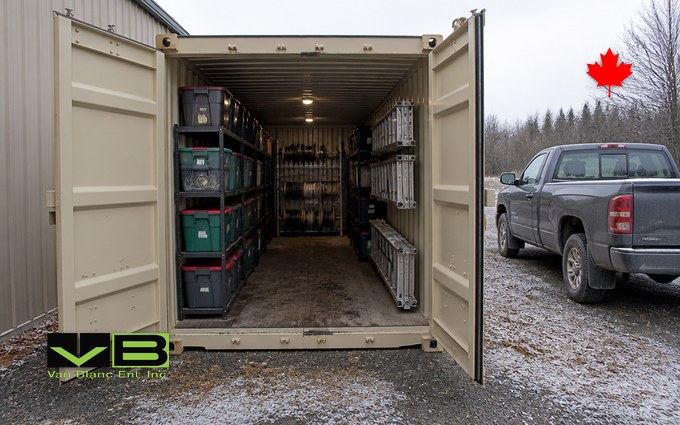
A steel container on the installer’s own lot solves the space problem in one Van Blanc delivery. It locks, it keeps the weather out, and it sits behind the shop where the trucks load. The table further down sorts a typical light inventory by how it stores in a Van Blanc box.
Nothing in a light inventory needs heat. It needs dry air, order and a lock. Load everything dry in January, give the box a pair of vents, and set a few moisture absorbers on the shelves. Where vents go on a storage box covers the placement. With the inventory listed, a quick check in late summer shows what needs replacing before the first install.
| Item | How it stores | Where in the box |
|---|---|---|
| Client strings, cut to length | Coiled, tagged with the client address, in lidded totes | Shelves, sorted by route |
| Spare wire on reels | On a rod rack or upright, off the floor | Back wall |
| Clips and sockets | Sorted by type in small bins | Upper shelves, near the door |
| Timers, controllers, GFCI adapters | Dry, in sealed bins with desiccant packs | Upper shelves |
| Extension cords | Coiled and tested, damaged ones replaced | Hooks on a wall rail |
| Extension ladders | Hung flat on wall brackets, rails labelled | Side wall, full length |
| Wreaths, garland, displays | Bagged, light items on top | Front, last in and first out |
Shelving a 20ft for Reels and Totes
A 20ft container is 19 ft 4 in long and 7 ft 8 in wide inside, with 7 ft 10 in of headroom. It holds 1,172 cubic feet, per the 20ft dry container’s spec table. Its cargo door opening is 7 ft 8 in wide and 7 ft 6 in high, which takes a loaded cart or pallet jack.
The usual layout runs shelving down both long walls and leaves a centre aisle to the back. Totes go on the shelves by route, so a crew can pull one street’s clients at a time. Ladders hang on one wall above the lower shelves, and reels sit on a rack at the back. Van Blanc fits shelving, vents and lockboxes as options built at the yard before delivery, so the box arrives ready to load.
A solo installer with a short client list may not need the full length. A 10ft has about 72 square feet of floor inside and about 560 cubic feet of volume, on the 10ft product page. For a ten, ask the yard what is on the ground. A compact ten that fits a narrow driveway suits a one-truck business in town. A company with several crews may outgrow one twenty and add a second, one box per depot.
Your light inventory, sized to a box
Tell us how many client totes, reels and ladders you carry, where the box would sit and your postal code. We match the inventory to a size, set up the shelving and vents with you, and send one all-in number with a real lead time.
Family-run in Brantford since 1995 · 4 Brantford yards · 4.9★ across 140+ Google reviews.
New or Used Steel for the Light Store
Containers come in four grades. Buyers call the first one new; the trade calls it one-trip, because the box made exactly one loaded voyage from the factory. New boxes arrive with clean paint and tight doors, though minor handling marks are possible and we point them out in the yard. Cargo worthy boxes are used, with surface rust and paint variance on a sound frame and floor. Wind and watertight boxes are used, with more cosmetic wear and doors that close and seal. As-is units are donor or scrap stock.
Behind a shop, a used box with a sound floor and sealing doors gives the light inventory dry, lockable steel. Where the box faces clients or a busy street, a new one brings factory paint and the best resale value. Both 20ft grades are in stock and ready for your order, and so is the 20ft high cube with a foot more headroom. Your Van Blanc quote names the exact unit and the delivery cost before anything is paid.
To weigh a twenty against other lengths, the full lineup of sizes and grades we carry sits on one page. Van Blanc sells containers outright, and you can walk the row and pick the exact unit before you pay.
Delivery Before the First Install Day
Van Blanc delivers in 1 to 3 days anywhere in Ontario, shipped from our 4 Brantford yards. Every quote comes with a real lead time, not a hopeful one. An installer who orders in late fall can have the box placed before the first trucks load. Payment can be made on delivery, by draft cheque, cash, wire transfer or credit card by authorization form.
Most of the province’s busiest light routes run through the GTA and the Golden Horseshoe. A crew working Scarborough to Etobicoke can order through containers sold to Toronto businesses. Lakeshore crews on the west side can look at a box dropped at an Oakville shop lot. For crews based on the Speed River side, there is container delivery around the Royal City.
On delivery day the truck needs open, level ground and a clear path to the spot behind the shop. Set level blocks or timbers under the corners before the Van Blanc truck arrives. That way the doors swing true and the floor stays off wet ground.
Installer’s Pre-Season List
Before the first roofline of the year
- Inspect every ladder against its label and retire any with damaged rails, feet or locks.
- Set each ladder at 4 to 1 and check it with the arms-out test before climbing.
- Check each site for overhead power lines, and stay at least 3 metres away.
- Test stored strings and cords, and replace damaged ones.
- Check that strings, cords and timers carry an approval mark and an outdoor rating.
- Follow the maker’s instructions and connect no more than three light strings together.
- Pack GFCI adapters and outlet covers for houses that lack them.
- Load totes from the box by route, and re-label anything that lost its tag.
- Book the Van Blanc storage box before the January takedown with a container quote request to the yard.
With the list done and the box sorted, call with your inventory count and postal code. A twenty for the light store lands in 1 to 3 days, wherever your routes run in Ontario.
Frequently Asked Questions
How much does it cost to have Christmas lights installed in Ontario?
It depends on the measured roofline, the number of storeys and peaks, whether the company supplies the lights, and any trees or wraps. Service calls, takedown and storage also move the number. Ask two or three companies to quote the same scope, and compare what each package includes.
How early is too early to put up Christmas lights?
No rule sets a start date for turning them on. Many crews hang lights in fall while roofs are dry and the ground is not frozen. They leave them off until the owner wants them lit. ESA says to take decorations down after the holidays, since they are not meant for year-round use.
How many strings of Christmas lights can you connect together?
ESA says to follow the manufacturer’s instructions and connect no more than three light strings together. Never exceed the wattage limit on the package, and use GFCIs for outdoor connections. The instructions on the box are the final word for that product.
How do you start a Christmas lights installation business?
Most start inside an existing trade, such as landscaping or window cleaning, that already owns ladders and trucks. You need graded ladders, liability insurance for work at height, a supplier of approval-marked commercial strings, and a crew trained on ESA and ladder rules. You also need dry storage for the eleven months between seasons.
Is hanging Christmas lights profitable?
It can be, mostly through repeat clients. The first year carries the design, measuring and often new lights. In later years the strings are already cut and labelled, so each house takes less time. Keeping those strings dry and organised between seasons protects that advantage.
Where do Christmas light installers store lights in the off-season?
A steel container on the installer’s own lot works well. Lights go in coiled and tagged in lidded totes on shelves, with reels, clips, timers and ladders sorted around them. Load everything dry, add vents and moisture absorbers, and lock the box until fall.
What size container does a Christmas light business need?
A 20ft suits most installers, with 19 ft 4 in of inside length for shelving down both walls and ladders on brackets. A 10ft, with about 72 square feet of floor, fits a solo operator in town. Count client totes, reels and ladders before choosing.
Sources
- Electrical Safety Authority. (2025). Holiday Safety and Top 10 Safe Holiday Decorating Tips. ESA, Holiday Safety, checked November 2026.
- CSA Group. (2018, reaffirmed 2022). Z11-18 (R2022), Portable ladders. CSA Group, Z11-18 Portable ladders, checked November 2026.
- Werner. (2026). What is the 4 foot rule for ladders? Werner, 4 foot rule for ladders, checked November 2026.
- Little Giant Ladder Systems. (2018). How to Get the Correct Ladder Angle. Little Giant, How to Get the Correct Ladder Angle, checked November 2026.
- Canada Energy Regulator. (2015). Market Snapshot: LED Christmas lights are cost and energy saving compared to incandescent. Canada Energy Regulator, LED Christmas lights market snapshot, checked November 2026.
- Statistics Canada. (2022). The northern (electric) lights: Stats to brighten your day and night. Statistics Canada, StatsCAN Plus on household lighting, checked November 2026.
See a Shelved Twenty in Brantford
We have been supplying shipping containers across Ontario since 1995. Our public yard at 90 Morton Avenue East is one of our 4 Brantford yards, and you can walk it without an appointment.
Van Blanc Ent. Inc., 90 Morton Ave E Unit 1B, Brantford, ON N3R 7J7, 519-754-6844.
Bring your client count and a photo of the lot behind your shop, step inside a twenty, and picture the shelves before the January takedown. Worth the drive for unbeatable quality, family customer service with 30 years of experience.