
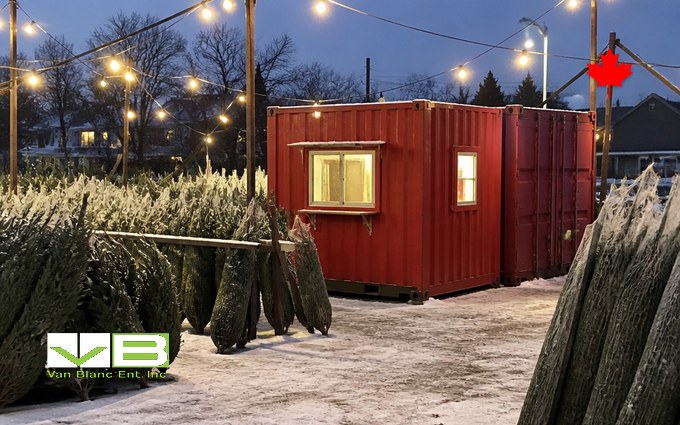
Quick Answer: To start a Christmas tree lot in Ontario, pick a busy site with parking and power, and book Ontario-grown trees early. Be in full operation by the first Saturday in December (December 5, 2026), the Christmas Tree Farmers of Ontario advise. Van Blanc sells 10ft sales huts and 20ft lockups.
What This Tree Lot Guide Covers
- Starting a Christmas Tree Lot: The Order of Work
- Christmas Tree Lot Location and Size
- When Do Ontario Tree Lots Open?
- Buying Trees From Ontario Growers
- Keeping Lot Trees Fresh
- The Netting and Baling Station
- Tree Stands and Display Racks
- Lighting for Dark December Evenings
- Cash Handling at the Sales Counter
- Securing the Lot Overnight
- A 10ft Sales Hut and a 20ft Lockup
- Lot Boxes: New or Used Steel
- Tree Lot Delivery and Box Placement
- Service Clubs and Farm Satellites
- After Christmas Eve: Teardown and Records
- Tree Lot FAQs
Reading Time: 20 minutes
Starting a Christmas Tree Lot: The Order of Work
A Christmas tree lot is a short-season outdoor shop: a fenced patch of pavement, a few hundred cut trees, a baler and a till. The Christmas Tree Farmers of Ontario (CTFO) tell every operator, new or returning, to treat those weeks as a real business, because surprises cost money. Almost all of the work happens before the first car pulls in.
Here is the order we suggest, drawn from the CTFO retail guide and a tree supplier’s lot guidebook.
- Pick the site and get the landowner’s terms in writing.
- Choose a grower and order early, before the best trees are spoken for.
- Book the storage and the sales hut, with any door, window or insulation work the hut needs.
- Build the fence, the lights and the baling station in late November.
- Be in full operation by the first Saturday in December, and stay open through Christmas Eve.
- Pack the kit away and write down what sold.
Van Blanc has sold shipping containers out of Brantford since 1995, and step three is where we come in. A compact ten from our rows becomes the sales hut, with a man door, a window and a counter. A 20ft box takes the baler, the stands, the fencing and the signs, and it locks every night. Both ship from our 4 Brantford yards: a stocked twenty in 1-3 days across most of Ontario, the fitted hut once its shop work is done.
Christian LeBlanc, second-generation operator, Van Blanc Ent. Inc.: “Order the hut before you order the trees. A plain twenty is a quick delivery, but a ten with a man door and a window goes through our shop first, and the trees show up on the grower’s date whether the hut is ready or not. Tell us which side faces the road and we cut the window there.”
Christian’s order runs against instinct, since the trees feel like the main event. The boxes are the slow part only when they need shop work, and a framed counter window is shop work.
Christmas Tree Lot Location and Size
Christmas tree lot location is the single most important factor in a short season’s success, according to the CTFO. Its ideal site sits on a busy road heading to or from a shopping area. Drivers should be able to turn in from either side once they spot the trees. Parking should be firm-surfaced and easy to see, with electricity and inside storage space on hand.
That storage line is the one a parking lot fails. A plaza corner or a Toronto church parking lot has no back room, so the CTFO’s inside storage has to arrive on a truck. A Van Blanc twenty parked behind the display is that storage room, with a steel roof and a lock.
The Kirk Company, a US tree supplier, adds numbers in its guidebook for lot operators. It says 87% of fresh-cut trees are bought at lots within 5 miles (8 km) of home. So a lot draws from its own neighbourhood, whether that’s the townhouses around a Brampton plaza or the streets near a community centre lot in Ajax. Kirk wants the lot visible from 200 to 300 feet (61 to 91 m) in at least two directions, and it rates a corner lot highly. It also cites research that most customers buy from the first or second lot they visit.
| Site check | CTFO guide | Kirk guidebook |
|---|---|---|
| Traffic | A busy road to or from a shopping area | Slow, heavy traffic, no faster than 35 mph (56 km/h) |
| Access | Turn-ins from either side of the road | Easy access from both directions |
| Parking | Firm surface, easy to see | Room for the busiest hours, plus a loading zone at the exit |
| Power | Electricity on site | A lighting source, since most sales come after dark |
| Storage | Inside storage space | Close to the display but out of sight |
Get the terms in writing before anything is delivered, including level stone footing for each corner if the boxes sit on grass or gravel. If there’s no formal agreement for the site, the CTFO suggests a written list of terms, initialled by the owner. Make that list say where the boxes sit, when they arrive and the date the lot must be clear. Check your liability insurance for the location as well. Permits are managed by your municipality, so check with your local building or planning department before you order.
When Do Ontario Tree Lots Open?
Ontario tree lots should be in full operation no later than the first Saturday in December, the CTFO advises, and stay open through Christmas Eve. In 2026 that runs from Saturday, December 5, to Thursday, December 24: 20 selling days at full strength. The CTFO and the Canadian Christmas Tree Growers Association have also declared the first Saturday of December Christmas Tree Day in Canada.
Some lots open earlier. In the United States, the CTFO notes, many operators open before the Thanksgiving weekend selling pumpkins. Then they switch to trees without closing: a business that changes stock with the season. Kirk’s guidebook says about 75% of tree sales land in the first two weeks of December. It warns that an early opening adds costs and risks losing trees. In Ontario, the CTFO notes, spruce is harvested last, usually from the end of November onward.
The CTFO says to open each day well before lunch and stay open until at least 9 p.m., in line with local retail hours. Kirk suggests 11 a.m. to 9 p.m. on weekdays and 9 a.m. to 10 p.m. on weekends.
| When | On the lot | With the boxes |
|---|---|---|
| September and October | Settle the site and its terms; order trees | Choose the ten and the twenty; book window cut-outs framed for the hut’s counter |
| Early to mid November | Plan fence lines, the baling station and lights | Both boxes set level before frost sets into the lot |
| Late November | Trees delivered, counted and checked; spruce from the end of November | Baler, shaker, stands and netting staged in the twenty |
| Saturday, December 5 | Christmas Tree Day; lot in full operation | Hut open from before lunch until 9 p.m. or later |
| First two weeks of December | When Kirk puts about 75% of sales | Twenty locked every night with the gear inside |
| Thursday, December 24 | Last selling day | Final count in the hut |
| January | Fence, racks and signs down; records written up | The season’s kit packed into the twenty |
Buying Trees From Ontario Growers
Buying trees for a lot starts with a grower, and growers run a season of their own on the farm. The CTFO’s wholesale directory sorts Ontario growers by area code: 519, 613, 705 and 905. Its retail guide suggests narrowing suppliers by phone, then visiting the farm where your trees will be cut. Ask the grower for tagged trees, which mark each tree as farm grown and can carry an individual price.
Payment and paperwork come next. The CTFO describes typical terms as a good-size deposit with the order and the balance in cash on delivery or pick-up. Check that the invoice spells out exactly what you agreed to buy, the same habit as the checks to run before paying for a container. The guide also says to plan on about 10% of your trees left over. If sales are very good, you can likely buy more in mid-December.
Ontario Has No Official Tree Grades
There is no official Christmas tree grading system in Ontario, the CTFO points out. Steel boxes are sold in named grades; trees aren’t. If your order names a grade, make sure you and the grower read it the same way, ideally on a farm visit. For scale, the CTFO says as many as 800 baled trees fit in a big tractor trailer. A lot ordering a few hundred trees is a fraction of one load.
Delivery day needs hands. An insulated hut out of the wind beats a car hood as the desk for the paperwork. Agree a firm date, confirm the time the day before, and be there to help unload, count and check every tree. Note any shortage or damage on the bill of lading or invoice, and have the trucker initial it. The CTFO points out that the trucker has no authority to make adjustments. Kirk adds that you and the driver both sign the delivery receipt, since unnoted shortages leave you no recourse.
Keeping Lot Trees Fresh
Keeping lot trees fresh comes down to holding moisture in, from the farm truck to the customer’s stand. Premature needle drop, usually caused by moisture loss, is the most common complaint about a real tree, according to the CTFO. Its guide says unheated indoor storage keeps moisture in best and protects trees from ice and sleet. The alternative is to leave trees baled, in the shade and out of the wind, until they go on display.
The CTFO doesn’t mention containers. Still, a closed twenty, new or used and graded before sale, is unheated indoor storage in the plainest sense. Its steel roof keeps the sleet off the stock. When the gear leaves floor space, baled overflow can wait in there instead of under a tarp. For cold locations, Kirk says to keep stored trees off the pavement on pallets or tarps. Display only part of the stock at a time, and restack and cover unsold trees each night. Above freezing, unbundle and fluff the trees so limbs don’t snap.
Train every volunteer on the CTFO’s freshness checks.
- Hold a branch about six inches (15 cm) from the tip and pull it through your fingers. The needles should stay on.
- Bend a needle between finger and thumb. It should form a U without snapping, unless the tree is frozen.
- Lift the tree a couple of inches and drop it on the stump. Few outer needles should fall.
- Check for fragrance and a good green colour.
The CTFO retail guide says to hand out a tree-care brochure with every sale. A 10ft container set up as the counter is where that pile lives. The CTFO’s care rules: make a straight cut about one inch (2.5 cm) off the butt, and use a stand that holds at least four litres. Check it daily, because a tree may drink up to four litres a day. Let the water drop below the cut and a seal forms. With that care, the CTFO expects a tree to stay fresh indoors for two to three weeks.
The Netting and Baling Station
A netting station turns a sold tree into something that fits on a roof rack. Kirk’s guidebook says 89% of customers expect their tree baled in netting. One pass through Kirk’s own baler compresses a tree by as much as two-thirds, the company says. Netting also discourages theft, since an unwrapped tree leaving the lot gets noticed.
The CTFO says to shake every long-needled tree with a mechanical shaker before the customer gets it, along with any short-needled tree carrying debris. Invest in a baling cone. Then see each tree tied down before the car leaves.
Mark which way the twenty’s cargo doors face before delivery day, then put the station right beside them. Keep it between the display and the exit, so the line moves one way: pick, pay at the hut, shake, bale, load. A hand baler on its folding stand, the shaker, the netting rolls and the twine then go straight back inside. Nobody loads a pickup at 9 p.m.
Tree Stands and Display Racks
Tree stands do two jobs on a lot. They hold display trees upright, and they’re the first accessory the CTFO says to stock for sale. Boxed stands for sale, saws and twine are worth sorting the way contractors organize a tool crib in a box. For display, the CTFO’s advice is to show trees individually and refill gaps from inventory as soon as they open up. Stands, overhead hangers, lean-to racks and T-bar posts can all work.
Kirk’s guidebook describes five display methods and where each one suits.
| Method | How it works | Where Kirk says it suits |
|---|---|---|
| Sawhorse | Trees lean on an upright frame, seen from both sides | Lower-priced trees; more upkeep |
| Strung line | Trees tied to a line between two posts | Cheap, attractive, stable in wind |
| Wooden stand | Each tree nailed to its own stand | Small displays and sidewalks; catches wind |
| Stake | Tree tied to a driven or cemented stake | Dirt surfaces, with a forest look |
| Drilled tree | Trunk drilled to sit on a pin stand with water | Every tree sale is also a stand sale |
Kirk also argues for room between trees, so a family can see each one from every side, and for a separate bargain corner. Stands, racks, posts and line kits then sit idle for eleven months. In a Van Blanc twenty, shelving fixed along one wall keeps them dry and findable until the next November.
Lighting for Dark December Evenings
Lighting is a sales tool on a tree lot, because much of the selling happens in the dark. On December 5, 2026, the sun sets in Toronto at 4:41 p.m., and civil twilight ends at 5:13 p.m., according to the US Naval Observatory’s sun data. By December 21, sunset is 4:44 p.m. A Toronto lot open to 9 p.m., as the CTFO suggests, sells for more than four hours after sundown every evening.
For lot lights and the hut’s power, Ontario’s Electrical Safety Authority says hire a Licensed Electrical Contractor, who can supply ESA’s Certificate of Acceptance. On the box side, Van Blanc roughs in the hut’s interior wiring at our Brantford yards before delivery. Your licensed electrician makes the final connection on site, and putting light fixtures inside steel walls has its own guide.
Kirk’s guidebook says the bulk of sales come late in the afternoon or evening. The more lit and lively the display looks, it says, the more customers it draws. It wants every sign well lit, and the big trees shown on lit corner poles or racks. The CTFO adds evening lighting, signage and banners for a festive feel. CCOHS, the Canadian Centre for Occupational Health and Safety, comes at the same lights from the safety side. Its advice is to keep every area well lit and to check the lighting before it gets dark.
Cash Handling at the Sales Counter
Cash handling on a tree lot is a small-shop problem, starting with a dedicated circuit for the point-of-sale gear. CCOHS publishes money-handling advice for people who work alone, and nearly all of it fits a lot.
- Have a cash control policy, and keep the minimum in the till.
- Encourage debit and credit cards.
- Remove large bills as soon as they come in, and use a locked drop safe.
- Post a sign saying only a small amount of cash is kept on site.
- Never count cash in public view.
- Vary when you empty the till and when you take deposits to the bank.
- Keep a charged mobile phone within reach.
The CTFO’s retail guide makes the same point in one line: once the season starts, take excess cash off the lot often. Kirk recommends tree tags with a tear-off price stub, which make the cash box easy to balance. Plan the grower’s money too, if the balance is due in cash at delivery.
Where the Money Goes at Closing
The hut locks, but the day’s take should leave with a person, at a time that changes. Van Blanc’s yards cut and frame a window with steel bars for the counter. It keeps the line outside and the cash behind steel while the lot is open. Overnight, only equipment stays: the till, the tags and the brochures.
Polymer notes have their own checks. The Bank of Canada’s routine is feel, look, tilt and flip. Feel for raised ink on the portrait and the large number. Look for a metallic portrait in the big transparent window that matches the main one, and tilt the note to watch its colours shift. Teach it to everyone who takes a shift on the till.
Securing the Lot Overnight
Securing the lot overnight starts with people, the CTFO says: if it’s practical, someone should stay on the lot each night. Good lighting and fencing around all displays and inventory come next. Snow fencing is the most practical temporary fence, the guide notes, and it also steers customer traffic. A “Guard Dog” sign helps too.
CCOHS lists visible security cameras as something that may deter a robbery. A cellular camera on a steel box can watch the till window and the lockup doors. Kirk’s guidebook has a fallback for lots where nobody stays. Leave a light on in the office with a radio playing moderately loud, and keep the lot lights on all night. Ask the local police to keep an eye on the lot during their rounds. On a lot built around two boxes, the hut is that office.
Then comes the part steel does best. Everything that walks away easily goes into the twenty at closing: the baler, the shaker, saws, twine, netting and the stands for sale. Lockboxes come standard on most new containers, and Van Blanc adds factory-style lockboxes to used ones, so the padlock sits inside a steel shroud. Inside the shroud, a puck padlock with its shackle tucked away leaves bolt cutters nothing to bite.
A 10ft Sales Hut and a 20ft Lockup
A tree lot needs two very different rooms, and Van Blanc’s answer is two boxes. One is warm, lit and open to the public all day. The other is a locked store for kit worth stealing. The sizes below come from our own product pages, and the full yard list of sizes and grades puts them all on one page.
| Spec | 10ft sales hut | 20ft lockup |
|---|---|---|
| Outside length | 2.99 m (9’10”) | 6.06 m (19’10”) |
| Outside width and height | 2.44 m (8’0″) wide, 2.59 m (8’6″) tall | Same width and height |
| Footprint | Half a parking stall: 8 by 10 ft | One parking stall: 8 by 20 ft |
| Inside | About 16 m³ (560 ft³) | 19 ft 4 in x 7 ft 8 in x 7 ft 10 in; 33.2 m³ (1,172 cu ft) |
| Door opening | Cargo doors, plus any man door cut | 7 ft 8 in wide, 7 ft 5 in high |
| Empty weight | About 1,300 kg (2,870 lb) | About 2,260 kg (4,982 lb) |
| Job on the lot | Counter, till, card reader, drop safe, tags | Baler, shaker, netting, stands, racks, fencing, signs |
| Shop work | Man door, barred window, an insulated roll-up front or insulation for evening shifts, wiring rough-in | Lockbox, extra vents, shelving |
The Ten as a Sales Hut
The ten sits on half a parking stall, which matters on a host’s lot where every stall is a favour. Van Blanc’s yards cut a hinged steel man door for the volunteers and a framed window facing the line, then add security bars over the glass. If volunteers will spend whole evenings inside, we insulate it. Recent stock across our 4 Brantford yards has included tens that arrived with cargo doors, a man door and a window already fitted. Ask what’s on the ground when you call.
A roll-up door is the other way to build a counter. Roll-ups go in at 6, 7, 8 and 10 foot widths. Weighing an 8 against a 10 foot roll-up covers the trade-off for a serving front. Customers look at the hut all season, so a new ten straight from the one-trip rows is the base Van Blanc suggests for it.
The Twenty That Locks Every Night
The lockup is judged on floor space and a wide door. A twenty comes new, or used from the rows of graded second-hand twenties, and the grade section below sets out what each one does well. Shelving down one wall takes the stands and boxed stock. The baler and shaker sit nearest the doors, with fencing and racks at the back. Through the season, each morning starts and each night ends at those doors.
How many boxes a lot needs is a judgment call, so treat these as starting points. A single lot with a few hundred trees can start with one ten and one twenty. A lot that also flocks trees, which Kirk says needs extra space, or runs a big wreath trade, may add a second twenty. A grower with two satellite lots in town needs a pair at each. The full door, floor and payload figures for a twenty sit on its product page.
Lot Boxes: New or Used Steel
Lot boxes come in the same four grades as every container Van Blanc sells, and each grade has a job it does well.
- New, which the trade calls one-trip: the box carried one load out of the factory and was then sold. Factory paint and clean steel make it the base Van Blanc uses for anything customers see or staff work inside, like the hut.
- Cargo worthy: used, structurally sound and fit for further shipping, a working base for roll-up doors and workshop-style builds.
- Wind and watertight: used, weather-tight and secure, with surface wear, a good fit for vents, bars, lockboxes and shelving.
- As-is: donor and scrap stock, sold for heavy custom cutting.
The grade is the buyer’s call. Whichever grade you choose, buy a box you can see. Van Blanc shows the exact unit by its container number, in the rows or on a video call, before you commit. What to check on a second-hand box lists the doors, floor and roof points worth a look. Listings that want money before you’ve seen the box are the ones to walk away from.
Tree Lot Delivery and Box Placement
Tree lot delivery from Van Blanc runs 1-3 days across most of Ontario from our 4 Brantford yards. Eastern Ontario runs such as Ottawa and Kingston take the same 1-3 days. A hut with shop work leaves Brantford once our crew has built and checked it, on the date your quote gives. That’s the reason to order in October: the trees come on the grower’s date, and the boxes should be level and locked first.
Placement is worth sketching with the host before the truck comes. For a twenty, the tilt-deck driver needs about a 70-foot straight approach and a foot of clearance on each side. A ten lands in tighter spots where a longer box can’t, which suits a crowded plaza corner. What happens on delivery day with a tilt-deck walks through the drop.
Think about how customers move. Put the hut where the line forms, with the window facing the trees or the road. Set the twenty behind the display with its doors toward the baling station, so the heaviest kit travels the shortest distance. From our yards, a satellite lot inside Toronto is a 1-3 day delivery. When the lot sketch is ready, send it with your opening date and we’ll match the boxes to it.
Price the Hut and the Lockup
Tell us where the lot is, when the trees arrive and what the hut needs: a man door, a window, insulation or power. We will match a ten and a twenty from the rows and quote the pair as one all-in number, with a real lead time.
Family-run in Brantford since 1995 · 4 Brantford yards · 4.9★ across 140+ Google reviews.
Service Clubs and Farm Satellites
Service clubs and youth groups run tree lots as fundraisers. Both lot guides speak to them, and a volunteer tool library that owns its 20ft shows a club’s box at work all year. The CTFO says that if your lot is connected with a voluntary organization, feature it prominently on site and in any promotion. Kirk says a service club should advertise where the profits go, which it says has great emotional appeal.
A backyard lot in Copper Cliff. Sudbury.com reported in December 2018 that Mike Peters had run a tree lot out of his Balsam Street backyard for 22 years. It raised money for the First Copper Cliff Scouts. He started in 1996 with 100 trees and was bringing in about 300. The lot opened every day from 9 a.m. to 9 p.m. until the trees were gone, strung with lights and staffed by his family, the Fleming family and the Scouts.
A club that owns its boxes gets more than one season out of them. The twenty becomes the club’s store, holding the tree kit from January to October alongside whatever else the club runs. How charities plan and approve a container purchase helps with the board conversation. The ten can work outside December too, as a vendor stall at a holiday market on a free weekend.
Growers who run satellite lots in town face the same two-room problem, a long drive from the barn. Each lot needs a lit hut and a locked store, while the farm keeps its own steel base for the baler and netting through the off-season.
After Christmas Eve: Teardown and Records
After Christmas Eve, the lot still has a few days of work in it. The CTFO advises against cutting tree prices at the end of the season unless similar operations force it. Lower prices, it says, teach customers to buy later next year. A well-signed lot with several seasons behind it needs little extra publicity, it adds, though most operators won’t be that lucky. Teardown is really the first step of next season’s setup.
Write things down while they’re fresh. The CTFO says to track tree types, sizes, who bought what and each accessory’s sales. It also suggests a customer list for next year. Kirk suggests a daily sales tally at noon, 6 p.m. and closing, with a note on the weather, so you can see when the rush comes and staff for it.
Then pack the twenty: fence rolls, racks, posts, stands, signs and light strings. If the host agrees in writing, the boxes can stay on site until next season. Clubs that keep their gear in steel between seasons leave theirs in place the same way. If the lot has to be cleared, moving a placed box is a job for a local hauler you arrange. Van Blanc delivers the container you buy and sets it down once, so plan the spot with next December in mind. A club adding a box for next year can time it, since container demand moves with the seasons.
Frequently Asked Questions
What does it take to open a Christmas tree lot in Ontario?
A busy site with firm parking, power and storage, the landowner’s terms in writing, and trees ordered early from an Ontario grower. Add fencing, lights, a baling station and staff who know tree care. The Christmas Tree Farmers of Ontario say to be in full operation by the first Saturday in December and stay open through Christmas Eve.
How late do Christmas tree lots stay open?
The CTFO’s retail guide says to open each day well before lunch, stay open until at least 9 p.m. and keep the lot running through Christmas Eve. With an early-December sunset in Toronto at about 4:41 p.m., most evening hours are sold under lot lights. The lighting plan matters as much as the hours.
How much space does a Christmas tree lot need?
The Kirk Company’s lot guidebook recommends a minimum frontage of 100 to 200 feet (30 to 61 m). Its recommended depth is 100 to 125 feet (30 to 38 m). Allow extra room if you flock trees, plus parking for the busiest hours. Smaller sites can use wooden-stand displays, which Kirk rates for small display areas.
What size container works as a tree lot sales hut?
A 10ft container is the size Van Blanc would start with. Our yards cut a man door and a barred window into it, insulate it and rough in the wiring before delivery. Your licensed electrician connects it on site. Customers see it all season, so a new one-trip ten is the base we suggest, with a 20ft lockup beside it for the gear.
Where can customers dispose of a Christmas tree after the holidays?
Most municipalities collect discarded real Christmas trees and chip them for mulch, according to the Christmas Tree Farmers of Ontario. So the answer is the customer’s own town collection dates. Real trees are completely biodegradable. A lot that prints local pickup dates on its tree-care handout saves its customers a phone call in January.
What is the Christmas tree capital of Canada?
Tourism Nova Scotia says Lunenburg County is considered the Balsam Fir Christmas Tree Capital of the World. It says the province’s growers sell and ship over 350,000 balsam firs a year across Canada and the United States. An Ontario lot can buy closer to home, since the CTFO lists wholesale growers by Ontario area code.
What goes in the 20ft when the lot closes for the night?
Anything worth stealing or spoiled by sleet: the baler and its stand, the shaker, netting rolls, twine, saws, stands for sale and extension cords. The cash leaves with a person, and CCOHS advises varying when deposits go to the bank. A lockbox over the padlock and lot lights left on finish the job.
Sources
- Christmas Tree Farmers of Ontario. Guide to Successful Retailing of Christmas Trees for seasonal operations, plus the Christmas Tree Care, Harvesting, Christmas Tree Day, Real Tree Facts and Wholesale Suppliers pages. CTFO Guide to Successful Retailing of Christmas Trees; CTFO Christmas Tree Care; CTFO Harvesting Christmas Trees; CTFO Christmas Tree Day; CTFO Real Tree Facts; CTFO Wholesale Suppliers directory, checked October 2026.
- Kirk Company. Successful Christmas Tree Lot Business Practices, lot operator guidebook (PDF). Kirk Company tree lot guidebook, checked October 2026.
- US Naval Observatory, Astronomical Applications Department. Sun and Moon Data for One Day, Toronto (43.65 N, 79.38 W, UTC-5), December 5 and December 21, 2026. USNO sun data for Toronto, December 5; USNO sun data for Toronto, December 21, checked October 2026.
- Canadian Centre for Occupational Health and Safety. Working Alone: Handling Money; Bank of Canada, Counterfeit prevention. CCOHS Working Alone, Handling Money; Bank of Canada counterfeit prevention, checked October 2026.
- Electrical Safety Authority. Licensed Electrical Contractors. ESA guide to hiring a Licensed Electrical Contractor, checked October 2026.
- Ulrichsen, H. (2018). Peters’ tree lot has been bringing Christmas to Copper Cliff for 22 years. Sudbury.com. Sudbury.com Copper Cliff tree lot story, checked October 2026.
- Tourism Nova Scotia. Nova Scotia’s Unique Christmas Tree Traditions. Tourism Nova Scotia Christmas tree traditions, checked October 2026.
Walk the Rows Before the Trees Arrive
We have been supplying shipping containers across Ontario since 1995. The public yard at 90 Morton Avenue East is one of our 4 Brantford yards.
Van Blanc Ent. Inc., 90 Morton Ave E Unit 1B, Brantford, ON N3R 7J7, 519-754-6844.
Bring a sketch of the lot and your opening date. The yard is open Monday to Thursday from 9:30 to 5, and Friday until 4. Call ahead and we will check which of our 4 Brantford yards has a ten that would take a counter window and a twenty for the gear. Worth the drive for unbeatable quality, family customer service with 30 years of experience.