
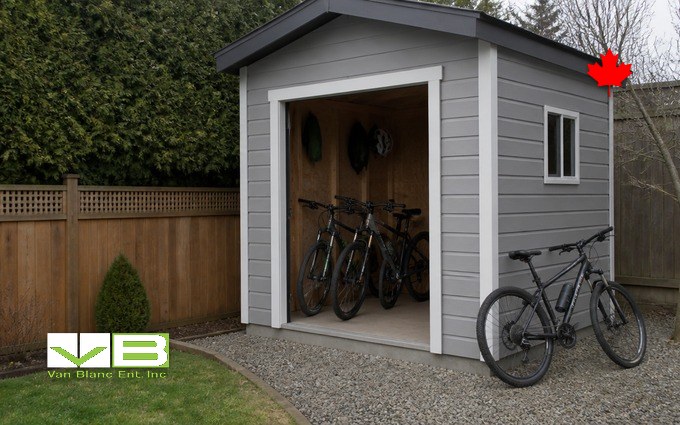
Quick Answer: A bike shed is mid-tier security storage: a lockable weather-proof box that keeps bicycles dry, rust-free, and off the porch. Steel resists theft best, wood looks best, and every tier beats a tarp. Lock the frame inside the shed anyway, since the shed’s lock is a delay, never a wall.
In This Guide
- Bikes Finally Deserve a Building
- The Bike Storage Ladder
- The Rust Science of an Ontario Winter
- Security in Layers
- The E-Bike Winter Chapter
- The Townhouse Problem
- Sizing for a Real Family Fleet
- The Maintenance Corner
- The Winter Commuter’s Routine
- When the Job Outgrows the Shed
- The Buying Checklist
- Bike Shed FAQs
Reading Time: 12 minutes
Bikes Finally Deserve a Building
For most of a century the family bicycle wintered wherever it fell, against the porch, under a tarp, in the garage’s most resented corner, and nobody thought the arrangement worth a building. The e-bike era ended that logic. The bikes leaning in Ontario’s yards now include machines worth more than the first cars their owners drove, and even the pedal-only fleet has climbed in value while it climbed in importance, carrying commutes, school runs, and the family’s best cheap recreation. Storage that was always mildly negligent is now expensively negligent: rust eats drivetrains, freeze-thaw wrecks what water reaches, and theft has followed the money into backyards. So the bike shed has arrived as its own product category, and this guide walks the whole ladder honestly, including the rung where our steel takes over and the several rungs where it should not.
Christian, Van Blanc: “The bike calls used to be one a summer. Now it is e-bike families, a cycling club, and last spring a delivery outfit running twenty bikes off one yard. Same sentence every time: these things got valuable and the shed did not keep up. For two bikes I tell them to buy a bike shed, not a container. For twenty, different conversation.”
The Bike Storage Ladder
| Tier | What it buys | Honest limit |
|---|---|---|
| Tarp or cover | Rain off the saddle | Traps humidity; zero security |
| Deck-box or bike locker | One or two bikes, dry and hidden | Thin walls, tight fit, no workspace |
| Wood or resin bike shed | Family fleet, dry, tidy, decent locks | Cladding and hinges set the security ceiling |
| Metal bike shed | Best theft resistance in the category | Condensation needs managing; looks utilitarian |
| Container corner | Fleet-scale, real security, workshop room | Built for roughly six bikes and up |
The ladder’s honest reading matches the category’s own reviewers: every rung beats the rung below it on the two things that matter, dryness and delay, and the right rung is the cheapest one that covers your fleet’s value. The storage guides that test these products agree on the material hierarchy, steel outperforming wood and resin for theft resistance while wood wins yards where looks vote, and they agree on the buying details that separate good from cheap within a tier: cladding thickness and tongue-and-groove construction in wood, hinge and hasp quality everywhere, and a floor, because a shed without one parks the fleet on wicking ground. The resin tier’s fuller story lives in our review of the plastic shed class, and its bike-relevant summary is simple: fine against weather, modest against pry bars.
One tier deserves a special mention because it hides in plain sight: the corner of an existing garage or shed, upgraded rather than replaced. A household that already owns a dry lockable building often needs no new structure at all, just the interior anchor, a rack that gets the bikes off the floor and out of the car’s door-swing, and the discipline of an assigned zone the lawnmower cannot colonize. The honest ladder starts there, at nearly free, and only climbs when the existing buildings are genuinely full or genuinely insecure, which is a test worth running before any catalogue opens.
The Rust Science of an Ontario Winter
What kills stored bikes in this province is rarely one soaking; it is the cycle. A bike ridden through winter streets carries road salt into storage, humidity swings condense water onto cold metal every time a thaw follows a freeze, and a tarp or unventilated box holds that moisture against chains, cassettes, cables, and spokes for months. The defence costs almost nothing once the mechanism is understood. Storage wants airflow more than it wants a hermetic seal, vents high and low so the air changes instead of stewing. The floor wants to be dry and non-wicking, which is why the good sheds float their floors and the good container setups rack bikes off the plywood. And the bike itself wants thirty seconds of ritual at the storage door in winter, the quick wipe-down that takes the salt off before the door closes on it. A fleet stored to that standard emerges in April needing lube; one stored under the classic blue tarp emerges needing a mechanic.
Security in Layers
The security conversation stays honest only if the first sentence is blunt: no shed lock stops a determined thief, it delays one, and delay plus visibility is the whole game. So the practitioners layer it. The building locks with real hardware, a hasp through-bolted rather than screwed, because screws are a gift. The bikes lock again inside the building, frames to an anchor, with the lock through the rear triangle where the guides point out it protects the frame and rear wheel together, not through the front wheel that leaves in ten seconds. Lighting covers the approach through the long dark months, a camera earns its keep where a neighbourhood’s theft pressure justifies it, and the quietest layer of all is sight-lines, since a shed the street cannot see into is a shed a thief must gamble on. None of the layers is expensive. Their sum is a target that takes too long and tells on the visitor, which is what security actually means at residential scale.
The paperwork layer costs the least and gets skipped the most. Every bike’s serial number lives under the bottom bracket, and a phone photo of it beside a photo of the whole bike takes a minute per machine; insurance claims and police recoveries both run on exactly that minute. Households with real fleet value should also have the insurance conversation before the theft rather than after, since home policies handle bikes differently across insurers and the e-bike tier sometimes wants its own scheduling. And the community layer is real too: stolen-bike registries and local cycling groups recover machines regularly, but only the documented ones, because a recovered bike nobody can prove ownership of goes back to nobody.
Fleet-Scale Bike Storage?
Clubs, delivery operations, outfitters, and big households store bikes by the dozen, and that is where our steel earns the job: racked walls, real locks, room for the bench and the chargers. We will tell you honestly if a bike shed is all you need. Real lead time, not a hopeful one. Fast 1-3 day delivery across Ontario from our Brantford yards.
Van Blanc Ent. Inc. · Brantford, Ontario · Since 1995 · 4.9 stars across 140+ Google reviews · Cash on delivery
The E-Bike Winter Chapter
Electric bikes rewrote the storage rules mid-decade, and the battery wrote most of the new text. Lithium batteries dislike the cold in both directions, losing usable range when ridden frozen and, more importantly for storage, disliking being charged below freezing, which every manufacturer’s guidance handles the same way: in deep winter the battery comes off the bike and lives indoors, stored partly charged in a dry, temperate room, while the bike itself winters in the shed like its ancestors. That split settles the classic question of whether bike storage needs heat, and the honest answer for nearly everyone is no, the machine is happy cold and dry, and only the battery needs the house. The rest of the e-bike chapter is weight and width: these are heavier machines with longer wheelbases and fatter tires, so the racks, ramps, and door widths sized for a nineties mountain bike need rethinking, and the buying checklist below carries the measurements. What e-bikes mostly changed, though, is the stakes, since a shed holding two commuter e-bikes now protects a sum that makes the good hasp and the interior anchor look like the bargains they are.
The Townhouse Problem
The hardest bike-storage questions come from the properties with the least room to answer them. Townhouses, semis on narrow lots, and the older urban streets store bikes in side passages a wheelbarrow barely clears, and the category has evolved for exactly that geometry: vertical bike lockers holding one or two bikes upright by the front wheel, slim lean-to style bike sheds a metre deep against a wall or fence, and the deck-box tier doing double duty as bench seating on a patio that cannot spare a footprint. The buying logic compresses but does not change, dryness, delay, and daily convenience, with one urban addition: discretion. A slim shed that reads as garden furniture draws less attention than a bike-shaped locker that announces its contents, and on a street where the storage is visible from the sidewalk, looking boring is a security layer all its own. The renter’s version of the problem adds a landlord to the conversation, and the freestanding tiers earn their keep there too, arriving without anchors in the mortar and leaving with the tenant.
Sizing for a Real Family Fleet
Bike storage fails by census error more than by design: households count their bikes on a calm day and buy for that number, then the fleet grows a trailer, a kid’s next size, a fat bike, and the shed built for four is stacking six within two years. The practitioners size for the fleet plus its future and plus its accessories, because helmets, pumps, panniers, the repair stand, and the trailer consume real volume, and they fight for floor area with the bikes themselves. Vertical racking is the honest multiplier, wall hooks or stand-up racks that store bikes by the front wheel and cut the footprint per bike roughly in half, with the caveat the e-bike chapter demands: heavy bikes want wheel-channel racks or floor parking, since hoisting twenty-five kilograms to a hook nightly is a resolution nobody keeps. The layout rule from every working building on this site applies at bike scale too: one reach deep, an aisle you can walk, and the daily riders nearest the door, because storage that makes the morning commute annoying gets abandoned back to the porch by June.
The Maintenance Corner
A fleet stored well still needs working on, and the storage that plans for maintenance keeps its bikes on the road twice as reliably as the storage that only parks them. The corner costs little: a wall-mounted repair stand or the folding kind, a small shelf of the consumables every bike burns, lube, patches, tubes in the fleet’s sizes, a track pump living where the bikes live so pressure checks actually happen, and light good enough to find a bearing race by. What the corner buys is the shift from breakdown maintenance to rhythm maintenance, the ten-minute weekly once-over that catches the fraying cable and the drying chain while they are still trivia, and it buys the family’s next mechanic too, since kids learn wrenching in exactly this kind of corner. In the shed tiers the corner is a wall; in the container tier it grows into the bench half of the room and becomes, for the clubs and delivery fleets, the difference between an operation and a pile of bikes. Either way the principle is the one every working building on this site repeats: storage that includes the work keeps working.
The Winter Commuter’s Routine
The riders who use their storage hardest are the ones who never stop riding, and Ontario’s winter commuters have worked the routine into a science worth copying. The bike that comes in from salted streets gets the thirty-second treatment at the door, a rag over the drivetrain and rims before the salt sets up shop, and the chain gets wet-weather lube on a weekly rhythm rather than a when-it-squeaks one. The storage earns its half of the bargain with a mat or drip tray under the winter bike’s parking spot, since a slush-loaded machine sheds a puddle nightly and a wet floor is how the whole shed’s humidity climbs. Gloves, lights, and the high-visibility layer live on hooks at the door where the pre-dawn departure can find them, and the e-bike battery’s indoor shelf sits beside the charger with the same logic. None of it is complicated, and all of it compounds: the commuter who runs the routine buys drivetrains in years while the one who skips it buys them in seasons, and the difference funds a rather nice shed.
Spring gets its own short ceremony. The winter bike comes off the drip tray for a proper wash and a drivetrain inspection, the summer bikes come down from their hooks with a pressure check and a bolt once-over, and the shed itself gets its floor swept, its vents cleared, and its hasp hit with a shot of lubricant. Twenty minutes, once a year, and the whole system rolls into the good season ready instead of rusty.
When the Job Outgrows the Shed
Somewhere above roughly six bikes, the dedicated bike shed stops being the honest answer, and the buyers who reach that line are recognizable: the cycling family whose fleet crossed into double digits with the trailer and the spares, the club storing loaner and race bikes together, the outfitter or tour operator turning bikes over daily through a season, and the delivery operation whose e-bike fleet is the business itself. That scale wants what a container is: a room, not a cabinet, with racked walls down both sides, an aisle, bench space for the maintenance that a working fleet demands weekly, power for the charger bank where the site can feed it, and steel security that changes the theft conversation entirely. It also wants the fleet-management habits the bigger operations bring anyway, numbered racks, a sign-out sheet, the wipe-down station at the door. Our conversion bench outfits that version routinely, and the honest boundary runs both directions: below the line we send callers to the bike-shed catalogue without ceremony, and above it the box earns the job on room, security, and the workshop the fleet was already begging for.
Many people call us saying they can get a bin for $1,000 less on Facebook. Two weeks later some of them call back to say they got scammed. Bike people, pleasant as they are, are not exempt, and the rule holds: inspect in person, pay on delivery, and buy from a yard with an address.
The Buying Checklist
Whatever rung of the ladder fits, the same short list separates the purchase that works from the one that disappoints. Measure the longest bike with its fenders and rack, then check the door diagonal, not just the width, because bikes enter tilted. Check cladding and panel gauge against the security honesty above, and put hands on the hinges and hasp before believing any listing. Confirm ventilation exists, high and low, and that the floor is real and raised. Plan the interior anchor for the second lock layer before delivery day, since drilling is easier before the shed fills. Site the building where the house’s lights and windows cover its door, on a base that drains, with the roof clear of the snow-slide paths this province’s winters run. And keep the receipt culture the category deserves now: serial numbers photographed, the e-bike batteries’ indoor shelf assigned, and the fleet counted honestly, growth included, before the size is chosen. Permits are managed by your municipality, so check with your local building or planning department before you order, though at bike-shed scale the conversation is usually a short one.
Bikes earned their building the moment they started carrying commutes and four-figure price tags, and the right building is the cheapest one that keeps the fleet dry, delayed against theft, and pleasant to grab at eight in the morning. Climb the ladder only as far as the fleet demands, spend the savings on the hasp and the interior anchor, and bring the batteries inside when the real cold arrives. The porch was never storage. It was just where the bike gave up.
Bike Shed FAQs
What is the most secure type of bike shed?
Steel sheds lead the category for theft resistance, and the storage guides agree, but hardware decides more than material: a through-bolted hasp, quality hinges, and a second lock layer inside, frames anchored with the lock through the rear triangle. Every shed lock is a delay, so layer it with lighting and sight-lines.
Do bikes rust in outdoor storage over an Ontario winter?
Only when moisture is managed badly. The killers are trapped humidity, freeze-thaw condensation, and road salt carried in on winter riders. A ventilated shed with a dry raised floor, plus a thirty-second wipe-down after salty rides, brings a fleet to April needing lube rather than a mechanic. Tarps trap exactly what they should shed.
Does an e-bike need heated winter storage?
The bike does not; the battery does. Manufacturers’ guidance runs the same way across brands: in deep winter the battery comes off, lives indoors partly charged in a dry temperate room, and never charges below freezing. The bike itself winters happily in cold, dry storage like any other machine.
How big should a bike shed be?
Size for the fleet plus its future plus its accessories, since trailers, helmets, pumps, and the repair stand eat real volume. Vertical racking roughly halves the footprint per bike, though heavy e-bikes want wheel channels or floor parking. Keep it one reach deep with the daily riders nearest the door.
When does bike storage justify a shipping container?
Above roughly six bikes, and clearly at fleet scale: clubs, outfitters, delivery operations, and big cycling households. A container gives racked walls, an aisle, bench space, charger power where the site feeds it, and steel security. Below that line, an honest supplier points you at the bike-shed catalogue instead.
Sources
- The Best Bike Lock. (2026). Best Bike Storage Shed: Dry, Practical and Secure. thebestbikelock.com. The category’s security-first buying analysis
- Momentum Mag. (2025). The Best Bicycle Storage Solutions for Winter. momentummag.com. Winter storage and locking practice for daily riders
- Heartland Sheds. (2025). Outdoor Bicycle Storage Shed Ideas. heartlandsheds.com. A shed maker’s sizing and layout guidance
- Patiowell. (2025). The Ultimate Guide to Outdoor Bike Storage. patiowell.com. Rust prevention and weather protection fundamentals
Reach Van Blanc in Brantford
We have supplied Ontario’s yards with working steel since 1995, and the bike world found us when the fleets got serious. If yours has crossed the line where a shed stops being honest, the rows at 90 Morton Avenue East hold the room your bikes are asking for.
Van Blanc Ent. Inc., 90 Morton Ave E Unit 1B, Brantford, ON N3R 7J7, 519-754-6844
Storing a fleet, a club’s season, or a delivery operation? Call with the bike count and the site.