
Quick Answer: Toro Steel Buildings is a Markham, Ontario supplier of pre-engineered steel building kits: straight-wall buildings in red iron or cold-formed steel, and Galvalume arch buildings in quonset and straight-sidewall styles up to 125 feet wide. The kit is engineered and stamped for your province; the foundation and erection are yours.
In This Review
- Where We Stand (Read This First)
- What Toro Steel Buildings Actually Is
- The Systems, Decoded
- What a Toro Building Is Genuinely Good At
- The Kit Reality: What Arrives and What Doesn’t
- Arch or Straight Wall for an Ontario Roof
- The Warranty, Decoded
- What to Confirm Before You Sign
- Who Should Buy a Toro Building
- The Steel Building That Arrives Built
- Toro Steel Buildings FAQs
Reading Time: 13 minutes
Where We Stand (Read This First)
This review is written by a shipping container yard in Brantford, Ontario. We are not affiliated with Toro Steel Buildings, we receive nothing from them or from anyone who sells their kits, and the containers we sell are, for a narrow band of buyers, a competing way to get a steel building. Read every word knowing that. It also cuts the other way: a 60-foot clear-span arch is not something a container will ever be, and for most of the people who type Toro’s name into Google, a kit building of some kind is the right purchase. This review’s job is fit, not takedown.
Every fact about Toro below was checked against torosteelbuildings.com and its Better Business Bureau profile on September 11, 2026. Where Toro makes a claim about itself we say so; where a number comes from the company’s own pages we say that too. Nothing here is a scraped customer quote.
What Toro Steel Buildings Actually Is
Toro Steel Buildings Ltd. is a Canadian pre-engineered steel building supplier headquartered in Markham, Ontario, accredited by the Better Business Bureau since April 2018. By its own account it has been in the business for more than forty years, has served more than 85,000 customers, and draws on some thirty manufacturing facilities. It sells across every province and territory and into the United States, and it says its engineers carry stamps for every Canadian province and territory and design to the current National Building Code of Canada. Its nearest neighbour in the same search is Metal Pro Buildings of Thornhill, a Pioneer Steel dealer, reviewed in the Metal Pro review.
What Toro sells is a kit: engineered, pre-cut, pre-drilled steel components with illustrated instructions, delivered to your site with engineered drawings that include the foundation specifications or the arch reactions an engineer needs to design an alternative base. The buyer, or the contractor the buyer hires, builds the foundation and erects the building. That division of labour is the single most important thing to understand about the company, and it is the thread through everything below.
The Systems, Decoded
| System | What it is | Typical use | Trade-off |
|---|---|---|---|
| Straight wall, red iron | Hot-rolled I-beam frames with steel purlins and girts, sheeted in panel | Shops, warehouses, riding arenas, larger farm buildings | Heaviest, widest spans, most crane and crew to erect |
| Straight wall, cold-formed | Lighter gauge formed-steel frames, bolted | Garages, workshops, smaller commercial | Lighter and cheaper to erect; narrower span limits |
| Arch, Q style | Classic quonset: single-radius arch, clear span, comes to the ground both sides; widths to 125 feet | Hay, equipment, aircraft, bulk storage | Curved walls lose usable floor at the edges; endwalls and doors are their own line |
| Arch, S style | Straight sidewalls under an arched roof | Equipment stored against walls, shops | Recovers wall space at some cost in simplicity |
Toro’s arch buildings are made from Galvalume Plus steel, the aluminum-zinc coated sheet the whole arch-building industry uses, and the company lists six arch styles of which the Q and the S are the two most buyers choose between. The straight-wall systems are what the industry calls pre-engineered metal buildings, the same family as the warehouses on every industrial road in Ontario, scaled down to garages and shops. Our quonset hut guide covers the arch category on its own terms, and the metal building kit comparison covers what happens to any steel kit as it scales.
What a Toro Building Is Genuinely Good At
Strengths first, because they are real. Clear span is the big one: a Q-style arch puts a column-free floor under a roof that sheds snow by its shape, at widths no other building type reaches for the money, which is why quonsets sit on farms from Norfolk to the Ottawa Valley. Provincial engineering stamps are the second: a Toro kit arrives with drawings a building department can read, designed to the loads for your location, and that is worth more than most buyers realise until they need drawings an engineer will sign. Speed of the shell is the third: pre-cut, pre-drilled components mean a competent crew stands a building in days once the foundation has cured. And the product range means a buyer can move from a garage to a hangar without changing suppliers.
Where the Kit Is the Right Answer
A farm that needs 40 by 60 feet or more of dry, column-free storage for equipment and hay; a shop that needs a real bay with a crane; a rural property that has the space, the site, the concrete contractor and the crew or the erector. For that buyer a Toro kit, or one from the several Canadian competitors in the same business, is the correct category, and no container is.
The Kit Reality: What Arrives and What Doesn’t
This is where the fit questions start, and it applies to every kit supplier, Toro included. What arrives is the steel: the frames or arches, the sheeting, the fasteners, the drawings. What does not arrive, by the company’s own description, is the foundation, which is a separate engineered concrete job priced and built by your contractor to the specifications in Toro’s drawings. Endwalls, doors, windows, insulation, trim and delivery are lines that a quote may or may not include; reading which is on the purchase order is the buyer’s job, and it is the single line item that decides whether the kit price and the finished-building price land anywhere near each other.
Erection is the other half. A kit is a set of parts until it is a building, and the labour to bolt an arch or a red-iron frame together is either your weekends with a rented lift or an erector’s invoice. Toro’s marketing is honest that this is a DIY product, and the company’s blog is full of owners who did it themselves; the honest counterpoint is that a 40 by 60 arch is a project with a crane in it, and a straight-wall red-iron building is a project with an erector in it. Price the whole building, not the box of steel.
Foundation First, Always
The most common budgeting mistake in steel-kit buying, regardless of brand, follows the same sequence: the kit is ordered on the strength of a per-square-foot number, the foundation is priced afterward, and the second number surprises the buyer. Toro provides the foundation specifications with the drawings, which is the right way to do it. Use them to get the concrete quoted before you sign for the steel, and the surprise disappears.
Arch or Straight Wall for an Ontario Roof
Toro’s own comparison page frames this well and it is worth restating for this climate. An arch sheds snow by geometry; a Q-style roof has no flat surface for wet March snow to sit on, which is why the quonset survived on the prairies and why Toro’s arch buildings are rated for the loads its engineers stamp. What the arch gives up is the wall. Anything stored against a curved wall loses the floor at the edge, and shelving, workbenches and equipment want a straight wall, which is exactly what the S style and the straight-wall systems provide. A straight-wall building carries snow on purlins and a pitched roof, engineered to the same loads, and gives you every square foot of the floor.
The Ontario answer, then: bulk storage, hay, machinery that parks in the middle, choose the arch. Shop, garage, anything with a workbench, choose straight wall, and expect to pay for the frames. Our container-versus-quonset comparison and the pole barn comparison put the same question to the two farm buildings people cross-shop against a kit.
The Warranty, Decoded
Toro’s published warranty for straight-wall buildings has two parts, and they are different animals. The structural side is a one-year limited warranty against failures caused by faulty or substandard materials. The finish side is the panel manufacturer’s paint warranty, which runs from 25 to 40 years depending on the panel and coating chosen. Read that the way it is written: the long number is the paint, the short number is the steel, and the erection and the foundation are covered by whoever did them. For the arch systems, Toro now publishes its own schedule: a 50-year warranty against rust perforation on the Galvalume Plus panels, a 30-year warranty against snow and wind load failure on buildings erected to the stamped drawings, and a 60-day window to report shortages and defects. Read the perforation term as a coating term, a hole through the sheet rather than surface weathering, and read the 60-day term as the deadline for counting the bundles when the truck leaves.
None of that is unusual in the industry, and it is not a criticism of Toro. It is the reason a buyer should get the warranty in writing on the purchase order rather than from a sales conversation, and should ask, specifically, what happens if a panel is damaged in transit and what the claim process is.
What to Confirm Before You Sign
The Purchase Order Checklist
- The engineering inputs: ground snow load, wind, and seismic for your site, not a default, written on the order.
- Exactly what is in the kit: endwalls, doors, windows, trim, insulation, fasteners, and what is quoted separately.
- Foundation specifications delivered with the drawings, and a concrete quote in hand before the steel is paid for.
- Delivery: to where, on what truck, who unloads, and the window.
- Erection: DIY, or an erector named and quoted.
- Warranty terms, for the frame, the panels and the coating, in writing.
- Deposit, balance and cancellation terms, and the date the price is held to.
- The BBB profile, read before signing, as with any supplier.
A supplier that answers all eight in writing is a supplier you can buy from. That is true of Toro and of every steel-kit company in Canada, and it is the same discipline our buying guide asks of anyone quoting a container.
How Toro Compares to the Other Canadian Steel-Kit Suppliers
Google’s other question under this search is which company makes the best metal buildings, and the honest answer is that the Canadian market has a handful of credible suppliers in the same business and they are compared on the same eight lines, not on a brand name. Norsteel, Olympia, Pioneer Steel, Future Buildings and SteelMaster are the arch specialists most Ontario buyers cross-shop against Toro’s Q and S styles; the straight-wall side is a longer list of pre-engineered building suppliers and their dealers. One thing to know when you collect those quotes: Toro and Norsteel both list 1405 Denison Street in Markham as head office, and Toro names Future Buildings as a sister company, so get quotes from both but know they are neighbours. The reviews of those brands are on their way in this same series, under the same rules.
What separates them in practice is not the steel, which comes from the same mills and coil coaters, but the specifics: the gauge and coating quoted for your building rather than the brochure; whether the engineering stamp is for your province and your site loads; how endwalls, doors and trim are priced; the delivery window and who unloads; and the deposit and cancellation terms. Two suppliers quoting the same 40 by 60 arch can differ by a third once those lines are filled in, and the cheaper brochure number is rarely the cheaper building. Toro’s advantage in that comparison is a long track record and provincial stamps across the country; its disadvantage is the same one every kit seller carries, which is that the purchase order is the only thing that binds, so every line belongs on it.
Delivery and Site Access
Arch panels and straight-wall frames arrive on a flatbed, bundled, and the truck needs room to get in and a forklift or a crew to get the bundles off. Ask on the order how the building ships, whether unloading is included, and how long the steel can sit on the ground before it is erected, because Galvalume bundles left in the weather with water between the sheets stain, and a stained panel is a warranty argument nobody wins.
Who Should Buy a Toro Building
The farm, the contractor’s yard, the aviation owner, the shop that needs a real bay: anyone whose building is measured in thousands of square feet, who has the site, the concrete and the erection sorted, and who wants provincial engineering behind it. In that band Toro is one of a handful of credible Canadian suppliers and a reasonable one to shortlist. Compare it against the others on the eight lines above, not on the per-square-foot number.
Who should not: anyone whose need is a few hundred square feet of lockable, dry storage or a small office, who does not want to pour a foundation, and who wants the building this month. That buyer is not a steel-kit buyer at all, whatever the search results say, and the next section is for them. The alternatives lineup lays out the full range of buildings between those two ends, from carports to fabric structures.
The Steel Building That Arrives Built
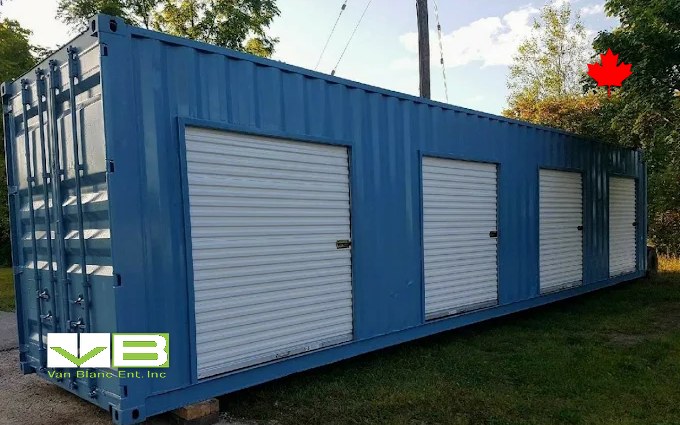
A used shipping container is the other steel building, and the honest comparison is one of scale, not quality. A container is 160 or 320 square feet of 1.6 millimetre Corten steel that arrives finished on a tilt-deck truck, in one to three days at any point in the province, and sits on four levelled bearing points rather than a poured foundation. There is no erection, no engineering to commission, no crane, and no season; the tilt-deck placement is the install. It locks behind a lockbox shroud, it does not care about snow, and our steel-versus-stationary comparison puts it against a stationary build over twenty years.
What it is not is big. Two 40-footers with the shared wall opened make a 640 square foot bay; beyond that you are into multi-unit conversions that join and roof multiple units, which is real work and still not a 60-foot clear span. A Toro Q-style arch and a container are different tools, and a lot of farms own both: the arch for the combine, the box for the tools that walk away.
Where the box wins. Under about 700 square feet, when the site is a lane or a yard, when the buyer wants it this month, and when security matters more than span. A used wind-and-watertight unit from the yard for storage, or a factory-fresh one-trip box where it will be seen or converted; the used-and-new grade guide explains the difference and the quote-factors page explains what moves the number. Where the kit wins. Everything above that line.
If the need is under 700 square feet, price the box first
Tell us what you’re storing and your postal code, and we’ll send an all-in number for a used or new container, delivered and placed, usually the same day. If the answer is that you need an arch, we’ll say so. Or visit the rows in Brantford and pick the unit by its number.
Every container we sell is sold outright; there is no rental fleet, and the rent-versus-buy page explains the arithmetic. If the building you need is measured in thousands of square feet, shortlist Toro with its competitors, get the eight answers in writing, and pour the foundation first.
Toro Steel Buildings FAQs
Are Toro Steel Buildings good quality?
The materials are the industry’s standard: red iron or cold-formed steel frames for straight-wall buildings and Galvalume Plus panels for arches, with engineering stamped for your province. The quality of the finished building depends on the foundation and the erection, which are the buyer’s responsibility, so a Toro building is as good as the concrete under it and the crew that bolted it. Get the foundation quoted before you sign for the steel.
How much does a 40×60 steel building cost in Canada?
We do not print dollar figures because steel and freight move the number by the season, but the drivers are consistent: the system (arch is cheapest per square foot, red iron the most), the gauge and coating, the engineering for your site loads, the endwalls and doors, delivery, and then the two lines outside the kit that surprise buyers, the poured foundation and the erection. Price the whole building from a concrete quote and an erector quote, not from the per-square-foot brochure figure.
Is Toro Steel Buildings a Canadian company?
Yes. Toro Steel Buildings Ltd. is headquartered in Markham, Ontario, has been accredited by the Better Business Bureau since 2018, and sells across every Canadian province and territory. By its own account it has more than forty years in the business and has served more than 85,000 customers.
Does a Toro kit include the foundation?
No. The foundation is not included with any Toro building kit. The engineered drawings that ship with the kit include the foundation specifications, or the arch reactions an engineer needs to design an alternative base, and the buyer has the foundation built by a concrete contractor before the steel goes up.
What warranty does Toro offer?
For straight-wall buildings Toro publishes a one-year limited warranty against failures caused by faulty or substandard materials, plus the panel manufacturer’s paint warranty of 25 to 40 years depending on the panel and finish. For arch buildings Toro publishes a 50-year rust perforation warranty, a 30-year snow and wind load warranty, and a 60-day period to report shortages and defects. Erection and foundation are warranted by whoever performed them.
Arch or straight wall for Ontario snow?
Both are engineered to the loads for your site. An arch sheds snow by its shape and gives the widest clear span, at the cost of curved walls that lose floor space at the edges. A straight-wall building or Toro’s S-style arch keeps the walls usable for benches and equipment. Bulk storage favours the arch; shops and garages favour straight walls.
How does a shipping container compare to a Toro building?
They solve different sizes. A container is 160 to 320 square feet of steel that arrives built, sits on four level points, and locks, with no foundation or erection. A Toro kit is a building measured in thousands of square feet that you erect on a poured foundation. Under about 700 square feet the container usually wins on speed, cost and security; above it, the kit is the only one of the two that exists.
Sources
- Toro Steel Buildings. (2026). Metal Building Packages: DIY Kits. torosteelbuildings.com
- Toro Steel Buildings. (2026). Steel Building Styles: Arch vs Straight Wall. torosteelbuildings.com
- Toro Steel Buildings. (2026). Foundation for Metal Building. torosteelbuildings.com
- Toro Steel Buildings. (2026). Warranty. torosteelbuildings.com
- Better Business Bureau. (2026). TORO Steel Buildings Ltd., Markham ON: Business Profile, Reviews and Complaints. bbb.org
- Toro Steel Buildings. (2026). Prefab Garage Kits in Canada. torosteelbuildings.com
Reach Van Blanc in Brantford
We have been supplying shipping containers across Ontario since 1995. Our yard is at 90 Morton Avenue East in Brantford, and we deliver right across the province with payment on the day of delivery. No deposit, no upfront wires, no chase-the-paperwork.
Van Blanc Ent. Inc., 90 Morton Ave E Unit 1B, Brantford, ON N3R 7J7, 519-754-6844 (cell) or 1-888-509-6658 (toll-free).
If you were pricing a kit and the need turned out to be a few hundred square feet of lockable storage, describe it over the phone and we’ll tell you on the spot which box does it and whether the truck can reach the site. Worth the drive for unbeatable quality, family customer service with 30 years of experience.