
Last updated: May 25, 2026
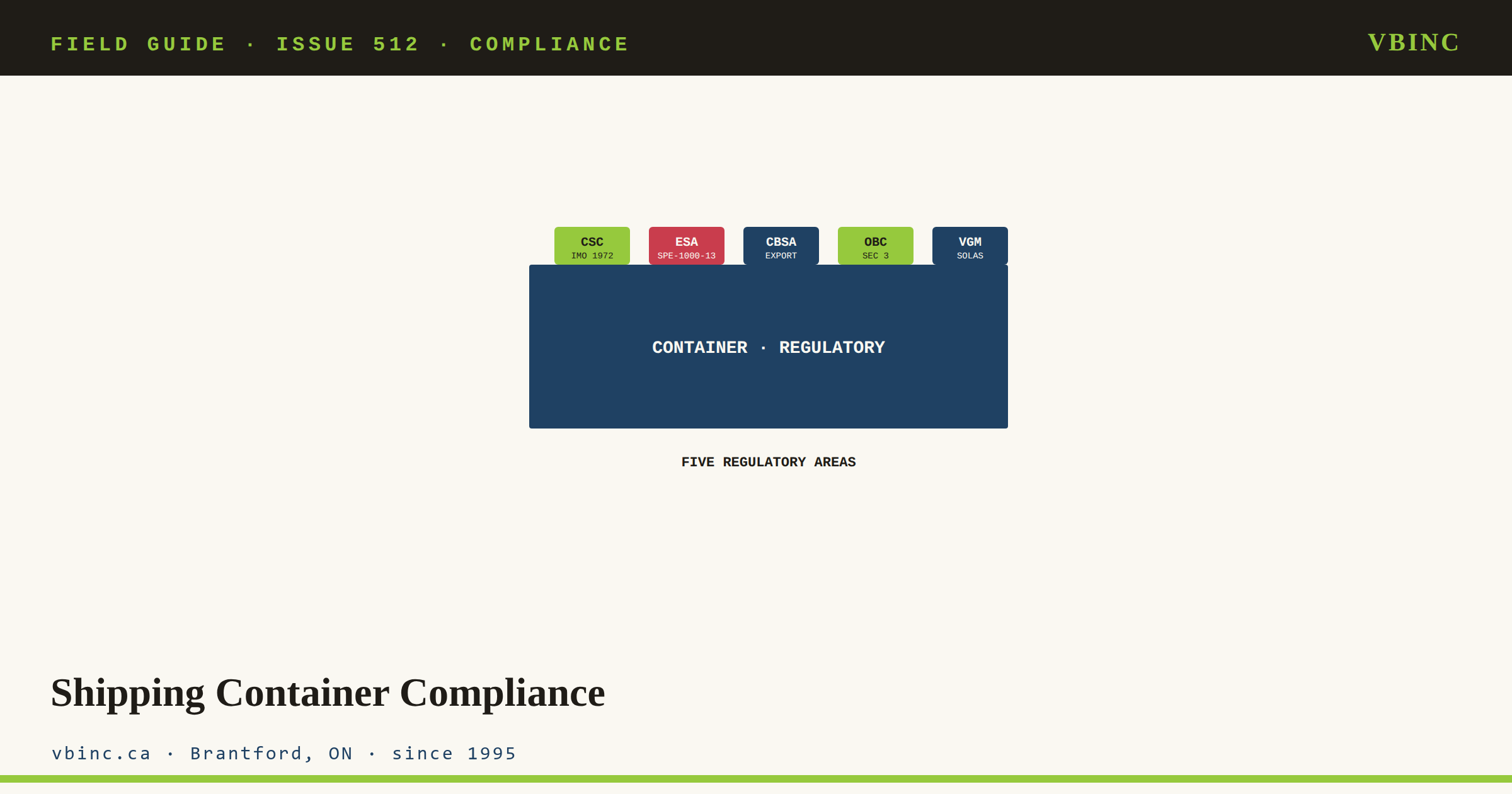
Quick answer. Five Canadian compliance frameworks govern shipping containers: IMO CSC 1972, ESA SPE-1000-13, CBSA import rules, Ontario Building Code, and SOLAS VGM. Canadian container compliance covers five areas: CSC plate (ocean shipping), ESA electrical (any electrified container), CBSA customs (export), fire code (occupied conversions), and VGM weight verification (ocean freight). Most Ontario storage users only encounter ESA if they wire the box. The other four apply to commercial freight and conversion projects. Three decades family-run, 140+ verified Google reviews. 1-3 day delivery from our 4 Brantford yards across Ontario.
Which compliance areas matter most for Canadian container buyers?
Container compliance regulations exist for reasons most buyers never need to engage with. The CSC convention exists because containers used to fall off ships and kill people. The ESA inspection exists because home electrical fires used to start in unpermitted DIY wiring. CBSA declarations exist because cross-border shipping needs documentation. The regulations are unobtrusive when you do not need them and absolute when you do.
For most Ontario container buyers (storage use, no modifications, no electrical, no export), compliance is invisible. For commercial buyers, conversion builders, exporters, and electrified setups, compliance is real and the path is straightforward when you know what triggers what. This guide explains the five compliance areas, who they apply to, and the deep-dive articles that go into each one in detail.
What are the five compliance areas for Canadian containers?
1. CSC Plate Certification (international ocean shipping)
The Container Safety Convention (CSC), administered by the International Maritime Organization since 1972, requires that every container used in international ocean shipping carry a valid certification plate. The CSC plate documents the original manufacture date, rated payload, identification numbers, and the next-required inspection date. Containers in CSC-certified service must be re-inspected periodically (typically every 30 months after the initial 5-year certification).
For Canadian buyers: CSC compliance matters if you intend to ship the container internationally via ocean cargo. It does not matter if you are using the container for stationary land-based storage. A used container with an expired CSC plate is fine for storage and modification – it is just not certified for further ocean shipping. CSC recertification cost in Ontario depends on the inspection itself plus any structural repairs the unit needs to meet the standard, so the price moves with the container’s condition rather than a fixed fee.
2. ESA Electrical Inspection (any electrified container in Ontario)
The Electrical Safety Authority (ESA) regulates electrical work in Ontario. Any container with electrical service – sub-panel, lighting, outlets, HVAC, generator hookups – must be installed by an ESA-licensed contractor and inspected. DIY electrical without inspection voids insurance and creates fire-risk liability.
The ESA inspection fee scales with the scope of the work, and the licensed contractor’s labour is billed separately on top of it. For a basic container office electrical (sub-panel, four outlets, LED lighting, single mini-split prep), the all-in cost is driven mostly by the contractor’s hours, with the ESA inspection adding a smaller fixed step.
What does not need ESA: a container with no electrical at all (pure storage), and a container that runs on plug-in extension cord from an existing inspected outlet. The threshold is permanent wiring inside the container.
3. CBSA Customs (container export from Canada)
The Canada Border Services Agency administers customs declarations for any container leaving Canada. Export declarations cover the container itself (if you are selling or shipping the steel box internationally) and the contents (any cargo inside the container at the time of export). The declarations must be filed before the container leaves Canadian waters.
For Canadian buyers: CBSA compliance matters only for international export. If you are shipping a container to Nova Scotia or BC, no CBSA involvement (interprovincial). If you are exporting the container or its contents internationally, the declarations are mandatory. We handle CBSA compliance for any cross-border deliveries we arrange.
4. Ontario Building Code (occupied conversions)
The Ontario Building Code (OBC) applies to any container used as occupied space – office, cabin, restaurant, residential dwelling, commercial work area. Storage-only containers are typically exempt from OBC requirements (they are classified as accessory structures or sheds in most municipalities).
Once a container becomes occupied space, the OBC requirements engage: structural engineering for the conversion, code-compliant electrical (ESA), code-compliant plumbing, fire-rated egress, accessibility for commercial use, and inspection at each construction phase. The OBC compliance path adds to a conversion budget on top of the base build cost. The conversion contractor handles the OBC engagement; we deliver the base container.
5. VGM SOLAS (commercial ocean freight weight verification)
The Verified Gross Mass (VGM) requirement under SOLAS (Safety of Life at Sea) regulations applies to containers being loaded onto ships for international ocean transport. The shipper must verify the container’s loaded weight before it is loaded aboard. This affects commercial exporters and freight forwarders, not stationary storage users.
For Canadian buyers: VGM matters only if you are loading the container for ocean export. Domestic Ontario container moves do not engage VGM. The weight verification can be done by certified weigh stations or by approved calculation methods.
What fire safety code applies to occupied container conversions?
Beyond the structural OBC requirements, occupied container conversions in Ontario face fire safety code compliance. The Ontario Fire Code requires emergency egress windows or doors for any occupied space, fire-rated assemblies between living and equipment spaces, smoke and CO alarms where required, and clear evacuation paths.
For a container converted to a cabin or office, this typically means a man-door on the side (which serves as secondary egress), smoke alarms, and a clear interior path. For more complex conversions (multi-container builds, container restaurants, container residential), the fire code requirements grow with the occupancy classification.
Are old containers safe? Asbestos, lead paint, and end-of-life disposal
Older shipping containers (pre-2000 manufacture) may have lead-based paint or asbestos-containing materials in some components. Decommissioning or major modification of these containers requires hazardous material handling per Ontario environmental regulations. Most modern containers (post-2005 manufacture) do not have these concerns, but used Cargo Worthy or Wind-and-Watertight units from older fleets may.
End-of-life container disposal also engages Ontario environmental regulations. Recycling steel containers is the standard path, with regional recycling credits available in some Ontario regions. The container’s CSC plate, identification markings, and any remaining cargo residue need documentation at the recycling intake point.
Featured deep-dives in the compliance family
Shipping Container Electrical ESA Ontario: SPE-1000-13, Service Sizing, Real Costs
The complete ESA compliance guide for any electrified Ontario container. Covers SPE-1000-13 standard requirements, service sizing for tools and lighting, GFCI rules, the inspection process, and the cost of doing it right versus the risk of doing it wrong (the wrong path voids insurance).
CSC Recertification Cost Shipping Container Ontario
For containers that need to return to international ocean shipping service after sitting in stationary use. CSC re-inspection process, the repair work commonly required, the ACEP (Approved Continuous Examination Program) alternative, and the realistic cost in 2026 Ontario dollars.
Shipping Container Export Ontario: CBSA Clearance, CSC Re-Certification, Port Logistics
For Canadian sellers exporting containers internationally. CBSA export declaration process, the CSC re-certification path for the container itself, port logistics for loading onto ships, and the documentation chain that prevents your container from being held at customs.
CBSA Export Declaration Shipping Container Canada
The Canadian customs declaration process for container exports. Required forms, electronic submission via CERS, the documentation chain (commercial invoice, packing list, bill of lading), and the timing requirements for declaration before vessel departure.
VGM SOLAS Compliance Shipping Container Canada
The Verified Gross Mass requirement under SOLAS for any container being loaded onto international ocean vessels. The two acceptable weighing methods, the shipper responsibility, and the Canadian terminal procedures that enforce VGM compliance.
The full compliance spoke index
Electrical compliance (ESA)
CSC and international shipping
Customs and export
Fire and occupied builds
Environmental and end-of-life
What customers actually say
“I recently purchased a 20′ sea can from this company and couldn’t be happier. The process was smooth and stress free; from the initial selection process to delivery. The sea can is in excellent condition and constructed of heavy duty materials. You will not be disappointed putting your confidence into these guys for your next purchase.”
– Jeremy F., 2022, Google review
The “smooth and stress free” pattern is what proper compliance looks like from the buyer side. We handle the CSC plate documentation. We provide CBSA export support when needed. We coordinate ESA inspection on electrified mods. The compliance regulations are designed to protect buyers, not to create friction for them – a real Canadian yard absorbs the compliance work so the customer transaction stays simple.
Frequently asked questions about container compliance
What is a CSC plate on a shipping container?
The Container Safety Convention plate is a metal certification plate riveted inside the cargo door of every container originally certified for international ocean shipping. It documents the manufacturer, manufacture date, identification number, rated payload, and CSC re-inspection requirements. Required for containers used in international ocean cargo service. Not required for stationary land storage use.
Do I need an ESA electrical inspection for my container?
Yes if you have any permanent wiring inside the container – sub-panel, lighting, outlets, HVAC, generator hookups. ESA inspection by a licensed contractor is mandatory in Ontario for any electrical installation. DIY electrical without inspection voids insurance and creates fire-risk liability. The ESA inspection fee scales with the scope of the install, and the licensed contractor’s labour is billed separately on top of it.
Do shipping containers need permits in Ontario?
Placement requirements vary by municipality. A quick call to your local planning office before delivery is the easiest way to confirm what works for your property. Storage-use placements often do not require permits. Occupied conversions trigger the Ontario Building Code regardless of municipality. We confirm placement requirements with you during the order conversation.
What is VGM and does it apply to my container?
Verified Gross Mass is a SOLAS regulation requiring the loaded weight of any container being loaded onto an international ocean vessel to be verified before loading. It applies only to commercial international ocean freight. Domestic Ontario container moves and stationary storage do not engage VGM. If you are loading the container for ocean export, the shipper is responsible for the VGM declaration.
Do I need CBSA paperwork for a container I am exporting?
Yes for any international export from Canada. CBSA requires an export declaration filed via CERS before the vessel departs. The declaration covers the container and any contents being exported. The forms include commercial invoice, packing list, and bill of lading. For domestic interprovincial moves (Ontario to Nova Scotia, for example), no CBSA involvement is required.
Does my container conversion need Ontario Building Code approval?
Yes if the conversion creates occupied space (office, cabin, residential, commercial work area). The OBC requires structural engineering, code-compliant electrical (ESA), code-compliant plumbing, fire-rated egress, and inspection at each construction phase. Storage-only containers are typically exempt as accessory structures. The conversion contractor handles OBC engagement; we deliver the base box.
What is CSC recertification and do I need it?
CSC recertification is the periodic re-inspection of a container intended to remain in international ocean shipping service. The original certification lasts 5 years; subsequent inspections happen every 30 months under the standard examination program or continuously under the Approved Continuous Examination Program (ACEP). Required only for containers returning to ocean cargo service. Stationary storage users do not need it.
Are older containers a hazardous material concern?
Older containers (pre-2000 manufacture) may have lead-based paint or asbestos-containing materials in some components. Decommissioning or major modification of these units requires hazardous material handling per Ontario environmental regulations. Modern containers (post-2005) do not have these concerns. Most current inventory in Canadian yards is post-2010 manufacture, but we document age and condition per unit so buyers know what they are getting.
What happens to a shipping container at end of life?
Steel recycling. Containers at end of useful life (extensive corrosion, structural damage beyond repair) get cut up and sent to steel recyclers. Ontario has regional recycling credits available in some areas. The CSC plate gets removed and destroyed (so the unit cannot be illegitimately re-entered into shipping service), identification markings are recorded, and the steel is processed. Useful life for a well-maintained container is 25-40 years.
Does Van Blanc handle compliance paperwork for buyers?
For some categories yes. We provide CSC plate documentation on every unit sold. We coordinate CBSA export support for any cross-border deliveries we arrange. We refer to ESA-licensed contractors for electrical work and verify their compliance on deliveries that include electrical mods. We do not handle OBC engagement for occupied conversions – that work is done by the conversion contractor doing the build-out.
Compliance starts with picking the right container
The compliance path is upstream of the build path. The right grade selection at order time (One-Trip avoids many of the older-container hazmat concerns), the right pre-delivery modifications (vents, basic mods at our yard avoid post-delivery ESA complications), and the right contractor referrals for the build-out work all contribute to a smooth compliance experience. Browse current inventory or call to discuss compliance specifics before committing: 519-754-6844 or 1-888-509-6658. Paul and Christian are usually both on site at the Brantford yard.
Where Van Blanc delivers across Ontario
CSC plates and ESA electrical matter most for commercial and industrial buyers. We deliver from our four Brantford yards to communities right across the province, including Hamilton, Toronto, Sarnia, Windsor, London and Mississauga. See the full Ontario service-area map to find your town.
Ready to price your container?
Tell us the size and your postal code and we’ll send back an honest, all-in number, container, delivery, and placement, usually within 1-3 days. No pressure, no mystery fees.
Family-run in Brantford since 1995 · 200+ containers in stock · 4.9★ across 140+ Google reviews · every box graded by a person, walk it before it lands.
Deeper in the Compliance Field Guide
Container compliance is layered, but it hangs off one international anchor: the Convention for Safe Containers, an IMO convention in force since 1977, which is the reason every seagoing box carries a CSC safety approval plate. First examination comes within five years of manufacture, then periodic re-examination keeps the plate alive. A storage container on your back lot does not need a current plate; a container going back into international service does, and the difference changes what a fair price looks like. We read the plate with you when you walk the yard.
Certification and Shipping
Electrical and Fire
Tax, Insurance, and Value
Sources & References
Authoritative external sources cited or referenced in this guide: