
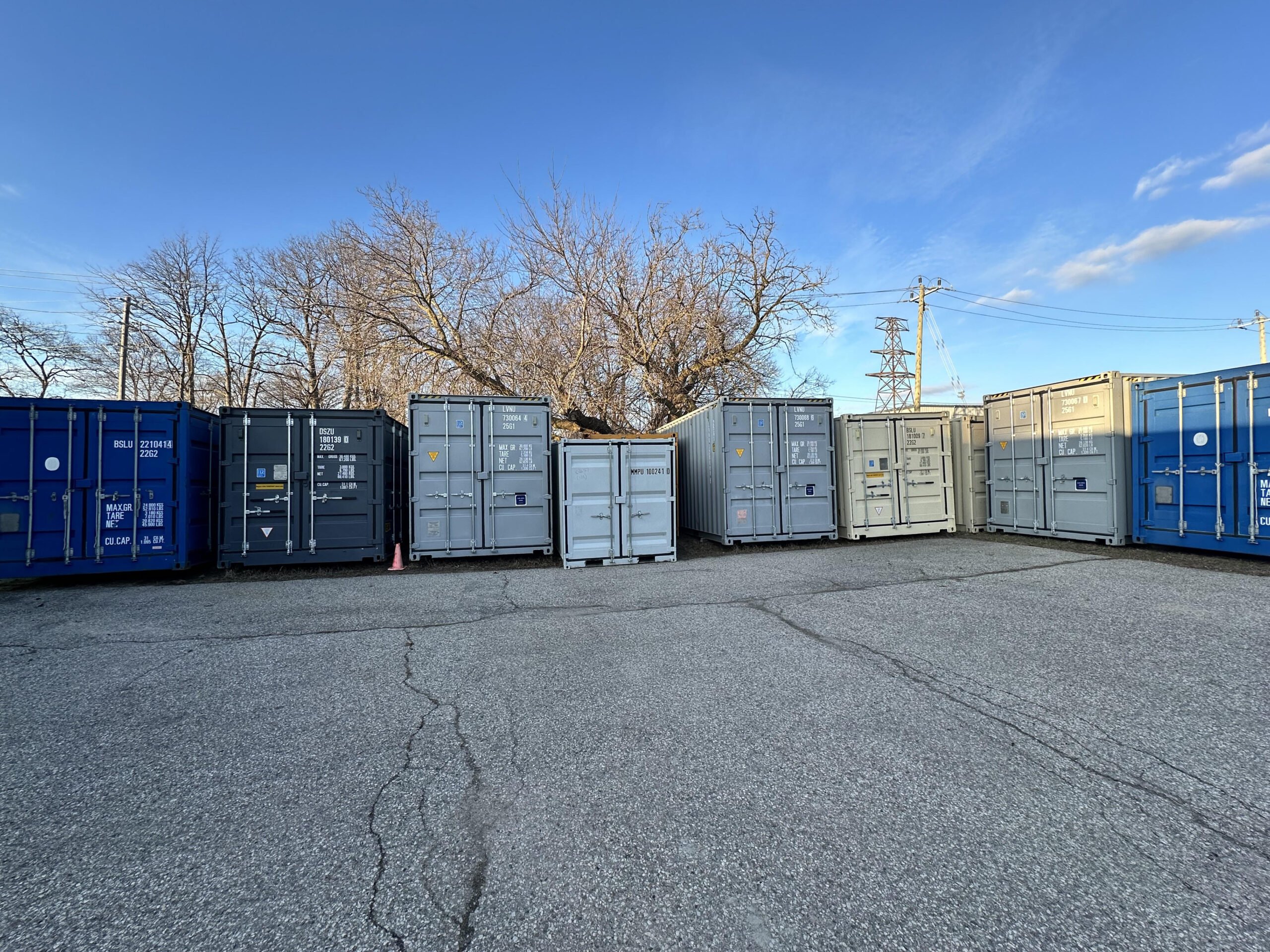
Quick Answer: A double-door shipping container, also called a tunnel container, has full cargo doors at both ends for drive-through access. The 20ft and 40ft variants run a modest premium over a single-door because of the extra door set and lower production volume. Van Blanc source-to-orders these for Ontario buyers on a realistic 2 to 4 week lead time. 30+ years operating, 4.9 stars on 140+ Google reviews. Single-door units deliver in 1-3 days Ontario-wide from our four Brantford yards.
In This Guide
- What is a double-door tunnel container?
- How big is it and what can it carry?
- Who actually buys a double-door?
- How does it handle warehouse pallet flow?
- Can you build a retail or food kiosk?
- How do farms and cottages use one?
- New (one-trip) vs used double-door?
- What drives the price in Canada?
- How long is the lead time?
- How is it delivered and placed?
- How do you spot a scam listing?
- FAQs
- Reach Van Blanc
Reading Time: 13 minutes
What is a double-door tunnel container?
A double-door shipping container is a factory-built unit with full-size cargo doors at both ends, front and back, so a load can pass straight through instead of dead-ending against a fixed wall. The industry name for the format is a tunnel container, because the bin becomes a pass-through channel. Some yards write double-door-both-ends, abbreviated DDBE, on the spec sheet. The configuration is the same under every name: two sets of cargo doors, two cam-bar mechanisms, two lockboxes, and a clear sightline from one end to the other when both doors are open.
A double-door tunnel container is a shipping container with full cargo doors welded at both ends from the factory, giving forklifts and long loads a clear drive-through path. It carries the same ISO frame and floor rating as a single-door unit, so it stacks, ships, and certifies identically. The only working difference is the second door set.
Standard single-door GP containers, which is what most Ontario buyers picture when they hear sea can or c-can, have one set of cargo doors at the rear and a fixed steel wall at the front. That works fine for stationary storage where you load and unload from the same end. Where the format breaks down is when the load itself is longer than the rear-door opening can clear, when the buyer wants to drive a forklift straight through, or when the bin is doing double duty as a retail or service kiosk that needs a customer side and a staff side. Adding doors after purchase is possible, and we cover that path in our guide to cutting a second cargo opening into an existing bin.
“Most people who phone us about a double-door already know exactly why they want one. They have a long load that fights them through a single rear door, and they have done it the hard way at least once. My dad calls the format a load follower: the doors follow the cargo, the cargo never bends to the doors. I grew up hearing that on the trips to Asia, and it holds up every time a tunnel bin leaves the yard.”
Christian LeBlanc, second-generation operator, Van Blanc Ent. Inc.
The factory build matters here. A double-door tunnel container is engineered as a tunnel from the welding jig forward. The corner castings, frame, and floor are all rated to the same ISO standard as a single-door GP, which means the unit stacks, ships, and certifies the same way. This is not a single-door bin that someone retrofitted with a second set of doors after the fact. Retrofit double-door conversions exist and they have their place for buyers who already own a single-door and need pass-through later, but the factory tunnel build is structurally cleaner and easier to source CSC-plated.

Why Ontario buyers source double-doors specifically from Brantford
The four Brantford yards we operate carry a deep rotation of single-door GP in 20ft and 40ft, but double-door tunnel units are a source-to-order item across most of Ontario, not a yard-stock category. The reason is volume. For every fifty single-door GPs that move across a Canadian yard in a given month, roughly one or two double-doors clear. The format is a deliberate specialty buy, and buyers searching for one have usually already worked out why they need the second door. Our job is to source the right unit on a real timeline, not to dress up a single-door bin as something it is not. If you are still deciding which footprint suits the job, the full breakdown of 20ft, 40ft, and high cube dimensions lays out the numbers behind every format.
How big is a double-door container and what can it carry?
A double-door tunnel container has the same external footprint as its single-door cousin at the same length and height: a 20ft tunnel is 6.06m long, a 40ft tunnel is 12.19m, both 2.44m wide. Where the two diverge is interior layout and the door opening on the second end. The numbers below are the figures buyers ask for most when they call.
| Format | External length | External width | External height | Each door opening (W x H) | Interior volume |
|---|---|---|---|---|---|
| 20ft Standard Tunnel | 6.06m (19’10”) | 2.44m (8’0″) | 2.59m (8’6″) | ~2.34m x 2.28m (7’8″ x 7’5″) | ~33 m³ |
| 40ft Standard Tunnel | 12.19m (40’0″) | 2.44m (8’0″) | 2.59m (8’6″) | ~2.29m x 2.34m (7’6″ x 7’8″) | ~67 m³ |
| 40ft High Cube Tunnel | 12.19m (40’0″) | 2.44m (8’0″) | 2.90m (9’6″) | ~2.29m x 2.57m (7’6″ x 8’5″) | ~76 m³ |
The door opening number is the figure that matters for buyers running forklifts through. A standard 4,000-pound electric forklift with a 42-inch fork carriage clears the 7-foot-8-inch door width with room to either side, and the 7-foot-5-inch door height on a standard double-door clears the mast on a lowered carriage. The 40ft high cube tunnel adds another full foot of vertical, which is what most warehouse buyers running pallet-jacks under-stacked pallets actually want, because the 8-foot-6-inch door opening on the HC clears a tall pallet without forcing the operator to break down the stack first.
Payload capacity tracks the underlying ISO format. A 20ft tunnel carries up to roughly 27,800 kg gross, a 40ft tunnel up to roughly 27,300 kg gross, and a 40ft HC tunnel up to roughly 26,500 kg gross. The slightly lower 40ft figure compared to 20ft is a quirk of how ISO 6346 distributes structural margin across the longer span; in practice no Ontario buyer is loading a 40ft anywhere near maximum gross. The figures matter for export-grade buyers shipping internationally and for the structural inspection that confirms a CSC plate.
Where the structural margin goes on a tunnel build
A factory tunnel container distributes weld density and corner-casting reinforcement differently from a single-door GP. Because the front end is no longer a fixed steel wall doing structural duty as a brace, the cross-bracing on the top and bottom rails has to carry more of the racking load. Reputable manufacturers handle this with thicker corner posts and an extra weld pass at the door-frame junctions; lower-grade builders skip steps and the resulting bin twists out of square within a year. This is why grade and provenance matter more on a tunnel than on a single-door. ISO 6346 specifies the coding and marking; ISO 1496-1 specifies the structural testing. A CSC plate on a tunnel container is evidence that both standards were met at build.
Who actually buys a double-door container?
The buyer who actually drives a double-door tunnel container purchase has a long item. Most of the calls Van Blanc takes on these bins come from a single buyer profile, and it is more specific than the brochure copy lets on. Twenty-foot canoes. Steel tube in 24-foot mill lengths. Schedule 40 PVC pipe in 20-foot sticks. Kayaks racked vertically. Lumber bundles longer than the rear-door opening can clear on a single-door bin. A grain auger pipe that has to live somewhere dry between seasons.
Volume is not the problem with a single-door GP for this buyer; a 20ft single-door holds plenty of interior length for a 20ft canoe. The problem is access: the buyer has to back the trailer in, push the canoe forward into the bin from the rear, climb in over the bow, and walk the stern up to clear the doors. Or worse, the buyer has to slide the canoe in at an angle, jam it against the front wall, then deal with three more canoes that all want the same diagonal path through the same rear opening. Hour two of this exercise the buyer is on Google searching for a bin with doors at both ends.
The long-item storage case is the dominant reason double-door tunnel containers exist in this market, and everything else is downstream of it. Paul puts it to buyers directly, which is why a lot of them stop their research after one phone call.
“The long-item buyer is the customer who actually drives the double-door purchase. A buyer storing twenty-foot canoes or twenty-foot lengths of steel tube wants to pass through both ends, not back the trailer up twice. Once you have unloaded a 20-foot canoe through a single-door bin you understand the difference in your shoulders. Forty years in international trade and thirty years in containers specifically taught me that the format follows the load, every time.”
Paul LeBlanc, owner, Van Blanc Ent. Inc., thirty years in the container industry and 40 in Asian trade
How does a tunnel container handle warehouse pallet flow?
A double-door tunnel container handles warehouse pallet flow by turning the bin itself into a first-in-first-out lane. The second large buyer profile is the small Ontario warehouse or distribution operation running pallet flow through a container as an overflow bay. The mechanics are simple: load palletized inventory in one end of the tunnel, pull palletized inventory out the other end. Materials that came in first leave first. FIFO logistics, built into the steel itself, not into the rack system. No restacking, no climbing over the older pallets to reach the newest ones, no breaking down the stack to find the right SKU.
For a smaller Ontario operation that has outgrown its existing dock but cannot justify a permanent warehouse expansion, a 40ft HC tunnel container sitting on the gravel pad alongside the building does the same job at a fraction of the capital cost. Load eight to ten pallets through the west door each morning, pull eight to ten pallets through the east door each afternoon. Six months later the inventory pattern stays clean because the steel forces the rotation discipline.
Two operational details matter on warehouse pallet flow setups. First, the pad needs to be wide enough on both ends to swing a forklift, which usually means a 30-foot clearance off each door for a turn-around. Second, the doors on both ends should be configured to swing through 270 degrees to lay flat against the side walls during active loading hours, not the standard 180-degree swing. The 270 hardware is a small upgrade at the build stage and a noticeable productivity gain on a busy week.

How a Hamilton small distributor actually uses a 40ft HC tunnel
The pattern we see repeatedly across the Hamilton, Burlington, and Stoney Creek industrial fringe: a 40ft high cube tunnel container parked alongside the dock, acting as overflow buffer for inventory the main warehouse cannot absorb during peak. Inbound trailer drops on the west side, forklift loads pallets in through the west door. Outbound picks happen through the east door into a smaller delivery van. The operator never breaks down a stack to reach an older pallet because older pallets are always at the east end, by definition. End-of-quarter inventory count clears in two hours instead of an afternoon because the pallets are in chronological order down the length of the bin.
Can you build a retail or food kiosk from a tunnel container?
A double-door tunnel container makes an excellent retail or food kiosk shell, and the third buyer profile is the small-business owner converting one into exactly that. The geometry of the format pays off in a way that single-door containers cannot match: customer side at one end, prep and staff side at the other end, with the long interior between them as the workflow spine.
For a food kiosk, the typical layout puts a serving window in the cargo doors at one end, with the doors themselves either modified into a permanent serving counter or left as a roll-up depending on the modification budget. Staff and inventory enter through the cargo doors at the other end, dropping straight into prep workflow without crossing the customer line. The result is a clean operational separation in 8 feet of width that would otherwise require a much larger footprint. We have seen Toronto and Hamilton entrepreneurs run successful coffee kiosks, dessert vendors, and lunch-window operations out of 20ft tunnels with this layout.
The drive-through coffee kiosk variant pushes the format further. The customer car pulls up to one end of the bin, orders through a serving window cut into the cargo doors at that end, and the staff hands product out a smaller pickup window cut into the side wall a few feet away. The opposite end of the tunnel handles staff entry, inventory loading, and bulk waste removal. The two flows never cross, which is the operational benefit a single-door layout cannot replicate without a much larger structure.
The pop-up retail layout that uses both ends as customer entries
The other retail layout buyers ask about is the pop-up where both ends open to customers as a walkthrough. Customers enter through the cargo doors at one end, walk the length of the bin past merchandise displays on both walls, and exit through the cargo doors at the other end. The flow handles substantially higher peak volume than a single-door pop-up where customers have to back-track to leave. Festival and event operators with double-door tunnels measure peak throughput at roughly double a single-door pop-up of the same length. The bin also moves out of the venue in a single tilt-deck pickup at the end of the event, no disassembly required. Serving windows, roll-up counters, and the rest of the kiosk build are covered in our walkthrough of which conversions earn their cost back.
How do farms and cottages use a double-door container?
Farms and cottages use a double-door tunnel container as a drive-through shelter for equipment and watercraft that will not load cleanly through a single rear door. The fourth common buyer profile splits between Ontario farms and cottage country. The Ontario farm running drive-through tunnel storage typically uses a 40ft tunnel as a feed-and-equipment pass-through. The combine or tractor backs into the field-side door at harvest time, equipment gets pulled out the road-side door for transport to the next operation, and the bin doubles as winter feed storage in the off-season. Norfolk and Haldimand farms running cash crop or cattle operations are the typical caller on this profile.
The cottage country buyer is different. The buyer here is usually storing watercraft, and the long-item problem comes up in a more acute form than at the farm. A 20-foot cedar-strip canoe, a tandem kayak, a stand-up paddleboard rack, a 16-foot fishing boat on a cradle. Loading these through a single rear door at an angle is the kind of operation that breaks gunwales, scrapes hulls, and wears the buyer down by the end of the season. A 20ft tunnel container lets the buyer slide each watercraft in from one end and out the other with the trailer winch, no awkward angles and no climbing over the bow.
The lumber and rough-material angle shows up across both profiles. Pressure-treated 4×4 in 16-foot sticks. Steel pipe in 20-foot lengths for fence and gate work. Field drain pipe in 20-foot coils for tile drainage projects. PVC conduit in 20-foot sticks for electrical runs. None of these load cleanly through a single-door bin. All of them load through a tunnel bin the way they want to load: straight through, drop, done.
Should you buy a new (one-trip) or used double-door?
A double-door tunnel container is most realistically bought new, because the format is predominantly available as new builds. The industry calls these one-trip units: a container made exactly one loaded voyage from the Asian manufacturer to North America, with cargo aboard to offset the shipping cost. One-trip tunnels carry the factory paint, the original CSC plate, and the cleanest door operation on both ends. The hardware is fresh, the gaskets seal, and the locking gear works the way the engineer drew it. For buyers running a retail kiosk, an active warehouse pallet flow, or a high-visibility farm site, one-trip is the realistic grade choice.
Cargo-worthy tunnel containers do exist in the secondary market but in much thinner volumes than CW single-doors. The reason is straightforward: tunnel containers spend less time in international rotation than single-doors, because they were custom-built for specific cargo applications and tend to stay in those applications instead of entering the general pool. The CW tunnels that do reach the Canadian market typically come at a modest discount to one-trip, roughly 15 to 25 percent below new build, with the usual surface rust spots, paint variance, and cosmetic wear of a CW grade.
Wind-and-watertight tunnels are rare in Canada and we generally do not recommend them for active drive-through use, because door warp on a heavily-cycled WWT bin tends to compromise the seal on at least one end. For a stationary tunnel storing long lumber that does not need both doors operated daily, WWT can work; for any active pass-through use, one-trip or CW is the realistic floor. If you are weighing a secondhand tunnel against a new build, our walkthrough of what to inspect before paying for a used bin lays out how the grades actually behave in the field.
What drives the price of a double-door in Canada?
The price of a double-door tunnel container is driven by five things: length, height, grade, the manufacturer’s order schedule at the time of source, and delivery distance across Ontario. Against a comparable single-door GP, the double-door carries a modest premium that varies with all five. Our new 20ft and 40ft high cube double door units carry posted double door prices; the table below shows where the premium comes from.
| Format | Double-door premium over single-door | What moves the premium | Realistic grade to source |
|---|---|---|---|
| 20ft Standard | ~20 to 25% | Second door set, twin cam-bars and lockboxes, lower production volume | One-trip |
| 40ft Standard | ~20 to 30% | Added length plus extra door hardware and thinner secondary-market supply | One-trip, occasional CW |
| 40ft High Cube | ~20 to 30% | Extra vertical clearance, taller door framing, scarcest tunnel build to source | One-trip |
Delivery is quoted from our four Brantford yards and scales with distance across Ontario. Southern Ontario destinations within a 200 km radius land at the lower end of the delivery range. Eastern Ontario and Northern routes carry more transport distance and price up from there. The delivery quote is given in writing before the order confirms, not added on at the door.
Where the double-door premium gets earned back is in the operational time saved over the life of the bin. A buyer running pallet flow through a tunnel saves roughly 30 to 60 seconds per pallet versus single-door restacking, which compounds quickly at warehouse volume. A buyer storing 20-foot watercraft saves the back strain and trailer-positioning time on every load. A retail kiosk operator gets a clean staff-customer flow separation that would otherwise require a much larger footprint. The math is operational, not financial, and most buyers who source a tunnel do so because they have already worked it out for their use case. Because most tunnel bins come as one-trip stock, buyers comparing options often start from our factory-fresh stock and how to request one, then read the broader overview of what the grades cost in the Canadian market for full grade comparisons and the deeper look at what a 40ft costs to own.
How long is the lead time on a double-door container?
The lead time on a double-door tunnel container is a realistic 2 to 4 weeks from order confirmation to delivery, because the format is source-to-order rather than yard stock. We do not keep tunnel containers on the ground the way we keep single-door GP in 20ft and 40ft. The reason is the same reason most Ontario yards do not: the demand pattern is too specialized for sitting inventory.
Realistic lead time on a source-to-order double-door tunnel container, from order confirmation to delivery on the buyer’s pad, runs 2 to 4 weeks. The window covers sourcing from the manufacturer or regional inventory pool, arranging transport into our Brantford yards, pre-delivery inspection of doors and seals on both ends, and the final tilt-deck or crane-truck delivery to the buyer’s site. We can source you a double-door, and we will tell you the realistic lead time before we take a deposit, not after.
The brand position here matters. Buyers shopping for tunnel units sometimes get told the bin is on the lot when it is not, then watch the delivery slide week after week. Our reputation across thirty years rests on the opposite practice. Every quote comes with a real lead time, not a hopeful one. If the source window says four weeks, the bin lands inside four weeks. If a 2-week sourcing path is available, that is what we quote. The customer reviews displayed on our homepage say it directly. Scott J., one of those reviewers, put it: “Most of all they deliver on a COD basis, can’t get more honest than that.”
Why we source double-doors to order instead of faking yard stock
A claim of tunnel units sitting on the ground is worth a second question: it is often source-to-order in disguise, or an aging unit other buyers already passed on. Van Blanc would rather give a buyer the real 2 to 4 week sourcing window and deliver a clean unit, than promise a same-week pickup and either deliver a substandard bin or push the delivery date sideways for a month. Paul has run this practice since 1995 and Christian carries it forward into the second generation. Worth the drive for unbeatable quality, family customer service, with 30 years of experience in this industry. See our about page for the founder story.
Ready to price your container?
Tell us the size and your postal code and we’ll send back an all-in number, container, delivery, and placement, usually within 1-3 days. No pressure, no mystery fees.
Family-run in Brantford since 1995 · 200+ containers in stock · 4.9★ across 140+ Google reviews · every box graded by a person, walk it before it lands.
How is a tunnel container delivered and placed?
A double-door tunnel container is delivered the same way as a single-door, by tilt-deck truck that rolls the bin onto a prepared pad, with one wrinkle: it needs clearance on both ends instead of one. Delivery differs from a single-door in two practical ways, placement orientation and pad access on both ends. A single-door bin can sit with the rear doors close to a fence line or wall because the front wall does not open. A tunnel container needs clearance on both ends, which is a placement question worth solving before the truck arrives.
The pad needs to allow a forklift, pallet jack, or vehicle pass-through on the working ends. For warehouse pallet flow operations, the standard rule is 30 feet of clear backing-up space off each door. For long-item buyers loading watercraft or pipe through the bin, the rule is the length of the longest item plus 10 feet of working room. The truck tilts the deck and rolls the bin onto the pad, doors at both ends become operable as soon as the bin clears the deck. If the buyer’s preferred orientation does not match the tilt-deck path, we send a crane-truck and crane-place the bin in the exact alignment the buyer needs. The crane upgrade carries an added cost that depends on the route and the crane capacity required, and it is quoted in writing before the order confirms.
How do you spot a double-door scam listing?
You spot a double-door scam listing by its impossible promise: a tunnel container at a price below the realistic Canadian market, delivered faster than any established yard can source one. The scam pattern Van Blanc warns about across every page on this site shows up sharper on double-door tunnel containers than on standard single-door GPs. The mechanic is the same: a Facebook Marketplace listing offers a tunnel container at a price below realistic Canadian market, the buyer sends a deposit, the seller stops responding, the bin never arrives. What makes tunnel containers particularly attractive to scammers is that legitimate Canadian inventory really is thin, so a buyer who has been told “we will source you one in 2 to 4 weeks” by an established yard sometimes mistakes a faster Facebook offer for a better deal.
It is not. The faster Facebook offer is the scam. If three Ontario yards quote 2 to 4 weeks on a double-door and a Facebook seller quotes next-week delivery at a price well below the realistic Canadian market, the math says the bin does not exist. We field the panicked call-back from those buyers two weeks later, every week. The advice we give before they deposit is the same advice we give after they get scammed: deal with a yard that has been in this trade long enough to have a real address, a real phone number, a real customer review trail, and the family name on the front door. Our breakdown of how the deposit-and-disappear con plays out covers the full pattern.
Paul on the cheaper double-door listing
“Tunnel containers attract more scam listings per real listing than any other format in the Canadian market,” Paul says. “The buyer has done their homework, they know the legitimate lead time is two to four weeks, then they see a listing for next-week delivery at a price far below the market and the homework goes out the window. Two weeks later the call comes in. We see the pattern every month. The bin that is suspiciously cheaper on Facebook is the bin that never arrives. Thirty years of operating Van Blanc has shown me the same play every cycle.” Paul has thirty years in the container industry and 40 in Asian trade.
Frequently Asked Questions
What is a double-door shipping container called in the industry?
The industry name is tunnel container. Some manufacturers and yards also use double-door-both-ends, abbreviated DDBE. All three names refer to the same factory-built unit with full cargo doors at both ends. The term tunnel container reflects the pass-through configuration, while double-door is the more common buyer-facing name in Canadian sales channels.
How much more does a double-door container cost than a single-door?
The premium runs roughly 15 to 30 percent over a comparable single-door GP at the same length and height. The exact figure depends on length, height, grade, and the manufacturer’s order schedule at the time of source, and a one-trip 20ft tunnel sits at the lower end of that band. The wider end of the premium applies to high cube tunnels and CW-grade units sourced through specialty channels.
Can Van Blanc deliver a double-door tunnel container in 1 to 3 days?
No, and we say so up front. Double-door tunnel containers are a source-to-order item for us, with a realistic lead time of 2 to 4 weeks from order confirmation to delivery. Our 1 to 3 day delivery window applies to single-door GP units we keep in rotation across our four Brantford yards. Tunnel units are sourced specifically for the order.
Will a forklift fit through a 20ft tunnel container?
Yes. The door opening on a standard 20ft tunnel is roughly 7 feet 8 inches wide by 7 feet 5 inches high. A standard 4,000-pound electric forklift with a 42-inch fork carriage clears the width comfortably and the height on a lowered mast. The 40ft high cube tunnel adds an extra foot of door height for taller pallet stacks.
What is the most common reason buyers choose a tunnel container?
Long-item storage is the dominant driver in our experience. Buyers storing 20-foot canoes, 20-foot steel tube, lumber bundles longer than the single-door opening, or watercraft that loads awkwardly through a rear door are the largest segment. Warehouse pallet flow operators and retail kiosk converters are the next two largest buyer groups, in that order.
Are double-door containers available in 20ft and 40ft sizes?
Yes, both 20ft and 40ft are factory-built configurations, and the 40ft is also available as a high cube tunnel with an extra foot of vertical clearance. The 45ft tunnel exists but is rare in the Canadian secondary market. For most Ontario buyers the choice comes down to load length: a 20ft tunnel handles canoes, pipe, and most lumber bundles, while the 40ft suits pallet flow and longer mill stock. Tell us the longest item you plan to store and we will tell you which size clears it.
Can a tunnel container be modified into a drive-through retail kiosk?
Yes, and the format is well suited to it. The most common layout puts a serving window on one end with the cargo doors modified into a counter, and staff or inventory access through the cargo doors at the opposite end. Drive-through coffee and food kiosks frequently use the tunnel format for this clean separation between customer and staff flow.
Sources
- International Organization for Standardization. (2022). ISO 6346:2022, Freight containers: Coding, identification and marking. iso.org/standard/82754.html
- International Organization for Standardization. (2013). ISO 1496-1:2013, Series 1 freight containers: Specification and testing, Part 1, General cargo containers for general purposes. iso.org/standard/53638.html
- Institute of International Container Lessors. (2024). IICL Inspection Criteria for Container Grading. iicl.org
Reach Van Blanc in Brantford
We have been supplying shipping containers across Ontario since 1995. Our warehouse is at 90 Morton Avenue E in Brantford, and we deliver right across the province on a cash-on-delivery basis. No surprise fees, no chase-the-paperwork. Specialty units like double-door tunnel containers are source-to-order through our four Brantford yards on a real 2 to 4 week lead time, not a hopeful one.
Van Blanc Ent. Inc. 90 Morton Ave E Unit 1B, Brantford, ON N3R 7J7. 519-754-6844 or toll-free 1-888-509-6658.
If you have a long-item load, a pallet flow operation, a retail kiosk concept, or watercraft that loads through a single-door bin the hard way, call us. We will tell you whether a tunnel container is the right answer, or whether a single-door GP with a wider door modification would do the same job for less.
Tell us the orientation you want the doors to face and the clearance you have on each end, and we will match the truck to the site, tilt-deck for a straight roll-on or a crane-truck when the alignment is tight.