
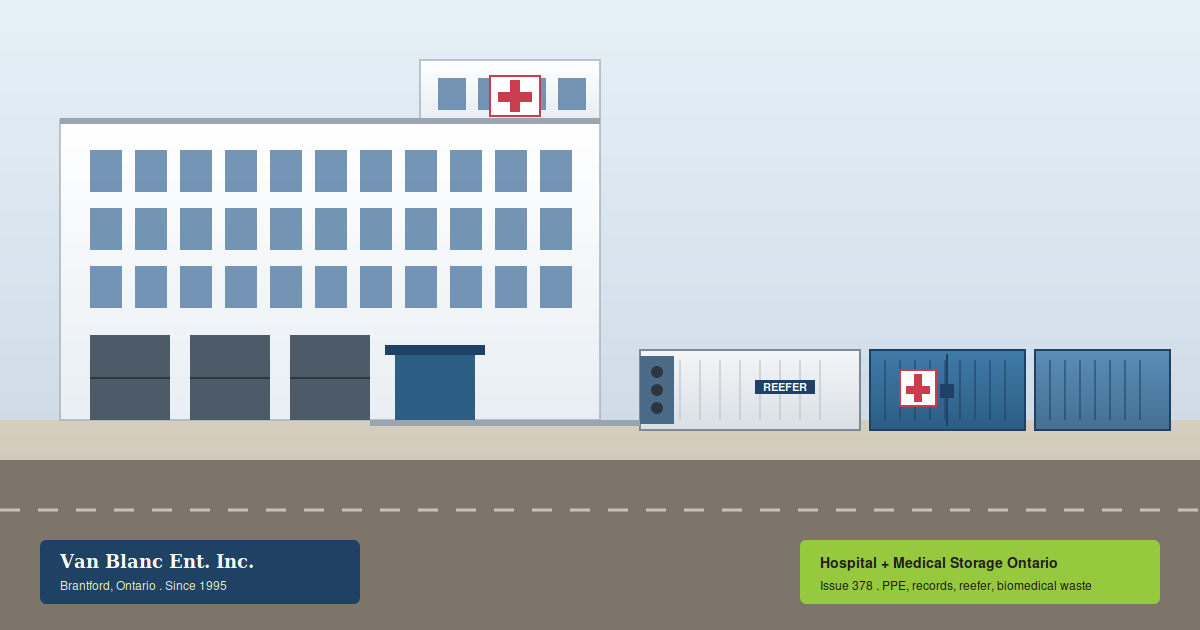
What do hospitals and medical facilities use shipping containers for in Ontario?
Ontario hospitals, clinics, and long-term care facilities use shipping containers for four medical workloads: PPE stockpile storage in a locked climate-controlled dry container, a 10-year medical records archive in a fire-rated insulated unit, pharmacy and biospecimen overstock in a refrigerated container at 2 to 8 degrees Celsius, and biomedical waste staged in a separate locked unit apart from clean storage.
Beyond those four core jobs, durable medical equipment storage (beds, wheelchairs, walkers) usually wants a 40ft high cube for the headroom. Procurement teams ordering 3 to 8 containers for a multi-site network get a single quote with itemized freight, ESA-certified electrical add-ons, and ramp door upgrades. Van Blanc has been supplying shipping containers across Ontario since 1995, with delivery to every region in 1 to 3 days from our 4 Brantford yards. Pricing depends on your site, your grade choice, and your freight zone, so call for a real quote.
What size container do hospitals use for PPE stockpile storage?
PPE stockpile storage in Ontario hospitals does not look the way it did in February 2020. The procurement conversation around personal protective equipment changed permanently that month. The lesson of that month, and the eighteen that followed, was that just-in-time global supply chains for N95 respirators, isolation gowns, nitrile gloves, and surgical masks could collapse in a week. Federal and provincial reviews of pandemic preparedness afterward all reached the same conclusion: hold more, hold it closer to the point of use, and have a real plan for how it stays usable while it sits.
The federal National Emergency Strategic Stockpile (NESS) audit in the early 2020s pulled its footprint from eleven warehouses down to a smaller number, then reversed course as hospital networks asked for distributed buffer stock closer to regional clusters. The shape of the answer at the hospital and regional health authority level has been local PPE buffer inventory, parked physically near the loading dock, ready to roll into the building when the central supply room runs short.
A 20ft dry container is the most common size for an on-site PPE buffer. A pallet of N95 boxes is roughly 48 by 40 inches by 60 inches tall and weighs about 200 kilograms. A 20ft dry container fits ten pallets on the floor in a standard configuration, or twelve with custom shelving on the walls. A 40ft high cube fits twenty pallets on the floor and accepts a second deck for an additional ten pallets above. Climate control matters because N95 filtration media has a manufacturer-stated shelf life that assumes storage at 10 to 30 degrees Celsius and humidity under 80 percent. An uninsulated container in an Ontario January will run below freezing inside, and an uncooled container in August can hit 50 degrees at the ceiling.
What hospital procurement actually orders
“After 2020 the call from hospital procurement teams changed shape,” says Paul LeBlanc, owner of Van Blanc Ent. Inc. “Before, it was a one-off question about a single bin for a renovation. After, it was three to five bins at a time for a regional buffer stockpile. Insulated, locked, ESA-certified light and a single outlet for an air mover. Some networks wanted a roll-up door for forklift access. Some wanted personnel doors for shelf-pick. The container industry watched a global supply story unfold in real time, and every Ontario hospital network we deal with came out of it wanting more local buffer, not less.”
The other shift was who signed the purchase orders. Procurement officers who never bought a container before 2020 are now part of standing committees that include facilities, infection prevention, and supply chain. The container has to clear all three before the truck leaves Brantford. That changes how the quote is built: insulation R-value documented, light circuit specified, lock hardware named, and floor coating disclosed if the buyer is going to store boxes directly on the marine plywood.
How long must Ontario hospitals keep medical records?
The Ontario Public Hospitals Act and the College of Physicians and Surgeons of Ontario policy on medical records both set the same baseline. Adult patient records must be retained for a minimum of ten years from the date of the last entry. Pediatric records must be retained for ten years past the patient’s eighteenth birthday. That means a chart opened on a six-year-old in 2026 has to survive until at least 2048.
The volume math is significant. A medium-size Ontario community hospital generates roughly fifteen to twenty linear metres of physical chart material per thousand admissions per year. Even with electronic health records replacing most net new paper, the existing paper archive does not go away. A facility with a 1990s-2010s paper-record history will hold somewhere between three hundred and one thousand linear metres of legacy charts, all of which sit under the same ten-year minimum.
The cost lever is the rental fee for off-site climate-controlled records storage. Commercial medical records vault services in southern Ontario bill per linear metre per month for climate-controlled, fire-rated, access-audited storage, and that meter never stops. A hospital holding five hundred linear metres of legacy paper carries that monthly charge indefinitely. Over a ten-year retention horizon it compounds into a large recurring expense that produces no clinical value.
An on-site insulated container with appropriate fire-rated lining and a logged-access lock is, for many facilities, the cheaper path. The records-grade build is a 40ft high cube dry container with R-19 closed-cell spray foam insulation, an interior gypsum fire-rated lining, an industrial dehumidifier, and a Medeco-keyed personnel door, with the conversion work added on top of the container itself. Amortized over the ten-year retention horizon, the monthly carrying cost of owning that bin lands well below the monthly off-site rent for equivalent volume. Records stay on hospital property, access is controlled by the hospital’s own roster, and the bin does not disappear when the storage vendor’s lease ends.
Fire rating and humidity, not just steel walls
A bare steel container is not a records vault. The Ontario Hospital Association Records Retention Toolkit and the CPSO records policy both emphasize that the storage environment must protect record integrity, which in practice means temperature and humidity stability and protection from fire propagation. A records-grade container conversion adds: closed-cell spray foam insulation for thermal mass, an interior gypsum board lining for fire resistance, a portable dehumidifier sized for the cubic volume, and a tamper-evident lock with access logging. Skipping any of these saves a little upfront and creates an audit finding the first time the Information and Privacy Commissioner asks how records are protected.
For the cost framework underneath every line item in a records-grade container, our walkthrough of the order each conversion upgrade gets layered in covers everything from insulation up through electrical and security hardware. The fire-rated lining, spray foam, and Medeco-keyed door are part of the records-grade build our Brantford yard completes before delivery.
Which container fits hospital beds, wheelchairs, and walkers?
Hospitals and long-term care homes cycle durable medical equipment through seasonal demand peaks. A community hospital that needs forty extra hospital beds during a winter respiratory surge does not need those beds in July. They sit somewhere. The somewhere is usually a corner of an underground parking level, a converted storage room that used to be something else, or an off-site warehouse the facility pays rent on.
A 40ft high cube container handles this workload well. The 9 foot 6 inch interior height accommodates a stacked hospital bed (roughly 7 feet 6 inches tall when partially raised on its lift mechanism) plus airspace, where a standard 40ft dry at 8 foot 6 inch interior height runs tight. Wheelchairs and walkers stack on shelving lining the walls. Side opening doors, a popular custom modification, let staff load the bin laterally without rolling everything to the rear doors.
The container is delivered, sited on a level pad near the loading bay, and accessed by Environmental Services or Materials Management as inventory turns over. The bin is not a permanent fixture of the building footprint, which means it does not enter the building’s gross floor area for fire code calculations and does not trigger the same accessory-occupancy reviews as a built shed.
| Workload | Container size | Why this size | Typical interior fit-out |
|---|---|---|---|
| Hospital beds (10 to 25 units, stacked) | 40ft high cube dry | 9’6″ interior accommodates raised bed mechanism | Bare floor for rolling units, plus wall shelving and an LED light circuit |
| Wheelchairs and walkers (50 to 120 units) | 20ft dry | Wall shelving holds the whole inventory at usable density | Full-height galvanized shelving on both side walls, single duplex outlet |
| Mixed durable equipment + linens | 40ft high cube dry | Combines pallet floor space with shelf walls | Pallet zone at the door end, shelving at the nose, R-19 insulation for linens |
| Bariatric equipment (lifts, oversize beds) | 40ft high cube + double-door modification | Door width upgrade accommodates wide units | Side-opening or double doors, open floor, heavy-duty floor coating |
Long-term care homes use the same workload pattern at a smaller scale, often a single 20ft unit for the seasonal lift inventory and the rehabilitation equipment that rotates between residents.
What container stores pharmacy and biospecimen cold chain?
Pharmacy storage is the workload where the container has to do real work. Routine drug inventory sits at room temperature, but a meaningful slice of any hospital pharmacy is cold chain: vaccines at 2 to 8 degrees Celsius, biologics at 2 to 8 or frozen, biospecimens at minus 25 or colder, and ultra-low-temperature reagents at minus 70. The hospital pharmacy refrigerator footprint is finite. When the central supply outgrows the in-pharmacy cold space, the overflow goes to a reefer.
A reefer container is a refrigerated shipping container. A 20ft reefer is the smallest practical size, with about 28 cubic metres of usable interior after insulation. A 40ft high cube reefer is the workhorse, with about 67 cubic metres. Set-point ranges depend on the refrigeration unit. A modern Carrier or ThermoKing genset can hold 2 to 8 degrees Celsius reliably, and the colder models can hold minus 25 to minus 35 for frozen pharma. Below minus 35 the math gets harder and most hospitals deploy purpose-built ultra-low-temperature freezers instead of reefer containers.
The reefer comes with its own electrical requirement. A 40ft reefer running at 2 to 8 degrees draws roughly 6 to 10 amps continuously on a 460 volt three-phase circuit, with start-up surges to 30 amps. A 20ft reefer runs on the same 380/460 volt three-phase supply through a 32-amp plug; where hospital exterior service is single phase, a phase converter sized by an electrician fills the gap. The ESA-licensed electrician installing the receptacle has to size the feed to the unit’s data plate and the facility’s available service. This is not a job the procurement officer leaves to chance.
Carrier vs ThermoKing vs Daikin for pharma
“For pharmacy and biologics buffer storage I tell hospital procurement teams to specify the refrigeration unit brand in the RFP, not just the size of the box,” Paul says. “Carrier and ThermoKing are the two we see most often in healthcare deployments because parts and service are everywhere in Ontario. Daikin units are excellent but the service network is thinner. For a reefer storing vaccines at 2 to 8 Celsius, the question on a Sunday morning when the unit alarms is who can get a technician on site in four hours. That answer should drive the brand choice, not the upfront unit price.”
For deeper technical specs on the refrigerated side, our deeper look at reefer gensets and the electrical loads they pull covers single-phase versus three-phase requirements and remote monitoring options.
Why does biomedical waste need a separate container?
Biomedical waste is regulated. In Ontario it falls under Regulation 347 of the Environmental Protection Act and the Ministry of the Environment, Conservation and Parks classification system for waste management. The category covers sharps, anatomical waste, microbiology cultures, blood-soaked materials, and certain pharmaceutical waste streams. The waste cannot be commingled with general municipal solid waste, and it cannot be stored in the same physical space as clean PPE or active pharmaceutical inventory.

For hospitals managing waste between pickup cycles by a licensed hauler (Daniels Health Canada, Stericycle, or equivalent), a dedicated waste-staging container solves the separation requirement cleanly. The configuration is a 20ft dry container, painted yellow or marked with the biological hazard symbol per Workplace Hazardous Materials Information System (WHMIS) and Transportation of Dangerous Goods placarding, parked away from the main loading dock and clean-storage bins. The interior is fitted with secondary containment trays, an interior light, and a tamper-evident lock with restricted access.
The separation rule is the part procurement teams sometimes miss. A clean-PPE container and a biomedical-waste container cannot be the same container, and they should not be physically adjacent if a single licensed hauler is picking up from both. The waste container has its own pickup schedule, its own paper trail under the Generator Registration Reports system, and its own audit history. Co-located clean storage triggers cross-contamination questions during accreditation reviews.
Marking and placarding, not just colour
Painting the container yellow is the start. The Transportation of Dangerous Goods Regulations require a Class 6.2 (Infectious Substances) placard on the unit when the waste is staged on site between licensed-hauler pickups. WHMIS labelling applies to the interior storage containers and pallets. The container itself does not need to be a sealed cryo-class unit. Standard 20ft dry construction with the right markings and a locked door is the deployed configuration in most Ontario regional health authorities.
Ready to price your container?
Tell us the size and your postal code and we’ll send back an all-in number, container, delivery, and placement, usually within 1-3 days. No pressure, no mystery fees.
Family-run in Brantford since 1995 · 200+ containers in stock · 4.9★ across 140+ Google reviews · every box graded by a person, walk it before it lands.
What do long-term care homes use shipping containers for?
Long-term care homes and retirement residences face the same workload categories at a different scale and a different regulatory footprint. The same 10-year records retention rule applies. The PPE buffer is a fraction of a hospital’s volume, but seasonal respiratory illness still drives the same surge pattern. Durable equipment cycles harder because each resident’s individual mobility needs change over time.
The size mix at long-term care is heavier on 20ft units than 40ft. A 200-bed home typically runs a single 20ft dry for PPE buffer, a second 20ft dry for records archive, and a 20ft reefer if the on-site pharmacy buffer exceeds the medication room’s refrigerator capacity. Hospital-scale 40ft reefers are uncommon at this tier because the pharmacy volume does not justify the capital cost.
The driver in long-term care procurement is often the facilities manager rather than a centralized procurement office. The decision cycle is faster and the budget approval path is shorter, but the same documentation discipline applies. The container has to be insulated, ESA-certified for electrical, lockable, and accessible by staff without compromising resident privacy. A container parked under a resident-room window is a different conversation than one parked at the service entrance behind a privacy screen.
Multi-site retirement-residence operators ordering for three to eight properties at once get a single Brantford-yard quote with itemized per-site freight. Northern Ontario sites get the premium-freight quote up front rather than as a surprise on the invoice. For a deeper read on the size and grade trade-offs, see how the sizes and grades stack up across our catalogue.
What goes in a hospital container procurement RFP?
Hospital and regional health authority procurement processes are formal. The container purchase usually flows through a Request for Quotation or Request for Proposal, with line items pre-specified by the facilities or supply chain team and the bidders responding against the spec. The RFQ pattern that healthcare procurement has converged on after 2020 has roughly the following structure:
- Container condition grade: one-trip, cargo-worthy, or wind-and-water-tight (WWT). Most healthcare deployments specify one-trip for the clean PPE and pharmacy applications because the interior steel is unrusted and the doors seal tight. WWT can work for biomedical waste staging where cosmetic condition is irrelevant.
- Container size: 20ft, 40ft, or 40ft high cube. The high cube is specified when bed or wheelchair stacking is part of the workload.
- Insulation specification: R-19 to R-25 closed-cell spray foam is the healthcare default. R-30 at ceiling for pharmacy applications.
- Electrical specification: ESA-certified by a licensed electrician, with the receptacle sized to the load. Reefer units get a dedicated circuit. Records and PPE bins get a single 20 amp duplex for a dehumidifier or air mover.
- Lock hardware: Medeco-keyed personnel doors with a lockbox or padlock backup. Access logging optional.
- Interior finish: Gypsum board fire-rated lining for records storage. Galvanized shelving for PPE. Bare interior for biomedical waste (easy decontamination).
- Site preparation: Level gravel pad or concrete slab, sized for the container footprint plus a 3 foot working perimeter.
- Delivery and offload: Tilt-deck or roll-off truck delivery, placement coordinated with facility operations. Loading dock proximity preferred for daily access.
- Lead time: Brantford-yard deployments to Ontario healthcare sites are quoted at 1 to 3 days for standard configurations. Custom conversions (records-grade interior, reefer with specific genset brand) add 2 to 4 weeks for the conversion work.
The procurement team’s job is to align the spec with the operational requirement, then run a sealed-bid evaluation against compliance with the spec. The supplier’s job is to bid against what the spec actually asks for, disclose where the standard configuration deviates, and quote freight and lead time without inflation buffer. The hospital procurement officers we deal with read the spec carefully and call when something does not line up. That is the right tempo for healthcare procurement.
What drives the price of a healthcare-sector container order?
Healthcare procurement gets the same pricing band as every other sector. The size and grade drive the base price, the conversions and customizations drive the rest. Multi-bin orders get a per-bin discount on freight when the delivery is consolidated, but not on the bin itself, because the underlying container market does not give us a volume discount that we could pass through.
| Configuration | Use case | What drives the 2026 quote |
|---|---|---|
| 20ft dry, one-trip, basic light + duplex | PPE buffer, durable equipment | Lowest band: grade choice (one-trip vs WWT) and freight zone are the main movers |
| 40ft high cube dry, one-trip, R-19 insulation, lighting, duplex | Mixed durable equipment, beds, records overflow | Steps up with footage, the insulation package, and the lighting circuit |
| 40ft HC, records-grade conversion (R-25 SPF, gypsum lining, dehumidifier, Medeco lock) | 10-year medical records archive on site | Conversion labour (gypsum lining, dehumidifier, Medeco hardware) adds the most over the base box |
| 20ft reefer, Carrier or ThermoKing genset, 2 to 8°C set-point | Pharmacy cold-chain buffer, biospecimen | Working genset and its service history set the price; three-phase hookup or phase converter factors in |
| 40ft HC reefer, Carrier or ThermoKing, 2 to 8°C or to minus 25°C | Large pharmacy buffer, frozen biologics | Highest band: genset capacity, three-phase feed, and frozen set-point range drive it |
| 20ft dry, WWT, painted and placarded for biomedical waste | Biomedical waste staging between hauler pickups | Lower base (cosmetic grade is irrelevant), plus paint and placarding labour |
| Multi-bin healthcare network order (4 to 8 bins, consolidated freight) | Regional health authority deployment | Per-bin pricing as above, with a consolidated freight discount across the delivery |
The Facebook ad showing a 40ft high cube reefer at a price far below the market is, in our 30 years of operating, the bin that never arrives. The reefer market does not produce working units at that number in 2026 because the genset alone costs more than the whole listing wholesale. Many people call us saying they found a bin suspiciously cheaper on Facebook. Two weeks later they call back saying they got scammed. Healthcare procurement officers reading this know what compliance and audit exposure looks like when the storage container holding biospecimens never shows up. Line-item pricing, real lead times, and a real Brantford yard the procurement officer can visit are the differentiators worth the slightly higher line item. We unpack how the too-cheap-to-be-real reefer listings actually work so a procurement officer can spot the pattern before wiring a deposit. Our notes on container shopping cover the broader cost picture, and you can browse the bins we have ready to ship from Brantford while you scope the order.
Why do healthcare facility managers visit the Brantford yard?
The container is a long-term capital asset on a hospital balance sheet. Cosmetic defects are forgivable when the bin is going to live behind a privacy fence at the loading dock. Structural defects, a sagging floor, twisted doors, a frame that took a crane hit, lock the conversion work into compromises before the gypsum even goes up. Facility managers and procurement officers who walk our Brantford yard before they sign the purchase order spend the time it takes to find the right box. We prefer that.
“Healthcare procurement walks our yard differently than residential buyers do,” Paul says. “They open every door, they read the CSC plate, they ask about the build year, they crawl underneath to check the cross-members on the bin they are considering for a records-grade conversion. They are thinking about ten years of records retention sitting inside, and a Health Information Privacy Commissioner asking about chain of custody. The yard visit is part of the audit trail before the bin even leaves Brantford.”
Van Blanc delivers across Ontario in 1 to 3 days from our 4 Brantford yards. Every quote comes with a real lead time, not a hopeful one. For healthcare procurement teams driving in to inspect the bin before it lands at the loading dock, our yard is at 90 Morton Ave E, Brantford, ON N3R 7J7. Worth the drive for unbeatable quality, family customer service with 30 years of experience.
Hospital and medical container storage FAQ
How long must Ontario hospitals keep medical records?
Ontario hospitals retain adult patient records for a minimum of ten years from the date of the last entry, under the Public Hospitals Act and College of Physicians and Surgeons of Ontario policy. Pediatric records must be kept for ten years past the patient’s eighteenth birthday. An insulated, fire-rated, logged-access container keeps that legacy paper on hospital property for the full retention horizon.
What size shipping container is best for a hospital PPE stockpile?
A 20ft dry container is the most common size for an on-site PPE buffer, fitting ten pallets on the floor or twelve with wall shelving. A 40ft high cube fits twenty pallets on the floor plus a second deck of ten above. Both should be insulated, locked, and given an ESA-certified light circuit so N95 filtration media stays inside its 10 to 30 degree Celsius shelf-life window.
Can a shipping container store vaccines and biologics at 2 to 8 degrees Celsius?
Yes. A refrigerated container, or reefer, with a working Carrier or ThermoKing genset holds 2 to 8 degrees Celsius reliably for vaccine and biologic buffer, and colder units reach minus 25 to minus 35 for frozen pharma. A 20ft reefer offers about 28 cubic metres and a 40ft high cube reefer about 67 cubic metres. The genset needs an ESA-sized electrical feed matched to the unit’s data plate.
Does biomedical waste need its own separate container?
Yes. Under Ontario Regulation 347 of the Environmental Protection Act, biomedical waste such as sharps, anatomical waste, and cultures cannot be commingled with general waste or stored in the same space as clean PPE or active pharmaceutical inventory. A dedicated 20ft dry container, placarded for Class 6.2 infectious substances and locked, stages the waste apart between licensed-hauler pickups.
How fast can Van Blanc deliver a container to an Ontario hospital?
Van Blanc delivers standard configurations to every region of Ontario in 1 to 3 days from our 4 Brantford yards, and every quote comes with a real lead time rather than a hopeful one. Custom conversions, such as a records-grade interior or a reefer with a specified genset brand, add 2 to 4 weeks for the conversion work before delivery.
Can a procurement team order multiple containers for several hospital sites at once?
Yes. Procurement teams ordering 3 to 8 containers for a multi-site network get a single Brantford-yard quote with itemized per-site freight, ESA-certified electrical add-ons, and any ramp or door upgrades broken out by line item. Northern Ontario sites get the premium-freight figure up front, and the whole network deployment runs through one point of contact from quote to delivery.
Sources
- College of Physicians and Surgeons of Ontario. Medical Records Management policy. cpso.on.ca/physicians/policies-guidance/policies/medical-records-management
- Ontario Hospital Association. Records Retention Toolkit: A Guide to the Maintenance and Disposal of Health Records (September 2022). oha.com Records Retention Toolkit
- Public Health Agency of Canada. National Emergency Strategic Stockpile (NESS). canada.ca NESS overview
- Government of Ontario. Environmental Protection Act, Regulation 347 (General – Waste Management). ontario.ca/laws/regulation/900347
- Daniels Health Canada. PPE recycling and biomedical waste management for healthcare facilities. danielshealth.ca PPE recycling guide
- Public Health Ontario. Storage Areas for Sterile Items and Maintaining Sterility (Best Practice Document). publichealthontario.ca sterile storage guidance
- Transport Canada. Transportation of Dangerous Goods Regulations, Class 6.2 Infectious Substances. tc.canada.ca/en/dangerous-goods
Placement requirements vary by municipality. A quick call to your local planning office before delivery is the easiest way to confirm what works for your property.
Reach Van Blanc in Brantford
We have been supplying shipping containers across Ontario since 1995. Our warehouse is at 90 Morton Avenue E in Brantford, and we deliver across the province in 1 to 3 days from our 4 Brantford yards. Every quote comes with a real lead time, not a hopeful one. For Ontario hospital, long-term care, and regional health authority procurement teams, we run multi-bin orders through a single point of contact from quote to delivery.
Van Blanc Ent. Inc.. 90 Morton Ave E Unit 1B, Brantford, ON N3R 7J7. 519-754-6844. 1-888-509-6658
If you are managing a healthcare facility container deployment and want to walk a one-trip 20ft or a 40ft high cube reefer before you commit the purchase order, our yard is open weekdays at 9:30. Bring the spec sheet. Paul or one of the LeBlanc team will spend the time it takes to find the right configuration.