
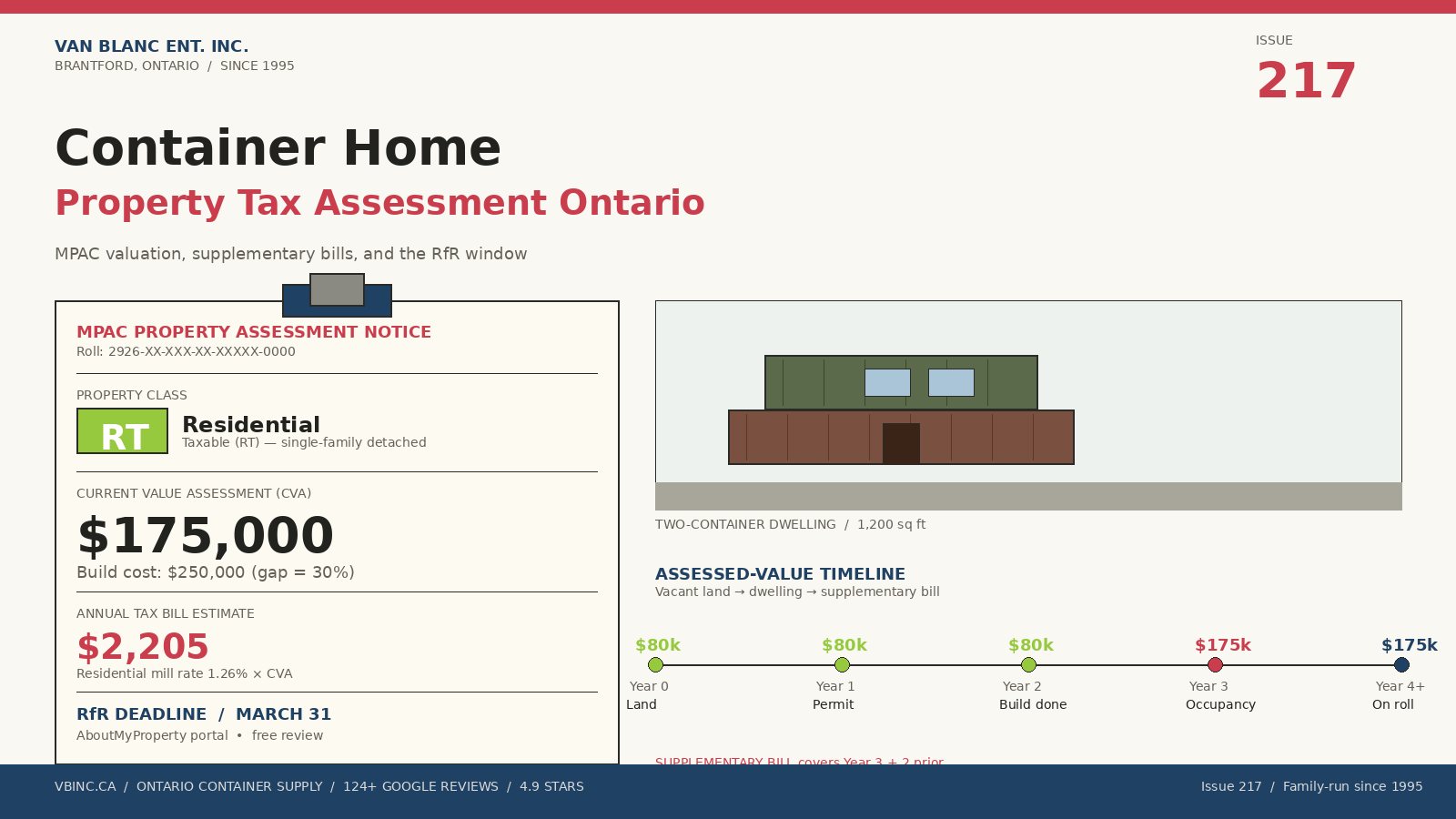
Quick Answer: Container home property tax assessment in Ontario is handled by MPAC under the residential property class, which values the dwelling using the direct comparison approach against site-built homes. Assessed value usually lands at 60 to 75 percent of total build cost. Supplementary bills cover the year built plus two prior years, and the Request for Reconsideration deadline is March 31 of the tax year. This is the property-tax assessment buyers see in Ontario before the first annual bill arrives. Van Blanc has shipped containers across Ontario since 1995. 4.9-star service, 1-3 day delivery from 4 Brantford yards.
In This Guide
- Why Assessment Is a Separate Conversation From Permitting
- What Does MPAC Do With a Container Home File?
- The Residential Property Class and Why It Matters for Tax Rate
- Why Is My Container Home Assessed Below Build Cost?
- The Direct Comparison Approach Applied to Steel Walls
- What Is a Supplementary Tax Bill on a Container Home?
- Accessory Container Storage vs Container Dwelling Assessment
- Paul on the Buyers Who Ask About the Tax Bill First
- How Do I Appeal a Container Home Assessment in Ontario?
- What To Document Before MPAC Visits
- Frequently Asked Questions
Reading time: about 14 minutes.
Why Assessment Is a Separate Conversation From Permitting
A container home property tax assessment in Ontario is the value MPAC assigns to the finished dwelling, separate from any permit the municipality issued. MPAC values the steel-walled house against comparable local homes using the direct comparison approach, then the municipality applies the residential tax rate. Permitting decides if you can build; assessment decides what you pay yearly.
Buyers walk into our Brantford yard with a real fear about a container home, and most of the time it is the wrong fear. The fear is usually about whether the municipality will allow the structure. That conversation belongs with the local building department and we tell every buyer the same thing: call your planning office before you place anything permanent. What this guide covers is the part of the process that catches buyers off guard later, after the building is up, after the inspections are signed, after the family moves in. The property tax bill arrives in the mail and the assessed value does not match anything the family expected. That gap between expectation and reality is the property-tax assessment buyers see in Ontario, and it has its own rules, its own timeline, and its own appeal process. None of it is about permits.
The Municipal Property Assessment Corporation, known in shorthand as MPAC, is the provincial body that values every property in Ontario for tax purposes. MPAC does not approve construction, issue building permits, or rule on whether a container home is legal. Those decisions sit with the municipality. MPAC arrives after construction is complete and assigns a Current Value Assessment, abbreviated CVA, to the finished property. The municipal council then sets a tax rate. The CVA times the tax rate produces the annual property tax bill. Container home owners in Ontario sometimes assume that because their building is unusual, MPAC will either skip them or undervalue them. Neither happens. MPAC has been folding alternative dwellings, including steel-walled houses, into its assessment cycle for years. The methodology is consistent, and our wider walk-through of building a container home in this province sets out where assessment fits in the rest of the timeline.
One thing we want to be clear about before going further. Paul has watched container homes go from a hobbyist curiosity in 2010 to a legitimate dwelling category in 2026. The buyer profile changed. The municipal acceptance changed. The financing options changed. The one thing that did not change is the underlying tax framework. A container home in Ontario is real property, taxed like real property, assessed like real property. Understanding that one fact saves families thousands in surprise supplementary bills.
What Does MPAC Do With a Container Home File?
Christian LeBlanc, second-generation operator: “Nobody walks into the yard worried about MPAC. They worry about whether the township will say yes. Then a year or so after they move in, the tax notice shows up and they finally meet MPAC. I grew up around these conversations, and the one I have most with container home buyers now is the assessment, not the permit. The permit is the start. The assessment is the part that follows them.”
MPAC, the Municipal Property Assessment Corporation, operates on an assessment cycle, currently extended through 2026 by provincial direction, where every property in Ontario is reassessed against a common valuation date. Between full reassessment years, MPAC continues to handle three categories of properties: new construction, demolitions, and properties where a use change has occurred. A new container home falls into the first category. When a municipality issues an occupancy permit for the dwelling, that data flows to MPAC. Within 90 to 180 days, an MPAC field inspector or desk assessor opens a file on the property. That file produces the Property Assessment Notice that lands in the mailbox.
The inspector compiles a structural inventory of the dwelling. For a container home this typically means: number of containers used (one, two, three, sometimes a stack of six or more for two-storey builds), total finished floor area in square feet, exterior cladding (raw Corten, wood-clad, steel-clad, vinyl, stucco), interior finish grade, basement or no basement, foundation type (concrete pad, screw piles, helical piers, full footings), number of bedrooms and bathrooms, garage or no garage, lot size, and waterfront or non-waterfront. Each of these variables feeds into MPAC’s valuation model the same way it would for any other detached dwelling. The fact that the structure started life as ISO 6346 shipping containers does not register as a separate property type in the MPAC system. It registers as residential, with structural notes.
What MPAC sees on the file: primary structure code (typically 301 for single-family detached), wall material code, foundation code, square footage, and lot characteristics. The container origin shows up in the file notes, not the structure code. That distinction is why the assessment does not get a discount or premium just for being a container home.
The Residential Property Class and Why It Matters for Tax Rate
Every property in Ontario falls into one of seven major property classes for tax purposes: residential, multi-residential, commercial, industrial, pipeline, farm, and managed forest. The class determines which tax rate the municipality applies. A container home occupied as a permanent or seasonal dwelling falls into the residential class. The residential tax rate is almost always the lowest of the seven classes, which is why the classification matters even more than the assessed value in some cases. A property miscoded as commercial by mistake (which happens occasionally when a container home is built on a property that previously held a business) can pay double or triple the tax bill until the classification is corrected through an RfR.
For container homes specifically, three classification edge cases come up regularly. First, a container home on a farm property: the dwelling itself sits in residential, but the surrounding acreage stays in the farm property class. The line is drawn at the boundary of the residential curtilage, which MPAC typically defines as the building envelope plus an immediate yard area. Second, a container home used part-time as a short-term rental: the property generally stays residential as long as the owner files no business registration tied to the dwelling, but municipalities are tightening this. Third, a container home stacked above a workshop or studio space: the workshop portion may get classified separately depending on how the floor area splits between residential and commercial use.
The standard residential property class is what buyers should expect. Anything else means something unusual happened on the file. The first thing to check on the Property Assessment Notice is the property class code in the top right corner. If it does not read RT (residential taxable) or RTEP (residential taxable, eligible for phase-in), that is the signal to call MPAC and ask why.
The Brant County context: we see a small but growing cluster of container builds across Brant County and the surrounding townships, mostly on rural and agricultural parcels. Every one of them ends up assessed under the residential class for the dwelling envelope, with the surrounding acreage staying farm-class where the property qualifies under the Farm Property Class Tax Rate Program. The two classifications coexist on the same tax bill.
Why Is My Container Home Assessed Below Build Cost?
Assessed value sits below build cost on most Ontario container homes because MPAC values what the local market would pay, not what the family spent putting the dwelling up. This is where families get the biggest surprise, and it works in both directions. A container home built up from its full slate of costs (containers, foundation, modifications, interior finish, mechanicals, permits, professional fees) typically lands at a CVA noticeably below that total once MPAC finishes the file. The gap exists because MPAC values the property using the direct comparison approach against the local resale market for comparable detached dwellings. Build cost includes the labour and materials that went into creating the structure. Assessed value reflects what the local market would pay for it if it sold today. Those two numbers diverge.
For most Ontario container home builds, that divergence runs in the family’s favour. A build that gets assessed below what it cost to put up produces a property tax bill calibrated to the lower assessed figure, not to the money the family actually spent. The lower CVA is a tax win. The downside shows up if the family ever wants to sell or take a mortgage against the finished home: the assessed value is public record, and a bank or buyer can use it as a reference point. A build that later re-appears as a sale-comparable in the MPAC database makes that container home look like a discount property in the local market regardless of construction quality.
The opposite gap (assessed value above build cost) happens occasionally on premium container builds in high-value cottage country. A waterfront container home in Muskoka can carry a CVA well above what it cost to build, because the lot value, not the structure value, drives the assessment in that market. Container homes in Toronto’s residential corridors face the same dynamic, where land value dwarfs structure value and the assessment reflects what any comparable lot would sell for regardless of what sits on it.
The 60 to 75 percent rule of thumb: on most rural and small-town Ontario container builds, expect MPAC’s assessed value to land between 60 percent and 75 percent of total build cost. On waterfront, urban-core, and premium-lot builds, expect the gap to narrow or invert because land value drives the assessment. Get a sense of the local comparable assessments before you buy the lot, not after the build is done.
The Direct Comparison Approach Applied to Steel Walls
MPAC’s direct comparison approach pulls recent sales of similar residential properties within a defined radius around the subject property, adjusts for differences (square footage, bedrooms, bathrooms, lot size, waterfront, garage, basement, age), and produces a CVA that reflects what the subject property would have sold for at the common valuation date. For a container home, the comparables are typically traditional stick-built or modular homes of similar square footage in the same neighbourhood. MPAC does not have a separate container-home comparable pool because the residential market does not segment that way.
The adjustment process is where the container origin starts to show up. A container home of 1,200 square feet on a half-acre lot, with two bedrooms, one bathroom, no basement, and screw-pile foundation, gets compared to traditional 1,200 square foot homes in the area, then adjusted for the missing basement (downward), the alternative foundation (typically downward), and any premium finishes (upward). The container-as-structure does not get a separate adjustment line because MPAC’s valuation tables do not have a “container premium” or “container discount” cell. What it does get is a quality-of-construction code that the assessor enters based on observed finish level, which indirectly captures whether the build looks like a high-end custom dwelling or a budget hobbyist project.
The age of the structure also matters. A container home built in 2018 and assessed in 2026 carries an effective age of eight years on the residential model. That treatment is the same as any other dwelling built in 2018. MPAC does not depreciate container construction faster or slower than other dwelling types, though a sharp-eyed assessor who notes visible Corten surface oxidation may bump the depreciation modestly. That is one reason cladding decisions on a container home affect not just curb appeal but assessment outcome: a clean-clad container home reads as a standard dwelling to the assessor, while a raw-Corten build reads as something more unusual and may invite a slightly different valuation file note.
What Is a Supplementary Tax Bill on a Container Home?
A supplementary tax bill is the catch-up bill MPAC and the municipality issue once a new dwelling lands on the assessment roll, and container home owners frequently get blindsided by one that arrives 12 to 24 months after move-in. The mechanism is straightforward and worth understanding before the first build year, not after the bill lands. When a new dwelling is constructed in Ontario, MPAC has the authority to issue a supplementary assessment that captures the added value of the new building. The municipality then issues a supplementary tax bill that covers the current tax year and, in many cases, up to two prior tax years if the construction completion date predates the assessment.
For a container home that finishes construction in March 2024 (with a one-trip shell the family picked off the lot in Brantford in late 2023) and gets the MPAC file completed in late 2025, the supplementary bill arriving in early 2026 can cover the 2024 partial year (from the move-in date forward), the full 2025 year, and the 2026 year that the municipality is starting to bill on. That stack of supplementary tax can add up to a five-figure number on a higher-value build, due all at once. Families that did not budget for it end up scrambling.
The exact retroactive period depends on when MPAC issued the supplementary assessment relative to the construction date and on the municipality’s billing practice. Some municipalities pro-rate aggressively. Others wait until the next regular tax year and roll the supplementary into the standard cycle. The cleanest way to anticipate the supplementary bill is to call MPAC about three months after the occupancy permit is issued and ask whether a file has been opened on the property. If a file is in progress, the supplementary is coming. Set aside the difference between the expected residential property tax and what the family was paying on the unimproved land before construction. That difference, multiplied by the number of months from occupancy to first bill, is roughly the supplementary stack waiting in the mail.
| Build milestone | MPAC trigger | Likely bill timing |
|---|---|---|
| Lot purchased, no build | Existing land assessment carries forward | Annual bill on land value only |
| Building permit issued | Construction-in-progress note added to file | No bill change yet |
| Container delivery and shell install | Field inspector may note partial construction | No bill change typically |
| Occupancy permit issued | MPAC opens supplementary file | Supplementary bill 12 to 24 months later |
| First full assessment year | Property added to standard tax roll | Annual bill at full dwelling assessment |
Accessory Container Storage vs Container Dwelling Assessment
A container on a property used purely as storage gets treated very differently from a container converted into living space. A 20ft or 40ft container sitting on a rural property as a tool shed, equipment shelter, or seasonal storage typically does not change the residential property assessment by a measurable amount. MPAC may note the structure on the file as an accessory building, but the contribution to CVA on a typical farm or rural residential lot is usually small enough that the annual tax impact is negligible at typical Ontario residential tax rates.
The line between accessory and dwelling is drawn by the use, not the structure. A container with insulation, electrical, plumbing, a bathroom, and a kitchen, the kind of finished living build people turn a steel box into, counts as a dwelling unit regardless of whether the municipality issued a formal occupancy permit. MPAC has authority to assess based on observed use during a field inspection, and a finished interior is enough evidence of dwelling use even if the property owner argues otherwise. Container home buyers who try to play this line by saying “it’s just a workshop” while clearly living in the structure full-time set themselves up for both supplementary assessment and potential municipal enforcement.
The cleanest path is accurate classification from the start. If the build is a dwelling, declare it as such, get the occupancy permit, and let MPAC assess accordingly. If the build is a workshop or storage container that happens to have a small finished area for occasional overnight use (the hunting camp or fishing cabin pattern), that distinction holds up under assessment review as long as the structure does not have full residential mechanicals. The grey zone between accessory and dwelling is where most assessment disputes happen, and it is also where buyers should think hardest before construction.
Paul on the Buyers Who Ask About the Tax Bill First
Paul LeBlanc, owner: “The buyers I trust the most on a container home build are the ones who ask about the tax bill before they ask about the container price. Means they thought through the whole thing. Thirty years in this industry I have learned that the families who get blindsided by the supplementary bill are the same families who skipped the property tax math at the start. The ones who called MPAC during the planning phase, who looked up the residential mill rate in their township, who set aside the difference between their land-only tax and their estimated full-dwelling tax for the first 18 months. Those families never call us upset. They built within a budget that already had the bill in it.”
Paul has run Van Blanc since 1995. The container homes he watches go up across Ontario are a small slice of his customer base, but it is a growing slice, and the assessment surprise comes up often enough that the conversation now happens at the yard before the first container leaves. The answer he gives every container home buyer: the property tax assessment is the part of the build that catches up with you 18 months after move-in. Knowing the framework in advance is the whole defence.
How Do I Appeal a Container Home Assessment in Ontario?
A container home assessment that looks too high is appealed in Ontario through MPAC’s free Request for Reconsideration process, filed by March 31 of the tax year in dispute. If the assessed value on the Property Assessment Notice looks wrong, MPAC offers a free review process called the Request for Reconsideration. The deadline for the 2026 property tax year is March 31, 2026, for property owners who received their notice in the prior fall. For each subsequent year, the RfR deadline is March 31 of the tax year. The deadline is firm. An owner who misses March 31 can no longer file an RfR for that tax year, though they retain the right to appeal future years.
The RfR is filed online through the AboutMyProperty portal, by mail using the RfR form, or by letter. The evidence to include is the heart of the file: photos showing the actual condition of the property (especially anything different from what the assessor recorded), recent sale prices for comparable properties in the area, assessed values of comparable properties (available through AboutMyProperty), and estimates for any significant repairs or deficiencies that affect value. For a container home, useful evidence often includes the actual build cost documentation (which, as noted above, frequently shows the build cost lower than the assessed value in waterfront or urban-core cases) and comparable container dwelling assessments in nearby Ontario municipalities.
MPAC tries to respond to RfRs within 180 days. The response is a written decision: either MPAC adjusts the assessment, partially adjusts, or denies the request. If the owner disagrees with the RfR outcome, the next step is an appeal to the Assessment Review Board, which has a 90-day filing window from the date of the RfR result letter. The ARB process involves a formal hearing and is materially more involved than the RfR. Most container home assessment disputes resolve at the RfR stage, particularly when the file note correctly identifies the unusual construction type and the assessor agrees the structure was over-comparable to traditional stick-built homes in the area.
Practical RfR strategy for container homes: file early in the year, not at the deadline. Include high-quality interior and exterior photos showing the actual finish level. Include three to five comparable property assessments pulled from AboutMyProperty. State the build cost with supporting invoices. If the CVA appears to assume traditional stick-built construction, point out specifically that the structure is a container build and ask MPAC to confirm the file accurately reflects the construction type.
What To Document Before MPAC Visits
The MPAC field inspection is short, usually under an hour, and the inspector is gathering data, not negotiating. What gets recorded during that visit drives the assessment for the next several years. Container home owners who prepare for the inspection get cleaner files. Container home owners who treat the inspection as just another visit get assessments based on whatever the inspector happened to observe.
Three documents should be ready when the inspector arrives. First, the build cost summary: a one-page breakdown of containers, foundation, modifications, interior finish, mechanicals, and professional fees, with the totals visible. Second, the structural drawings stamped by the engineer if the build required one, which most multi-container or two-storey container homes will have. Third, the occupancy permit and any related municipal documentation. None of these are required for the inspection, but offering them voluntarily ensures the file reflects what was actually built rather than what the inspector estimated from a walk-through.
The inspector will measure the exterior footprint, count windows and doors, note exterior cladding, count bedrooms and bathrooms during a brief interior walk-through if invited inside, and ask about basement and garage. Be straightforward in every answer. Inspectors have seen enough container builds to know what they are looking at, and inaccurate answers create file notes that come back to bite in the RfR process later. Accurate answers produce a clean file that is easier to defend if it ever needs defending. We see this pattern across every kind of unusual construction, and container homes are no exception.
A Brief History of How Container Homes Got Here
Container homes started showing up in Ontario in any visible numbers around 2010, mostly as small bohemian builds in cottage country and on rural acreage where municipal oversight was lighter and neighbours did not object. By 2015, a small wave of cottage-country container builds had moved through assessment cycles, and MPAC’s first generation of field notes on container homes started accumulating in the system. By 2020, container homes were appearing in suburban applications and the municipal acceptance had broadened. By 2026, container construction is mainstream enough that the average Ontario assessor has handled at least one or two container home files and the methodology is settled.
The reason the property tax assessment question still catches buyers off guard is that the build community has not caught up with the assessment community. The container home blogs, the build channels, the contractor pages, and the Pinterest boards focus heavily on design, modifications, and construction sequence. They almost never cover the property tax angle. By the time the buyer thinks about the assessment, the build is done and the supplementary bill is in the mail. Walking into that timeline with eyes open is the difference between a happy home and a stressful first year.
Frequently Asked Questions
Will MPAC assess my container home differently from a traditional house?
The assessment methodology is the same: direct comparison against local residential sales, adjusted for property characteristics. The container origin shows up in file notes and the quality-of-construction code, not in a separate property type. Final assessed value lands close to what a comparable traditional dwelling of the same square footage would carry, with minor adjustments for foundation type, finish level, and any visible structural differences.
How much will my property taxes increase after I build a container home?
The increase depends on local tax rate and the gap between your previous land-only assessment and the new dwelling assessment. A common pattern: a vacant rural lot moves from a modest land-only assessment to a much larger full-dwelling assessment once the home is finished, and the annual bill climbs in step. The exact numbers vary by township, region, and lot value, but a 3x to 5x property tax increase is normal once a dwelling is added to vacant land.
Does an accessory container on my property change my tax bill?
Usually not by a meaningful amount. A 20ft or 40ft container used purely for storage on a residential or rural property typically adds very little to the assessed value, so the additional annual tax is minor. Containers used for storage do not trigger the supplementary assessment process that container dwellings do. If the container has insulation, electrical, plumbing, or a finished interior, MPAC may classify it as a dwelling unit regardless of how the owner describes it.
What is a supplementary tax bill and why am I getting one?
The supplementary bill captures the increased property value created by new construction, and it can cover the year the building was completed plus up to two prior years if the MPAC assessment was completed retroactively. Container home owners often receive their first supplementary 12 to 24 months after move-in. Setting aside the difference between expected dwelling tax and land-only tax monthly during construction is the cleanest way to handle it.
Can I appeal my container home assessment if I think it is too high?
Yes. File a Request for Reconsideration with MPAC by March 31 of the tax year you are disputing. The RfR is free, filed online through AboutMyProperty or by letter, and MPAC reviews the file at no cost to you. Include comparable assessment data, photos of actual condition, and any documentation that shows the file does not reflect what was built. MPAC responds within roughly 180 days.
What evidence helps win a container home RfR?
The strongest evidence is comparable property assessment data pulled from AboutMyProperty showing similar nearby dwellings assessed at lower values. Build cost documentation helps when the assessed value materially exceeds construction cost. Photos showing actual interior finish level help when the assessor recorded a higher quality grade than was built. Engineer-stamped drawings help when the structural file is unclear. A clear, factual letter referencing each piece of evidence outperforms emotion-driven arguments every time.
Does the property class change if I rent my container home short-term?
Generally no, as long as the property is not registered as a business and the rental is occasional. Year-round short-term rental operations may trigger a property class review, particularly in municipalities that have implemented short-term rental licensing programs. Each municipality handles this differently, so check the local rules before going commercial with the rental.
How does MPAC find out I built a container home?
The municipality reports new construction to MPAC when the occupancy permit is issued, when the building permit is closed, or during routine data sharing. MPAC field inspectors also drive through neighbourhoods periodically and note new structures. Aerial photography, available through AboutMyProperty and updated regularly, captures new construction visually even without ground inspection. Skipping the building permit does not hide the construction from MPAC, it just creates a messier file and possibly a municipal enforcement issue.
Are container homes assessed at a discount compared to stick-built?
Not directly. MPAC does not apply a container discount in the valuation model. What sometimes happens indirectly is that container homes with budget interior finishes get a lower quality-of-construction code, which produces a lower assessment. A container home built to high finish standards typically assesses at the same value as a comparable stick-built home of the same square footage. The structure type alone is not a discount factor.
What is the difference between assessed value and market value?
Assessed value is MPAC’s estimate of what the property would have sold for on the valuation date used in the current assessment cycle. Market value is what the property would sell for today. The two can drift apart between assessment cycles, particularly in fast-moving real estate markets. Property tax is based on assessed value, not market value. A sale price above or below the assessed value does not automatically trigger reassessment, though it may inform the next cycle’s data.
Sources
- Municipal Property Assessment Corporation. (2026). Property Assessment and Property Taxes. mpac.ca/en/UnderstandingYourAssessment/PropertyAssessmentandPropertyTaxes
- Municipal Property Assessment Corporation. (2026). Request for Reconsideration (RfR) 2026 property tax year. mpac.ca RfR 2026 PDF
- Municipal Property Assessment Corporation. (2026). Residential Property Assessments. mpac.ca/en/PropertyTypes/ResidentialPropertyAssessments
- Municipal Property Assessment Corporation. (2026). How to file a Request for Reconsideration (RfR). mpac.ca RfR filing
- Government of Ontario. (1990, current). Assessment Act, R.S.O. 1990, c. A.31. ontario.ca/laws/statute/90a31
Reach Van Blanc in Brantford
We have been supplying shipping containers across Ontario since 1995. Our warehouse is at 90 Morton Avenue E in Brantford, and we deliver right across the province on a cash-on-delivery basis. No surprise fees, no chase-the-paperwork.
Van Blanc Ent. Inc. 90 Morton Ave E Unit 1B, Brantford, ON N3R 7J7 +1 888-509-6658
If you are weighing a container home build and want to walk a one-trip 40ft high cube before the conversation with MPAC ever starts, come see the yard. Paul or Christian will walk it with you, and the bin you choose is the bin you take home.
Related Reading
Ready to price your container?
Tell us the size and your postal code and we’ll send back an all-in number, container, delivery, and placement, usually within 1-3 days. No pressure, no mystery fees.
Family-run in Brantford since 1995 · 200+ containers in stock · 4.9★ across 140+ Google reviews · every box graded by a person, walk it before it lands.