
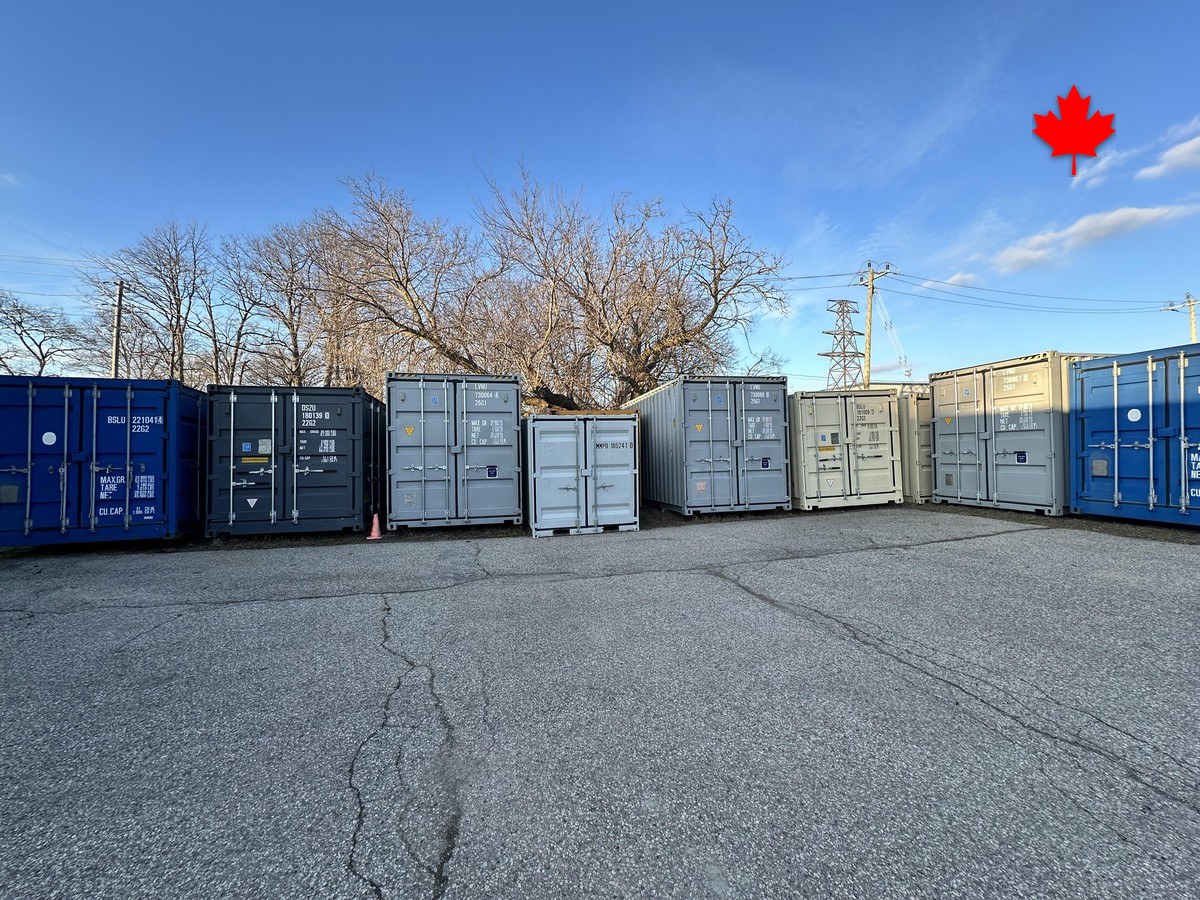
We sell containers. We do not rent.
Van Blanc sells shipping containers outright. We do not rent, we do not lease, and we do not offer rent-to-own. Renting comes up on this page because buyers compare it against owning, and that comparison is worth reading, but purchase is the only arrangement we offer. Stocked units deliver from our Brantford yards in 1 to 3 days. Request a sale quote or call the yard at 519-754-6844.
Quick Answer: London has more storage container companies than almost any city in Ontario, which makes choosing the real decision. Van Blanc sells steel containers outright and delivers them to London addresses in 1 to 3 days from our Brantford yards, an hour up the 403, where you can walk the rows and pick your exact box first; we do not rent.
Search for storage containers in London, Ontario and you will not find a shortage. You will find pod franchises, locker operators with container sidelines, regional specialists, and brokers, all quoting the same city. That crowd is actually good news for London buyers: it means the containers themselves are commodities, and the decision comes down to the things that differ, which are grade honesty, delivery reality, whether the price is for a box you own outright, and whether you can see it before money moves. This page walks that decision the way we would across the counter, including the parts where another option beats ours.
The London Storage Map, Category by Category
Every storage option in London falls into one of four buckets. Locker facilities, City Storage being the largest with well over a thousand units, suit small volumes and climate-sensitive goods; you drive to them, and gate hours apply. Pod franchises deliver a lighter composite box and often warehouse it back at a depot, a model built for household moves. Container specialists, and London has several, including companies whose names literally put “box” in the search bar, deliver real ocean-grade steel to your property. And then there are yards like ours: family operations that stock the steel, sell it in every grade, and let you kick the doors first; we do not rent, and why we sell rather than rent is its own short page. We are an hour outside the city, and buyers from London make the drive weekly because inspecting a used container before paying beats trusting a brochure photo of one.
The honest sorting question is volume and duration, and for buyers leaning toward owning, the used rungs of the ladder get their own honest page. A closet’s worth for a month belongs in a locker. A household or job site’s worth for a season or more belongs in steel on your own property, and then the only questions left are which size, which grade, and whose truck.
What do London buyers actually store in a container?
London’s economy shapes its storage demand in ways a generic container page never touches. Health care and education anchor the city: the hospital network and its supplier web employ tens of thousands, and Western and Fanshawe pump a rental-housing churn through the core every spring that landlords manage out of laneways and parking pads. Manufacturing runs heavier than outsiders expect, from armoured vehicles in the southeast to the food plants that never left, and the construction sector has been adding large employers even while the broader labour market has had a rough year. Each of those threads ends in the same steel box for a different reason.
The Old North renovation. Century home, plaster dust, main floor contents needing six weeks somewhere dry. A 20ft on the driveway keeps the furniture twenty steps away instead of across town behind a gate code.
The student-rental landlord. Turnover season between April and September flips half the near-campus housing stock. A container in the laneway holds appliances, furniture, and reno materials through the churn, then parks behind the next property. The landlords running multiple doors move the same unit between houses every spring.
The industrial supplier. The plants at the city’s edges run on contractors and parts suppliers whose busy seasons stack pallets past what their leases hold. A 40ft high cube behind the shop is warehouse capacity that arrives in days and is still there for the next contract.
The event season. Western Fair district markets, festival infrastructure, seasonal retail along Wellington and Wonderland: all of it lives somewhere between uses, and increasingly that somewhere is a container behind the venue.
The two-households-into-one move. A tight year also means families consolidating: parents moving in, estates being settled, two kitchens becoming one. That transition never fits a weekend, and a container in the driveway lets it take the months it actually needs, without a locker’s meter running across town while the family sorts what stays.
Why the Forest City Became Container Country
London earned its place as Southwestern Ontario’s wholesale hub back when the railways crossed here, and the pattern never broke: goods for the whole region still stage through London’s warehouses, carriers, and yards. That freight DNA is why the city grew more container companies than anywhere between Toronto and the border, and why a London buyer’s neighbourly advice about sea cans is usually pretty good; half the city has worked around them. It is also why the market rewards suppliers who compete on plain dealing rather than proximity. The steel is the same everywhere. The yard behind it is not.
The Seven-Point Check Before You Order From Anyone
Use this on us too. A crowded market is a gift to buyers who ask the right questions, and these seven sort the yards from the brokers in one phone call.
Ask every London container supplier:
- Can I see the exact unit? In person or a walkaround video of the specific box, not a stock photo of the model.
- Quote me all four grades. One-trip, Cargo Worthy, Wind and Watertight, As-Is. A seller hiding a rung is steering you.
- Show me the CSC plate. The riveted door plate proves the box was built to the international safety standard, whatever the seller calls the grade.
- Is delivery in the number? An all-in quote to your postal code, not a teaser plus a surprise truck fee.
- What is the real lead time? A specific day range, committed to, beats “soon.”
- When do I pay? Payment on delivery protects you. Large deposits to sellers you have never met are how the marketplace scams work.
- Who answers the phone after delivery? A yard with a name on the gate has a reputation to keep. A reseller with a web form does not.
The deposit question deserves its own sentence, because we take the call every month: someone found a container online for a thousand dollars less, wired a deposit, and two weeks later the seller and the money are gone. The Canadian Anti-Fraud Centre logged its worst year on record in 2025, and too-cheap steel is a recurring thread in it. The whole scam dies against one habit: see the box, pay on delivery.
Loading It So the Year Goes Smoothly
However you source the container, ten minutes of loading discipline saves the contents. Spread weight low and even across the floor rather than stacking one dense wall of boxes at the door end; the international packing code that governs commercial container loads is built on exactly that principle, and it scales down to a household. Keep a hand’s width between cargo and the steel walls so condensation never touches fabric or cardboard, put pallets or scrap lumber under anything that would mind a cold floor, and load the things you will want first at the door end, because every renovation runs longer than the calendar said it would. Leave the floor vents clear and the box will cycle air through an Ontario summer and winter without complaint.
Renting, Buying, and a Tight Year
London’s labour market has had the hardest stretch of any big Canadian city recently, and we would rather name that than pretend it away, because it changes the right answer for a lot of buyers. In a tight year, flexibility is worth real money, and one plain fact frames it: Van Blanc sells outright only. Renting from a fleet operator keeps storage as a monthly decision instead of a capital one, and for a need measured in weeks that can be the right call. A box bought once holds its value, so the flexibility is on the exit instead: it sells on when the need ends, and an equipment loan through your own bank or financer gives the monthly shape without the rent. And when a business is consolidating locations, a purchased container often replaces a leased space several times its cost; the box outlives the downturn and the next lease both. We will run whichever math fits your situation and tell you plainly which door makes sense, including when the answer is a locker across town.
Price Your London Delivery
Size, grade, and your postal code: that is everything a real quote needs. London runs are an hour from our yard, inside our standard 1-to-3-day window, and every quote comes with a real lead time, not a hopeful one. The fastest answer is a call.
Container Rental in London: What the Agreement Should Say
Most London container searches are rental searches, and since we do not rent, here is what to get in writing from a fleet operator before you sign, because rental agreements deserve the same scrutiny as purchases. The condition record: photos of the unit at drop-off, so the end-of-term conversation is about facts. The responsibility split: weather and steel are the supplier’s problem, forklift punctures are yours, and the line between should be written, not assumed. The term shape: what the minimum is, what month-to-month looks like after it, and what notice ends it. And the exit paths: whether the rental can convert toward purchase, and what pickup costs when you are done. Put that beside the number for a used box bought once and most London renters past a few months come out ahead owning.
One London-specific note: turnover season books solid. Landlords and movers who want a unit for the April-to-June churn should call weeks ahead, not days; the spring stock is finite and April is its January.
And when a box you bought has finished its work, moving it on is the same tilt-deck in reverse: a private sale or a buyback conversation with the yard, then a hauler’s truck. Empty the unit fully, including the corners where the last few things always hide, sweep the floor, and leave the doors unlocked on pickup morning. The truck needs the same clear approach it had on delivery day, so if a fence went up or a woodpile grew beside the box, mention it when you book the hauler rather than when the driver is standing in the driveway. A unit that goes swept and dry sells for most of what it cost, and turnover-season landlords keep theirs for next spring anyway.
Past the City: Middlesex County’s Fringe
London deliveries do not stop at the city sign. Komoka, Ilderton, Dorchester, Thorndale: the commuter-and-hobby-farm belt around the city takes a steady run of 40ft units for implements, hay, and workshop overflow, set on ties at the laneway’s end. Rural placements change the checklist slightly, gate width and soft ground replace driveway width as the questions that matter, and the tilt-deck handles the rest. Same 1-to-3-day window, same quote line, just flag the farm gate when you book.
The 403 Delivery Math
London sits about an hour down the 403 and 401 from our Brantford yard, which puts every London address inside our standard 1-to-3-day delivery window on a tilt-deck truck with a fully insured carrier. The driver needs roughly 30m (100ft) of straight approach for a 20ft unit, overhead clear of lines and branches, and a firm, level spot blocked on ties or patio stones so the unit sits proud of grade and sheds water away from the door sills. Narrow drives in Old East and Wortley Village sometimes take the 10ft instead of the 20ft, and the driver will say so on the phone before the truck rolls, because a placement rethink costs nothing at the quoting stage and a headache on delivery day. The full ground-prep detail lives in our guide to setting the pad before the truck backs in.
Sizes Against London’s Housing Stock
| Unit | External size | Where it fits in London |
|---|---|---|
| 10ft | 2.99m x 2.44m (10′ x 8′) | Old East and Wortley narrow lots, laneway placements |
| 20ft | 6.06m x 2.44m (20′ x 8′) | Standard double driveways, most renos, most landlords |
| 40ft | 12.19m x 2.44m (40′ x 8′) | Industrial lots, farm properties on the city fringe |
| 40ft High Cube | 12.19m x 2.44m x 2.90m tall | Racking-height business overflow behind the shop |
The 20ft carries most of the city. Its 33.2 cubic metres swallows a main floor with room to walk the aisle, and its footprint leaves a car’s width beside it on a standard double drive. Buyers stuck between sizes should hear our thirty-year observation again: the small box is the one that gets replaced.
The Four Grades, Called Honestly
Wherever you buy in London, make the seller walk you through all four grades, because a ladder with a missing rung is how buyers overpay. New (one-trip) units crossed the ocean once, loaded, straight from the factory: original paint, clean floors, decades ahead, the pick when appearance or conversion is in the plan. Cargo Worthy (CW) is certified used steel, structurally confirmed, cosmetically worn, still fit for export work. Wind and Watertight (WWT) is the working grade for stationary storage: sealed against weather and rodents, honest dents and surface rust, and usually the right answer for a London driveway or back lot. As-Is is the cheap rung with floor, frame, or door questions, sold for cladding, donor builds, and buyers who know exactly what they are getting. We stock all four in Brantford and point at the flaws before you ask, which is most of the reason people drive an hour to buy a box they could have ordered blind closer to home. The wider buying story for the city lives in our London shipping container guide.
Storage Bin, Sea Can, C-Can: The London Vocabulary
London’s market has its own dialect. The companies competing here have trained the city to say storage box and big box alongside the older Canadian standbys, so the same buyer might search a storage bin for the driveway, a sea can for the farm property, and a c-can because that is what the site foreman said. All of it lands on the same 8ft-wide corten steel built to ISO 668. Whichever word you brought with you, the quote line and the steel are identical, and our yard answers to all of them.
London Storage Container FAQ
Who delivers storage containers in London, Ontario?
Several companies serve London, from pod franchises to container specialists. Van Blanc sells steel containers outright and delivers them from our Brantford yards, an hour up the 403, inside a 1-to-3-day window, and you can walk the rows and pick your exact unit before paying; we do not rent.
Is it better to rent or buy a storage container in London?
For a need measured in weeks, renting from a fleet operator can win; past a few months, buying does, and that is all Van Blanc does: no rental, lease, or rent-to-own. In a tight economy a used wind-and-watertight box bought once holds its value and sells on when the need ends, and an equipment loan through your own bank or financer gives the monthly shape without the rent.
How fast can a container reach a London address?
One to three days for most orders, on a tilt-deck truck from Brantford. London sits about an hour from the yard, so in-stock units often land on the earlier end of that window. Every quote carries a real lead time, not a hopeful one.
Can a container fit on a narrow London lot?
Old East and Wortley Village drives often take the 10ft unit where a 20ft will not swing its doors. The driver confirms approach, overhead clearance, and placement on the phone before the truck rolls.
What do London landlords use containers for?
Turnover season. Between April and September the near-campus rental stock flips, and a laneway container holds appliances, furniture, and renovation materials through the churn. Landlords with multiple properties move the same unit between houses every spring.
What grade of container should a London buyer pick for driveway storage?
Wind and Watertight, usually: sealed against weather and rodents with honest cosmetic wear priced in. Pay for Cargo Worthy only if the box might ship again, and for new (one-trip) when appearance or a future conversion matters.
Do I have to see the container before delivery?
No, but it is the single best protection a used-container buyer has, and it is why London buyers drive to Brantford weekly. If you cannot make the trip, we describe every flaw on the phone before you commit, and you pay on delivery, not in advance.
Can a business put a container behind its shop long term?
That is the most common commercial use we deliver to London: a 40ft high cube as permanent overflow behind the building. Tell your insurer, block the corners level, and the unit will outlast the lease. Placement rules are your municipality’s call; check with the local planning department first.
Why buy from a yard an hour away instead of a broker in town?
Because the yard is the product. Brokers sell photos of inventory they have never touched; a family yard walks you down the rows, opens the doors, and points at the dents before you pay. An hour on the 403 is cheap insurance on a steel purchase meant to last decades.
Do you deliver to Komoka, Ilderton, and the Middlesex fringe?
Yes, the commuter and hobby-farm belt around London is a regular run: Komoka, Ilderton, Dorchester, Thorndale and the concession roads between. Flag the gate width and any soft ground when you book, and the tilt-deck takes the laneway from there, inside the same 1-to-3-day window.
Sources
- London Economic Development Corporation. (2026). 2025-2026 Local Labour Market Plan. ledc.com
- Immigration, Refugees and Citizenship Canada. (2025). Economic profile: London-Middlesex, Ontario. canada.ca
- International Organization for Standardization. (2020). ISO 668: Series 1 freight containers, classification, dimensions and ratings. iso.org
- StorTrack. (2025). Self-Storage Pricing Trends, U.S. and Canada, December 2025. stortrack.com
- Canadian Storage Info. (2025). Q2 2025 Self-Storage Market Update. canadianstorageinfo.ca
An Hour From London, Worth the Drive
Van Blanc has supplied containers across Southwestern Ontario since 1995: family-run, 4.9 stars across 140+ verified Google reviews, and a real yard at 90 Morton Avenue East in Brantford where you can walk the rows before deciding anything. London deliveries run 1 to 3 days.
Van Blanc Ent. Inc., 90 Morton Ave E Unit 1B, Brantford, ON N3R 7J7. 1-888-509-6658