
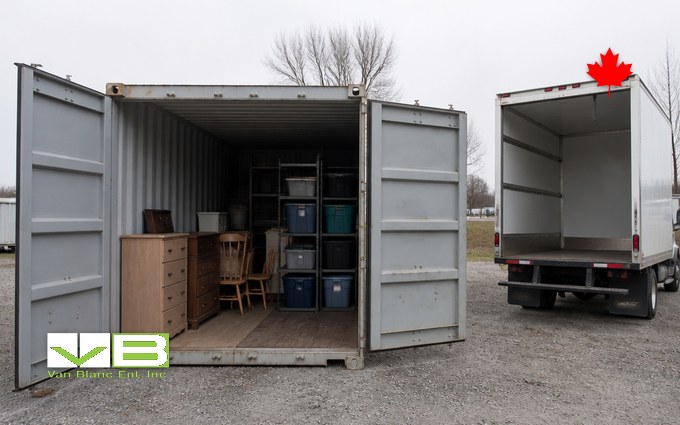
Quick Answer: To start a junk removal business in Ontario, register the business and insure the truck. Get a CVOR certificate if it weighs over 4,500 kg. Check MECP’s waste transportation permissions, then price each job by load volume. A 40ft container from Van Blanc becomes the crew’s sorting and resale depot.
What This Junk Hauling Guide Covers
- How to Start a Junk Removal Business in Ontario
- Junk Removal Business Plan and Niche
- Registering Your Business Name in Ontario
- Junk Hauling Trucks and Trailers
- Junk Haulers and the CVOR
- MECP Rules for Hauling Waste
- Tires, Fridges and Hazardous Waste
- Junk Removal Crews: WSIB and Insurance
- Junk Removal Pricing Models
- Is a Junk Removal Business Worth Starting?
- Junk Removal Advertising and Referrals
- Donation, Resale and Recycling Streams
- Junk Sorting Depot in a 40ft
- Laying Out Bays Inside the Forty
- A Second Box for Resale Stock
- New or Used Steel for the Depot
- Estate Cleanouts and Restoration Pack-Outs
- Delivery to Hamilton, London and Oshawa
- Junk Removal Startup Checklist
- FAQs
Reading Time: 17 minutes
How to Start a Junk Removal Business in Ontario
A junk removal business is a company that clears unwanted furniture, appliances, renovation debris and household clutter from homes and businesses, then hauls it away. The good ones send as little as possible to landfill. What can be resold gets resold, what can be donated gets donated, and metal goes for scrap. For the household side of that work, see how a family holds a parent’s belongings while the estate settles.
In Ontario, starting one means a short list of provincial registrations. The truck may fall under the Ministry of Transportation’s operator rules. You also need a working knowledge of the environment ministry’s waste rules. Most start-up guides online are written for the United States or British Columbia, so this one sticks to Ontario sources.
Paul and Christian LeBlanc run Van Blanc Ent. Inc., a shipping container seller with 4 Brantford yards and a history that dates from 1995. The last third of this guide covers the steel box a junk crew sorts into. A depot can start as a standard forty with 2,395 cu ft inside, and some haulers add a second box later for resale stock.
A workable order for a new hauler looks like this:
- Pick the work: household cleanouts, renovation debris, office clear-outs, or a mix.
- Register the business name through the Ontario Business Registry.
- Choose a truck or a truck and trailer, then check whether it needs a CVOR certificate.
- Find out which MECP permission your waste transportation system needs.
- Learn the special streams: tires, fridges and freezers, and hazardous waste.
- Register with WSIB within 10 calendar days of the first hire, and buy commercial insurance.
- Set a pricing model and a minimum charge.
- Line up disposal, donation, recycling and scrap outlets before the first job.
- Give the reusable goods a locked, dry box between pickup and sale.
Junk Removal Business Plan and Niche
A junk removal business plan sets out what you will haul, for whom, and where every load goes once it leaves the client’s driveway. Ontario’s own start-a-business steps begin with market research and a business plan before registration. For a hauler, the plan carries three decisions that shape everything after it.
- The client mix. Homeowners, landlords, realtors, property managers and contractors each call for different work. Contractor debris is heavy; a household cleanout is lighter and full of things worth selling.
- The equipment. A pickup and a dump trailer, a box truck, or a larger truck each changes the CVOR question, the insurance quote and how much fits per trip.
- The outlets. Know where mixed waste, scrap metal, donations and resale stock will go before you quote a single job.
That third decision is where Ontario’s rules start to bite, and where storage enters the plan. A company that resells what it hauls needs somewhere to hold the stock. Price a box into the plan alongside the truck. Our posted container prices show what each size and grade costs before you call.
“When a junk removal crew asks me for a depot box, my first question is where the resale stock goes after pickup. A hauler holding sofas and dressers for weeks needs a tight roof and sound door gaskets more than fresh paint.”
Paul LeBlanc, owner, Van Blanc
Write the funding side down too. Invoice Fly’s guide names personal savings as the most common source, followed by small business loans and equipment financing. A lender wants an invoice that names what it is financing.
Registering Your Business Name in Ontario
Ontario’s start-a-business guide says that a business with employees, facilities or offices in Ontario must register using the Ontario Business Registry. The registry gives you a 9-digit Ontario Business Identification Number, the BIN, from ServiceOntario. The guide notes that the BIN is different from the Business Number the Canada Revenue Agency issues.
Search the registry for free before you settle on a name. A catchy name is only useful if nobody else in Ontario already trades under it. Plain names that say what you do read well on a truck door and on a yard box painted in company colours.
The structure choice comes first: sole proprietorship, partnership or corporation. Incorporating under a word name rather than a number name means ordering an Ontario-biased Nuans report first, the guide says. The CRA business number, HST registration and payroll account follow.
Contractors starting out follow much the same steps. Van Blanc’s guide to the registration and WSIB steps a new contractor takes walks through the CRA side in more detail. Permits are managed by your municipality, so check with your local building or planning department before you order.
Junk Hauling Trucks and Trailers
The truck is the biggest early decision, and it drives two rules covered below: the CVOR line and your insurance class. Three setups are common for a new hauler.
- A pickup truck pulling a dump trailer. Cheapest to start, and the trailer tips the load at the transfer station.
- A box truck. Enclosed, so furniture headed for resale stays dry, and easy to brand.
- A dump truck. Built for renovation debris, concrete and shingles, and heavier on the scale.
Weigh the plan against the work. A crew that mostly clears basements and garages handles bulky, light goods, so volume matters more than weight. A crew working flooded homes after the contents are packed out hauls wet drywall and carpet, which is heavy.
Whatever you drive, the gross weight you declare at ServiceOntario matters. MTO says you must declare a registered gross weight high enough for the heaviest load you plan to carry. It is illegal to run heavier than that figure.
Junk Haulers and the CVOR
The CVOR is the Commercial Vehicle Operator’s Registration, the Ministry of Transportation’s program for trucks and buses. MTO’s page says that if you operate a commercial vehicle in Ontario, you must have a valid CVOR certificate. You carry the certificate, or a copy, in each truck operated under it. The rule is about your truck, a separate question from the tilt-deck or crane truck that brings a container to your yard.
For trucks, the line MTO draws is weight. You need a CVOR for trucks with a registered gross weight or actual weight over 4,500 kg.
| Truck setup | What MTO says about the CVOR |
|---|---|
| Truck with registered gross weight or actual weight over 4,500 kg | CVOR certificate needed |
| Truck other than a tow truck, at 4,500 kg or less, towing a trailer or not | No CVOR needed |
| Trailer and load over 2,800 kg | Trailer counts toward the truck’s registered gross weight |
| Trailer and load at 2,800 kg or less | Registered gross weight is the truck and its load only |
| Personal-use pickup, rated 6,500 kg or less, factory or duplicate box, no commercial cargo, tools or equipment | Exempt, but a hauling business does not meet those conditions |
MTO’s list of operator duties includes daily and annual or semi-annual inspections, hours of service records, maintenance records, and cargo securement. Those records and the truck kit need a dry home, and a container fitted out as a small workshop gives them one. Every operator gets one of four safety ratings: Satisfactory, Satisfactory-unaudited, Conditional or Unsatisfactory. The rating is public, and MTO notes it can affect your ability to attract customers.
Trailers and the 2,800 kg Line
A dump trailer is where many new haulers cross the line without noticing. MTO says a trailer and its load count toward the vehicle’s registered gross weight if they weigh more than 2,800 kg. At 2,800 kg or less, the registered gross weight is the truck and its load only.
MTO’s method is a public scale. Weigh the truck with its load, pull forward, weigh the trailer with its load, and add the two. A loaded trailer of shingles or wet carpet can pass 2,800 kg faster than a trailer of sofas. Weigh a real load before you register the truck. Depot boxes stay put once they land, so a crew hauling out of Whitby, Oshawa and Courtice only weighs what rolls.
When a Pickup Needs No CVOR
MTO’s exemption for pickups is narrow. It covers a pickup used for personal purposes without compensation. The truck must be rated at 6,500 kg or less, with the original, unmodified box or an unmodified replacement that duplicates it. It must not carry or tow a trailer carrying commercial cargo or tools. Equipment normally used for commercial purposes counts too. A pickup earning money on junk jobs is a commercial vehicle. Call MTO’s CVOR office if you are unsure.
MECP Rules for Hauling Waste
Ontario’s Ministry of the Environment, Conservation and Parks (MECP) treats moving waste as a waste transportation system. MECP defines that as a waste management system that transports waste beyond the boundaries of a site or from site to site. The rules sit in the Environmental Protection Act, Regulation 347 and Ontario Regulation 119/25. Read them before a crew clearing basements on the Hamilton Mountain and in the lower city takes its first paid load.
MECP’s page lists garbage, domestic waste, commercial waste and construction debris among the materials normally considered waste.
MECP’s core line is short. Unless exempt, environmental permissions for waste transportation systems may include an Environmental Compliance Approval (ECA) or registration in the Environmental Activity and Sector Registry (EASR). In some cases you may need both.
“Environmental permissions set out specific operating, monitoring and reporting requirements that owners and operators of a waste management system must comply with.”
Ontario Ministry of the Environment, Conservation and Parks, Environmental Permissions for Waste Transportation Systems
EASR Registration or an ECA
MECP says you must register in the EASR when your system meets all of these conditions.
- It transports waste beyond the boundaries of a site or from site to site.
- Only waste transportation vehicles move the waste: trucks, vans and trailers on roads and highways.
- Its management of waste is only the collection, handling, transportation or transfer of EASR waste.
- Each type of EASR waste is kept separate from every other type.
- EASR waste is not mixed, blended, bulked or intermingled with other waste or material.
On the truck and at the yard, Van Blanc’s guide to mapping where each pallet sits before the box is loaded helps keep streams apart.
Non-hazardous (municipal) waste is a type of EASR waste on MECP’s list. An ECA comes in when a system does more than collect, handle, transfer and transport. MECP gives processing such as mixing, blending and bulking as examples. Operators who already hold an ECA for activities O. Reg. 119/25 prescribes must register them in the EASR by August 1, 2028.
MECP also names exemptions. A system that manages only agricultural wastes is exempt, for example. Ontario Regulation 101/94 exempts blue box and leaf and yard waste systems under certain conditions. Being exempt does not relieve you of any other legal requirement, MECP adds.
Sorting Goods at Your Own Yard
A level gravel pad under the depot box is the easy part of the yard. A box full of furniture headed for resale is a different thing from a box of mixed garbage waiting for the dump. MECP’s guidance says Regulation 347 includes requirements for determining whether a material is a waste, and if so, how it should be managed. Will your yard hold anything that counts as waste, or process it? Then ask MECP’s Client Services and Permissions Branch which permission the yard needs.
Tires, Fridges and Hazardous Waste
Three kinds of junk come with rules of their own in Ontario, each from a different authority.
Tires and RPRA Registration
Tires waiting for a full load can sit in a used twenty set aside for tires and scrap, off the depot floor. Tires fall under Ontario’s Resource Productivity and Recovery Authority (RPRA). RPRA defines a hauler as a person that arranges for the transport of tires used in Ontario. Those tires are destined for processing, reuse, retreading or disposal. That does not include a person moving tires they generated themselves. RPRA says a hauler under the Tires Regulation must register in its Registry within 30 days of hauling. Haulers also file an annual performance report, due May 31 each year.
“The City reserves the right to request proof of residency and refuse quantities that appear to be generated from commercial, industrial, institutional or business activities.”
City of Brantford, Landfill, Residential Tire Recycling Program
Fridges, Freezers and Air Conditioners
Ontario Regulation 463/10 covers refrigerants. Under section 41, equipment that has contained a refrigerant cannot be dismantled, destroyed, recycled or incinerated without a section 32 notice. Nor can it be deposited in a dump or landfilling site without one. A certified person affixes it, stating the equipment no longer contains any refrigerant. A copy is kept for two years. In practice, a hauler needs a certified refrigeration technician in the chain before a fridge goes for scrap. Strap appliances upright on the truck; E-track rails and ratchet straps do the same job inside a Van Blanc box.
“These items will not be accepted at the landfill unless they have been properly drained and tagged by a technician certified under the Ozone Depletion Prevention (ODP) program.”
City of Brantford, Landfill, Refrigerant-Containing Appliances
Hazardous Waste and Asbestos
MECP says hazardous waste requires special handling with respect to how it is collected, stored, transported, treated, recovered and disposed. It is a subject waste, which must be registered through the Hazardous Waste Program Registry. MECP lists asbestos waste as its own EASR waste type. Any waste mixed, blended, bulked or otherwise combined with asbestos is excluded. Prontco’s start-up guide notes that most independents simply decline hazardous materials and refer them out. Write your own policy into the quote so clients know before you arrive. For loading the rest, the habits that keep a container load from shifting apply to a truck box too.
Junk Removal Crews: WSIB and Insurance
A junk crew lifts heavy, awkward loads every day, so workplace insurance arrives with the first hiring decision. WSIB’s registration page says most Ontario businesses that have employees, family members and subcontractors included, must register. You have 10 calendar days to register from the day you hire your first employee. WSIB names trucking or transportation businesses among the industries that must register.
Owners outside construction are not automatically covered, WSIB notes, though they can request optional coverage. Phone WSIB with your business activity and let them classify it. A crew that grows into two trucks around Hamilton and the Stoney Creek industrial strip will want that answer before the second hire.
Private insurance covers what WSIB does not. Plan for commercial general liability, for the doorframe or floor a crew damages, and commercial auto coverage on every truck. MTO’s CVOR page also expects each truck to carry a commercial vehicle auto liability policy with the appropriate minimum coverages.
Tell the broker where reusable stock waits overnight. A locked steel box on a pad is a better answer than the back of a truck. A puck lock with a hidden shackle adds to it. Ask about a welded lockbox, roof vents and shelving on our modification list when you quote the depot.
Junk Removal Pricing Models
Junk removal pricing usually follows how much of the truck a job fills, and Prontco’s guide says volume pricing dominates. Invoice Fly lists volume-based, item-based and time-based pricing, and Prontco’s guide recommends fractions of a load (quarter, half, full) quoted from photos the client texts.
| Model | How the price is built | Works best for |
|---|---|---|
| Volume-based | The share of the truck the load fills: a quarter, half or full load | Household cleanouts and mixed loads |
| Item-based | A set charge per piece, such as a sofa, mattress or appliance | Single-item pickups |
| Time-based | Crew hours plus disposal fees | Large or slow jobs, such as a hoarded house |
| Weight surcharge on volume | Volume price plus a charge for dense loads like shingles or concrete | Renovation debris |
Whatever model you pick, the same costs sit underneath it. Tipping fees at the transfer station, fuel, crew wages, insurance and truck payments come first. Stairs, long carries and dense material add more. Resale, donation and scrap revenue, which steel yards pay by weight, pull the other way.
“Waste Transfer Stations are for commercial customers and waste collection trucks to drop off waste.”
City of Hamilton, Community Recycling Centres
Set a minimum charge that covers a trip to the client and back. Van Blanc prices containers the same way, by size, grade and distance. Customers comparing quotes are really comparing those drivers, so explain the price in those terms on the phone. The same logic shows up in how a small firm weighs its first container purchase.
Is a Junk Removal Business Worth Starting?
Whether a junk removal business is worth it depends on your local market, the truck you can afford and how well you control disposal costs. The trade has a low barrier to entry. A first truck, a registration and an insurance policy can get a hauler working. A Van Blanc box can follow once the resale stock grows. That same low barrier means plenty of competition, so the work you keep comes down to answering fast and showing up on time.
Prontco’s guide makes the point that donation and recycling cut disposal costs. A sofa that goes to resale earns twice, once on the pickup and once on the sale. A load that all goes to the transfer station earns once and pays a tipping fee. That is why the depot sections below matter as much as the truck. A depot box can also double as a sales point, the way a container pop-up shop sells from the lot.
Ontario’s paperwork is manageable for one owner. It covers the registry, the CVOR if your weights call for it, and the MECP permission. Add RPRA if you haul tires, then WSIB and insurance. Treat the rules as a checklist and work through it before you advertise.
Junk Removal Advertising and Referrals
The best marketing for a new hauler is the truck and the phone. A clean, lettered truck parked in a driveway is seen by every neighbour on the street. A phone answered on the second ring wins the job the other company let go to voicemail.
- Set up a Google Business Profile with real photos of your crew and truck, then ask every happy client for a review.
- Offer photo quotes by text, so a client can send three pictures and get a range back.
- Call realtors, property managers and estate lawyers. They see cleanouts every month and need someone reliable.
- Talk to restoration firms and renovation contractors, who generate repeat debris.
Lettering a box works best on new steel still in its factory paint, because the paint needs only spot touch-up before the letters go on. A crew running cleanouts from a base in Oshawa and Durham gets the same roadside sign from a box parked at the yard gate.
Donation, Resale and Recycling Streams
Diversion means keeping a load out of the landfill by sending each part of it somewhere useful. Every load splits into streams, and each stream has its own destination.
| Stream | Typical items | Where it goes next |
|---|---|---|
| Resale | Solid wood furniture, tools, bikes, lamps, decor | The depot, then online listings or a yard sale |
| Donation | Clean household goods, clothing, books | A charity that accepts them, with a receipt for the client where offered |
| Scrap metal | Bed frames, barbecues, filing cabinets | A scrap yard |
| Special streams | Tires, fridges, freezers, electronics | The routes covered above |
| Waste | Broken, soiled or mixed material | A transfer station or landfill |
Charities change what they accept, so phone before you load. Scrap and resale both need somewhere to wait until a full load or a buyer appears. That waiting space is where a container earns its place in a hauling business. It sits locked and dry on your own lot. A crew working out of a London lot can check stock with a flashlight at night.
Junk Sorting Depot in a 40ft
A sorting depot is where a junk crew unloads reusable goods and sorts them into streams. It holds them until they sell, go to charity or go for scrap. A Van Blanc forty with room for 20 pallets on the floor does that job on a hauler’s own property. It lands on a pad, it locks, and it keeps upholstered furniture dry through an Ontario winter.
“In 19 years in containers, I’ve learned a junk removal depot comes down to the floor and the doors. The crew opens that box all day long, so I pick depot boxes with flat hardwood and locking bars that swing easy.”
Paul LeBlanc, owner, Van Blanc
The figures below come from Van Blanc’s product pages. The standard forty’s inside volume follows CN Intermodal’s sheet, and the door opening follows Hapag-Lloyd’s.
| Box | Length inside | Width inside | Height inside | Door (Hapag-Lloyd) | Volume | Pallets, one layer |
|---|---|---|---|---|---|---|
| 20ft standard | 5.898 m (19 ft 4 in) | 2.352 m (7 ft 8 in) | 2.385 m (7 ft 10 in) | 2,340 by 2,292 mm | 33.2 m³ (1,172 cu ft) | 10 pallets |
| 40ft standard | 12.040 m (39 ft 6 in) | 2.337 m (7 ft 8 in) | 2.388 m (7 ft 10 in) | 2,340 by 2,292 mm | 67.8 m³ (2,395 cu ft) | 20 pallets |
The forty is the usual depot size because sorting needs floor. As a rule of thumb, a crew needs an aisle down the middle and room to set a sofa down. A twenty works as a small depot or as the resale box covered below. The twenty’s inside measurements and weights are on its own page.
If tall pieces like armoires and shelving units come through often, look at the high cube’s extra foot of inside height. Used and new high cube forties are in stock and ready for your order.
Price Your Depot Box
Tell us what the crew hauls, where the box will sit and whether you want doors at one end or both. A call is the fastest way. We will come back with a size, a grade and one all-in number with a real lead time.
Family-run in Brantford since 1995 · 4.9★ across 140+ Google reviews
Laying Out Bays Inside the Forty
A sorting layout gives each stream its own bay so nothing gets sorted twice. One workable plan for a 40ft runs from the doors to the back wall.
- Intake, just inside the doors. Loads come off the truck here and get a first look.
- Resale bay, along one wall. Furniture stands upright with blankets between pieces.
- Small goods, on shelving. Tools, lamps and decor sit in labelled bins.
- Donation bay, along the other wall. Bagged and boxed, ready for the next charity run.
- Scrap corner, at the back. Metal waits here until there is a full load for the scrap yard.
“When I set a depot box down for a junk removal hauler, I face the doors toward where the truck backs in. The crew can then unload a cleanout straight into the intake bay without carrying anything across the lot.”
Christian LeBlanc, second-generation operator, Van Blanc
Wire-deck shelving fixed along one long wall keeps small resale goods visible and off the floor. A dolly needs a smooth path over the door sill. The floor sits 170 mm above the ground, so a ramp bridging the sill to the gravel saves a lot of lifting.
A crew that unloads by forklift should know the floor rating. Van Blanc’s 40ft page gives a forklift axle load of 5,460 kg, and the guide to driving a forklift into a container covers the approach. Upholstery and mattresses hold moisture, so vents that move air through a stored load are worth adding.
For a depot that loads at one end and ships at the other, ask about doors at both ends of the box. Intake comes in one end, sold pieces leave by the other, and nothing gets moved twice. New high cube forties with double doors are in stock and ready for your order.
A Second Box for Resale Stock
A hauler that sells what it collects can add a second box once the depot fills. The depot stays the sorting floor. The second box holds finished stock: cleaned, photographed and ready for a buyer to view.
Two setups suit that second box. A 20ft keeps stock compact and fits a smaller lot. A forty with side doors opens along its length, so a buyer can see the whole stock without the crew moving anything out first. New high cube forties with open sides are in stock and ready for your order, as are 20ft open-side units.
“Open-side forties for a junk hauler’s resale stock get an extra look from me before they go on my list. Those long side door gaskets are where rain finds its way in, and wet upholstery won’t sell.”
Paul LeBlanc, owner, Van Blanc
Some haulers take resale stock to a weekend sale. Van Blanc’s piece on roadside stands and pop-up sales in a container covers that kind of setup. If you are buying the depot and the resale box together, read what changes when you order more than one box at a time.
Depot Box or Resale Box
- Depot: a 40ft, cargo doors at one end or both, shelving down one wall, and a ramp at the sill.
- Resale box: a 20ft, or a 40ft with side doors, cleaned stock only, lettered with the company name.
- Both: a lockbox over the padlock, a level pad, and vents if upholstery stays more than a few weeks.
New or Used Steel for the Depot
Grade sums up a box’s age and condition, and the choice is yours. Van Blanc sells four grades, from new steel down to as-is, and each suits a different depot plan.
- New (one-trip): shipped loaded once from the factory, still in its original paint, with a few handling scuffs possible. One-trip is the trade’s name for a box that has crossed the ocean loaded just once. It has the longest service life ahead and the best resale value.
- Cargo worthy (CW): a used box with a current CSC plate, a sound floor and some surface rust.
- Wind and watertight (WWT): an older used box, roof and floor sealed, heavier exterior rust, CSC plate possibly expired.
- As-is: donor and scrap stock with a defect written down at sale.
A used forty has the same inside dimensions as a new one. A used box with surface rust still keeps the stock dry, and a branded box facing the road reads well in new paint. Walk our used forties, graded row by row, to compare the paint and the floors. Every size and door style we stock, listed side by side, shows the full range, including the double-door and open-side units.
“In our Brantford yards I hand a junk removal crew a flashlight and send them inside to stamp on the floorboards by the doors. That’s where the dolly, the dropped dresser and the wet boots land, so it’s the first board to judge.”
Christian LeBlanc, second-generation operator, Van Blanc
Buy from a seller you can visit. An online ad that undercuts every Ontario seller and wants a deposit before you see the box fits the fake-listing pattern buyers report. Seeing the box in person settles it, and a walk through the rows before you pay takes an hour.
Estate Cleanouts and Restoration Pack-Outs
Two kinds of client send a junk hauler steady work, and both already use containers. Estate cleanouts come through executors, realtors and estate lawyers. Families often hold the contents in a box on the driveway while they decide what to keep. Van Blanc’s estate cleanout guide covers how that step works. When the family is ready, the hauler clears whatever they let go.
Restoration jobs come through insurers and restoration contractors after a flood or fire. The crew packs out the contents, and the damaged material goes as debris. Van Blanc’s guide to restoration pack-outs covers how that job runs. A hauler who knows how both jobs run can call those firms with a clear offer. Take the debris, the leftovers and the final sweep.
Both jobs produce resale stock and donations as well as waste, which is why the depot pays its way. The tilt-deck drop on delivery day is the same whether the box sits at a family’s house or at your yard.
Delivery to Hamilton, London and Oshawa
Delivery from our 4 Brantford yards takes 1 to 3 days anywhere in Ontario, Van Blanc’s standard window. Every quote states a real lead time. Haulers in the three cities below get the same window.
- Hamilton: on an industrial lot near the QEW or the Red Hill Valley Parkway, confirm the tilt-deck has room to swing in and set down.
- London: on the edge of a contractor yard or a farm property, walk the route the truck will take across soft ground.
- Oshawa and Durham: at a home-based depot, check the driveway width and the overhead lines before the truck arrives. Read whether a loaded delivery truck can crack a driveway first.
The truck needs straight access and room to tilt the deck and pull away. Measure the approach before you order, check overhead wires, and pick a pad that drains. You pay when the box arrives. Van Blanc takes a draft cheque, cash or a wire, and credit cards go through an authorization form.
Junk Removal Startup Checklist
- File the business name with the Ontario Business Registry; keep the 9-digit BIN on record.
- Get the CRA business number, then HST and payroll accounts as you need them.
- Weigh the truck and trailer, then register a gross weight that covers your heaviest load.
- Apply for a CVOR certificate if the truck is over 4,500 kg.
- Ask MECP which permission your waste transportation system and yard need.
- Register with RPRA within 30 days of hauling tires.
- Find a certified refrigeration technician for fridges and freezers.
- Ask Van Blanc about a lockbox and vents for the depot box.
- Register with WSIB within 10 calendar days of the first hire.
- Buy commercial general liability and commercial auto insurance.
- Set a pricing model and a minimum charge.
- Line up a transfer station, a scrap yard and two charities.
- Order the depot box, starting with a forty sized for a sorting floor, on a level pad.
Call Van Blanc at 519-754-6844 with the site address and what the crew hauls. Expect a recommended size and grade, plus a delivery date, most often the same day you call.
Frequently Asked Questions
Is it easy to start a junk removal company in Ontario?
The start is simpler than most trades. No trade certificate is required to haul junk. You still need an Ontario Business Registry registration, insurance, and WSIB once you hire. A truck over 4,500 kg needs a CVOR certificate, and MECP sets the permission for transporting waste.
What is the best way to advertise junk removal?
Start with a Google Business Profile, real photos and reviews from every happy client. Offer quick quotes from photos sent by text. Then build referrals with realtors, property managers, estate lawyers and restoration firms, who see cleanouts every month. A lettered truck and a lettered depot box advertise every day.
How much does junk removal cost in Canada?
Prices vary by company and city, so ask for quotes. Most haulers price by how much of the truck a load fills, from a quarter to a full load. Some charge per item for single pickups. Dense material, stairs, long carries and disposal fees push a price up.
How do I choose a name for a junk removal business?
Pick a short name that says what you do and where you work, so it reads well on a truck door. Search the Ontario Business Registry for free to check that nobody already uses it. Then register it, since Ontario requires businesses with employees, facilities or offices in the province to register.
Do junk removal trucks need a CVOR in Ontario?
Yes, once the truck’s registered gross weight or actual weight passes 4,500 kg, MTO requires a CVOR certificate. A trailer and its load count toward that weight when they weigh more than 2,800 kg. Trucks at 4,500 kg or less do not need one, whether towing or not.
Do I need an ECA to haul junk in Ontario?
It depends on what you haul and what you do with it. MECP says waste transportation systems, unless exempt, may need an ECA or an EASR registration. A system that only collects, handles, transfers and transports EASR waste registers in the EASR. Processing points to an ECA.
What size container does a junk removal depot need?
Most sorting depots start with a 40ft, which holds 2,395 cu ft and gives room for an aisle and separate bays. A 20ft suits a small depot or a resale box. Add a second box when finished stock starts crowding the sorting floor.
Sources
- Ministry of Transportation of Ontario. Commercial vehicle operator’s registration (CVOR). Checked November 2026.
- Ministry of the Environment, Conservation and Parks. Environmental Permissions for Waste Transportation Systems; and Government of Ontario, e-Laws, O. Reg. 463/10, Ozone Depleting Substances and Other Halocarbons, sections 32 and 41. Checked November 2026.
- Government of Ontario. Register your business online, step 4 of the provincial start-up guide. Checked November 2026.
- Resource Productivity and Recovery Authority. Tires: haulers, retreaders and processors. Checked November 2026.
- Workplace Safety and Insurance Board (WSIB), registration page. How to register your business. Checked November 2026.
- Invoice Fly, Starting a Junk Removal Business: Your Complete Guide, and Prontco, Start a Junk Removal Business in BC. Checked November 2026.
- City of Brantford. Landfill, refrigerant-containing appliances and the residential tire recycling program. Checked November 2026.
- City of Hamilton. Community Recycling Centres, waste transfer stations. Checked November 2026.
See a Depot-Size Forty in Brantford
We have been supplying shipping containers across Ontario since 1995. Of the 4 Brantford yards, the public one at 90 Morton Avenue East is where buyers come to look.
Van Blanc Ent. Inc., 90 Morton Ave E Unit 1B, Brantford, ON N3R 7J7, 519-754-6844.
Doors open at 9:30 on weekdays, and nobody needs an appointment. The yard closes at 5 from Monday through Thursday and at 4 on Fridays. Bring a sketch of your lot and a list of what the crew hauls, and walk the inside of a forty before you decide. Worth the drive for unbeatable quality, family customer service with 30 years of experience.