
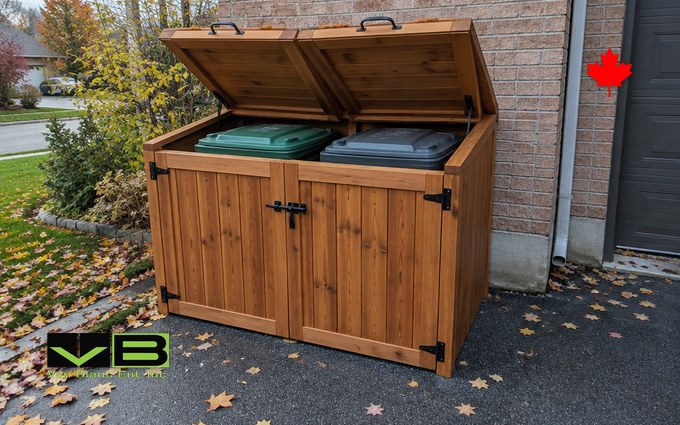
Quick Answer: A garbage can shed is a latched, vented enclosure sized to municipal carts: a 360-litre cart needs 26 by 35 inches of floor and 45 inches of height, plus lid swing. In Ontario the latch decides the raccoons, the walls decide the bears, and a rolling cart decides the door.
In This Guide
- What does a garbage can shed have to beat?
- Size it to the cart, not the can
- The four kinds of enclosure sold in Ontario
- Raccoons: the latch is the whole product
- Bears: what Bear Wise actually says
- Smell, vents and the hose
- The Ontario winter and the collection morning
- When the enclosure has to be a building
- The ten-foot bin room, done properly
- Which one to buy
- Garbage can shed FAQs
Reading Time: 13 minutes
What does a garbage can shed have to beat?
A garbage can shed has five opponents, and a good one is designed against all five rather than against the eye of the neighbour. The first is the raccoon, which in southern Ontario is a nightly visitor with hands. The second is the black bear, which in cottage country from Parry Sound to the Haliburton Highlands treats an unsecured cart as a feeder. The third is wind, which lays a 240-litre cart on its side and spreads a week of household waste down the street. The fourth is smell, which in a July heat wave is the reason the enclosure sits at the far end of the driveway. The fifth is the Ontario winter, which freezes lids shut and buries doors. A shipping container yard is an odd author for this guide, and we say so up front: the honest container fit is the cottage bin room and the rural lot with six carts, and it arrives two-thirds of the way down, after the enclosure question is answered on its own terms. The general case for steel against a built shed lives in the steel-against-shed math; this page is the garbage-specific one.
Size it to the cart, not the can
The mistake that sends enclosures back to the store is measuring for a garbage can when the municipality issues a cart. Most Ontario municipalities now run wheeled carts for automated or semi-automated collection, and a cart is bigger in every dimension than the galvanized can the enclosure was drawn around. Wellington County’s cart program lists the standard 360-litre cart at 44.5 inches high, 34.4 inches deep and 25.1 inches wide. A 240-litre cart runs roughly 42 inches high, 22 wide and 28 deep. Toronto’s raccoon-resistant green bin, rolled out from Scarborough in April 2016 and across the city by the end of 2017, is 100 litres at 97 by 48 by 61 centimetres. An enclosure has to hold the carts, let the lids open inside it or lift its own lid clear of them, and let each cart roll out without unloading its neighbour. That last requirement is the one a bike shed built the same way never has to meet, and it is why garbage enclosures are wider and shallower than they look in the catalogue.
| Cart | Size | Interior the enclosure needs per cart |
|---|---|---|
| 360 L garbage or recycling cart (Wellington County spec) | 44.5 in H x 34.4 in D x 25.1 in W | About 28 in wide, 37 in deep, 48 in high with 6 in of lid swing above if the cart lid opens inside |
| 240 L cart (typical) | About 42 in H x 22 in W x 28 in D | About 25 in wide, 31 in deep, 45 in high |
| Toronto green bin (2016 model) | 97 x 48 x 61 cm, 100 L | About 22 in wide, 27 in deep, 42 in high; the twist latch needs no extra room |
| Blue box or bag-stand recycling | Varies by municipality | Shelf or hook height, not floor space; shelving that hangs off a corrugated wall is the container version of the same idea |
Two 360-litre carts side by side want an interior close to 56 inches wide and 37 deep. That number rules out most of the resin cabinets sold as two-bin sheds, which are sized for the old 32-gallon can and hold two of those with room to spare and two municipal carts not at all. Read the interior dimension on the box, subtract the carts, and if the answer is less than two inches on each side, the doors will fight you every Tuesday.
The four kinds of enclosure sold in Ontario
Ontario buyers choose between resin cabinets, cedar or wood enclosures, steel cabinets, and the corral built from fence panels. Each one answers the five opponents differently.
Resin cabinets
The resin cabinet is the Home Depot and Canadian Tire answer, and the Keter Store-It-Out Prime is the model most people mean. Home Depot Canada lists it at 52 by 28.1 by 44.7 inches outside and 48 by 24 by 42.8 inches inside, 880 litres, sized for two 32-gallon bins with a bin-opening cut-out, a step-on lock with the lock sold separately, built-in ventilation, an integrated floor and a two-year limited warranty. The larger Darwin model lists 1,150 litres and two 240-litre bins. Resin never rots, hoses clean, and assembles in an hour. Its limits are the ones the Keter review’s look at the resin covers for the brand’s walk-in sheds: the panels flex, the latch is plastic-on-plastic, and a determined raccoon on a warm night has all the time it needs. For a suburban lot with two small cans and a fence between the cabinet and the ravine, it is the right buy.
Cedar and wood enclosures
The cedar enclosure is the Toronto answer, built by shops that size the interior to the city’s own carts. The better ones are Western red cedar with tongue-and-groove lids that shed water, stainless hardware that does not rust at the hinge, two- or three-point key latches that a raccoon cannot lift, and a vent panel so the box breathes. They arrive as modular panels and go together in an afternoon. A homeowner with a saw can build the same thing from a plan, and the wood shed guide’s notes on cedar explain why the species matters for anything that lives on wet pavement. Wood is the enclosure that looks like it belongs beside a brick house. It is also the one that needs a coat of finish every few years and a base that keeps its bottom rail out of the puddle.
Steel cabinets
Powder-coated steel cabinets sit between the two: stiffer than resin, cheaper than cedar, and the only one of the three a bear cannot open by leaning on it, provided the latch is a proper one. Their weakness is the Ontario winter, which is hard on thin painted steel at the hinge line, and the noise of a steel lid in the wind at 2 a.m. The buyer weighing steel against resin at the same store is having the same argument what Rubbermaid’s double-wall resin does settles for sheds: the stiffer panel wins on the latch, the resin wins on the hose.
The fence-panel corral
The corral is three fence panels and a gate, open at the top, and it is what most Ontario driveways actually have. It hides the carts, it stops the wind from walking them, and it does nothing at all about raccoons or smell. Its one real virtue is that the cart lids open freely and the carts roll straight out, which is more than the catalogue cabinets can say.
| Enclosure | Raccoons | Bears | Wind and smell | Fits two municipal carts? | Maintenance |
|---|---|---|---|---|---|
| Resin cabinet | Slows them; step-on latch with a padlock helps | No | Wind yes; vented, so smell moderate | Usually not; sized for cans | Hose |
| Cedar enclosure | Yes with a key latch | Not rated | Yes; vented | Yes when built to the cart | Finish every few years |
| Steel cabinet | Yes with a real latch | Resists leaning, not prying | Yes; check for vents | Sometimes; measure | Touch up rust at the hinge |
| Fence-panel corral | No | No | Wind yes; smell no | Yes | None |
| Steel bin room (container) | Yes | Yes; a lock a raccoon cannot work and a bear cannot pry | Yes with louvres top and bottom | Six carts and the recycling | Hose the floor; nothing else |
Raccoons: the latch is the whole product
Raccoons do not break into enclosures; they open them. The City of Toronto learned this at scale, which is why the 2016 green bin carries a latch that has to be turned ninety degrees to release, a motion a raccoon’s hands cannot manage, and why the city replaced a 46-litre bin with a 100-litre one built around that latch. An enclosure has to clear the same bar. Gravity latches, magnetic catches and any lid a raccoon can lift with its back are decoration. The Toronto Wildlife Centre’s advice for households without a garage or shed is a latched enclosure with doors that restrict access, or bins hung from a wall hook by their handles; Skedaddle, the Toronto wildlife-control company, lists a wooden lock-box with a padlock and motion-activated lights among the measures that actually work. In practice the enclosure latch that works is a two- or three-point key latch on the door and a strapped or latched lid on the cart inside it, plus the habit that beats every product: bins go out on the morning of collection, never the night before. The chicken coop guide’s predator section reaches the same conclusion from the other side of the fence, because the raccoon that opens a feed bin is the raccoon that opens a garbage cabinet.
Bears: what Bear Wise actually says
Ontario’s Bear Wise program is the province’s own guidance, and it is specific enough to build to. At home, it says to put garbage out only on the morning of garbage day and never the night before, to keep it in containers with tight-fitting lids stored in a bear-proof location such as a basement or a sturdy garage, and to wash cans and recycling containers with a strong-smelling disinfectant such as bleach. At the cottage it goes further: store garbage in a bear-resistant container with a tight-fitting lid, or in a secure shed or garage, and do not store garbage in plywood boxes, old freezers or vehicles. When you leave, take the garbage with you or drop it at an approved waste disposal site on the way. Read that list against the four enclosures above and the cottage answer is plain. A resin cabinet is not a secure shed. A cedar box, however well latched, is a plywood box in a bear’s terms. The cottage enclosure is a building with a real door, which is where the steel box in the last row of the table stops being a stretch. The lake roads around the cottage lots in Muskoka and the country around Parry Sound are where we deliver most of them.
Christian LeBlanc, Van Blanc Ent. Inc.: “The cottage call usually starts with a bear story. What they want is a place the garbage and the recycling can sit locked until the dump run, and that is a ten-footer with two vents and a padlock. It is not a complicated box.”
Smell, vents and the hose
An enclosure that seals against animals seals in the smell, so ventilation is the second design decision after the latch. The catalogue cabinets vent through slots near the lid; the cedar builders fit a louvred panel; the corral is all vent. The rule is a low intake and a high exhaust on opposite sides so warm air rises out and pulls fresh air through, which is the same reasoning louvres top and bottom follow on a steel box. The rest is housekeeping: a hose-down monthly in summer, the bleach wash Bear Wise recommends, no grease in the cart, and a floor that drains. A resin cabinet with an integrated floor drains onto itself, which is the one place the fence corral on bare pavers wins.
The green bin is the problem, and the freezer is the fix
Nine-tenths of the smell is the organics cart. Households that keep meat scraps in a bag in the freezer until collection morning have an enclosure that smells of nothing, and a cart that raccoons stop visiting because there is nothing in it worth the effort. This costs nothing and works in every enclosure on this page.
The Ontario winter and the collection morning
Winter is the season that separates enclosures that were designed from enclosures that were drawn. A lid that opens up freezes shut under an inch of ice and cannot be opened with a cart in the way. A door that swings out cannot swing through a snowbank the plow left on Tuesday night. A resin floor on a sloped driveway collects meltwater that refreezes under the cart wheels. The enclosure that works in January has a door that opens over the snow or slides, a floor the cart rolls off without a lip, a lid with a handle you can grip in a mitt, and a spot the plow does not bury. The same logic decides the ground under the box for a steel bin room: a hard pad, slightly proud of the surrounding grade, so water leaves and the door swings free.
The collection morning is the routine the enclosure is built around. In most of southern Ontario the truck runs early, the carts have to be at the curb with the lids closed and the handles facing the road, and they have to come back before the raccoons wake up. An enclosure at the top of a long driveway adds two trips to that morning, which is why cottage owners and rural households, who often haul to a transfer station instead, size a single locked room for a week or a season rather than a cabinet for a night.
When the enclosure has to be a building
The enclosure stops being a cabinet and becomes a building in four situations, and none of them is the two-cart suburban driveway. The first is the cottage in bear country, where Bear Wise wants a secure shed or garage and the cottage has neither, and where the garbage waits a week or a season for the dump run. The second is the rural lot or hobby farm with six carts, a recycling pile and a trailer of scrap between trips, the same lot that keeps the camper that winters at the back of the property. The third is the small business without a dumpster contract, the shop with three carts and a recycling cage behind it that the landlord wants out of sight, a cousin of a container restaurant’s back-of-house. The fourth is the works yard, the campground or the festival ground, where a parks department’s works yard or festival grounds between events hold dozens of carts and want them locked, vented and out of the weather. In all four the honest answer is a room, and a shipping container is the cheapest steel room that arrives finished.
Need the room, not the cabinet?
Tell us how many carts, where the box would sit, and whether it is a cottage lane or a works yard. We will tell you ten-foot or twenty, which grade, where the vents go, and one honest all-in number with a real lead time.
Family-run in Brantford since 1995 · 200+ containers in stock · 4.9★ across 140+ Google reviews · every box graded by a person, walk it before it lands.
The ten-foot bin room, done properly
A container bin room is a ten-foot steel bin room on a hard pad, with the cargo doors facing the lane, a louvred vent low on one side wall and a second high on the opposite wall, a padlock behind a steel shroud, and a ramp at the sill so the carts roll in. Inside a ten-footer there is close to 7 feet 8 inches of width and 9 feet 3 inches of length, which holds four 360-litre carts in a row with the recycling on a shelf above, or six carts if the lids can open in the aisle. A twenty-footer doubles that and is the right size for a works yard or a campground. The floor is marine plywood from the factory; a bin room that gets hosed wants it sealed or covered with a rubber mat, and the floor every container ships with explains the sealing options. The vents are the build decision that matters most, because a sealed steel box with a week of organics inside is a box nobody opens twice; vents that stop the box sweating covers the sizes and the placement, and the louvred vents themselves come from the accessory shelf at the yard, along with the loading ramp that turns the sill into a slope a cart handles.
Security is where the container earns the cottage job. The doors are the same doors that crossed an ocean, the handles are cam locks on both doors, and a welded lockbox over the hasp puts the padlock inside a steel shroud a pry bar cannot reach. A bear that has opened a cedar box in a minute does not open this. For a cottage lot where the box is visible from the dock, cedar-clad to match the cottage is a real option, and a light colour keeps the interior cooler in July, which matters for smell. Grade is a simple call: the grade that a bin room needs is wind-and-watertight, the most common used grade, with a sealed door and surface rust that nobody minds behind the woodshed. Cargo-worthy is a fair upgrade if the box will be lifted onto a barge or a trailer later; one-trip is for the box people will see.
A Haliburton cottage lane
The layout we deliver most often is a ten-footer at the top of the lane where the tilt-deck can reach, doors toward the drive, on four concrete blocks over a pad of crushed stone. Two 360-litre carts, one recycling cart, the returnables and the barbecue live in it from the May long weekend to Thanksgiving; the family loads the truck for the transfer station on the way home. It cost one delivery and an afternoon, and it has not been opened by anything with fur since. The same delivery is described in the Haliburton lake roads page, and a tilt-deck that backs down a cottage lane covers what the lane needs to be.
The number is set by size, grade, the vents and the lock, and the distance from Brantford, and what sets the number on a small box is the same list on every quote. We sell outright, never rent, and a buyer who wants to spread the cost does it through their own bank with the invoice and the serial number we supply. A pad of compacted stone is the only site work most bin rooms need, and the ten- and twenty-footers on the lot in Brantford can be walked before the truck is booked.
Which one to buy
Match the enclosure to the lot
- Two small cans, a fenced suburban driveway, raccoons but no bears: a resin cabinet with a padlock through the step-on latch, and the freezer habit for the organics.
- Two or three municipal carts beside a house you care about the look of: a cedar enclosure built to the cart dimensions with a three-point key latch and a vent panel, on a hard base.
- Carts on a windy corner with nothing to hide: a fence-panel corral, and accept that it does nothing about smell.
- A cottage in bear country, a rural lot with six carts, a shop without a dumpster, or a works yard: a locked, vented steel room, which is a used box at a working grade and arrives on a truck.
- Anyone downsizing a house with a garage into a home without one: read the downsizing guide’s storage math before buying a cabinet for the carts, because the carts are the smallest part of the problem.
Whatever the lot, buy the enclosure after you have measured the carts, not before, and put the latch ahead of the colour on the list. The raccoon does not care what it looks like. How a container compares with every shed type is the wider comparison if the bin room has started to sound like the woodshed and the workshop too.
Frequently Asked Questions
How big does a garbage can shed need to be for two 360-litre carts?
About 56 inches wide and 37 inches deep inside, with at least 48 inches of height and 6 inches of clearance above if the cart lids open inside the enclosure. A single 360-litre cart is 25.1 inches wide, 34.4 deep and 44.5 high on the Wellington County spec. Most resin two-bin cabinets are sized for 32-gallon cans and will not take two municipal carts; measure the interior on the box.
Do garbage can sheds keep raccoons out?
Only if the latch does. A raccoon opens gravity latches, magnetic catches and any lid it can lift with its back. A two- or three-point key latch on the door, a strapped or latched cart lid inside, and bins put out on the morning of collection rather than the night before are what stop them. Toronto’s own green bin uses a twist latch for the same reason.
What does Ontario’s Bear Wise program say about storing garbage at a cottage?
Store garbage in a bear-resistant container with a tight-fitting lid, or in a secure shed or garage, and never in plywood boxes, old freezers or vehicles. Put garbage out only on the morning of collection, wash cans with a strong disinfectant, and when you leave the cottage take the garbage with you or drop it at an approved waste disposal site on the way.
Are resin garbage bin sheds any good?
For two small cans on a fenced suburban lot, yes. The Keter Store-It-Out Prime, for example, is 880 litres inside, hoses clean, vents, and has a step-on latch that takes a padlock. Its limits are a flexing panel, a plastic latch and an interior sized for cans rather than the cam-lock handles and steel doors a bin room in bear country needs.
Can I use a shipping container to store garbage bins?
Yes, and it is the honest answer for a cottage in bear country, a rural lot with many carts, a shop without a dumpster or a works yard. A ten-foot container with a louvred vent low on one wall and high on the other, a sealed or matted floor, a ramp at the sill and a padlock inside a welded lockbox holds four to six municipal carts, locked and out of the weather, and arrives on a tilt-deck in one to three days.
How do I stop garbage bins from smelling in an enclosure?
Vent it low on one side and high on the other so air moves through, hose the floor monthly in summer, wash the carts with a bleach solution, keep grease out of the cart, and keep meat scraps in a bag in the freezer until collection morning. The organics cart is most of the smell, and the freezer habit removes most of it at no cost.
Sources
- Government of Ontario. (2026). Bear Wise: tips and tools. ontario.ca
- Toronto Wildlife Centre. (2026). Raccoons getting in garbage and compost bins. torontowildlifecentre.com
- Circular Materials. (2026). Information on new recycling carts, Wellington County. circularmaterials.ca
- CBC News. (2016, April). Raccoon-resistant green bins latest weapon in Toronto’s compost battle. cbc.ca
- Home Depot Canada. (2026). Keter Store It Out Prime 31 cu. ft. Resin Lockable Storage Small Shed. homedepot.ca
- Skedaddle Humane Wildlife Control. (2026). 10 effective ways to raccoon-proof your trash bins. skedaddlewildlife.com
Reach Van Blanc in Brantford
We have been supplying shipping containers across Ontario since 1995. Our yard is at 90 Morton Avenue East in Brantford, and we deliver right across the province with payment on the day of delivery. No deposit, no upfront wires, no chase-the-paperwork.
Van Blanc Ent. Inc., 90 Morton Ave E Unit 1B, Brantford, ON N3R 7J7, 519-754-6844 (cell) or 1-888-509-6658 (toll-free).
If the cabinet has lost to the raccoons twice and the bear has found the cottage, call with the number of carts and your postal code, and we will tell you on the spot which ten-footers are on the ground and when one can land. Worth the drive for unbeatable quality, family customer service with 30 years of experience.