
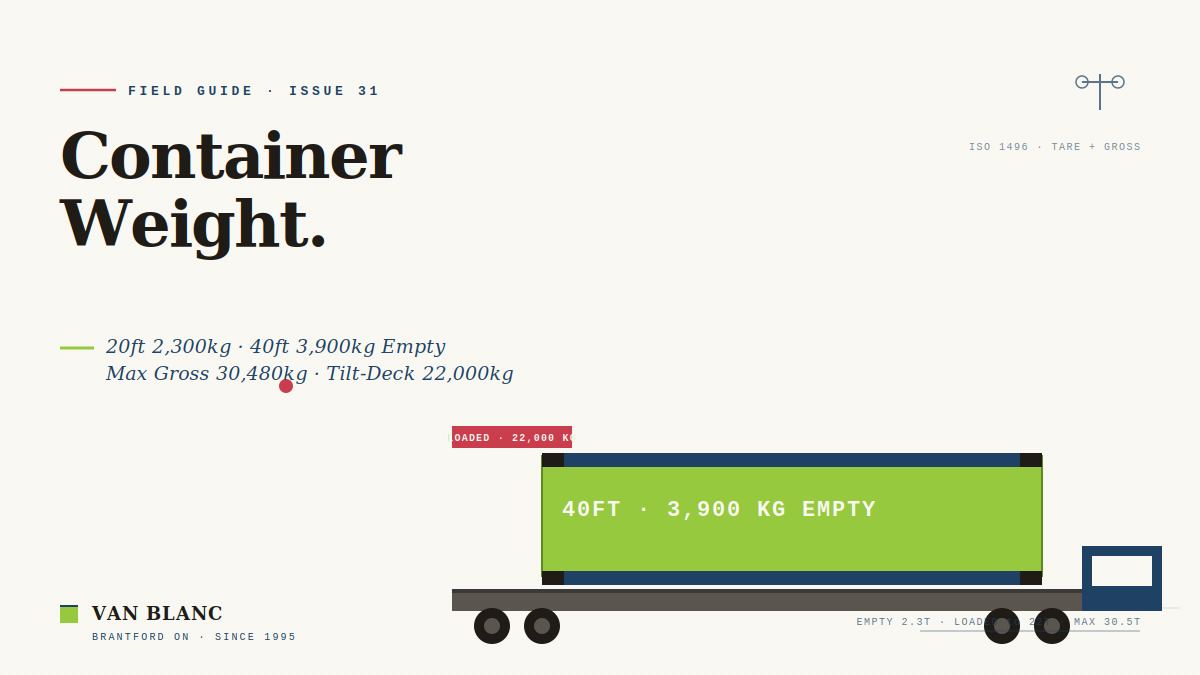
Quick Answer: Per ISO 1496-1 (general cargo containers). A 20ft shipping container weighs 2,200-2,300 kg empty; a 40ft is 3,750-3,900 kg; a the 40ft high-cube spec 3,900-4,100 kg. Max gross weight (container + cargo) is 24,000-30,480 kg depending on size. Tilt-deck delivery puts 14,000-22,000 kg on the access road; soft soil and rural bridges need pre-delivery verification. The LeBlanc family has run Van Blanc Ent. Inc. since 1995. 140+ verified Google reviews at 4.9 stars, 1-3 day delivery.
Ready to buy one? The 20ft, 40ft, high cube and 45ft sizes in the weight table below are on our containers for sale page. Before you buy, we photograph the exact unit at our 4 Brantford yards, CSC plate included, so you see that box’s own numbers. Delivery takes 1 to 3 days anywhere in Ontario, and you pay on delivery.
In This Guide
- What are the three weight numbers on a shipping container?
- How much does each shipping container size weigh?
- Why does empty (tare) weight matter when you buy?
- Will a container delivery truck handle my driveway and access road?
- Foundation and pad load capacity
- Stacking weight and structural limits
- What are the road weight limits for hauling a container in Ontario?
- Refrigerated container weight specifications
- How weight distributes inside a container
- How does loaded weight change the math versus empty?
- FAQs
Reading Time: about 11 minutes
What are the three weight numbers on a shipping container?
A shipping container has three weight numbers: tare weight (the empty container, 2,200-2,300 kg for a 20ft and 3,750-3,900 kg for a 40ft), maximum payload (the cargo it is rated to carry), and maximum gross weight (tare plus payload, capped at 24,000-30,480 kg by ISO 1496). All three are stamped on the CSC plate riveted to the cargo doors.
Every shipping container has these three weight specifications, all stamped on the CSC plate riveted to the cargo doors. Buyers focused on storage applications often ignore these numbers, then run into a problem at delivery, pad construction, or eventual cargo loading. The three numbers:
- Tare weight: the empty container itself. Determines delivery truck combined weight and what your driveway has to handle.
- Maximum payload: the cargo weight the container is engineered to carry. Determines what you can store inside without violating structural ratings.
- Maximum gross weight: tare plus payload. The international shipping limit per ISO 1496 for safe road and ocean transport.
Tare and payload combine to give max gross. Industry convention is to print all three on the CSC plate in kilograms (and sometimes pounds). The tare is fixed by manufacturer; payload and gross are the engineered ratings that hold for the life of the container per CSC re-inspection. Every unit in our sea can sale rows has a plate you can read before you buy, so the tare you plan the driveway around is the tare that arrives.
How much does each shipping container size weigh?
Shipping container weight varies slightly by manufacturer, build year, and steel gauge. At the small end, a 10ft weighs about 1,300 kg empty, the lightest ISO length. Older containers (pre-2000) often weigh more due to heavier steel; newer containers use optimised steel utilisation. If you are still deciding between footprints, our rundown of the sea can sizes Ontario buyers actually use pairs each length with its typical empty weight. The CSC plate on the specific unit shows actual numbers. Plate figures for a common 20ft series, and every grade we stock, are on our page for a used or new 20ft container for sale.
| Container Type | Tare (Empty) Weight | Max Payload | Max Gross Weight |
|---|---|---|---|
| 10ft Standard | 1,200-1,350 kg (2,650-2,975 lb) | 10,150 kg | 11,500 kg |
| 20ft Standard | 2,200-2,300 kg (4,850-5,070 lb) | 21,750 kg | 24,000 kg |
| 20ft High Cube | 2,350-2,450 kg (5,180-5,400 lb) | 21,550 kg | 24,000 kg |
| 40ft Standard | 3,750-3,900 kg (8,270-8,600 lb) | 26,580 kg | 30,480 kg |
| 40ft High Cube | 3,900-4,100 kg (8,600-9,040 lb) | 26,580 kg | 30,480 kg |
| 45ft High Cube | 4,800-5,000 kg (10,580-11,025 lb) | 25,000 kg | 30,000 kg |
| 20ft Refrigerated | 3,000-3,200 kg (6,610-7,050 lb) | 20,800 kg | 24,000 kg |
| 40ft HC Refrigerated | 4,500-4,800 kg (9,920-10,580 lb) | 25,680 kg | 30,480 kg |
Two patterns to note from the table. First, High Cube containers weigh slightly more than standard equivalents because of the additional steel for the taller envelope, but the max gross weight stays the same (ISO 1496 limit). Our High Cube vs Standard breakdown explains when the extra steel is worth the premium. Second, reefers weigh significantly more than dry containers because of the insulated walls and refrigeration unit, and their max payload is correspondingly reduced. Full reefer specs live in our our guide to reefer units.
Why does empty (tare) weight matter when you buy?
Empty weight, the tare, matters more than payload or gross for most Ontario container buyers using the unit for storage or modification. It tracks closely with the steel envelope, so reading tare alongside the full external and internal measurements for each box gives you the clearest picture of what you are putting on your pad. Tare determines:
- Delivery feasibility. The tilt-deck truck carrying the empty container has to reach your property without exceeding bridge weight limits, soft-soil bog points, or driveway crack thresholds. Empty + truck combined weight is what your access road has to handle.
- Foundation requirements. The pad or cribbing under the container has to support the empty weight plus any added cargo or modifications. For a 40ft HC sitting on four corner castings at 4,000 kg empty, each corner carries roughly 1,000 kg of static load before any cargo is added.
- Delivery weight class. Tilt-deck delivery of the container you buy scales with weight class. An empty 20ft rides lighter than an empty 40ft on the access route into your Ontario property.
- Stacking considerations. If the buyer plans to stack two containers, the lower container’s structural envelope has to support the upper container’s tare weight as a constant load distributed through the corner castings.
Paul LeBlanc, owner, Van Blanc Ent. Inc.: “The first thing a buyer should read on any container is the CSC plate. The tare weight on that plate tells you what your driveway has to carry the day we deliver it, and it never changes for the life of the box. I have been in containers nineteen years and in Asian trade for forty before that. The number on the plate is the honest one. The number someone quotes you over a Facebook listing is not.”
CSC plate: where the actual tare weight is
Every shipping container has a CSC (Container Safety Convention) plate riveted to the cargo doors. The plate shows the actual tare weight in kilograms for that specific unit, along with maximum payload, maximum gross, container number, owner code, and manufacturer ID. Reading the CSC plate during yard inspection confirms you are buying the unit you think you are buying. A unit without a CSC plate, or with an illegible plate, is either an older container retired from international service or a container that has had its plate removed; both are flags worth investigating before purchase. Every box on our shipping containers for sale page can be photographed down to its CSC plate before you pay.
Will a container delivery truck handle my driveway and access road?
Tilt-deck delivery puts the combined weight of the truck plus the empty container on your access road, and that combined number surprises most first-time Ontario container buyers. Three scenarios:
| Container | Tilt-Deck Truck (empty) | Container (empty) | Combined Road Weight |
|---|---|---|---|
| 20ft | ~11,000-12,000 kg | ~2,200-2,300 kg | ~13,500-14,500 kg |
| 40ft | ~13,500-14,500 kg | ~3,750-3,900 kg | ~17,500-18,500 kg |
| 40ft HC | ~13,500-14,500 kg | ~3,900-4,100 kg | ~17,700-18,800 kg |
| 40ft HC Reefer | ~13,500-14,500 kg | ~4,500-4,800 kg | ~18,300-19,500 kg |
Most Ontario rural and suburban driveways handle 15,000-19,000 kg combined weight without issue, and how that load reaches your property is something we plan ahead of the drop. Walking through what the delivery day looks like before the truck arrives is the easiest way to head off a soft-soil or tight-access surprise. Concrete driveways tolerate this easily. Asphalt driveways tolerate this with minor compression (1-3 mm tire impressions) that recovers within a few weeks. Gravel driveways handle it well if the gravel base is properly compacted; loose top gravel may rut and need re-grading after delivery. For the broader picture of 40ft container dimensions and what fits, see our dimensions guide.
Where it gets harder: soft topsoil with poor drainage, freshly poured concrete (less than 28 days cured), interlock pavers with shallow base, wooden bridges on rural access roads with unknown weight ratings, and rural culverts that have not been inspected in 20+ years. For any of these conditions, pre-delivery site survey matters. The fix is usually to lay 1.2 m x 2.4 m sheets of 3/4-inch plywood or 1/2-inch OSB under the tilt-deck wheel paths during the drop, then remove after the truck rolls clear. The plywood sheets are inexpensive and reusable for the next job.
Foundation and pad load capacity
Once the container is placed, the static load distributes through four corner castings to whatever foundation you have prepared. For a 40ft container at 4,000 kg empty, each corner casting transfers about 1,000 kg of load to the ground. Add typical cargo at 5,000-15,000 kg distributed across the container floor, and each corner casting can transfer 2,000-5,000 kg. Tare, gross and payload figures for the 40ft containers we sell are on our product page.
Standard Ontario foundation approaches and their load capacity:
| Foundation | Site Prep Effort | Load Capacity per Corner | Best Fit |
|---|---|---|---|
| Compacted stone pad with no cribbing | Lowest: grade and compact only | 1,500-2,500 kg | Light cargo storage only |
| Stone pad + 6×6 pressure-treated cribs | Low: pad plus four timber cribs | 2,500-4,000 kg | Most general storage uses |
| Stone pad + concrete deck blocks | Moderate: pad plus levelled blocks | 3,500-5,500 kg | Heavy commercial / industrial |
| Helical screw piles | Higher: installer with drive head | 5,000-8,000 kg | Sloped sites, poor soil |
| Engineered concrete pad with frost footings | Highest: excavation, forms, pour, cure | 10,000+ kg | Permanent residential / multi-container builds |
For most Ontario storage applications, the stone pad with 6×6 pressure-treated wooden cribs at the corner casting positions handles the empty container weight plus typical cargo loading without issue. This is what about 70 percent of Van Blanc deliveries land on. Concrete pads are reserved for permanent residential builds, multi-container stacked configurations, and industrial uses where the container will not be relocated.
Stacking weight and structural limits
Shipping containers are engineered for stacking 6-9 high in ocean cargo service. On land, stacking 2-3 high for residential, office, or industrial use is well within the structural envelope. The corner castings carry the load through to the foundation; the long side walls do not bear stacking load directly.
Stacking weight calculations for typical Ontario builds:
- Two 40ft HC stacked vertically: Upper container empty weight (~4,000 kg) plus cargo (say 3,000 kg for finished residential interior) gives 7,000 kg of stacking load distributed through four corner castings to the lower container’s structural envelope, then through the lower container’s corner castings to the foundation. Standard ISO 1496 ratings handle this with significant safety margin.
- Three 40ft HC stacked: 14,000 kg combined upper-stack load. Still within ISO 1496 ratings but requires structural-engineer review for permanent residential installations, especially in seismic zones.
- Side-by-side rather than stacked: No vertical loading concerns. Each container sits on its own foundation. Common for multi-container residential builds where the architectural design wraps containers in an L-shape, U-shape, or courtyard configuration.
For any stacking beyond 2-high, work with a structural engineer who can stamp the design. An engineered, sealed design is the safe way to confirm the corner-casting loads, anchoring, and wind and seismic behaviour of a multi-high build before anyone occupies or works around it.
What are the road weight limits for hauling a container in Ontario?
Ontario road-haul carries its own legal weight limits per the Highway Traffic Act and Ministry of Transportation regulations, separate from the container’s own weight ratings. For typical tilt-deck container delivery:
- Provincial weight limits: Standard 5-axle truck-trailer combinations on Ontario highways can carry up to about 41,000 kg gross combined vehicle weight. Tilt-deck container delivery rarely approaches this limit.
- Seasonal load restrictions: Many rural Ontario municipalities impose half-load restrictions during spring thaw (typically late February through May) that reduce permissible road weights by 50 percent. This can affect delivery scheduling for cottage country and rural agricultural routes. Confirm with the local municipality before scheduling late winter or early spring delivery.
- Bridge and culvert ratings: Provincial and rural bridges have posted weight limits. The 18,000 kg combined weight of tilt-deck plus 40ft container is well within typical provincial bridge ratings but may exceed older rural concession-road bridge ratings.
- Construction zone considerations: Active construction zones with reduced lane width or compromised pavement may require alternate routing. The delivery driver coordinates this with the buyer ahead of time.
Christian LeBlanc, second-generation operator: “Weight comes up in every container call for two reasons: the customer wants to know if their driveway can handle delivery, and they want to know if the container can carry their planned cargo. Honest answers: most Ontario driveways handle delivery fine, and almost no Ontario use case approaches the container’s max payload. The constraint is usually access width and overhead clearance, not weight. We pre-survey every delivery and confirm both before dispatching.”
Refrigerated container weight specifications
Reefers are heavier than dry containers because of the insulated walls (4-6 inches of polyurethane foam between inner and outer steel skins) and the refrigeration unit on the door end. Empty weight is 700-1,200 kg more than equivalent dry containers, which affects delivery logistics and payload capacity:
- a 20ft refrigerated unit empty: 3,000-3,200 kg (vs 2,300 kg for 20ft dry). Max payload reduces to 20,800 kg.
- the 40ft high-cube reefer empty: 4,500-4,800 kg (vs 4,000 kg for 40ft HC dry). Max payload reduces to 25,680 kg.
For winery, dairy, produce, and pharma cold-storage applications, the reduced payload is rarely binding because cold-chain cargo (bottled product, pallets of perishable goods) is volume-limited before weight-limited. Tilt-deck delivery of a reefer adds 500-700 kg to the combined road weight versus dry containers, still well within most Ontario delivery routes. Our what delivery day looks like covers the full tilt-deck process.
How weight distributes inside a container
The container floor is designed to handle the rated payload across its full surface, but uneven loading creates real stress on the structural frame. Five practical rules from over 30 years of delivering containers across Ontario:
- Distribute heavy cargo across the long axis. A 40ft container loaded with all heavy items at one end stresses the corner castings unevenly. Spread heavy pallets along the length of the floor, not concentrated at the cargo doors or the closed end.
- Use the centre line for the heaviest single items. If you have one extremely heavy item (a vehicle, a large machine, a stone slab), centre it across the long axis so the weight transfers evenly to both side walls and corner castings.
- Keep concentrated point loads under 1,500 kg. Vehicle wheels, machine feet, and stacked steel coils create point loads. Spreading concentrated weight with plywood or steel plate (1.2 m x 2.4 m, 19 mm thick) distributes the load across the floor structure and prevents long-term floor deformation.
- Avoid stacking against the cargo doors. The door end of the container is structurally weaker than the closed end (the doors themselves are not load-bearing). Heavy cargo stacked against the doors during transport or seismic events can stress the door frame. Keep heavy stacks at least 1 metre from the cargo doors.
- Block-and-brace any rolling cargo. Vehicles, ATVs, drum loads, and rolling equipment need wheel chocks, ratchet straps, or welded tie-down points to prevent shift during transport. Loose cargo shifting during a tilt-deck delivery can damage the container interior and the cargo itself.
Ready to price your container?
Tell us the size and your postal code and we’ll send back an honest, all-in number, container, delivery, and placement, usually within 1-3 days. No pressure, no mystery fees.
Family-run in Brantford since 1995 · 200+ containers in stock · 4.9★ across 140+ Google reviews · every box graded by a person, walk it before it lands.
How does loaded weight change the math versus empty?
Loaded weight matters mainly for the minority of buyers who fill the container before it travels (an export shipment loaded for marine freight, or a unit a third-party hauler relocates already loaded). Most Ontario container buyers receive their unit empty and load it after it is placed, so empty (tare) weight governs the delivery. When a container does travel loaded, the loaded weight affects several operational details:
- Tilt-deck capacity: Standard tilt-deck trucks handle loads up to about 24,000 kg combined. Empty container plus tilt-deck weighs about 14,000-19,000 kg, leaving 5,000-10,000 kg of cargo capacity before the load exceeds standard tilt-deck rated weight.
- Bridge ratings: A loaded 40ft container at 22,000 kg cargo plus 4,000 kg tare plus 14,000 kg truck reaches 40,000 kg combined road weight, near the standard provincial highway maximum. A route hauling a loaded container has to be verified for bridge ratings before dispatch.
- Spring half-load restrictions: Many rural Ontario municipalities reduce permissible road weights by 50 percent from late February through May. A loaded container travelling during this window may require lower-load detour routes or postponement until restrictions lift.
- Weight drives the haul rate: Tilt-deck haulage rates scale with combined weight, which is why an empty delivery and a fully loaded relocation are priced very differently. We deliver the container you buy; relocating an already-loaded unit later is a job for a third-party hauler.
Frequently Asked Questions
How much does a 20ft shipping container weigh empty?
2,200-2,300 kg (4,850-5,070 lb) for a standard 20ft. High Cube weighs slightly more at 2,350-2,450 kg due to the taller envelope. Max payload 21,750 kg, max gross 24,000 kg. The exact tare for any specific container is stamped on its CSC plate.
How much does a 40ft shipping container weigh empty?
3,750-3,900 kg (8,270-8,600 lb) for a standard 40ft. High Cube weighs 3,900-4,100 kg. 40ft HC Reefer weighs 4,500-4,800 kg due to insulation and refrigeration unit. Max payload (standard or HC) is 26,580 kg; max gross 30,480 kg.
Will the container delivery damage my driveway?
Most Ontario driveways handle the 14,000-19,000 kg combined truck-plus-container delivery weight without issue. Concrete handles it easily. Asphalt tolerates it with minor compression that recovers within weeks. Gravel handles it if properly compacted. Soft soil, freshly poured concrete (under 28 days cured), and interlock pavers with shallow base may rut or crack; use plywood sheets under wheel paths during delivery to spread the load.
Can I stack two containers vertically?
Yes, well within ISO 1496 structural ratings. Two 40ft HC stacked vertically with 3,000-5,000 kg of cargo each puts roughly 7,000-9,000 kg on the lower container’s corner castings, well below the rated stacking capacity. For 3-high stacks or any stacking that people will occupy or work around, have a structural engineer stamp the design so the corner-casting loads and anchoring are verified before use.
What is the heaviest cargo I can store in a shipping container?
Up to the max payload limit: 21,750 kg for 20ft, 26,580 kg for 40ft standard or HC, 20,800 kg for 20ft reefer, 25,680 kg for 40ft HC reefer. Cargo must be distributed evenly across the floor; concentrating heavy items at one end can stress the structural frame. Almost no Ontario land-based storage use case approaches these limits.
Do bridge weight limits affect my container delivery?
Typically not on provincial highways or major rural roads, where bridge ratings comfortably exceed the 18,000-19,000 kg combined tilt-deck weight. May matter on older rural concession-road bridges with posted lower ratings, and during spring thaw half-load periods when many municipalities reduce permissible weights by 50 percent. Confirm with the local municipality before late-winter or spring delivery.
Can I inspect the CSC plate before I buy?
Yes at the Van Blanc Brantford yard. We carry over 200 containers in inventory and we let buyers physically walk the row, read CSC plates, verify tare weights and CSC re-inspection dates, and pick the specific unit before paying. The CSC plate is the source of truth for any container’s weight specifications.
Sources
- International Organization for Standardization. (2013). ISO 1496-1:2013, Series 1 Freight Containers – Specification and Testing, Part 1: General Cargo Containers. iso.org
- International Organization for Standardization. (2022). ISO 6346:2022, Freight containers – Coding, identification and marking. iso.org
- International Maritime Organization. (1972, amended). International Convention for Safe Containers (CSC). imo.org
- Ministry of Transportation Ontario. (2025). Vehicle Weights and Dimensions on Highways. ontario.ca
- Transport Canada. (2025). Cargo Securement Standard 10 – Containerized Cargo Road Haulage. tc.canada.ca
Reach Van Blanc in Brantford
We have been supplying shipping containers across Ontario since 1995. Our warehouse is at 90 Morton Avenue E in Brantford, and we deliver right across the province on a cash-on-delivery basis. Every container in inventory has its CSC plate visible for inspection. Pre-delivery site surveys confirm weight tolerances for your specific access route.
Van Blanc Ent. Inc. – 90 Morton Ave E Unit 1B, Brantford, ON N3R 7J7 – +1 888-509-6658
Worried about your driveway, bridges, or pad capacity? Drive to Brantford, walk our row with Paul or Christian, read the CSC plates, and we will pre-survey your delivery access. Over 200 containers in inventory, and you pick your specific bin before paying.