
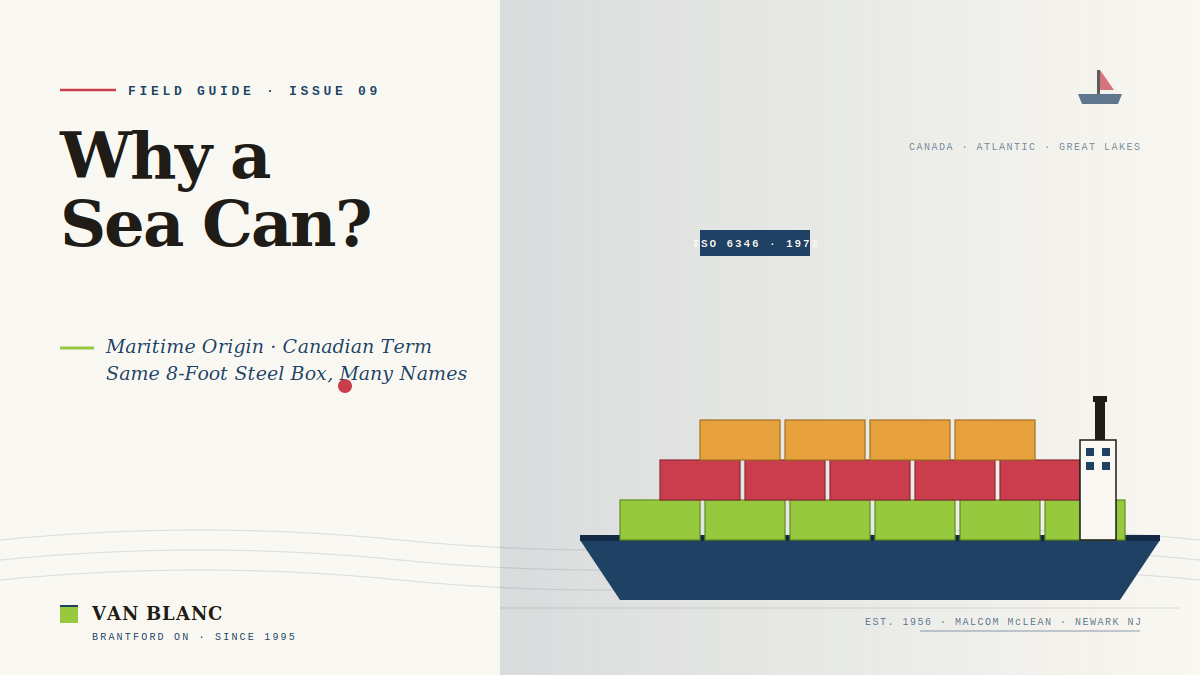
Quick Answer: A shipping container is called a sea can in Canada because the box was built to cross the sea, and Canadians clipped “sea container” down to “sea can.” The name took hold after Malcolm McLean’s 1956 voyage proved one steel box could move from ship to truck without unloading, and stuck because it fits the way Canadians actually talk. For the full picture, see how the slang spread through Canada’s container trade. Family-run since 1995, 4.9 stars across 140+ verified Google reviews. Delivery in 1-3 days from our 4 Brantford yards.
In This Guide
- How did “sea can” become Canada’s word for a steel shipping box?
- The 1956 ship that made the name necessary
- Why is it called a sea can and not something else?
- Why Canadians said it first
- Is a sea can the same as a c-can or a c-container?
- Where “sea can” sits in the full Canadian container vocabulary
- What Paul saw from the import side
- What do Ontario buyers mean when they search “sea can”?
- One scam to watch when you are shopping by name
- Frequently Asked Questions
- Sources
- Reach Van Blanc in Brantford
Reading time: 13 minutes
How did “sea can” become Canada’s word for a steel shipping box?
A sea can is the Canadian colloquial name for an ISO shipping container, the 8-foot-wide weather-tight steel box used for ocean freight and land storage. The word is a clipped form of “sea container.” Canadian dockworkers, military supply chains, and prairie farmers shortened it through the 1980s, and it became the everyday term across rural Canada.

If you grew up in rural Canada, you probably heard “sea can” before you heard “shipping container.” The 8-foot-wide steel box parked behind the equipment shed at the back of a farm field. The blue or rust-red rectangle that showed up to a job site on a tilt-deck trailer. The box your uncle bought from a guy in 1998 and never moved off the gravel pad. Whatever the box ended up doing, the word for it was sea can.
The full name is “sea container.” Like many things Canadians use every day, the long version got squeezed in conversation. Sea container became sea can. Once enough people said it that way, the short form was the name. By the 1990s the term had spread from Western Canada eastward, picked up by farmers, contractors, second-generation immigrants from container-shipping countries, returning military, and the container trade that Van Blanc has been part of since 1995.
The American version of the same shortcut is conex box, which we will get to. The British version stayed as shipping container and never shortened. In Canada, the word that won was sea can. This page explains why, all the way back to a 58-container voyage out of New Jersey in 1956 that remade the world.
Christian LeBlanc, second-generation operator, Van Blanc Ent. Inc.: “Most callers in Ontario open with sea can, not shipping container. A farmer in Brant County, a contractor in Hamilton, a cottager up in Haliburton, they all say it. We answer in whatever word they use. It is the same box on the same tilt-deck truck out of our Brantford yards, no matter which name brought them to the phone.”
The 1956 ship that made the name necessary
Before 1956, freight crossed the ocean as loose cargo. Sacks, crates, barrels, drums, bales of cotton, pallets of canned goods. Stevedores loaded each piece by hand into the holds of break-bulk freighters. A medium-sized ship could take a week to unload at port, with crews of dockworkers shuffling cargo piece by piece. Loading cost about 5.83 US dollars a ton. Theft was constant. Damage was constant. The ship sat in port more than it sat at sea. Every box in our Brantford yards descends from the fix McLean built for that problem, right down to the corner castings a crane still hooks today.
On April 26, 1956, a converted World War II oil tanker called the SS Ideal-X sailed from Port Newark, New Jersey, to the Port of Houston, Texas. On its deck were 58 steel boxes, 35 feet long, lifted onto the ship by crane in a single afternoon. The man who put them there was Malcolm McLean, a North Carolina trucking entrepreneur who had spent two decades watching dockworkers handle freight one piece at a time and decided there had to be a better way. McLean’s calculation was that loading containers would cost 16 cents per ton instead of 5.83 dollars. He was off, but only slightly. The real number turned out to be even better.
The economics that made containerization inevitable
McLean’s 1956 voyage proved a single point: if you put cargo into a sealed steel box at the factory, sent that box by truck to the ship, lifted the whole box onto the deck with one crane, and unloaded it at the destination port onto another truck, you eliminated almost all the labour cost of break-bulk freight. The same logic worked at every link in the chain. By the late 1960s, the major shipping lines had adopted the standard. The International Organization for Standardization codified the dimensions in ISO 668 in 1968 and the marking system in ISO 6346 in 1972. The container had become the default. The factory in Asia, the ship across the Pacific, the train across North America, and the truck to the back of a Brant County farm were all carrying the same box.
The box needed a name. In English-speaking shipping circles, “container” or “intermodal container” did the job in trade publications. On the docks, “freight container” and “ocean container” both saw use. In Canada, where the boxes started arriving in serious volume through the 1970s and 1980s as Asian manufacturing scaled, two words ended up describing the box more often than any other: sea container. And sea container, in Canadian mouths, became sea can.
Why is it called a sea can and not something else?
The name “sea can” combines two plain words for a plain reason. The “sea” part is simple. The box was built for the sea. Corten weathering steel resists salt-air corrosion. Twist-lock corner fittings let cranes stack the box four high on a deck. Tare weight, payload, and dimension standards exist so a box loaded in Shanghai can be lifted onto any ship in any port without question. Sea is the original purpose, the original environment, and the engineering brief.
The “can” part takes a moment longer. In English, “can” has carried the meaning of a sealed metal container since at least the 19th century. Tin cans for food, milk cans for dairy, ammunition cans for the army, garbage cans for the alley. The word stuck to anything that was metal, sealed, and moved cargo or contents from one place to another. By the time the steel shipping box arrived in Canada, “can” was already a thoroughly Canadian word for a metal container with a function. Stretching it to cover a 20-foot weather-tight steel box was a small step. The box was a can. The can went on the sea. Sea can.
The British did not adopt this. They had their own naval English and stuck with “container” or “shipping container.” The Americans went a different way. The US Army had been building its own family of standardised steel boxes since the Korean War, and the term they coined was conex, short for “container express.” That military word seeped into civilian American usage and never left. So the same 8-foot-wide steel box that a Canadian rancher calls a sea can, an American contractor often calls a conex. Same box. Different word. Different national habit.
Why Canadians said it first
Canada was unusually well placed to put “sea can” into everyday speech. Three reasons.
First, the Royal Canadian Navy and the Canadian Forces have a long-running internal vocabulary called Jackspeak, the Canadian naval slang dictionary that catalogues hundreds of terms used by sailors and supply officers over a century of service. Canadian military supply chains adopted intermodal containers early because Canadian operations stretched across two oceans, the Arctic, and a long list of NATO ports. By the 1980s, the navy’s working vocabulary already included “sea can” as a standard term for the steel boxes that arrived at the docks at Halifax and Esquimalt. Canadian soldiers and sailors carried the word back to civilian life when they retired or rotated out, much the way American veterans carried “conex” home.
Second, the Canadian prairies had a working culture of metal storage long before containerization. Grain bins, fuel tanks, milk cans, and railcar surplus had been parked behind farmhouses for a century. When the first wave of used shipping containers became cheap enough to buy in the 1980s, prairie farmers slotted them into the same mental category. They were just bigger cans. The word transferred without anybody having to argue about it.
Third, Canadian English has a habit of clipping multi-syllable industrial terms down to short, punchy ones. We say tarp instead of tarpaulin, gas instead of gasoline, hydro instead of hydroelectricity, eavestrough instead of rain gutter, two-four instead of case of twenty-four beer. Sea container becoming sea can is the same instinct. The long form survived in trade paperwork. The short form survived in conversation, on the radio, on the phone with a supplier, on the way back from the yard with a friend.
The word travelled east through the import trade
Western Canada said “sea can” first, but the word reached Ontario through the import-export community by the late 1980s. Containers arriving at Vancouver and Montreal were rolling on rail through Brantford daily. The customs brokers, freight forwarders, and small-business importers who handled them used “sea can” in conversation because the people on the dock used it. Van Blanc opened its Brantford yard in 1995 inside that trade. By that point, the term was established Ontario vocabulary, especially in agricultural counties like Brant, Norfolk, Haldimand, and Wellington, where farm storage drove the early Canadian buy-and-resell market.
Is a sea can the same as a c-can or a c-container?
A sea can and a c-can are the same box. If you have spent any time in Canadian container conversation, you have probably heard “c-can” used interchangeably with “sea can.” Some buyers will say it as one word, ccan, almost as a single syllable. The compressed shorthand can throw newcomers off. It is the same box.

The c-can spelling is what happens when you say “sea can” fast enough that the second word’s vowel disappears. Sea can becomes c-can becomes ccan. Some Western Canadian suppliers built their entire branding around the c-can spelling, which is why search engines see strong volume on both forms. Google’s data shows roughly 2,900 monthly Canadian searches for “c can” and another 590 for the compressed “ccan,” all alongside 9,900 monthly searches for “sea can” itself. They are all the same product.
If you are looking at a list where one supplier writes “sea can,” another writes “c-can,” and a third writes “shipping container,” you are looking at three suppliers describing identical units. The vocabulary varies. The product does not. What changes the box is its length and grade, and if you are still deciding between a 20-footer and a 40-footer, our full dimensions guide for Canadian buyers lays out the interior and exterior measurements side by side.
| Term | Where it comes from | Who uses it most | Canadian search volume |
|---|---|---|---|
| Sea can | Sea + can, clipped from “sea container” | Canadian residential, farm, small business | 9,900 / month |
| C-can | “Sea” reduced to its phonetic letter | Canadian contractors, casual buyers | 2,900 / month |
| Ccan | Compressed shorthand of c-can | Western Canada online listings | 590 / month |
| Shipping container | Industry standard English | Trade publications, industry buyers | 9,900+ / month |
| Conex box | US military “container express” | American buyers, retired military | 170 / month (Canada) |
| Intermodal container | ISO standard naming | Logistics, supply chain, freight forwarders | 260 / month |
| Storage container | Use-case framing | Residential renovators, homeowners | 1,300+ / month |
| Cargo container | Trade and export framing | Export businesses, retailers | 480 / month |
One word that needs a careful note: “sea bin.” A handful of buyers will say sea bin instead of sea can, especially older buyers in rural Ontario where “bin” is the working word for any large outdoor container. The trouble with searching “sea bin” online is that it collides with the Seabin Project, a global environmental initiative making automated marine trash collectors for marinas. If you search “sea bin for sale Ontario,” you will get a mix of shipping container listings and floating debris collectors. Always specify “sea can” or “shipping container” to keep the search pointed at the right product.
Where “sea can” sits in the full Canadian container vocabulary
Most Canadian buyers do not arrive at a container supplier with one word in their head. They have heard several over the years. Each word carries a slightly different angle. Knowing what each one signals helps a buyer get on the same page as the supplier on the first call. And when the vocabulary question turns into a buying question, our guide to buying a sea can in Ontario picks up where the etymology leaves off.
Sea can / sea container
The default Canadian residential and farm term. Used most often by buyers from rural Ontario, Western Canada, and small-business owners who picked up the term from neighbours, suppliers, or military service. Implies the speaker is not in the freight-forwarding industry but knows what the box is and what it does.
C-can, c-container, c can
The compressed Canadian shorthand. Slightly more common in Western Canada than the East but heard everywhere. Used by contractors, second-generation Canadian-Asian buyers, and casual buyers who want to sound informal. Same product as sea can.
Conex box, conex container
The American military term, short for “container express.” Common among retired Canadian Forces members who served alongside US units, American contractors working in Canada, and buyers who picked up the word from US-based YouTube tutorials about container homes. The word implies a buyer with a military or industrial background. Most Canadian suppliers will recognise the term and translate to “shipping container” without comment.
Intermodal container
The trade-paper word. Used by procurement officers, logistics managers, supply-chain professionals, and freight forwarders. “Intermodal” means the box can move between ship, train, and truck without unpacking, which is the whole point. If a buyer says intermodal container on the first call, they are usually a procurement professional, and the conversation will move quickly to spec sheets, ISO 6346 markings, and how we grade a used box as cargo worthy or wind and watertight.
ISO container
A more technical synonym for intermodal container, naming the International Organization for Standardization that governs the dimensional and marking standards. Used by structural engineers, modification fabricators, and buyers who care about whether a unit’s CSC plate is still current for export. About 170 Canadian searches per month, almost all from professionals.
Cargo container
Used most often by export businesses and retailers. Implies the speaker is shipping cargo in the box rather than using the box for storage. Most Canadian residential buyers do not search this term. About 480 Canadian searches per month, with high commercial intent.
Storage bin, shipping container, cargo bin
The use-case words. A homeowner doing a renovation searches “storage container.” A farmer searches “storage bin for sale.” A contractor searches “shipping container.” Same product, different framing of why the buyer wants it. The vocabulary tells the supplier what the buyer plans to do with the box, which is more useful than the brand-style word.
What Paul saw from the import side
Van Blanc’s owner, Paul LeBlanc, came to containers from the import side, where the boxes were the means and the contents were the product. He watched the term move from the dockworker community through the freight forwarders and settle into Canadian household speech by the time his son Christian was old enough to walk the yard with him.
Paul LeBlanc, Owner, Van Blanc Ent. Inc.: “The goods we brought in came home in steel boxes. People called them shipping containers if they read the trade papers and sea cans if they had any common sense. By the late 1980s the dockworkers were saying sea can on the radio so often that the word reached the farms. By the time we opened in Brantford in 1995, every farmer in Brant County already knew what a sea can was. The word grew up alongside the trade.”
Paul’s view from the import side is part of why Van Blanc’s vocabulary on the phone matches what Ontario buyers actually say on the phone. The yard staff use sea can, c-can, shipping container, conex, and intermodal interchangeably depending on who is on the call. None of them are wrong. They are different generations and different professions describing the same 8-foot-wide steel box.
What do Ontario buyers mean when they search “sea can”?
The phrase “sea can” carries a buyer’s intent in a way that “shipping container” does not. Most people who type “sea can” into Google in Canada are looking for one of a small number of specific outcomes. Knowing which outcome you are after helps you get to the right grade, size, and price faster.

Farm storage in Brant, Norfolk, Haldimand, Wellington
Around half of Van Blanc’s sea can buyers in any given month are farmers. The use case is equipment storage at the back of a working field, hay or feed storage, secure tool storage during harvest, or refrigerated reefer units for greenhouse and cannabis operations. The right grade is usually Wind & Watertight, the value pick for stationary land storage, and the right delivery is a tilt-deck truck from one of our 4 Brantford yards. We quote the unit and the route together so the number you hear is the number you pay.
Construction site office, GTA contractor
The contractor in Brampton, Mississauga, or Hamilton who is searching “sea can” usually wants a job-site office or a secure on-site lockbox for tools and materials. The right grade depends on the build. A new (one-trip) 20-footer gives a clean, brandable starting point for a modified office, with original factory paint and doors that operate cleanly. A Cargo Worthy unit is the value pick for tool storage where surface rust and a few dents do not matter. What moves the quote is size, grade, delivery distance, and the current steel market, so we price each order rather than post a number that goes stale.
Cottage or rural property, year-round storage
The cottage owner in Muskoka, Haliburton, or the Kawarthas is searching “sea can” because they want a place to store the Sea-Doos, snowmobiles, and lawn equipment when the property is closed for winter. A 20-foot Wind & Watertight or a 40-foot standard handles the use. Delivery to cottage country is premium freight from Brantford, and we quote it per route because the road in to a lake property is not the same as a flat industrial yard. If you are weighing what a 20-footer versus a 40-footer actually costs to keep on a seasonal property, our plain-language breakdown of what drives a container’s price across Ontario walks through every factor before you call.
Residential workshop, garage, or studio
The homeowner in Brantford, Cambridge, or Kitchener who searches “sea can” usually wants a 20-foot dry box for the back of the property. Workshops, garage extensions, hobby studios. A Wind & Watertight unit is the practical pick for plain storage. A new (one-trip) unit is the one to choose if the buyer plans to insulate, finish, and use the box as occupied space, because it starts from clean factory paint and a sound floor. If a finished workshop or studio is the goal, the conversion side of the yard handles venting, windows, man doors, and insulation; you can see the scope of that work on our container conversion and modification options.
What none of these searches usually mean is “I want to ship cargo internationally.” International shipping intent shows up under different vocabulary, mostly intermodal container or cargo worthy container, and the buyer cares about CSC plate validity. Sea can searches are a Canadian domestic-use signal. That is a useful tell on the first call. It tells the supplier you are buying for use in Canada rather than for export. Once you have settled on the use, you can see what we currently have in the yard for Ontario buyers in each size and grade.
Ready to price your container?
Tell us the size and your postal code and we’ll send back an all-in number, container, delivery, and placement, usually within 1-3 days. No pressure, no mystery fees.
Family-run in Brantford since 1995 · 200+ containers in stock · 4.9★ across 140+ Google reviews · every box graded by a person, walk it before it lands.
One scam to watch when you are shopping by name
The Facebook Marketplace trap
The vocabulary around containers is loose enough that scammers exploit it. Many Ontario buyers call Van Blanc saying they have found a sea can on Facebook Marketplace for far less than our quote. Two weeks later, after they have wired a deposit to a seller who never delivers, the same buyer calls back. We have taken that call too many times to count over 30 years. If a sea can listing sits far below the market price, there is no sea can. There is a Facebook profile collecting deposits. Always verify the supplier has a real yard you can visit, a registered Ontario business address, and a working phone number that someone answers. Van Blanc has 4 Brantford yards. You can come walk a bin before you pay.

The vocabulary itself does not protect you. A scammer can write sea can, c-can, conex, or shipping container, and the listing will read as competent. What protects you is the supplier behind the listing. A real Ontario container supplier has a yard, a name, a phone, and a paper trail. A scammer has a Facebook profile and a Western Union address. The price gap will tell you which one you are looking at every time. We put the warning signs together in one place, so before you wire a deposit anywhere it is worth reading how to tell a real supplier from a fake one.
Frequently Asked Questions
Why is it called a sea can in Canada specifically?
Three reasons converged. The Royal Canadian Navy used “sea can” in its working vocabulary by the 1980s. Canadian prairie farmers already used “can” for any metal storage container, so the leap to a 20-foot steel box was small. And Canadian English clips long industrial terms by habit, the same instinct that made “tarpaulin” into “tarp” and “gasoline” into “gas.” Sea container became sea can. The word stuck because it fit the way Canadians talk.
Is it sea can or c can?
Both. They are the same word, written two ways. “Sea can” is the original spelling, taken from “sea container.” “C-can” is what the same phrase becomes when you say it fast and the second word’s vowel disappears. Some Western Canadian suppliers brand themselves around the c-can spelling. Both forms describe the same 8-foot-wide steel shipping box. Use whichever feels natural.
What is the proper name for a sea can?
The proper trade name is “intermodal container” or “ISO container,” referring to the International Organization for Standardization codes that govern the dimensions and markings. Industry buyers and trade publications use these terms. Everyday Canadian buyers say sea can, c-can, or shipping container. None are incorrect. The trade name is more formal. The colloquial names are more common.
What is a sea can used for?
Sea cans are used for farm equipment storage, construction site offices, residential workshops, garage extensions, cottage off-season storage, retail pop-up shops, refrigerated bulk storage, mining camp bunkhouses, and ocean shipping itself. The original purpose was ocean cargo. The Canadian secondary market is dominated by stationary land use, where the box becomes a steel-walled storage building with weather-tight doors and a 25-year lifespan.
Is a sea can the same as a shipping container?
Yes. A sea can is a shipping container. The names are interchangeable. “Shipping container” is the international English term used in trade and industry. “Sea can” is the Canadian colloquial term used in conversation. The product is identical: a standard ISO 6346 steel box, 8 feet wide, available in 20, 40, 45, and 53-foot lengths, with corten weathering steel walls and twist-lock corner fittings.
Where does the word “sea can” come from historically?
The word emerged from the maritime shipping industry in the 1960s and 1970s, after Malcolm McLean’s 1956 voyage proved that intermodal containers could replace break-bulk freight. Canadian dockworkers, military supply chains, and import-export traders shortened “sea container” to “sea can” by the 1980s. Western Canadian farmers and prairie buyers carried the term into rural civilian use. By the 1990s it had spread to Ontario through the import community and the freight forwarders.
Sources
- American Business History Center. (2024). Malcolm McLean: Unsung Innovator Who Changed the World. americanbusinesshistory.org
- Port Houston. (2023). Ideal X: The First Container Ship. porthouston.com
- Wiktionary. (current). Appendix: Canadian English military slang. en.wiktionary.org
- International Organization for Standardization. (2022). ISO 6346:2022 Freight containers, Coding, identification and marking. iso.org
- International Maritime Organization. (1972, amended). International Convention for Safe Containers (CSC). imo.org
Reach Van Blanc in Brantford
Van Blanc has been supplying shipping containers across Ontario since 1995. Our four Brantford yards stock 20-foot, 40-foot, 45-foot, and 53-foot units in one-trip, Cargo Worthy, Wind & Watertight, and reefer configurations. We deliver across the province in 1 to 3 days. Every quote comes with a real lead time. We are family-run, 4.9 stars across 140+ verified Google reviews, and we still answer the phone when it rings.
Van Blanc Ent. Inc. 90 Morton Ave E Unit 1B, Brantford, ON N3R 7J7. 519-754-6844
If you have been calling sea cans by one name your whole life and just want to confirm the product is the same as what your neighbour has parked on the back forty, the answer is yes. Come walk the yard. Worth the drive for the quality, family customer service with 30 years of experience.