
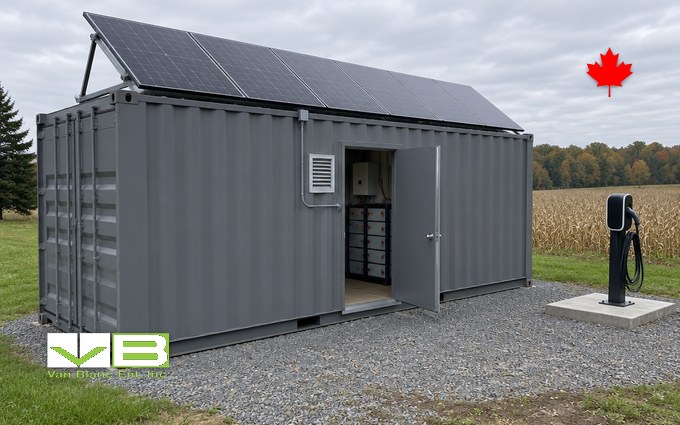
Quick Answer: A battery enclosure in Ontario follows the 2024 code: 20 kilowatt-hours per unit, one metre from windows and doors, a dedicated room or outdoor-rated unit, and a detached battery building three metres from the house. Lithium banks must stay above freezing to charge. A lined, heated container is that room.
In This Guide
- Four things people mean by a battery or solar enclosure
- The 2024 Ontario rule for home batteries, plainly
- Cold: why a lithium bank needs a warm room and a lead-acid bank needs a vented one
- Off-grid banks: the battery room at a cabin, camp or farm
- Inverters, charge controllers and the rest of the solar gear
- EV chargers and the pedestal question
- Containerized battery systems: the industry’s own enclosure
- The container as a battery room, honestly
- Enclosures on one sheet
- The battery enclosure checklist
- Battery and solar enclosure FAQs
Reading Time: 12 minutes
Four things people mean by a battery or solar enclosure
Battery storage has become four different purchases in Ontario in about five years, and the enclosure for each is a different building. The first is the home battery, a wall-mounted unit beside the panel that stores solar or cheap overnight power for the house, and its enclosure is either the garage wall or its own outdoor-rated housing, placed by a rule that came into force in 2025. The second is the off-grid bank, a rack of lithium or lead-acid batteries at a cabin, a camp or a farm that runs the place with an inverter and a solar array, and its enclosure is a room that stays above freezing and breathes. The third is the electric-vehicle charger, which is not a battery at all but gets searched with them, and its enclosure is a pedestal or a wall box on a circuit. The fourth is the containerized battery system, the twenty- and forty-foot units the utility and commercial world uses as the standard housing for grid-scale storage, which is a steel box with an engineered interior. We sell the box in the fourth case and the room in the second, and the off-grid solar container layout is where the second one is built out; this page is the rules and the physics that decide what any of the four has to be. The generator shed guide is the sister page for the machine that backs most of them up.
The 2024 Ontario rule for home batteries, plainly
Ontario’s Electrical Safety Code 2024, in force since the first of May 2025, added a rule written for batteries at residential properties, and the Electrical Safety Authority’s bulletin explains it. The limits are capacity and distance. A residential energy storage unit is capped at 20 kilowatt-hours, and inside the house in a dedicated room the aggregate is 40; in a garage, outdoors or in a detached structure the aggregate rises to 80. Every unit sits at least one metre from any window or door of the home, with the vehicle door of a garage the single exception, and units sit at least one metre apart unless the manufacturer’s instructions, backed by the UL 9540A fire test, allow closer. Below grade is permitted in a dedicated room with a smoke alarm in it. Sleeping areas and rooms that open directly into them are out. Outdoors the unit must be outdoor rated, and the common example runs from minus 20 to plus 50 and may limit charging or discharging at the extremes, which is the physics section below. A detached structure built only to house batteries needs three metres of clearance from the house. The work is filed with the ESA through a notification and wired by a licensed electrical contractor when it is done for hire, which is the one sentence on paperwork this page needs. The mini-split sizing guide for a lined box is where the detached room’s heating and cooling are sized once it is a battery room rather than a home.
The 2024 rule in six lines
- 20 kWh per unit; 40 kWh aggregate in a dedicated indoor room; 80 kWh in a garage, outdoors or a detached structure.
- One metre from any window or door except a vehicle door; one metre between units unless UL 9540A-backed instructions say otherwise.
- Outdoor rated for outdoor units; a dedicated room with a smoke alarm below grade; never in or off a sleeping area.
- Three metres from the house for a detached structure built only to hold batteries.
- ESA notification and a licensed electrical contractor for work done for hire.
- The manufacturer’s manual governs everything the rule does not.
Cold: why a lithium bank needs a warm room and a lead-acid bank needs a vented one
The enclosure’s real job in Ontario is temperature, and the two chemistries want opposite things. Lithium iron phosphate, which is what most new off-grid banks and home batteries are, discharges happily from minus 20 to plus 60 and loses only about a tenth of its capacity at the freezing point, against half for lead-acid, but it must not be charged below zero without the charge current cut to a tenth of its rating, and below minus ten to a twentieth, because charging a cold lithium cell plates metal onto the anode and the damage is permanent. The practical answers are a battery management system that talks to the charger and throttles it, a self-heating battery that warms itself before accepting charge, or a room that never drops below freezing, which for a cabin left alone in January means insulation and a small thermostatic heater. Lead-acid wants the opposite enclosure: it tolerates cold charging, loses half its capacity at zero, and gives off hydrogen when it charges, so its room is vented high and low rather than sealed, and the bank sits off the floor where the acid cannot pool. An enclosure that is sealed and heated is right for one chemistry and wrong for the other, and the winter condensation routine for a steel box is the part both share: condensation on a cold wall is the enemy of every terminal in the room.
| Chemistry | Charge in the cold | Capacity at 0 C | Off-gassing | The room it wants |
|---|---|---|---|---|
| Lithium iron phosphate | Not below 0 C at full current; 0.1C below zero, 0.05C below minus 10; or self-heating cells | About 90 percent | None in normal use | Insulated, above freezing, smoke alarm, one metre spacing, foam by the inch |
| Flooded lead-acid | Yes, with more time | About 50 percent | Hydrogen on charge | Vented high and low, off the floor, acid-resistant tray |
| Sealed AGM or gel | Yes, derated | About 50 percent | Minimal, vent anyway | Vented, above freezing preferred |
| Home battery unit | Manufacturer-managed; example rating minus 20 to plus 50 | Managed internally | None in normal use | Outdoor-rated housing or a garage wall by the 2024 rule |
Off-grid banks: the battery room at a cabin, camp or farm
The off-grid battery room is the enclosure most of our buyers actually build. At a cabin or a hunt camp it is a rack of lithium batteries, a charge controller, an inverter and a combiner, which together run the lights, the pump and the fridge from the array on the roof, and the room’s four jobs are to stay above freezing, stay dry, keep the terminals away from anything that burns, and lock. At a farm the bank is bigger and often lead-acid, sited by a barn that already has a load, and the room adds ventilation and acid management. In both cases the code’s detached-structure sentence applies: three metres from a house, one metre from its own openings, a smoke alarm, and the wiring by a licensed contractor with the notification filed. The room that meets all of that on a lot the owner controls is a small insulated building, and the off-grid cabin conversion, battery wall included, shows the battery wall framed inside a lined box beside the bunks, which the 2024 rule now says should be its own room rather than the bedroom wall. The gear room in the hunt camp guide is the same room with a quad in it, and the batteries are the reason the heater runs all winter.
Christian LeBlanc, Van Blanc Ent. Inc.: “The Bancroft camp we delivered to had its battery wall framed before we backed in, and the owner’s first question was where the heater went. That is the right first question. A lithium bank in an unheated box in February is a bank you cannot charge until April.”
Inverters, charge controllers and the rest of the solar gear
The batteries are the part of a solar installation that needs a room; the rest of the gear needs a wall and air. The inverter and the charge controller make heat when they work and want a cool, dry, ventilated wall with clearance around them, out of direct sun, which is why they share the battery room in most off-grid builds and sit in the garage or on a north wall in a grid-tied one. The combiner box and the disconnects live outdoors near the array in weatherproof housings and need to be reachable. The array itself is the roof, a ground mount, or, on a box, a rack on the container’s roof angled for Ontario’s winter sun, with the conduit run down the wall to the room inside; the solar camera on a remote box is the smallest version of that layout. What none of it wants is the sealed, hot, dusty corner most first builds give it: an inverter that overheats derates, a controller that sits in damp corrodes, and both are the expensive half of the electronics. The circuit and lighting plan for a lined box is the wall layout the electronics borrow, and the smoke alarm the code asks for in the battery room covers them too.
EV chargers and the pedestal question
The electric-vehicle charger is searched with battery storage and belongs on this page for one reason: the enclosure question is the same, and the answer is mostly no. A Level 2 charger is an outdoor-rated appliance that mounts on a wall or a pedestal, on its own circuit from the panel, sized to the charger and installed with an ESA notification by a licensed contractor; it does not need a shed, a box or a roof, and a cover that traps heat around it is worse than the weather. Where the charger meets a container is the farm, the jobsite and the fleet yard: a box with a sub-panel becomes the powered point a charger hangs on, the vehicle parks beside it, and the same box holds the tools, which is the layout in the contractor’s parts store with a circuit and the reason fleets ask for a pedestal beside the doors. A battery-backed charger, where an off-grid bank charges a vehicle, is the one case where the charger and the battery room are the same project, and the room’s rules above apply.
Containerized battery systems: the industry’s own enclosure
At the top of the market the enclosure question has already been answered, and the answer is a shipping container. Grid-scale and commercial battery energy storage systems are built into twenty- and forty-foot units by their manufacturers, with racks, fire suppression, thermal management, a lined and gasketed interior, and the electrical gear in an adjacent box, because the container is a standard-sized, weatherproof, transportable, stackable steel room that every crane and truck in the world already handles. The standard those systems are designed to is NFPA 855, the installation standard for stationary energy storage, alongside the Canadian Electrical Code’s section on renewable and storage systems, and in Ontario the Fire Code requires systems in occupied buildings to follow the manufacturer’s instructions and those codes. Farmers in the province are now being approached to lease land for exactly these installations, and the Ontario Federation of Agriculture publishes a fact sheet on what to ask before signing. What that has to do with a family container yard is limited and honest: we supply the shell, one-trip and clean, to integrators who build the system inside it, and we do not build battery systems. The industrial buyer’s procurement guide is how those shells get specified and delivered, and the forty-foot high cube is the unit the integrators ask for.
The container as a battery room, honestly
Here is the box’s card for the second buyer, the off-grid bank. A 10-foot or 20-foot container lined and insulated is the detached battery room the 2024 rule describes: steel walls that do not burn, a floor the rack bolts to, a man door on the far side from the array, a louvred vent high and low, a small thermostatic heater on its own circuit that holds the room above freezing through a Bancroft January, a smoke alarm, one metre between units, three metres from the house, and a lock. It is not a fire-rated vault, and a lithium bank still needs the manufacturer’s spacing and the alarm the code asks for; it is not sealed against every gas, which is why the lead-acid room vents; and it is not wired by us. We do the shell at the yard: insulation and lining, the door, the vents, the rack points and the conduit sleeves. A licensed electrical contractor does the panel, the circuits, the heater and the battery connections, files the notification and books the inspection, and we say so on the quote. Grade is a one-trip box for a room that gets lined, because the foam wants clean steel and the doors have to seal. What moves the number is size, grade, the lining and the distance from Brantford, and the drivers behind a lined-box quote are the same list on every call. We sell outright, never rent; a buyer spreading the cost does it through their own bank with the invoice and the serial number we supply.
Battery room, or a shell for an integrator?
Tell us the chemistry, the kilowatt-hours, whether the room is at a house, a camp or a farm, and where it would sit. We will tell you a ten or a twenty, the lining, the vents and the heater circuit, and one honest all-in number with a real lead time, with the wiring left plainly to your licensed contractor.
Family-run in Brantford since 1995 · 200+ containers in stock · 4.9★ across 140+ Google reviews · every box graded by a person, walk it before it lands.
Enclosures on one sheet
Put the four purchases on one sheet and the enclosure for each is obvious. The home battery goes on the garage wall or in its own outdoor housing by the 2024 rule, and needs no building. The off-grid bank goes in a detached room that is insulated, heated if lithium, vented if lead-acid, alarmed, one metre from its openings and three from the house, which is a lined box or a small shed built to the same list. The charger goes on a pedestal or a wall. The grid-scale system goes in the container it was built into. The buyer who reads the rule first and the manual second, and who puts the heater on the shopping list beside the batteries, ends up with a bank that charges in February; the Ontario storage buildings market, mapped by family is where the small shed alternative to a lined box sits among its neighbours.
| Purchase | Enclosure | Rule that governs it | Temperature job | Where a box fits |
|---|---|---|---|---|
| Home battery | Garage wall or outdoor-rated housing | 20 kWh per unit; 40 or 80 aggregate; 1 m from openings | Manufacturer-managed | Rarely; a detached room needs 3 m from the house |
| Off-grid bank | Detached, insulated, alarmed room | Same rule; ESA notification; licensed contractor | Above freezing for lithium; vented for lead-acid | Yes: a lined ten or twenty with a heater circuit |
| EV charger | Pedestal or wall box | Own circuit; ESA notification | None; do not cover it | As the powered point on a farm or fleet yard |
| Grid-scale system | The container it is built into | NFPA 855, CE Code section 64, Ontario Fire Code | Engineered thermal management | We supply the one-trip shell; integrators build the system |
Where the battery room calls come from
The battery calls come from the off-grid map: camps and cabins past the Bancroft bush roads and through the Haliburton back concessions, farms across the Norfolk County farms adding a bank to the barn, and integrators around the Hamilton industrial parks asking for clean forties. Worth the drive for unbeatable quality, family customer service with 30 years of experience.
The battery enclosure checklist
Before the batteries arrive
- Name the purchase: home battery, off-grid bank, charger or grid-scale system. The enclosure follows.
- Read the 2024 rule against the site: kilowatt-hours per unit and aggregate, one metre from openings, three metres for a detached battery building, no sleeping areas.
- Match the room to the chemistry: heated and alarmed for lithium, vented high and low for lead-acid, and the manufacturer’s spacing for both.
- Put the heater, the smoke alarm and the vents on the list beside the batteries, and size the heater’s circuit with the electrician.
- Book the licensed electrical contractor before the room, so the notification and the inspection land in the right order.
- Walk a ten and a twenty at the Brantford rows with the rack’s footprint, and check the door swing against the one-metre line.
A battery room built that way charges in February, passes its inspection, and does not share a wall with anyone asleep. The rule is new, the chemistry is unforgiving of cold, and the buyer who treats the enclosure as the first purchase rather than the last has read the page correctly.
Frequently Asked Questions
Can I put a home battery in a shed or a detached building in Ontario?
Yes, under the 2024 code’s residential rule: up to 80 kilowatt-hours aggregate in a garage, outdoors or a detached structure, each unit under 20, at least one metre from any window or door, and a structure built only to house batteries at least three metres from the house. The unit must be outdoor rated if the building is unconditioned, the work is filed with the ESA, and a licensed electrical contractor wires it when it is done for hire.
Do lithium batteries need to be kept warm in winter?
To charge, yes. Lithium iron phosphate discharges fine to minus 20 but must not be charged below zero at full current, with the current cut to a tenth below zero and a twentieth below minus ten, or the cells are permanently damaged. A battery management system that throttles the charger, self-heating cells, or an insulated room with a small thermostatic heater are the three answers, and the off-grid solar layout’s heated bank uses the third.
Why do lead-acid batteries need ventilation?
Flooded lead-acid batteries release hydrogen while charging, which is explosive in a sealed space, so their room is vented high and low and the bank sits off the floor on an acid-resistant surface. Sealed AGM and gel batteries release far less but are vented anyway. Lithium iron phosphate does not off-gas in normal use, which is why its room can be insulated and heated instead.
Is a shipping container a safe battery enclosure?
For an off-grid bank, a lined and insulated box is the detached battery room the rule describes: non-combustible walls, a heater circuit, vents, a smoke alarm, one metre spacing and a lock, with the wiring by a licensed contractor. For grid-scale systems the container is the industry’s own enclosure, engineered inside to NFPA 855. A bare, unlined, unheated box is neither; what insulating a steel box involves is the first step.
Does an EV charger need an enclosure?
No. A Level 2 charger is an outdoor-rated appliance on a wall or a pedestal, on its own circuit, installed with an ESA notification by a licensed contractor, and a cover that traps heat around it does harm rather than good. On a farm or a fleet yard, a container with a sub-panel becomes the powered point the charger hangs on, and the container tie-in for a generator is the same electrical conversation.
How far does a battery building have to be from the house?
Under the 2024 Ontario rule as the ESA bulletin explains it, a detached structure built only to house batteries needs three metres of clearance from the house, and the units inside it sit at least one metre from the structure’s own windows and doors. A garage or a multi-purpose outbuilding follows the garage and outdoor aggregate limit instead, and the manufacturer’s manual governs everything else.
Sources
- Solar X. (2026). Where to Install a Home Battery in Ontario: ESA Rules. solar-x.ca
- Electrical Business Magazine. (2024). Energy Storage System Installations: Residential Occupancies, Code File. ebmag.com
- RELiON Battery. (2026). How Do LiFePO4 Batteries Perform in Cold Temperatures? relionbattery.com
- National Fire Protection Association. (2026). NFPA 855, Standard for the Installation of Stationary Energy Storage Systems. nfpa.org
- Ontario Federation of Agriculture. (2024). Battery Energy Storage System Recommendations Fact Sheet. ofa.on.ca
Reach Van Blanc in Brantford
We have been supplying shipping containers across Ontario since 1995. Our yard is at 90 Morton Avenue East in Brantford, and we deliver right across the province with payment on the day of delivery. No deposit, no upfront wires, no chase-the-paperwork.
Van Blanc Ent. Inc., 90 Morton Ave E Unit 1B, Brantford, ON N3R 7J7, 519-754-6844 (cell) or 1-888-509-6658 (toll-free).
If the batteries are ordered and the room is the open question, call with the chemistry, the kilowatt-hours and your postal code, and we will tell you on the spot which boxes are on the ground and when a lined one can land. Worth the drive for unbeatable quality, family customer service with 30 years of experience.