
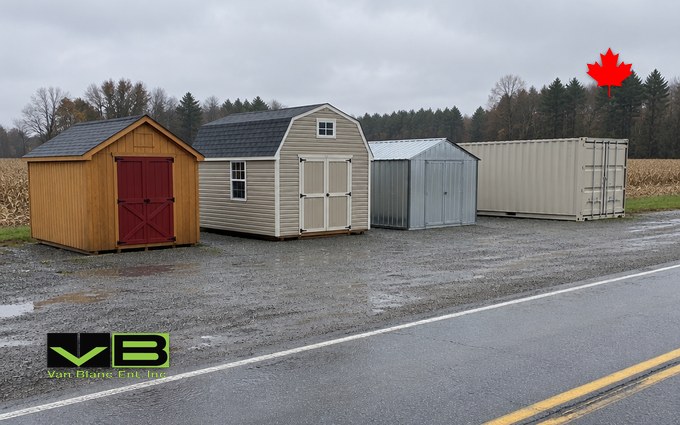
Quick Answer: Storage buildings for sale in Ontario fall into six families: box-store sheds, built sheds delivered assembled, steel kits, fabric spans, pole barns and shipping containers. Each arrives differently, sits on a different base and lasts differently. Match the building to the load, then buy from a lot you can walk.
In This Guide
- The six families of storage building sold in Ontario
- Box-store sheds: resin, metal and wood kits
- Built sheds delivered assembled: Amish shops, dealer lots and prefab yards
- Steel buildings and kits
- Fabric buildings and shelters
- Farm-yard storage buildings: pole barns, drive sheds and machine sheds
- Shipping containers as storage buildings
- The whole market on one sheet
- Where to buy: the lot-you-can-walk rule
- The storage building checklist
- Storage building FAQs
Reading Time: 13 minutes
The six families of storage building sold in Ontario
Search for storage buildings for sale and the results are a shelf: a resin shed from a warehouse club, a lofted barn on a dealer lot, a steel kit from Markham, a fabric span from Wingham, a Manitoba builder shipping into the northwest, and somewhere down the page a steel box from a yard like ours. They are all storage buildings and they have almost nothing else in common, which is why the buyer who compares them by the photograph and the price ends up with the wrong one. This guide sorts the market by family, names who sells each in Ontario, says how each arrives and what has to be under it, and puts the shipping container in its place beside the others. We sell containers from a yard in Brantford and nothing else, so the comparison hub where every structure we compete with is weighed is where our bias is declared; this page is the market map that hub sits inside. Six families, in the order a backyard buyer meets them and then the order a farm does.
The families are the box-store shed, sold flat in a carton or a crate; the built shed, framed in a shop and delivered assembled on a trailer; the steel building, sold as a bolt-together kit or an engineered frame; the fabric building, a steel truss under a tensioned membrane; the pole barn or drive shed, built on site by a crew; and the shipping container, a finished steel room delivered on a tilt-deck. Two of them come as kits the buyer raises, two arrive finished, and two are built where they stand. That single fact, how it arrives, predicts most of the rest: the base it needs, the lead time, the access the lot must have, and the day the building is dry inside. The sea can against the wooden shed is the two-way version of this comparison, and the six-way version below is the one the search actually asks for.
Box-store sheds: resin, metal and wood kits
The first family is the one on the Costco, Canadian Tire, Home Depot and Rona shelf, and the one the ShelterLogic and Aosom web stores ship to the door: resin sheds from Keter, Lifetime, Suncast and Rubbermaid, thin-gauge metal sheds from Arrow and ShelterLogic, and wood kits from a dozen importers. They arrive flat, in one or several cartons, and the buyer builds them on a weekend over a base the carton does not include. They are the cheapest square footage of roofed storage in the province and the shortest-lived, and both facts are honest: the resin shed guide explains what a double-wall polypropylene panel does and does not do through an Ontario winter, the metal shed guide covers the gauge and the anchoring that decide whether a steel-panel shed is standing in March, and the wood shed guide’s four routes sorts the flat-pack kit from the panelized kit and the prefab building. Our brand reviews of Keter, Lifetime, Rubbermaid and Suncast read the individual lines, and the retailer guides linked in the table below say what each shelf carries and how it ships. The family is built for bikes, patio cushions, a mower and garden tools beside a garden; once the list acquires a compressor, a business’s stock or anything with a resale market and a road view, the job calls for a door that locks like steel.
Built sheds delivered assembled: Amish shops, dealer lots and prefab yards
The second family is the shed built in a shop and delivered finished, and in Ontario it has three storefronts. The first is the Amish and Old Order Mennonite shop selling direct from the settlements around Milverton, Aylmer, Norwich and Chesley and the Mennonite country north of Waterloo: true two-by framing, hemlock board and batten, a metal roof, delivered on a trailer and skidded onto a stone base, and the Amish shed guide explains what the label actually means here and what base the builders ask for. The second storefront is the dealer lot, which is Old Hickory’s format: Mennonite-built lofted barns, utility sheds, lofted garages and cabins on lots in Brantford, Kitchener, Peterborough, Kingston, Arnprior, Oro-Medonte and Windsor, in sizes from 8 by 12 to 12 by 28, delivered, set and levelled, with a rent-to-own program offered by the dealers as an alternative to paying cash; our independent Old Hickory review reads the specs and says when the format is the wrong building. The third is the prefab yard: North Country Sheds sells prefab sheds, storage garages up to 14 by 44, cabins, bunkies, horse barns and run-ins from sample yards around Ottawa, Cornwall, Pembroke and Kingston, delivered 100 percent complete across Ontario and Quebec. From the west, Horizon Storage Sheds in Petersfield, Manitoba and Pine View Buildings, also in Manitoba, ship fully built sheds from 8 by 8 to 16 by 52 into Saskatchewan and western Ontario on a three-to-five-week lead, both with five-year craftsmanship warranties, and Pine View runs a rent-to-own program in place of bank financing. All of them are real wood buildings that outlast the box-store family by decades, all of them need a trailer path from the road to the pad, and none of them is a building a buyer moves twice. The bunkie guide is where this family crosses from storage into sleeping.
| Family | Who sells it in Ontario | How it arrives | Sizes | What goes under it | Honest lifespan |
|---|---|---|---|---|---|
| Box-store shed | Costco’s shed aisle, Canadian Tire’s portable sheds, Home Depot, Rona, ShelterLogic, Aosom | Flat in cartons; you build it | 4 by 6 to about 12 by 16 | Patio stones, a stone pad or a deck frame | Resin and thin metal 8 to 15 years; wood kits longer with a base |
| Built shed, delivered | Amish and Mennonite shops, Old Hickory dealers, North Country, Horizon, Pine View | Finished, on a trailer, set and levelled | 8 by 8 to 16 by 52; garages to 14 by 44 | Compacted stone or gravel, 4 to 6 inches | Decades with stain and a dry base |
| Steel kit or building | Norsteel, Pioneer, SteelMaster, Future Steel, arch and rigid-frame makers | Bundled panels and frame; you or a crew erect it | Kits to 35 feet wide; engineered frames any width | Concrete piers or a slab; a compacted stone base only for the smallest | 25-year rust-through and 40-year paint warranties are typical |
| Fabric building | Britespan of Wingham, ShelterLogic, Tempo, Cover-Tech and the car-shelter brands | Truss and membrane; dealer-erected at farm scale, owner-built at car-shelter scale | 10 by 20 car shelters to 210-foot clear spans | Anchors in earth for small; piers, blocks or a wall for large | Membrane 15 to 20 years on the big spans, a few winters on cheap shelters |
| Pole barn or drive shed | Local post-frame crews and farm builders | Built on site over weeks | 24 by 32 to 60-foot clear spans | Posts in the ground or on piers; a slab optional | A lifetime with roof maintenance |
| Shipping container | Container yards; ours is the Brantford yard on Morton Avenue East | Finished steel room on a tilt-deck, one to three days | 10, 20, 40 and 45 feet; high cubes at 9 feet 6 inches | Four blocks on a stone pad | 25 years plus; moveable |
Steel buildings and kits
The third family is the steel building, and it splits by width. Under about 35 feet, the market is the bolt-together kit: Norsteel’s EasyBuild line out of Markham is the Ontario example, galvanized frame, 26-gauge panels, engineer-stamped drawings, off-loaded by hand and raised by a handy owner or a small crew over a set of piers or a slab, and our Norsteel review reads the kit, the C-channel and the rigid-frame lines against each other with the warranties spelled out. Over that width it is an engineered rigid frame, quoted as a project with a foundation designed for it, which is a commercial building rather than a storage shed. The arch-type quonset, the curved steel hut that used to be the farm’s cheap span, has narrowed to a niche and even its makers now steer buyers to straight-wall frames. A steel kit is made for the two-car garage, the workshop, and the equipment shed a farm can pour a slab for; a kit is a project measured in weekends and inspections, so it does not give a buyer a dry room next week. The detached garage reality check is the same project seen from the permit office and the concrete truck, and the carport-or-garage verdict is the neighbour argument.
Fabric buildings and shelters
The fourth family is the fabric building, a steel truss under a tensioned membrane, and it runs from the ten-by-twenty car shelter in a driveway to a two-hundred-foot dairy barn. At the top end the Ontario name is Britespan Building Systems of Wingham, which builds column-free fabric structures from 24 to 210 feet wide to any length, carries a 20-year or 25-year warranty on the finished building, sells through more than forty dealers, and makes container top sets, the fabric roof that spans two of our boxes to make a covered bay. At the driveway end the family is the ShelterLogic and Tempo shelter, the fabric car shelter through an Ontario winter being the honest read on what an anchored tube frame survives and what it does not, and the carport guide’s open middle covering the roofed-but-open case. Fabric buys span and daylight per dollar better than anything else on this page and it buys no security and no insulation at all; it is a roof, and it is bought as one. The farm with hay, machinery or a riding arena to cover is shopping for span; the farm with sprayer chemical to lock up is shopping for a steel box, and plenty of yards end up running both.
Farm-yard storage buildings: pole barns, drive sheds and machine sheds
The fifth family is built where it stands: the post-frame pole barn, the drive shed with a 40-to-60-foot clear span and a sliding door a combine drives through, and the steel-sided machine shed that every concession road has three of. Nobody sells these from a lot; a local crew builds them over weeks on posts or piers, and they are built for machinery-scale spans. What they are not is sealed, locked or quick, and the drive shed question, answered from our side, is our account of what a container does beside one: the tool bay at the gable end, the crop-protection room, the parallel forties with a covered gap in the decade before the big build. The farm storage guide runs the feed, equipment and hay numbers for the box on a working yard. The agriculture storage building search is really three searches: the span for the machinery, which is fabric or post-frame; the dry room for the inputs, which is steel; and the bale shelter, which is the cheapest roof that keeps rain off.
Paul LeBlanc, Van Blanc Ent. Inc.: “I have been selling boxes to farms since 1995 and I have never told a farmer a container replaces his drive shed. What I tell him is that the shed does not lock and the box does. Most yards end up with both, and the box gets there first.”
Shipping containers as storage buildings
The sixth family is ours, and here is its honest card. A shipping container is a finished steel room, 8 feet wide and 8 feet 6 inches tall or 9 feet 6 inches in a high cube, in 10, 20, 40 and 45-foot lengths, delivered on a tilt-deck truck onto four blocks and a stone pad and dry, locked and in use the afternoon it lands. It is the only storage building on this page that arrives finished and can leave again, which matters to the tenant on a leased lot, the farm between builds, the contractor who moves yards and the buyer who is not sure the spot is right. It is sold in grades, and wind-and-watertight, cargo-worthy and one-trip are the three words that decide most of the price: a used wind-and-watertight box is the working answer for storage behind a shed or a shop, and a one-trip box is for the building that faces the street or gets lined. Against the families above it loses on looks beside a house, on span, on daylight and on the warmth of wood, and it wins on security, on mice, on moisture once vented, on lifespan and on the calendar. The twenties and forties in our rows are the stock, what moves a storage-box quote is size, grade, distance and the modifications, and the tilt-deck delivery day is what the lot has to be ready for. We sell outright, never rent; a buyer spreading the cost does it through their own bank with the invoice and the serial number we supply.
Not sure which family?
Tell us what will live inside, where it would sit, how a truck reaches it and how soon you need it dry. We will tell you on the spot which size and grade of box fits, with one all-in number and a real lead time.
Family-run in Brantford since 1995 · 200+ containers in stock · 4.9★ across 140+ Google reviews · every box graded by a person, walk it before it lands.
The whole market on one sheet
Put the six families on one sheet and the questions that separate them are not price. They are how soon the building is dry inside, what the lot has to have under it and beside it, whether the building can be locked, whether it can leave, and how many years it lasts without a rebuild. The box-store shed is dry after a weekend on a base the buyer builds, and it lasts as long as its panels. The delivered shed is dry the day the trailer leaves, on a stone pad, and it lasts as long as the stain is kept up. The steel kit is dry after the weekends and the inspection, on piers or a slab, and it lasts as long as its paint warranty. The fabric span is dry when the dealer’s crew leaves, on anchors or a wall, and it lasts as long as the membrane. The pole barn is dry when the crew leaves in a month, on posts, and it lasts a lifetime. The container is dry the afternoon it lands, on four blocks, and it lasts a quarter century and moves. The self-storage unit against a box is the seventh option the sheet leaves off, because a rented unit is not a building, and the container shed against the traditional shed is the sheet’s most common two-way fight settled in detail.
| Question | Box-store shed | Delivered shed | Steel kit | Fabric span | Pole barn | Container |
|---|---|---|---|---|---|---|
| Dry inside by | A weekend, after the base | Delivery day | Several weekends plus inspection | Crew day | Weeks | The afternoon it lands |
| Under it | Stones or a pad | Stone pad | Piers or slab | Anchors, piers or a wall | Posts or piers | Four blocks on stone |
| Locks | A hasp | A hasp and a wood door | A steel door | No | A sliding door | Cam doors and a shrouded padlock |
| Can leave | Disassembled | Rarely | No | Yes, with a crew | No | Yes, on the same truck |
| Beside a house | Fine | Best | Fine | Temporary look | Rural | Needs screening or paint |
| Span | Small | To 16 feet | To 35 feet in a kit; any width engineered | To 210 feet | To 60 feet | 8 feet; a roof kit between two boxes for a bay |
Where to buy: the lot-you-can-walk rule
The one rule that crosses all six families is to buy from a place you can stand in. The box-store shed comes from a shelf you can see; the delivered shed comes from a settlement shop, a dealer lot or a sample yard, and every one of the builders above keeps a display you can open the door of; the steel kit and the fabric span come from a manufacturer with a dealer and a reference building nearby; the pole barn comes from a crew whose last three sheds you can drive past. The container comes from a yard, and the honest read on Ontario’s container suppliers exists because the exception to the rule is the marketplace listing with a deposit request and no yard, which is the one storage building on the market that reliably never arrives. Walk the rows, pick the box by number, pay when it lands; that is how a family yard proves it is legitimate, and it is the test to put to every seller in every family on this page.
Where the storage building calls come from
The shed-or-box calls come from every kind of lot: the Kitchener subdivisions and the Guelph acreages, the Norfolk County farm yards, and the cottage lots up the Simcoe and Muskoka corridor. Most of the callers have already walked a shed lot. Worth the drive for unbeatable quality, family customer service with 30 years of experience.
The storage building checklist
Before the deposit
- Write the list of what will live inside, with the widest and tallest item measured. The list picks the family before the photograph does.
- Decide whether it needs to lock, whether it needs to move, and whether it sits beside the house or behind the shop.
- Price the ground: stones, a stone pad, piers, a slab or posts, and the path a trailer or a tilt-deck needs to reach the spot.
- Ask every seller the same three questions: what is in the box or on the trailer, what is under the warranty, and when is it dry inside.
- Read any payment program as a loan and price it as one, against the cash price of the same building.
- Stand inside one before you pay, whether that is a dealer lot on King George Road or our rows a few minutes away on Morton Avenue.
A storage building bought that way fits the lot it lands on. Every family on this page sells a model on each side of the 161-square-foot line where the paperwork changes, so the size decision and the paperwork decision are the same decision. The buyer who reads the sheet before the shelf ends up with a shed beside the garden, a span over the machinery, or a box behind the shop, and knows why.
Frequently Asked Questions
What types of storage buildings are for sale in Ontario?
Six families: box-store sheds in resin, metal and wood kits; built sheds delivered assembled from Amish and Mennonite shops, Old Hickory dealer lots and prefab yards like North Country; steel kits and engineered steel buildings from makers like Norsteel; fabric buildings from Britespan and the car-shelter brands; site-built pole barns and drive sheds; and shipping containers from yards like ours in Brantford.
What is a portable storage building?
In the shed trade it means a built shed delivered assembled on a trailer and set on a stone pad, the Old Hickory and Amish-shop format, portable in the sense that it arrived whole rather than that it leaves easily. A shipping container is the storage building that is portable in both senses: it arrives finished on a tilt-deck and moves to the next property on the same truck.
Which storage building lasts longest?
A post-frame barn with its roof maintained and a corten steel container both outlast the owner’s need for them; a delivered wood shed lasts decades with stain and a dry base; a steel kit is warranted for 25 years against rust-through and 40 on paint; a fabric membrane runs 15 to 20 years on the big spans; resin and thin metal box-store sheds are the shortest-lived, at roughly a decade.
What is the cheapest storage building?
Per square foot on the day of purchase, the box-store resin or metal shed, on a base the buyer builds. Per year of dry, locked storage, a used wind-and-watertight container is usually the lowest number on this page, because it needs no base beyond four blocks, no assembly, no stain and no rebuild. A fabric span buys roof width and a pole barn buys machinery-scale span, but neither locks like a steel box or leaves on the same truck that brought it.
Do storage buildings need a permit in Ontario?
Ontario’s building permit exemption for a small accessory building sits at 15 square metres, about 161 square feet, which is why so many sheds and small kits are cut to a footprint under it. Anything larger, and anything with services, is a question for the municipality before it is a purchase, and every family on this page sells models on both sides of that line.
Can I buy a storage building on a payment plan?
Some shed dealers and builders offer rent-to-own or third-party financing programs, and those are loans to be priced as loans. We sell containers outright and do not rent or finance; a buyer spreading the cost does it through their own bank, and the container financing guide explains how that conversation usually goes.
Sources
- North Country Sheds. (2026). Prefab Sheds, Storage Garages, Cabins and Bunkies Delivered Across Ontario and Quebec. northcountrysheds.com
- Horizon Storage Sheds, Petersfield, Manitoba. (2026). Custom Sheds for Sale in Canada. horizonstoragesheds.com
- Pine View Buildings, Manitoba. (2026). Sheds, Lofted Barns, Garages and Workshops. pineviewbuildings.ca
- Britespan Building Systems, Wingham, Ontario. (2026). Fabric Buildings for Agriculture, Commercial and Municipal Use. britespanbuildings.com
- Norsteel Buildings, Markham, Ontario. (2026). Steel Buildings and EasyBuild Kits in Ontario. norsteelbuildings.com
Reach Van Blanc in Brantford
We have been supplying shipping containers across Ontario since 1995. Our yard is at 90 Morton Avenue East in Brantford, and we deliver right across the province with payment on the day of delivery. No deposit, no upfront wires, no chase-the-paperwork.
Van Blanc Ent. Inc., 90 Morton Ave E Unit 1B, Brantford, ON N3R 7J7, 519-754-6844 (cell) or 1-888-509-6658 (toll-free).
If the list you wrote has a lock, a move or a deadline in it, call with the list and your postal code, and we will tell you on the spot which boxes are on the ground and when one can land. Worth the drive for unbeatable quality, family customer service with 30 years of experience.