
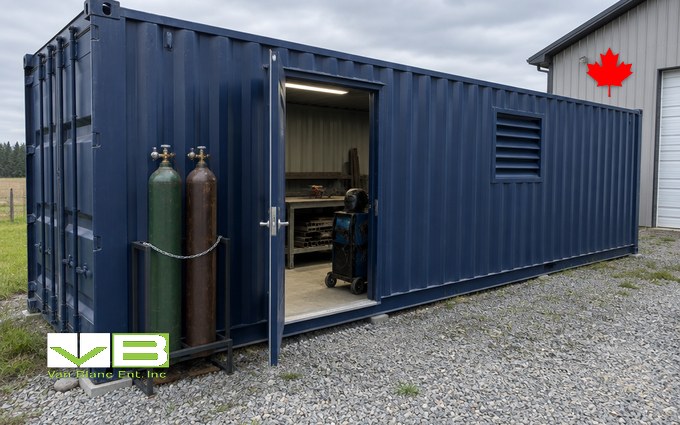
Quick Answer: A welding shop needs a non-combustible floor, 240-volt power on dedicated circuits, source-capture ventilation, gas cylinders stored upright and separated, and room for a fire watch. In Ontario the shop lives in a garage bay, a leased industrial unit, a steel building, or a shipping container annex fitted before delivery.
In This Guide
- What does a small welding shop actually need?
- How much space does a one- or two-welder shop take?
- What power does a welding shop pull?
- How do you store gas cylinders in a welding shop?
- The 11-metre rule and the fire watch
- Fume, air and the makeup problem
- The four ways to house a welding shop in Ontario
- The container welding shop, done properly
- The twenty-foot cylinder store
- The mobile welder’s base
- Which size and grade to buy
- The welding shop buyer’s checklist
- Welding shop FAQs
Reading Time: 14 minutes
What does a small welding shop actually need?
A welding shop is a room that can take sparks, pull fume, feed a 240-volt arc and keep pressurised gas from becoming the story. Strip away the equipment catalogue and there are six things every shop has to get right: a floor that will not burn, power sized to the machines, air that moves fume away from the hood, separation between the arc and anything combustible, a cylinder store that keeps oxygen and fuel gas apart, and a rack for stock that is longer than the room is wide. We sell one of the four buildings that can hold all six, which is why the setups other trades run out of a container already list welding as a regular fit-out. This guide serves the shop question first. The container gets its section once the six requirements are on the table.
The audience is wider than it sounds. A licensed fabricator leaving a leased bay, a farm that welds its own implements, a mobile welder who needs a base for stock and cylinders, and a hobbyist who has outgrown the corner of a two-car garage all end up asking the same six questions. The answers differ by scale. The physics does not.
How much space does a one- or two-welder shop take?
Space in a welding shop is set by the longest stock you handle and the distance sparks travel, not by the size of the welder. CK Supply’s setup guide puts spatter travel at up to 40 feet (12 metres) from the work, which is why a bench in a cluttered garage is a fire report waiting to be written. A bench-only shop for small parts fits a 10 by 10 foot footprint with 8 feet of clearance overhead. A fabrication shop that cuts and fits 20-foot lengths of tube needs a bay at least 24 feet long so the stock can enter, turn and leave without a second person. Where the stock comes in matters as much as where it sits, and the general container workshop guide covers the door-end delivery zone that applies to any shop.
| Shop type | Working footprint | What sets the number |
|---|---|---|
| Bench welding, small parts, MIG or TIG | 10 x 10 ft minimum, 8 ft clear | A bench, a vise, the welder cart and room to step back from the arc |
| Repair shop for farm and trailer work | 12 x 20 ft, one wide door | A trailer tongue or a bale spear has to come inside; a 10 ft door is the minimum |
| Fabrication bay with 20 ft stock | 8 x 40 ft or 12 x 24 ft | Length of the stock plus a cut station; the extra foot of headroom in a 40-foot high cube earns its keep with a hoist |
| Two welders plus a plasma table | 24 x 40 ft and up | Two arcs need two exhaust points and a shared grind zone that neither hood covers |
| Cylinder and consumables store | 8 x 10 to 8 x 20 ft, separate from the arc | Upright cylinders, a rod oven and dry storage, away from spatter and sun |
Two habits shrink the footprint without shrinking the work. Put the cut station at the door so long stock never crosses the room, and store bar and plate vertically on racking rated for plate and bar stock rather than in a pile on the floor. A shop that plans the flow this way runs in half the space of one that plans around the machines.
What power does a welding shop pull?
A welding shop runs on 240 volts. A residential 120-volt circuit will run a small flux-core machine at low duty cycle and nothing more. Each welder wants its own 240-volt circuit, typically 50 amps for a mid-size MIG or a stick machine, sized under Section 42 of the Canadian Electrical Code, which rates welder circuits by duty cycle rather than plate amperage. Add a plasma cutter, a compressor and a grinder bank and a one-person shop lands on a 100-amp subpanel; two welders and a table push it toward 200. The wiring logic is the same whether the room is a garage or a steel box, and the ESA path for a container panel walks through how the inspection works when the building is one we deliver.
Three things get missed on the power side. Lighting is the first: an arc-welding bay with one ceiling fixture is a bay where the fit-up is done by feel, and lighting a windowless bay explains why task lights at the bench matter more than lumens overhead. The second is the exhaust fan, which is a motor load that has to be on the panel before the welder is. The third is the rod oven, a small heater that runs all day and belongs on its own circuit so it never trips when the plasma fires.
Duty cycle, in one paragraph
A welder rated 200 amps at 30 percent duty cycle can hold that arc for three minutes in every ten before it needs to cool. The Code sizes the supply conductors from that rating, which is why two machines with the same plate amperage can want different breakers. Ask the welder’s manual for the rated input at the duty cycle you will actually run, hand that number to the electrician, and the panel gets sized once. A 100 amp subpanel installed in the box is the common answer for a one-welder shop with a compressor.
How do you store gas cylinders in a welding shop?
Gas cylinders are stored upright, restrained, capped and separated by gas type, in a dry and ventilated spot away from the arc. The Canadian Centre for Occupational Health and Safety publishes the numbers most Ontario shops work from, and they are specific enough to build a room around. Oxygen cylinders sit at least 6.1 metres (20 feet) from fuel-gas cylinders such as acetylene or propane, or behind a wall at least 1.5 metres (5 feet) high with a half-hour fire resistance rating. Every cylinder is secured with an insulated chain or a non-conductive belt so it cannot fall. Valve caps go on in storage. The storage area stays below 51.7 degrees Celsius, out of direct sun, with no-smoking signs posted, and empties are tagged and kept apart from full cylinders. Acetylene stays upright always, because the cylinder is packed with acetone that will foul the regulator if it is laid down.
| Rule | Number to build to | Why it exists |
|---|---|---|
| Oxygen to fuel gas separation | 6.1 m (20 ft), a 1.5 m (5 ft) wall rated half an hour, or two boxes set apart | An oxygen leak beside a fuel leak is the shop fire nobody survives |
| Restraint | Insulated chain or non-conductive belt, every cylinder | A falling cylinder with the valve sheared off becomes a projectile |
| Storage temperature | Under 51.7 C (125 F), out of direct sun | Pressure climbs with heat; a dark steel wall in July can pass the limit |
| Distance from the arc | Far enough that sparks, slag and flame cannot reach them | CCOHS wording; CK Supply’s 40 ft spatter figure is the practical planning distance |
| Empties | Tagged and stored apart from full cylinders | Prevents an empty going back on the line and a full one being treated as empty |
| Ventilation | Dry, well-ventilated, never a sealed cupboard | A slow leak in a sealed room accumulates; in a vented one it leaves |
The Canadian standard behind all of this is CSA W117.2, Safety in welding, cutting and allied processes, in its 2019 edition. It points to CSA B340 for cylinder selection and to the B149 series for propane and natural gas. You do not need to buy the standard to build a compliant store. You need the six rows above and a building that can hold them, which is where the louvred vents we stock stop being a spec-sheet footnote and become the first line of the build.
The 11-metre rule and the fire watch
Hot work is governed by a simple radius. NFPA 51B, the hot-work standard that Canadian insurers and the Ontario Fire Code’s welding-and-cutting section lean on, calls for a fire watch whenever combustibles sit within 35 feet (11 metres) of the work, whenever sparks can pass through an opening in a wall or floor, and whenever the work touches combustible construction. The current edition keeps that watch in place for at least an hour after the last arc. Plywood, painted or not, is combustible construction under that standard, which is the reason the plywood floor every container ships with gets covered with steel plate before a welder moves in.
Ontario’s Regulation 851 for industrial establishments adds its own welding section, including the rule that a drum, tank or pipe that has held a flammable is cleaned and tested before anyone strikes an arc on it. This guide stops there. Whether a given shop needs a permit or an inspection is a question for your municipality and your insurer, and it is not one we answer. The practical version for a small shop is short. Keep the 11 metres clear of anything that burns, or close the radius with a welding curtain and a steel floor. Keep an ABC extinguisher at the bench and a second at the door. Store the solvents and the paint on the far side of the cylinder wall, and if the shop also finishes what it builds, the paint and spray booth guide for small shops explains why the booth wants its own room.
Fume, air and the makeup problem
Welding fume is a controlled substance in an Ontario workplace, with exposure limits set under Regulation 833, and the way a shop meets them is by capturing fume at the source and diluting the rest. A fume arm over the bench or a portable extractor at the arc handles the first job. A powered exhaust fan high on one wall and an intake louvre low on the opposite wall handle the second. The number that decides whether the room works is the makeup air: a fan that pulls 1,000 cubic feet a minute out of a sealed room stalls, and a shop in a steel building or a container is a sealed room by default. The CFM arithmetic for a steel welding bay gives the fan sizes by container length and the louvre area to match; the same arithmetic scales to a garage bay with the door shut in January.
Grinding is the fume problem people forget. A cut-off wheel throws fine steel dust that no fume arm catches, and it settles into the same corner the rod stock lives in. Give grinding its own zone, downstream of the exhaust, with shelving that hangs off the corrugation for consumables on the clean side of the room.
The four ways to house a welding shop in Ontario
An Ontario welding shop lives in one of four buildings: the garage bay you already own, an industrial unit you lease by the month, a steel building or pole barn you put up on your own land, or a shipping container fitted out as a bay or an annex. Each one answers the six requirements differently, and the honest comparison depends on what you weld, where the shop sits, and how long you intend to stay. The container-against-every-alternative comparison covers the general case; this section is the welding-specific one.
The garage bay
The garage is where most Ontario welding starts, and for a bench shop doing small repairs it can be where it stays. The floor is already concrete. The problems arrive with scale. A 240-volt run from the house panel is a real electrical job, the fume shares air with the kitchen through the man door, the 11-metre radius takes in the lawn mower and the gas can, and the cylinders end up beside the car, which is the week the auto shop’s seasonal tire box starts looking like the model for a cylinder store. A garage shop that turns into a business also turns into a conversation with your insurance broker, because a home policy and a shop policy are different documents. None of that is a reason not to weld in a garage. It is the reason the garage is where people weld until the day the stock is longer than the bay.
The leased industrial bay
A leased unit in an industrial plaza gives a fabricator the floor, the door height and the three-phase service in one move, which is why so many shops start there. The lease is the trade-off. It runs monthly for as long as the business does, the landlord’s hot-work rules and cylinder limits apply, and the shop improvements stay with the building on the way out. For a business that needs 3,000 square feet and a crane, the leased bay is the right answer and this page will not pretend otherwise. For a one- or two-welder operation with land of its own, the monthly line is the number to compare against owning the building, and financing a box through your own bank lays out how the owned option is usually paid for.
The steel building or pole barn
On your own land, a purpose-built steel building or a post-frame barn is the long-term fabrication shop: clear span, a slab poured to take a crane column, doors sized to the stock, and room to grow. It is also a construction project, with a site, a foundation, a build season and a contractor. The arch-building guide and the post-frame guide each cover what the build involves in Ontario. For a shop that has already outgrown two containers, this is the destination. For a shop that has not yet outgrown one, it is a large number and a long wait for capacity that a container delivers next week.
The container annex
A shipping container is the fourth route and the one we sell. It is a steel room with a steel roof that arrives finished, sits on a pad, and can be cut, vented and wired at the yard before the truck leaves. The two configurations that welders actually buy are a 40-foot high cube fitted out as a working bay, and a 20-foot unit parked beside an existing shop as the cylinder store, rod room and tool crib. The next three sections cover both, and the comparison table below sets the four routes side by side.
| Route | Floor and fire | Power | Cylinders | Time to a working shop | Best fit |
|---|---|---|---|---|---|
| Garage bay | Concrete floor; shares air and the 11 m radius with the house | 240 V run from the house panel | Beside the car unless a separate store is built | A weekend, plus the electrician | Bench and repair work, hobby scale |
| Leased industrial bay | Concrete, purpose-built; landlord hot-work rules | Often three-phase already in | Landlord limits apply | Move-in day | Fabricators needing 3,000 sq ft and a crane |
| Steel building or pole barn | Poured slab, clear span | New service, your spec | A separate lean-to or room | A build season | The permanent shop on owned land |
| Container annex | Steel plate over plywood, or the box set on a slab; what the box should sit on is a one-day job | 100 A subpanel, ESA-inspected on site | A dedicated vented 20-foot store | Delivered in days, fitted at the yard | One- or two-welder shops, mobile welders, farms |
The container welding shop, done properly
A container welding shop is a 40-foot high cube with a steel floor, a personnel door and a wide opening on the long side, a low intake louvre and a high powered exhaust, a 100-amp subpanel, task lighting and a fire-rated liner wherever insulation goes. Done in that order, it is a bay that a fabricator can run all winter. Done out of order, it is a hot steel tube with a welder in it. The order is the whole guide.
Start with the floor. The factory floor is 28-millimetre marine plywood, which is fine for storage and wrong for an arc. Two answers work: lay steel plate over the plywood and screw it down, or set the box on a poured pad and pull the plywood so the shop floor is the slab. Then cut the openings. A welder’s bay wants the material door on the long wall, near the cargo-door end, and a roll-up door cut into the long wall is the fit-out that lets 20-foot stock come in sideways instead of down the length of the box. The personnel door goes at the far end so a person can leave without passing the arc. The cut-ins and vents we do at the yard are done under engineered drawings with the header framed before delivery, which is the part of a container conversion that should never be improvised on site with a grinder.
Air comes next, and it is the decision that decides which wall gets cut. Christian LeBlanc, who walks the rows with buyers at the Brantford yard, puts it this way.
Christian LeBlanc, Van Blanc Ent. Inc.: “The welders who come in usually want the twenty for the cylinders and the rod, and the forty for the bay. The first thing I ask is where the exhaust is going, because that decides which wall we cut, and it decides it before the door does.”
Power and light follow the air. The panel we can rough in; the final connection and the inspection belong to your licensed electrician, and the site’s electrical guides cover the ESA process in detail. Heat is the last decision and the one that changes the liner. An unheated bay is bare steel inside, which is the safest welding surface there is. A heated bay needs insulation, and insulation in a welding shop means spray foam behind a fire-rated liner, never exposed foam within reach of spatter. Heating a steel bay through January covers the mini-split and the unit-heater options once the liner is in.
A Brant County repair shop in a 40-foot high cube
The layout that works for farm and trailer repair puts the cut station and the material rack at the cargo-door end, the bench and the welder in the middle third under the exhaust fan, and the grind zone at the personnel-door end with the compressor outside under a lean-to. Cylinders live in a separate 20-foot store or in a chained rack on the outside wall under cover. Nothing combustible lives inside the box except the welder’s gloves, which is the point. The setup follows the metalworking bay in the conversion guide and adds the steel floor and the long-wall door.
Pricing the bay or the cylinder store?
Tell us what you weld, the longest stock you handle, and where the box will sit. We will tell you the size, the grade, which wall gets the door and the vent, and one honest all-in number with a real lead time.
Family-run in Brantford since 1995 · 200+ containers in stock · 4.9★ across 140+ Google reviews · every box graded by a person, walk it before it lands.
The twenty-foot cylinder store
The cylinder store is the container most welders should buy first, and it is the one the trade hub has been describing at paragraph depth for a year. A twenty-foot box parked beside the shop takes the oxygen, the acetylene, the argon and the CO2 out of the bay and puts them in a room built for them. The build is short. A louvred intake low on one long wall and a louvred exhaust high on the opposite wall keep air moving through the box without a fan. Chained racks along one wall hold the cylinders upright. The 1.5-metre half-hour wall from the CCOHS rule goes across the box to split oxygen from fuel gas, or, simpler still, the fuel gas takes the twenty and the oxygen takes the ten-foot unit beside it and the separation is a matter of where the truck sets them down.
The same box holds the rod oven, the wire spools and the consumables on the dry side, which means the shop’s most moisture-sensitive stock stops living beside the door where condensation collects. The tool crib layout that keeps consumables dry applies directly. Security is the last spec and it is a real one: a store full of cylinders and copper-wound machines is a target, and the answer is a lockbox welded over the door hasp plus locks that survive a cutting disc, fitted before the box leaves the yard.
Sun and steel
A dark container in full sun in July can push its interior past the storage limit for cylinders. Set the store where it gets afternoon shade, paint it a light colour, or run the louvres top and bottom so the box breathes. This is the one fit-out decision that costs nothing at the yard and everything if it is skipped.
The mobile welder’s base
A mobile welder runs an engine-driven machine on a truck and does the work at the customer’s site, which leaves the business with no shop and a stock problem. Cylinders for exchange, rod and wire in quantity, the spare regulators, the plate offcuts that get used on the next job, and a place to do the fabrication that cannot be done on a tailgate all need a roof. That roof is usually a container on the welder’s own property, and the fit-out is the cylinder store above with a bench at one end. Running the box off a generator covers the power question for a base with no service, which is common on rural lots.
The reason the mobile trade lands on a container rather than a shed is the same reason a fabricator does: the box locks, it does not burn, it arrives in one to three days from our four Brantford yards, and if the business moves, the base moves with it on the same tilt-deck that dropped it. The tilt-deck drop on delivery day explains the access a driveway needs, which for a mobile welder’s yard is rarely a problem.
Which size and grade to buy
The size follows the stock and the grade follows the use. A welding bay wants the 40-foot high cube for the headroom and the length; a cylinder store wants a 20-foot standard, or a 10 where two gases need physical separation. On grade, a working bay that nobody but the welder sees is a cargo-worthy unit: structurally certified, doors that seal, surface rust that a grinder will find anyway. A store that only holds cylinders and consumables can be a wind-and-watertight box, the most common used grade, as long as the doors close tight. A customer-facing shop, a branded truck-side bay, or anything that will be insulated and lined is worth a one-trip shell, because the liner hides the steel for twenty years and the steel should be right before it disappears. As-is units are the fourth grade and they are for donors and cladding, never for a room with a person and an arc in it. The four grades explained for a shop buyer puts the differences in one table.
Buying is outright. Van Blanc sells containers and does not rent or lease them, and a shop that wants to spread the cost does it through its own bank or equipment financer with the invoice, the grade and the serial number we supply. What moves the number is the size, the grade, the fit-out list and the distance from Brantford, and what moves the quote on a shop box is the same list, in the same order, on every quote we write. How to inspect a used unit before paying is worth a read before you drive in, because the rows on the ground this week are graded by a person, and the buyer who walks them with Christian usually leaves with a different box than the one they came for.
Where the welding shops are
The steel trades cluster where the steel is. The fabricators around Hamilton and the Mountain buy bays; the repair shops in Brant, Norfolk and Oxford buy cylinder stores for farm work; the mobile welders around Cambridge and Kitchener buy bases. All of them are within an hour of the Morton Avenue yard, and most of them drive in to walk the rows first. Worth the drive for unbeatable quality, family customer service with 30 years of experience.
The welding shop buyer’s checklist
Before you spec the building
- Write down the longest stock you handle and the door it enters through. That sets the length.
- List every machine with its rated input at the duty cycle you run. That sets the panel.
- Decide which gases you keep on site and in what quantity. That sets the cylinder store and whether it needs the 1.5-metre wall.
- Mark the 11-metre radius on a sketch and list what falls inside it. That sets the floor, the curtain and where the solvents go.
- Decide whether the shop is heated. That decides the liner, and the liner decides the fit-out order.
- Decide how long the shop stays where it is. Under five years and likely to move, a container that moves with the business; permanent on owned land with a crane, a building; neither, a lease.
A shop specified in that order is specified once. The common mistake is to buy the welder first, the building second, and to discover the exhaust wall on move-in day. The trade hub’s short version of this setup, and the setups the other trades run, sit under the modification guide that every fit-out on this site links up to.
Frequently Asked Questions
How big does a welding shop need to be?
A bench shop for small MIG or TIG work fits a 10 by 10 foot space with 8 feet of headroom. A repair shop that takes trailers and implements needs about 12 by 20 feet with a 10-foot door. A fabrication bay handling 20-foot stock needs at least 24 feet of length, or a 40-foot container laid out with the cut station at the door. The stock length and the spatter radius set the size, not the welder.
Can you run a welding shop in a shipping container?
Yes, and welders are one of the regular trade fit-outs at our yard. A 40-foot high cube with a steel floor over the plywood, a long-wall material door, a low intake louvre, a high powered exhaust fan, a 100-amp subpanel and a fire-rated liner where insulation goes is a working bay. Cylinders belong in a separate vented 20-foot store, not in the bay.
How far apart do oxygen and acetylene cylinders have to be stored?
The CCOHS guidance Ontario shops follow is 6.1 metres (20 feet) of separation between oxygen and fuel-gas cylinders, or a wall at least 1.5 metres (5 feet) high with a half-hour fire resistance rating between them. All cylinders are stored upright, chained or belted, with valve caps on, below 51.7 degrees Celsius and out of direct sun, with empties tagged and kept apart.
What electrical service does a small welding shop need?
A 240-volt supply with a dedicated circuit per welder, sized under Section 42 of the Canadian Electrical Code by the machine’s rated input and duty cycle. A one-welder shop with a plasma cutter and a compressor usually lands on a 100-amp subpanel; two welders and a table push toward 200 amps. The exhaust fan, the lighting and the rod oven are separate loads that go on the panel first.
Do I need to insulate a container welding shop?
Only if you heat it. An unheated bay is bare steel inside, which is the safest surface to weld beside. A heated bay needs closed-cell spray foam behind a fire-rated liner, with no exposed foam anywhere spatter can reach. Insulation changes the fit-out order, so decide on heat before the openings are cut.
How long does a fire watch last after welding?
NFPA 51B, the hot-work standard insurers and the Ontario Fire Code’s welding section reference, requires a fire watch whenever combustibles are within 11 metres (35 feet) of the work, and the current edition keeps the watch in place for at least 60 minutes after hot work stops. A steel floor and a cleared radius are how a small shop shortens the list of things the watch is watching.
What container grade is right for a welding shop?
Cargo-worthy for a working bay nobody but the welder sees, wind-and-watertight for a cylinder and consumables store, and a new one-trip shell for anything that will be lined and insulated or that customers walk into. As-is units are never used for a room with a person and an arc in it.
Sources
- Canadian Centre for Occupational Health and Safety. (2026). Welding: Storage and Handling of Compressed Gas Cylinders. ccohs.ca
- Standards Council of Canada. (2019). CSA W117.2:19, Safety in welding, cutting, and allied processes. scc-ccn.ca
- National Fire Protection Association. (2019). NFPA 51B, Standard for Fire Prevention During Welding, Cutting, and Other Hot Work. nfpa.org
- Government of Ontario. (1990, current). Industrial Establishments, R.R.O. 1990, Reg. 851, section 78. canlii.org
- Government of Ontario. (current). Control of Exposure to Biological or Chemical Agents, R.R.O. 1990, Reg. 833. ontario.ca
- CK Supply. (2026). How to Set Up a Welding Shop. cksupply.com
Reach Van Blanc in Brantford
We have been supplying shipping containers across Ontario since 1995. Our yard is at 90 Morton Avenue East in Brantford, and we deliver right across the province with payment on the day of delivery. No deposit, no upfront wires, no chase-the-paperwork.
Van Blanc Ent. Inc., 90 Morton Ave E Unit 1B, Brantford, ON N3R 7J7, 519-754-6844 (cell) or 1-888-509-6658 (toll-free).
If the welder is bought and the building is the open question, call with the longest stock you handle, the gases you keep and your postal code. We will tell you on the spot which shells are on the ground and how soon a fitted one can land. Worth the drive for unbeatable quality, family customer service with 30 years of experience.