
Quick Answer: Sprung Structures is a Calgary family company that makes tensioned fabric buildings on aluminum arches, 30 to 200 feet wide, with a 50-year substructure guarantee and membranes guaranteed up to 25 years. It is a clear-span building; a container is a small secure vault, and many Ontario yards need both.
In This Guide
- Where We Stand (Read This First)
- What Sprung Actually Is
- The System, Decoded
- What a Sprung Building Is Genuinely Good At
- The Documented Trade-Offs
- Sprung vs the Ontario Fabric Builders
- Where a Container Wins, and Where It Does Not
- The Pairing Most Yards End Up With
- Who Should Buy a Sprung Building
- The Container You Would Buy Alongside, or Instead
- The Ontario Sequence
- Sprung Structures FAQs
Reading Time: 14 minutes
Where We Stand (Read This First)
This review is written by a shipping container yard in Brantford, Ontario. We are not affiliated with Sprung Structures, we receive nothing from them, and we sell a product that competes with a Sprung building for exactly one kind of buyer, the one who needs a few hundred square feet of secure dry storage and is weighing a small fabric building against a steel box. For every other buyer of a Sprung, which is most of them, we sell nothing that competes and, as the pairing section explains, sometimes sell the lockable room that goes inside. Read it knowing that.
Facts about Sprung were checked against sprung.com, its frequently asked questions, its history and building-components pages, and its published project sheets on September 11, 2026, and are attributed where it matters. We did not scrape customer reviews and we make no claims about how the company treats its clients. Whether any building, fabric or steel, can go on a particular Ontario lot is a question for your municipality and an engineer, and this page does not answer it. The container versus fabric structure comparison is the head-to-head; this page is the brand.
What Sprung Actually Is
Sprung is a Calgary family business whose lineage runs back to 1887, when Philip Dorland Sprung and W.A. Deny established the Western Tent & Mattress Co. to serve the Alberta frontier. The company spent the middle of the twentieth century in garments, then, in the late 1960s, Philip Davis Sprung answered a travelling carnival’s request for a tent that would not blow down by inventing a tensioned fabric structure; he applied for the first patents on the Stressed Membrane Structure on July 26, 1971. In 1973 the glue-laminated timber arches were replaced with aluminum, which is the building the company still sells: extruded aluminum arches with an architectural membrane tensioned between them. Sprung opened a research greenhouse in 1982 and a commercial one in 1985, and its main facility, on 100 acres south of Calgary, was completed in 2007.
By the company’s count it has delivered more than 12,000 structures in over 100 countries, from warehouses and aircraft hangars to arenas, churches, mining camps, military facilities and film sound stages, and it keeps a Toronto office as its eastern Canadian base alongside the Calgary headquarters. That footprint matters to an Ontario buyer in two ways: the engineering has been done many thousands of times, and the building still ships from Alberta.
The System, Decoded
| Element | What Sprung publishes (2026) |
|---|---|
| Frame | Extruded, non-corroding aluminum arches; 50-year pro-rata guarantee, described as having an indefinite life expectancy |
| Membrane | Interwoven, reinforced ripstop architectural membrane, tensioned once and not re-tensioned; guaranteed performance of up to 25 years, pro-rata; flame-retardant certified; several colourfast options |
| Widths and lengths | 30 to 200 feet wide, any length |
| Foundation | Where soil conditions allow, no foundation is required for structures up to 160 feet wide |
| Insulation | Optional multi-layer fiberglass blanket system; R-values by consultation |
| Design conditions | Engineered for winds to 170 miles per hour, snow loads to 300 pounds, and temperatures from minus 50 to above plus 50 Celsius |
| Erection rate | Up to 2,000 square feet a day non-insulated, up to 1,000 insulated; a 915 by 150 foot building cited as erected in 20 days |
| Availability | Inventory of up to 2 million square feet for immediate delivery |
| Afterlife | Dismantled, reconfigured and re-erected; expandable |
Read that table as a description of a building type rather than a product on a shelf. A Sprung is a permanent-grade clear-span structure that happens to be fast to erect and possible to move, which is a different object from the steel-tube-and-tarp portable garage that shares the word “fabric” with it. The portable garage review covers that lighter category; nothing in it applies here except the physics of a cover under snow.
What a Sprung Building Is Genuinely Good At
Strengths first, because they are real and documented. Speed is the first: a crew that puts up a thousand or two thousand square feet a day delivers a large building in weeks rather than a construction season, and the no-foundation rule up to 160 feet wide on suitable soil removes the slowest and most weather-dependent step of any Ontario build. Clear span is the second: no interior columns from 30 to 200 feet, which is why the building shows up as arenas, aircraft hangars and salt domes. The guarantees are the third, and they are unusual in the fabric category: a half-century on the frame and up to a quarter-century on the membrane, both pro-rata, with the membrane tensioned once. Daylight through the membrane is the fourth, a real operating saving in a warehouse or a riding arena. Relocatability is the fifth: a building that can be taken down and put up again is an asset a poured-slab structure never is. And a company that stocks up to two million square feet for immediate delivery is one that can answer an emergency, which is why the format appears after floods, fires and pandemics.
The Buyer It Was Built For
A municipality, a mine, a school, a church, a warehouse operator or a contractor with a large clear-span need, a site that can take a wide footprint, a horizon of a decade or more, and either no time for a conventional build or a real chance the building will move. For that buyer a Sprung, or a competing engineered fabric building, is the right category, and a container yard has nothing to sell against it.
The Documented Trade-Offs
With the source named for each, because a review that stops at the strengths is a brochure. The membrane is the wear component: Sprung’s own guarantee language, up to 25 years pro-rata, tells you the envelope has a service life and that a building owned for forty years will be re-skinned once, which is a cost the aluminum frame’s fifty-year guarantee does not cover. Insulation is optional and blanket-type, per the FAQ, and the R-value is by consultation, so a heated Ontario building needs that conversation before the quote rather than after. Freight is real: the factory and the stock are in Alberta, and an Ontario site pays to bring the components east, plus the erection crew’s time. The company publishes design capability for 300-pound snow loads and 170-mile-per-hour winds, which is more than any Ontario code asks, but the number that applies to your site is the one your engineer stamps, and a fabric roof that sheds snow well still needs a plan for where the snow lands along the walls.
Two more that are ours rather than Sprung’s. Security in a fabric building lives in the door and the perimeter rather than the envelope: a membrane can be cut, which is why the fabric structure comparison gives the security column to steel and why the pairing section below exists. And a Sprung is a building in every municipal sense, with the site work, the engineered drawings, the doors, the floor and the approvals a building carries; the no-foundation rule shortens the schedule, it does not remove the process. Whether that process fits your lot is your municipality’s call, so check with your local building department before you order.
Sprung vs the Ontario Fabric Builders
An Ontario buyer pricing a Sprung will also hear from fabric builders closer to home, and the honest comparison is by frame material and membrane class rather than by brand loyalty. Britespan, in Wingham, builds on hot-dip galvanized steel trusses under a high-density polyethylene membrane, with spans from 24 to 210 feet and 20- or 25-year warranties. Cover-Tech, in Woodstock, New Brunswick, builds on galvanized steel tube with X-brace purlins under a reinforced polyethylene cover with a 10-to-15-year prorated UV warranty, in widths to 80 feet. Sprung builds on extruded aluminum under an architectural membrane with the guarantees in the table above. The Cover-Tech page reads the New Brunswick builder with the same rules as this page. The Britespan page reads the Wingham builder, Container Top Sets included, with the same rules.
| Sprung | Britespan | Cover-Tech | |
|---|---|---|---|
| Frame | Extruded aluminum arches, 50-year pro-rata guarantee | Hot-dip galvanized steel trusses | Galvanized steel tube with X-brace purlins |
| Envelope | Tensioned architectural membrane, up to 25 years pro-rata | HDPE membrane, 20- or 25-year warranty | Reinforced polyethylene, 10 to 15 years prorated UV; PVC options |
| Widths | 30 to 200 ft | 24 to 210 ft | To 80 ft (gothic), 62 ft (straight wall) |
| Foundation | None to 160 ft on suitable soil, per Sprung | Blocks, containers, piers, slab, poured wall and more | Posts, concrete, pipe bases, sea containers |
| Ships from | Calgary | Wingham, Ontario | Woodstock, New Brunswick |
No prices, because all three quote per project, but the table tells you what each price buys: Sprung sells the longest guarantees and the widest single-source engineering record at the cost of freight from the west; the two eastern builders sell steel frames and shorter freight, and both publish container foundations as an option, which is the hybrid the pole barn write-up points to. Which membrane class suits a given Ontario job is a conversation with all three, and this page will not pretend to settle it.
Where a Container Wins, and Where It Does Not
The honest scale split is the most useful thing on this page. A 20-foot shipping container is 160 square feet of steel vault; a 40-foot high cube is 320. A Sprung starts at 30 feet wide and runs to 200, so its smallest sensible building is several times the floor of the largest container and its typical one is a hundred times it. They do not compete on the same job. Where they meet is the buyer who has a few hundred square feet of gear to protect and is looking at the small end of the fabric market, and for that buyer the head-to-head is blunt: the container arrives finished, locks, and needs no site work, and a fabric building of any brand is a project.
Past a thousand square feet the argument reverses. A yard that needs to park machines under a roof, a municipality that needs to keep salt dry, an arena, a warehouse: those are clear-span jobs, and a row of containers is the wrong tool for them, as the drive shed alternatives guide says about farm equipment and the quonset guide says about the arch. Container versus quonset and container versus metal building kit draw the same line for steel buildings, and it lands in the same place.
The Pairing Most Yards End Up With
What actually happens on a lot of Ontario sites is both. The fabric building covers the machines, the material and the work; a container or two inside it or beside it holds the tools, the fuel-adjacent gear, the parts and the records behind a steel door with a lock box, because a membrane keeps out weather and a corten box keeps out people. Public-works yards do this with a salt-and-sand dome and a container tool crib; contractors do it with a fabric shop and a shelved parts container; farms do it with the drive shed and the chemical lockup. The container can also be the building’s foundation: both Ontario-region fabric builders publish container-mounted profiles, in which two rows of sea cans carry the arches and the boxes become the building’s secure sidewalls. Sprung’s published foundation options do not include containers, so with a Sprung the pairing is a container placed inside or alongside rather than under.
Paul LeBlanc, Van Blanc: “The Sprung calls I get aren’t people choosing between a Sprung and a sea can. They’re municipalities and contractors who already have the big building, or are about to, and need a room inside it that locks. That’s a used 20-footer with a lock box and shelving, set on blocks at one end of the span. The fabric building keeps the snow off; the container keeps the tools where they were left.”
Who Should Buy a Sprung Building
Buy a Sprung, or bring Sprung into the tender with the eastern fabric builders, if the job is a large clear span, the site can take the footprint and the snow-shed zone, the horizon is long enough to amortize an engineered building, and speed or future relocation matters. The guarantees favour an owner who intends to keep the building for decades; the erection rates favour one who cannot wait a season; the stock favours one with an emergency. Public works, arenas, warehousing, mining and remote camps, aviation and large institutional uses are the company’s own list, and it is the right list.
Keep shopping if the need is a few hundred square feet, if security is the first requirement, if the ground is a farm lane a tilt-deck can reach and a crew cannot, or if the money has to produce a usable building this week rather than this quarter. That buyer is buying a container, and the sea can versus shed comparison is the page that starts the sizing.
The Container You Would Buy Alongside, or Instead
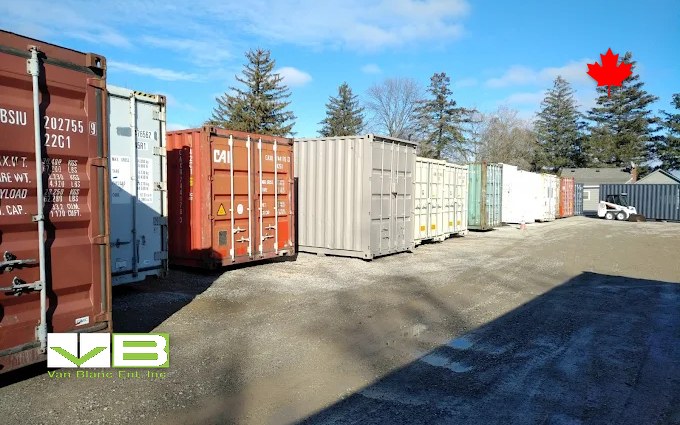
For the small-footprint buyer, and for the lockable room inside the big building, the answer from the yard is the 20-foot cargo box: 160 square feet, corten walls and roof, marine plywood floor, double cargo doors with four locking bars, a payload rating far past anything a tool crib will hold, delivered finished. Buy it used and wind-and-watertight for a parts or equipment lockup from the used aisle, or one-trip from the one-trip aisle if it is going to be cut for a window and wired as a site office inside the span. For more floor, the high cube at 40 feet is 320 square feet with a foot of extra headroom. The condition grades page explains what separates the grades and the cost-driver rundown explains the number.
Every container we sell is picked by a person and can be picked by you: drive to 90 Morton Avenue East, walk the rows with Paul or Christian, and choose the unit by its number before any money moves. Payment is on delivery, after you have seen the box on your ground. Delivery is by tilt-deck in one to three days to every Ontario address we serve, and our delivery-day guide covers the straight run the truck needs, which matters when the box is going inside a building through an end door. Everything is sold outright; Van Blanc keeps no rental fleet and does not lease.
Need the lockable room, or the small building? Price the box once
Tell us the size, the grade you have in mind, and your postal code, and we will send an all-in number for the container delivered and placed, usually the same day. If your job is really a fabric clear-span job, we will say so and get out of the way. Or come out to the yard and pick the unit yourself.
The Ontario Sequence
For a buyer going the fabric route, the order that saves the most grief is the one every engineered building shares: municipality and engineer first, site and soil second, building third. Sprung’s no-foundation rule depends on the soil, so the geotechnical question comes before the quote, and the snow-shed zone along the walls has to be drawn into the site plan before the footprint is fixed. Freight from Calgary and the erection crew’s schedule set the calendar; the membrane colour and the door package set the finish. The soil and pad guide and the helical-pier versus pad comparison cover the ground a container shares with any building, and the container ventilation primer is the read for a container that will live inside a heated span. The Toro steel-kit review is the steel-kit sibling of this page, and the supplier-by-supplier reviews hub lists every supplier we have looked at, ourselves included, while the alternatives overview is the wider read for anyone still deciding what kind of building they need at all.
Sprung Structures FAQs
Is Sprung Structures a Canadian company?
Yes. Sprung is a family business headquartered south of Calgary, Alberta, with roots in the Western Tent & Mattress Co. founded in Calgary in 1887; the tensioned fabric structure it sells was patented by Philip Davis Sprung in 1971 and moved to aluminum arches in 1973. It keeps a Toronto office as its eastern base and reports more than 12,000 structures delivered in over 100 countries.
How much does a Sprung structure cost?
Sprung quotes per project and we do not print figures that would be wrong by the time you read them. The drivers are width and length, whether the building is insulated, the door and end-wall package, the membrane specification, foundation or no foundation, freight from Alberta to your site, and the erection crew’s time. A container yard’s honest contribution is the lockable room inside, which is quoted separately and simply.
How long do Sprung structures last?
Sprung guarantees the aluminum substructure for 50 years pro-rata and describes it as having an indefinite life expectancy, and guarantees the membrane’s performance for up to 25 years pro-rata. In practice that means a building owned for decades keeps its frame and is re-skinned at least once, which is the cost to plan for.
Do Sprung structures need a foundation?
Per Sprung’s FAQ, where appropriate soil conditions exist no foundation is required for structures up to 160 feet wide, which is the single biggest reason the format goes up quickly. Whether your soil qualifies is a geotechnical question answered before the quote, and the municipal process for a building of this size still applies.
Can a Sprung building be moved?
Yes. Sprung describes its structures as relocatable and expandable: they can be dismantled, reconfigured and re-erected, and the company has built its case on that since the 1970s. A shipping container is relocatable in the simpler sense of being lifted onto a truck whole, which is why the two are often paired rather than compared.
Sprung vs Britespan vs Cover-Tech: what is the difference?
Frame and membrane class. Sprung uses extruded aluminum arches under a tensioned architectural membrane with 50-year and up-to-25-year guarantees, shipped from Calgary. Britespan of Wingham, Ontario uses hot-dip galvanized steel trusses under HDPE with 20- or 25-year warranties and spans to 210 feet. Cover-Tech of Woodstock, New Brunswick uses galvanized tube with X-brace purlins under reinforced polyethylene with a 10-to-15-year prorated UV warranty, to 80 feet wide. Both eastern builders publish container foundations; Sprung does not.
Is a shipping container cheaper than a Sprung structure?
For a few hundred square feet of secure storage, yes, and it arrives finished with no site work. Past about a thousand square feet the comparison stops making sense, because a container is a small steel vault and a Sprung is a clear-span building; most yards that own one also own the other, with the container as the lockable room inside or beside the span.
Sources
- Sprung Structures. (2026). Frequently Asked Questions. sprung.com
- Sprung Structures. (2026). History. sprung.com
- Sprung Structures. (2026). Aluminum Substructure: Building Components. sprung.com
- Sprung Structures. (2026). Relocatability. sprung.com
- Sprung Structures. (2026). Tension Fabric Buildings, Fabric Membrane Structures. sprung.com
- Britespan Building Systems. (2026). Innovative Fabric Buildings for Your Business. britespanbuildings.com
- Cover-Tech Inc. (2026). Fabric Buildings. cover-tech.com
Reach Van Blanc in Brantford
We have been supplying shipping containers across Ontario since 1995. Our yard is at 90 Morton Avenue East in Brantford, and we deliver right across the province with payment on the day of delivery. No deposit, no upfront wires, no chase-the-paperwork.
Van Blanc Ent. Inc., 90 Morton Ave E Unit 1B, Brantford, ON N3R 7J7, 519-754-6844 (cell) or 1-888-509-6658 (toll-free).
If the big building is settled and the next question is the room inside it that locks, call with the size and your postal code and we will tell you on the spot what is in stock and when it can land. Worth the drive for unbeatable quality, family customer service with 30 years of experience.