
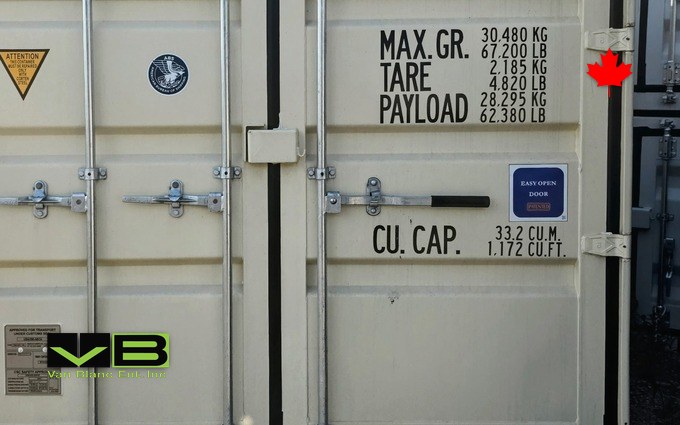
Quick Answer: Container door handles are the forged steel levers that rotate each locking rod, wedging cams into keepers and compressing the door gasket. New one-trip stock now comes three ways: standard, comfort height, and patented easy-open single-lever doors. All three configurations are in our Brantford yards right now, ready to compare.
In This Guide
- The Part Nobody Thinks About Until They Own One
- How a Container Door Actually Locks
- Why the Ocean Froze the Design for Fifty Years
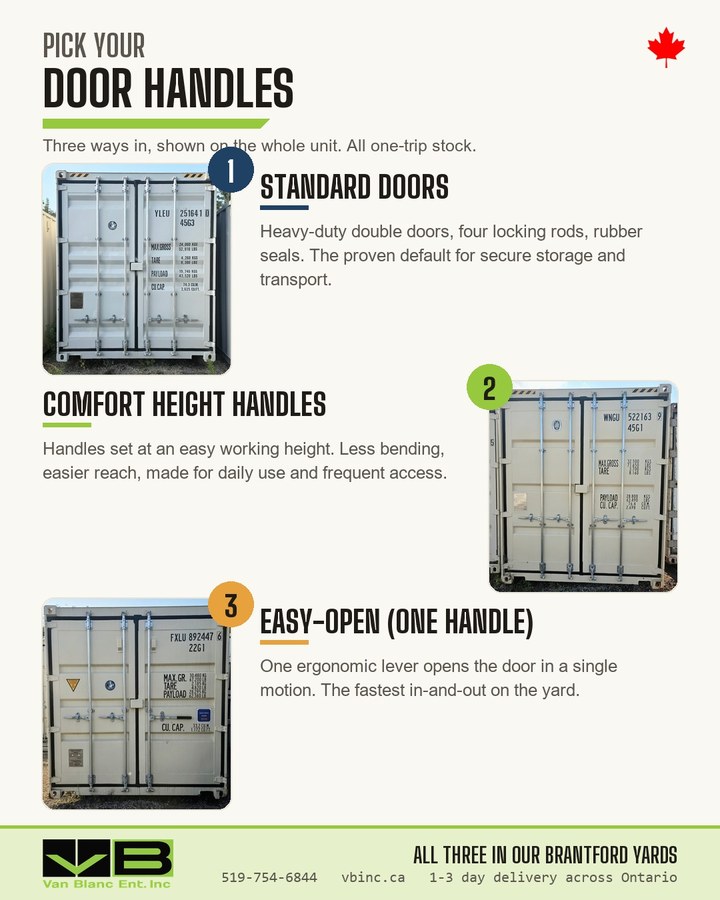
- Standard Doors: The Ocean Default
- Comfort Height Handles: The One-Trip Upgrade
- Easy-Open Doors: One Lever, and Yes, It Is Patented
- Watch All Three Side by Side
- Which Doors Fit Which Buyer
- The Winter Chapter
- Handles on Used Containers, and What the Parts Counter Stocks
- The Rest of the Door System
- Door Handle FAQs
Reading Time: 13 minutes
The Part Nobody Thinks About Until They Own One
Nobody shops for a shipping container because of the door handles, and everybody lives with the choice they made every single time they visit the box. That is the whole case for this page. The handle is the one part of a container your hands touch daily, in gloves, in the rain, in February, often twenty times a week on a working unit, and the industry has quietly spent the last few years improving it in ways most buyers never hear about until they are standing in a yard looking at three different door setups and wondering why one has a long black-grip lever where the others have four silver ones.
We stock all three current configurations at our Brantford yards, on new one-trip units that arrived this season, which is exactly why this guide exists: our own customers keep asking what the differences are, whether the fancy one is worth it, and whether the handles on their fifteen-year-old wind-and-watertight unit can be brought back to life. Straight answers to all three follow, plus the fifteen-second mechanical lesson that makes every door decision easier.
Paul LeBlanc, Van Blanc: “Door handles are one of the four parts people ask this counter for most, along with gaskets, lockboxes, and corner castings. I have watched buyers pick between two identical bins because one door felt better in the hand. That is a fine reason. You will shake hands with that lever a few thousand times before the box wears out.”
How a Container Door Actually Locks
A container door has no latch in the household sense. What it has is a wedging machine, and understanding it takes one paragraph. Each of the two doors carries two vertical locking rods, four across the pair. At the top and bottom of every rod sits a forged steel cam, a crescent-shaped lobe, eight cams in total. Welded to the container frame above and below them sit eight matching keepers. When you swing the handle, it rotates the rod through its hub, and every cam on that rod turns into the recess of its keeper. The crescent shape works as a wedge: as it seats, it physically pulls the door inward against the frame, compressing the rubber door gasket that makes the box weathertight. A forged retainer catch then holds the handle in its cradle so vibration on a highway or a ship cannot swing it open.
| Part | What it does |
|---|---|
| Lock rod (x4) | The vertical shaft the handle rotates; carries the cams |
| Cam (x8) | Forged crescent lobe at each rod end; wedges into its keeper |
| Keeper (x8) | Frame-mounted bracket that receives the cam and pulls the door tight |
| Handle and hub | The lever and its pivot; your mechanical advantage over all that friction |
| Retainer catch | Holds the handle seated so nothing opens by accident |
| Door gasket | The rubber seal the whole system exists to compress |
Every configuration on this page uses that same machine. The differences between standard, comfort height, and easy-open doors are entirely about where the handles sit and how many motions the unlocking takes, which sounds minor until you do it daily. The system’s genius is that it converts an easy horizontal swing of your arm into hundreds of kilograms of clamping force on the seal, and its one demand is respect for the sequence, which is why we keep the technique for opening a stubborn door as its own short guide.
Why the Ocean Froze the Design for Fifty Years
It is worth a minute on why door hardware stayed unchanged for two generations and then sprouted three configurations in a decade. The container was standardized in the 1960s for one customer: the intermodal system of ships, trains, and trucks, where a door gets operated a handful of times per voyage by longshoremen working at deck height. For that customer, the low four-handle layout was correct, and international standardization froze it there, because a fleet only works when every box behaves identically. Nobody was designing for the box’s second life, since the second life barely existed.
What changed was where containers retire. The last two decades built an enormous ground-level population of containers doing storage duty, and a new class of first-owner buyers, self-storage operators, contractors, farms, ordering new units that would never see a second ocean. Factories responded to the actual customer for the first time: handles moved to waist height, and the patented easy-open lever arrived courtesy of the storage industry, where a door that customers can open one-handed is a business advantage rather than a nicety. The three configurations in our yard are simply the three eras of that story, all still in production, all still correct for their original jobs.
Standard Doors: The Ocean Default
The standard configuration is the one the global shipping fleet runs on: four rods, four handles mounted low on the doors, each with its own retainer. The low mounting is not an accident and not laziness. A container on a ship or a truck deck sits well above the ground, and low-mounted handles let a worker standing on the dock or the pavement reach and operate the doors without climbing. Fifty years of intermodal logistics standardized that height, which is why nearly every used container you will ever meet carries it.
On the ground in a storage role, the standard setup remains perfectly good: four independent locking points, proven hardware, and the full wedge-and-gasket seal. Its honest costs are ergonomic. You bend to operate it, you work four handles to open both doors fully, and a rod that has sat locked through a winter asks for real arm. None of that matters much on a box you open monthly. All of it matters on a box you open daily, which is precisely the gap the newer configurations exist to close.
Comfort Height Handles: The One-Trip Upgrade
Comfort height doors take the identical locking machine and mount the handles at waist level. That is the entire change, and in daily use it is transformative in the least glamorous way possible: no bending, no crouching on wet gravel, no wrestling a low lever with your back at a bad angle. The configuration has become common on new one-trip production because factories now build containers knowing that a large share will spend their lives as ground-level storage rather than in ship stacks, and a waist-high handle serves a person standing on the same ground as the box.
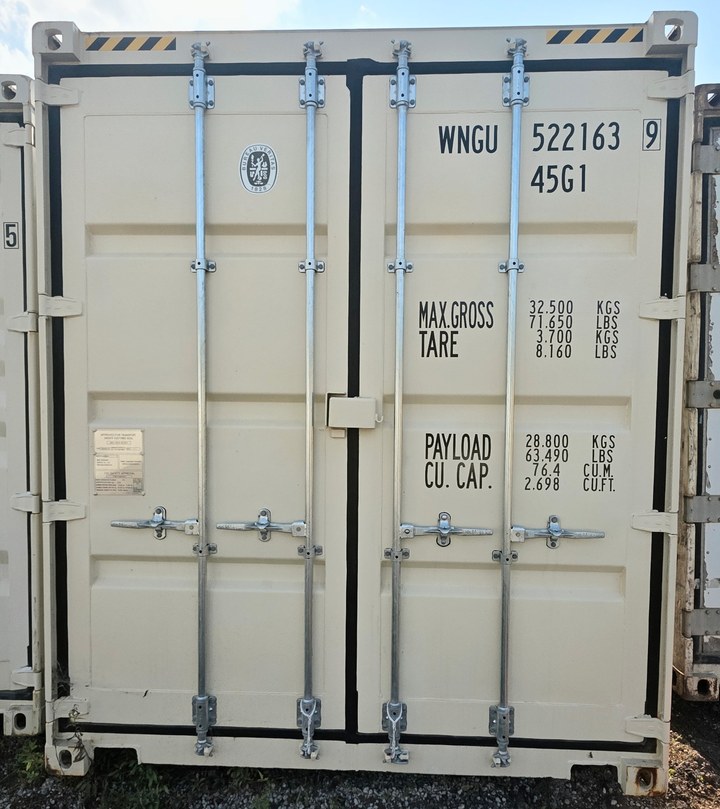
There is no mechanical trade-off hiding underneath: same rods, cams, keepers, and gasket compression, same security profile, same everything except where your hands land. The only honest caution is contextual. If your use case ever involves operating the doors while the unit rides a truck deck, low handles regain their original purpose, which is one of several reasons the used fleet keeps them. For the buyer whose container lives at ground level and works weekly, comfort height is the quiet quality-of-life win among the one-trip rows these doors arrive on, and buyers touring our yard reliably notice the difference within one open-and-close.
Easy-Open Doors: One Lever, and Yes, It Is Patented
The easy-open door is the configuration that stops people mid-walk in our yard. In place of the standard hardware, each locking rod carries one long lever with a softened, anti-slip grip, mounted at working height, and the geometry of that longer lever multiplies your force so the whole unlocking happens in one smooth motion, one hand, no bending. The design is genuinely patented, held under design patent ZL 2014203303622 by Flex Box of Hong Kong, which is why the doors wear their little blue “Easy Open Door, Patented” decal and why you will only find the real article on certain production runs of new containers, mostly one-trip 20-footers and 40-footers in standard and high-cube heights.
The refinements run deeper than the lever. The grip material stays holdable in rain, frost, and gloves, the exact conditions Ontario supplies for half the year. The hinges on these builds typically carry grease fittings, the same zerk nipples your equipment already uses, so the doors can be lubricated for life without any disassembly. It is the one door configuration engineered from the start around a person who visits the box every day, and the market it was built for, self-storage operators whose customers open doors constantly, is the strongest endorsement it could have: the people who profit from doors being easy chose this one.
Watch All Three Side by Side
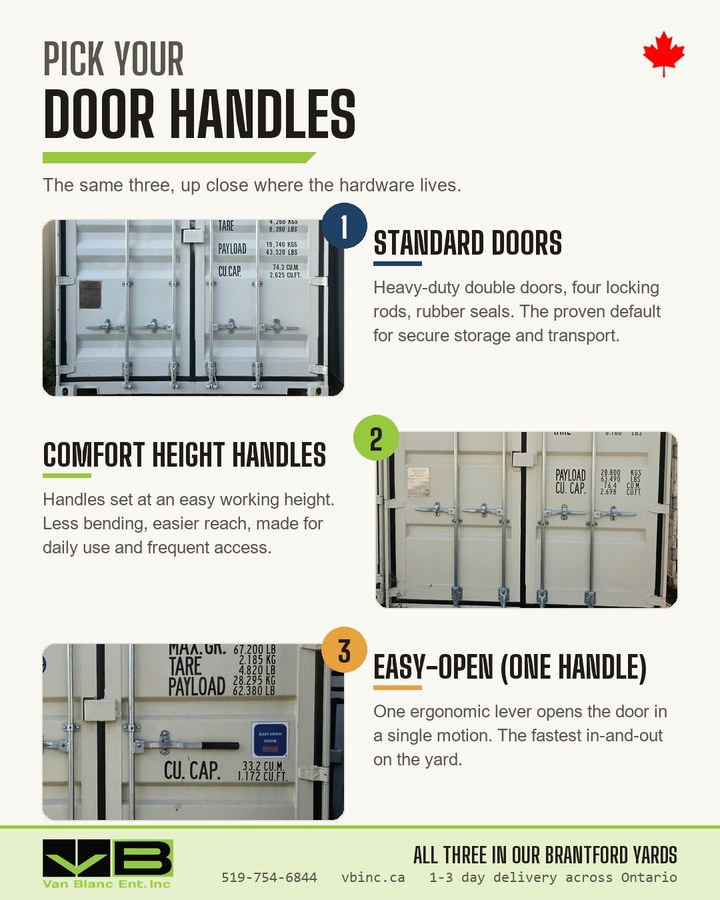
Photos flatten door hardware, so here are all three configurations on the actual units in our yards this season, one after the other.
The units in that clip are current stock, filmed as they sit. When a configuration sells through, the next arrival may carry different doors, which is one more argument for the oldest advice on this site: come stand in the yard and put your hand on the lever before you decide anything.
Pick Your Doors in Person
Standard, comfort height, and easy-open are all on the ground in Brantford right now, on new one-trip stock. Tell us how often you will open the box and we will point you at the right doors, with a real lead time, not a hopeful one. Fast 1-3 day delivery across Ontario from our Brantford yards. The fastest answer is a call.
Van Blanc Ent. Inc. · Brantford, Ontario · Since 1995 · 4.9 stars across 140+ Google reviews · Cash on delivery
Which Doors Fit Which Buyer
The selection logic is a frequency question wearing steel. Open the box monthly, a seasonal-storage rhythm, an archive, a farm unit that works at planting and harvest, and standard doors serve completely; the ergonomics of an occasional bend round to nothing, and the used market’s pricing makes the standard configuration the value play. Open the box weekly and comfort height starts paying its way, because the small tax of low handles compounds with repetition. Open it daily, a shop annex, a parts room, a market vendor’s stock unit, a job-site tool crib cycled every morning and evening, and the easy-open door stops being a luxury: one motion in, one motion out, several hundred times a year, in whatever weather the day supplies.
Businesses tend to feel this arithmetic fastest, which is why the easy-open units we land rarely sit long. A crew that loses ninety seconds per visit to stiff low handles is buying those seconds back forever with the right doors, and an operation putting multiple people through the same door multiplies the return. Fleet and multi-unit buyers can mix configurations across an order, working doors on the daily units, standard on the deep storage, and the quote conversation is where that gets sorted, honestly and per use.
The Winter Chapter
Ontario adds its own paragraph to every door decision, because the handle you choose is one you will operate at minus fifteen in gloves. Cold stiffens everything in the system: the gasket hardens and grips the frame, grease thickens in the hubs, and a door that swung freely in October asks for conviction in January. The configurations do not rank equally in that weather. Bare low handles demand a crouch on ice, the easy-open door’s softened grip was designed for exactly this glove-and-frost duty, and the extra leverage of a long lever is worth the most on the mornings the gasket has frozen to the frame.
The maintenance ritual that keeps any configuration civil through winter takes ten fall minutes: grease the hubs and hinges, run a silicone wipe along the gasket faces so ice releases instead of bonding, and cycle both doors fully once so every cam seats clean before the cold sets in. Owners who do it report January doors that behave like September doors. Owners who skip it meet the pry bar, and the pry bar is how retainers end up on our parts counter’s shopping list.
Handles on Used Containers, and What the Parts Counter Stocks
Now the second question our counter hears weekly: what about the doors on the used unit you already own? Used stock almost universally carries the standard low configuration, and its usual complaints are age rather than design: handles stiffened by dry hubs, retainers bent by pry-happy previous owners, and the occasional rod nudged out of true by a forklift that got ambitious. Most of it is serviceable. Hubs and hinges respond to penetrating oil and grease, seized cams usually free up once the door is taken through its full sequence properly, and genuinely worn parts can be replaced, because the hardware is standardized and available.
That is where we come in on the parts side. Door handles are one of the four items our counter is asked for most, and we stock or source them alongside the rest of the door-hardware shelf: retainers, hubs, cams, hinges, and the gaskets whose replacement we walk through in replacing a worn door gasket. The broader catalogue, castings to lockboxes, lives in the full container parts field guide. The working rule we tell every used-container owner: the door system is the one part of the box designed to be maintained, so maintain it, and a twenty-year-old door will keep sealing like it means it. How grades shape what you inherit is covered in how grades change what doors you get, and the short version is that grade describes wear, never design: a cargo-worthy unit and a wind-and-watertight unit carry the same standard hardware at different mileages.
When you walk used rows, doors are the five-minute inspection that predicts the ownership experience. Swing both doors through their full travel, cycle every handle into and out of its retainer, and watch each cam seat. Stiffness is a maintenance item; a door that will not align with its keepers can mean a racked frame, and that is a different conversation. We cycle the doors with you on every unit we sell, which is most of what “walk the yard before you pay” actually means in practice.
The Rest of the Door System
Handles are one member of a door ecosystem, and buyers weighing configurations usually benefit from seeing the whole map. Security stacks on top of whichever handles you choose: every configuration here accepts padlocks through its retainers, and serious storage adds lockbox hardware over the padlock so bolt cutters have nothing to reach. Buyers who need doors at both ends should look at double-door tunnel units, and operations that want a completely different opening motion, overhead rather than swing, are comparing categories rather than handles, which is the subject of roll-up doors measured against cargo doors.
One practical note that saves delivery-day phone calls: whichever doors you choose, decide where they should point before the truck arrives. Swing doors need room to swing, daily-use doors deserve the convenient end of the pad, and which way your doors should face on delivery day covers the thinking in full. Our drivers place units exactly as asked; the asking is the part that has to happen in advance.
The container industry spent fifty years perfecting a door for the ocean and the last few years finally perfecting one for the person who owns the box. All three chapters of that story are sitting in our yards right now, and the difference between them is one you feel in your hand, not one you read. Come swing all three levers. Your back will cast the deciding vote.
Door Handle FAQs
What are the handles on a shipping container called?
The lever itself is the door handle, mounted through a handle hub to a vertical locking rod. Turning it rotates forged cams at the rod’s ends into frame-mounted keepers, wedging the door tight and compressing the gasket. A retainer catch holds the handle in its locked position against vibration.
What is an easy-open shipping container door?
A patented door configuration, design patent ZL 2014203303622 held by Flex Box of Hong Kong, that replaces standard hardware with one long anti-slip lever per locking rod at working height. The added leverage opens the door in a single one-handed motion. It appears mainly on new one-trip 20-foot and 40-foot containers.
Why are container door handles so low?
Because the standard configuration was designed for intermodal shipping, where containers sit on ship decks and truck beds well above the ground. Low handles let a worker on the dock or pavement operate the doors without climbing. Comfort height and easy-open doors relocate the handles for ground-level storage life.
Are comfort height handles less secure than standard?
No. Comfort height doors use the identical locking machine, four rods, eight cams, eight keepers, and full gasket compression, with the handles simply mounted at waist level. Security is unchanged, and every configuration accepts padlocks and lockbox hardware the same way.
Can stiff container door handles be fixed?
Usually, yes. Most stiffness is dry hubs and hinges, which respond to penetrating oil and grease, and cams that seat poorly usually correct once the door is operated in the proper sequence. Genuinely worn handles, retainers, and hinges are standardized parts that can be replaced; our Brantford counter stocks or sources them.
Sources
- HZ Containers. (2025). Easy Open Door, Patented. hz-containers.com. The patented single-lever design and its ZL 2014203303622 registration
- HZ Containers. (2025). Door Handle: Shipping Container Door Handle. hz-containers.com. Handle leverage, grip materials, and the greaseable hinge detail
- Budget Shipping Containers. (2025). What Is an Easy Open Shipping Container Door? budgetshippingcontainers.co.uk. Handle-height variations across one-trip and used stock
- Tradecorp USA. (2024). 9 Components of the Shipping Container Door Kit. tradecorp-usa.com. The rod, cam, keeper, and retainer anatomy summarized above
Reach Van Blanc in Brantford
We have sold containers across Ontario since 1995, and the parts counter at 90 Morton Avenue East has handled enough door hardware to have opinions. All three door configurations in this guide are on the ground here now, on new one-trip stock, alongside the used rows for comparison.
Van Blanc Ent. Inc., 90 Morton Ave E Unit 1B, Brantford, ON N3R 7J7, 519-754-6844
Not sure which doors your use deserves? Call and describe a normal week with the box. The answer usually takes one minute, and if it is the cheapest option, that is the one we will say.