

Quick Answer: For ongoing storage in Ontario, owning a sea can from Van Blanc beats renting PODS or Cubeit once you pass roughly two to two-and-a-half years, the break-even the rental fleets themselves publish. PODS and Cubeit are built for short-term, hands-off facility storage. A container you own is permanent, modifiable, and yours. Cubeit does not publish rates; each quote is built per postal code from monthly rent, delivery and pickup.
Buying a Sea Can Instead?
Van Blanc sells new and used sea cans outright from our 4 Brantford yards, from 20ft and 40ft dry boxes to 45ft high cubes and reefers. Delivery across Ontario takes 1 to 3 days, you pay on delivery, and the box is yours to keep, modify or resell. See sea cans you can buy outright, or call for an all-in delivered quote. Every other size we stock, from minis to 53 ft high cubes and reefers, is on the page where you can buy a shipping container from the full range.
In This Guide
- The real question: rent or own?
- How PODS, Cubeit, and a sea can each work
- The three-way comparison table
- PODS: the national moving-and-storage brand
- Cubeit: the Costco-partnered one-size pod
- What Cubeit costs in Ontario
- Cubeit sizes vs sea can sizes
- Cubeit vs PODS head-to-head
- The sea can you own from Van Blanc
- Who each option actually suits
- FAQs
Reading time: 9 minutes
Should I rent a storage pod or own a shipping container?
If you need space in Ontario for longer than about two years, owning a shipping container is almost always cheaper than renting a pod, and it is the option a rental-versus-rental comparison never puts on the table. That two-year mark is not a number Van Blanc invented to sell boxes. It comes from the national fleets that rent and sell containers (we walk through the rental-versus-owning math in detail separately), whose own rent-or-buy resources put the break-even point at just over two years in most cities. Past that line, every month of rent is money you do not get back, while a container you bought keeps working and keeps its resale value.
So this page is built around the choice as we explain it at the counter. PODS and Cubeit are rental and moving-pod services. Van Blanc sells and delivers the steel box for you to keep. We are not a moving company, and we do not pack or haul your belongings. What we will do is lay out all three side by side, cite each competitor’s own published facts, and show where owning pulls ahead.
One thing worth saying up front, because we field the question every week at the Brantford yards: this is a storage and ownership decision. The “cubeit vs pods” search usually comes from someone weighing two rental pods against each other. The piece a two-pod search never surfaces is the third column, where you stop renting and start owning. Our page on what owning costs against a rented pod puts a month number on that switch. Read all three, then decide.
Where Van Blanc fits in this comparison
Van Blanc Ent. Inc. is a family-run shipping container yard in Brantford, Ontario, in business since 1995. We sell new and used sea cans, with modifications finished at the yard, and deliver across Ontario in 1 to 3 days from our four yards on a cash-on-delivery basis. We are the “own it” column, not the “rent it” column. We supply and deliver the box; you keep it.
How do PODS, Cubeit, and a sea can each work?
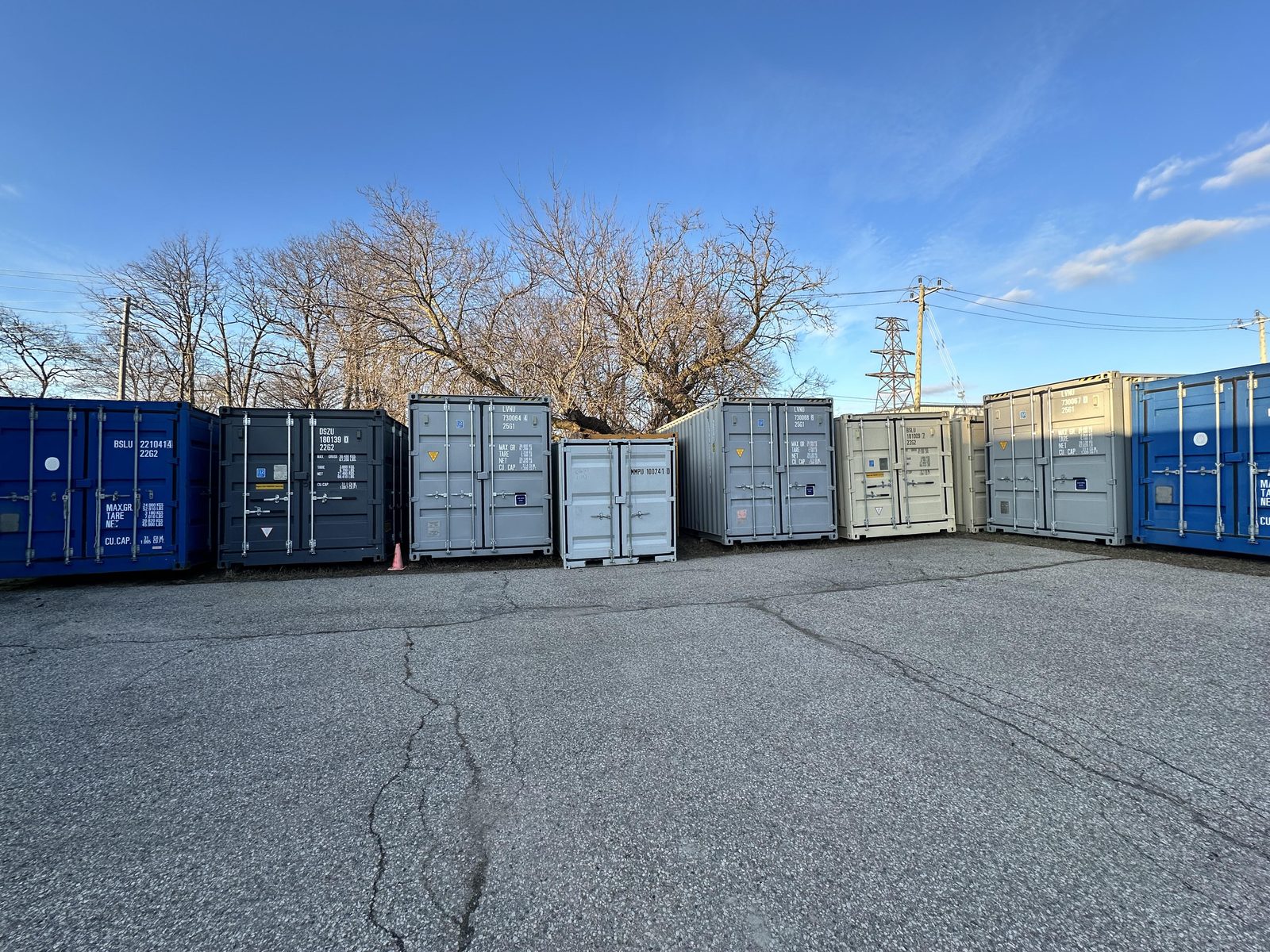
The three options work in different ways, and understanding the mechanics is most of the decision. Two are rental services that bill you on a cycle. One is a purchase that ends with a steel box on your property that belongs to you. A fourth, the U-Haul U-Box, is a single 8 by 5 by 7.5-foot box you rent several of, and how a U-Box works and measures up is its own page.

PODS: rent by the month, pack at your own pace
PODS delivers a steel-frame container to your property at ground level, with no ramp to climb. You load it yourself over time. Billing is monthly: per the PODS Canada site, “your first 30 days are included in the price, then rent monthly if needed.” You can keep the container on your property or have PODS warehouse it at one of their secure Storage Centers, which the company notes are “not climate-controlled, but they are designed to keep containers clean, secure, and dry.” PODS positions itself openly as both a moving and a storage company, and it offers three sizes. MI-BOX runs the same model through independent dealers covering Hamilton, Burlington, Niagara, the western and northern GTA, and the Kitchener, Guelph and Cambridge corridor; the MI-BOX comparison reads its composite box and dealer map against an owned sea can.
Cubeit: one size, four-week cycles, level delivery
Cubeit, a Canadian portable-storage brand you may know from its Costco partnership, runs a simpler model. There is one container size, measuring 8 feet wide by 8 feet tall by 16 feet long, with 128 square feet of floor space, which Cubeit says holds the contents of 3 to 4 rooms. Rental is billed “in increments of 4 weeks (28 days),” with “no deposit required.” Their proprietary horizontal lifting system keeps the unit level during delivery and pickup instead of tilting it on a ramp. Like PODS, you can keep the Cubeit on your driveway or have it stored at one of their secure Canadian facilities. Go Mini’s bills on the same 28-day cycle with three lengths up to 20 feet, and the Go Mini’s comparison reads its galvanized pod and franchise map against an owned sea can.
The sea can: buy it once, keep it for decades
A sea can is the Canadian name for the same ISO shipping container the rest of the world uses. When you buy one from Van Blanc, it arrives on a tilt-deck truck and is set on your site, and it is yours. There is no billing cycle, no return date, and no facility storing it on your behalf. A well-kept container has a 25-plus-year functional life. You can paint it, cut a personnel door into it, add windows or ESA-certified electrical, lock it, and leave it for as long as you own the property. The trade-off is simple: you pay once, up front, and you need a spot to put it.
The single fact that decides most of this
Rentals are priced to be easy to start and easy to stop. Ownership is priced to be cheaper over time. If you know it is years, or forever, every rental cycle is money spent on space you will never own. If you are unsure, buying still covers you, because a box you own resells when the need ends. The break-even sits near the two-year mark across the industry.
Sea can vs PODS vs Cubeit: the comparison table
Here is the three-way comparison in one view. Cost is described in structure, not dollars, because real numbers move with size, grade, delivery distance, and live stock, and a published figure would be out of date by the time you read it. For your exact number, call us at 519-754-6844 for a fast quote.
| Factor | Sea Can (Van Blanc, owned) | PODS (rented) | Cubeit (rented) |
|---|---|---|---|
| Ownership | You own the container outright and keep it | Rental, returned to PODS when finished | Rental, returned to Cubeit when finished |
| Cost structure | One up-front purchase plus a per-kilometre delivery charge; nothing after that | Recurring monthly rent (first 30 days included) plus delivery and pickup fees per trip | Recurring 4-week (28-day) rental cycles, no deposit, plus delivery and pickup |
| Container quality and grade | Choose your grade: One-Trip, Cargo Worthy, Wind-and-Watertight, or As-Is; walk the yard and pick the exact unit | Uniform steel-frame rental fleet, maintained by PODS | Uniform rental fleet, level-lift delivery, maintained by Cubeit |
| Sizes | 20ft and 40ft dry, 40ft and 45ft High Cube, plus reefers (seven sizes) | Three sizes: 8ft, 12ft, 16ft | One size: 8ft x 8ft x 16ft (128 sq ft) |
| Term flexibility | No term to manage; keep it as long as you like or resell it. Pays back once you pass roughly two years | Very flexible short-term; cancel when the project ends | Very flexible short-term; 28-day cycles, cancel anytime |
| Modifications | Full freedom: paint, doors, windows, shelving, electrical, signage | Not permitted on a rental unit | Not permitted on a rental unit |
| Off-site storage option | It lives on your property (or any site you choose) | Keep on-site or store at a PODS Storage Center | Keep on-site or store at a Cubeit facility |
| Typically used for | Long-term storage, farms, trades, businesses, anyone who wants a permanent asset they can modify | Short to medium projects, transitions between homes, hands-off storage | Short-term local storage, decluttering, renovations, driveway convenience |
The pattern in the table is consistent. The two rental columns are nearly interchangeable on the things that matter to a short project, which is why a straight “cubeit vs pods” comparison often comes down to local availability and delivery style. The ownership column is the one that pulls away the longer your timeline runs.
What does PODS offer?
PODS sells flexible, low-commitment storage with a national footprint and an off-site option. The monthly billing means you are never locked into a long term, and you can keep the unit on your property or move it to a PODS Storage Center. People book it to clear a house for a few months, stage a renovation, or bridge a gap between properties.
PODS also offers three sizes, from an 8-foot unit suited to a small load up to a 16-foot unit the company lists as its most popular. That range lets you match the container to the job instead of paying for space you will not use. The limitation, for a storage buyer, is the same one every rental shares: the meter never stops. PODS is built around moving and short-cycle storage, so the longer you keep paying monthly, the more you spend on space you will never own, and you cannot modify a unit you are only renting.
A typical PODS booking
A homeowner in Cambridge is renovating the main floor and needs the living-room contents out of the way for three months. That is the job PODS is built around, billed monthly. A used 20ft sea can bought for the same job holds the room’s contents, sits locked on the driveway, costs the same whether the work takes three months or ten, and afterward becomes garage overflow or goes back on the market.
What sizes do PODS containers come in?
PODS sizes run 8ft, 12ft, and 16ft long, all built as aluminum-skinned panels on a steel frame rather than solid corten steel. The 16ft unit holds roughly the contents of a three-to-four-room home. For comparison, a 20ft sea can carries about 15 percent more volume than the largest PODS unit in a fully steel shell, and a 40ft roughly doubles it, which is why the size conversation usually settles the rent-or-own question before the price conversation starts.
What does Cubeit offer?
Cubeit sells simple, local, driveway storage in a single size, so there is no size to guess. The 8-by-8-by-16 unit holds 3 to 4 rooms, which covers most home decluttering, renovation, and short-move staging jobs. The 28-day billing with no deposit lowers the barrier to starting, and the level horizontal lift keeps a loaded unit flat during pickup, which matters if you are stacking fragile boxes inside.
The Costco partnership gives Cubeit a trust anchor that resonates with a lot of Ontario households, and the secure-facility option means you do not have to keep the box in your own driveway if you would rather not. The limitation is, again, the rental ceiling. One size means no scaling up to a 40-foot footprint for a bigger job, you cannot modify the unit, and at 28 days a cycle the cost accumulates the same way every rental does. Over a season the cycles add up quietly. Over years, the arithmetic turns against you.
Paul LeBlanc, owner: “I have got nothing bad to say about the rental pods. The call I hate getting is the one two years in, when somebody works out they have paid for a box three or four times over and they still do not own it. That is the math worth doing up front. So we hand it to them.”
How much does Cubeit cost in Ontario?
Cubeit does not publish rates. Every quote is generated per postal code through their online tool or by phone, and the total typically combines a monthly rental rate, a delivery charge, a pickup charge at the end of the term, and an optional storage fee if the pod lives at their facility instead of your driveway. None of those lines is public, so long-term comparison shopping means requesting a quote; buyers searching “Cube It prices” as two words reach the same per-postal-code quote tool.
The real comparison is rental-forever against owning, rather than our number against theirs. Every month a pod sits on your property, the meter runs. A sea can you buy once costs what it costs on delivery day and then never again, and the box still holds resale value years later. If it does not, the ownership math takes over quickly, and we will walk you through that math on one call to the yard.
What sizes do Cubeit containers come in?
Cubeit’s standard unit in Ontario is a single 16 ft format: 8 feet wide, 8 feet high, 16 feet long, about 128 square feet of floor. The one-size model keeps their logistics simple, and it suits a three-to-four-room house move. For the crew side of a house move, see how Ontario movers bill by home size. What it cannot do is scale. A 20 ft sea can carries roughly 15 per cent more floor area in marine-grade corten steel, a 40 ft doubles it, and both are yours to keep, modify, or resell; the full numbers live in the 20ft dry spec breakdown. If the load is a whole house, a contractor’s inventory, or a farm season, the pod format simply runs out of box before the job runs out of stuff.
Cubeit vs PODS head-to-head: how the two rentals compare
Cubeit offers a single 16 ft unit, 28-day billing cycles, no deposit, and a level horizontal lift that keeps a loaded unit flat. PODS offers a choice of sizes (8, 12, or 16 ft), monthly billing with the first 30 days included, and positions itself around moving as well as storage. For pure driveway storage the two services overlap almost completely; the differences are size fit and billing style.
| Factor | Cubeit | PODS |
|---|---|---|
| Sizes | One format: 8 x 8 x 16 ft, about 128 sq ft | Three sizes: 8, 12, and 16 ft |
| Billing | 28-day cycles, no deposit | Monthly, first 30 days included |
| Positioning | Portable storage, with a Costco partnership as its trust anchor | Moving and storage, national footprint |
| Off-site option | Secure-facility storage available | PODS Storage Center option |
| Modifications | Not allowed on a rental | Not allowed on a rental |
| Published pricing | No; quoted per postal code | No; quoted per postal code |
Both quotes are generated per postal code, so you get both numbers for your address and compare the all-in totals, delivery and pickup included. Put a Van Blanc quote beside them while you are at it: the meter never stops on either rental, and past roughly two years the ownership math in the next section takes over.
Why own a sea can from Van Blanc instead of renting?
You own a sea can when your need for space is long-term, permanent, or simply yours to decide. The container becomes an asset on your property rather than a recurring line on your bank statement, and unlike a rental it holds resale value if you ever sell it. That is the core of the ownership case, and it is why the fleets that rent containers tell their own customers that buying makes sense once you expect to need the space for more than about two and a half years.
Ownership also opens up two things no rental allows. The first is choice of quality. When you buy from Van Blanc, you pick your grade and you can walk the Brantford yards and choose the exact unit before you pay a dollar. A One-Trip 20ft is essentially new, with clean factory paint, ideal if the box will be visible or branded. A Wind-and-Watertight 20ft is a used grade that is sealed and rodent-proof with real cosmetic wear, the working farmer’s friend for feed and equipment. You decide which unit leaves the yard.
The second is modification freedom. A container you own can be painted, fitted with a personnel door and windows, wired with ESA-certified electrical, shelved out, or signed for your business. A rented unit cannot be touched. Christian has watched the same trades customers come back for a second and third box as their operations grow, because once you own one and see what it does, the rental clock stops making sense.
The case for owning
- Own a sea can when: you need the space for years or permanently, you have a spot for it, you want to modify it, or you want an asset with resale value.
- If the end date is uncertain: storage needs tend to run past the first guess, and a box you own resells when the job is done.
- The break-even: roughly 18 months to 2.5 years for most ongoing storage. Above it, owning usually wins outright. Run your own timeline against the two-year break-even.
One warning we give every buyer, because we take the call every week. If you are shopping to buy and you find a sea can listed for far less than a real supplier on Facebook Marketplace, that is not a deal, that is the trap. People send a deposit, the listing vanishes, and they phone us two weeks later with no container and no refund. A legitimate yard you can drive to and walk is the cure. For the full breakdown, read our the buyer’s guide we keep for first-time purchases.
Ready to price your container?
Tell us the size and your postal code and we’ll send back an all-in number, container, delivery, and placement, usually within 1-3 days. No pressure, no mystery fees.
Family-run in Brantford since 1995 · 200+ containers in stock · 4.9★ across 140+ Google reviews · every box graded by a person, walk it before it lands.
Should you rent a pod or buy a sea can for your timeline?
Match the option to your timeline and your property, and the decision makes itself. Most regret in this category comes from renting for what turned out to be a long-game need. Storage jobs often run past the date first guessed, and an owned box covers both outcomes: it stays as long as you need it and resells when you are done.

What PODS and Cubeit get booked for
Renovations, decluttering, a few months between homes, or storage off-site at a facility. A straight “cubeit vs pods” call comes down to which one delivers to your address and whether you prefer one size or three. Before the first billing cycle, price a sea can: a 20ft holds more than the largest pod, and it resells or goes back through buyback when the job is done.
Buy a sea can from Van Blanc if
You are a farm, a trade, a small business, or a household that needs secure space for years; you have room for the container; you want to modify it; or you simply want to stop paying rent on space you will never own. Buyers across Ontario drive to our Brantford yards to pick their exact box, then we deliver it back to them in 1 to 3 days. That is the whole advantage of buying from a yard you can visit: you see the steel before it is yours. Compare the seven sizes on our container options page, or browse current stock on containers for sale.
Sold outright. Delivered in 1 to 3 days.
Van Blanc sells new and used shipping containers outright from our 4 Brantford yards, with delivery in 1 to 3 days and payment on delivery. We do not rent, lease or offer rent-to-own. Request a sale quote or call the yard at 519-754-6844.
Frequently Asked Questions
Is it cheaper to rent a pod or buy a shipping container in Ontario?
For long-term storage, buying is cheaper, and the box keeps its resale value. The national fleets that both rent and sell containers publish break-evens of just over two years in most cities. Past roughly two to two-and-a-half years, owning a sea can costs less than continuing to rent.
What is the difference between Cubeit and PODS?
Both are portable-storage rental services where you load the unit yourself and keep it on-site or stored at their facility. Cubeit offers one size, an 8 by 8 by 16 foot container with 128 square feet, billed in 4-week cycles with no deposit. PODS offers three sizes, 8, 12, and 16 foot, billed monthly with the first 30 days included. PODS positions itself as both moving and storage; Cubeit focuses on portable storage.
Can I modify a rented storage pod?
No. Rented units from PODS or Cubeit cannot be modified, since you return them when you are finished. Only a container you own can be painted, fitted with doors or windows, wired with ESA-certified electrical, or shelved out. If modification matters to you, buying a sea can is the only option that allows it. Call Van Blanc at 519-754-6844 to talk through a build.
Does Van Blanc rent containers or move my belongings?
No. Van Blanc sells containers outright and does not rent, lease, or offer rent-to-own. Past a few months, buying a used wind-and-watertight box normally costs less than renting one, and you can sell it on or ask us about buyback when you are done.
What size container do I need for whole-home storage?
For most homes, a 40ft container holds the contents of a typical three to four bedroom house with room to spare, while a 20ft suits a smaller load, a renovation, or trade storage. Cubeit and PODS top out at a 16 foot rental, so if you need a larger permanent footprint, buying a 40ft or 40ft High Cube sea can is the way to get it. We help you size it on a quick call.
Can I see a container before I buy it from Van Blanc?
Yes. You can drive to 90 Morton Avenue East in Brantford, walk the rows with Paul or Christian, and pick the exact sea can before you pay a dollar. That is the advantage a rental click cannot match. We have supplied containers across Ontario since 1995, with a 4.9 star rating across 140+ verified Google reviews. Worth the drive for the quality and the family service.
Which is cheaper, Cubeit or PODS?
Neither company publishes Ontario rates; both quote per postal code. Cubeit bills in 28-day cycles with no deposit, while PODS bills monthly with the first 30 days included, so short-term totals usually land close together. Get both quotes for your address and compare the all-in numbers including delivery and pickup. Past roughly two years of continuous storage, buying a sea can costs less than renting either.
Are Cubeit and PODS containers the same size?
No. Cubeit rents a single format, an 8 by 8 by 16 foot unit with about 128 square feet of floor. PODS offers three sizes: 8, 12, and 16 foot. Both services top out at 16 feet, so for a bigger footprint you are into ownership territory: a 20 ft sea can carries roughly 15 per cent more floor area than the largest pod, and a 40 ft doubles it.
Sources and References
Reach Van Blanc in Brantford
We have been supplying shipping containers across Ontario since 1995. Our yard is at 90 Morton Avenue E in Brantford, and we deliver right across the province on a cash-on-delivery basis. No surprise fees, no chase-the-paperwork. If you have run the rent-versus-own math and ownership wins, this is where you start.
Van Blanc Ent. Inc., 90 Morton Ave E Unit 1B, Brantford, ON N3R 7J7. Call +1 888-509-6658 or 519-754-6844.
Still weighing a pod rental against owning a sea can? Call us for a real quote, then set it against the rental bill for your timeline.