
Quick Answer: A shipping container workshop for trades costs a fraction of a stick-built shop of the same size, because the steel structure already exists. Start with a Cargo Worthy 20ft or 40ft container for a two-zone shop, add closed-cell spray foam (R-19 walls, R-30 ceiling), a 100A panel with two 220V circuits, balanced ventilation for welding fumes, and 4-6 LED panels. Delivered from our Brantford yard in 1-3 days. What drives your number is grade, size, and freight zone, so call Christian or Paul for a same-day quote.
Shops whose real bottleneck is customer tires twice a year should price the container tire hotel before adding another parts room.
Crews still living out of stacked gang boxes can start one step earlier with the job box versus tool crib comparison, thicker steel included.
In This Guide
- Why do tradesmen pick a container over a stick-built shop?
- Is a 20ft or a 40ft better for a one-trades workshop?
- Should you buy CW grade or one-trip for a working shop?
- How do you lay out the tool wall, workbench, and vise?
- How do you ventilate welding fumes and grinding dust?
- How do you wire 220V for a welder, compressor, and plasma cutter?
- How do you light a container shop without shadows?
- How do you insulate a container shop for year-round Ontario use?
- Painted steel or plywood for the interior wall?
- How do you fit fold-out benches, tool storage, and security?
- Is a heated floor worth it for winter work?
- What real Brantford-area shops has Van Blanc delivered?
- Frequently Asked Questions
Reading Time: 14 minutes
Why do tradesmen pick a container over a stick-built shop?
A shipping container workshop gives a tradesman the same usable floor space as a stick-built shop for a fraction of the cost, because the steel structure already exists and arrives in a day. A Cargo Worthy 20ft or 40ft container takes spray foam, a 220V panel, ventilation, and lighting, then moves on a tilt-deck if the worksite changes.
A stick-built 12 by 20 detached workshop in Ontario carries a heavy bill once you include footings, permits, framing, roof, electrical service, and finishing. A 20ft shipping container delivered to your driveway gives you the same usable floor space for a small fraction of that, even with a full trades-grade fitout, because the structure already exists and arrives in a day. The container also moves. If you sell the property, change worksites, or rotate the bin to a different operation, you load it on a tilt-deck and go.
Welders, mechanics, carpenters, and electricians keep calling Van Blanc with the same set of questions. How loud is too loud for a residential street? Will the panel handle a Lincoln 225 plus a 60-gallon compressor running at the same time? Can the floor take a chain hoist over an engine? Will it sweat in January? This guide answers each one from the floor of our Brantford yard, not from a blog template written by someone who has never opened a 9-foot HC door.
Paul LeBlanc started Van Blanc in 1995. Before that he spent four decades in Asian trade, working out of factories that ran their own welding booths, machine shops, and fabrication bays inside repurposed sea cans. He has watched the same conversion done well and done badly thousands of times. His son Christian works the yard now with him. When a tradesman walks our row of bins, one of them walks with you and points at the corner posts, the seal channels, and the floor on the bin you are to buy.
Paul LeBlanc: “A welder called me last spring asking if a 20ft could really replace the shop he was about to spend a fortune framing. I told him to come walk the yard. He stood inside a Cargo Worthy bin, swung the cargo doors, looked at the floor, and ordered one before he left. Two weeks later he had a panel, a fan, and a vise in it, and he was working out of it. The steel does the heavy lifting. Your money goes into what you put inside it.”
The 30-year Ontario operator angle
Pool brokers ship to Ontario from a depot they have never seen. Van Blanc owns four Brantford yards and has delivered to working farms, machine shops, body shops, and fabrication operations across Brant, Norfolk, Haldimand, Hamilton, Niagara, and Waterloo regions for 30 years. The container that lands at your shop is the same container Paul or Christian walked with you before you paid. Fast 1-3 day delivery to every region across Ontario. Every quote comes with a real lead time, not a hopeful one.
Is a 20ft or a 40ft better for a one-trades workshop?
Most one-trades shops fit inside a 20ft High Cube. The HC version gives you 9 feet 6 inches of exterior height instead of the standard 8 feet 6 inches, which translates to about 8 feet 4 inches of clear interior headroom after spray foam and an LED panel drops. That is enough to swing a pipe wrench overhead, hoist a small block, or stand a 4-foot piece of stock on end while you cut it.
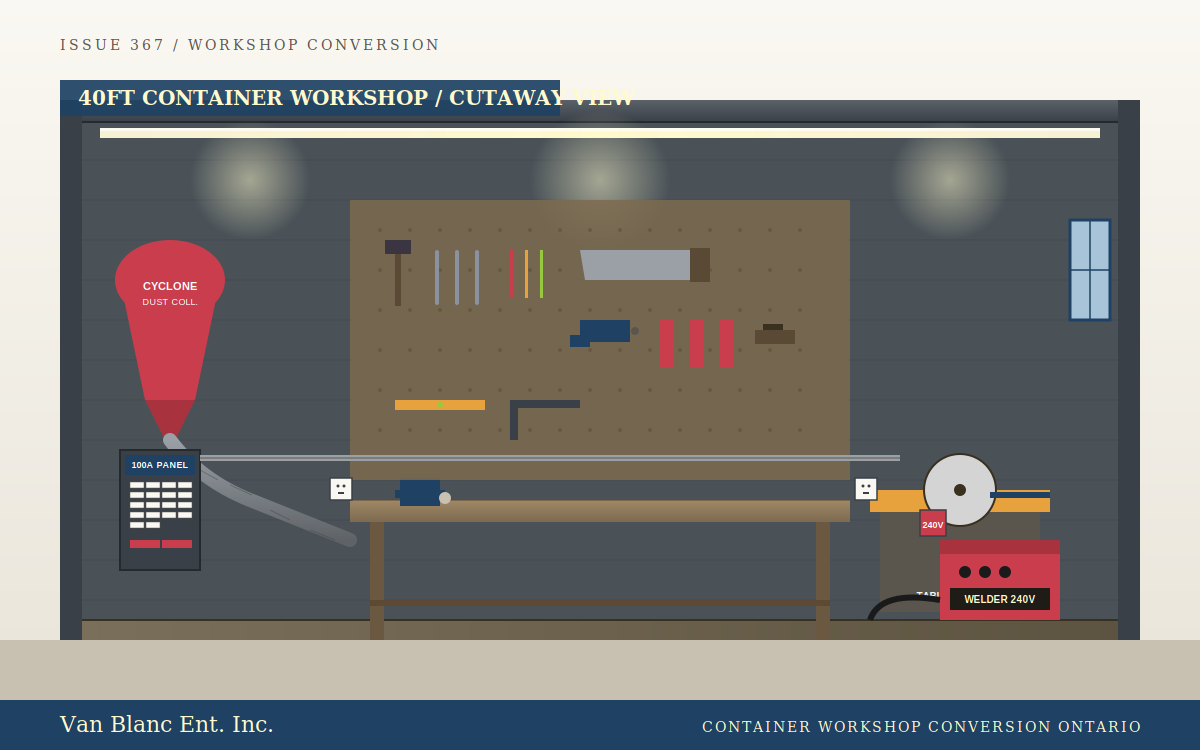
A 20ft HC gives you 160 square feet of usable floor. Lay it out with one long wall as the tool wall and workbench, one long wall as overhead storage and a vise station, the back wall as your welding corner with extraction, and the cargo-door end as your loading and project staging area. One tradesman, one bench, one workflow.
The 40ft HC steps you up to 320 square feet and is the right call when you need to separate dirty work (welding, grinding, cutting) from clean work (assembly, finishing, paint, electronics). It also lets you park a vehicle inside if you fit a roll-up door on the cargo end. Electricians who carry full inventory and need a layout bench plus a wire prep bench plus secure parts storage usually go 40ft. Mechanics doing more than oil changes go 40ft.
| Trade | Recommended Size | Reason |
|---|---|---|
| Welder / fabricator | 20ft HC or 40ft HC | 20ft works for solo shop. 40ft if you run more than one machine or do longer stock. |
| Mobile mechanic | 20ft HC | Mobility plus tool storage. Roll vehicle work onto outside pad next to the bin. |
| In-shop mechanic | 40ft HC | Vehicle inside, lift clearance under the HC, bench along the long wall. |
| Carpenter | 20ft HC | Bench, miter saw station, lumber rack overhead, dust collection on the back wall. |
| Electrician | 40ft HC | Wire prep bench, layout bench, sectioned parts bins, secure inventory. |
| Combined trades (small contractor) | 40ft HC | Separate dirty from clean zones, vehicle clearance, full crew tool storage. |
Should you buy CW grade or one-trip for a working shop?
This is the part where the upsell usually happens. A one-trip container looks beautiful. Factory paint, clean corners, no rust spots, doors swing easy. It also carries a steep premium over a working-grade bin and gets dented inside two weeks of real shop use. The first time you back a vehicle out and clip the corner post, the first time you drop a piece of rebar against the wall, the first time a sparks shower from the grinder scorches the paint, that pretty one-trip looks like every other working shop.
Cargo Worthy is the grade for working tradesmen. CW means the bin has passed re-inspection for further ocean shipping. The frame is structurally sound, the floor is rated for heavy cargo loads, the doors close and seal tight against weather. Surface rust, paint variance, the occasional small dent on the side panels are part of the deal. A 20ft HC in CW grade typically lands well below a one-trip bin in our yard. Save the difference and put it toward the panel, the spray foam, and the ventilation.
Paul LeBlanc: “I tell every working tradesman the same thing when he walks the yard. You are buying a workshop, not a show car. Cargo Worthy gives you the same durable steel frame and the same tight cargo doors as the one-trip. The cosmetic difference matters to nobody except the guy who has never used the bin for actual work. Save your money on the steel and spend it on what goes inside.”
The four grades, in plain language. One-Trip is essentially new, having made just one journey from Asia, and commands the top price of the four grades. Cargo Worthy (CW) is the working-shop sweet spot, surface wear plus structural soundness. Wind & Watertight (WWT) seals against weather but cannot be re-certified for shipping, fine for stationary storage but the frame inspection is lighter. As-Is is the bottom grade and we rarely recommend it for a workshop because the floor or door issues that knock a bin into As-Is also make modification work more expensive. Once you start adding the door, window, and electrical cuts a working shop needs, a sound CW frame is what keeps the labour predictable, so CW is the right starting point. If you want to compare grades the way we do in the yard, our walkthrough of what to inspect before you put money down on a used bin covers the corner castings, floor, and door seals point by point.
How do you lay out the tool wall, workbench, and vise?
Sketch your floor plan on paper before the bin is delivered. Once spray foam goes on, you have committed to the layout because every electrical outlet, vise plate, and bracket mount is anchored through the steel into the foam. Moving them later means cutting and patching.
A standard 20ft HC working layout, looking in from the cargo doors:
- Right long wall (8 feet from door to back): overhead storage rail at 6 feet 6 inches, ratchet strap to the cargo lashing rings. Hang chop saw cart, mig roll cart, and oxy-acetylene set on this side. Floor open for movement.
- Right long wall (rear 12 feet): 8-foot main workbench at 36 inches tall. 1-1/2 inch hardwood top with a 1/4 inch steel overlay where the vise mounts. Vise bolted through to the corrugation with 3/8 inch lag bolts and washers backing up the strike.
- Back wall (8 feet wide): welding corner. Move the fab table here. Exhaust fan punches through the back wall above the table. Make-up air vent in the side wall at floor level, opposite side of the fan.
- Left long wall (full 20 feet): tool wall. French cleat system on 3/4 inch plywood backer, anchored through to the steel side panels. Tool silhouettes painted on the plywood so missing tools show up at a glance at the end of the shift.
- Door end: staging area. Keep this clear so you can roll a part in, work it, and roll it out.
For a 40ft HC mechanic shop, run a vehicle bay down the centre 24 feet, drive-through with a roll-up door at the cargo end. The back 16 feet becomes the bench wall, tool wall, and parts storage. The wider 40ft layout lets the dirty side stay dirty without contaminating the assembly side.
Vise mount detail
Working tradesmen wreck weak vise mounts inside the first month. A vise yanks sideways, downward, and rotationally every time you torque on it. The corrugation in the side panel cannot hold a vise on its own. Build a 1/4 inch steel plate sub-mount, weld it to the inside of the corrugation at three points, then bolt the vise through the plate. The container’s steel frame becomes part of the vise. Nothing rocks loose.
How do you ventilate welding fumes and grinding dust?
This is where DIY container workshops most often go wrong. A sealed steel box plus welding plus grinding equals trapped fumes, eye strain, and lung damage. Welding fumes contain hexavalent chromium, manganese, and metal oxide particles that the CSA W117.2 standard for welding safety treats as a serious occupational hazard. You need a real ventilation plan, not a single fan stuck in a hole.
The principle is balanced ventilation. One mechanical exhaust fan pulls fume-laden air out. One make-up air intake on the opposite side of the bin lets clean air in. Without the intake, the exhaust fan starves, runs against a vacuum, and pulls almost no air. Working tradesmen get this wrong all the time.
For a 20ft welding-and-grinding bin, run a 14 inch industrial exhaust fan rated 1,800 to 2,200 CFM in the back wall above your welding corner. Pair it with a 10 inch x 14 inch low intake vent in the opposite side wall, near floor level, with a hooded weather cover outside and a removable filter inside. The cross-draught pulls fumes up and out across the operator’s breathing zone, not into it.
For grinding dust, add a fume arm or a portable cyclone collector. The exhaust fan handles airborne weld fume but grinding dust needs point capture or it settles all over the bin. A 4 inch flex hose to a 35 to 50 gallon cyclone in the corner pays for itself in cleanup time within six months.
Fan sizing rule of thumb
Total bin volume for a 20ft HC is roughly 1,200 cubic feet. CSA welding-safety guidance calls for at least 20 air changes per hour in an enclosed welding space. 1,200 cubic feet times 20 changes per hour equals 24,000 cubic feet per hour, or 400 CFM minimum continuous. Most working welders run double that (800 to 1,000 CFM continuous) to keep the breathing-zone air clear in real conditions. A 14 inch fan rated 1,800 to 2,200 CFM peak runs comfortably at 800 to 1,000 CFM in real-world install conditions with hood, filter, and damper losses.
How do you wire 220V for a welder, compressor, and plasma cutter?
This section is where the Electrical Safety Authority gets serious. In Ontario, any permanent electrical work on a structure including a converted shipping container requires a permit and a Licensed Electrical Contractor under the Ontario Electrical Safety Code. The container itself is treated as an outbuilding once it is wired. Do not pull the wire yourself unless you are an LEC. The inspection at the end is what protects your insurance claim if the bin ever burns.
For a one-trades welding or mechanic shop, the standard service is a 100 amp sub-panel fed from the main house or shop panel via a buried 4/4/4/8 aluminum conductor, or a 60 amp panel if the run is short and the load is modest. From that sub-panel:
- One dedicated 50 amp 220V circuit for the arc welder. A Lincoln 225, Miller 211, or comparable stick/MIG machine draws 30 to 50 amps continuous. Wire 6 AWG copper to a NEMA 6-50 receptacle.
- One dedicated 30 amp 220V circuit for the compressor. A 60-gallon two-stage compressor (Eaton, Ingersoll-Rand) on a 5 HP motor draws 22 to 26 amps at start. Wire 10 AWG copper to a NEMA 6-30 receptacle.
- One dedicated 30 amp 220V circuit for a plasma cutter if you run one, or as a backup for a second welder.
- Four 20 amp 120V circuits on GFCI, one per long wall plus one for the bench plus one for lighting. Standard 12 AWG copper to NEMA 5-20 receptacles every 6 feet along the bench wall.
Wire is run in surface-mounted EMT conduit after the spray foam goes on. Do not bury wire in the foam itself. Conduit lets the next electrician, including you, change a run without cutting foam. EMT also protects against the bumps and scrapes a working shop inflicts on walls.
Run the panel before the foam
The most common mistake we see: spray foam goes in first, then the electrician arrives and has to cut channels for the conduit. Order of operations: rough in the panel location and the conduit runs first (or at least mark them on the steel), spray foam second, mount the conduit and pull the wire third. Schedule the LEC for the day after the foam guy.
How do you light a container shop without shadows?
Shop lighting is not a place to save money. You need 5,000K colour temperature for crisp visibility on metalwork, at least 100 lumens per square foot across the working zone, and even fixture spacing so your hand does not shadow the work as you move around the bench.

For a 20ft HC workshop, plan four 4-foot linear LED panels rated 50 watts and 6,000 to 7,500 lumens each. Run them parallel to the long walls, two on each side, mounted 8 inches off the wall and offset 4 feet from each end. This puts light on the bench, on the tool wall, and on the floor without dropping a shadow on whatever you are working on.
For a 40ft HC workshop, plan six to eight panels in the same configuration. Add a separate task light on a swing arm above the welding corner and above the vise. Mechanics add a magnetic LED bar that clips inside the engine bay.
Wire the panels to one dedicated 20 amp 120V circuit so a tripped welder circuit does not knock the lights out mid-cut. Add a 12V battery-backup work light at the door for the inevitable winter night when the genset is the only power and you need to find the breaker panel.
How do you insulate a container shop for year-round Ontario use?
Ontario winters drop a steel container to outside-ambient temperature within 30 minutes of the heater shutting off. Ontario summers heat it past 50°C with no insulation. A working shop is uninhabitable year-round without insulation. Closed-cell spray foam is the right product and the right thickness for the job.
Specifications, brand-confirmed by the Ontario spray foam trades:
- Closed-cell spray foam, R-6 per inch. Open-cell foam (R-3.5 per inch) does not seal moisture and is the wrong product for a steel-walled shop.
- Walls: 3 inches (R-18 to R-19). Brings interior wall temperature close enough to ambient that condensation stays off the steel.
- Ceiling: 5 inches (R-30). Heat rises and the roof is your biggest loss surface in winter and biggest heat-gain surface in summer.
- Floor: 1 to 2 inches under marine plywood (R-6 to R-12). Or skip floor foam and run a radiant heated floor (see below).
A 20ft HC closed-cell spray foam package in Ontario is one of the larger line items in the build, and it should come from a licensed installer. Get it done before any electrical or interior wall work. Spray foam expanding behind a finished wall is an expensive lesson.
Why closed-cell, not batt insulation
Batt insulation (R-13 fiberglass, R-15 mineral wool) needs a stud cavity. A shipping container has corrugated steel walls with no cavity until you frame one in. Framing in studs eats 4 to 5 inches of interior dimension on each wall, which on a 7 foot 8 inch wide container is a lot. Closed-cell spray foam bonds directly to the steel corrugation, takes only 3 inches of depth, acts as its own vapour barrier, and stops the steel from sweating. It is the correct product for a steel-walled structure. Batt is the wrong product.
Painted steel or plywood for the interior wall?
After spray foam goes on, you have a choice. Leave the foam exposed (it is sprayable and looks gray-cream when it cures), spray a colour-coat over the foam, or build a finished interior wall over it.
The two practical choices for a working shop are:
Painted spray foam. Spray a white or light-grey latex over the cured foam. Cheapest finish, bounces light around the bin, lets you see what you are working on. Downside: you cannot mount anything heavy directly to the foam. Vise plates, tool walls, and shelf brackets need to anchor through to the steel underneath. Drill out through the foam to the steel, sleeve the mounting holes, and bolt through.
Plywood interior wall. 3/4 inch CDX plywood, mounted on furring strips bonded to the foam with construction adhesive, or screwed through to the steel corrugation with self-tapping screws. The plywood becomes your mounting surface for the French cleat tool wall, shelf brackets, and bench. Costs more in materials for a 20ft HC, looks finished, hides utility runs behind it, and you can swap out a damaged panel without rebuilding the wall.
For a working welder or mechanic, the right answer is usually plywood on the long walls, painted foam on the ceiling. You mount your tool wall and bench through the plywood, the ceiling does not need to hold anything, and you get the best cost-to-function tradeoff. If you would rather have the cutting, framing, and interior fit-out done before the bin lands, that is the kind of work our crew handles at the yard under engineered drawings so the unit arrives shop-ready.
How do you fit fold-out benches, tool storage, and security?
A 20ft HC is 160 square feet. Every square foot has to earn its keep. Fold-out and mobile work surfaces let you reconfigure for what the day’s job needs.
Three layouts that pay off:
- Fold-down secondary bench on the tool-wall side. 24 inch deep, hinged to the wall at 36 inches off the floor, drops onto two folding legs. Adds 16 square feet of bench when you need it, folds flat against the tool wall when you do not.
- Wheeled tool drawer cart that locks. 41 to 56 inch Snap-on, Mac, or Husky chest on casters. Pulls out for the day, locks back against the bench wall at night. The full tool inventory is portable in a way a fixed cabinet is not.
- Overhead retractable parts bins. Mount a 4 foot wide pulley shelf above the bench, lower it for working access, raise it when you need floor clearance below.
Security matters because a workshop bin sitting on a driveway, a farm laneway, or a jobsite is a target. The cargo doors are the strongest part of the container by design. Add a weld-on lockbox over the right-hand door pin and run a Class 5 or Class 6 disc lock through it. Cargo doors with a proper lockbox are pry-bar resistant. The cheap way (a padlock through the original handle) is the way a working shop gets emptied in 12 minutes.
If you cut a man door in the side wall for daily access, fit a steel-frame insulated commercial door with a deadbolt and a strike plate that anchors through to the steel frame. Residential pre-hung exterior doors are the second most common break-in point once a bin is cut open, which is one of the trade-offs we walk through in the wider rundown of what a steel box can become.
Ready to price your container?
Tell us the size and your postal code and we’ll send back an all-in number, container, delivery, and placement, usually within 1-3 days. No pressure, no mystery fees.
Family-run in Brantford since 1995 · 200+ containers in stock · 4.9★ across 140+ Google reviews · every box graded by a person, walk it before it lands.
Is a heated floor worth it for winter work?
The single best comfort upgrade for an Ontario container workshop is a heated floor. Concrete or marine-plywood floors stay 10 to 15°C colder than the air column above them in winter. You can run the propane heater all day and your feet still ache. A radiant heated floor solves it.
Two real-world options:
Electric radiant cable under a steel overlay. Lay 240V mat cable on the original marine plywood floor, screw down a 14 gauge steel overlay welded at the edges, and you have a workshop floor that runs at 20 to 22°C across the whole bin. It is a moderate add-on for a 20ft HC and wires into the sub-panel as a dedicated 240V circuit.
Hydronic radiant under marine plywood overlay. Pex tubing in a foil reflective channel, connected to a small propane or electric boiler outside the bin. Higher install cost but cheaper to run if you already have a propane source. Better for 40ft bins where the cable length on an electric system gets long.
Either option gives you a workshop that is comfortable in February without burning through propane every month on a forced-air space heater that only warms the air above shoulder height.
What real Brantford-area shops has Van Blanc delivered?
A few of the working shops we have delivered to in the last several years across Brant, Norfolk, and Haldimand. Names of customers withheld for their privacy. The shops are real and the configurations are concrete.
Welder, Burford. 20ft HC CW with 100A sub-panel, 50A NEMA 6-50 for a Miller 211, 30A NEMA 6-30 for the compressor, four 20A 120V circuits, four LED panels, 14 inch exhaust fan in the back wall, balanced intake. Heated electric floor under steel overlay. Plywood interior on long walls, painted foam ceiling. The fitout roughly matched the bin price again on top of it. Used as primary income-earning fab shop, second income out of a residential property.
Mobile mechanic, Norfolk. 20ft HC CW left mostly open inside (no fixed bench), wheeled tool chest, fold-down work surface on the side wall, two 220V outlets, four 120V outlets, two LED panels, vinyl flooring over the original plywood. Loaded on a flat trailer twice a year for the seasonal field service rotation across cash-crop and dairy properties.
Carpenter, St. George. 40ft HC CW with a 100A sub-panel, miter saw station midway down one long wall with dust collection ducting to a cyclone in the corner, lumber rack overhead, six LED panels, double swing-doors on the side wall for unloading 16-foot stock. Insulated for year-round small-furniture work. The finished fitout added well over the bin price again.
Electrician, Six Nations adjacent (Brant County side). 40ft HC CW with a sectioned tool wall on the entire left long wall, three workbenches on the right long wall (rough wire prep, layout, final assembly), 100A panel, sectioned parts storage in 18 stacked bins under the right bench. Primary working shop for a one-man residential service operation.
Paul LeBlanc: “Every working tradesman who walks our yard for the first time asks the same question: ‘Will this bin actually hold up?’ I tell them to look at the corner castings, look at the seal channels on the cargo doors, look at the floor. A Cargo Worthy bin built to ISO 6346 has carried 60,000 pounds across the Pacific. Your welder, your compressor, and your tools are not going to wear it out. The bin will outlast the trade.”
Frequently Asked Questions
How much does a finished container workshop cost in Ontario?
For a 20ft HC starting from a Cargo Worthy bin, the budget breaks into five buckets: the container itself, closed-cell spray foam, electrical (100A sub-panel and circuits via a Licensed Electrical Contractor), ventilation and lighting, and interior wall finish. Electrical and spray foam are usually the two biggest line items. A 40ft HC build costs more across every bucket because there is more steel to insulate, wire, and light. The cleanest way to know your turnkey number is to tell us the size and your postal code and let us quote the bin plus delivery, then layer the fitout estimate on top.
Can I run a 220V arc welder in a container workshop?
Yes. The standard install is a 100A sub-panel with a dedicated 50A 220V circuit on a NEMA 6-50 receptacle, wired in 6 AWG copper through surface-mounted EMT conduit. A Lincoln 225, Miller 211, or comparable machine runs comfortably. The wiring must be done by a Licensed Electrical Contractor in Ontario under the Ontario Electrical Safety Code, with an ESA permit and inspection.
Do I need ventilation for welding inside a container?
Yes, and the design matters. A sealed steel box plus welding equals trapped fumes including hexavalent chromium and manganese. Install balanced ventilation: a 14 inch industrial exhaust fan rated 1,800 to 2,200 CFM in the back wall above your welding corner, paired with a low intake vent in the opposite side wall. CSA W117.2 welding-safety guidance calls for 20 air changes per hour minimum in enclosed welding spaces.
What size shipping container is best for a one-trades workshop?
For most solo trades (welder, mechanic, carpenter, electrician), a 20ft High Cube is the right size. 160 square feet of floor, 8 feet 4 inches of clear headroom after spray foam, room for a tool wall, bench, vise, and welding corner. Step up to a 40ft HC if you need to park a vehicle inside, separate dirty from clean work zones, or run a multi-bench layout.
Should I buy a one-trip or Cargo Worthy container for a workshop?
Cargo Worthy. A CW 20ft HC costs substantially less than a one-trip bin of the same size. Both are structurally sound with tight cargo door seals. The cosmetic difference (surface rust, paint variance, minor dents on a CW) does not matter once you are working in the bin. Spend the savings on spray foam, panel, and ventilation.
How long does a container workshop last in Ontario weather?
A properly insulated Cargo Worthy container with surface-rust touch-up every 5 to 7 years has a working life of 25 to 35 years in Ontario climate. Closed-cell spray foam stops interior condensation, which is the main rust accelerator. The marine plywood floor lasts 20+ years under a steel overlay. The cargo door seals last 10 to 15 years and are replaceable.
Can Van Blanc deliver a container workshop to my property?
Yes. We deliver across Ontario from our 4 Brantford yards in 1-3 days for most regions, with tilt-deck trucks that can place a 20ft or 40ft container on most driveways, farm laneways, and shop pads. Premium freight applies to Northern Ontario routes. Call Paul or Christian at 519-754-6844 or 1-888-509-6658 to confirm site access and lead time.
Where is the closest container workshop supplier to Brantford?
Van Blanc Ent. Inc. at 90 Morton Avenue East in Brantford has been delivering shipping containers across Ontario since 1995. 4.9 stars across 140+ verified Google reviews. Walk our row of bins in person, talk to Paul or Christian, choose the exact unit going to your shop. Worth the drive for unbeatable quality, family customer service with 30 years of experience.
Sources
- Electrical Safety Authority. (2025). Ontario Electrical Safety Code, 28th edition. esasafe.com/role/oesc
- Canadian Standards Association. (2019). CSA W117.2, Safety in welding, cutting, and allied processes. csagroup.org
- International Organization for Standardization. (2022). ISO 6346:2022, Freight containers, Coding, identification and marking. iso.org
- Transport Canada. (2025). Cargo Securement Standard 10, Containerized Cargo. tc.canada.ca
- Sprayfoam Solutions. (2026). Closed-cell spray foam R-value and Ontario application guide. spfsolutions.ca
Reach Van Blanc in Brantford
We have been supplying shipping containers across Ontario since 1995. Our warehouse is at 90 Morton Avenue E in Brantford, and we deliver right across the province on a cash-on-delivery basis. No surprise fees, no chase-the-paperwork. 4.9 stars across 140+ verified Google reviews.
Van Blanc Ent. Inc. 90 Morton Ave E Unit 1B, Brantford, ON N3R 7J7. Call Paul or Christian directly at 519-754-6844 (cell) or 1-888-509-6658 (toll-free).
Bring your floor-plan sketch with you when you visit. We will walk the row of CW bins with you, talk through the panel sizing for your welder and compressor, and confirm a real lead time to your shop.