
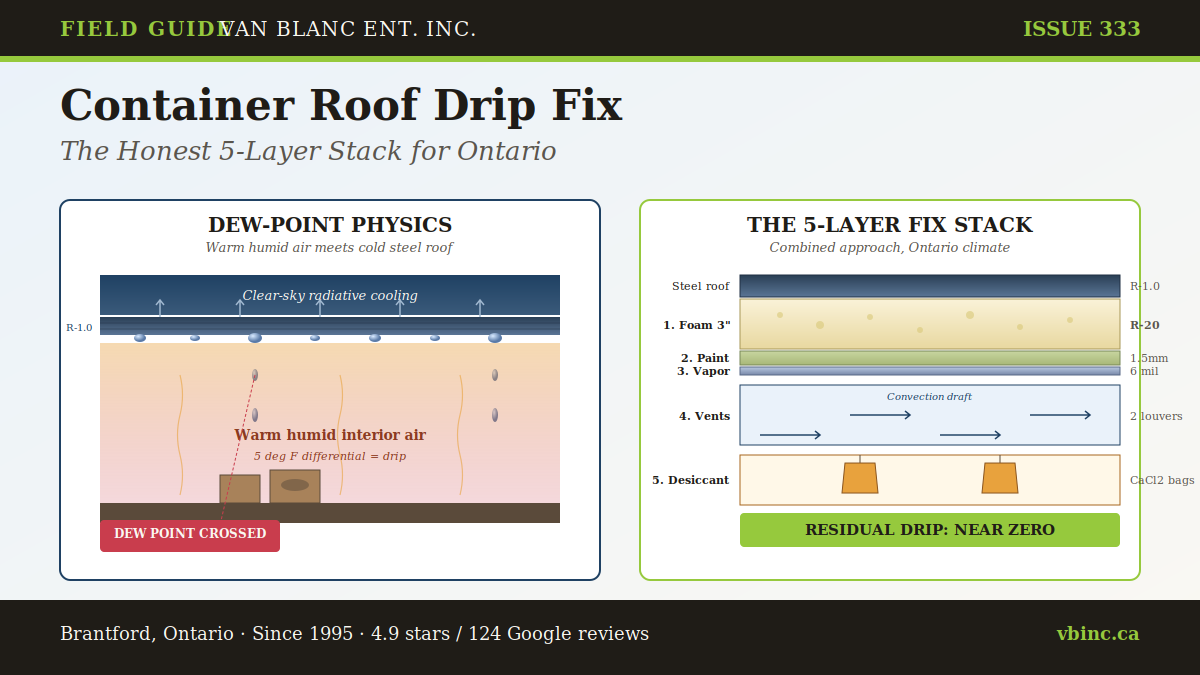
Quick Answer: Container roof condensation drip (the “sweating box” problem) happens when warm humid interior air meets a cold steel roof and crosses the dew point, dropping liquid water onto your contents. The 3-layer fix that actually works in Ontario: insulate the roof first with R-20 closed-cell spray foam at 3 inches applied directly to the corrugated underside, add a vapor barrier and two passive louver vents (one low, one high) for convection airflow, and back the build with a desiccant load through the worst humidity months from late June through early September. Anti-condensation paint is a legitimate Tier 2 option for short-hold and unmodified boxes. A single fix on its own (vents only, paint only, foam only) leaves residual drip in roughly 4 out of 10 Ontario installations we follow up on. The combined stack drops residual drip to near zero on a 20-footer and lasts the life of the container. Pricing varies by grade, size, and freight zone, so call Christian or Paul for a same-day quote. Family-run since 1995, 4.9 stars across 140+ verified Google reviews. Delivery in 1-3 days from our 4 Brantford yards.
In This Field Guide
- Why does my shipping container sweat?
- Why does container condensation show on the roof first?
- Does closed-cell spray foam stop container roof condensation?
- Does anti-condensation paint actually work on a container?
- Do you need a vapor barrier in a shipping container?
- How much ventilation does a container need to stop sweating?
- Does desiccant stop shipping container condensation?
- What condensation fix stack actually works in Ontario?
- Where can I buy a pre-treated container in Ontario?
- Frequently asked questions
Reading time: about 13 minutes. This roof-drip guide sits under our overview of why steel boxes sweat and connects to the wider build picture: what an insulated container costs, the airflow choices that move moisture out, and running heat or cooling in a converted unit.
Why Does My Shipping Container Sweat?
A shipping container sweats when warm, humid interior air touches the cold steel shell and crosses the dew point, turning vapor into liquid water that drips from the roof. It is condensation rather than a leak. The steel holds almost no insulation value, so the surface chills below the air’s dew point on clear nights and water forms.
Container sweat is not a defect. It is a property of warm humid air meeting cold steel, and it follows the same physics as droplets on a cold drink glass. When any surface drops below the dew point of the air around it, water vapor changes state and becomes liquid on that surface. A corrugated steel roof is the worst possible surface for the math: an uninsulated 14-gauge corrugated roof carries an R-value of roughly R-1.0, against a recommended R-20 for an Ontario building envelope.
After a hot humid Ontario summer day, the inside air of a closed container stays warm and saturated deep into the evening. The roof, exposed to clear-sky radiative cooling, drops below the interior dew point sometime between sunset and 2 in the morning. Water precipitates onto the underside of the steel, gravity does its work, and the drip starts. Documented industry guidance puts the trigger threshold at a 5-degree Fahrenheit differential between interior air and the steel surface. In Ontario locations near Lake Ontario, Lake Erie, the Georgian Bay shoreline, and inland river valleys, that differential hits on most clear summer nights.
Christian LeBlanc, second-generation operator: “Customers call in late July with a bin dripping water onto their boat cover, their documents, or their tools. They think the container is leaking. The roof is not leaking. The air inside is shedding moisture against a cold steel ceiling. The fix is breaking that contact between humid air and cold steel. Once you understand the physics, the five-layer stack we recommend becomes obvious.”
Why Does Container Condensation Show on the Roof First?
In every container we follow up on in Ontario, the roof shows condensation first and worst. Three structural reasons drive the pattern.
Radiative cooling hits the roof hardest. A horizontal surface exposed to a clear night sky loses heat to deep space at a rate vertical walls do not match. The corrugated roof of a sealed container can drop 8 to 12 degrees Celsius below ambient on a clear October night, while the walls (shielded from sky exposure and warmed by ground re-radiation) drop only 3 to 5 degrees. The roof crosses the dew point first.
Warm air rises and accumulates against the ceiling. Inside a sealed container, convection drives the warmest and most moisture-laden air upward. That column of saturated air settles into the corrugated roof channels and sits in direct contact with the coldest interior surface in the box. Maximum vapor pressure meets minimum surface temperature.
Corrugation channels concentrate the drip. The shape of a standard ISO container roof (per ISO 1496-1) has long parallel channels running the length of the container. Condensation that forms on the underside of these channels runs along the channel, accumulates at the low point, and either drips onto contents or pools against the door gasket and rusts the threshold.
The pattern is predictable enough to use as a diagnostic. Wet spots running in parallel lines along the length of the box mean dew-point condensation on the roof. Wet spots that are random, irregular, or concentrated near a single penetration mean a leak, and the repair is leak repair (not a condensation fix). For the full leak-versus-sweat decision tree, work through our guide to diagnosing a sweating box. For structural repair, see our container roof repair Ontario guide. The CSC plate on the door end tells you the structural condition the container left the factory in; here is how to read the stamped plate on the door and what those numbers mean.
Does Closed-Cell Spray Foam Stop Container Roof Condensation?
Yes. Closed-cell polyurethane spray foam (Fix 1 in the stack) is the most effective single fix for container roof condensation in Ontario. The foam puts an insulating layer between warm humid interior air and the cold steel surface, raising the interior-facing surface temperature well above the dew point, so the steel never chills below it.
- Roof at 3 inches, walls thinner. Three inches of closed-cell on the roof delivers roughly R-18 to R-21, the priority surface because it crosses the dew point first. Walls can run thinner (2 inches at R-12 to R-14) if budget is tight.
- Closed-cell rather than open-cell. Closed-cell has roughly twice the R-value per inch of open-cell and acts as a vapor barrier in itself at thicknesses above 1.5 inches. Open-cell is permeable and lets moisture migrate to the steel surface behind it.
- Direct adhesion to clean steel. The corrugated interior must be clean, dry, and rust-free. Pressure-wash the interior, allow a 48-hour dry-out, and lightly grind obvious rust before the spray crew arrives.
- Continuous coverage, no cold bridges. The crew must hit every corrugation valley and ridge, corner welds, and the area around any roof penetrations. A 1-inch gap becomes a localized dew-point trap.
Foam pricing scales with the surface area you cover and the thickness you spec, so a 20-foot roof (160 square feet) at 3-inch thickness sits well below a full thermal envelope, and a 40-footer runs roughly double the equivalent 20-foot build. Grade of the box, freight zone, and whether the work happens at our yard or on your site all move the quote. The foam is part of the at-the-yard conversion work, applied under controlled cure conditions before the box ever reaches your property. Lifespan matches the container. No degradation curve, no annual maintenance. For full cost build-outs see our insulated containers Ontario 2026 cost guide; if you plan to heat or cool the finished space, our notes on sizing a unit for a steel box cover the load math. The rent-versus-buy math on foam favours owners; weigh the cost of leasing against owning long term.
Does Anti-Condensation Paint Actually Work on a Container?
It works, within limits. Anti-condensation paint (Fix 2 in the stack) is the Tier 2 option for situations where foam is impractical: short-hold boxes, unmodified shipping operations, and tight budgets. The engineering is real even though the performance ceiling sits below foam.
The mechanism is two-part. Anti-condensation coatings combine water-absorptive particles (typically cellulose fibers and heat-expanded perlite) with a resinous binder, per the documented composition in USPTO patent 4364994 covering this product class. When the dew point is crossed and water vapor would otherwise condense into liquid drops, the cellulose fibers absorb that moisture into the coating layer instead. When the air later warms and the dew point retreats, the absorbed moisture evaporates back without ever having existed as free liquid. The coating layer also adds a small insulation buffer at roughly 1 to 1.5 millimetres thickness.
Product class examples include GrafoTherm (the original cellulose-fiber-and-perlite formulation widely referenced in the UK and European container industry) and Tnemec’s Aerolon family (an aerospace-grade insulating coating with documented industrial performance data). Both are spray-applied to a clean, primed steel surface and cure in 24 to 48 hours.
Tradeoffs:
- Lower performance ceiling. Handles light-to-moderate condensation events; saturates under heavy multi-day events. Four consecutive humid nights at 14 to 30 degrees Celsius can saturate the paint until the air dries enough to release the stored moisture back.
- Surface prep is 2 to 3 days for a 20-footer. Degrease, light grind, primer coat, then anti-condensation coat. Factory paint inside used containers is rarely a suitable direct base.
- Lower material cost than foam. Anti-condensation coating runs well under a closed-cell foam build for the same 20-footer roof and walls, which is part of why it earns its Tier 2 slot for short holds and tight budgets.
- Reapplication every 8 to 12 years per typical manufacturer guidance. Foam lasts the life of the container.
The right use case: a Wind & Water Tight container you expect to keep for 1 to 3 years, a budget-constrained storage build for non-critical contents, or a layer-2 add-on for a high-humidity industrial application. Most customers pick foam or paint rather than both.
Do You Need a Vapor Barrier in a Shipping Container?
Sometimes. A vapor barrier (Fix 3 in the stack) sits between the interior finished surface and the insulation behind it, and its job is to stop water vapor from migrating through the wall assembly and condensing against the steel container shell behind the insulation. Whether you need one depends entirely on which insulation you chose.
Closed-cell spray foam at 3-inch thickness is itself a Class II vapor retarder under the National Building Code of Canada (perm rating below 1.0). Foam customers do not need a separate vapor barrier sheet; the foam handles both jobs.
The vapor barrier conversation matters when:
- Using fiberglass batts, rockwool, or rigid foam board. All three are permeable to water vapor. Humid interior air will migrate through them and hit the steel shell behind. Without a vapor barrier on the interior face (6-mil polyethylene sheet, properly taped at seams), you have moved the dew-point problem from the visible interior to the hidden cavity behind your insulation. The drip is still there; you just cannot see it. Hidden-cavity rust accelerates fast.
- Using anti-condensation paint with an added interior finish. The paint handles the air-to-steel interface but does not stop vapor migration through drywall or panelling added later. A vapor barrier behind the finish gives you a redundant layer.
- Building a finished interior (living, office, food storage). Occupied or refrigerated builds have stricter thermal and moisture requirements, and a properly detailed vapor barrier is part of any reasonable spec.
Detailing matters more than material choice. Un-taped seams, un-sealed vent and electrical penetrations, or a single tear from drywall screw drift makes a vapor barrier roughly equivalent to no vapor barrier at all. Our breakdown of how to layer insulation in a steel box covers placement step by step; the dehumidification and air-exchange requirements that pair with the barrier are covered in our guide to conditioning a container interior.
How Much Ventilation Does a Container Need to Stop Sweating?
For a standard 20-foot box, two passive louver vents (one low, one high, diagonally opposite) are the baseline that stops sweating in shoulder seasons. Ventilation (Fix 4 in the stack) is the most universally applicable layer. Every container in Ontario benefits from at least those two passive vents, and many benefit from a powered upgrade for active operations. The mechanism: ventilation exchanges saturated interior air with drier exterior air before saturation builds. If interior air never reaches the dew point against the steel surface, condensation cannot form even on uninsulated steel. The math depends on outdoor humidity (a humid August day will not produce dry replacement air, so vent-only solutions are weaker in peak humidity months), but for spring and fall shoulder seasons, vent-only can be sufficient.
Standard practice for a 20-foot dry-storage box:
- Two passive louver vents, one low and one high. A 24 by 24 inch louver on each long side, one near the floor at one end and one near the roof at the opposite end. Cool outside air enters low, warms, rises, exits high. The installed cost comes down to louver materials plus the labour to cut and seal two openings, so it stays the most affordable layer in the stack.
- Powered vent for active operations. Workshops, hobby spaces, and generator rooms produce more interior heat and moisture than a stored-goods box; a roof-mounted solar or 12-volt hardwired fan adds active exchange. A solar unit hardwired with install costs more than a passive louver pair but draws no power and runs maintenance-free. A 100 CFM unit exchanges a 20-footer’s 1,170 cubic feet every 12 minutes.
- Whirlybird turbine vent. Wind-powered, light active airflow whenever there is wind. It is the cheapest powered option to install and moves lower CFM than a solar fan. Reasonable for low-budget installations in windy locations.
Placement geometry matters more than vent count. Two vents stacked on the same wall barely exchange air. Two vents diagonally opposite (low on one wall, high on the opposite wall at the opposite end) produce the strongest convection draft. For the full passive-versus-mechanical decision tree, see our container ventilation passive vs mechanical Canada guide.
Does Desiccant Stop Shipping Container Condensation?
Desiccant helps, but only as a supplement rather than a standalone fix. Desiccant (Fix 5 in the stack) is the cheapest add-on you can run. A desiccant material (silica gel, calcium chloride salt, activated alumina, molecular sieve) holds water molecules tightly enough to pull them out of saturated air, lowering the interior dew point below the steel surface temperature so condensation cannot form.
Two common product classes:
- Large-format hanging desiccant bags. Calcium chloride pellets in a fabric-and-plastic dual-chamber bag. Top chamber holds pellets; lower chamber catches saturated brine. Each bag treats 500 to 1,000 cubic feet (Container Dri II is the common product line). A 20-footer at 1,170 cubic feet typically uses 2 bags hung from roof corrugations. Each bag is inexpensive and gets replaced every 60 to 90 days in peak months, so the running cost is modest.
- Rechargeable silica gel. Canisters regenerated by oven-drying at 120 degrees Celsius. Higher upfront outlay, each canister covering 200 to 400 cubic feet, but multi-year operating cost is far lower than disposable bags. Right choice for permanent installations.
Tradeoffs: desiccant is a supplement rather than a primary fix for severe condensation. A heavily condensing box (uninsulated, unventilated, moisture-releasing contents) saturates desiccant capacity within days. Desiccant works as the final 10-to-15 percent of dehumidification on top of foam, paint, and vents. It does not stop air infiltration; a leaky door gasket pulls humid exterior air in faster than desiccant can dry it. Spent calcium chloride brine is mildly corrosive and should be bucketed and drained per municipal guidance, not dumped on lawn or concrete.
The right use case: a Wind & Water Tight container with two passive louver vents storing moisture-sensitive contents (documents, electronics, fabric, leather, archival material) through June-to-September. Two bags replaced every 60 days a season. Cheapest insurance in the stack.
What Condensation Fix Stack Actually Works in Ontario?
The condensation fix stack that works in Ontario combines two or three layers matched to the use case, because no single fix is sufficient for every application. The pattern after three decades of supplying containers across the province is that the right stack depends on use case, budget, and timeline. The four stacks below cover the realistic range.
| Stack | Use Case | Build | Relative Cost and What Drives It |
|---|---|---|---|
| Stack A | Short-hold box (kept a year or less) | 2 passive louver vents + 2 hanging desiccant bags | Lowest. Louver materials, light labour, and a few seasonal bag replacements. |
| Stack B | Long-term storage, owner-occupied | Anti-condensation paint on roof + 2 louver vents + 2 desiccant bags | Low to moderate. Surface prep and coating area drive it; reapplies every 8 to 12 years. |
| Stack C | Working storage / workshop | Closed-cell foam 3 in roof / 2 in walls + 1 powered vent | Moderate to high. Foam square footage, thickness, and powered-vent install. |
| Stack D | Occupied (office, living, food-grade) | Foam 3 in full envelope + vapor barrier + mechanical vent + dehumidification | Highest. Full envelope, barrier detailing, and mechanical conditioning. |
Stack A is the largest category among short-hold owners. Roughly 60 percent of buyers who plan to resell the box within a year run that build and never see a serious drip event. Stack B is roughly 20 percent, mostly used-container purchasers who want a permanent fix without the foam budget. Stacks C and D together are the remaining 20 percent, building toward HVAC-conditioned or thermally controlled use.
Local Tip: Pre-Treat at the Yard Rather Than on Your Property
For Stack B, C, and D builds, get paint or foam applied at our 4 Brantford yards before delivery. Yard application gives the spray crew clean access, controlled cure conditions, no rain interruptions, and a properly ventilated work area. The container arrives finished, ready for vents and desiccant install, with no spray-foam smell setting into your property’s air during the first cure week. Two licensed Brantford-area spray-foam contractors handle the yard-applied builds, and the same arrangement covers cellulose-fiber anti-condensation paint.
Where Can I Buy a Pre-Treated Container in Ontario?
In Ontario, the practical answer is to buy from a supplier who will pre-treat the box before it leaves the yard. Our 4 Brantford yards hold 200+ containers in mixed grades, sizes, and pre-modification states, and you can browse what is currently in the yard ready to buy before you commit. Customers planning a condensation-fix build walk the row, read CSC plates, push door seals, and pick the exact box that matches their spec. Pre-build inspection is structural to the right answer: the interior surface condition determines what your spray-foam or paint crew deals with on day one.
What we screen for before recommending a box for a foam or paint build:
- Clean interior with no loose rust scale. Heavy surface rust adds 4 to 8 hours of prep grinding before any coating crew can spray.
- Tight door gaskets and threshold seals. A box with degraded gaskets pulls humid exterior air in faster than interior conditioning can dry it. Gasket replacement is a yard add-on.
- Sound roof with no patches over previous lifting eyes. A patched roof complicates roof-side foam adhesion. We prefer Wind & Water Tight original-roof boxes for foam-build customers.
- Readable CSC plate showing manufacture year and refurbishment history. If you are unsure what a healthy plate reads like, our walkthrough on checking a build year and refurb history shows what the numbers should look like.
National pod fleets ship from a generic pool. You take what the truck brings, condensation-fix planning happens after the fact (often after a wet-contents incident), and the prep work runs longer than it should because the interior was never inspected pre-shipment. With us, you inspect first, plan the build before the box leaves the yard, and the spray crew works on a known-good substrate.
Christian LeBlanc, second-generation operator: “We had a customer come up to the Brantford yard after a damp-affected inventory loss from another supplier’s drop. He walked the row, picked a clean 2018-build 20-footer with original roof and tight gaskets, and we coordinated the closed-cell foam crew at our yard before delivery. Three years later, no drip, no inventory damage, no callback. That is what in-person inspection plus yard pre-treatment is worth on a permanent build.”
If you are planning a condensation-fix build in 2026, start the conversation with the use case (dry storage, workshop, occupied, food-grade) and the timeline (short hold versus permanent). Call, walk us through the application, and we will tell you which stack fits, what the installed cost is, and which of our 4 Brantford yards has the cleanest candidate box.
Ready to price your container?
Tell us the size and your postal code and we’ll send back an all-in number, container, delivery, and placement, usually within 1-3 days. No pressure, no mystery fees.
Family-run in Brantford since 1995 · 200+ containers in stock · 4.9★ across 140+ Google reviews · every box graded by a person, walk it before it lands.
Frequently Asked Questions
What causes water to drip from the roof of my shipping container?
Dew-point condensation. Warm humid air inside meets the cold steel underside of the roof and water vapor changes state into liquid on the surface. A differential of just 5 degrees Fahrenheit between interior air and the steel surface triggers visible drip in a saturated atmosphere. The roof drips first because radiative cooling on a clear night drops it 8 to 12 degrees Celsius below ambient. It is physics rather than a leak, and the fix is breaking the contact between humid air and cold steel.
How do I know if my container is leaking or just condensing?
Look at the wet-spot pattern. Condensation produces parallel wet lines running the length of the container along the corrugation channels. Leaks produce random or irregular wet patches concentrated near a single penetration. Parallel lengthwise pattern means condensation and this guide. Irregular or localized pattern means a leak and our container roof repair guide.
Which fix is most effective: foam, paint, vents, or desiccant?
Closed-cell spray foam at 3 inches on the roof is the most effective single fix, delivering R-18 to R-21 and acting as a vapor barrier in itself. It eliminates condensation permanently and lasts the life of the container. Anti-condensation paint is second. Vents and desiccant alone handle light condensation but saturate under peak humidity events. The pattern: combine 2 to 3 layers rather than relying on one.
How much does closed-cell spray foam cost on a 20-foot container in Ontario?
Foam cost is driven by the square footage you cover and the thickness you spec at 3-inch on the roof. A 20-foot roof alone is only 160 square feet, so a roof-only job sits well below a full thermal envelope (3 inches on the roof and 2 inches on the walls). A 40-footer runs roughly double the equivalent 20-foot build. Grade of the box and freight zone also move the quote, so the real number comes from a same-day call rather than a fixed sticker.
Does anti-condensation paint really work, or is it a gimmick?
It works within its limits. The cellulose-fiber-and-perlite formulation in USPTO patent 4364994 absorbs water vapor at the air-to-steel interface before it condenses, and releases it back when conditions warm. The performance ceiling is moderate events; heavy multi-day events saturate the coating. It is a legitimate Tier 2 solution at lower cost than foam, with an 8 to 12 year usable life. GrafoTherm and Tnemec’s Aerolon family have documented industrial-use data.
How many vents does a 20-foot container need to prevent condensation?
Two passive louver vents minimum, diagonally opposite (low on one wall at one end, high on the opposite wall at the other end). The geometry creates natural convection. A 24 by 24 inch pair is the standard size for a 20-footer, and the installed cost comes down to louver materials plus the labour to cut and seal the two openings. For active workshops, add a powered roof vent rated at 100 CFM or higher.
Should I use silica gel or calcium chloride desiccant?
Calcium chloride hanging bags (Container Dri II class) are the standard for general dry storage. Each bag treats 500 to 1,000 cubic feet, replacement every 60 to 90 days per bag. Silica gel rechargeable canisters are better for permanent installations where you will run an oven-regeneration cycle. Pick calcium chloride for a short hold, silica gel for permanent owner-occupied builds.
Do I need a vapor barrier if I am using closed-cell spray foam?
No, not as a separate sheet. Closed-cell foam at 3-inch thickness is itself a Class II vapor retarder under the National Building Code of Canada (perm rating below 1.0). Foam handles both insulation and vapor barrier in one layer. With fiberglass batts, rockwool, or rigid foam board, yes, a separate 6-mil polyethylene barrier on the warm side is required, properly taped at seams.
Can I do the condensation fix myself, or do I need a contractor?
Vent install and desiccant placement are competent-owner tasks; a weekend with a jigsaw and louver kit gets a Stack A build done. Anti-condensation paint is borderline DIY (roller-applied works, spray is better). Closed-cell spray foam is a licensed-contractor task; isocyanate chemistry requires proper ventilation, PPE, and curing conditions not safe for untrained applicators. Our 4 Brantford yards coordinate licensed foam crews for yard pre-treatment.
Why drive to Brantford to pre-inspect a container for a condensation-fix build?
Because interior surface condition determines what your foam or paint crew deals with on day one. Heavy rust, degraded gaskets, or a patched roof adds 4 to 8 hours of prep grinding and pushes the coating bill up. We screen 200+ containers at our 4 Brantford yards and you walk the row and pick the cleanest match. National fleets ship from a generic pool; the drive pays for itself the first time a screened interior saves a half day of prep on the spray crew bill.
Sources and Further Reading
- United States Patent and Trademark Office. (1982). Patent 4364994: Process and composition for minimizing accumulation of moisture on a cold surface exposed to humid conditions. uspto.gov
- Sprayfoam Solutions Toronto. (2024). Ultimate Guide to Spray Foam Insulation: Cost, Value, and Installation in Ontario. spfsolutions.ca
- Tnemec Company, Inc. Condensation Control is No Sweat with Insulating Coating System. tnemec.com
- International Organization for Standardization. (2013). ISO 1496-1:2013, Series 1 freight containers – Specification and testing. iso.org
Reach Van Blanc in Brantford
We have been supplying shipping containers across Ontario since 1995, with a 200+ container inventory at our 4 Brantford yards and 1-3 day delivery into every region of the province. You are welcome to walk the row, read the CSC plates, and pick the exact container that fits your condensation-fix build before any money changes hands. We can also coordinate yard pre-treatment with licensed spray-foam and anti-condensation paint contractors so the container arrives ready for vent install and contents load-in. Cash on delivery, no surprise fees, no e-transfer deposits.
Van Blanc Ent. Inc. 90 Morton Ave E Unit 1B, Brantford, ON N3R 7J7 +1 888-509-6658
If you have an Ontario container with an active condensation drip problem in 2026, call us. The fix is structural, the math is plain, and the right stack for your use case is a 15-minute conversation.