
Quick Answer: Etobicoke Warehouse Overflow Containers
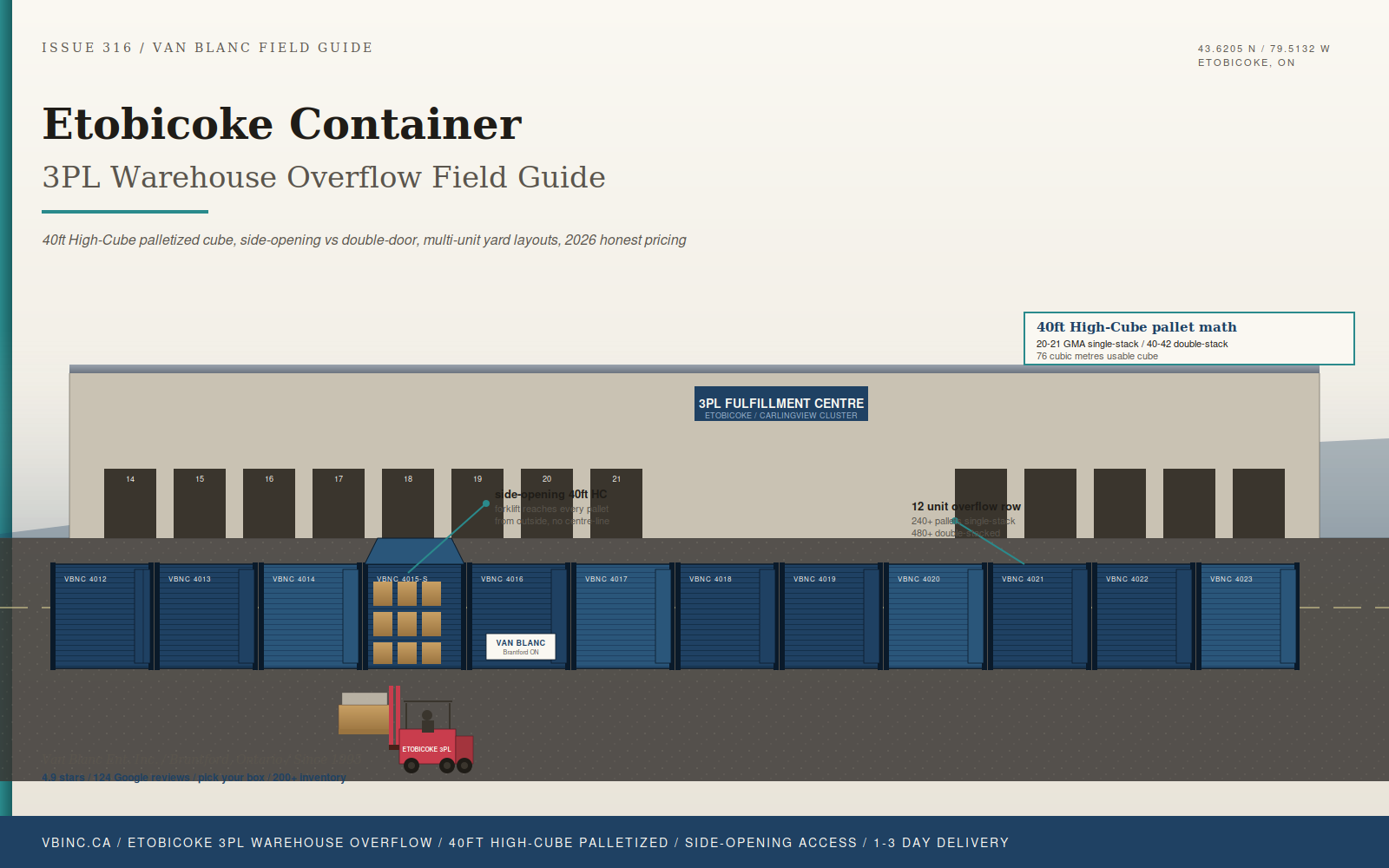
Containers carrying the CSC safety-approval plate are built to the same CSA Group structural standards used for marine cargo, so the boxes we sell hold their cube and their load rating for decades. For Etobicoke 3PL operators and e-commerce fulfillment centres running short on cube during peak, a 40ft High-Cube container holds 20 GMA pallets single-stacked, or 40 GMA pallets double-stacked with stable freight. That works out to about 76 cubic metres of usable cube per box. Most Etobicoke buyers we serve run a row of 5 to 20 units along the back fence of their facility as palletized overflow, with side-opening units near the dock for forklift access and standard double-door units for archive and slow-mover SKUs. Delivered pricing in 2026 tracks the size, grade, and door configuration you choose: a 40ft Cargo Worthy lands well below a 40ft High-Cube One-Trip into Etobicoke from our four Brantford yards, with the One-Trip premium reflecting its near-new condition. Real lead time is 1 to 3 days. You walk the row in Brantford and pick the specific container before you pay. Call 519-754-6844 to book a yard visit. Family-run since 1995 with cash-on-delivery pricing. Call for a same-day quote tailored to your site.
A warehouse-overflow container is a steel ISO box bought outright and parked on land you already pay for, swapping leased peak-season cube for owned capital equipment. A single 40ft High-Cube holds about 76 cubic metres of usable space, enough for 20 GMA pallets single-stacked, and pays for itself across one Etobicoke peak.
Etobicoke is one of the densest 3PL and fulfillment clusters in the GTA, packed between Highway 401, Highway 427, the Queensway, and the Pearson airport edge. When peak season hits in October through January for retail, or May through July for cold-chain, leased indoor square footage in Etobicoke is the most expensive overflow cube in the country. Operators pay GTA spot rates that run several times the per-pallet monthly cost seen in lower-cost industrial markets for small-volume overflow at a public 3PL.
This guide is for the buyer who has already done the math on leased mezzanine space, rack-stacking the existing 24-foot clear, and shipping pallets to a secondary 3PL across town, and is now looking at on-site containers as the cheaper, faster, more controllable option. Van Blanc has been moving containers into Etobicoke industrial parks for thirty years.
Why Do Etobicoke 3PL Operators Run Out of Cube at Peak?
Etobicoke 3PL operators run out of cube at peak because of one structural gap, and every Etobicoke 3PL we sell to hits it. Base-cube cost (year-round leased square footage) is sized for the average month, not the peak. Sizing the lease for peak means paying for empty rack 8 months a year. Sizing for the average means scrambling every fourth quarter. GTA industrial vacancy has been below 2 percent for most of the post-pandemic cycle, with net rents near record highs on top of TMI. Adding 5,000 to 20,000 square feet of leased indoor space for a 90-day window is rarely possible at any price.
Public 3PL overflow is the second option. Canadian enterprise pallet-storage contracts negotiated at scale earn the lowest per-pallet monthly rates, but Etobicoke spot-market overflow for small-volume buyers quotes at a steep premium, plus inbound and outbound handling charged per pallet each way. A 400-pallet peak over 90 days stacks up a large bill in storage and handling, with no equity and no control over inventory access.
The containers-on-fence option converts that operating expense into capital equipment, parked on land you already pay for. Five 40ft High-Cube containers buy roughly 100 GMA pallets of single-stack overflow for a one-time delivered cost. That capital pays back inside one peak season at GTA overflow rates, and the units sit on your back fence the rest of the year as buffer inventory, returns processing, archive, or seasonal staging.
Paul LeBlanc, who runs the yard side of Van Blanc, hears this every August. “The 3PL ops manager calls because they remember last October. They do not want to write another big overflow cheque, and they do not want to tell their retail customer the order shipped from a third warehouse with no inventory accuracy. A row of containers on the back fence solves both for less than one peak of leased overflow.”
Is Buying Containers Cheaper Than Leasing Etobicoke Warehouse Space?
For most Etobicoke overflow buyers, owned containers beat leased square footage on cube-per-dollar, and the comparison is what wins the argument. The boxes we keep graded and ready in Brantford for buyers across the GTA are bought once and parked on land you already pay for. A 40ft High-Cube container has internal dimensions of roughly 12.04 metres long by 2.35 metres wide by 2.70 metres high, giving about 76 cubic metres or 2,689 cubic feet of usable cube. The floor footprint is roughly 320 square feet. Spread the one-time delivered cost of a 40ft High-Cube One-Trip across those 320 square feet and the cost per square foot of pad space is paid once and owned outright.
Compare that to leased GTA industrial space charged per square foot per year (net), plus TMI, plus tenant improvements, racking, and HVAC conditioning. Roughly three years of lease cost on the same square footage equals the one-time purchase price of the container. By year five the lease has cost about double the box; by year ten, about four times as much.
What the container does not give you: climate conditioning, fire suppression to NFPA 13 standards, sprinklered loss-prevention coverage, or insurance-classed indoor storage rates. For high-value, regulated, or temperature-controlled inventory, leased indoor cube remains the right answer. Container math wins for the 70 to 80 percent of warehouse inventory that is shelf-stable consumer goods, packaging, slow-movers, archive, returns awaiting processing, and seasonal staging.
For broader grade and pricing context, see our guide to what sets a Canadian container price and our rundown of container types in Canada guide.
How Many Pallets Fit in a 40ft High-Cube Overflow Container?
The 40ft High-Cube is the workhorse container for Etobicoke 3PL overflow, and for good reason. The extra foot of internal height over a standard 40ft (9’6″ external versus 8’6″) matters more than people expect because it lets you double-stack standard 48 by 40 inch GMA pallets without crushing the bottom pallet when freight density is uneven. The pallet count math, based on standard ISO container specifications:
- GMA pallets (48″ by 40″) single-stack: 20 pallets per 40ft HC, loaded with a forklift in two rows of 10.
- GMA pallets double-stacked: 40 pallets per 40ft HC, possible only when bottom-pallet freight is dense and stable (cases of canned goods, bottled water, packaging). Do not double-stack mixed-density freight without engineered slip sheets.
- Euro pallets (1.2m by 0.8m) single-stack: 24 to 25 pallets per 40ft HC.
- Euro pallets double-stacked: 46 to 48 per 40ft HC with stable freight.
- Pallet Wide variant (specialty containers): 30 Euro pallets single-stacked, but supply is intermittent in Ontario.
For a 20ft container the math is roughly half: 10 GMA pallets single-stack, 20 double-stacked. Most Etobicoke 3PL buyers we serve choose 40ft High-Cubes for overflow because the per-pallet cost of cube is lower and the loading time per pallet at the dock is shorter than running two 20ft drops.
Maximum payload on a 40ft High-Cube is roughly 26,460 to 28,560 kg (58,300 to 63,000 lbs) of cargo, well above the practical weight of 40 stacked pallets of consumer goods. The weight ceiling almost never binds for warehouse overflow use. Cube is the constraint, not tonnage.
Side-Opening or Double-Door: Which Container Suits Forklift Access?
The door choice between side-opening and standard double-door containers is the single biggest layout decision for an Etobicoke overflow yard. Most buyers default to the wrong answer because they have only seen standard double-door containers. Standard containers open at one end only: you load and unload along the centre line, so reaching the back pallet means unloading every pallet in front. Fine for LIFO inventory; brutal for FIFO or random access.
Side-opening containers (full-side-access or open-side units) have full-length doors on one or both long sides, so the forklift reaches every pallet from outside. The trade-off:
- Standard double-door is cheaper, more common, and right for archive, slow-movers, returns awaiting processing, and any inventory touched only a few times per year. Roughly 30 percent less than side-opening.
- Side-opening runs 30 to 50 percent more but lets you treat the container as a giant pallet rack. Forklift driver runs along the side, takes any pallet, drops it on the dock conveyor. Time-savings pay back the premium inside one peak season for active pick-and-pack.
- Retrofitted roll-up doors on standard containers are a middle option. Faster operation on the end, but does not solve the centre-line loading problem. Worth it for high-cycle in-and-out, not for random access.
The three door types compare like this for warehouse-overflow access, with cost shown only in relative terms:
| Door type | Forklift access | Relative cost | Best for |
|---|---|---|---|
| Standard double-door | One end only, centre-line loading (reach the back pallet by clearing the front ones) | Baseline, the most affordable and most common | Archive, slow-movers, returns awaiting processing, seasonal staging |
| Side-opening (full-side-access) | Every pallet reachable from outside along the full length | Highest, runs 30 to 50 percent above the double-door baseline | Active pick-and-pack zones near the dock |
| Retrofitted roll-up door | Faster on the end, but still centre-line loading | Double-door baseline plus an accessory cost | High-cycle in-and-out staging, not random access |
Our usual recommendation for a 10 to 20 unit Etobicoke yard: 70 percent standard double-door for archive and slow-movers, 20 percent side-opening near the dock for active pick zones, 10 percent with roll-up doors and shelving for staging. The side-opening cuts, roll-up doors, and shelving are all part of the conversion work finished at the yard before a unit ships, and the full roll-up and hardware specifics live in our field guide to container accessories and hardware.
How Do You Lay Out Rows of 5, 10, or 20 Containers in an Etobicoke Yard?
A multi-container Etobicoke yard layout follows a handful of repeatable patterns, and the right one depends on your parcel. The Etobicoke warehouse parcels we deliver into typically run 1.5 to 6 acres with the building taking 50 to 65 percent of the lot. The patterns that work in real GTA industrial parcels:
- Single row along the rear fence, doors inward. The simplest layout. Containers end-to-end against the back property line, doors facing the dock. Works for rows of 5 to 15. Needs 14 to 16 feet of clearance for forklift swing.
- Double row, back-to-back. For rows of 15 to 30 units, back-to-back doubles cube per linear foot of fence. Doors face inward on the warehouse-side row; the fence-side row holds archive or sealed-pallet long-hold.
- Stacked two-high. Containers stack natively on their corner castings. In Ontario any stacked permanent installation should be reviewed by a structural engineer for wind load and pad capacity. See our piece on seismic brackets for stacked containers.
- U-shape compound with central staging pad. Containers form three sides of a U with the open end facing the dock. Interior pad becomes a staging and consolidation area. Common in 3PL yards consolidating outbound LTL daily.
- Side-yard linear with weatherized walkway. Where the back yard is unavailable, a side-yard row with covered walkway works for moderate pallet flow. Uses dead space that otherwise generates no revenue.
For foundation choice (concrete pad, compacted gravel, sonotube pier), most single-row single-high installations sit on compacted 6-inch gravel with timber cribbing at the corner castings. Stacked or paved-apron sites need engineered foundations sized for the corner-casting point loads.
What Does Container Delivery Into an Etobicoke Industrial Park Involve?
Container delivery into an Etobicoke industrial park comes down to access, clearance, and apron strength, and a few site patterns repeat. The clusters we deliver into most often are along Carlingview Drive, Skyway Avenue, Rexdale Boulevard, the Dixon Road corridor, Attwell Drive, and the industrial blocks between Eglinton Avenue West and Highway 27. The patterns repeat:
- Tilt-deck approach. The tilt-deck trailers need 70 to 90 feet of straight approach for a 20ft drop and 90 to 110 feet for a 40ft drop. Most Etobicoke loading courts have this, but trailers parked overnight at the dock can block it. Coordinate dock scheduling on delivery day.
- Overhead utility lines. Older Etobicoke blocks have hydro service drops crossing the side yard at 18 to 22 feet. The trailer mast during tilt is 14 to 16 feet. Check for low service drops before the truck arrives.
- Curb cuts and apron capacity. Older buildings off Dixon and Rexdale sometimes have soft asphalt aprons that crack under loaded axle weight (roughly 25,000 to 30,000 lbs concentrated during the slide). Reinforced concrete handles it; thin asphalt over poor base can damage.
- Loading-court turn radius. Tight L-shaped courts in older buildings sometimes cannot accommodate a 53-foot tractor-trailer plus tilt-deck. The carrier can switch to a shorter rigid truck at a small added cost. Send dimensions before booking.
- Airport corridor clearance. The Pearson airport perimeter has height restrictions in some zones. The trailer at full tilt is within standard limits, but verify if your facility is in a Nav Canada notification zone.
We send a pre-delivery checklist to every Etobicoke buyer before the truck rolls. Real lead time from order to drop is 1 to 3 days, shipped from our four Brantford yards. Not the 4-to-8-week schedules importers quote for ex-port units. For the full prep list, see our container delivery access guide.
What Drives Your Bulk-Order Etobicoke Container Quote?
Your bulk-order Etobicoke container quote is driven by a short list of factors, and we quote every bulk order live on the phone, delivered to industrial postal codes M9V, M9W, M9P, M9R, M9C and adjacent. Single unit prices are on our posted container list; here is exactly what moves your bulk per-unit cost up or down:
- Size (20ft versus 40ft): a 40ft box costs more per unit than a 20ft, but far less per cubic foot of cube, which is why most overflow buyers choose 40ft.
- Height (standard 40ft versus 40ft High-Cube): the extra foot of internal height on a High-Cube carries a modest premium and is what lets you double-stack pallets.
- Grade (Cargo Worthy versus One-Trip): a near-new One-Trip sits well above a used but certified Cargo Worthy; the gap reflects age, cosmetics, and remaining service life. If you want the longest service life and best resale value for a row that fronts the road, our near-new One-Trip stock priced for Ontario buyers is the grade to ask about (the industry calls them one-trip because they made exactly one loaded voyage from the factory).
- Door configuration: standard double-door is the baseline; side-opening (full-side-access) runs 30 to 50 percent more as specialty equipment, and retrofitted roll-up doors add an accessory cost.
- Order volume: a 5 to 10 unit bulk order lowers the per-unit cost because the carrier drops 2 to 3 containers per truck on one Brantford-to-Etobicoke run; a 15+ unit order is priced case by case with deeper freight savings.
- Delivery distance and access: the run from our Brantford yards to Etobicoke is short, but a tight loading court that forces a rigid-frame truck adds a small handling charge.
- Steel market and season: the global price of Corten steel and peak-season demand both shift the baseline, which is why a bulk order is honoured at the quoted price.
Bulk pricing reflects real savings on freight (the carrier can drop 2 to 3 containers per truck on the same trip into Etobicoke from Brantford) and on yard handling. We do not quote phantom volume discounts that vanish on the invoice. The number we quote on the call is the number on the invoice.
One note on side-opening units. Full-side-access containers are specialty equipment with a price to match. We keep new 20ft and 40ft high cube side openers on hand, delivered in 1 to 3 days. Call to confirm the configuration before building a layout around them.
Is the Facebook Bulk-Container Deal a Scam?
The Facebook bulk-container deal aimed at warehouse operators is almost always a scam, and we have to say it plainly because it costs Etobicoke buyers real money every peak season. The fake “bulk container deal” pattern targets warehouse operators in August and September, just before peak ramps. A Facebook Marketplace or Kijiji listing appears offering 5 to 20 containers at a price far below the market with free GTA delivery. The seller claims ex-shipping-line inventory “near the Port of Toronto” that needs to move this month before terminal storage fees kick in. They ask a per-unit deposit, adding up to a large lump sum, to hold the bulk order. The containers never arrive. The bank cannot reverse e-transfers.
Real wholesale economics: a 40ft container at the Port of Montreal in As-Is condition already wholesales for a substantial sum before any trucking to the GTA, and trucking, grading, and yard prep each add to that base. No legitimate Ontario seller can deliver a 40ft to Etobicoke below what the box itself costs at port. The Facebook “bulk deal” priced far under the market is the dominant scam pattern in our market, and 3PL operators are a prime target because the order size is large and the urgency feels real.
Paul has seen this pattern across the GTA for three years running. “The 3PL controller calls us in October after they wired to a Facebook seller and nothing showed up. There is nothing we can do at that point. The only protection is buying from a real Ontario yard you can drive to.”
The test is simple: can you drive to the seller’s physical yard, walk the row, see the specific containers you are buying, and inspect them before paying? Van Blanc keeps 200+ units across our four Brantford yards and has sold containers since 1995. The drive from Etobicoke is about 70 minutes via the 403. For broader buying-side guidance, see how we walk first-time buyers through a purchase, and if you are weighing ownership against a short-term hold, compare the numbers in our rent-versus-buy breakdown.
Related GTA Buyer Context: Mississauga, Toronto, Brampton
Etobicoke is one of five GTA submarkets we deliver into. The math is similar across the cluster, but the buyer profile shifts. Mississauga 3PL buyers along Dixie Road and Tomken Road run larger footprints and often want 20 to 50 unit yards for full overflow programs. Brampton operators in the Steeles and Airport Road corridor lean heavier on construction-trailer storage and seasonal cycles. Toronto core operators have less yard space and often want 20ft units in side-lot configurations rather than 40ft along a rear fence.
For sibling guides see our Mississauga warehouse overflow guide, Brampton warehouse overflow, and Toronto 40ft commercial storage. For the Etobicoke service-area parent, see Etobicoke shipping containers.
Ready to price your container?
Tell us the size and your postal code and we’ll send back an all-in number, container, delivery, and placement, usually within 1-3 days. No pressure, no mystery fees.
Family-run in Brantford since 1995 · 200+ containers in stock · 4.9★ across 140+ Google reviews · every box graded by a person, walk it before it lands.
Frequently Asked Questions: Etobicoke Warehouse Overflow Containers
How many GMA pallets fit in a 40ft High-Cube container?
A 40ft High-Cube container holds 20 standard 48 by 40 inch GMA pallets single-stacked, loaded in two rows of 10. Double-stacking with stable, dense freight raises capacity to 40 pallets. Euro pallets (1.2m by 0.8m) give 24 to 25 single-stacked or 46 to 48 double-stacked. The internal cube is roughly 76 cubic metres or 2,689 cubic feet.
Is buying containers cheaper than leasing 3PL overflow space in Etobicoke?
For most Etobicoke 3PL operators, yes, the capital pays back inside one peak season. GTA spot-market 3PL overflow carries a steep monthly per-pallet rate on top of inbound and outbound handling fees charged each way. A row of 5 to 10 owned containers along the back fence converts that operating expense into capital equipment, with the units sitting as buffer cube the rest of the year.
Should I buy side-opening containers or standard double-door for warehouse overflow?
Most operators benefit from a mix. Roughly 70 percent standard double-door containers (for archive, slow-movers, returns awaiting processing, and seasonal staging) and 20 percent side-opening units near the dock for active pick zones. Side-opening units cost 30 to 50 percent more but let forklifts access every pallet from outside, saving substantial time during peak pick-and-pack cycles.
What does a 40ft container delivered to Etobicoke cost in 2026?
The delivered cost depends on grade and door type: a used but certified 40ft Cargo Worthy is the most affordable, a near-new 40ft High-Cube One-Trip sits above it, and a 40ft high cube side-opening One-Trip, which we also stock, is the most expensive. Bulk orders of 5 to 15 units typically save 8 to 15 percent per unit delivered. Beware any Facebook listing priced far below the market for a 40ft delivered, because that price band is almost always a scam.
How long does delivery take from Brantford to an Etobicoke 3PL facility?
Real lead time is typically 1 to 3 days from order confirmation to drop, shipped from our four Brantford yards. The drive from our yards to Etobicoke industrial blocks is about 70 minutes via Highway 403 and 401. The carrier can drop 2 to 3 containers per truck on the same trip, which compresses bulk-order schedules dramatically. We do not run the 4-to-8-week schedules importers quote for ex-port units.
Can I stack containers two-high in an Etobicoke industrial yard?
Yes, containers stack two-high natively on their corner castings, doubling the cube per square foot of pad space. In Ontario, any stacked permanent installation should be reviewed by a structural engineer for wind load, foundation pad capacity, and any insurance-classed loss-prevention review your facility carries. We supply the containers; the engineering and the foundation design are between you and your local structural engineer.
What foundation does an Etobicoke warehouse-overflow container need?
Single-row, single-high installations on stable ground work on compacted 6-inch gravel with timber cribbing under the corner castings. Stacked installations or poor-soil sites need sonotube piers or concrete pads sized for the corner-casting point loads (roughly 8,000 to 9,000 lbs per corner on a loaded 40ft).
How many containers can fit on a typical Etobicoke industrial parcel?
A 1.5 to 6 acre Etobicoke parcel with the building occupying 50 to 65 percent of the lot typically has space for 10 to 30 containers along the rear and side fences, depending on layout. Double-row back-to-back layouts and two-high stacking can push capacity higher. We can walk through a satellite image of your specific parcel during the planning call and confirm what fits before you place an order.
What if my Etobicoke facility has tight loading-court turn radius?
Older buildings off Dixon Road, Rexdale, and the Carlingview cluster sometimes have L-shaped courts that cannot accommodate a 53-foot tractor-trailer plus tilt-deck. The carrier switches to a shorter rigid-frame truck for those at a small added cost. Send court dimensions and any low service drops before booking.
What happens if I sent a bulk deposit to a Facebook container seller and nothing arrived?
The Canadian Anti-Fraud Centre is the first call. Banks do not reverse e-transfers once accepted. Document the listing, messages, and payment, then report to CAFC and Facebook to help shut down the seller account. Then call a real Ontario yard you can drive to and start over. We have helped GTA 3PL operators recover from this exact scam more times than we would like to count.
Walk the Row Before You Buy
Van Blanc Ent. Inc. has been supplying shipping containers across the GTA since 1995. We hold 200+ containers across four Brantford yards, deliver 1 to 3 days into Etobicoke 3PL facilities, and let you stand in front of the specific units before you pay. Rated 4.9 stars on 140+ Google reviews. Call 519-754-6844 or drive 70 minutes from Etobicoke to our Brantford yards to walk the row.
Sources and Further Reading
- Across Logistics, Pallet Count Capacity for 20ft and 40ft Containers
- Buske Logistics, 3PL Pricing Guide 2026 (real warehouse and pallet storage rates)
- Olimp Warehousing, Pallet Storage Cost per Month 2026 Guide
- Your Logistics, 3PL Warehousing Ultimate Guide for 2026
- Canadian Anti-Fraud Centre, online sale fraud reporting
- Etobicoke industrial area overview (Wikipedia, with cluster references)