
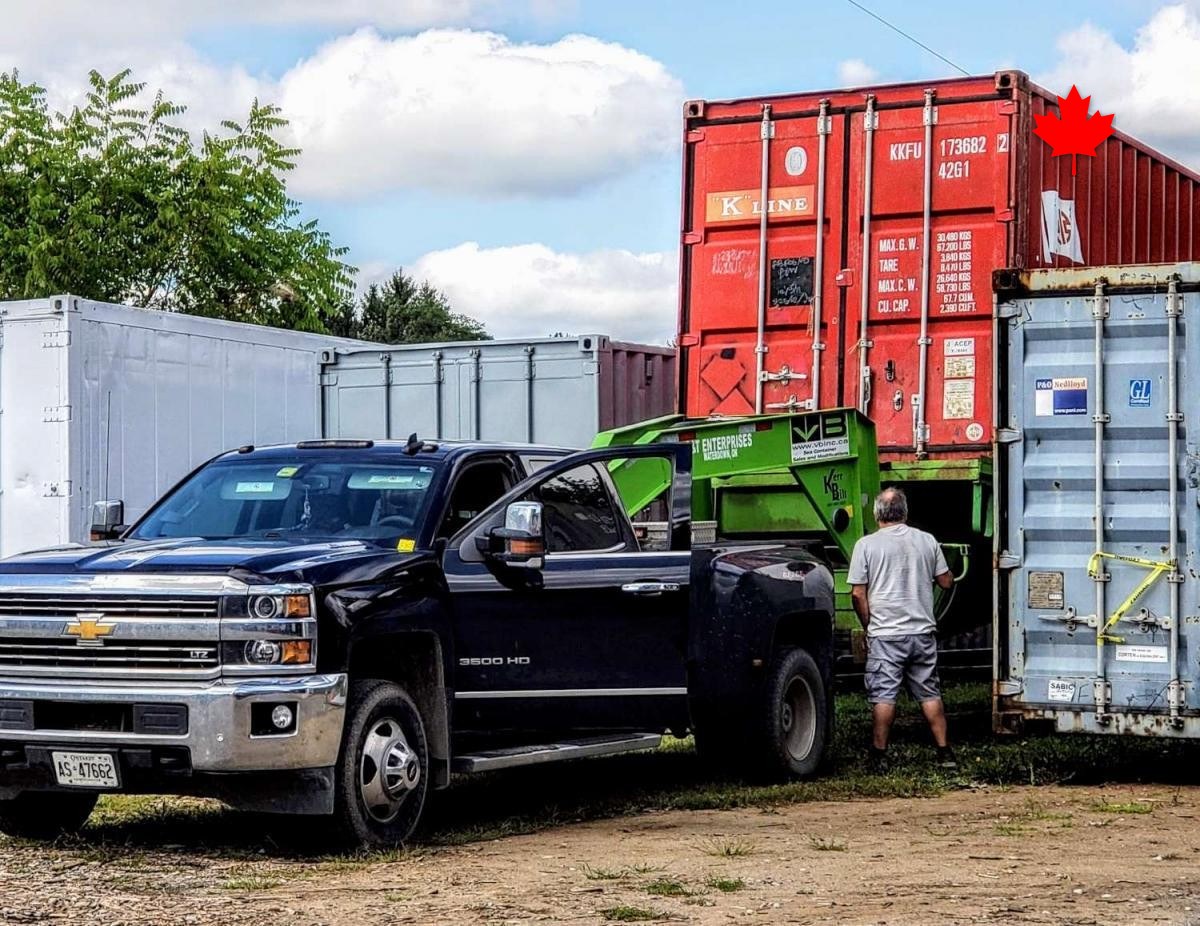
We sell containers. We do not rent.
Van Blanc sells shipping containers outright. We do not rent, we do not lease, and we do not offer rent-to-own. Renting comes up on this page because buyers compare it against owning, and that comparison is worth reading, but purchase is the only arrangement we offer. Stocked units deliver from our Brantford yards in 1 to 3 days. Request a sale quote or call the yard at 519-754-6844.
Quick Answer: The city that makes Canada’s steel stores in it too. Van Blanc sells storage containers outright and delivers them across Hamilton in 1 to 3 days from our Brantford yards, thirty-five minutes up the 403, with every grade named for what it is and the exact unit yours to inspect first; we do not rent.
Hamilton is mid-transformation, and transformations eat storage. The B-Line LRT is in peak construction, tearing up and rebuilding the city’s main artery through 2027. The bay front is being reimagined as Steelport, one of the largest intermodal employment hubs in the country. Green-steel work is remaking the mills, GO service now runs to Toronto every fifteen minutes, and the residential streets from Dundas to Stoney Creek are full of renovators betting on the city’s next decade. Every one of those stories, at street level, involves somebody needing a secure steel box for a while. This page is the guide to getting one in Hamilton: rent or buy, what grade, what the LRT construction means for placement, and why the box will probably come from a family yard one city over.
The B-Line Decade: Storage While the City Rebuilds
A transit build supporting six thousand jobs a year does not happen quietly. For the businesses along King and Main, LRT construction means torn-up frontage, rerouted customers, and in plenty of cases a renovation brought forward because the street is already a mess anyway. A container solves the practical half of that disruption: stock moved out of a back room being rebuilt, fixtures stored between fit-outs, patio furniture and signage held through a construction season. For the contractors on the project’s edges, it is the standard site lockup story at unusual scale, with staging space along the corridor scarce and theft pressure high. Either way the mechanics are the same: a 20ft lands where you have room, a lockbox shrouds the padlock, and the box moves on or stays when the street is a street again.
One corridor-specific note from our delivery seats: placements near active LRT work need the approach conversation before the truck rolls, because lane closures move weekly. Tell us the block, and the driver checks the access the day before rather than discovering it the day of.
Steel City, Steel Storage
There is something fitting about Hamilton’s storage of choice. The corten plate in a shipping container is the same family of weathering steel the city has rolled for a century, engineered to form its own protective oxide skin instead of rusting through. Hamilton buyers tend to know this without being told; this is a town where a surprising number of customers read the CSC plate unprompted and ask about wall gauge. The industrial fabric feeds demand too. The mills and the supplier web around them run on contractors, parts, and maintenance stock that overflow every lease cycle, and the coming Steelport build promises a decade of intermodal work on the bay front, in a facility whose whole vocabulary is the container. Selling sea cans to Hamilton feels less like introducing a product and more like returning a native species. Every name the box answers to, and Hamilton uses most of them, is mapped in the naming guide.
The Harbour Century, Closing Its Loop
Hamilton’s harbour moved the raw side of Canadian industry for a hundred years: ore in, steel out, lakers at the piers and rail spurs feeding the mills. The shipping container arrived late to that story because bulk cargo never needed it, which is partly why the city, for all its steel, never grew a big container yard of its own. Steelport changes the geometry. An intermodal hub on the bay front puts the container at the centre of the harbour’s next act, and the boxes that will move goods through Hamilton’s future are the same species that store a renovator’s furniture on Ottawa Street today. We find Hamilton buyers like knowing this lineage, and not only for the trivia: a town that understands where steel comes from negotiates used steel better than any market we serve.
What does Hamilton mill country know about keeping steel?
Hamilton asks the best maintenance questions, so here are the answers in one place. Surface rust on a used container is cosmetic history, not a verdict; corten steel weathers into a stable oxide skin, and a WWT unit wearing patchy bloom on its panels can out-last the shed it replaced. The spots that actually matter are the ones a yard walk checks in two minutes: door gaskets that no longer compress, sill and header corrosion where water sits, floor delamination near the door end, and corner castings that took a crane hit. Repainting is optional and mostly aesthetic; if you do it, a wire-wheel and a rust-inhibiting coating over clean steel beats a thick coat over scale every time. And the cheapest maintenance of all is placement: blocked corners, a hand of airflow underneath, and grade that sheds water buy more service life than any paint ever will.
Lake Weather and the Box
The head of the lake makes its own weather, and steel storage feels it two ways. Humidity off the bay raises the condensation stakes in shoulder seasons, so the standard discipline matters a little extra here: cargo a hand’s width off the walls, floor vents clear, nothing stored soaking wet. And exposure matters on the Mountain brow and the flats alike, where wind finds anything unanchored; a properly blocked container does not care, but tarps, lean-tos, and cheap sheds demonstrably do, which is a fair summary of why half our Hamilton deliveries replace exactly those. Snow load is a non-question; a roof rated for eight loaded containers stacked on it carries a lake-effect winter without noticing.
Hamilton’s food economy adds one specialty note. The market stalls, caterers, butchers, and brewers between Ottawa Street and Locke Street periodically outgrow their walk-ins, and the answer at that point is not a dry box but a reefer: an insulated container with its own refrigeration unit, holding temperature from a standard electrical connection. We keep refrigerated units and the guidance on running one in the same rows as the dry stock, and the quote conversation is the same two minutes. For everything else the city stores, the dry WWT box remains the default, but a food town deserves to know the cold option exists before renting a second walk-in it does not need.
Mountain, Lower City, and the Delivery Map
Hamilton’s geography sorts deliveries into three kinds. The Mountain runs on post-war suburbs with wide driveways; a 20ft placement there is as routine as it gets. The lower city is older and tighter: Ottawa Street, Barton, the north end, where alley access and short frontages often make the 10ft the right unit and make the pre-delivery phone conversation the most valuable two minutes of the order. And the fringes, Ancaster, Dundas, Waterdown, Binbrook, Stoney Creek’s orchard edge, behave like the suburbs and farmland they are, with room for 40-footers and gate-width questions instead of driveway ones. From our Brantford rows, the whole map sits thirty-five to forty-five minutes up the 403, comfortably inside the standard 1-to-3-day window on a tilt-deck truck with a fully insured carrier.
The placement recipe does not change by neighbourhood: roughly 30m (100ft) of straight approach for a 20ft, overhead clear of wires and branches, and a firm spot blocked on ties or patio stones, set slightly proud of grade so water sheds away from the door sills. The full pad walkthrough lives in our ground-prep guide.
Who’s Storing What in Hamilton
The King Street merchant. Frontage torn up, back room doubling as a warehouse, and a season of stock with nowhere to breathe. A container in the rear lot holds the overflow until the corridor calms, and a box you own does not care how long the construction actually takes. Merchants along the B-Line have learned to stop believing schedules; owned steel does not ask them to.
The Ottawa Street renovator. The textile district’s century homes are being opened up one at a time, and plaster-era houses renovate slower than anyone plans. A 20ft out front keeps the main floor’s contents twenty steps away for the duration, and the driver threads the needle on the short drives; testimonial history says our drivers enjoy the challenge.
The industrial-fringe supplier. Machine shops and maintenance contractors serving the mills stack seasonal stock past their leases every cycle. A 40ft high cube behind the shop turns parking into racking-height overflow, delivered in days and owned outright, so it stays or sells on when the contract picture changes.
The commuter family. Fifteen-minute GO service made Hamilton a bedroom community on purpose, and the moving trucks followed. Between closing dates, during basement conversions, or while a Toronto household compresses into a Dundas semi, a driveway container bridges the gap without a storage facility’s meter or gate hours.
The Stoney Creek fruit belt. The orchard edge still farms, and its equipment winters in steel: sprayers, bins, and the market-stand kit that runs from June to Thanksgiving. A WWT 40-footer at the laneway’s end beats a decaying drive shed on every line item that matters.
The Westdale landlord. McMaster’s neighbourhoods run the same turnover economy as every university city: leases flipping in spring, furniture and appliances cycling between units, and a hospital-and-campus workforce that moves more often than the city average. A laneway container through the churn season has become standard kit for landlords running more than a couple of doors, kept from one spring to the next.
One more Hamilton habit worth naming: the parts counter. Because this market keeps containers for decades, it also maintains them, and door gaskets, handles, and lockboxes are the pieces that age first. We stock the hardware that keeps an older box honest at the yard, and the same phone call that quotes a container can quote its tenth-year gasket. A unit maintained on that schedule effectively stops depreciating; the fruit-belt farmers proved that math long before we wrote it down.
Price Your Hamilton Delivery
Size, grade, and your postal code get you an all-in number with a real lead time, usually the same day. Hamilton runs thirty-five minutes from our rows. If the placement is tight or the block is mid-LRT, say so and the driver scouts it first. The fastest answer is a call.
Rent or Buy in Hamilton
Hamilton’s horizon question has a construction-era twist: nobody along the corridor knows exactly how long their disruption lasts, and we sit on one side of the answer, because Van Blanc sells outright and does not rent. The usual split says a need measured in weeks can rent from a fleet operator and a need past a few months should buy; the corridor’s disruptions have mostly run past a few months, and a used WWT box bought once costs less than the second year of any rental and sells on when the street is a street again. How renting from a fleet operator compares with owning is set out on our short page on why we sell rather than rent, and the purchase side of the yard runs all four grades with the flaws pointed out first. If the cash needs spreading, an equipment loan from your own bank does it against a box you already own. We will tell you plainly which door fits, including the cases where a climate-controlled locker across town serves better, antiques and instruments being the usual examples.
Sizes Against Hamilton’s Streets
| Unit | External size | Hamilton fit |
|---|---|---|
| 10ft | 2.99m x 2.44m (10′ x 8′) | Lower-city short frontages, alley placements |
| 20ft | 6.06m x 2.44m (20′ x 8′) | Mountain driveways, renos, corridor merchants, site lockups |
| 40ft | 12.19m x 2.44m (40′ x 8′) | Industrial lots, Ancaster and Binbrook acreage, fruit-belt farms |
| 40ft High Cube | 12.19m x 2.44m x 2.90m tall | Racking-height supplier overflow near the industrial belt |
The 20ft carries the city, as it does everywhere, and the thirty-year sizing rule survives the trip up the 403 intact: buyers regret small far more often than they regret big, and the price step between sizes is smaller than most people guess. When a lower-city lot genuinely cannot swing a 20ft’s doors, the 10ft exists for exactly that street.
The Grade Ladder, Read Like a Mill Town Reads It
Hamilton buyers ask sharper steel questions than most, so here is the ladder with the engineering left in. New (one-trip) units crossed once from the factory, loaded: original coatings intact, floors clean, the pick when the box faces customers or becomes a conversion. Cargo Worthy is used steel that passed structural recertification for international shipping: honest surface wear, confirmed frame and floor, the grade for anything that might ship again. Wind and Watertight is the stationary workhorse: gaskets seal, panels shed weather, cosmetic history on display and priced in, the usual right answer for a driveway, back lot, or laneway. As-Is closes the ladder with declared floor, frame, or door faults, sold for cladding stock, donor builds, and buyers who know their welder. Every rung is in our rows at Brantford, and on used units the dents get pointed out before you ask, because in this market especially, the buyer checking the plate deserves a seller who beat them to it.
Sea Can, C-Can, Container: The Local Dialect
Hamilton splits its vocabulary by generation and trade: sea can from the older east-end hands, c-can from the site trailers, storage container from the search bar, and box from everyone once the thing is actually in the driveway. All of them name the same 8ft-wide corten unit built to ISO 668, and all of them get the same quote line at our counter. The steel does not care what you call it, and neither do we. The buying-side companion, sizes and grades included, is the Hamilton shipping container rundown.
Hamilton Storage Container FAQ
Where can I get a storage container in Hamilton?
Delivered, from yards within trucking distance: Van Blanc runs Hamilton from Brantford, thirty-five minutes up the 403, in 1 to 3 days. Walk the rows at 90 Morton Avenue East first if you want to pick the exact unit, which used-container buyers should.
Can businesses along the LRT construction get temporary storage?
That is currently our most common Hamilton call: a container in the rear lot holding stock and fixtures while frontage is torn up. A box you own does not care that the construction schedule keeps moving, and placements near active work get an access check before the truck rolls.
How fast is delivery to Hamilton?
One to three days for stocked units, tilt-deck, fully insured carrier. The 403 run is short enough that Hamilton orders often land at the front of the window. Every quote carries a real lead time, not a hopeful one.
Will a container fit a lower-city lot?
Often the 10ft where a 20ft cannot swing its doors: Ottawa Street, Barton, and the north end run short frontages and alley access. The driver confirms approach by phone first. Permits are managed by your municipality; check with the local building department before you order.
Is a container or a storage locker better in Hamilton?
Volume and duration decide. A closet’s worth for a month belongs in a locker; a household, site, or shop’s worth for a season or more belongs in steel on your own property. Climate-sensitive goods like instruments and antiques stay in climate-controlled lockers.
What grade should a Hamilton buyer pick?
Wind and Watertight for stationary storage, which is most of the city’s use. New (one-trip) when the box faces customers or becomes a conversion. Cargo Worthy only if it might genuinely ship again. As-Is only when you know exactly what you are welding.
Do you deliver to Ancaster, Dundas, Waterdown, and Stoney Creek?
All of them, plus Binbrook and the fruit-belt farm edge. Fringe placements trade driveway questions for gate-width ones: flag the access and any soft ground at booking and the tilt-deck handles the rest, inside the same delivery window.
Can a contractor run several containers across Hamilton sites?
Yes, and buying several at once beats one-off orders: name the season up front and the yard holds units ahead of your mobilizations instead of quoting you into a queue. Boxes you own rotate between sites on any tilt-deck you book.
Should I see the container before delivery?
For used steel, yes if you possibly can: thirty-five minutes to walk the rows and feel the door gaskets beats any photo. If you cannot make it, every flaw gets described on the phone first, and you pay on delivery, not in advance.
What does a container quote need from me?
Postal code, size guess, the surface it will sit on, your timeline, and whether you lean new or used. From those five, an all-in number with a real lead time comes back the same day, and the phone version takes two minutes.
What moves a container quote in Hamilton?
Size, grade, delivery distance, and the season. Hamilton sits close to the yard, so distance helps you here. We publish no dollar figures because steel prices move; every quote is an all-in number to your postal code with a real lead time.
Sources
- Housing, Infrastructure and Communities Canada. (2026). Federal government highlights progress on Hamilton LRT. canada.ca
- Railway Gazette International. (2026). First major contract for the Hamilton LRT project awarded. railwaygazette.com
- Slate Asset Management. (2026). Steelport: modern industry on Hamilton’s waterfront. thesteelport.com
- International Organization for Standardization. (2020). ISO 668: Series 1 freight containers, classification, dimensions and ratings. iso.org
- Canadian Storage Info. (2025). Q2 2025 Self-Storage Market Update. canadianstorageinfo.ca
Thirty-Five Minutes From the Steel City
Van Blanc has supplied containers across Hamilton and the head of the lake since 1995: family-run, 4.9 stars across 140+ verified Google reviews, and a real yard at 90 Morton Avenue East in Brantford where the rows are open and the flaws get pointed out first. Hamilton deliveries run 1 to 3 days, and buyers who make the short 403 drive pick their exact box. Paul has spent thirty years in containers, Christian grew up in the rows, and between them every Hamilton question from wall gauge to gasket age gets a straight answer before any money moves. That is the whole pitch, and it has outlasted every market cycle since the yard opened.
Van Blanc Ent. Inc., 90 Morton Ave E Unit 1B, Brantford, ON N3R 7J7. 1-888-509-6658