
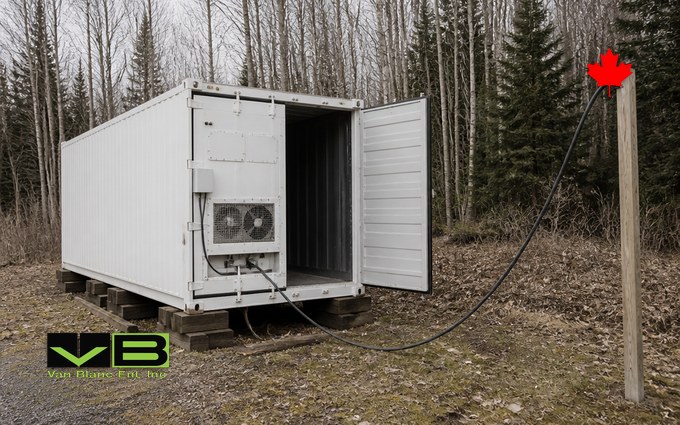
Quick Answer: How long to hang a deer depends on temperature. Food-safety guidance allows two to three days at 4 °C (40 °F) or colder. Aging up to two weeks needs air at about 0 to 2 °C. Above 4 °C, cool and butcher promptly, or hang it in a 20ft reefer.
What This Deer Hanging Guide Covers
- How Long to Hang a Deer, by Air Temperature
- Deer Hanging Does Two Jobs
- Deer Meat and the 4 °C Line
- Deer Cooling in the First 24 Hours
- Two Weeks: The Outer Limit for Aging
- Hanging Skin-On or Skin-Off
- Aging vs Spoilage
- Head Up or Head Down
- Warm November Afternoons in Ontario
- Deer Hanging Room: A 20ft Reefer
- Hunt Camps and Small Processors
- Power at the Camp or Shop
- Ordering Before the Gun Season
- Venison in the Freezer
- FAQs
Reading Time: 15 minutes
How Long to Hang a Deer, by Air Temperature
How long to hang a deer has no single number, and the guidance agrees on why: the air around the carcass sets the clock. Hunters argue about days. Food-safety writers talk about degrees first, then days. A deer hung in a cold, steady room can wait for the butcher. The same deer under a tarp on a mild afternoon cannot. Paul LeBlanc runs Van Blanc, a Brantford company since 1995, and we sell the 20ft reefer that holds a carcass at a set temperature. That is why we read this guidance closely before writing a word about boxes.
“Before I sell a reefer to a hunt camp, we start it at one of our Brantford yards and watch the display come down to its set point. Hanging deer for days takes a machine that holds that number.”
Paul LeBlanc, owner, Van Blanc
The table sorts what four extension and government sources say by temperature band. The sources do not agree on length, and the table leaves that disagreement in place. The short figures come from food-safety pages. The longer ones assume a refrigerated room that holds its number day and night, the kind of set-point control a reefer logs for fresh meat.
| Air around the carcass | What the guidance says | Source |
|---|---|---|
| Below freezing | Do not let the carcass freeze within the first six hours after harvest; tenderizing stops once it is frozen | UW-Madison Extension; Penn State Extension, wild game |
| 32 °F to 36 °F (about 0 to 2 °C) | The proper aging range; never higher than 40 °F, and no longer than 2 weeks | Wisconsin DATCP |
| 35 to 40 °F (3 to 4 °C) | Cool the carcass to this range quickly. If processing your own, hold it at 40 °F (4 °C) or below for two to three days, at most | Penn State Extension, venison |
| Under refrigeration | Aging for 5 to 7 days should improve tenderness without undue spoilage | Penn State Extension, wild game |
| 35 to 45 degrees (°F) | The aging range; 7 to 10 days for a noticeable difference in steaks | UW-Madison Extension |
| Above 4 °C (40 °F) | Bacteria grow quickly; in warm weather, aging is not advised | Health Canada; UW-Madison Extension |
Two readings come out of that table, one for a deer camp with no cold room and one for a camp with it. A hunter butchering at home without a cooler should plan on the Penn State figure. Chill fast, then hold two to three days at 4 °C or colder, at most. A camp or shop with a walk-in cold room that holds its number can age longer, inside the Wisconsin band, and stop at two weeks. Where the sources overlap, take the colder temperature and the shorter time. UW’s band runs up to 45 °F, but Wisconsin’s food-safety division says never above 40 °F, so this guide uses 40 °F.
Deer Hanging Does Two Jobs
Deer hanging is the practice of suspending a field-dressed carcass in cool, moving air before it is cut. It does two different things, and they need different conditions. The first job is cooling: getting body heat out of the meat before bacteria use it. The second is aging: holding the cold carcass while the meat’s own enzymes tenderize it. Cooling has a deadline. Aging is optional. Penn State’s venison guide says aging is not necessary when the meat is going into sausage.
One hunter says the deer hung a week and tasted great. Another says it went sour in three days. Both can be true, because the weeks were different. A cold week did both jobs. A mild week did neither well, and a walk-in deer cooler built from a reefer exists to take the weather out of that argument.
Rigor Mortis and the Freeze Risk
Rigor is the stiffening that sets in after death, and it passes before the meat is cut. UW-Madison Extension warns against letting the carcass freeze within the first six hours after harvest. Wisconsin’s state food-safety division puts it the same way: hold the carcass at 40 °F or less, but avoid freezing it before rigor, to avoid toughening. Penn State adds that the tenderization benefit of aging ends if the carcass freezes.
That is why an Ontario cold snap is not a perfect hanging week. A carcass on an open meat pole at minus fifteen overnight can freeze before rigor passes. A Van Blanc reefer avoids both ends. It can hold a set point above freezing on a cold night and below 4 °C on a mild one. How a reefer’s controller and airflow work covers the machine side.
UW-Madison Extension describes aging as holding carcasses cold so natural enzymes tenderize the meat. Its figure for a noticeable eating difference in steaks is 7 to 10 days. It also names the cost: exposed surfaces dry out. Penn State says aging is not recommended for a carcass with little or no fat covering, since it can dry out. Wisconsin adds a gate: age a deer only if it was properly handled, is clean and is not gut shot.
Deer Meat and the 4 °C Line
The food-safety sources here draw the same line at about 4 °C, or 40 °F. Health Canada calls 4 °C (40 °F) to 60 °C (140 °F) the temperature danger zone where bacteria can grow quickly. Its advice for a household fridge is 4 °C (40 °F) or lower. Wisconsin’s division of food safety says that when the air is over 40 °F, harmful bacteria grow quickly. Deer processing at home, at camp or at a small shop starts from that line, and so does the cooler a camp builds around it.
Quebec’s government has a page written for hunters, and it gives a cooling target with a clock. Ideally, the carcass is cooled to 7 °C within the first 24 hours. During transport and storage it is kept between 0 °C and 4 °C to limit bacterial growth. Wisconsin’s state guidance asks hunters to aim to chill the carcass surface to 40 °F or lower within 24 hours. A Van Blanc 20ft reefer set inside the 0 °C to 4 °C band meets that storage figure on any day. The temperature rules a walk-in cooler works to apply to it as well.
Air Temperature vs Meat Temperature
The guidance talks about two temperatures. Air temperature decides how fast heat leaves the carcass. Meat temperature decides what bacteria can do. A thermometer in the thickest part of a hindquarter tells you where the meat is. A thermometer on the wall tells you where it is heading. The reefer’s display shows the air readings a reefer reports, and a probe thermometer in the meat confirms the carcass has caught up.
Deer Cooling in the First 24 Hours
The first day is about cooling, and the guidance moves quickly. UW-Madison Extension says cooling should begin within a couple hours of harvest. Field dressing comes first, and Wisconsin’s guidance says to field-dress immediately after death. It suggests spreading the rib cage so air circulates. If the air is over 40 °F, it says to consider packing the cavity with ice or snow sealed in plastic bags.
“Immediately field dress game with its entrails and hide removed and cooled to a temperature of at least 5ºC (or 40º F) to prevent spoilage.”
Ontario Ministry of Natural Resources, hunting notices and updates: best practices for wild game
Penn State says to keep the carcass cool during transport and out of sunlight, and never in a trunk while warm. Quebec’s page adds that the roof or hood is no place for it, because of the heat the vehicle gives off. A camp with a short path from the skinning pole to the cold room gets the carcass cold sooner. Our notes on how an Ontario deer camp is laid out cover that path. The first 24 hours end with a cold carcass, which is where Quebec’s 7 °C target and Wisconsin’s 40 °F surface target land. That is a cooling deadline. It says nothing about tenderness.
Butchering after one day is safe practice when the meat is cold and past rigor. Hunters who cut that early skip aging, and the meat is a little firmer for it. For sausage and ground venison it makes little difference. A hunter heading that way can read the curing-room setup meat producers use for the next step.
Two Weeks: The Outer Limit for Aging
Two weeks is the longest hang any of these sources allows, and it comes with conditions. Wisconsin’s guidance says deer should not be aged longer than 2 weeks, at 32 °F to 36 °F, never above 40 °F. That is a cold-room figure. It does not describe a garage, a barn or a tree, where the air swings with the weather. Hunting forums report longer hangs, but those are anecdotes, and the government pages do not back them.
The other sources stop well short of that. Penn State’s wild game page gives 5 to 7 days of aging under refrigeration. Its venison page tells home processors to hold the carcass at 40 °F (4 °C) or below for two to three days, at most. A processor or camp aiming for two weeks needs a room that holds the colder band the whole time. A Van Blanc reefer set inside that band holds it day and night. That is the job a refrigerated twenty set just above freezing was built to do.
“Age the carcass by hanging in a clean, cool, dry place with a near constant temperature, preferably 34 to 36°F.”
Utah State University Extension, How to Preserve Venison
Hanging Skin-On or Skin-Off
Skin-on vs skin-off is the second big camp argument, and the sources split it by job. For cooling, the hide holds heat in. British Columbia’s Wildlife Health Program says to cool the carcass rapidly and skin it as much as possible. It also says to keep the abdomen open and the carcass off the ground. For aging and transport, the hide protects the meat.
Hide On in a Cold Room
Wisconsin’s guidance says to leave the skin on during cold aging, to hold down shrinkage and avoid discoloration. Penn State says to leave the hide on when aging at home or at camp, to protect against too much drying. UW-Madison Extension calls the hide a good way to keep the meat surface clean. Quebec’s page asks hunters to wait until they are out of the forest to skin, because the skin protects the meat from contaminants. In a held cold room, hide-on is what the aging guidance describes. It is how carcasses usually hang in a camp reefer set just above freezing.
Hide Off on a Warm Day
On a warm day with no cold room, the cooling advice wins. Skinning lets heat out faster, and quartering or deboning speeds it further, as BC’s guidance notes for larger animals. Those cuts then go into a fridge or onto ice. Penn State notes that US state laws require the hide removed before processing at a commercial processor. That is a US rule, so ask your Ontario processor what they accept before you skin.
“Cool the animal as soon as possible and in warmer weather, remove the skin to aid cooling.”
Ontario Ministry of Natural Resources, field dressing, transporting and preparing wild game
Aging vs Spoilage
Aging and spoilage start from the same place: a carcass held over time. The difference is temperature and cleanliness. Aging happens in the cold band, on a clean carcass, which is why camps that age deer use a refrigerated container that holds the band. Spoilage is what the same carcass does when the room warms up or the meat was contaminated in the field.
The sources give plain signs to stop. Wisconsin’s guidance lists the signs: organs that smell offensive or show a greenish discharge, and black blood or clots in the muscle. Meat from that carcass should not be eaten. BC’s fact sheet says meat that smells sour or is green may not be safe to eat. BC’s sheet names the cause: poor cooling and hygiene let bacteria grow and spoil the meat. Trim the dried outer layer from an aged carcass. Throw out meat with those signs, and do not try to rescue it with a longer cook.
Spacing helps too. Carcasses that touch trap warm air between them, so a processor taking in many hunters’ deer needs rail length. A 40ft high cube reefer for a busier cutting shop gives that length, and Van Blanc sells it alongside the 20ft.
“If you do not have the proper cooler space, spoilage or dehydration may result.”
Julie Garden-Robinson, Food and Nutrition Specialist, NDSU Extension
A Hanging Log for Each Deer
Tape a card to each carcass: date and time of the kill, when it went into the cold, and the room temperature morning and evening. A processor taking in several hunters’ deer can see at a glance which carcass is on day two and which is on day nine. A Van Blanc reefer shows the room reading on its display, so the card gets filled without opening the doors.
Head Up or Head Down
Hunters hang deer both ways, and the food-safety pages do not pick one. Head-down, by the hind legs on a gambrel, opens the body cavity and suits a rail in a cooler. Head-up, by the neck or antlers, is common at camp because it is easy to rig from one branch. What the guidance asks for either way is air movement and a carcass off the ground. Wisconsin’s guidance asks processors to hang the carcass rather than leave it on the floor. In any insulated or refrigerated box, that means a rail or hooks overhead.
“A common mistake is to hang the animal by the head without opening the chest cavity and removing the esophagus.”
Rob Carpenter, Ontario OUT of DOORS, Ontario Federation of Anglers and Hunters, citing wild game butchers
In a reefer, the choice comes down to the room’s height. The Van Blanc 20ft reefer gives 2.240 m of clear inside height. Our cooler layout for a hunt camp’s season covers the rail and hook spacing. Hang carcasses so they do not touch each other or the walls, which leaves room for the cold air to move.
Warm November Afternoons in Ontario
Ontario’s November gun season is the reason this question comes up every fall. Many hunters assume November air is cold enough to hang a deer outside. Environment and Climate Change Canada’s climate normals for the Peterborough airport station say otherwise. Over 1981 to 2010, November’s average daily high was 6.4 °C. That is above the 4 °C line on an ordinary afternoon, and above the set point a reefer parked at camp holds all month.
| Peterborough A, November normal (1981 to 2010) | Value | What it means for a hanging deer |
|---|---|---|
| Average daily high | 6.4 °C | Above the 4 °C line on a typical afternoon |
| Average daily temperature | 1.9 °C | Inside the aging band, on average only |
| Average daily low | -2.6 °C | Below freezing on a typical night |
| Days with a high above 10 °C | 7.8 days | About a week of mild afternoons in the month |
| Days with a high at or below 0 °C | 3.2 days | Only a few days stay frozen all day |
An outdoor meat pole in that month swings across the 4 °C line almost every day. It sits below freezing at night and above 4 °C after lunch. The average looks fine, but the meat lives through the swings. Van Blanc’s answer to that swing is a box with its own refrigeration, set below the line. Camps in Peterborough and the Kawartha hunt country see that pattern in a normal year, and a warm spell makes it worse.
“For big game, always prepare for cold storage close to your hunting area prior to your hunt to ensure suitable facilities are available should the weather turn warm.”
Ontario Ministry of Natural Resources, hunting notices and updates
Further north the nights are colder, but the afternoon problem does not go away. A camp running a full gun season past the bush roads outside Greater Sudbury still gets mild days. A deer that freezes overnight, thaws by noon and refreezes is going through the swings the guidance warns against.
Deer Hanging Room: A 20ft Reefer
A reefer is a shipping container with insulated walls and a refrigeration unit built into one end. With power on, it keeps whatever set point the controller is given. The listing for our twenty-foot reefer gives a range from -30 °C to +30 °C. For hanging deer, that means one box can sit at 2 °C for aging while a cold snap or a warm afternoon passes outside. The box’s display shows the set point on the outside, so nobody opens the door to check it.
| 20ft reefer, as listed on our product page | Figure |
|---|---|
| Inside length | 5.44 m (17 ft 10 in) |
| Inside width | 2.270 m (7 ft 5 in) |
| Inside height | 2.240 m (7 ft 4 in) |
| Door opening (width x height) | 2.290 x 2.210 m |
| Internal volume | 27.7 m³ (978 cu ft) |
| Temperature range | -30 °C to +30 °C |
| Power (Carrier PrimeLINE base unit) | Nominal 380/460 volt, 3-phase |
The floor is the reefer’s T-bar air-channel decking, so cold air moves under the load. Carcasses hang from a rail fitted inside, and the build details sit on our page on fitting out a deer cooler, not here. A refrigeration contractor or a handy camp crew does that fit-out. Van Blanc delivers the box, sets it down and shows you the controller.
Insulated Box vs Reefer for Hanging Game
An insulated container is a different product, and it does not cool anything on its own. Our insulated container page puts it plainly: a reefer holds a set temperature, while an insulated container only slows the change. A carcass hung in an insulated box with no cooling changes temperature more slowly than the air outside, but it still follows the weather. Over a mild November week, it warms past 4 °C with everything else. An insulated box works as dry, locked storage beside a reefer, and the insulated container’s build options cover what it is good for.
“When a hunt camp asks me whether an insulated box will do for hanging deer, my answer is no. Insulation only slows the weather down. A carcass needs the reefer’s machine holding its set point through a mild November week.”
Paul LeBlanc, owner, Van Blanc
The same goes for a reefer whose machine does not run. A non-operating reefer kept as insulated storage is useful for gear and dry goods. As a hanging room it behaves like any insulated box. For deer, the refrigeration unit is the part that matters.
Hunt Camps and Small Processors
For this buyer, Van Blanc quotes one 20ft reefer per camp or per processor as the starting point. A camp hangs its own season’s deer in it. A small processor uses it as overflow when the November rush fills the main cooler, the same job a reefer does as a butcher’s extra walk-in. The table below is a rule of thumb, drawn from the uses our reefer and hunt-camp pages describe.
| Buyer | Box that usually suits | Set point to plan around | Where it sits |
|---|---|---|---|
| Family hunt camp | One 20ft reefer for hanging; a dry 20ft for gear | 0 °C to 4 °C | Beside the skinning area, doors toward the truck path |
| Outfitter running hunts for clients | One 20ft reefer | 0 °C to 4 °C, logged daily | Near the lodge, on power |
| Small game processor | One 20ft reefer as overflow beside the main cooler | Matched to the main cooler | At the receiving door |
| Farm that processes its own deer | One 20ft reefer, used for other cold storage the rest of the year or switched to freezer duty after the season | Set by the season | By the barn’s power supply |
The gear side of a camp is a different box. Stands, decoys, ATV gear and the camp kitchen go in a dry twenty set beside the camp cooler. It locks the same way and needs no power. Our guide to blinds and camp buildings for Ontario deer hunters sorts out which jobs each camp building does.
A Processor’s November Overflow
Small processors in deer country see the same peak every year: the opening week of the gun season. Hunters who booked a slot get their deer in. Hunters who did not are left holding a carcass on a mild afternoon. A reefer parked at the receiving door holds those carcasses at the processor’s own cooler temperature until the cutting room catches up. After the season, the same box stores boxed meat, produce or anything else the shop keeps cold.
Camps around Barrie and the Simcoe County deer country often run a reefer on a farm’s existing power. Those camps put the box beside the barn, where the supply is already in place.
Power at the Camp or Shop
Power is the first thing to check before a reefer goes to camp. Our 20ft reefer page gives the Carrier PrimeLINE base unit’s rating as nominal 380/460 volt, 3-phase, and Hapag-Lloyd fits its reefers with a 32 A plug. Most Ontario homes and many farms run on single-phase service. Those sites need three-phase power or a phase converter first, and our guide to three-phase supply for a reefer explains both.
“A reefer parked on its ties with no three-phase supply nearby makes a very quiet hanging room. So when a deer camp calls, I ask what power reaches the spot where the box will sit before we talk about delivery dates.”
Christian LeBlanc, second-generation operator, Van Blanc
A licensed electrician confirms what the building can feed and wires the circuit to the plug and voltage on the unit’s nameplate. That work is paid to the electrician, separately from the box. The Van Blanc quote names the unit, so the electrician knows what to wire for. A camp with no grid power at all runs the unit from a diesel generator, and a proper generator hookup for a container covers the connection. Book the electrician when you order, so the circuit is ready on delivery day.
Your Deer Season, Quoted Landed
Tell us where the camp or shop is, what power it has, and how many deer hang in a busy week. We will tell you which reefers are on the ground, the make and hours on the machine, and one landed number with a real lead time. The fastest answer is a call.
Family-run in Brantford since 1995 · 4 Brantford yards · 4.9★ across 140+ Google reviews.
Ordering Before the Gun Season
The time to order a hanging room is before opening week, not during it. Reefers are not on our posted price list, so call and ask the yard which units are on the ground. Each Van Blanc quote names the make, model and approximate hours on the refrigeration unit. You can watch the machine run and pull down to its set point before the box ships. A technician’s pre-purchase check of a used reefer is worth doing on any unit that will hold food.
Delivery runs 1 to 3 days anywhere in Ontario from our 4 Brantford yards. Van Blanc’s tilt-deck truck slides the box off the back, so the approach road decides where the doors end up. Bush camps should read what a truck needs on a rural access road before booking a date. Set the box on ties or cribbing under the corner castings, levelled at all four corners, with room at the unit end for the power cable.
“Before I drop a reefer at a deer camp, I walk the approach road with whoever is there, because the tilt-deck decides where the doors face. Doors toward the skinning pole save a long carry with every carcass.”
Christian LeBlanc, second-generation operator, Van Blanc
The dry boxes are another matter. Every dry size on our posted container price list is in stock and ready for your order. A gear box for camp can come from our graded used stock or from one-trip boxes off their first voyage. For anyone comparing every size and grade on one screen, the full sale list across all four yards has them side by side. Payment is cash, draft cheque, wire transfer or credit card by authorization form, and pay on delivery is our policy.
One warning before any deposit: buyers call us every season about a listing far below every yard’s price, and some call back two weeks later, scammed. A real seller lets you see the unit, and starts the refrigeration while you watch. The signs of a fake container listing take five minutes to read.
Venison in the Freezer
Hanging ends when the meat is cut, wrapped and frozen. Health Canada sets a household freezer at -18 °C (0 °F) or lower. Quebec’s page asks hunters to store frozen game at -18 °C or colder. For fresh, unfrozen cuts, Penn State says to refrigerate and use them within two or three days.
Wisconsin’s guidance and Penn State’s both say properly wrapped venison stores in the freezer for 9 to 12 months. Health Canada notes that its freezer times are for quality, while its fridge times are for safety. Venison kept frozen solid past a year is a quality question: drier, with more freezer burn. Wisconsin also advises against refreezing thawed meat. A Van Blanc reefer can run as a freezer too, down to -30 °C. A reefer run as a deer-season freezer covers the extra power it draws.
Frequently Asked Questions
How long do you let a deer hang before butchering?
It depends on the temperature. Penn State Extension tells home processors to hold the carcass at 40 °F (4 °C) or below for two to three days, at most. With a cold room held at 32 °F to 36 °F, Wisconsin’s guidance allows aging up to 2 weeks. On a warm day, cool the meat and butcher it promptly.
Is 24 hours long enough to hang a deer?
For cooling, the first day is the deadline. Quebec’s government guidance aims for 7 °C within the first 24 hours, and Wisconsin’s says to chill the surface to 40 °F or lower in that time. A cold carcass past rigor can be butchered then. It will not have aged, which matters more for steaks than for ground venison.
Is 2 weeks too long to hang a deer?
Two weeks is the outer limit in Wisconsin’s food-safety guidance, and only in a room held at 32 °F to 36 °F, never above 40 °F. Penn State gives 5 to 7 days of refrigerated aging, and UW-Madison Extension 7 to 10 days for a noticeable difference. Outside a held cold room, two weeks is too long.
Is 2 year old venison still good?
Health Canada says its freezer times are for quality and its fridge times are for safety, so venison kept frozen solid at -18 °C is judged on quality. Wisconsin’s guidance and Penn State’s give 9 to 12 months for well-wrapped venison. After two years, expect dryness and freezer burn, and trim or grind it.
What temperature is too warm to hang a deer?
Above 4 °C (40 °F). Health Canada’s danger zone starts there, and Wisconsin’s guidance says bacteria that cause foodborne illness grow quickly over 40 °F. UW-Madison Extension advises against aging venison in warm weather. On a mild November day, a reefer or a fridge is safer than an open meat pole.
Can you hang a deer in a shipping container?
In a refrigerated one, yes. A reefer holds a set point between -30 °C and +30 °C, so it can sit at 2 °C through a warm spell. A plain or insulated container has no cooling, and the carcass inside follows the weather. The reefer needs three-phase power, a phase converter or a generator.
How much does a reefer for hanging deer cost?
A Van Blanc reefer is quoted landed, with the box and delivery as one number. Grade, the hours on the refrigeration unit and the delivery distance move it most. The electrician’s circuit is a separate cost. Call 519-754-6844 with your postal code and the power you have, and the number usually comes back the same day.
Sources
- Gouvernement du Québec. Wild game meat: Information for hunters. Quebec.ca wild game meat information for hunters, checked November 2026.
- Health Canada. Safe food storage. Health Canada safe food storage, checked November 2026.
- Wisconsin Department of Agriculture, Trade and Consumer Protection, Division of Food Safety. (2013). Caring for Venison in Warm Weather. Wisconsin DATCP, Caring for Venison in Warm Weather, checked November 2026.
- Sindelar, J. University of Wisconsin-Madison Division of Extension. Handling venison safely. UW-Madison Extension, Handling venison safely, checked November 2026.
- Cutter, C. N. Penn State Extension. (2020). Proper Care and Handling of Venison (fact sheet). Penn State Extension, venison from field to table, checked November 2026.
- Penn State Extension. (2023). Proper Processing of Wild Game and Fish. Penn State Extension, processing wild game and fish, checked November 2026.
- B.C. Wildlife Health Program. Safe Game Meat Handling. Government of B.C., Safe Game Meat Handling fact sheet, checked November 2026.
- Environment and Climate Change Canada. Canadian Climate Normals 1981-2010, Peterborough A. ECCC climate normals for Peterborough A, checked November 2026.
- Ontario Ministry of Natural Resources. Hunting notices and updates: Field dressing, transporting and preparing wild game. Ontario.ca, hunting notices and updates, checked November 2026.
- Carpenter, R. Ontario OUT of DOORS, Ontario Federation of Anglers and Hunters. (2024). Preventing wild game spoilage. Ontario OUT of DOORS, Preventing wild game spoilage, checked November 2026.
- Utah State University Extension. How to Preserve Venison. USU Extension, How to Preserve Venison, checked November 2026.
- Garden-Robinson, J., and Marchello, M. NDSU Extension. A Pocket Guide for the Care and Handling of Deer and Elk (FN536, reviewed April 2024). NDSU Extension, care and handling of deer and elk, checked November 2026.
See a Reefer Run in Brantford
We have been supplying shipping containers across Ontario since 1995. Our public yard is at 90 Morton Avenue East, one of our 4 Brantford yards.
Van Blanc Ent. Inc., 90 Morton Ave E Unit 1B, Brantford, ON N3R 7J7, 519-754-6844.
Call with your camp’s location and power before the season opens. We will start a reefer for you at the yard or on a video call, so you can watch it pull down to a hanging temperature. Worth the drive for unbeatable quality, family customer service with 30 years of experience.