
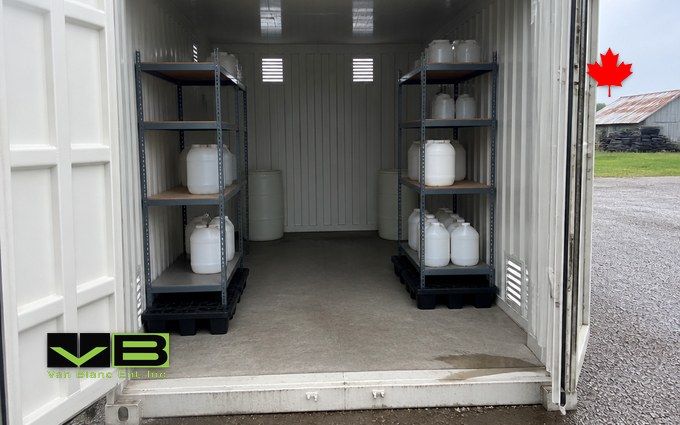
Quick Answer: A chemical storage building for pesticides needs outside venting, a locked door, a warning sign at each entrance and a drain-free, curbed floor. OMAFA puts it 30 m from other farm buildings or behind a 1-hour fire separation. Van Blanc sells the shell: a vented new 10ft or 20ft container.
What This Chemical Store Guide Covers
- What does a pesticide storage building need?
- Chemical storage building types compared
- Ventilation sized to the floor
- Spill containment and the curbed floor
- Keeping fuel, feed and seed apart
- Signs, locks and emergency numbers
- Fire safety and where the store sits
- Freezing, heat and shelf life
- Container chemical store: 10ft or 20ft
- Container grades for a chemical store
- Farms, golf courses and lawn crews
- Delivery to the spot you picked
- Chemical store checklist
- Chemical and pesticide storage FAQs
Reading Time: 19 minutes
What does a pesticide storage building need?
A chemical storage building is a free-standing room kept for pesticides alone. It is locked and vented, it has a floor that holds a spill, and it carries a warning sign at every entrance. That is the working summary of Farm pesticide storage facility, a fact sheet from Ontario’s agriculture ministry, OMAFA, updated September 14, 2026. The fact sheet notes that storing pesticides under unsafe conditions is illegal under Ontario’s Pesticides Act and O. Reg. 63/09. The rest of this page quotes the guidance as the ministry sources word it. It applies to any shell, from poured concrete to a steel container fitted out as a workroom.
The OMAFA fact sheet, with the National Farm Building Code of Canada points it summarises, asks for these.
- Nothing stored may harm anyone, touch food or drink for people or animals, or contaminate the environment.
- A warning sign near the store and at all entrances, with emergency numbers nearby.
- For the higher-risk classes it singles out (old Class 2 and 3): outside vents, no floor drain, a locked door.
- Ventilation that stops toxic or flammable vapours building up, and access from outdoors only.
- An impervious, drain-free floor, curbed to hold the largest container and never less than 50 mm (2 in.).
- Freeze-sensitive products in an insulated, heated cabinet.
- 30 m (100 ft) from other farm buildings, or a fire separation rated for at least 1 hour.
OMAFA prefers a separate, free-standing building, prefabricated or built for pesticides alone, and describes prefab units up to about 9.3 square metres (100 square feet). Van Blanc, a family-run container seller in Brantford since 1995, sells a third version. It is a new 10ft or 20ft container, vented and locked in our yards before delivery. A container does not meet any of these points by itself. The curbed floor, the sign, the siting and the extinguisher are finished around it. Each section below says which part is Van Blanc’s and which is yours.
Christian LeBlanc, second-generation operator, Van Blanc Ent. Inc.: “For a chemical store I ask to see the labels before we talk size. The labels tell you if anything can freeze, and that settles insulated or plain. After that it’s vents, the lock and which way the man door faces. The curbed floor is yours to finish once the box lands, and you should hear that from us on the first call.”
Chemical Storage Building Types Compared
Chemical storage buildings come in six families, and the choice turns on how much you hold and who builds the floor. The container is one of them, a steel shell that takes the locks, vents and add-ons a box can take before it leaves our yards. Chemical-safety suppliers sell purpose-built lockers and hazmat buildings, many with a welded steel sump under a grated floor. OMAFA pictures a prefabricated pesticide storage, a modular unit a farm can buy ready-made. Farms that build their own can follow the plans OMAFA points to in its best management practices book, BMP 13. Those plans are for a 2,440 mm by 3,650 mm (8 by 12 foot) wood-frame, steel-clad storage. A room inside an existing barn needs a 1-hour fire separation, its own outside entrance and venting to the outdoors, per BMP 13. BMP 13 also lists storage cabinets for small volumes. Sizing the container version starts with the 20ft’s inside measurements and your shelf list.
| Type | What arrives | Spill containment | Where it fits |
|---|---|---|---|
| Purpose-built locker or hazmat building | A finished steel unit from a chemical-safety supplier | Welded steel sump under a floor grate | Drums and totes, in one delivery |
| Prefabricated pesticide storage | A modular unit, up to about 9.3 m2 of floor | Built into the unit | Farms that want a ready-made store |
| Farm-built storage | The BMP 13 plan, 8 by 12 wood frame, steel-clad | Poured, curbed and sealed concrete | A farm crew with a season to build |
| Room in an existing building | Your own space, fire-separated | Your curb and your sealed floor | Small inventories beside the shop |
| Storage cabinet | A cabinet for small volumes | An impervious floor with a curb, per BMP 13 | A few jugs |
| Shipping container | A new 10ft or 20ft, vented, with its lockbox already in place | Added after delivery: a curbed steel sump liner, or spill pallets for small quantities | A season’s shelf list, set out where the 30 m line holds |
Every family does the same jobs in a different shell. The container brings steel walls and cargo doors that lock, and Van Blanc builds the vents and the man door in before it ships. Moving air through a closed steel box is its own subject, and extracting fumes from a container shop covers it on a box this size.
Ventilation Sized to the Floor
Ventilation in a pesticide store does two jobs, according to BMP 13. It removes fumes, and it takes excess heat and humidity out with them. OMAFA gives two routes. It says an unheated or uninsulated store should have at least 0.55 square metres (6 square feet) of total inlet and exhaust area. That is per 9.3 square metres (100 square feet) of floor. A heated and insulated store aims to exchange a quarter to a half of its air every minute. On 100 square feet of floor, a 20 to 25 cm (8 to 10 in.) exhaust fan normally does that job. OMAFA adds a switch to start the fan before anyone enters, and a timer that clears stale air on its own.
On a container the arithmetic is short. Most new boxes in our rows carry 2 to 4 factory vents, set high on the side walls. Our ventilation field guide puts the free area of a factory louvre at about 70 square inches. Four of them come to roughly 280 square inches, under 2 square feet. Our 20ft page gives about 148 square feet of floor, so the passive figure works out to about 8.9 square feet (0.82 m2) of openings. A 10ft measures 2,840 mm by 2,350 mm inside, per the spec our 10ft page quotes. That is about 72 square feet, which works out to about 4.3 square feet (0.39 m2). The factory vents were built to equalize pressure in transit, so a chemical store gets added louvres, a fan, or both.
BMP 13 wants every intake and exhaust screened against birds, bees and rodents. A hinged baffle can cut the draft in cold weather. The baseline louvre in our guide to stopping container rain is roughly 12 by 12 inches. At that nominal size, 8.9 square feet divided by 1 square foot a louvre comes to nine. Free area is smaller than face size, so the real count runs higher, set by the louvres actually fitted. They work best placed high and low on opposite walls, so air comes in low and leaves high.
Fan Math for an Insulated Store
Insulation moves the sizing from vent area to air changes. A 20ft holds 1,172 cubic feet. A quarter to a half of that each minute is roughly 290 to 590 cubic feet per minute. A 10ft at about 560 cubic feet works out to roughly 140 to 280. Van Blanc’s own welder can fit a roof turbine, a solar fan or a line-powered fan before the box ships. A wired fan’s final hookup belongs to your licensed electrician on site, and the ESA side of a container circuit covers that part. The switch that starts the fan before entry goes on the same circuit.
Spill Containment and the Curbed Floor
Spill containment is the part of a container chemical store built after delivery, so it goes in the plan first. OMAFA’s summary of the National Farm Building Code of Canada asks for a concrete or other impervious floor with no floor drain. The curb runs around the full perimeter and holds the largest container, never under 50 mm (2 in.). BMP 13 sizes that curb to hold 110% of the largest container or 10% of the total volume of all containers. Whichever is larger wins, and it calls a curb of 50 to 100 mm (2 to 4 in.) usually adequate. BMP 13 also asks for a sealed floor, with pallets under the containers so the curbed area holds more of a spill.
A container floor is marine plywood, the floor our 20ft page grades on every used box. Plywood is not the impervious floor the guidance describes. Containment goes in on top of it, built by you or a fabricator, and it is the one big job Van Blanc leaves to you. One route is a welded steel sump liner with its lip at curb height. The other is spill pallets and trays under every container. Ontario’s environment ministry lists those in steel or plastic for small quantities, in its chemical storage guideline. For larger quantities, the same guideline asks for containment at least 15 cm above the surrounding floor. Either way, nothing should reach the plywood, because what soaks into marine ply tends to stay there.
Stock the Spill Kit Before the Product
OMAFA’s spill fact sheet puts a spill kit in the store, in the sprayer and anywhere else pesticides sit. It lists chemical-resistant gloves, coveralls, boots and goggles, plus a respirator and absorbents. A bentonite and polymer mix plugs a leaking container. A shovel, broom and dust pan, a hazardous material bag and a warning sign round it out. After a spill, it says to call the local environment ministry office or the 24-hour Spills Action Centre immediately.
Keeping Fuel, Feed and Seed Apart
Separation starts with one line in BMP 13: pesticide storages must only be used for the storage of pesticides. Fuel, feed, fertilizer and seed all stay out. On a working farm, the seed goes back to the grain and seed side of the farmyard. BMP 13 gives the feed reason directly. Livestock feeds are not to be stored in the same location as pesticides, to avoid contaminating the feed. The Canadian Centre for Occupational Health and Safety (CCOHS) adds food, utensils, animal feed, seeds and water to its do-not-store-near list.
Fuel is a fire question. OMAFA’s farm fire guide, Publication 837, ranks buildings with flammable materials such as fuel storage as high risk. It separates them from other farm buildings by at least 45 m (148 ft), or by a fire separation rated for at least 2 hours. Pesticide storages sit in its low-risk group with hay, straw and feed storage, at 30 m (100 ft) or 1 hour. Read together, a fuel storage building keeps 45 m from the chemical store, and the chemical store keeps 30 m from the barn.
Inside the store, OMAFA’s practices keep insecticides, herbicides, rodenticides and fungicides apart. In a container, that means a shelf run for each group. Volatile products go in a tightly sealed container or a separate area. OMAFA keeps every pesticide in its original container, or in a labelled secondary container of similar material if the original is damaged. CCOHS adds that large quantities of herbicides belong in a separate building or area, since many evaporate quickly. It also gives flammable and combustible products their own section, away from heat and flame.
Signs, Locks and Emergency Numbers
The warning sign is spelled out to the word. Ontario’s environment ministry publishes it as Sign G, an octagonal sign with a red background and capital letters in black, yellow or white. Top to bottom it reads PESTICIDE STORAGE, AUTHORIZED PERSONS ONLY, WARNING and IN CASE OF FIRE USE EXTREME CAUTION. CHEMICAL STORAGE can replace PESTICIDE STORAGE. OMAFA wants it near the store and at all entrances, and it names Workplace Safety and Prevention Services as a source for the signs.
A locked door controls who goes in, and a padlock shrouded inside the lockbox is the usual setup on a new container. Emergency numbers go up beside the sign: the fire department, the hospital and the Ontario Poison Centre at minimum. OMAFA suggests ambulance, physician, police and the Spills Action Centre as well, plus a copy at the nearest telephone. Windows can stay out of the plan. BMP 13 keeps their number to a minimum and puts steel bars over the ones that stay.
Protective gear lives outside the store. OMAFA keeps respirators and protective clothing nearby but not inside, in an adjacent room or structure, so a spill cannot reach them. Its anteroom idea goes further: a clean room with its own outside entrance, sealed off from the storage and vented separately. On a container site, the clean room can be a ten for the gear and the spill kit or a corner of the next-door shop.
Fire Safety and Where the Store Sits
Fire safety for a pesticide store is mostly a matter of where it sits. OMAFA puts the store at least 30 m (100 ft) from other farm buildings and 60 m (200 ft) from dwellings. It keeps it 90 m (300 ft) from surface water and wells. The ground should be dry and stable, where flooding will not occur, and graded so roof water runs away. For a container, that means a pad that drains and sits level. Ontario’s environment ministry adds that a chemical storage area should stay reachable by firefighters and their equipment. BMP 13 gives the reason: firefighters who know where pesticides are stored can take precautions and contain the runoff.
An ABC-type fire extinguisher belongs close to the store but not inside it, OMAFA says. Its practices add a mixing area next to the store, built to contain any spilled material. A frost-free hydrant sits outside, with a self-draining backflow preventer. A concrete ramp level with the top of the curb lets a front-end loader in. OMAFA also suggests light-coloured roofing to cut heat build-up, which on a container is the colour you pick. Reaching the spot takes a farm lane the truck can work.
Freezing, Heat and Shelf Life
Temperature decides two things in a chemical store: whether a product survives winter, and how long it stays good. BMP 13 gives a storage range of 4 to 32 °C (40 to 90 °F). For a store that is insulated and heated, it suggests R-20 walls and an R-30 ceiling. Heat comes from electric or hot-water sources on a thermostat, with no flames of any sort, since leaking containers can give off flammable vapour. Freezing matters because water-based liquids expand their volume by 10% as they freeze, which can rupture a container. OMAFA’s smaller answer is an insulated cabinet warmed by low-wattage bulbs on a thermostat, with nothing touching the bulbs. A container store can go either way, and insulated units, factory-built or foamed in our shop, cover the insulated side.
Purdue University’s extension service says manufacturers generally design formulations to stay stable for at least two to three years. That holds in the original sealed packages. It adds that storage which protects products from freezing can significantly extend their useful shelf life. OMAFA’s buying rule is to purchase only what one growing season needs. When a store has to stay above freezing, spray foam or rigid panel insulation goes in at Van Blanc’s yards. The heat source is wired on site.
Container Chemical Store: 10ft or 20ft
A container chemical store is a new 10ft or 20ft dry container, vented and fitted at Van Blanc’s yards. It is finished on site with containment, signs and the gear kept outside. The size follows the shelf list. As a rule of thumb, one store per site covers it. If no nearby room can hold the protective gear and a second spill kit, a small second box can. Recent 10ft stock has included factory-built tens and cut-downs from new 20s. The 20ft is the standard ISO box, 19 ft 4 in long inside.
Sizing to One Season’s Shelf List
BMP 13 caps shelves at 150 cm (60 in.) high and 45 cm (18 in.) deep. Each shelf gets a 5 cm (2 in.) lip, and the aisle stays at least 60 cm (24 in.) wide. A 20ft is 7 ft 8 in (2.352 m) wide inside. Shelf runs on both long walls still leave about 1.45 m of aisle. Each run can stretch close to the full 5.898 m inside length. A 10ft gives the same width on a shorter run of about 2.8 m. CCOHS wants shelves made of materials that do not absorb pesticides, such as metal, and wall-mounted shelf runs carry the jugs in either size. Drums and totes sit on the floor, inside the containment.
| Chemical store figure | 10ft dry container | 20ft dry container |
|---|---|---|
| Outside length | 9 ft 10 in (2.99 m) | 19 ft 10 in (6.058 m) |
| Inside floor | 2,840 by 2,350 mm, about 72 sq ft | 19 ft 4 in by 7 ft 8 in, about 148 sq ft |
| Inside volume | About 560 cu ft (16 m3) | 1,172 cu ft (33.2 m3) |
| Cargo door opening | 2,342 by 2,280 mm | 2.343 by 2.280 m, or 7 ft 8 in by 7 ft 5 in |
| Passive vent area at OMAFA’s ratio | About 4.3 sq ft (0.39 m2) | About 8.9 sq ft (0.82 m2) |
| Fan air at a quarter to a half per minute | About 140 to 280 cfm | About 290 to 590 cfm |
| Shelf run per long wall | About 2.8 m | About 5.9 m |
| Against OMAFA’s prefab range (up to about 9.3 m2) | Inside it | About half again larger |
Box figures come from our 10ft and 20ft product pages, and the full size and dimension chart covers the other lengths. The vent, fan and shelf rows apply the OMAFA and BMP 13 figures above to them.
What Our Yards Fit Before Delivery
Van Blanc’s yards fit these before the box ships.
- Louvres cut, framed, sealed and screened toward the vent figure, or a roof turbine, solar fan or line-powered fan fitted by our own welder.
- A steel man door cut in under engineered drawings, so daily trips skip the cargo doors.
- The lockbox, standard on most new containers.
- Spray foam or rigid panel insulation when a label says the product cannot freeze.
- Shelving, one of the storage-side jobs on our list, built to the plan in your quote.
- Electrical roughed in for a fan or heat, with the final connection by a licensed electrician at your site.
- The exterior colour, where a light roof helps with heat.
The full list is on the vents, man doors and shelving we fit before a box leaves. All of it happens before the truck is loaded.
What You Finish After It Lands
- The containment: a curbed, drain-free floor such as a welded steel sump liner, sized to 110% of the largest container or 10% of the total. Spill pallets or trays suit small quantities, per MECP.
- Sign G at every entrance, with the emergency numbers beside it.
- An ABC extinguisher close to the store, outside it.
- The protective gear outside the store, plus a spill kit in the store (OMAFA) and clean-up equipment near it (CCOHS).
- The 30 m, 60 m and 90 m distances, settled when you pick the spot.
- A heated cabinet for freeze-sensitive products, if the box stays plain.
Container Grades for a Chemical Store
Van Blanc sells four grades, and new is the cleanest start for a chemical store. A new container is what the trade calls one-trip. It has made one loaded voyage from the factory, with factory paint, tight door seals and a floor that has carried one cargo. One-trip containers whose floors have carried a single load mean the only residue in the store is your own. Cargo worthy stock has been in use 8 to 15 years and carries a re-certified plate. Wind and watertight stock has been in use 12+ years: sealed and dry, with heavier surface rust. As-is boxes are donor shells for heavy cutting, with the defects disclosed in writing.
A used box can still become a chemical store. Before choosing one, read what a used floor’s cargo history tells you, since a used floor has carried other cargo before yours. To compare them in stock, all of our sizes and grades on one page lays out what Van Blanc sells across our 4 Brantford yards.
Farms, Golf Courses and Lawn Crews
A container chemical store suits any operation that buys a season of product at once and needs it locked, vented and apart. On the farms ringing Guelph, home to the provincial agriculture ministry, a 20ft set 30 m from the barns can hold the season. Herbicides, fungicides and insecticides each get their own shelf run. Among the market farms in the townships around Kitchener, a market garden may fit its season into a 10ft.
Out west, Essex County growers from Windsor out to the Leamington greenhouses work to the same fact sheet. A golf course can use the same figures as a yardstick. That puts the store 30 m from the maintenance shop and clubhouse, and 90 m from the irrigation pond and any well. A lawn-care or landscaping company can set the store beside a second box for the mowers, keeping product and machines apart. Van Blanc delivers to all of them from the same rows.
Pool Chemicals in Their Own Box
Pool chemicals have their own guidance, and Quebec’s government page on chlorine sets it out. Store chlorinating agents in a cool, dry, well-ventilated place out of the sun. Never store them near acidic products, such as the ones that lower pH. Together they can release chlorine gas, which is highly toxic. Keep them far from heat, flames, gasoline, fertilizer, pesticides, paint and cleaning products. Liquid containers go under powders, never the other way round. For a chlorine fire, the page says not to use a dry chemical extinguisher. Douse it with lots of water and call 9-1-1.
Quebec’s list already keeps chlorine far from pesticides. Its fire advice also differs from the ABC extinguisher a pesticide store keeps nearby, so the two do not share a store. A hotel grounds crew in Niagara Falls with a pool and gardens could run two small boxes, one for each.
Price Your Chemical Store
Send us the shelf list and whether anything on it can freeze. Tell us where the store will sit and how far that is from the barn, the house and the water. We will tell you 10ft or 20ft, vents or fan, the man door and the insulation. You get one all-in price back, with the lead time stated.
Family-run in Brantford since 1995 · 4 Brantford yards · 4.9★ across 140+ Google reviews.
Delivery to the Spot You Picked
Delivery comes from our 4 Brantford yards: 1-3 days across most of Ontario, Eastern Ontario runs such as Ottawa and Kingston included. The drop is planned around the distances above. Per our 20ft page, the tilt-deck wants a 70-foot straight run to the spot, with a foot spare on each side. The pad must sit flat enough that the box cannot rock. Per our 10ft page, a ten needs less straight run than any other box we place. Measure the 30 m line, the house and the water first, and the tilt-deck drop itself takes care of the rest. Every quote comes with a real lead time, not a hopeful one. Van Blanc has delivered across Ontario since 1995, with 4.9 stars across 140+ Google reviews.
Chemical Store Checklist
Before the Store Holds Product
- List one season’s products and read each label for freezing and storage limits.
- Pick the spot: 30 m from other farm buildings, 60 m from dwellings, 90 m from surface water and wells, on dry ground.
- Choose the box, a 10ft or a 20ft from our stock, new for a clean floor.
- Size the vents to OMAFA’s ratio, or a fan to a quarter to a half air change per minute.
- Add insulation and heat, or a heated cabinet, for anything that cannot freeze.
- Build the containment: no drain, a curb or sump for 110% of the largest container or 10% of the total.
- Post Sign G at every entrance, with the emergency numbers beside it.
- Keep the gear and the ABC extinguisher outside, close by, with a spill kit in the store and clean-up gear near it.
- Keep fuel storage 45 m away, and keep feed, seed and pool chemicals out of the store.
Frequently Asked Questions
How long can you store pesticides?
Purdue University’s extension service says manufacturers generally design formulations to stay stable for at least two to three years in the original sealed packages. Protecting them from freezing can significantly extend useful shelf life, it adds. OMAFA’s advice on the buying side is to purchase only what one growing season needs. Check each label for storage limits as well.
Where should chemicals never be stored?
Never near food, utensils, animal feed, seeds or water, never in a storage room shared with anything but pesticides, and never over a floor drain. CCOHS lists the first group, BMP 13 keeps pesticide storages for pesticides only, and OMAFA rules out the drain. Fuel storage stays 45 m away or behind a 2-hour fire separation, per OMAFA Publication 837. Pool chlorine never sits beside acids.
What are the four types of pesticides?
OMAFA’s storage practices name four to keep apart from each other: insecticides, herbicides, rodenticides and fungicides. Its fact sheet adds miticides and nematicides to the wider list of pesticides. In the store, each group gets its own shelf or section, with volatile products in a tightly sealed container or a separate area.
What are the ventilation requirements for a chemical storage room?
OMAFA’s fact sheet asks for ventilation to the outdoors that stops toxic or flammable vapours building up. An unheated store should have at least 0.55 square metres (6 square feet) of inlet and exhaust area. That is per 9.3 square metres (100 square feet) of floor. A heated, insulated store aims to exchange a quarter to a half of its air every minute. On a container, CFM sizing for a container workshop shows the fan side of that math.
What is a bund for chemical storage?
A bund is the raised edge around a storage floor that holds a spill: a curb, sill or dyke. BMP 13 sizes it to 110% of the largest container or 10% of the total volume, whichever is larger. It calls 50 to 100 mm usually adequate. Ontario’s environment ministry asks for at least 15 cm for larger quantities.
Can I store pool chemicals in a shed?
Yes, if it is cool, dry, well-ventilated and out of the sun, per Quebec’s chlorine guidance. Keep chlorine away from acids, gasoline, fertilizer, pesticides, paint and cleaners, with liquids under powders. That rules out sharing the pesticide store, and the chlorine routine for a container pool follows the same storage habits.
Can a shipping container be a chemical storage building?
A container is the shell of one, and it does not meet the guidance by itself. Van Blanc fits the vents or a fan, a man door, the lockbox, insulation and shelving in our yards. The buyer finishes the curbed containment over the plywood floor, the Sign G warning sign, the extinguisher outside and the 30 m siting.
How can you minimize the pesticides you keep in storage?
Buy only what one growing season needs, as OMAFA advises, and use opened containers the same season, as Purdue’s extension service puts it. OMAFA’s spill fact sheet also asks for a written list of the pesticides on hand, kept in two or more places and reviewed every year. A short list means a smaller store, a smaller curb and less to clean up.
Sources
- OMAFA, Ontario’s agriculture ministry. (2026). Farm pesticide storage facility, OMAFA fact sheet. Checked October 2026.
- OMAFA. (2026). Handling pesticides safely to prevent spills, OMAFA. Checked October 2026.
- OMAFA. BMP 13, Pesticide Storage, Handling and Application, Storage chapter. BMP Books, Pesticide Storage chapter. Checked October 2026.
- Ontario MECP. MECP guideline on environmental protection at chemical and waste storage facilities. Checked October 2026.
- Ontario MECP. (2020). MECP sample warning signs for pesticide use, Sign G. Checked October 2026.
- OMAFRA, now OMAFA. (2022). OMAFA Publication 837, farm fire risk reduction. Checked October 2026.
- CCOHS. (2023). CCOHS OSH Answers, Pesticides: Working Safely. Checked October 2026.
- Purdue University Extension. (2025). Purdue Extension, pesticide shelf life (PPP-142). Checked October 2026.
- Gouvernement du Quebec. Quebec.ca, safe use of chlorine in pools and spas. Checked October 2026.
Chemical Store Quotes and Yard Visits
We have been supplying shipping containers across Ontario since 1995. Our public yard is at 90 Morton Avenue East in Brantford, one of our 4 Brantford yards. Call first and we will tell you where the new 10ft and 20ft units you want to walk are sitting.
Van Blanc Ent. Inc., 90 Morton Ave E Unit 1B, Brantford, ON N3R 7J7, 519-754-6844.
Bring the shelf list and a rough sketch of the farmyard or the maintenance yard. The fastest answer is a call, and we will tell you which size, which vents and which door, and when one can land. Worth the drive for unbeatable quality, family customer service with 30 years of experience.