
Quick Answer: To start a catering business in Ontario, notify your health unit and cook in an inspected kitchen. Keep a trained food handler on every shift. O. Reg. 493/17 holds potentially hazardous food at 4 °C or lower, or 60 °C or higher. Add insurance, registration, and cold and dry storage.
Inside This Catering Start-Up Guide
- How to Start a Catering Business
- Catering Business Types: Drop-Off, Full-Service, Event
- Menu, Concept and a Written Plan
- Ontario Food Premises Rules for Caterers
- Can I Cook Meals at Home and Sell Them?
- Catering Kitchen Options: Shared, Leased, Owned
- Hot and Cold Holding on the Road
- Catering Business Insurance and Registration
- What Moves Catering Startup Costs
- Staff, Gear and the First Bookings
- December Party Season Pressure
- A 20ft Reefer for Cold Overflow
- A Dry 20ft for Chafers, Tables and Linens
- Power, Pad and Placement Beside the Kitchen
- Grades, Delivery and Ordering the Pair
- FAQs
Reading Time: 17 minutes
How to Start a Catering Business
A catering business is a food business that cooks for events and delivers the meal to where the guests are. Canada’s industry classification puts it plainly. Caterers provide food services for events such as graduation parties, wedding receptions and trade shows. They generally have the equipment and vehicles to carry meals to the event and to cook on site. Van Blanc sells the steel boxes many of those kitchens park out back, a refrigerated 20-footer for the overflow cooler among them.
Paul and Christian LeBlanc run Van Blanc from 4 Brantford yards, and caterers call them every fall about holiday overflow. This Van Blanc guide answers the start-up question first, in the order the work happens. The storage answer comes near the end, once you know what a working catering kitchen has to hold.
The path in Ontario looks like this:
- Pick a niche and a menu you can cook in volume, then write a plan around it.
- Find an inspected kitchen: a shared one, a leased one, or your own.
- Give notice to your local medical officer of health before you start, as the Health Protection and Promotion Act requires.
- Get food handler training, so a trained person is on site during every hour you operate.
- Register the business, open a business bank account and buy insurance.
- Buy equipment, plan how food travels, and line up cold and dry storage, such as a new one-trip box for the event gear.
- Book the first events, hire for them, and keep records from day one.
Industry data says the trade can pay, before Van Blanc ever comes into it. Innovation, Science and Economic Development Canada’s figures for 2024 show 74.8% of small and medium caterers were profitable. That share is an industry average, and your own margin depends on menu, volume and waste.
Catering Business Types: Drop-Off, Full-Service, Event
Caterers sort themselves by how much of the event they run. The three common types are drop-off, full-service and on-site event catering. Each one changes what your kitchen, vehicle and staff list look like, and what you will need to store. Office districts across Toronto suit drop-off lunch menus, while wedding work falls mostly on weekends.
| Type | What the client gets | What the caterer needs most | Typical bookings |
|---|---|---|---|
| Drop-off | Trays and platters delivered, set out, then the driver leaves | Cold capacity and a reliable delivery vehicle | Office lunches, meetings, small home parties |
| Full-service | Food plus servers, setup, clearing and breakdown | Staff, chafing dishes, linens, tables and serviceware | Weddings, galas, holiday parties |
| On-site event | Cooking at the venue, often from a mobile kitchen or tent | Portable cooking and hot-holding gear, a handwashing setup | Festivals, corporate barbecues, fairs |
| Contract or institutional | Meals for one client over a set period | Steady volume and a fixed menu cycle | Camps, schools, work sites |
Canada’s statistical system treats that last row as a separate industry, food service contractors, so most new caterers start in the first three. Pick one type to open with. A drop-off menu can grow into full-service once you have the staff and the serviceware. Community kitchens that cater from a church hall carry the same gear load. Storage for church halls and food banks shows how they handle it.
Your concept follows the type. A niche makes marketing easier: corporate breakfasts, halal or kosher-style menus, barbecue, plant-based, or wedding packages. The niche also sets your gear. A barbecue caterer needs smokers and hot-holding. Winter storage for a restaurant’s patio furniture shows how much outdoor kit a food business ends up owning.
“When a caterer calls, I ask about the menu first. Smokers, tents and folding tables for barbecue work belong in dry steel. A drop-off menu of prepped trays needs cold space, so we talk about which reefers are on the ground.”
Paul LeBlanc, owner, Van Blanc
Menu, Concept and a Written Plan
Test the menu before you sell it. Cook each dish at the volume you plan to sell, then hold it for the time it will sit at an event. Some dishes fall apart after an hour in a chafing dish, and that is better learned at home. Cost every recipe per portion, then price the menu by the head or by the platter.
The written plan answers four questions. Who books you, what they pay, what it costs to cook and deliver, and how many events a month cover your fixed costs. Lenders ask for that plan, and it keeps the first year honest. Equipment, the kitchen and insurance sit in the fixed column. Food, staff hours and fuel sit in the per-event column. Storage belongs in the fixed column too, and Van Blanc’s published container prices fill that line before you call anyone.
Ontario’s guide for food and beverage manufacturers suggests registering a business name and a business number early. A business number also lets you register for HST, income tax and payroll accounts. The same guide says most food businesses incorporate because of potential liability, and it does not recommend a sole proprietorship for a food business. An accountant can tell you which form fits your situation.
Ontario Food Premises Rules for Caterers
Every catering kitchen in the province answers to Ontario Regulation 493/17, known as the Food Premises Regulation. Public health inspectors from your local health unit inspect against it, and a kitchen built inside a shipping container meets the same sections as a storefront. The rules below come from the regulation’s own wording, and the table sets out the sections a caterer meets most often.
| O. Reg. 493/17 | What it says | What it means for a caterer |
|---|---|---|
| Section 5 | A notice of intention to operate includes your name, contact information and the location of the food premise | Your health unit hears from you before the first event |
| Clause 7(3)(d) | Every food premise has refrigerated space adequate for the safe storage of potentially hazardous food | Cold space has to match your busiest week |
| Section 27 | Potentially hazardous food is stored, transported and displayed at an internal temperature of 4 °C or lower, or 60 °C or higher | The rule follows the food into the van and onto the buffet |
| Section 28 | Food meant to be kept frozen stays frozen until it is sold or prepared for use | Frozen stock needs freezer space, such as a reefer run below zero |
| Subsection 29(2) | Records of food purchases are kept on the premise at least until the first anniversary of the purchase date | Keep supplier invoices for a year |
| Section 30 | Refrigeration and hot-holding equipment is big enough for the food and has accurate indicating thermometers that are easily read | Every cooler and hot box carries a thermometer |
| Section 31 | Racks, shelves or pallets protect food from contamination and are readily cleanable | Plan cleanable shelving, not cardboard boxes on the floor; racks fitted before the box leaves Brantford suit a reefer |
| Section 32 | At least one food handler or supervisor who has completed food handler training is on the premise during every hour it operates | Train yourself before you hire anyone |
Section 27 allows one exception. Food may sit outside the safe range for periods of up to two hours when preparation, processing or manufacturing needs that time. Ask your inspector how that window applies to plating for a large event. The regulation defines potentially hazardous food as food that needs time and temperature control to limit the growth of micro-organisms.
A reefer that holds potentially hazardous food is refrigeration equipment, so section 30 applies to it too. Panel rooms and set points are covered in our walk-in cooler guide for Ontario food businesses. This article stays on catering.
Notice to the Medical Officer of Health
Subsection 16(2) of the Health Protection and Promotion Act covers the notice. Anyone who intends to operate a food premise tells the medical officer of health. Section 5 of the regulation lists what the notice includes. Most health units post an online form, and the Middlesex-London Health Unit has separate forms for fixed, mobile and special event operators. Send it early. Middlesex-London suggests sending floor plans for review before you build or renovate.
Inspections follow. The health unit for London and Middlesex County says it inspects randomly one to three times per year or more. Frequency depends on the food, how it is handled and the inspection history. The ministry’s 2019 reference document describes the same risk-based approach. Permits are managed by your municipality, so check with your local building or planning department before you order.
Food Handler Training on Every Shift
Section 32 is the rule new caterers miss. It applies to food service premises, and a catering kitchen prepares meals for consumption elsewhere, which fits the regulation’s definition. Training comes from a board of health or a program the ministry recognizes as equivalent. Middlesex-London’s wording is blunt: at least one certified food handler must always be available during operation. Its guidance also tells food handlers with diarrhea or vomiting to stay home until at least 48 hours after symptoms stop. Peel Region, the health unit for Mississauga and Brampton kitchens, posts its own home-based food business page too.
Can I Cook Meals at Home and Sell Them?
Sometimes, and only after your health unit and municipality say yes. The Health Protection and Promotion Act excludes a room actually used as a dwelling in a private residence from the definition of a food premise. A home catering business therefore needs space set apart from the living areas. Health units word their home-based conditions a little differently. Read your own unit’s page, whether you cook in Brantford and Brant County or further afield.
Middlesex-London lists these conditions before a home-based food business is approved and inspected:
- A separate entrance from outside that does not pass through living areas.
- A separate, designated space for the business.
- Food and materials stored apart from household items.
- Sinks that meet the Food Premises Regulation for the food and the operation.
- Potable water, with sample results provided if you are on a well.
Thunder Bay District Health Unit’s 2013 guidelines for home caterers go further. A home caterer preparing potentially hazardous food needs a written food safety plan approved by a public health inspector. The home can be inspected up to 3 times per year, with the owner’s permission for entry at any reasonable time. Pets stay out of the kitchen while food is prepared.
Those conditions are why many caterers start in a shared kitchen instead. A home kitchen also runs out of fridge space fast, and clause 7(3)(d) still asks for refrigerated space adequate for the food. A reefer parked beside a separate business entrance can carry that load, as long as your inspector agrees with the setup.
Catering Kitchen Options: Shared, Leased, Owned
Catering needs an inspected kitchen, and new operators reach one of three ways. Each comes with its own trade-off between monthly cost and control over your schedule.
- Shared or commissary kitchens rent hourly or monthly time in an inspected space. You start fast with little equipment, but you book around other tenants and cold storage is usually tight.
- Leasing a closed restaurant, church hall or banquet kitchen gives you your own hours. The lease, the equipment inside and the inspection all become yours.
- Building or owning a kitchen gives full control and the highest start-up cost. Some operators fit one into an industrial unit with a loading door.
The kitchen you pick decides what you store elsewhere. A shared kitchen might give you one shelf in its walk-in, and that is not enough for a wedding weekend. Restaurants that cater on the side hit the same wall. Both kinds of kitchen can add an insulated reefer body or a running reefer out back.
Hot and Cold Holding on the Road
Section 27 covers food while it is transported, so the van is part of the job. The Thunder Bay District Health Unit’s home caterer guidelines set out the practical side. Move food quickly, in thermal insulated containers with hot packs for hot food and cold or ice packs for cold food. Each container needs an accurate indicating thermometer. Food stays covered, in food-grade containers used for nothing else.
The same guidelines give cooling times for food cooked ahead. Hot food is cooled from 60 °C to 20 °C within 2 hours, then from 20 °C to 4 °C within 4 hours. Shallow pans, smaller batches and an ice-water bath help, and the cooling path a walk-in has to support follows the same numbers. Extremely hot food never goes straight into a refrigerator. Reheated food returns to its original cooking temperature.
“Hot holding units such as steam tables, chafing dishes, display or drawer warmers, etc. are not considered cooking equipment and are not to be used for reheating food.”
Toronto Public Health, special event food vendor guidance
Thunder Bay District also strongly recommends keeping samples from large functions for seven days. Its figures are 200 grams of each solid food and 125 mL of each liquid, labelled, dated and frozen. If a guest falls ill, those samples give the health unit something to test. Its freezer figure is -18 °C or lower, and food is stored on shelves at least 15 cm off the floor. Van Blanc’s reefers can hold that freezer figure, and the power a reefer draws is the first thing to check.
Probe at the Door, Not at the Buffet
Take a probe reading as food leaves the kitchen and again when it lands at the venue. Write both on the event sheet. If the hot food arrives under 60 °C, reheat it before service.
Catering Business Insurance and Registration
Ontario’s food and beverage manufacturing guide is direct about cover. Written for food processors, it says you will need general insurance plus product liability and complete operations liability. Those protect you against claims from customers who become ill from your food or suffer damage. A caterer cooks and serves, so ask a broker about both.
Ask the broker about the rest of your exposure too:
- Commercial general liability, and whether your venues want a certificate naming them.
- Auto cover for the delivery van while it carries food and gear for pay.
- Property and equipment cover, including gear stored off site in a container with a lockbox over the padlock.
- Spoilage cover for food lost when a cooler or reefer fails.
Registration runs in parallel. The same guide calls it a good idea to register a business name and get a business number early. The business number is also how you register for HST. Your accountant can say when HST applies to your sales. Keep one business bank account, so every catering invoice and supplier bill lands in one place.
What Moves Catering Startup Costs
How much investment a catering business needs depends on the kitchen route more than anything else. The same question about opening a restaurant in Canada has a far bigger answer, because a restaurant pays for a dining room as well. A caterer can start lean in a shared kitchen with rented chafing dishes. The required spend climbs with every piece of gear you own outright.
The cost drivers, in rough order of size:
- Kitchen access: hourly commissary time, a kitchen lease, or a build-out.
- Vehicle: a used cargo van is the usual first purchase.
- Cold storage: kitchen fridges first, then a walk-in or a 20-foot reefer set at your cooler temperature.
- Hot-holding and transport: insulated carriers, chafing dishes and probe thermometers.
- Serviceware and rentals: linens, platters, tables and tents, owned or rented per event.
- Insurance, registration and food handler training.
- Marketing: a website, photos and tasting events.
Storage for the gear you own is a cost line too. A container quote from Van Blanc covers the box and delivery as one number, and a written quote by email usually comes back the same day. Many people call us saying they found a bin for a lot less on Facebook, and some call back two weeks later, scammed. Test a container listing before paying a deposit.
Staff, Gear and the First Bookings
Hire for events, not for a calendar you do not have yet. Start with the cooks your menu needs, and call in servers per booking. Schedule by headcount and service style: a plated dinner needs far more servers per guest than a drop-off lunch. Anyone who handles food falls under section 33, which covers hygiene, clean outer garments and no tobacco on the job.
Buy the gear that earns money every week and rent the rest from an event rental house. Insulated carriers, sheet pans, hotel pans and probe thermometers come first. Chafing dishes, beverage dispensers and folding tables follow once bookings repeat. Each purchase needs somewhere dry to live between events. A box with doors along one side keeps every shelf in reach.
To market and advertise a catering company, start local and visual. A clean website with real photos, wedding and event directories, and tastings for venue managers bring the first calls. Corporate clients book again when the order arrives on time and hot. Hamilton’s mix of industry and event venues is a good example of a market where office catering and weddings overlap.
December Party Season Pressure
December is when the plan meets the calendar. Office parties, family gatherings and holiday open houses stack up in the same few weeks. A caterer can be cooking for several events a day, and every tray made ahead needs a cold shelf until it ships.
Two things run out first for a busy caterer. Cold space goes as soon as you prep ahead, because proteins, dairy, dressings and desserts all want 4 °C or lower. Floor space goes next, because chafers, linens, tables and décor fill every corner of the kitchen. Clause 7(3)(d) does not relax in a busy month, and a crowded walk-in also blocks the air flow that keeps food cold.
“Ensure coolers and refrigerated truck temperatures are kept at 4°C (40°F) or below.”
Toronto Public Health, transporting food for special events
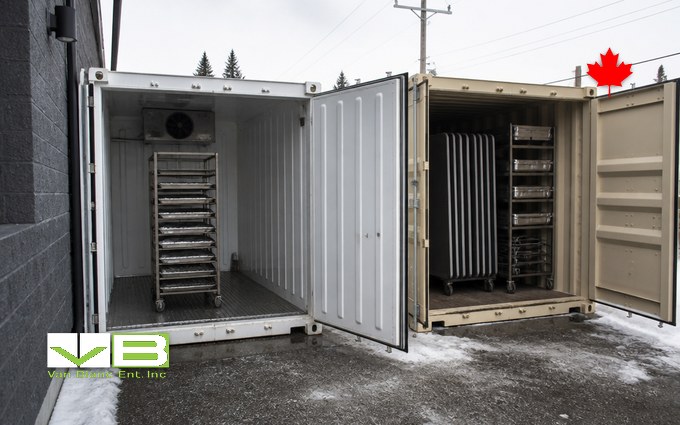
Van Blanc’s answer is two boxes outside the kitchen door, which skips building a cooler room into the kitchen. One is a 20ft refrigerated container for cold overflow. The other is a standard dry 20ft for everything that is not food. Together they free the kitchen to do what it was inspected for: cooking. Van Blanc can quote both boxes as one landed number.
A 20ft Reefer for Cold Overflow
Van Blanc’s refrigerated 20ft is a steel box lined with foam, with its cooling machine fitted at the front wall. Our 20ft reefer page with its full spec sheet names catering companies, wedding catering and festival catering. Each uses the box as overflow walk-in space. The figures below come from that page.
- Inside volume of 27.7 m³ (978 cu ft), with roughly 10 cm of foam on each side.
- A temperature range of -30 °C to +30 °C, so the same box runs as a cooler or a freezer.
- An empty weight of about 3,000 kg with the refrigeration unit.
- A T-bar aluminium floor that carries cold air under the load, so pallets and racks must leave those channels open.
One Van Blanc reefer holds one set point. A caterer with chilled and frozen stock either runs two boxes or keeps frozen stock in the kitchen freezer. Our notes on holding frozen stock in a reefer cover that side. Put cleanable racks inside, as section 31 asks, and a thermometer where staff can read it without opening the doors.
Reefers are not on our standing price list, and the units on the ground change through the year. Ask the yard at 519-754-6844, or send the yard a message, about which 20ft reefers are available, with each unit’s make, model and machine hours. We start the machine for you before you buy, at one of our yards or on a video call. Book a refrigeration technician’s check for a box that will face a public health inspection. What a reefer technician looks at before purchase lists the items.
“Before a caterer buys a reefer from us, I start the machine so they can watch it pull down and hold their set point. Wedding trays and holiday party prep sit in that box, so the machine matters as much as the steel.”
Paul LeBlanc, owner, Van Blanc
A Dry 20ft for Chafers, Tables and Linens
A standard dry 20ft from Van Blanc holds the event kit that crowds a catering kitchen. Our dry 20-footer’s spec sheet gives the numbers below, with door figures from Hapag-Lloyd’s fleet specification. Keep food out of the dry box. Its plywood floor is not the tight, smooth, non-absorbent floor the regulation asks for in rooms where food is handled. Gear goes in instead, the way a restaurant’s patio set waits out the winter.
| Measure | 20ft reefer (cold overflow) | Dry 20ft (event gear) |
|---|---|---|
| Inside length x width x height | 5.440 x 2.270 x 2.240 m | 5.898 x 2.352 x 2.385 m |
| Usable volume | 27.7 m³ (978 cu ft) | 33.2 m³ (1,172 cu ft) |
| Door opening (W x H) | 2.290 x 2.210 m | 2,340 x 2,292 mm (7 ft 8 in x 7 ft 6 in) |
| Floor | T-bar aluminium air-channel decking | Marine plywood |
| Pallet floor space | Racks and pallets set to leave air channels open | 10 pallets on the floor |
| What goes in | Proteins, dairy, prepped salads, desserts, drinks on ice, at 4 °C or lower | Chafing dishes, folding tables, linens in sealed totes, serving platters, décor, tents |
| Power | 380/460 V three-phase on a 32 A plug | None needed; lights optional |
Inside the dry box, shelving along both long walls keeps chafers and platters off the floor and leaves a centre aisle for a dolly. Tables stand on edge at the back, and vents that stop condensation keep linens dry. Linens go in sealed totes so they come out clean, and a lockbox keeps the bolt cutters away. Shelving, vents and lockboxes from our custom features list can be fitted before delivery.
“When a caterer comes to see a dry 20ft at our Brantford yards, I hand them the tape first. Measure the folding tables on edge and the chafer crates against the door opening, because that gear goes in and out around every event.”
Christian LeBlanc, second-generation operator, Van Blanc
A new 20ft with doors on one long side is on our price list too. It lets staff reach every shelf without unloading the front, which suits a box opened before and after every event. Every size and grade we sell, side by side shows the open-side and high cube options next to the standard 20ft.
Power, Pad and Placement Beside the Kitchen
Power decides where the Van Blanc reefer goes. A reefer runs on 380/460 V three-phase power through a 32 A plug. A single-phase site needs three-phase service or a rotary phase converter sized from the unit’s data plate. Phase converters and three-phase supply for a reefer are covered in their own guide. Any electrical work is roughed to spec, and a licensed electrician makes the final connection.
“Plan for a possible power failure by having a backup generator or extra coolers, ice, sternos, chafing dishes etc.”
Region of Peel Public Health, food safety at special events
Both boxes sit on the same simple base: railway ties or cribbing under the four corners, on firm ground, level. A reefer with stock inside is heavy, so check that all four corners bear evenly before the first load goes in. Put the reefer’s doors toward the kitchen’s back door and the unit end toward the power. The dry box can sit further out, doors toward the van.
Delivery comes by tilt-deck truck, which slides the box off the back along the truck’s line of travel. What a tilt-deck needs to set a box down explains the clearances. Where a fence or a tight lot blocks the approach, a HIAB crane truck can lift it in instead.
“Behind a catering kitchen, I find where the van backs in before I pick a spot for the reefer. The tilt-deck needs a straight run, and the box can’t end up blocking the door your staff carry trays through.”
Christian LeBlanc, second-generation operator, Van Blanc
Grades, Delivery and Ordering the Pair
Van Blanc sells dry 20ft containers in four grades, and the choice is yours. New, one-trip boxes have made a single loaded voyage and look the part beside a client-facing kitchen. Cargo worthy boxes are used, re-certified and sound, with surface rust. Wind and watertight boxes are older, sealed and weather-tight. As-is units are project shells sold with defects written down. Our graded used containers list what each grade looks like in the yard.
Every new and used 20ft on our price list is in stock and ready for your order, across our 4 Brantford yards. Delivery runs 1 to 3 days to every region of Ontario, Eastern Ontario included. That covers a caterer in the Ottawa area and the valley towns as surely as one down the road from us. Every quote comes with a real lead time, not a hopeful one.
Payment is on delivery. Van Blanc accepts draft cheque, cash, wire transfer, or a credit card by authorization form. Order the dry box now and the reefer as soon as your electrician confirms the supply, so both are working before the first December party.
Price a Reefer and a Dry 20ft Together
Tell us your postal code, your busiest week’s cold stock and the gear you need to store. We will match a reefer and a dry box, list the grades and the machine hours, and send one landed number. The fastest answer is a call.
Family-run in Brantford since 1995 · 4 Brantford yards · 4.9★ across 140+ Google reviews.
Frequently Asked Questions
Is it legal to sell homemade food in Ontario?
Yes, with conditions. A home-based food business must meet the Food Premises Regulation and be approved and inspected by your health unit. Middlesex-London, for example, asks for a separate outside entrance, a separate business space and separate storage. Low-risk foods face fewer requirements than potentially hazardous ones. Call your health unit before you sell anything.
Do I need a licence to start a catering business in Ontario?
Provincially, you give notice to the medical officer of health before you open. At least one trained food handler or supervisor works every hour you operate. Inspections follow. Municipal requirements vary, so check with your city or township as well. Register the business name and get a business number for HST.
What are the three types of catering?
Drop-off, full-service and on-site event catering. Drop-off delivers trays and leaves. Full-service adds servers, setup and clearing. On-site event catering cooks at the venue. Contract catering for one client over a set period is classed separately, as food service contractors.
Is a catering business profitable in Ontario?
It can be. Federal industry statistics for 2024 show 74.8% of small and medium caterers in Canada were profitable, based on industry averages. Margins depend on menu cost, waste, staff hours and how many events fill a week. A lean start in a shared kitchen keeps fixed costs low while bookings build.
How cold does a catering reefer need to be?
Cold enough that potentially hazardous food stays at 4 °C or lower, the Ontario limit. Set the controller a little below that so door openings leave a margin. A reefer runs from -30 °C to +30 °C, so the same box can also hold frozen stock at -18 °C.
Can I store catering equipment in a shipping container?
Yes. A dry 20ft holds chafing dishes, folding tables, linens and décor between events, with shelving along the walls. Keep food out of the dry box and put cold food in a reefer instead. New and used 20ft boxes on Van Blanc’s price list are in stock and delivered in 1 to 3 days.
Does a reefer need three-phase power?
Yes, a standard reefer runs on 380/460 V three-phase power with a 32 A plug. A single-phase property needs three-phase service or a rotary phase converter sized from the unit’s data plate. A licensed electrician makes the final connection. Ask the yard at 519-754-6844 for the plug and data plate of a specific unit.
Sources
- Government of Ontario. O. Reg. 493/17: Food Premises, current consolidation. Ontario Food Premises Regulation on e-Laws, checked November 2026.
- Ontario Ministry of Health. (2019). Food Premises Reference Document. Ministry of Health food premises reference document, checked November 2026.
- Middlesex-London Health Unit. Starting a Food Business. Middlesex-London Health Unit, starting a food business, checked November 2026.
- Thunder Bay District Health Unit. Operating Guidelines for Home Caterers (revised March 2013). Thunder Bay District Health Unit home caterer guidelines, checked November 2026.
- Innovation, Science and Economic Development Canada. Caterers, NAICS 72232: Canadian Industry Statistics summary. ISED Canadian Industry Statistics for caterers, checked November 2026.
- Ontario Ministry of Agriculture, Food and Agribusiness. Setting up your business, Guide to Food and Beverage Manufacturing in Ontario. Ontario food and beverage guide, setting up your business, checked November 2026.
- Toronto Public Health. Special Event Food Vendors. Toronto Public Health, special event food vendors, checked November 2026.
- Region of Peel Public Health. Food safety special event guidelines. Region of Peel, food safety special event guidelines, checked November 2026.
Walk Both Boxes at Our Brantford Yards
We have been supplying shipping containers across Ontario since 1995. Our public yard is at 90 Morton Avenue East, one of our 4 Brantford yards.
Van Blanc Ent. Inc., 90 Morton Ave E Unit 1B, Brantford, ON N3R 7J7, 519-754-6844.
Bring your December booking list and a photo of the electrical panel. We will open a dry 20ft for you to measure against your gear, and, if a reefer is on the ground that week, run it so you can watch it hold your set point. Worth the drive for unbeatable quality, family customer service with 30 years of experience.