
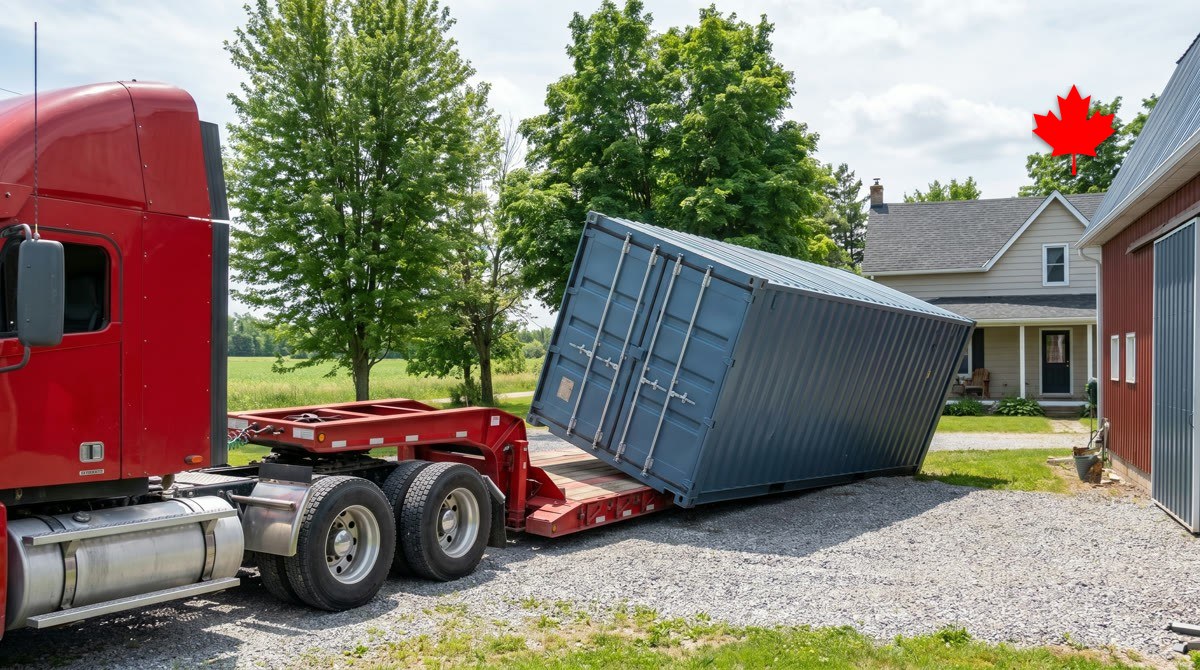
We sell containers. We do not rent.
Van Blanc sells shipping containers outright. We do not rent, we do not lease, and we do not offer rent-to-own. Renting comes up on this page because buyers compare it against owning, and that comparison is worth reading, but purchase is the only arrangement we offer. Stocked units deliver from our Brantford yards in 1 to 3 days. Request a sale quote or call the yard at 519-754-6844.
Quick Answer: Half of Canada’s freight moves through Mississauga; storing some of it there is the expensive part. Van Blanc sells steel containers outright and delivers them across Mississauga in 1 to 3 days from our Brantford yards, with all four grades named for what they are and the exact unit yours to walk first; we do not rent.
Mississauga is the logistics capital of the country: eighteen thousand companies, seven highways, the cargo aprons of Pearson, and more warehouse floor than some provinces. The paradox is that in the city built to move and hold goods, holding your own goods is the costly part. Industrial rents price by the square foot of somebody’s racking, self-storage prices by the cubic metre of somebody’s building, and the small business or household in the middle pays the density premium either way. A steel container on your own property is the one storage format that skips the premium entirely, which is why the 905’s container demand keeps climbing. The used rungs carry most of that demand, and the used-steel rundown covers them grade by grade. This page covers how it works here: who it fits, where it physically fits, and what to ask before any box lands.
The Logistics-Capital Paradox
Pearson’s cargo modernization is pouring investment into moving goods faster, and every gain in freight velocity tightens the same squeeze: space near the corridors gets more valuable, and the overflow of a growing business gets more expensive to park indoors. Warehouse availability in Mississauga and Brampton has loosened slightly, but the arithmetic has not changed for the company that needs two hundred square feet of overflow, not twenty thousand. Third-party logistics wants volume commitments. Industrial sublets want terms. The container behind your own unit wants a delivery fee and one invoice, and it holds a business’s entire slow-moving inventory tier within reach of the shipping door. For companies importing through Pearson or the intermodal terminals, there is a neat symmetry in the solution: the goods arrived in a container; the overflow lives in one too.
Small-Business Warehouse Math in the 905
The pattern we see from Mississauga commercial customers is consistent. A distributor, contractor, e-commerce operation, or service fleet outgrows its unit’s back corner. The choices on the table are a bigger lease, a 3PL contract, a self-storage bay across town, or steel behind the building. The bigger lease is a multi-year commitment triggered by what might be a one-year bulge. The 3PL wants minimums and touches every carton twice. The storage bay adds a drive to every pick. The 40ft high cube behind the building adds racking-height floor space that scales the other direction too: when the bulge passes, the box sells on to the next business, and nobody amended a lease. Tell your insurer, block it level, and the overflow problem becomes a line item instead of a move.
Fitting out the box is its own small craft. A 40ft high cube takes two rows of standard pallet racking with a centre aisle, or one row plus bin shelving for pick-and-pack work, and the marine plywood floor carries a loaded pallet jack without complaint. Light it with a battery LED strip or run a cord from the building, keep the fast movers at the door end, and the container stops being overflow and starts being the annex. Businesses that treat it that way keep the unit for years, which is why buying it outright at the start is the cheaper path.
The Dense-Suburb Driveway Question, Answered Honestly
Mississauga’s residential streets are the tightest container market we serve, and physics beats optimism here. Townhouse complexes and condo-board streets generally cannot take a container at all; shared driveways and board rules settle the matter before physics gets a vote. Post-war detached streets in Streetsville, Clarkson, and Port Credit usually can, with the 10ft or 20ft depending on frontage, and the newer detached subdivisions toward Churchill Meadows fit a 20ft on most double drives. The deciding facts are the same everywhere: roughly 30m (100ft) of straight approach for the truck, overhead clear of wires, the driveway’s slope, and doors that need room to swing. The driver settles all of it on the phone before anything rolls, and when the answer is “your street cannot take one,” we say so and save everybody the morning. For households in the cannot column, a locker is the right recommendation and we make it without hesitation.
If your street is in the cannot column
Roughly a third of Mississauga households cannot host a container, and pretending otherwise would waste your time. The workable alternatives, in order: a locker for genuinely small volumes; a relative’s or friend’s detached driveway for a shared 20ft, which two households split more often than you would guess; and for home-based businesses, a small commercial bay with a container behind it, which pairs workspace and storage for less than either costs separately in this market. When a caller describes a townhouse complex, we walk through these instead of booking a truck that would have to turn around. The quote we do not send costs us a sale and saves you a morning, and it is why the cannot-column callers send us their detached-house friends.
Who buys storage containers in Mississauga, and for what?
The airport-corridor supplier. Parts, packaging, and service stock feeding the freight economy, stacked past the lease line every peak season. A high cube behind the unit holds the tier that does not turn weekly, twenty steps from the dock instead of twenty minutes down the 401.
The trade-show and events operator. Toronto’s convention calendar stages out of Mississauga’s industrial parks, and booth kits, staging, and AV cases spend most of their lives between shows. A container is the kit room that never bills by the pallet.
The Streetsville renovation. Older village streets, real driveways, houses worth opening up. A 20ft out front holds the main floor through the project, and the couch never sees a storage facility’s loading dock.
The landscaper’s winter. Mowers, trailers ride out back, but the hand equipment, irrigation stock, and seasonal product need dry steel from November to April. One 20ft at the yard’s edge replaces the rented bay and its gate hours.
The importer between shipments. Small firms bringing goods through Pearson or the rail terminals live with lumpy arrivals: three months of stock lands in one week. The container absorbs the lump on the company’s own pavement, at the company’s own pace.
Price Your Mississauga Delivery
Size, grade, and your postal code get you an all-in number with a real lead time, usually the same day. Tight placement or a condo-board question? Say so up front and we will give you the answer before the truck is ever booked. The fastest answer is a call.
Freight Country Context: Where All This Steel Comes From
The GTA is where Ontario’s container stream enters the province: boxes ride the rails from the ports, land at the region’s intermodal terminals, and disperse into the freight economy that Mississauga anchors. That stream is industry context worth understanding as a buyer, because it explains two things about the market. First, why fresh one-trip steel is so visible in GTA listings; the supply enters here. Second, why brokers cluster here: proximity to the stream makes it easy to sell photos of boxes one has never touched. Our own answer to the geography is simpler and older: the units we sell live in our Brantford rows, every delivery originates from our own yards, and the box in your quote is a box a LeBlanc has walked. In a market this thick with intermediaries, “come see it” is the entire differentiation, and it fits in three words.
Security in a Busy Region
A dense freight region carries dense theft pressure, and container security here deserves the plain version. The box itself is the strong link: corten walls and gasketed steel doors are not where losses happen. The padlock is, unless it is shrouded, which is what a lockbox does: a welded steel collar that turns a bolt-cutter theft into a loud, slow, usually abandoned project. Placement does the rest. Doors facing the building rather than the road, sightlines from a window or camera, and light overhead cost nothing at delivery time and change the unit’s whole risk profile. Commercial insurers in the 905 increasingly ask exactly these questions when extending contents coverage to an on-site container; arrive with the answers and the call takes five minutes. We fit lockboxes at the yard before delivery, and every commercial quote can include one.
The 905’s Storage Calendar
Mississauga’s container demand runs on three overlapping seasons. Spring belongs to the events trade and the movers, as the convention calendar wakes up and closing dates cluster. Summer belongs to renovations and the landscaping fleet. And the fourth quarter belongs to inventory, when e-commerce and retail overflow peaks and every importer’s fall shipments land at once; the yard books hardest from September through November, and the businesses that call in August get first pick of the high cubes. Stock runs deep, but any one week’s rows are finite, and buyers with a known season should order ahead of it, not inside it. It is the same advice we give every market, tuned to a city whose seasons are freight seasons. The corollary is worth a sentence of its own: off-season orders, February especially, get the deepest selection and the fastest trucks of the year, and the buyers who plan against the calendar rather than with it get the best of both.
Rent or Buy: The Opex-Capex Version
Mississauga asks the rent-or-buy question in accounting language, so here it is in kind, with our side stated first: Van Blanc sells outright and does not rent. Renting from a fleet operator keeps storage in operating expense, monthly, flexible, approvable at the manager level, and defensible for a bulge measured in weeks. Buying moves the box to the balance sheet, where it depreciates on a schedule the CRA already has a class for and holds resale value, and a used WWT bought once undercuts the rental line inside a year. An equipment loan through the company’s own bank or equipment financer gives the monthly shape without the rent, and how a fleet operator’s terms compare with owning is set out on our rentals page. For owner-operators and households the same logic applies without the vocabulary: a need measured in weeks borrows a trailer or rents elsewhere, a longer need buys, and the purchase rows at the yard run every grade with the flaws pointed out first.
From Brantford Into the 905
Mississauga runs about an hour from our rows, straight up the 403, which keeps the whole city inside the standard 1-to-3-day window on a tilt-deck truck with a fully insured carrier. Industrial-park placements are the easy half: wide aprons, forgiving approaches, and the only real question being which side of the building. Residential placements get the two-minute phone walkthrough described above. Two local specifics worth flagging when you book: gated complexes and secured industrial parks should warn the gatehouse a flatbed is coming, and airport-corridor addresses with truck-route restrictions should mention the block so the driver plans the legal approach rather than improvising one. Ground prep is the same everywhere: firm, level, blocked on ties or patio stones, slightly proud of grade. The full walkthrough lives in our pad-prep guide.
Sizes Against the 905
| Unit | External size | Mississauga fit |
|---|---|---|
| 10ft | 2.99m x 2.44m (10′ x 8′) | Older village streets, short frontages, tight side yards |
| 20ft | 6.06m x 2.44m (20′ x 8′) | Detached-home driveways, renos, landscaper yards |
| 40ft | 12.19m x 2.44m (40′ x 8′) | Industrial lots, events operators, importer overflow |
| 40ft High Cube | 12.19m x 2.44m x 2.90m tall | Racking-height storage behind commercial units |
Commercial Mississauga skews bigger than the rest of our map: the 40ft high cube is the default behind business units, where the extra foot of height turns into a third racking level. Residential Mississauga skews smaller, with the 10ft earning more placements here than anywhere south of the lower city in Hamilton. The 20ft still bridges both worlds, and the thirty-year sizing rule holds: the undersized box is the one buyers call back about.
Grades in an Import Town
Mississauga sees more fresh steel than any market we serve; one-trip units roll off the trains and out of the port stream constantly, which tempts buyers into thinking new is the default. The ladder deserves a fairer reading. New (one-trip): one loaded crossing, essentially new, right for anything visible, branded, or bound for conversion. Cargo Worthy: recertified structural soundness with honest surface wear, right for goods that might ship again. Wind and Watertight: the stationary workhorse, sealed against weather and rodents, the correct answer for most overflow and driveway work at a meaningful saving. As-Is: declared faults, priced accordingly, for cladding and donor projects. The import-town trap is paying one-trip money for a box that will spend its life behind a building holding trade-show crates; the WWT rung exists precisely for that job. We stock all four in Brantford and will talk you down a rung when the use case says so.
Sea Can, C-Can, Container: 905 Dialect
Mississauga’s vocabulary skews professional: container and storage container dominate, intermodal container shows up on purchase orders near the terminals, and sea can arrives with every buyer who grew up outside the GTA. The trades say c-can here like they do everywhere. All of it names the same 8ft-wide corten steel built to ISO 668, and the quote line at our counter does not care which word you bring. The full purchase-side picture for the city sits in the Mississauga container overview.
Mississauga Storage Container FAQ
Where can I get a storage container in Mississauga?
Delivered from yards outside the city: Van Blanc runs Mississauga from Brantford, about an hour up the 403, in 1 to 3 days. Walk the rows at 90 Morton Avenue East first to pick your exact unit, which used-steel buyers should whenever they can.
Can a container sit on a Mississauga driveway?
On most detached-home driveways, yes, sized to the frontage; on townhouse and condo-board streets, usually not, and we say so before booking anything. Permits are managed by your municipality; check with the City before you order.
Is a container cheaper than warehouse space for business overflow?
For a slow-turning overflow tier, usually: a high cube behind your unit adds racking-height floor without a lease amendment, minimums, or per-touch fees. For fast-turning volume a 3PL still wins. The split is turn rate, and we will say which side your case lands on.
How fast is delivery to Mississauga?
One to three days for stocked units on a tilt-deck with a fully insured carrier. Flag gatehouses, truck-route limits, and tight placements when you book and the driver plans the approach in advance. Every quote carries a real lead time, not a hopeful one.
What size do Mississauga businesses usually take?
The 40ft high cube: the extra foot of height becomes a third racking level behind a commercial unit. Households run 10ft or 20ft by frontage. When a buyer is stuck between sizes, three decades of deliveries say the same thing: the undersized box is the one buyers call back about.
Should an importer buy new or used?
Match the grade to the job, not the supply stream. Goods that ship again justify Cargo Worthy or one-trip; overflow that sits behind the building belongs in Wind and Watertight at a real saving. Paying new-steel money for stationary storage is the most common 905 mistake we talk buyers out of.
Can event companies use containers between shows?
That is one of our steadiest Mississauga uses: booth kits, staging, and cases living in a container between the convention calendar’s peaks. A box bought outright suits a schedule that changes yearly, and it travels to a new unit when the company does.
Do you deliver to Brampton and the rest of Peel?
Yes: Brampton, Malton, and the airport corridor ride the same routes inside the same 1-to-3-day window. Industrial placements are routine; residential ones get the same phone check as Mississauga streets.
What does a quote need from me?
Postal code, size guess, the surface it will sit on, timeline, and whether you lean new or used. From those five an all-in number with a real lead time comes back the same day, and the phone version takes two minutes.
Can two households share one container?
Yes, and in Mississauga’s tighter streets it is common: a 20ft on one detached driveway splits cleanly between two households with a marked centre line and two padlocks on a hasp bar. The purchase goes in one name; how you split the cost is your business.
Why buy from Brantford instead of a broker in the GTA?
Because the yard is the difference. Brokers resell photos; a family yard walks you down the rows, opens the doors, and points at the dents before you pay. You pay on delivery, not in advance, and the same people answer the phone in year five.
Sources
- Toronto Warehousing. (2026). Toronto Pearson LIFT 2026: Impact on GTA Warehousing and Logistics. torontowarehousing.ca
- Greater Toronto Airports Authority. (2019, current). Growing Responsibly: Toronto Pearson Master Plan 2017-2037. torontopearson.com
- International Organization for Standardization. (2020). ISO 668: Series 1 freight containers, classification, dimensions and ratings. iso.org
- StorTrack. (2025). Self-Storage Pricing Trends, U.S. and Canada, December 2025. stortrack.com
- Canadian Storage Info. (2025). Q2 2025 Self-Storage Market Update. canadianstorageinfo.ca
An Hour From the 905, Worth the Drive
Van Blanc has supplied steel containers across Peel and the western GTA since 1995: family-run, 4.9 stars across 140+ verified Google reviews, and a real yard at 90 Morton Avenue East in Brantford where the rows are open for walking and the flaws get pointed out first. Mississauga deliveries run 1 to 3 days. Christian, who started flying to Asia with his father at fifteen and now walks the rows daily, fields most of the 905 calls: the vocabulary is corporate, the questions are sharp, and the straight answer still wins every time. That has been the model since 1995, and the region that moves everything keeps proving it.
Van Blanc Ent. Inc., 90 Morton Ave E Unit 1B, Brantford, ON N3R 7J7. 1-888-509-6658