
We sell containers. We do not rent.
Van Blanc sells shipping containers outright. We do not rent, we do not lease, and we do not offer rent-to-own. Stocked units deliver from our Brantford yards in 1 to 3 days. Request a sale quote or call the yard at 519-754-6844.
Quick Answer
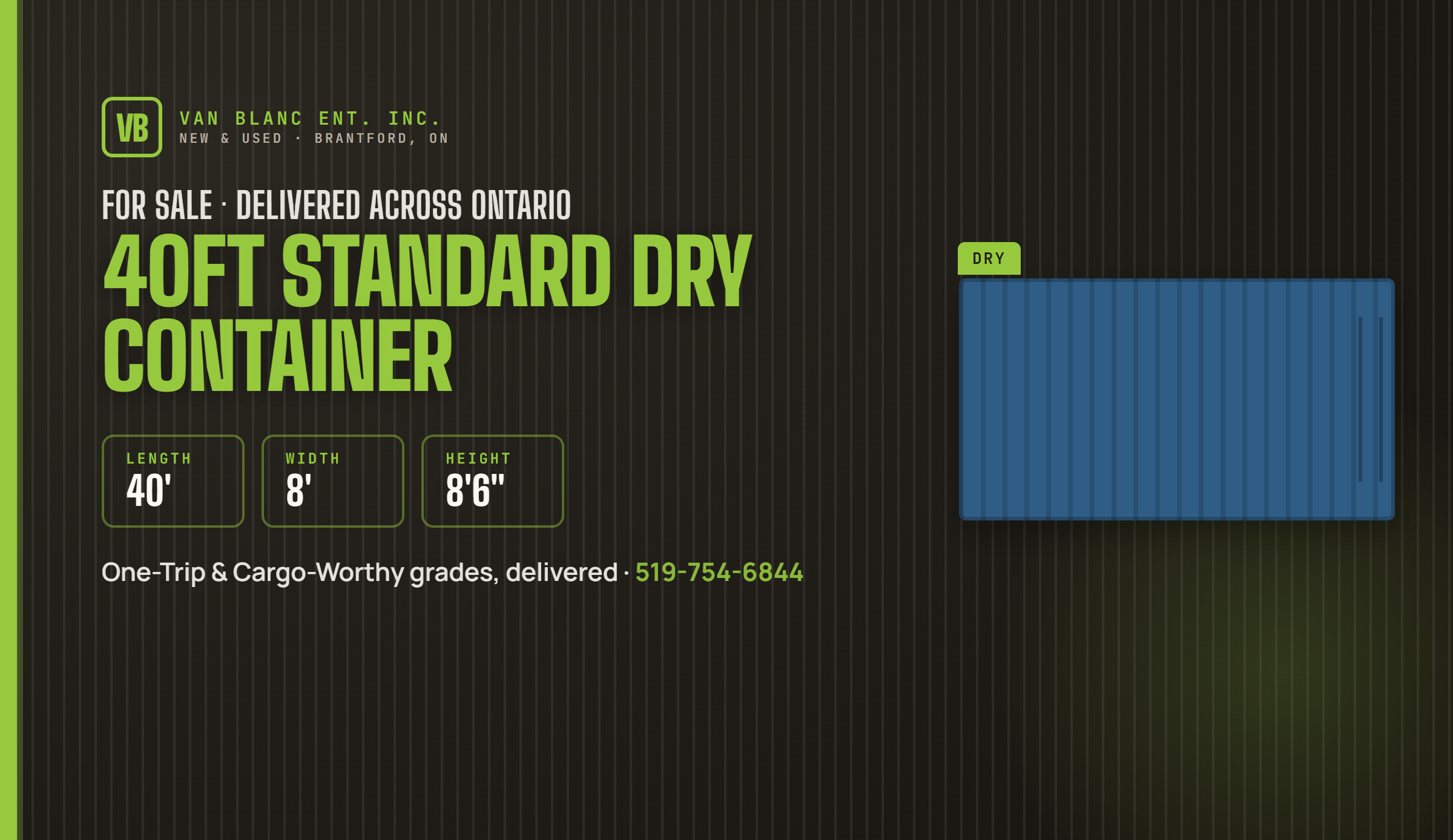
A 40ft dry shipping container is the workhorse of construction compounds, industrial yards, and retail backstock across Ontario. ISO 42G1 standard, 39 feet 5 inches long internally, 7 feet 8 inches wide and 7 feet 10 inches tall. It holds 2,390 cubic feet (double a 20ft), weighs up to 8,333 pounds empty, and carries 58,863 pounds of cargo on a 30,480 kg plate. Fits 20 to 21 standard North American pallets in a single layer. We stock 40ft units in One-Trip and Cargo Worthy grades at our Brantford yards quoted per order, with the grade walk-through included before you commit. Delivery in 1 to 3 business days across Ontario.

If the 20ft container is the most-sold size across our Brantford yards, the 40ft is the most-revenue-per-unit size. About three out of every ten units that leave our gates are 40-footers, and the buyers calling for them are usually doing something substantial. Multi-tenant GC compounds along the Davis Drive corridor in Newmarket. Multi-bin contractor yards along Forbes Road. Mid-sized retail backstock for chain locations. Agricultural growers staging a season’s equipment in a single locked structure. Light-industrial buyers running a parts cage that needs to hold 1,000-plus SKUs.
The 40ft is twice the internal volume of a 20ft (2,390 cubic feet vs 1,172) at roughly 1.4 times the price. That is why one forty against a pair of twenties usually resolves in the forty’s favour on cost per cubic foot. That is the cleanest math in container buying: you pay less per cubic foot of stored space when you go larger. The trade-off is access. A 40ft tilt-deck delivery needs a longer straight-line approach than a 20ft, and some residential and rear-yard commercial sites simply cannot accommodate the swing. We do a Google Earth pre-check before scheduling so the constraint is identified before the truck leaves Brantford, not after the driver gets stuck on a tight bend.
This page covers the real specifications and weights, the four grades we stock, what moves a 40ft quote, the use cases buyers actually pick 40ft for, and how delivery works. Van Blanc is a family-owned independent supplier, in business since 1995. You walk our 200-plus container inventory before any payment, and we let you read the CSC plate on the physical box you are buying.
40ft Container Size and ISO 42G1 Specs
How big is a 40ft container? It covers a 320 square foot footprint, and the table below gives every outside, inside and door measurement in feet and metres. Our sizes guide shows how the 40ft compares with the other standard sizes. Where our older figures and Hapag-Lloyd’s published specification differ by a few millimetres, we print the smaller inside figure, because that is the one your cargo has to clear.
| Measurement | Imperial | Metric |
|---|---|---|
| External length | 40 ft 0 in | 12.192 m |
| External width | 8 ft 0 in | 2.438 m |
| External height (standard) | 8 ft 6 in | 2.591 m |
| Internal length | 39 ft 5 in | 12.029 m |
| Internal width | 7 ft 8 in | 2.350 m |
| Internal height | 7 ft 10 in | 2.385 m |
| Door opening width | 7 ft 8 in | 2.340 m |
| Door opening height | 7 ft 5 in | 2.280 m |
| Internal volume | 2,390 cu ft | 67.7 m³ |
| ISO 6346 size + type code | 42G1 (standard 40ft, 8′6″ height, general-purpose) | |
Every 40ft we sell carries an ISO 6346 marking and a CSC (Convention for Safe Containers) plate on the cargo doors. Both confirm the container was built to the international standard for ocean transport and remain on the unit for its lifetime. Buyers verify both against the box they are buying when they walk one of Van Blanc’s four Brantford yards. The convention behind that plate, CSC 1972, was drafted by the International Maritime Organization and adopted in 1972.
How Much Does a 40ft Container Weigh?
A standard 40ft container weighs 3,780 kg (8,333 lb) empty on the heaviest 40ft general purpose series in Hapag-Lloyd’s published container specification. Van Blanc prints that heavier tare here. Lighter series in the same document come in at 3,700 kg. The CSC plate on the door states the tare of the exact box you buy. Read it before you book a crane or work out how that weight rides on the truck’s axles.
| Weight | 40ft standard | 40ft High Cube |
|---|---|---|
| Tare (empty) | 3,780 kg (8,333 lb) | 3,980 kg (8,775 lb) |
| Maximum payload | 26,700 kg (58,863 lb) | 26,460 kg (58,335 lb) |
| Maximum gross, 30,480 kg plate | 30,480 kg (67,200 lb) | 30,480 kg (67,200 lb) |
| Forklift axle load the floor carries (at 142 cm² or more of tyre contact per wheel) | 5,460 kg (12,037 lb) | 5,460 kg (12,037 lb) |
Tare is the empty box: what the tilt-deck carries to your site and what the pad holds before anything goes in. Payload is the most cargo the container is rated to carry. Maximum gross is the two together, and it is the ceiling stamped on the plate. Other 40ft series in Hapag-Lloyd’s fleet are plated at 32,500 kg (71,650 lb) gross, so their payload runs higher. The High Cube column comes from Van Blanc’s own 40ft High Cube spec page.
Our weight guide covers what the truck and the pad have to carry once the box is loaded, size by size. Two more figures in the same Hapag-Lloyd document matter if you are loading machinery or steel. Each lashing point on the rails and corner posts is rated at 1,000 kg (2,205 lb). A concentrated load on a 40ft floor should stay under 3 tonnes per running metre. The floor sits 170 mm (6.7 in) above the ground, so a pallet jack needs a ramp or a dock plate.
Standard 40ft vs 40ft High Cube
A 40ft High Cube has the same floor as a standard 40ft and one more foot of height, inside and out. The ISO 6346 size-type code on the door tells you which box you are standing in front of. A 42G1 is a 40 ft general purpose container 8 ft 6 in tall, and a 45G1 is the 9 ft 6 in high cube.
| Measurement | 40ft standard (42G1) | 40ft High Cube (45G1) |
|---|---|---|
| External height | 8 ft 6 in (2.591 m) | 9 ft 6 in (2.895 m) |
| Internal height | 7 ft 10 in (2.385 m) | 8 ft 10 in (2.695 m) |
| Door opening height | 7 ft 5 in (2.280 m) | 8 ft 5 in (2.575 m) |
| Internal volume | 2,390 cu ft (67.7 m³) | 2,694 cu ft (76.3 m³) |
| Floor length and width | Identical: the High Cube adds height only | |
Van Blanc’s High Cube spec page lists the volume as 2,700 cubic feet. Mobile Modular publishes 2,694, and we print the smaller number. The extra foot is what pallet stackers, tall shelving and conversion builders pay for. If insulation is on the plan, read our comparison of usable height once the walls are insulated before you choose.
Pallet Math and Real Practical Volume
A standard 40ft holds 20 to 21 standard North American pallets (40 by 48 inches) in a single layer. That means two rows of ten plus a partial at the door end. For Euro pallets at 1200 by 800 mm, the 40ft holds 23 to 24 in the same single-layer configuration. The reason the 40ft fits proportionally more Euro pallets than the 20ft is the floor length math works out cleaner at the longer dimension.
In residential terms, a 40ft holds the contents of a typical three-bedroom house with room left over. It also takes a complete two-car garage: both cars plus the seasonal storage, motorcycles, tools, lawn equipment and kids’ sports gear. For construction buyers, a 40ft fits a complete framing-stage and mechanical-stage tool and materials inventory for a four-to-six house subdivision build with shared compound access. For commercial buyers, a 40ft holds 1,000 to 2,500 SKUs of small-to-medium item retail backstock, depending on shelf arrangement.
40ft Container Grades We Stock
Same four grades as our 20ft inventory, with one difference for 40ft buyers: the CW grade premium over WWT is smaller because the 40ft used market is deeper. CW pricing reflects that supply. Below is the grade ladder.
| Grade | What It Is | Best 40ft Use Cases |
|---|---|---|
| One-Trip | Essentially new. Single voyage from Asia. Paint clean, doors tight, no rust. | Customer-visible commercial placements. Premium residential garage conversions. Container homes. Retail kiosk full-storefront builds. |
| Cargo Worthy (CW) | Used 8 to 15 years. CSC re-cert valid. Wind and water tight. Surface rust on exterior acceptable. The most popular 40ft grade. | GC compound storage. Multi-bin industrial yard. Agricultural overflow. Retail backstock. Working-buyer default. |
| Wind and Water Tight (WWT) | Used 12+ years. Roof and floor sealed. CSC may be expired. Heavier exterior rust. | Long-term static storage. Equipment-yard overflow. Back-of-farm placement. Multi-year cargo-block fixed positions. |
| As-Is | Specific repair scope disclosed in writing. Project shell. | Custom modification builds. Container houses where the shell is heavily cut. Workshop conversions with extensive structural rework. |
Container prices at our Brantford yards are quoted bare. Delivery across Ontario is quoted by destination distance and access, alongside the container itself. Multi-bin orders get a per-box discount on delivery starting at three units, deeper discounts at five and ten units. Modifications priced separately and added during the quote.
“The 40ft makes the math work for buyers who actually need it. I have walked customers backwards from a 40 to a 20 plenty of times when their use case is genuinely a 20-footer’s worth of stuff. But when the buyer is running a four-house compound, or a multi-tenant industrial yard, or a retail location with real backstock pressure, the 40 is the only honest call. We do not push you to the bigger product if you do not need it, and we do not let you under-buy when you do.”
Paul LeBlanc, owner, Van Blanc Ent. Inc.
Used 40ft Shipping Containers for Sale
The used 40ft market is the deepest in the trade, because the 40ft is the box the shipping lines run most and retire in the largest numbers. That is why a used 40ft shipping container for sale carries a smaller premium between grades than a 20ft does. The cargo worthy units that reach the used 40ft rows in Brantford are eight to fifteen years old with a valid plate, working doors and a sound marine plywood floor. The wind and watertight units are older and carry more rust on the panels. They are still dry and lockable, which is all a farm or a contractor yard asks of them. Rust through a corner post, a door sill or a floor cross-member is a different box and sells as-is with the defect written down. How an eight-year box compares with a fifteen-year one is the question most used-40 buyers are really asking. The answer is on the plate and the floor, not the paint.
A 40 ft sea can for sale is the same ISO 42G1 box; the county’s name for it changes nothing about the grade or the tilt-deck. Buyers who want the box cut for a workshop, an ADU or anything street-facing usually step up to a one-trip 40ft from the new rows. Straight walls and an unmarked floor are worth more once the welding starts. Everyone else buys used, and the years each grade gives you on a gravel pad is the honest way to price the difference. Walk the row or ask for the container number on a video call: a used 40ft is chosen, not assigned.
40ft Container Use Cases: Six Common Jobs
1. Multi-tenant GC compound storage
Compound storage often arrives beside a converted site office on the same delivery. Mid-rise and subdivision GC compounds use 40ft Cargo Worthy units as primary jobsite storage. They line Davis Drive in Newmarket, Carson Road in Midhurst, the Pickering north builds and the Milton 401-corridor developments. Two to four 40-footers per compound, side-by-side with a forklift aisle between them. Each box dedicated to a stage of the build (framing, mechanical, finish, security cabinet). Welded lockbox installed before delivery. Buyback available at end of build.
2. Industrial multi-bin contractor yards
Forbes Road in Springwater, Mulock Drive in Newmarket, the 401 employment corridors in Mississauga, the QEW industrial belt in Stoney Creek and Burlington. Multi-bin 40ft layouts hold electrical-contractor parts cages, HVAC distributor seasonal stock, fleet-vehicle accessories, and equipment-rental yards’ returnable inventory. CW grade, multi-bin discount, paint-matched to lot visual standard.
3. Retail backstock for chain locations
Multi-location retail (auto-parts chains, home-improvement, small-format grocery, building-supply outlets) uses 40ft High Cube containers as overflow backstock at the back parking lot, holding seasonal inventory the in-store backroom cannot accommodate. One-Trip grade preferred because the box is visible from the customer parking area. Painted in brand colours. Operational year-round, replaced every 5 to 7 years as the corporate visual standard evolves.
4. Agricultural equipment and harvest staging
Working farms across Norfolk, Haldimand, Brant, Wellington, Simcoe, and Durham counties use 40ft CW units for tractor implement storage, seed-staging, chemical-handling, harvest-handling overflow, and hay-equipment storage between cuts. Multi-bin orders common, two or three units in a row along the equipment yard. Tilt-deck delivery onto packed gravel or hardwood mats during the wet shoulder seasons.
5. Container home and ADU base structure
40ft One-Trip is the most-purchased size for residential container-home and ADU (accessory dwelling unit) builds in Ontario. Two stacked 40HCs form a four-bedroom 1,500-square-foot footprint. A single 40HC at grade builds a 320-square-foot studio ADU. Container-home builds are growing in Ontario as a residential alternative to traditional construction, and we work with several local fabricators who do the conversion work.
6. Workshop, garage, or commercial conversion
40ft conversions into auto-repair shops, welding shops, commercial-grade workshops, and small manufacturing facilities. About 305 square feet of interior floor space, large enough for a two-vehicle service bay or a complete cabinet-making shop. ESA-certified electrical, insulation, HVAC mini-split, finished interior. Larger commercial conversions use 40HC for the extra ceiling clearance for hoists and overhead equipment.
40ft Shipping Container for Sale in Ontario
A 40ft shipping container for sale in Ontario comes from three places: a stocked supplier yard, a national depot, or a classified listing. Van Blanc keeps 40ft units on the ground at our Brantford yards in New (one-trip) and Cargo Worthy grades. You walk the rows and pick the exact box, and it lands anywhere in Ontario in 1 to 3 days with payment on delivery.
That stocked-yard difference is the practical one. A listing shows a photo of somebody else’s container; the yard shows you the doors swinging on yours. Buyers comparing the market usually check the current stock list first, then drive in or call 519-754-6844 and describe the job.
40ft Container Price: What Moves the Quote
Get the honest 40ft number
Forty-footers are our volume bin, and the spread between grades is wider than most buyers expect. Walk the row at one of our Brantford yards, or send your postal code and intended use. The quote covers the box, the truck, and the drop, with nothing bolted on after.
Van Blanc does not publish a 40ft price, because the inputs behind it shift through the year. Our cost-by-size guide shows how the quote scales from one container size to the next. For a 40ft, these inputs do most of the moving:
- Grade: one-trip at the top, then cargo worthy, then wind and watertight, with as-is units priced against the defects written on the sheet.
- Distance and access: the kilometres from Brantford, and whether a tilt-deck can reach the spot or the drop needs a crane.
- Steel and supply: new-build steel costs and the number of used 40s the shipping lines retire both move the grade ladder.
Quotes hold 14 days. Multi-bin discounts deepen at five and ten units. Modifications (paint, lockbox, vents, windows, doors, electrical, insulation) are priced separately and added to the quote with scope written down before payment.
Delivering a 40ft to an Ontario Site
Every 40ft we sell leaves on one of our tilt-deck trucks from one of our four Brantford yards. The 40ft tilt-deck has different access requirements than the 20ft and they are worth knowing before you schedule a drop.
Delivery day runs the way every tilt-deck drop does, with more room needed. The driver needs a straight-line approach of approximately 90 feet to the drop spot (longer than the 70-foot approach a 20ft needs because of the truck length). A foot of clearance on each side of the trailer. A turning radius of about 35 feet to maneuver into position. A pad level enough that the container will not rock when the chains release. For most jobsite, industrial, and rural-residential properties, these constraints are easy to meet. For urban residential, suburban back-yard placement, and some older Yonge Street-style commercial rear-yards, the 40ft may not fit and we go to a 20ft instead.
For permanent placement of a 40ft, concrete piers below frost line at the four corner castings are the right call. Preparing the pad properly is what keeps the floor dry for decades. The piers carry the load directly and keep the container floor clear of soil contact. The box stays level for the next 25 years, even on clay-loam ground that heaves in February. For temporary jobsite placement, packed gravel direct-on-grade is fine for build cycles under 18 months.
If the tilt-deck cannot reach the final spot, we recommend a placement adjustment or a different size. Honest dispatch call the morning of, no surprise at the lot.
The 1,000 Dollar Facebook Container Scam Aimed at 40ft Buyers
First-time 40ft buyers get hit by Facebook Marketplace and craigslist container scams at a steady rate. The GC superintendent running a first compound and the farmer pricing a multi-bin order are the usual targets. The pattern is identical every time. A listing offers a 40ft One-Trip or a 40ft CW at less than half of what any yard charges. The seller claims to be in Toronto, Vaughan, or Hamilton, says delivery is included, and asks for an e-transfer deposit of about a thousand dollars to hold the unit. The container does not exist. The seller account disappears within 48 hours of the deposit clearing.
The simplest defence is to come walk one of Van Blanc’s four Brantford yards before you pay anything. We have 200-plus containers in stock at any time, including a steady inventory of 40ft One-Trip and CW units. You can read the CSC plate, check the cargo doors, inspect the interior, and pick the physical box you are buying. No supplier in Ontario whose price is half of market is going to let you inspect before payment, because there is no inspection to do. The container is not there. Our policy is no deposit on phantom inventory.
Frequently Asked Questions
What does a 40ft shipping container actually hold?
About 2,390 cubic feet of internal volume, double a 20ft. Practically that is the contents of a three-bedroom house with room to spare, or a complete two-car garage including both vehicles. It also takes 20 to 21 standard 40×48-inch pallets in a single layer, or 40-42 double-stacked in a High Cube. Retail users fit 1,000 to 2,500 small-to-medium SKUs, depending on shelving.
How much does a 40ft container cost in Ontario in 2026?
From Van Blanc in Brantford, 40ft pricing is quoted per order: grade sets most of the spread, delivery distance sets the rest, and the market moves with steel. One-Trip leads, Cargo Worthy is the working default, WWT covers static storage on a budget. Send the grade and your postal code and the all-in quote comes back, usually the same day, with multi-bin discounts from three units.
Is a 40ft container twice the price of a 20ft?
No, roughly 1.4 times the price for the same grade. That is the buying math that makes 40ft attractive when the use case justifies the volume: twice the cubic feet for well under twice the money. Every cubic foot of stored space costs noticeably less in a 40ft Cargo Worthy than in a 20ft of the same grade. The volume math favours the 40 if you can use it.
What is the difference between a 40ft and a 40ft High Cube?
Same external length and width. The High Cube (40HC) is 1 foot taller (9 feet 6 inches vs 8 feet 6 inches external), giving 1 foot more interior headroom. Internal volume goes from 2,390 to about 2,694 cubic feet. The high-cube premium is modest relative to the build value; we quote both heights side by side on request. For pallet-stacking applications, container conversions needing taller doors or windows, or any use case that benefits from extra ceiling, the HC is worth the small premium.
Can a 40ft container fit on my residential lot?
It depends. The 40ft external footprint is 40 feet by 8 feet (320 square feet). What usually determines fit is not the lot size itself but the tilt-deck delivery access. The driver needs about a 90-foot straight-line approach and a 35-foot turning radius. For many suburban back-yards and tight side-driveways the 40ft does not fit and we recommend the 20ft instead. We send a Google Earth pre-check before scheduling.
How long does delivery take from your Brantford yards for a 40ft?
One to three business days for most Ontario destinations. Same-day quote, next-day dispatch. Multi-bin orders are coordinated as a single delivery route from our Brantford yards, so a 3 or 4-bin compound order arrives together rather than as separate single trips.
What foundation does a 40ft container need?
For temporary jobsite placement under 18 months, packed gravel direct-on-grade is fine. For long-term residential or rural placement, railway ties or pressure-treated 6×6 cribbing under the four corner castings, with a half-inch drainage gap to grade. For permanent commercial or industrial placement, concrete piers below the frost line (1.2 metres in southern Ontario, deeper north). The container bears weight on the four corner castings only.
Do you stock 40ft containers at your Brantford yards?
Yes. We carry 40ft One-Trip and 40ft Cargo Worthy at all times across our four Brantford yards. 40ft High Cube and 40ft WWT vary by season and supply. As-Is project containers depend on what comes through the yard. Phone or email for current inventory.
How does Van Blanc compare to BigSteelBox for a 40ft order?
We can only speak for our side of that comparison. Van Blanc is family-owned with four Brantford yards and quotes each 40ft by its container number. You walk the rows or inspect on a video call before any payment. We deliver across Ontario in 1 to 3 business days on our own tilt-deck trucks, and take payment on delivery rather than a deposit. BigSteelBox is a legitimate national company with its own model; check its current lead times and terms on its site and put the two quotes side by side.
Do you offer rent-to-own on 40ft containers?
No. Van Blanc sells outright only: no rentals, no leases, and no rent-to-own. If spreading the cost matters, a purchase loan through your own bank or equipment financer is the route. We will supply the invoice, specifications, and serial number they ask for.
What is the average price of a 40 ft shipping container?
There is no useful average, because the grade moves the number more than anything else. A used wind and watertight 40ft is the lowest figure in the yard, and a cargo worthy unit sits above it with a valid plate. A one-trip costs the most and holds the most resale value. Delivery from Brantford is quoted per kilometre on top, and the steel market shifts the whole ladder by the month. Send the grade and your postal code and the all-in figure, container plus truck plus drop, comes back in writing, usually the same day.
Is a used 40ft shipping container worth buying?
For storage, almost always: a cargo worthy or wind and watertight 40ft gives you 2,390 cubic feet of dry, lockable, rodent-proof space at a fraction of a one-trip. The used 40ft market is also deep enough that the grade premiums are small. It is the wrong buy when the box will be cut for a workshop or an ADU, or has to look right where customers park. There, a one-trip earns its price. Buy by container number from a yard you can walk, and the used box is the better value most of the time.
Is a 40 ft sea can the same as a 40 ft shipping container?
Yes. Sea can, c-can, conex and shipping container are regional names for the same ISO 42G1 steel box. It is 40 feet long, 8 feet wide and 8 feet 6 inches tall, with the same corner castings, doors and grades. The name changes with the county; the container that lands on the tilt-deck does not.
Sources
- International Organization for Standardization, ISO 6346:2022 Freight containers: Coding, identification and marking, checked September 2026.
- International Maritime Organization, 1972 Convention for Safe Containers (CSC 1972), checked September 2026.
- Institute of International Container Lessors (IICL), home page, checked September 2026.
- Mobile Modular, 40-Foot Container Dimensions: Exact Specs for Size, Weight, Capacity, and Pallet Count, checked September 2026.
- Hapag-Lloyd, Container Specification (general purpose and high cube containers), checked September 2026.
Placement requirements vary by municipality. A quick call to your local planning office before delivery is the easiest way to confirm what works for your property.
See Your 40ft in Brantford First
Van Blanc Ent. Inc.
90 Morton Ave. East, Unit 1-B, Brantford, ON N3R 7J7
Cell: 519-754-6844
Toll-free: 1-888-509-6658
Family-owned and operated since 1995. Thirty years in Ontario shipping containers, four Brantford yards, 200-plus boxes in inventory.