
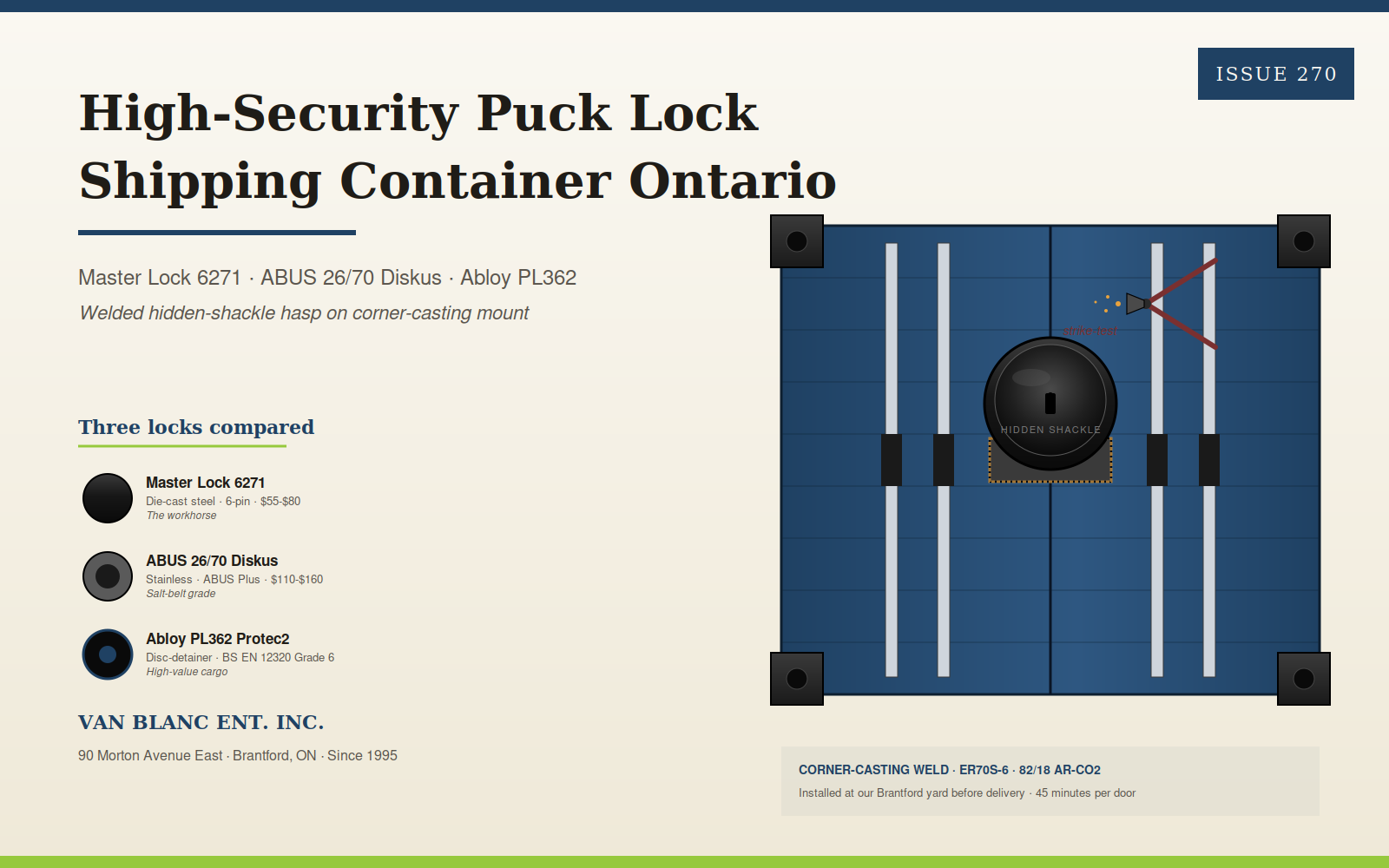
Quick Answer: A high-security puck lock shipping container Ontario setup pairs a hidden-shackle puck padlock (Master Lock 6271, ABUS 26/70, or Abloy PL362) with a welded hasp mounted to the door corner casting. The install, finished at our Brantford yard before delivery, runs about 45 minutes, with the add-on cost driven by the lock tier you choose, the hasp work, and whether you want a lockbox shroud on top. Pricing depends on your site, your grade choice, and your freight zone, so call for a real quote. Brantford-based since 1995, family-operated, 4.9-star verified (140+ Google reviews). 1-3 day delivery Ontario-wide.
In This Guide
- Why does a puck lock beat a standard padlock?
- What parts make up the puck-lock setup?
- Is the Master Lock 6271 a good lock?
- What makes the ABUS 26/70 different?
- Is the Abloy PL362 worth the premium?
- Why weld the hasp to the corner casting?
- What attacks defeat a container lock?
- How is it fitted at the Brantford yard?
- Will a puck lock rust in Ontario?
- What does layered security look like?
- FAQs
Reading time: about 14 minutes.
Why does a puck lock beat a standard padlock on a container?
A puck lock beats a standard padlock because its shackle is hidden inside a round, flat body, so bolt cutters and saws have nothing to bite. A long-shackle padlock leaves exposed steel that a 24-inch bolt cutter shears in under a minute. The puck design removes that target entirely.
Walk through any commercial yard in Brantford or Hamilton in 2026 and you will see the same thing on every working container: a round, flat lock that looks more like a hockey puck than a padlock. That is not fashion. It is what happens when a generation of contractors learn the hard way that a long-shackle padlock on a shipping container is a 30-second job for a pair of bolt cutters.
The math is unkind. A standard padlock shackle is exposed steel about 8 to 10 mm thick. A 24-inch bolt cutter delivers roughly 4,000 pounds of force at the jaws. Even hardened boron steel gives way in under a minute. Once the shackle is cut, the cam-action hardware on the container door spins freely, both doors swing open, and whatever was inside walks off in the back of a truck.
The puck-lock setup fitted at the Van Blanc yard solves this differently. Instead of leaving the shackle exposed, the lock body completely shrouds the U-bolt that catches the staple. Bolt cutters cannot find a purchase. A reciprocating saw cannot get an angle. A pry bar slides off the round body. The lock has to fail through the cylinder, the hasp, or the weld to the container, and on a properly installed setup all three of those points are stronger than the door panel itself.
That is the difference between a padlock at a hardware store and a hidden-shackle lock job done right. Same job on paper. Two completely different outcomes when a real thief shows up on a Saturday night.
The four-point chain in any container lock job
Container security is only as strong as the weakest of four points: the lock cylinder (pick and drill resistance), the lock body and shackle (cut and pry resistance), the hasp or staple (the steel piece the lock catches), and the mounting weld (how the hasp is attached to the door). A premium lock on a hardware-store hasp tacked on with three spot welds is no better than a padlock. Every hasp fitted at the yard is welded to the door corner casting or the heavy steel face of the door, on full perimeter welds, with ER70S-6 wire on a 82/18 argon-CO2 shielding mix per the corner casting metallurgy.
What parts make up the puck-lock setup?
Most buyers picture a puck lock as the lock itself. The lock is one of five parts. The whole assembly looks like this on a finished container door:
- The puck lock body. Round, flat, hardened steel or aluminum. The shackle is hidden inside the body when locked.
- The hidden-shackle hasp. A welded steel plate with a vertical U-bolt that fits up through the bottom of the lock body. The U-bolt is what the lock actually catches.
- The strike plate. The matching plate on the opposite door that the hasp closes against, holding both doors together.
- The mounting weld. How the hasp and strike plate are physically attached to the container. The lock is only as strong as this weld.
- The optional welded lockbox shroud. A steel cage that boxes in the lock body itself, blocking direct access to the lock face. Covered in detail in our welded lockbox guide.
You will see Ontario suppliers sell a puck lock kit that is just parts one and two in a bag. That covers the lock and the hasp. It leaves you to figure out the weld yourself, which is the part most owners get wrong. The install is finished at the yard before the container leaves on the truck, so the buyer takes delivery with a working lock setup rather than a bag of parts. The rest of the steelwork you might want is handled the same way, and we walk through it in our field guide to container doors, vents, and custom builds.
Christian LeBlanc, second-generation operator: “Thousands of these go out of the yard. The customer never thinks about the hasp until somebody tries to pop it. Every hasp gets welded to the corner casting with a full perimeter pass, not stitch welds, because stitch welds are the failure point under a pry bar. You can put a Rolls Royce of a lock on a Honda Civic of a hasp and you still lose the container.”
Is the Master Lock 6271 a good container lock?
The Master Lock 6271 ProSeries is the lock most Ontario contractors end up on. There is a reason. It is the value tier of the hidden-shackle category, carried by most Canadian hardware retailers, and delivers a 73 mm (2-7/8 inch) reinforced die-cast body with a 9 mm boron alloy shackle. Master Lock rates it for transportation, vending, and industrial applications, which is industry language for containers, trailers, and roll-up doors.
What you are getting for the price is a six-pin tumbler cylinder, anti-pry shrouding around the shackle gap, and a body that weighs about 0.6 kg in your hand. For a job-site office container in Brantford that the crew opens twice a day and closes every night, the 6271 is the right tool. We sell hundreds of these in our 4 Brantford yards every year, almost always paired with the welded hasp.
| Spec | Master Lock 6271 |
|---|---|
| Body width | 73 mm (2-7/8 in) |
| Shackle diameter | 9 mm boron alloy |
| Cylinder | 6-pin tumbler |
| Body weight | ~0.6 kg |
| Security tier | Value tier of the hidden-shackle category |
| Rated uses | Transportation, vending, industrial (containers, trailers, roll-up doors) |
| Keying options | Keyed alike, keyed different, master keyed |
One real limitation. The 6271 cylinder is six-pin tumbler, which means a competent locksmith with picks and a tension wrench can open it in about 30 to 90 seconds in a quiet environment. That is fine for keeping out an opportunist with bolt cutters. It is not fine if your container holds anything of real value in a known-target area. For that scenario, you want a disc-detainer cylinder, which is what the Abloy PL362 brings to the table.
What makes the ABUS 26/70 Diskus different?
ABUS is a German lock manufacturer that has been making industrial padlocks since 1924. Their 26/70 Diskus model is the European answer to the Master Lock 6271, and you will see it on European intermodal containers more often than any other brand. Same form factor (round, flat, hidden shackle), slightly different engineering philosophy.
Where the Master Lock body is die-cast steel, the ABUS 26 body is hardened stainless steel with a corrosion-resistant finish that handles Ontario winters better than most. Where the Master Lock cylinder is six-pin tumbler, the ABUS uses ABUS’s Plus cylinder system with a paracentric keyway that is meaningfully harder to pick. The shackle is the same 10 mm hardened steel range, fully enclosed when locked.
It carries a premium over the Master Lock, with the gap widening as you move up the cylinder tier. ABUS offers the 26/70 in multiple security grades (Diskus, Diskus Plus, and Granit-cylinder upgrades), so the same body can carry a base cylinder for low-stakes storage or a higher-security cylinder for a craft brewery that lost a pallet last quarter. We keep both Master Lock and ABUS on our shelves at the Brantford yard and let the buyer match the cylinder to the risk profile.
Climate note on the Diskus body
The stainless steel body on the ABUS 26 holds up noticeably better than die-cast on the Lake Erie shoreline and along the salt-belt highways through Tillsonburg and Simcoe. If your container lives within 10 km of the lake or beside a year-round salt route, the premium for an ABUS over a Master Lock pays back the first winter. Not a coating issue, a base-metal issue: stainless does not rust, painted die-cast eventually does.
Is the Abloy PL362 worth the premium?
The Abloy PL362 sits at the top of the hidden-shackle lock category for Ontario buyers who care about pick resistance. Abloy is a Finnish manufacturer (now part of the Assa Abloy group) and their disc-detainer technology is what professional locksmiths actually fear when they need to open one in the field without the key. There is a reason the PL362 is rated to BS EN 12320 Grade 6, which is the top of the British padlock security standard.
The disc-detainer cylinder is the differentiator. Instead of spring-loaded pin tumblers (six independent points that can be raked or picked one at a time), the PL362 uses rotating discs that all have to align simultaneously around a sidebar. There is no spring tension to feel, no individual feedback to read with picks. The Protec2 keyway has over a billion valid combinations. A locksmith with disc-detainer-specific picks (Sputnik, etc.) can still defeat it, but the time goes from 60 seconds to 30 minutes-plus, and the noise and skill profile is well above any opportunist.
The body is shrouded hardened steel, ground from solid blanks. The shackle is hardened boron with raised shoulders. The lock weighs about 1.4 kg. It sits at the top of the price range for this category in Ontario, depending on cylinder configuration and whether you want it keyed alike to an existing Protec2 master system. That is real money for a padlock, but for cold-storage reefers holding pharma, contractor lockboxes holding a load of copper wire, or storage units holding tools that take a year to replace, it is the right line item.
| Lock | Cylinder | Body | Pick resistance | Best for |
|---|---|---|---|---|
| Master Lock 6271 | 6-pin tumbler | Die-cast steel | Opens to a skilled picker in roughly 60 to 90 seconds | Job sites, residential storage, general security |
| ABUS 26/70 Diskus | ABUS Plus | Stainless steel | Paracentric keyway pushes picking time into the 5 to 15 minute range | Salt-belt locations, mid-value cargo, year-round outdoor |
| Abloy PL362 Protec2 | Disc-detainer | Hardened shrouded steel | Disc-detainer sidebar resists picking for 30 minutes plus, needs specialist tools | High-value cargo, known-target zones, regulated industries |
Why weld the hasp to the corner casting?
The hasp is where most container security jobs fail. A buyer spends on a premium lock, bolts a hasp to the door with self-tapping screws, and feels safe. Six months later a pry bar pulls the hasp off in 20 seconds with the lock still intact. The lock did its job. The hasp did not. We dig into the steel-plate side of this problem in our breakdown of how a properly welded hasp shrugs off bolt cutters and pry bars.
The right setup uses a heavy-gauge steel hasp (typically 6 to 8 mm plate), welded directly to the container’s steel face or to the corner casting of the door, with a hidden-shackle U-bolt that mates to the puck lock body. The corner casting is the cast-steel block at every corner of an ISO container (per ISO 6346 identification standards), originally engineered to handle stacking forces of 30,000 kg per corner. It is the strongest point on a container’s exterior, by an enormous margin. Welding the hasp there means the hasp will fail only if the corner casting fails, which means the hasp will not fail.
Why corner-casting welds matter
The ISO corner casting is made from cast steel, not cast iron, which is why welding it is permissible at all. The recommended procedure is ER70S-6 wire of 1.0 to 1.2 mm diameter on an 82% argon / 18% CO2 shielding gas mix, full perimeter weld, with the base metal cleaned of paint and oxide before the arc strikes. Stitch welds (3-inch beads with gaps) are quicker but they create stress concentrators that a pry bar can exploit. Full perimeter welds are slower but they distribute load uniformly and resist the lever forces a thief actually applies.
The hidden-shackle geometry of the hasp is the other half of the equation. The U-bolt is welded inside a steel housing on the hasp body, so when the lock catches it, the U-bolt is shrouded on all four sides. Bolt cutters need access to the U-bolt, and the hasp housing makes that geometrically impossible. The only attack surface left is the lock body itself, which is precisely what the puck lock was designed to defeat.
What attacks defeat a container lock, and what stops them?
Real-world container break-ins on Ontario job sites in 2026 follow a small set of attack patterns. We see the call-backs every week, and the same five techniques account for almost all of them.
| Attack | What it is | What defeats it |
|---|---|---|
| Bolt cutters | 24-inch hand bolt cutters, ~4,000 lb at the jaws. The standard opportunist tool. | Hidden-shackle puck design. The shackle is enclosed, the cutter cannot reach it. |
| Reciprocating saw (Sawzall) | Bi-metal or carbide blade on a cordless reciprocating saw. Cuts hardened steel given a clear line of attack. | Welded shroud (lockbox) over the lock body. The saw needs an angle, the shroud denies it. |
| Pry bar on hasp | Wedge a long pry bar between the hasp and the door, lever it off. | Full perimeter weld to the corner casting. Stitch welds fail here, full welds do not. |
| Lock picking | Picks plus a tension wrench. 60 to 90 seconds on a 6-pin Master Lock; 30 minutes plus on an Abloy disc-detainer. | Upgrade the cylinder. Disc-detainer Protec2 keyways resist this attack class. |
| Door-cam attack | Ignore the lock entirely, defeat the door cam-rod hardware with a wrench or grinder. | Cam-rod guards (bolt-on or welded steel covers over the lock rod handles). Most aftermarket kits. |
The pattern: the lock is one element in a system. A good puck lock defeats attack one. A welded hasp defeats attack three. A lockbox shroud defeats attack two. A cam-rod guard defeats attack five. A disc-detainer cylinder upgrade defeats attack four. The buyers who lose containers are almost always missing two or three of these, and the thief exploits the gap.
How is the puck lock fitted at the Brantford yard?
Every container leaves Van Blanc with whatever security configuration the buyer specifies on the order. The install is done at the yard, before delivery, so the truck arrives at your site with a working lock setup, not a parts bag. The workflow on a standard puck-lock plus welded-hasp install runs roughly like this:
- Container staging. The container is pulled into a work bay. Doors open, blocked to prevent swing, both door panels accessible.
- Surface prep. Grind paint and primer off the weld locations on the corner casting and the strike-side door face, exposing clean base metal.
- Hasp fit-up. Position the hidden-shackle hasp on the right door, position the strike plate on the left door, verify alignment with the lock body in place. Adjust before any welding.
- Tack welds. Four corner tack welds on each part to hold position during full weld.
- Full perimeter weld. ER70S-6 wire, 82/18 argon-CO2 shielding gas, continuous perimeter bead on the hasp baseplate and the strike plate. About 12 minutes per part for an experienced welder.
- Cool and clean. Wire-brush the slag and spatter. Inspect for porosity or undercut. Touch up any thin spots with a second pass.
- Primer and paint. Two-part epoxy primer over the welds, then a top-coat matching the container colour. Prevents flash rust on bare welds.
- Lock test. Install the lock, close both doors, lock it, key-test. Reopen, key out, repeat three times for cam-action and hasp engagement.
- Customer key handoff. Two keys per lock as standard; keyed-alike configurations available across multiple containers.
Total time on a single-door setup is about 45 minutes with one welder and one helper. It is charged as a flat-rate add-on per door, and what moves the number is which lock you pick: the Master Lock 6271 is the entry point, the ABUS 26 sits in the middle, and the Abloy PL362 is the top tier. That flat rate includes the lock, the hasp, the strike plate, the welds, the paint, and the test. Customers can also buy parts only and install themselves, but most who went that route and called back later wished they had ordered it done at the yard the first time.
Worth the drive to see the setup
If you are within two hours of Brantford and the security setup matters, buyers are welcome to drive to the yard at 90 Morton Avenue East and look over a finished setup on a unit in the row. You can see how the hasp sits on the corner casting, how the weld bead runs, how the lock engages, what the keyway looks like in the cylinder you chose. Buyers who do this almost always pick a higher security tier than they thought they needed, because the difference between a Master Lock 6271 and an Abloy PL362 is visible in person. Worth the drive for the quality, family customer service with thirty years of experience.
Will a puck lock rust in the Ontario climate?
A puck lock can rust in the Ontario climate, but the body material decides how fast: painted die-cast corrodes, stainless steel does not. Ontario winters are unfair to lock hardware. Salt spray on Highway 401, freezing rain on QEW shoulders, road brine carried on truck wheels from December through April, and humidity cycles that turn condensation into ice and back to condensation again. A lock that lives outdoors year-round in Norfolk County or Niagara Region sees about 250 freeze-thaw cycles a year and ends up with chronic exposure to chloride.
What rusts: painted die-cast steel bodies on the cheap puck locks, exposed shackles on conventional padlocks, unprotected hasp welds, and the steel face of any hasp that was bolt-mounted instead of welded (because the bolt holes trap moisture between the hasp and the door). What does not rust: stainless-steel lock bodies (ABUS 26 base metal, Abloy PL362 shrouding), properly primed and painted weld joints, and the corner casting itself, which is heavy enough cast steel that surface rust never becomes structural.
Practical rules for the Ontario climate, drawn from our wider guide to keeping a container theft-proof through Ontario winters:
- Wax the cylinder once a fall. A pin-cylinder lock that freezes shut in January is a customer service call. A wiped wax surface inside the cylinder prevents it.
- Use graphite-based lock lube, not WD-40 inside the cylinder. WD-40 attracts dust and gums up the pins after about six months.
- Touch up any weld paint chips before March. Once flash rust starts on a weld bead, it spreads under the paint and eats the hasp from inside.
- Replace the lock body every five to seven years if it lives outdoors year-round on a working site. The cylinder wears, the springs lose tension, and the seal degrades. The hasp lasts forever; the lock is a wear item.
What does a layered container security system look like?
The puck lock is one element. A complete container security setup pairs it with several other defences, each handling a different attack class. Most buyers add these in order of cost as their risk profile justifies it:
The layered-security stack
- Layer 1, puck lock plus welded hasp: Defeats opportunists, bolt cutters, and basic pry attacks. This is the foundation layer, covered in this article.
- Layer 2, welded steel lockbox shroud: Steel cage over the lock body itself, defeating reciprocating saws and angle-grinder attacks. See how the steel shroud is built and what it costs to add for the full breakdown.
- Layer 3, cam-rod guards: Bolt-on steel covers over the door cam-rod handles, defeating wrench attacks on the cam hardware itself. A modest add-on per door.
- Layer 4, motion-detection alarm: Battery-powered or 12V interior motion alarm wired to a cellular notification. Catches the break-in attempt in progress so police can respond before anything leaves the site. See our motion-alarm article for installation specifics.
- Layer 5, lighting and visibility: Photocell-triggered floodlight pointed at the container doors. The cheapest layer (hardware plus power), and the one most often skipped.
Layered correctly, a container with all five layers becomes a hard target. The thief needs bolt cutters AND a Sawzall AND a wrench AND silenced footsteps AND a way to disable the alarm AND a willingness to work under a floodlight. By layer three, the average opportunist is gone. By layer five, only a professional crew is even attempting it, and professional crews go elsewhere if the next container down the row is unprotected.
That decision tree is the real value of pairing the right puck lock with a welded hasp: it sits at the base of the stack, and every layer above it stacks cleanly on top. All of it can be fitted at the yard before the unit ships.
Frequently asked questions
What is a puck lock and why is it called that?
A puck lock is a round, flat, hidden-shackle padlock that looks like a hockey puck. The shackle (the U-bolt the lock catches) is completely enclosed inside the lock body when locked, so bolt cutters and saws cannot reach it. The shape is functional, not decorative: the round body has no edges for a pry bar to grip, and the low profile resists hammer blows.
Can bolt cutters cut a puck lock?
No, not directly. The shackle is hidden inside the lock body, so a standard 24-inch bolt cutter has no exposed steel to bite. A thief with bolt cutters cannot attack the lock itself; they can only attack the hasp the lock catches. That is why the welded hasp matters as much as the lock.
How much does it cost to install a puck lock setup on a shipping container in Ontario?
Installed at our Brantford yard, the add-on is a flat rate per door, and the lock tier is what moves the total: the Master Lock 6271 setup is the entry point, the ABUS 26/70 sits in the middle, and the Abloy PL362 is the premium option. That flat rate includes the lock, the welded hidden-shackle hasp, the strike plate, paint, and the install labour. Parts-only purchases are also available. Call the Brantford yard with your container size and postal code for a firm, all-in quote.
What is the difference between Master Lock 6271 and ABUS 26?
Same form factor (round, hidden-shackle puck), different engineering. The Master Lock 6271 has a die-cast steel body and a six-pin tumbler cylinder. The ABUS 26/70 has a stainless steel body (better in the Ontario salt belt) and an ABUS Plus paracentric cylinder (harder to pick). The ABUS handles climate better; both handle bolt cutters equally well.
Is an Abloy PL362 worth the extra money?
For a job-site office or residential storage container, no. The Master Lock 6271 is plenty. For containers holding high-value cargo (pharma, copper, high-value contractor tools, regulated inventory), the Abloy disc-detainer cylinder is meaningfully harder to pick or bypass, and the BS EN 12320 Grade 6 rating reflects that. Match the lock tier to the cargo risk, not to a feeling.
Can I install a puck-lock hasp on my container myself?
Technically yes, if you have a 200-amp MIG welder, ER70S-6 wire, the right shielding gas, and welding experience on cast steel corner castings. Realistically, most DIY installs we have seen end up with stitch welds (instead of full perimeter welds) that fail under a real pry attack. The install is done at the Brantford yard for a flat fee that includes the parts and labour, which is the path most buyers end up choosing.
Do puck locks freeze in Ontario winters?
Cylinders can freeze if water gets inside. The fix is preventive: wax or graphite-lube the cylinder every fall, and store a small de-icer in the truck. The ABUS 26 and Abloy PL362 ship with weather covers over the keyway that prevent most water ingress; the Master Lock 6271 does not, so add an aftermarket keyway cover if it lives in a wet outdoor location.
What is the difference between a puck lock and a welded lockbox?
Different layers. The puck lock is the actual lock and hasp; the welded lockbox is a steel cage that boxes in the lock body to shield it from saws and grinders. Many buyers run both: the puck lock with its hasp does the locking, the lockbox shroud protects the lock from cutting tools. We cover the cage half of the equation in the companion piece on shrouding the lock body in steel.
Will a puck lock work on a roll-up container door?
Yes, with the right hasp geometry. Roll-up doors use a different hasp design than swing doors (typically a vertical staple welded to the door rail and a strike on the floor track), but the same Master Lock 6271 or ABUS 26 body fits both. The Brantford yard stocks both hasp types and matches them to your container at install.
Can a locksmith open a puck lock if I lose the key?
Yes, but it is not fast. A six-pin Master Lock 6271 takes a professional locksmith about 60 to 90 seconds with picks. An ABUS 26 with the Plus cylinder takes 5 to 15 minutes. An Abloy PL362 takes 30 minutes plus and requires specialised disc-detainer tools that not every locksmith carries. Keep your spare keys somewhere safe, and consider keyed-alike configurations so one lost key does not lock out a whole fleet.
Sources
- International Organization for Standardization. (2022). ISO 6346:2022, Freight containers, coding, identification and marking. iso.org/standard/82754.html
- Master Lock Company. (2025). 6271 ProSeries Hidden Shackle Padlock, product specifications. masterlock.com
- Abloy Oy. (2025). PL362 Protec2 Shrouded Padlock, technical datasheet, BS EN 12320 Grade 6. abloy.com
- Transport Canada. (2025). Cargo Securement Standard 10, containerized cargo. tc.canada.ca
Reach Van Blanc in Brantford
We have been supplying shipping containers across Ontario since 1995. Our warehouse is at 90 Morton Avenue E in Brantford, and we deliver right across the province on a cash-on-delivery basis. No surprise fees, no chase-the-paperwork.
Van Blanc Ent. Inc., 90 Morton Ave E Unit 1B, Brantford, ON N3R 7J7, +1 888-509-6658.
If you want a puck lock and welded hasp installed before delivery, mention it on the order and it gets fitted at the yard the morning your container ships. Drive in and look it over if you want; the cylinders are on the shelf for comparison.
Related Reading
- The full 2026 theft-prevention playbook for Ontario container owners
- What a welded lockbox shroud adds over a bare puck lock
- A Friday-afternoon checklist for locking down a jobsite bin
- How to inspect a used container before you hand over a dollar
- Turning a steel box into an office, cabin, or pool build
Ready to price your container?
Tell us the size and your postal code and we’ll send back an all-in number, container, delivery, and placement, usually within 1-3 days. No pressure, no mystery fees.
Family-run in Brantford since 1995 · 200+ containers in stock · 4.9★ across 140+ Google reviews · every box graded by a person, walk it before it lands.